Adhyaya 42: Dattatreya on the Yogic Import of Oṃ (Praṇava): Matras, Worlds, and Liberation
ॐप्रणवयोगविवेचन (Oṃpraṇavayogavivecana)
Origin of Species
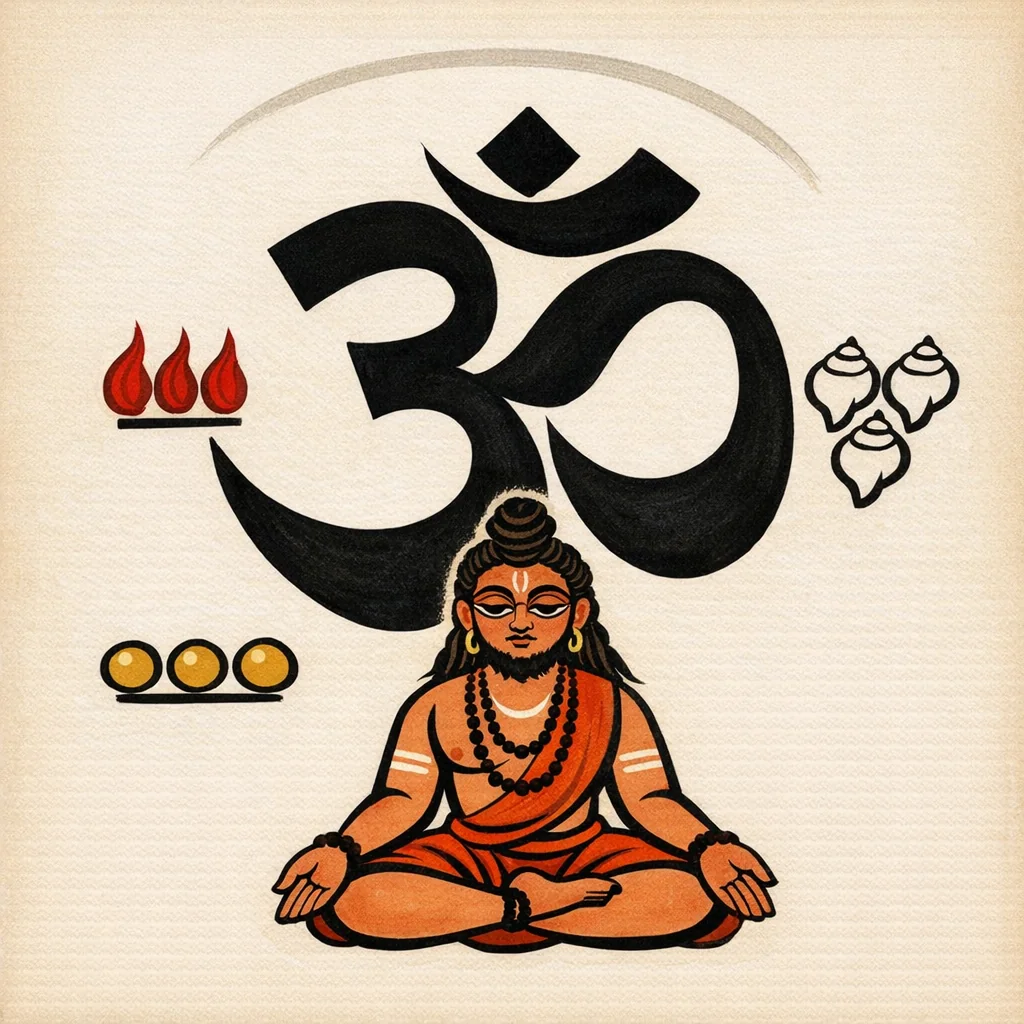
Adhyaya 42 presents Dattatreya’s teaching on the yogic meaning of Oṃ (Praṇava). He explains the mātrās A‑U‑M and the silence beyond sound (amātrā) as stages of contemplation linked with the worlds and culminating in liberation. Through meditation on the Praṇava, the yogin purifies the mind, loosens ego-clinging, deepens samādhi, and approaches mokṣa.
Divine Beings
Celestial Realms
Key Content Points
Focus Keywords
Shlokas in Adhyaya 42
Verse 1
इति श्रीमार्कण्डेयपुराणे योगिचर्यानामैकचत्वारिंशोऽध्यायः । द्विचत्वारिंशोऽध्यायः । दत्तात्रेय उवाच । एवं यो वर्तते योगी सम्यग्योगव्यवस्थितः । न स व्यावर्तितुं शक्यो जन्मान्तरशतैरपि ॥
Thus ends the forty-first chapter on the conduct of the yogin in the Śrī Mārkaṇḍeya Purāṇa. The forty-second chapter. Dattātreya said: The yogin who lives in this way, firmly established in right yoga, cannot be turned back—even across hundreds of births.
Verse 2
दृष्ट्वा च परमात्मानं प्रत्यक्षं विश्वरूपिणम् । विश्वपादशिरोग्रीवं विश्वेशं विश्वभावनम् ॥
And having beheld the Supreme Self directly, in the form of the universe—whose feet, head, and neck are the universe—who is the Lord of the universe and the source of the universe’s becoming.
Verse 3
तत्प्राप्तये महत्पुण्यमोमित्येकाक्षरं जपेत् । तदेवाध्ययनं तस्य स्वरूपं शृण्वतः परम् ॥
For attaining That, one should repeat the supremely meritorious single syllable ‘Oṁ’. That itself is his study; and for one who hears its true nature, it is the supreme teaching.
Verse 4
अकारश्च तथोकारो मकारश्चाक्षरत्रयम् । एता एव त्रयो मात्राḥ सत्त्वराजसतामसाḥ ॥
The letter ‘A’, likewise ‘U’, and ‘M’—these are the three letters. These alone are the three measures (mātrās): sattva, rajas, and tamas.
Verse 5
निर्गुणा योगिगम्यान्या चार्धमात्रोर्ध्वसंस्थिता । गान्धारीति च विज्ञेया गान्धारस्वरसंश्रया ॥
That half-mora is without attributes and is attainable only by yogins; it abides above the ordinary phonetic levels as the “ardha-mātrā”. It is to be known as “Gāndhārī”, resting upon the Gāndhāra musical note.
Verse 6
पिपीलिकागतिस्पर्शा प्रयुक्ता मूर्ध्नि लक्ष्यते । यथा प्रयुक्त ओङ्गारः प्रतिनिर्याति मूर्धनि ॥
When it is properly applied in practice, a touch like the movement of ants is perceived at the crown of the head; just so, when the syllable Oṁ is rightly employed, it rises up again toward the crown.
Verse 7
तथोङ्कारमयो योगी त्वक्षरे त्वक्षरो भवेत् । प्राणो धनुः शरो ह्यात्मा ब्रह्म वेध्यमनुत्तमम् ॥
Thus the yogin, made of Oṁ, becomes steady in the imperishable syllable. Prāṇa is the bow, the self (ātman) is the arrow, and Brahman is the unsurpassed target to be pierced.
Verse 8
अप्रमत्तेन वेद्धव्यं शरवत्तन्मयो भवेत् । ओमित्येतत् त्रयो वेदास्त्रयो लोकास्त्रयोऽग्नयः ॥
It must be pierced with vigilance; one should become like the arrow—wholly absorbed in that. This “Oṁ” indeed is the three Vedas, the three worlds, and the three sacred fires.
Verse 9
विष्णुर्-ब्रह्मा-हरश्चैव ऋक्सामानि यजूṃषि च । मात्राः सार्धाश्च तिस्त्रश्च विज्ञेयाः परमार्थतः ॥
Viṣṇu, Brahmā, and Hara, and also the Ṛk, Sāman, and Yajus—these are, in the highest sense, to be understood as the three mātrās together with the half-mātrā.
Verse 10
तत्र युक्तस्तु यो योगी स तल्लयमवाप्नुयात् । अकारस्त्वथ भूर्लोक उकारश्चोच्यते भुवः ॥
The yogin, rightly joined to this discipline, attains absorption into That (Tat). Then the letter A is the Bhū-world, and the letter U is called Bhuvaḥ.
Verse 11
सव्यञ्जनो मकारश्च स्वर्लोकः परिकल्प्यते । व्यक्ता तु प्रथमा मात्रा द्वितीयाव्यक्तसंज्ञिता ॥
The letter M, together with its consonantal element, is conceived as the Svarga-world. The first mātrā is “manifest”, while the second is said to be “unmanifest”.
Verse 12
मात्रा तृतीया चिच्छक्तिरर्धमात्रा परं पदम् । अनेनैव क्रमेणैता विज्ञेया योगभूमयः ॥
The third mātrā is the power of consciousness (cit-śakti); the half-mātrā is the supreme state. In this very sequence, these are to be known as the stages/grounds of yoga.
Verse 13
ओमित्यuccāraṇāt sarvaṃ gṛhītaṃ sadasad bhavet । ह्रस्वा तु प्रथमा मात्रा द्वितीया दैर्घ्यसंयुता ॥
By the utterance of “Oṁ”, everything is comprehended—both being and non-being. The first mātrā is short; the second is joined with length (i.e., long).
Verse 14
तृतीया च प्लुतार्धाख्या वचसः सा न गोचरा । इत्येतदक्षरं ब्रह्म परमोङ्कारसंज्ञितम् ॥
The third is called “pluta-ardha” (extended/overlong, and half beyond), and it is not within the range of ordinary speech. Thus this is the imperishable Brahman, known as the Supreme Oṅkāra.
Verse 15
यस्तु वेद नरः सम्यक् तथा ध्यायति वा पुनः । संसारचक्रमुत्सृज्य त्यक्तत्रिविधबन्धनः ॥
But the man who truly understands it, or who again meditates upon it in the proper manner, casts off the wheel of transmigration and becomes free, having abandoned the threefold bondage.
Verse 16
प्राप्रोति ब्रह्मणि लयं परमे परमात्मनि । अक्षीणकर्मबन्धश्च ज्ञात्वा मृत्युमरिष्टतः ॥
He attains dissolution into Brahman—the Supreme, the highest Self. And, knowing death as it truly is, he becomes unshaken and free from dread, even while the bond of karma has not yet fully exhausted.
Verse 17
उत्क्रान्तिकाले संस्मृत्य पुनर्योगित्वमृच्छति । तस्मादसिद्धयोगेन सिद्धयोगेन वा पुनः । ज्ञेयान्यरिष्टानि सदा येनोत्क्रान्तौ न सीदति ॥
Remembering the teaching at the time of departure, he again attains the state of a yogin. Therefore—whether one’s yoga is not yet perfected or already perfected—one should always know the signs of impending death, so that at the moment of passing one does not falter.
Frequently Asked Questions
The chapter investigates how the praṇava (Oṃ) functions as Brahman-in-sound and as a disciplined yogic method: by mapping its phonetic components to cosmic principles and prescribing concentrated practice, it argues that Oṃ-japa and contemplation can dissolve bondage and culminate in laya (merger) in the supreme Paramātman.
This Adhyaya does not develop Manvantara chronology or Manu lineages; instead, it provides a doctrinal yogic exegesis that can be read as a universal soteriological insert within the broader Purāṇic framework, independent of specific Manvantara transitions.
Adhyaya 42 is outside the Devi Mahatmyam (chapters 81–93) and contains no direct Śākta stuti, goddess-epithets, or battle narrative; its focus is praṇava-yoga and a triadic theism (Viṣṇu–Brahmā–Hara) articulated as correspondences within Oṃ.