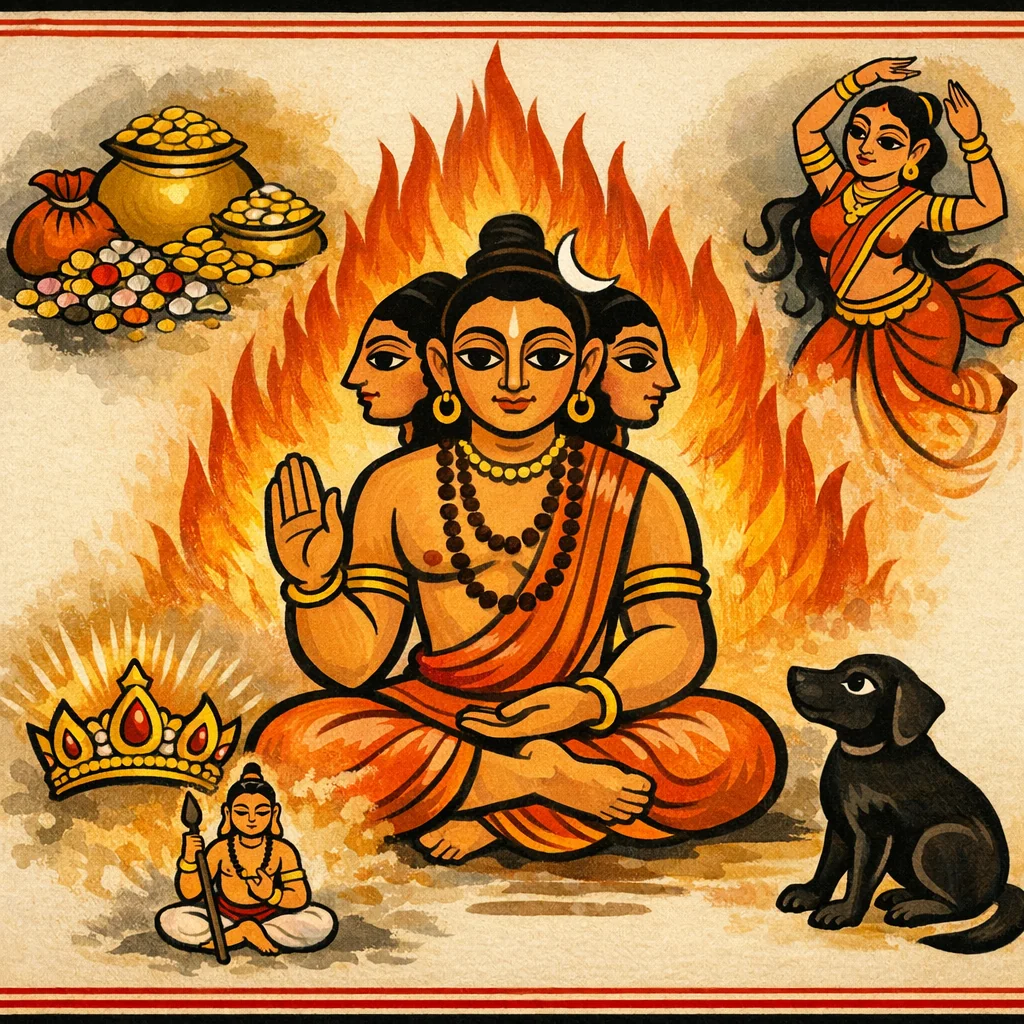
Adhyaya 40: The Yogin’s Impediments (Upasargas), Subtle Concentrations, and the Eight Siddhis
योगाध्याय (Yogādhyāya)
Creation of the World
This adhyaya explains the yogin’s impediments (Upasargas) that disturb samadhi, the subtle modes of concentration, and the signs by which the mind may be led astray. It teaches overcoming temptation, fear, distraction, and even wondrous powers through discipline, inner vigilance, and devotion to the Divine. It concludes by describing the eight siddhis (Aṣṭa-siddhi) and warning that pride or craving for power must not divert one from the aim of liberation.
Divine Beings
Celestial Realms
Key Content Points
Focus Keywords
Shlokas in Adhyaya 40
Verse 1
इति श्रीमार्कण्डेयपुराणे जडोपाख्याने योगाध्यायो नामैकोनचत्वारिंशोऽध्यायः । दत्तात्रेय उवाच । उपसर्गाः प्रवर्तन्ते दृष्टे ह्यात्मनि योगिनः । ये तांस्ते संप्रवक्ष्यामि समासेन निबोध मे ॥
Thus, in the Śrī Mārkaṇḍeya Purāṇa, in the narrative of Jaḍa, begins the chapter called ‘Yoga’. Dattātreya said: When the yogin has indeed perceived the Self, obstacles (upasargas) arise. Those I shall explain to you succinctly; listen to me.
Verse 2
काम्याः क्रियास्तथा कामान् मानुषानभिवाञ्छति । स्त्रियो दानफलं विद्यां मायां कुप्यं धनं दिवम् ॥
He comes to desire wish-fulfilling rites and human enjoyments—women, the merit gained from gifts, learning, magical power (siddhi), treasures, wealth, and even heaven.
Verse 3
देवत्वममरेशत्वं रसायनचयाः क्रियाः । मरुत्प्रपतनं यज्ञं जलग्न्यावेशनन्तथा ॥
He longs for becoming divine, for lordship among the immortals, for alchemical accumulations and operations, for moving or falling through the winds, for sacrificial prowess, and for entering water and fire without harm.
Verse 4
श्राद्धानां सर्वदानानां फलानि नियमांस्तथा । तथोपवासात् पूर्ताच्च देवताभ्यर्चनादपि ॥
He seeks the fruits of śrāddha rites, of all gifts, and of religious observances; likewise the merit from fasting, from public or charitable works (pūrta), and even from worship of the deities.
Verse 5
तेभ्यस्तेभ्यश्च कर्मभ्य उपसृष्टोऽभिवाञ्छति । चित्तमित्थं वर्तमानं यत्नाद्योगी निवर्तयेत् ॥
Assailed by those various acts (and their lures), he begins to desire them. A yogin should, with effort, turn back the mind that is moving in this way.
Verse 6
ब्रह्मसङ्गिमनः कुर्वन्नुपसर्गात् प्रमुच्यते । उपसर्गैर्जितैरेभिरुपसर्गास्ततः पुनः ॥
By making the mind cling to Brahman, one is freed from such obstacles. Yet, when these obstacles are conquered, other obstacles arise again thereafter.
Verse 7
योगिनः संप्रवर्तन्ते सत्त्वराजसतामसाः । प्रातिभिः श्रावणो दैवो भ्रमावत्तौ तथापरौ ॥
For yogins there arise obstacles born of sattva, rajas, and tamas—namely prātibha, śrāvaṇa, daiva, and also bhrama and āvarta (the other two).
Verse 8
पञ्चैते योगिनां योगविघ्राय कटुकोदयाः । वेदार्थाः काव्यशास्त्रार्था विद्याशिल्पान्यशेषतः ॥
These five, arising sharply, obstruct the yoga of yogins: (sudden mastery of) the meanings of the Veda, the meanings of poetry and treatises, and all branches of knowledge and arts without remainder.
Verse 9
प्रतिभान्ति यदस्येति प्रातिभः स तु योगिनः । शब्दार्थानखिलान् वेत्ति शब्दं गृह्णाति चैव यत् ॥
Because all things “shine forth” to him, it is called prātibha for the yogin: he knows all words and meanings, and he grasps the import of speech itself.
Verse 10
योजनानां सहस्रेभ्यः श्रावणः सोऽभिधीयते । ममन्ताद्वीक्षते चाष्टौ स यदा देवतोपमः ॥
He is called “śrāvaṇa” when (he can perceive) from thousands of yojanas away; and when he sees the eight quarters as if from the tip of his thumb—then he becomes godlike.
Verse 11
उपसर्गान्तमप्याहुर्दैवमुन्मत्तवद् बुधाः । भ्राम्यते यन्निरालम्बं मनो दोषेण योगिनः ॥
The wise call “daiva” an obstacle that appears like madness: when, due to a fault, the yogin’s mind wanders unsupported, without any prop.
Verse 12
समस्ताचारविभ्रंशाद् भ्रमः स परिकीर्तितः । आवर्त इव तोयस्य ज्ञानावर्तो यदाकुलः ॥
Deviation from all right conduct is called delusion (moha). When the whirl of knowledge is agitated, it is like an eddy in water.
Verse 13
नाशयेच्चित्तमावर्त उपसर्गः स उच्यते । एतैर्नाशितयोगास्तु सकला देवयोनयः ॥
That whirl which destroys the mind is called an “obstacle” (upasarga). By these, all beings of divine birth have had their yoga ruined.
Verse 14
उपसर्गैर्महाघोरैरावर्तन्ते पुनः पुनः । प्रावृत्य कम्बलं शुक्लं योगी तस्मान्मनोमयम् ॥
By exceedingly dreadful obstacles they are whirled about again and again. Therefore the yogin should wrap himself in a “white blanket” made of mind—inner purity and mental protection.
Verse 15
चिन्तयेत् परमं ब्रह्म कृत्वा तत्प्रवणं मनः । योगयुक्तः सदा योगी लघ्वाहारो जितेन्द्रियः ॥
Let him contemplate the supreme Brahman, having made the mind incline toward That. Ever disciplined in yoga, the yogin should eat lightly and have the senses conquered.
Verse 16
सूक्ष्मास्तु धारणाः सप्त भूराद्या मूर्ध्नि धारयेत् । धरित्रीं धारयेद्योगी तत् सौक्ष्म्यं प्रतिपद्यते ॥
There are seven subtle concentrations (dhāraṇās), beginning with earth. One should hold them at the crown of the head. Holding the earth-element, the yogin attains that subtlety.
Verse 17
आत्मानं मन्यते चोर्वोṃ तद्गन्धञ्च जहाति सः । यथैवाप्सु रसं सूक्ष्मं तद्वद्रूपञ्च तेजसि ॥
He then regards himself as subtler than earth and abandons its smell. Just as taste is subtle in water, so too is form subtle in fire.
Verse 18
स्पर्शं वायो तथा तद्वद्विभ्रतस्तस्य धारणाम् । व्योम्रः सूक्ष्मां प्रवृत्तिञ्च शब्दं तद्वज्जहाति सः ॥
Likewise, bearing that concentration, he abandons touch, the quality of air. Then, in ether, with a subtle movement of awareness, he similarly abandons sound.
Verse 19
मनसा सर्वभूतानां मनस्याविशते यदा । मानसीं धारणां बिभ्रन्मनः सूक्ष्मञ्च जायते ॥
When, by mind, he enters into the mind of all beings, then—maintaining the mental concentration (mānasī dhāraṇā)—the mind becomes subtle.
Verse 20
तद्वद् बुद्धिमशेषाणां सत्त्वानामेत्य योगवित् । परित्यजति सम्प्राप्य बुद्धिसौक्ष्म्यमनुत्तमम् ॥
So too, the knower of yoga reaches the intellect of all beings; and having attained unsurpassed subtlety of intellect, he abandons it (i.e., even buddhi is transcended).
Verse 21
परित्यजति सूक्ष्माणि सप्त त्वेतानि योगवित् । सम्यग्विज्ञाय यो 'लर्क ! तस्यावृत्तिर्न विद्यते ॥
The knower of yoga abandons these seven subtleties. One who has correctly understood them—O Alarka—has no return (no further revolving).
Verse 22
एतासां धारणानान्तु सप्तानां सौक्ष्म्यमात्मवान् । दृष्ट्वा दृष्ट्वा ततः सिद्धिं त्यक्त्वा त्यक्त्वा परां व्रजेत् ॥
Having perceived, again and again, the subtle nature of these seven dhāraṇās, the self-possessed yogin should—having attained the corresponding powers—renounce them again and again, and proceed toward the Supreme state.
Verse 23
यस्मिन् यस्मिंश्च कुरुते भूते रागं महीपते । तस्मिंस्तस्मिन् समासक्तिं संप्राप्य स विनश्यति ॥
O king, whatever being or element one develops attachment (rāga) toward, in that very object one becomes bound by clinging, and through that clinging one comes to ruin (spiritual downfall).
Verse 24
तस्माद्विदित्वा सूक्ष्माणि संसक्तानि परस्परम् । परित्यजति यो देही स परं प्राप्नुयात् पदम् ॥
Therefore, having understood the subtle principles as mutually entangled, the embodied being who relinquishes them attains the supreme station.
Verse 25
एतान्येव तु सन्धान्य सप्त सूक्ष्माणि पार्थिव । भूतादीनां विरागोऽत्र सद्भावज्ञस्य मुक्तये ॥
O king, fixing the mind upon precisely these seven subtle principles, one develops dispassion toward the elements and related factors; for the knower of reality (sadbhāva), this leads to liberation.
Verse 26
गन्धादिषु समासक्तिं सम्प्राप्य स विनश्यति । पुनरावर्तते भूप स ब्रह्मापरमानुषम् ॥
Having fallen into strong attachment to smell and the other sense-objects, one is ruined spiritually and returns again—O king—into the range from Brahmā down to the human state, that is, the cycle of rebirth across high and low conditions.
Verse 27
सप्तैताः धारणाः योगी समतीत्य यदिच्छति । तस्मिंस्तस्मिंल्लयं सूक्ष्मे भूते याति नरेश्वर ॥
O lord of men, when the yogin transcends these seven dhāraṇās at will, he enters dissolution (laya) into each corresponding subtle element.
Verse 28
देवानामसुराणां वा गन्धर्वोरगरक्षसाम् । देहेषु लयमायाति सङ्गं नाप्रोति च क्वचित् ॥
Whether among the bodies of gods, asuras, gandharvas, nāgas, or rākṣasas, he can enter absorption (laya) in those forms, yet he never acquires attachment anywhere.
Verse 29
अणिमा लघिमा चैव महिमा प्राप्तिरेव च । प्राकाम्यं च तथैशित्वं वशित्वञ्च तथापरम् ॥
Aṇimā, laghimā, mahimā, prāpti, prākāmya, īśitva, vaśitva, and the eighth (other) power as well—these are the (classical) eight siddhis.
Verse 30
यत्रकामावसायित्वं गुणानेतांस्तथैश्वरान् । प्राप्नोत्यक्ष्टौ नरव्याघ्र परं निर्वाणसूचकान् ॥
O tiger among men, one attains these eight lordly powers and qualities—culminating in the ability to determine outcomes as one wishes—yet they are only indicators pointing toward the supreme nirvāṇa.
Verse 31
सूक्ष्मात् सूक्ष्मतमोऽणीयान् शीघ्रत्वं लघिमा गुणः । महिमाशेषपूज्यत्वात् प्राप्तिर्नाप्राप्यमस्य यत् ॥
Aṇimā is to become smaller than the subtlest; laghimā is the quality of swift lightness; mahimā is the greatness whereby one becomes worthy of universal reverence; and prāpti is that for him nothing remains unattainable.
Verse 32
प्राकाम्यमस्य व्यापित्वादीशित्वञ्चेश्वरो यतः । वखित्वाद्वशिमा नाम योगिनः सप्तमो गुणः ॥
Because of his all-pervasiveness there is prākāmya (the power of unobstructed attainment), and because he is lordly there is īśitva (sovereignty). And because he can bring beings and things under control, the quality called vaśitā (mastery) is said to be the yogin’s seventh attribute.
Verse 33
यत्रेच्छास्थानमप्युक्तं यत्रकामावसायिता । ऐश्वर्यकारणैरेभिर्योगिनः प्रोक्तमष्टधा ॥
Wherever he wills, that place is said to be accessible to him; wherever he directs it, desire finds its fulfillment. By these causes of lordly power (aiśvarya), the yogin’s attainments are declared to be eightfold.
Verse 34
मुक्तिसंसूचकं भूप ! परं निर्वाणमात्मनः । ततो न जायते नैव वर्धते न विनश्यति ॥
O king, the supreme nirvāṇa of the Self is the indicator of liberation. Thereafter it is not born, it does not grow, and it does not perish.
Verse 35
नापि क्षयमवाप्रोति परिणामं न गच्छति । छेदं क्लेदं तथा दाहं शोषं भूरादितो न च ॥
Nor does it meet with diminution; it does not undergo transformation. And it is not subject to cutting, wetting, burning, or drying—afflictions beginning with earth (and the other elements).
Verse 36
भूतवर्गादवाप्नोति शब्दाद्यैः ह्रियते न च । न चास्य सन्ति शब्दाद्यास्तद्भोक्ता तैर् न युज्यते ॥
It is not attained (i.e., affected) by the class of elements, nor is it carried away by sound and the rest (sense-objects). Indeed, for it there are no sound and the rest; and as the experiencer of that realm, it is not yoked to them.
Verse 37
यथाहि कनकं खण्डमपद्रव्यवदग्निना । दग्धदोषं द्वितीयेन खण्डेनैक्यं व्रजेन्नृप ॥
Just as a piece of gold, when its impurities are burned away by fire—becoming as though free of alloy—attains unity with another piece (of pure gold), O king,
Verse 38
न विशेषमवाप्रोति तद्वद्योगाग्निना यतिः । निर्दग्धदोषस्तेनैक्यं प्रयाति ब्रह्मणा सह ॥
So too, the ascetic, by the fire of yoga, attains no (separate) distinction; his impurities being burnt away, he goes to oneness with Brahman.
Verse 39
यथाग्निरग्नौ संक्षिप्तः समानत्वमनुव्रजेत् । तदाख्यस्तन्मयो भूतो न गृह्येत विशेषतः ॥
As fire, when cast into fire, follows identity (with it): being called the same and becoming of the same nature, it is not apprehended as distinct in any special way.
Verse 40
परेण ब्रह्मणा तद्वत् प्राप्यैक्यं दग्धकिल्विषः । योगी याति पृथग्भावं न कदाचिन्महीपते ॥
So likewise, having attained oneness with the supreme Brahman, the yogin—his sins burnt away—never again goes into separateness, O lord of the earth.
Verse 41
यथा जलं जलेनैक्यं निक्षिप्तमुपगच्छति । तथात्मा साम्यमभ्येति योगिनः परमात्मनि ॥
As water, when poured into water, attains oneness, so the Self of the yogin attains sameness with the Supreme Self (Paramātman).
Frequently Asked Questions
The chapter examines how awakened yogic perception can generate temptations and distortions (upasargas) that mimic spiritual success, and it argues that ethical-psychological restraint—redirecting the mind toward Brahman and cultivating dispassion—is necessary to prevent siddhis, merit, and heavenly aspirations from replacing liberation.
It does not develop Manvantara chronology or genealogical transitions; instead, it functions as a stand-alone doctrinal instruction on yoga and liberation, framed as Dattātreya’s counsel to a king regarding the hazards and proper orientation of yogic practice.
This Adhyāya is outside the Devi Māhātmya section (Adhyāyas 81–93) and contains no stuti, epithet, or battle narrative of the Goddess; its primary contribution is yogic-advaitic soteriology centered on Brahman rather than explicit Śākta theology.