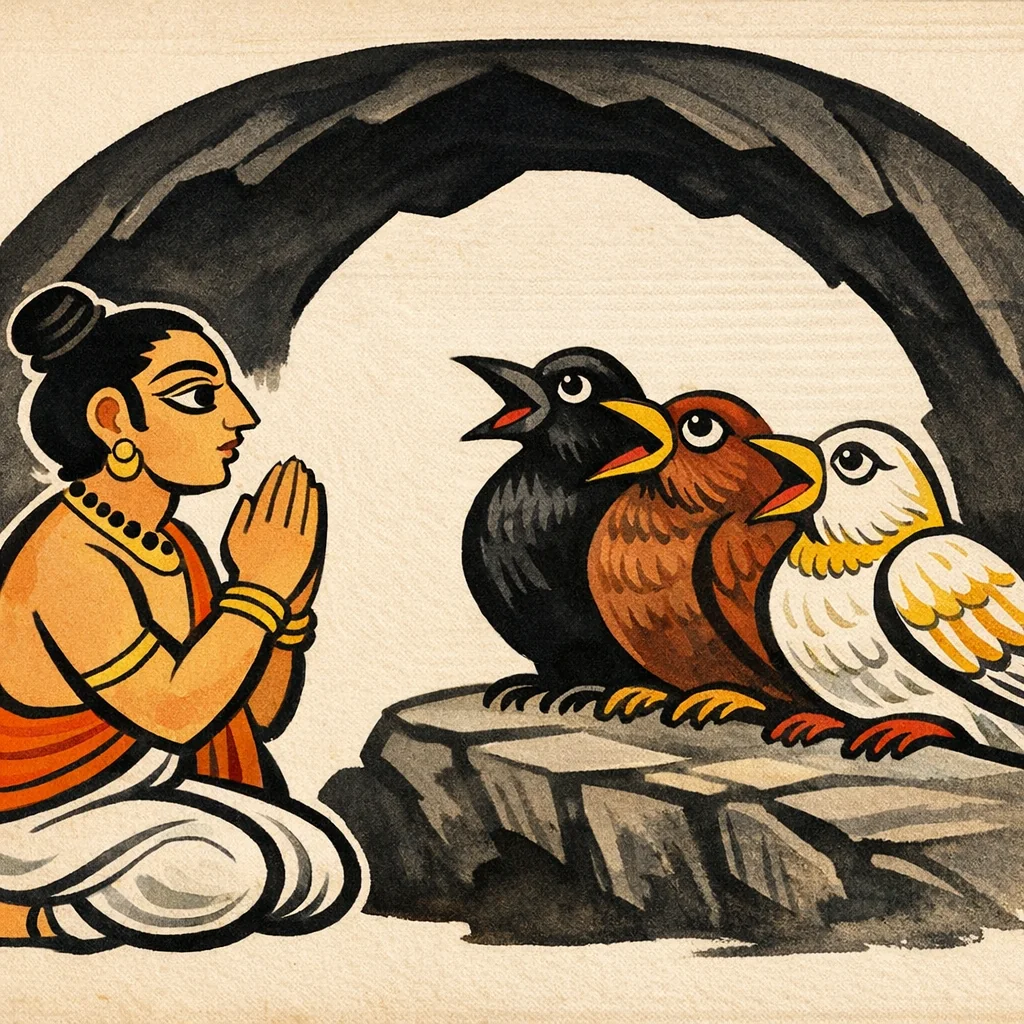
Adhyaya 4: Jaimini Meets the Dharmapakshis: Four Doubts on the Mahabharata and the Opening of Narayana Doctrine
विन्ध्यगिरिकन्दरप्रवेशः तथा जैमिनिसंशयप्रश्नः (Vindhyagirikandarapraveśaḥ tathā Jaiminisaṃśayapraśnaḥ)
Draupadi and Her Husbands
Jaimini enters a cave in the Vindhya mountains seeking the true purport of dharma. There he meets the Dharmapakshis—wise birds who speak on sacred law—and presents four doubts concerning episodes of the Mahabharata. Their holy dialogue begins the exposition of the Narayana doctrine, revealing Vishnu/Narayana as the ground of dharma and the path to liberation, turning uncertainty into devotional clarity.
Divine Beings
Key Content Points
Focus Keywords
Shlokas in Adhyaya 4
Verse 1
इति श्रीमार्कण्डेयपुराणे विन्ध्यप्राप्तिर्नाम तृतीयोऽध्यायः । चतुर्थोऽध्यायः । मार्कण्डेय उवाच— एवं ते द्रोणतनयाः पक्षिणो ज्ञानिनोऽभवन् । वसन्ति ह्यचले विन्ध्ये तानुपास्व च पृच्छ च ॥
Thus ends the third chapter of the Śrī Mārkaṇḍeya Purāṇa, called “Arrival at the Vindhya.” Now begins the fourth chapter. Mārkaṇḍeya said: “In this way, those birds—sons of Droṇa—became wise. They dwell on the Vindhya mountain; go to them, serve them, and question them.”
Verse 2
इत्यृषेर्वचनं श्रुत्वा मार्कण्डेयस्य जैमिनिः । जगाम विन्ध्यशिखरं यत्र ते धर्मपक्षिणः ॥
Having heard the words of the sage Mārkaṇḍeya, Jaimini went to the peak of the Vindhya, where those “birds of Dharma” were.
Verse 3
तन्नगासन्नभूतश्च शुश्राठ पठतां ध्वनिम् । श्रुत्वा च विस्मयाविष्टश्चिन्तयामास जैमिनिः ॥
Then, having come near that mountain, he heard the sound of recitation. Hearing it, Jaimini—overcome with wonder—began to reflect, pondering what it could be.
Verse 4
स्थानसौष्ठवसम्पन्नं जितश्वासमविश्रमम् । विस्पष्टमपदोषञ्च पठ्यते द्विजसत्तमैः ॥
The foremost among the twice-born recite the text with excellent articulation, with the breath restrained and without fatigue—clearly, and free from faults of wording.
Verse 5
वियोनिमपि सम्प्राप्तानेतान् मुनिकुमारकान् । चित्रमेतदहं मन्ये न जहाति सरस्वती ॥
“Though these young sages have come to be without (ordinary) birth, I deem this a marvel: Sarasvatī does not abandon them.”
Verse 6
बन्धुवर्गस्तथा मित्रं यच्चेष्टमपरं गृहे । त्यक्त्वा गच्छति तत्सर्वं न जहाति सरस्वती ॥
One’s circle of relatives, one’s friends, and whatever else is dear in the home—leaving them all behind, one departs; but Sarasvatī (learning/true knowledge) does not depart from a person.
Verse 7
इति सञ्चिन्तयन्नेव विवेश गिरिकन्दरम् । प्रविश्य च ददर्शासौ शिलापट्टगतान् द्विजान् ॥
Thus reflecting, he entered a mountain cavern; and, having gone inside, he saw brāhmaṇa sages seated upon stone slabs.
Verse 8
पठतस्तान् समालोक्य मुखदोषविवर्जितान् । सोऽथ शोकेन हर्षेण सर्वानेवाभ्यभाषत ॥
Seeing them as they were reciting, and observing them to be free from defects of the face, he then—moved by both sorrow and joy—addressed them all.
Verse 9
स्वस्त्यस्तु वो द्विजश्रेष्ठा जैमिनिं मां निबोधत । व्यासशिष्यमनुप्राप्तं भवतां दर्शनोत्सुकम् ॥
Welfare be to you, O best of the twice-born. Know me to be Jaimini, Vyāsa’s disciple, who has come here eager to behold you.
Verse 10
मन्युर्न खलु कर्तव्यो यत् पित्रातीव मन्युना । शप्ताः खगतामापन्नाः सर्वथा दिष्टमेव तत् ॥
Indeed, anger should not be indulged—especially the anger one directs even toward one’s father. Cursed, they attained the state of birds; in every way, that was nothing but fate (diṣṭa).
Verse 11
स्फीतद्रव्ये कुले केचिज्जाताः किल मनस्विनः । द्रव्यनाशे द्विजेन्द्रास्ते शबरेण सुसान्त्विताः ॥
In a lineage rich in possessions, certain high-minded men were indeed born. When their wealth was destroyed, those foremost among the twice-born were well consoled by a Śabara (forest-dweller).
Verse 12
दत्त्वा याचन्ति पुरुषा हत्वा वध्यन्ति चापरे । पातयित्वा च पात्यन्ते त एव तपसः क्षयात् ॥
Having given, people later beg; having killed, others are themselves killed. And having caused others to fall, they too—those very persons—are brought low when their store of austerity (tapas) is exhausted.
Verse 13
एतद्दृष्टं सुबहुशो विपरीतं तथा मया । भावाभावसमुच्छेदैरजस्रं व्याकुलं जगत् ॥
I too have seen this many times: things turning out contrary to expectation. The world is ceaselessly agitated, continually disrupted by the alternations of existence and non-existence (arising and perishing).
Verse 14
इति सञ्चिन्त्य मनसा न शोकं कर्तुमर्हथ । ज्ञानस्य फलमेतावच्छोकहर्षैरधृष्यता ॥
Reflecting thus in your mind, you ought not to give way to grief. This is the fruit of true knowledge: that one is not overcome by sorrow or by joy.
Verse 15
ततस्ते जैमिनिं सर्वे पाद्यार्घ्याभ्यामपूजयन् । अनामयञ्च पप्रच्छुः प्रणिपत्य महामुनिम् ॥
Then all of them honored Jaimini with water for washing the feet and with an arghya offering; and, bowing down to the great sage, they asked after his well-being.
Verse 16
अथोचुः खगमाः सर्वे व्यासशिष्यं तफोनिधिम् । सुखोपविष्टं विश्रान्तं पक्षानिलहतक्लमम् ॥
Then all the birds addressed Vyāsa’s disciple, that treasure-house of austerity—seated comfortably, rested, and relieved of fatigue by the breeze from their wings.
Verse 17
पक्षिण ऊचुः अद्य नः सफलं जन्म जीवितञ्च सुजीवितम् । यत् पश्यामः सुरैर्वन्द्यं तव पादाम्बुजद्वयम् ॥
The birds said: “Today our birth has become fruitful, and our life truly well-lived, because we behold your pair of lotus-feet—feet that are revered even by the gods.”
Verse 18
पितृकोपाग्निरुद्भूतो यो नो देहेषु वर्तते । सो ’द्य शान्तिं गतो विप्र युष्मद्दर्शनवारिणा ॥
O brāhmaṇa, the fire born of the ancestors’ wrath that has been abiding in our bodies—today it has become pacified, quenched by the water of your darśana (holy sight/presence).
Verse 19
कच्चित् ते कुशलं ब्रह्मन्नाश्रमे मृगपक्षिषु । वृक्षेष्वथ लता-गुल्म-त्वक्सार-तृणजातिषु ॥
O brāhmaṇa, is all well in your hermitage—among the deer and birds, and likewise among the trees, the creepers and shrubs, the bark-and-pith-bearing plants, and the various kinds of grasses?
Verse 20
अथवा नैतदुक्तं हि सम्यगस्माभिरादृतैः । भवता सङ्गमो येषां तेषामकुशलं कुतः ॥
Or rather, we did not state it properly, though we spoke with due regard; for those who have association with you, how could any misfortune (inauspiciousness) arise for them?
Verse 21
प्रसादञ्च कुरुष्वात्र ब्रूह्यागमनकारणम् । देवानामिव संसर्गो भवतोऽभ्युदयो महान् । केनास्मद्भाग्यगुरुणा आनीतो दृष्टिगोचरम् ॥
Show your favor here and tell me the reason for your coming. Your association is like that of the gods, bestowing grace; your arrival is a great blessing. By what weighty force of our good fortune have you been brought within the range of our sight?
Verse 22
जैमिनिरुवाच श्रूयतां द्विजशार्दूलाः कारणं येन कन्दरम् । विन्ध्यस्येहागतो रम्यं रेवाद्वारिकणोक्षितम् । सन्देहान् भारते शास्त्रे तान् प्रष्टुं गतवानहम् ॥
Jaimini said: “O tigers among the twice-born, hear the reason for which I have come here—to this cave of the Vindhya, charming and sprinkled with the waters at the gateway of the Revā. I have come in order to ask about those doubts I have concerning the Bhārata-śāstra.”
Verse 23
मार्कण्डेयं महात्मानं पूर्वं भृगुकुलोद्वहम् । तमहं पृष्टवान् प्राप्य सन्देहान् भरतं प्रति ॥
Earlier, having met the great-souled Markandeya—an eminent scion of the Bhṛgu lineage—I questioned him, for I had doubts concerning Bhārata (the land/people of Bhārata).
Verse 24
स च पृष्टो मया प्राह सन्ति विन्ध्ये महाचले । द्रोणपुत्रा महात्मानस् ते वक्ष्मन्त्यर्थविस्तरम् ॥
And when I questioned him, he replied: “On the great mountain Vindhya there are high-souled sons of Droṇa; they will explain the matter to you in full detail.”
Verse 25
तद्वाक्ययोदितश्चेमं माऽगतोऽहं महागिरिम् । तच्छृणुध्वमशेषेण श्रुत्वा व्याख्यातुमर्हथ ॥
Urged by their words, I have come to this great mountain. Now listen to it in full; having heard it, you should be pleased to explain it properly.
Verse 26
पक्षिण ऊचुः विषये सति वक्ष्यामो निर्विशङ्कः शृणुष्व तत् । कथं तन्न वदिष्यामो यदस्मद्बुद्धिगोचरम् ॥
The birds said: “When the matter is within our scope, we will speak without hesitation—listen to that. How could we not tell what lies within the range of our understanding?”
Verse 27
चतुर्ष्वपि हि वेदेषु धर्मशास्त्रेषु चैव हि । समस्तेषु तथाङ्गेषु यच्चान्यद्वेदसंमितम् ॥
Indeed, in all four Vedas, and likewise in the Dharmaśāstras, and in all the auxiliary limbs (Vedāṅgas), and in whatever else is in agreement with the Veda—there this teaching/point is found, or is to be understood as authoritative.
Verse 28
एतेषु गोचरोऽस्माकं बुद्धेर् ब्राह्मणसत्तम । प्रतिज्ञान्तु समारोढुं तथापि न हि शक्नुमः ॥
“O best of brāhmaṇas, these matters fall within the range of our understanding; yet, even so, we are not able to uphold and fulfill the vow we have undertaken.”
Verse 29
तस्माद्वदस्व विश्रब्धं सन्दिग्धं यद्वि भारत । वक्ष्यामस्तव धर्मज्ञ न चेनमोहो भविष्यति ॥
Therefore, O Bhārata, speak freely whatever doubt you have. We shall explain it to you, O knower of dharma, so that delusion may not arise in you.
Verse 30
जैमिनिरुवाच सन्दिग्धानीह वस्तूनि भारतं प्रति यानि मे । शृणुध्वममलास्तानि श्रुत्वा व्याख्यातुमर्हथ ॥
Jaimini said: “Here, O descendants of Bharata, I have certain matters that are doubtful. Hear those questions, O spotless ones; having heard them, you ought to explain them.”
Verse 31
कस्मान्मानुषतां प्राप्तो निर्गुणोऽपि जनार्दनः । वासुदेवोऽखिलाधारः सर्वकारणकारणम् ॥
Why did Janārdana—though beyond the guṇas—assume a human state? Vāsudeva, the support of all, is the cause of all causes.
Verse 32
कस्माच्च पाण्डुपुत्राणामेका सा द्रुपदात्मजा । पञ्चानां महिषी कृष्णा सुमहानत्र संशयः ॥
“And why is that one daughter of Drupada—Kṛṣṇā (Draupadī)—the chief queen of the five sons of Pāṇḍu? In this matter there is a very great doubt.”
Verse 33
भेषजं ब्रह्महत्याया बलदेवो महाबलः । तीर्थयात्राप्रसङ्गेन कस्माच्चक्रे हलायुधः ॥
Why did mighty Baladeva—he of great strength, the wielder of the plough—undertake a pilgrimage to sacred fords (tīrthas), presenting it as a remedy for the sin of brahmahatyā (Brahmin-slaying)?
Verse 34
कथं च द्रौपदेयास्ते 'कृतदाराः महारथाः । पाण्डुनाथा महात्मानो वधमापुरनाथवत् ॥
And how did those sons of Draupadī—great chariot-warriors, still unmarried—noble-souled and protected by the sons of Pāṇḍu, nevertheless meet with death as though they were without protectors?
Verse 35
एतत्सर्वं कथ्यतां मे सन्दिग्धं भारतं प्रति । कृतार्थोऽहं सुखं येन गच्छेयं निजमाश्रमम् ॥
“Tell me all this, for I am in doubt regarding the Bhārata (matter at hand). By this I shall be fulfilled; and then, in comfort, I may return to my own hermitage.”
Verse 36
पक्षिण ऊचुः नमस्कृत्य सुरेशाय विष्णवे प्रभविष्णवे । पुरुषायाप्रमेयाय शाश्वतायाव्ययाय च ॥
The birds said: “Having bowed in reverence to Viṣṇu—the Lord of the gods, the all-powerful, the Supreme Person—who is immeasurable, eternal, and undecaying…”
Verse 37
चतुर्व्यूहात्मने तस्मै त्रिगुणायागुणाय च । वरिष्ठाय गरिष्ठाय वरेष्यायामृताय च ॥
Salutations to Him whose essence is the fourfold emanation (the caturvyūha); who is constituted of the three guṇas and yet beyond the guṇas; who is the most excellent and the most weighty (the greatest); who is the best among the best; and who is immortal.
Verse 38
यस्मादणुतरं नास्ति यस्मान्नास्ति बृहत्तरम् । येन विश्वमिदं व्याप्तमजेन जगदादिना ॥
Than whom nothing subtler exists, and than whom nothing greater exists—by that Unborn One, the primordial source of the world, this entire universe is pervaded.
Verse 39
आविर्भावतिरोभावदृष्टादृष्टविलक्षणम् । वदन्ति यत् सृष्टमिदं तथैवान्ते च संहृतम् ॥
They describe this created world as marked by appearance and disappearance, and as distinguished into the seen and the unseen; and in the same way, at the end, it is withdrawn (dissolved).
Verse 40
ब्रह्मणे चादिदेवाय नमस्कृत्य समाधिना । ऋक्सामान्युद्गिरन् वक्त्रैर्यः पुनाति जगत्त्रयम् ॥
With mind gathered in samādhi, he bowed to Brahmā, the primordial deity; and, uttering with his mouths the Ṛk and Sāman hymns, he purifies the three worlds.
Verse 41
प्रणिपत्य तथेशानमेकबाणविनिर्जितैः । यस्यासुरगणैर्यज्ञा विलुप्यन्ते न यज्विनाम् ॥
Having bowed to that Lord (Īśāna), they—defeated by a single arrow—spoke of him as the one by whose hordes of Asuras the sacrifices of the sacrificers are plundered and destroyed.
Verse 42
प्रवक्ष्यामो मतं कृत्स्नं व्यासस्याद्भुतकर्मणः । येन भारतमुद्दिश्य धर्माद्याः प्रकटीकृताः ॥
We shall fully declare the entire doctrine (intention and teaching) of Vyāsa of wondrous deeds—by which, with the Mahābhārata as his aim, dharma and the other human goals were made manifest.
Verse 43
आपो नाराऽ इति प्रोक्ता मुनिभिस्तत्त्वदर्शिभिः । अयनं तस्य ताः पूर्वं तेन नारायणः स्मृतः ॥
The waters are called “nārā” by sages who perceive the truth. Since those waters were formerly the resting-place (ayana) of Him, therefore He is remembered as Nārāyaṇa.
Verse 44
स देवो भगवān सर्वं व्याप्य नारायणो विभुः । चतुर्धा संस्थितो ब्रह्मन् सगुणो निर्गुणस्तथा ॥
That God—Bhagavān Nārāyaṇa, the all-pervading and omnipotent Lord—having pervaded everything, O Brāhmaṇa, is established in a fourfold manner, both as possessed of attributes (saguṇa) and as beyond attributes (nirguṇa) as well.
Verse 45
एका मूर्तिरनिर्देश्या शुक्लां पश्यन्ति तां बुधाः । ज्वालामालोपरुद्धाङ्गी निष्ठा सा योगिनां परा ॥
The wise perceive a single, indescribable form—radiant and pure. Enveloped in a garland of flames, that vision/absorption is the supreme steadfast contemplation of yogins.
Verse 46
दूरस्था चान्तिकस्था च विज्ञेया सा गुणातिगा । वासुदेवाभिधानासौ निर्ममत्वेन दृश्यते ॥
She is to be understood as both far and near; she transcends the guṇas. That reality known by the name “Vāsudeva” is perceived through the state of non-possessiveness (freedom from “mine-ness”).
Verse 47
रूपवर्णादयस्तस्या न भावाः कल्पनामयाः । अस्त्येव सा सदा शुद्धा सुप्रतिष्ठैक रूपिणी ॥
Form, color, and the like are not her real states; they are constructions born of imagination. She indeed exists—ever pure—firmly established, of one undivided nature.
Verse 48
द्वितीया पृथिवीं मूर्ध्ना शेषाख्या धारयत्यधः । तामसी सा समाख्याता तिर्यक्त्वं समुपाश्रिता ॥
The second support of the earth, called Śeṣa, bears the earth below upon his head. He is said to be of tāmasic nature, having assumed the state of an animal (tiryak).
Verse 49
तृतीया कर्म कुरुते प्रजापालनतत्परा । सत्त्वोद्रिक्ता तु सा ज्ञेया धर्मसंस्थानकारिणी ॥
The third (type) performs action, devoted to the protection and governance of the people. She is known as one in whom sattva predominates—she who establishes and upholds the order of dharma.
Verse 50
चतुर्थो जलमध्यस्था शेते पन्नगकल्पगा । रजस्तस्या गुणः सर्गं सा करोति सदैव हि ॥
The fourth (state/form) lies amid the waters, resting upon the serpent-couch. Rajas is her quality; indeed, she continually brings about creation (sarga).
Verse 51
या तृतीया हरेर्मूर्तिः प्रजापालनतत्परा । सा तु धर्मव्यवस्थानं करोति नियतं भुवि ॥
That third manifestation of Hari—devoted to the protection of creatures—steadily establishes the orderly arrangement of dharma upon the earth.
Verse 52
प्रोद्धूतानसुरान् हन्ति धर्मविच्छित्तिकारिणः । पाति देवान् सतश्चान्यान् धर्मरक्षापरायणान् ॥
He slays the Asuras who have been driven forth, those who bring about the disruption of dharma; and he protects the gods and other virtuous beings who are devoted to safeguarding dharma.
Verse 53
यदा यदा हि धर्मस्य ग्लानिर्भवति जैमिने । अभ्युत्थानमधर्मस्य तदात्मानं सृजत्यसौ ॥
Whenever, O Jaimini, there is a decline of dharma and an uprising of adharma, then that Lord manifests (projects) Himself.
Verse 54
भूत्वा पुरा वराहेण तुण्डेनापो निरस्य च । एकया दंष्ट्रयोत्खाता नलिनीव वसुन्धरा ॥
In ancient times, becoming the Boar (Varāha), he drove back the waters with his snout; and with a single tusk he lifted up the Earth (Vasundharā), as a lotus-stalk is drawn up from the water.
Verse 55
कृत्वा नृसिंहरूपञ्च हिरण्यकशिपुर्हतः । विप्रचित्तिमुखाश्चान्ये दानवा विनिपातिताः ॥
Assuming the form of Narasiṃha, he slew Hiraṇyakaśipu; and other Dānavas too—beginning with Vipracitti—were struck down.
Verse 56
वामनादींस्तथैवान्यान् न संख्यातुमिहोत्सहे । अवताराश्च तस्येह माथुरः साम्प्रतं त्वयम् ॥
Vāmana and the other incarnations likewise—I do not venture to enumerate them here. Indeed, his avatāras are many in this world; and now you, O Māthura, stand before me at present (as one of them).
Verse 57
इति सा सात्त्विकी मूर्तिरवतारान् करोति वै । प्रद्युम्नेति च सा ख्याता रक्षाकर्मण्यवस्थिताः ॥
Thus that sāttvika manifestation indeed produces (or assumes) avatāras. She is also known as Pradyumnā, remaining engaged in the work of protection.
Verse 58
देवत्वेऽथ मनुष्यत्वे तिर्यग्योनौ च संस्थिता । गृह्णाति तत्स्वभावं च वासुदेवेष्छया सदा ॥
Established sometimes in godhood, sometimes in humanhood, and sometimes in an animal womb, the embodied being always assumes the corresponding nature—ever by the will of Vāsudeva.
Verse 59
इत्येतत्ते समाख्यातं कृतकृत्योऽपि यत्प्रभुः । मानुषत्वं गतो विष्णुः शृणुष्वास्योत्तरं पुनः ॥
Thus it has been explained to you—how the Lord (though already one who has accomplished all that is to be accomplished) nevertheless assumed humanhood as Viṣṇu. Now listen again to the further answer to this.
Frequently Asked Questions
The chapter foregrounds two linked inquiries: (1) the ethical discipline of equanimity—knowledge should render one undisturbed by grief or elation, even amid karmic reversal (human-to-bird embodiment); and (2) the hermeneutic problem of reconciling Mahabharata events with dharma, prompting Jaimini’s four doubts that require a doctrinal explanation of divine incarnation and karmic causality.
It does not yet enter a Manvantara catalogue; instead, it establishes the interpretive frame that will authorize later cosmological and dharmic exposition. By relocating inquiry from Markandeya to the Vindhya-dwelling Dharmapakshis and initiating a Narayana-centric proem, the text prepares a systematic, analytical mode of answering questions that can later be extended to Manvantara and cosmic-order discussions.
Adhyaya 4 lies outside the Devi Mahatmyam (Adhyayas 81–93) and contains no Shakta stuti or goddess-battle cycle. Its principal lineage is Vaishnava-Narayana theology (fourfold manifestation and avatara rationale), functioning as a doctrinal preface to resolving Bharata-related dharma problems rather than developing Shakti liturgy.