Adhyaya 37: Alarka’s Crisis and the Teaching on Non-Attachment (Madālasa’s Instruction Recalled)
अलर्कोपाख्यानम् — वैराग्योपदेशः (Alarkopākhyānam — Vairāgyopadeśaḥ)
Cycle of Rebirth
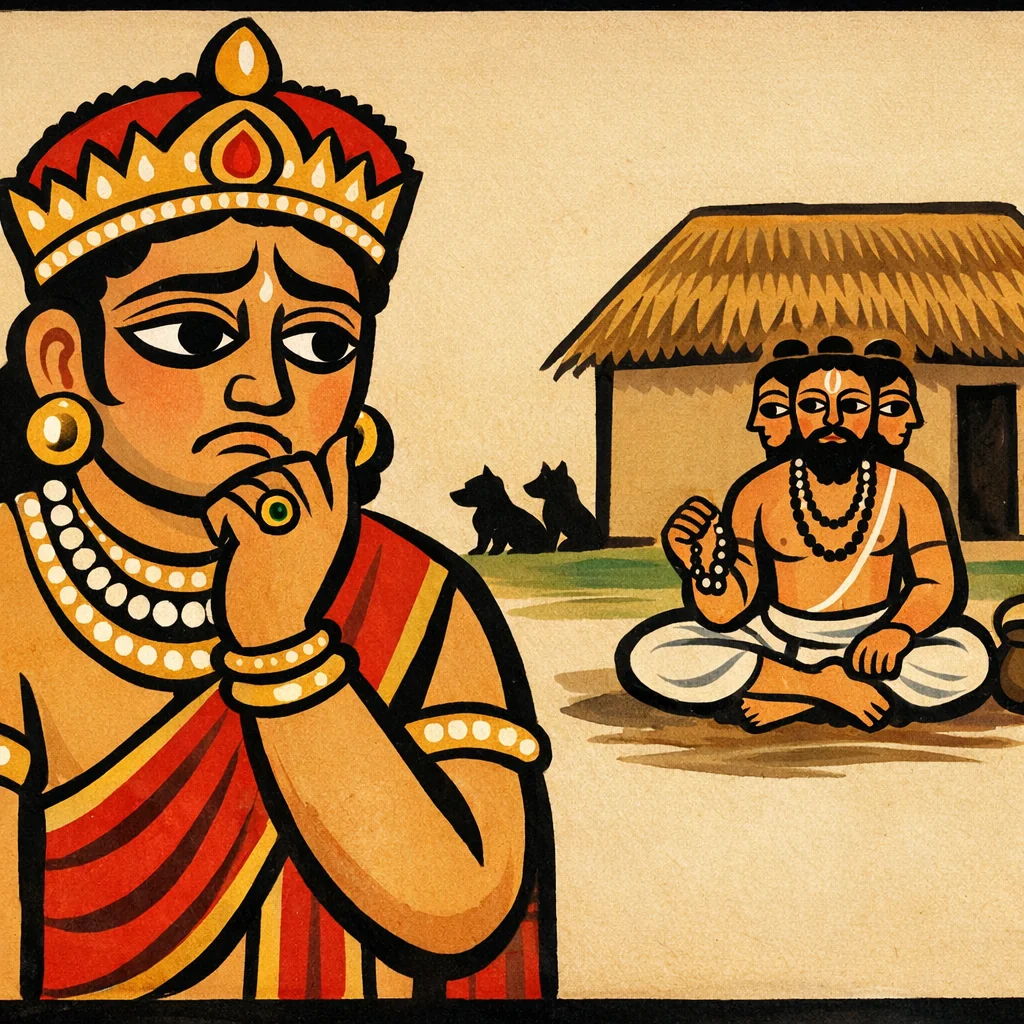
This chapter recounts King Alarka’s inner crisis as desire and attachment unsettle his mind and threaten his royal duty. He recalls his mother Madālasa’s teaching on vairāgya, non-attachment: seeing the impermanence of pleasure and pain, honor and power, and refusing to be bound by them. Through this sacred reflection, Alarka softens pride and greed, turns to self-mastery, and moves toward peace in the path of dharma.
Key Content Points
Focus Keywords
Shlokas in Adhyaya 37
Verse 1
सप्तत्रिंशोऽध्यायः जड उवाच सोऽप्यलर्को यथान्यायं पुत्रवन्मुदिताः प्रजाः । पालयामास धर्मात्मा स्वे स्वे कर्मण्यवस्थिताः ॥
Chapter 37. Jaḍa said: That Alarka too, in accordance with justice, protected the people—who were joyful as if (he were) their son—while they remained established in their respective duties.
Verse 2
दुष्टैषु दण्डं शिष्टेषु सम्यक्च परिपालनम् । कुर्वन् परां मुदं लेभे इयाज च महामखैः ॥
He administered punishment to the wicked and properly protected the well-conducted; doing so, he attained great joy, and he performed sacrifices (yajñas) with grand rites.
Verse 3
अजायन्त सुताश्चास्य महाबलपराक्रमाः । धर्मात्मानो महात्मानो विमार्गपरिपन्थिनः ॥
Sons were born to him—endowed with great strength and valor—righteous by nature, high-souled, and opposed to those who stray onto wrongful paths.
Verse 4
चकार सोऽर्थं धर्मेण धर्ममर्थेन वा पुनः । तयोश्चैवाविरोधेन बुभुजे विषयानपि ॥
He pursued wealth by means of dharma, and again pursued dharma supported by wealth; and, without discord between the two, he also enjoyed worldly pleasures.
Verse 5
एवं बहूनि वर्षाणि तस्य पालयतो महीम् । धर्मार्थकामसक्तस्य जग्मुरेकमहर्ह्यथा ॥
Thus, while he ruled the earth, many years passed for him—devoted to dharma, wealth, and pleasure—as if they were but a single day.
Verse 6
वैराग्यं नास्य सञ्जज्ञे भुञ्जतो विषयान् प्रियान् । न चाप्यलमभूत्तस्य धर्मार्थोपार्जनं प्रति ॥
No dispassion arose in him as he enjoyed dear sense-pleasures; nor did he ever feel ‘enough’ with regard to acquiring dharma and wealth.
Verse 7
तं तथा भोगसंसर्ग-प्रमत्तमजितेन्द्रियम् । सुबाहुर्नाम शुश्राव भ्राता तस्य वनेचरः ॥
His brother, named Subāhu—dwelling in the forest—heard that he was thus intoxicated by the company of enjoyments and had not conquered his senses.
Verse 8
तं बुबोधयिषुः सोऽथ चिरं ध्यात्वा महीपतिः । तद्वैरिसंश्रयं तस्य श्रेयोऽमन्यत भूपतेः ॥
Wishing to awaken him, he reflected for a long time and judged it best that the king be driven to seek refuge with an enemy—that is, to face hostile pressure.
Verse 9
ततः स काशिभूपालमुदीर्णबलवाहनम् । स्वराज्यं प्राप्तुमागच्छद् बहुशः शरणं कृतिः ॥
Then he approached the king of Kāśī, whose forces and mounts were formidable; seeking to regain his own kingdom, the capable man repeatedly took refuge with him.
Verse 10
सोऽपि चक्रे बलोद्योगमलर्कं प्रति पार्थिवः । दूतञ्च प्रेषयामास राज्यं अस्मै प्रदीयताम् ॥
That king, too, prepared his forces against Alarka and sent an envoy, saying: “Let the kingdom be handed over to him.”
Verse 11
सोऽपि नैच्छत्तदा दातुमाज्ञापूर्वं स्वधर्मवित् । प्रत्युवाच च तं दूतमलर्कः काशिभूभृतः ॥
He did not wish to surrender it without rightful authorization; knowing his own duty, Alarka replied to the envoy of the king of Kāśī.
Verse 12
मामेवाभ्येत्य हार्देन याचतां राज्यमग्रजः । नाक्रान्त्या सम्प्रदास्यामि भयेनाल्पामपि क्षितिम् ॥
“Let my elder brother come to me himself and ask for the kingdom in sincerity; I will not yield even a little land through aggression, nor out of fear.”
Verse 13
सुबाहुरपि नो याञ्चां चकार मतिमांस्तदा । न धर्मः क्षत्रियस्येति याञ्चा वीर्यधनो हि सः ॥
Even Subāhu, though prudent, did not then resort to begging; for begging is not the duty of a kṣatriya, since his wealth is valor.
Verse 14
ततः समस्तसैन्येन काशीशः परिवारितः । आक्रान्तुमभ्यगाद्राष्ट्रमलर्कस्य महीपतेः ॥
Then the lord of Kāśī, surrounded by his entire army, set out to overrun the kingdom of King Alarka.
Verse 15
अनन्तरैश्च संश्लेषमभ्येत्य तदनन्तरम् । तेषामन्यतमैर्भृत्यैः समाक्रम्यानयद्वशम् ॥
And closing in at close quarters immediately thereafter, he attacked and brought them under control through some of his attendants and retainers.
Verse 16
अपीडयंश्च सामन्तांस्तस्य राष्ट्रोपरोधनैः । तथा दुर्गानुपालांश्च चक्रे चाटविकान् वशे ॥
He pressed hard upon that king’s feudatories by blockading the country; likewise he brought the keepers of forts, and even the forest-tribes, under his control.
Verse 17
कांश्चिच्चोपप्रदानेन कांश्चिद् भेदेन पार्थिवान् । साम्नैवान्यान् वशं निन्ये निभृतास्तस्य येऽभवन् ॥
Some kings he won over by gifts, some by sowing dissension; others he brought under control by conciliation—those who had become secretly inclined to him.
Verse 18
ततः सोऽल्पबलो राजा परचक्रावपीजितः । कोषक्षयमवापोच्चैः पुरञ्चारुध्यतारिणा ॥
Then that king, of little strength and oppressed by the host of enemies, suffered a severe depletion of his treasury as his city was being besieged.
Verse 19
इत्थं सम्पीड्यमानस्तु क्षीणकोषो दिने दिने । विषादमागात्परमं व्याकुलत्वञ्च चेतसः ॥
Thus, being crushed in this way and his treasury dwindling day by day, he fell into deep despondency and great agitation of mind.
Verse 20
आर्ति स परमां प्राप्य तत् सस्माराङ्गुलीयकम् । यदुद्दिश्य पुरा प्राह माता तस्य मदालसा ॥
Having come to extreme distress, he then remembered the ring—concerning which his mother Madālasā had spoken to him long ago.
Verse 21
ततः स्नातः शुचिर्भूत्वा वाचयित्वा द्विजोत्तमान् । निष्कृष्य शासनं तस्माद्ददृशे प्रस्फुटाक्षरम् ॥
Then, having bathed and become pure, and having had the best of brāhmaṇas recite it, he drew out the written instruction from it and saw the letters clearly formed.
Verse 22
तत्रैव लिखितं मात्रा वाचयामास पार्थिवः । प्रकाशपुलकाङ्गोऽसौ प्रहर्षोत्फुल्ललोचनः ॥
There itself, the king read aloud what had been written by his mother; his body thrilled openly with horripilation, and his eyes blossomed with joy.
Verse 23
सङ्गः सर्वात्मना त्याज्यः स चेत् त्यक्तुं न शक्यते । स सद्भिः सह कर्तव्यः सतां सङ्गो हि भेषजम् ॥
Worldly association should be abandoned entirely. If it cannot be abandoned, then one should keep company with the good; for the company of the virtuous is truly a medicine.
Verse 24
कामः सर्वात्मना हेयो हातुं चेच्छक्यते न सः । मुमुक्षां प्रति तत्कार्यं सैव तस्यापि भेषजम् ॥
Desire should be rejected entirely. If it cannot be given up, then it should be directed toward liberation; that very longing for release is also its remedy.
Verse 25
वाचयित्वा तु बहुशो नृणां श्रेयः कथं त्विति । मुमुक्षयेति निश्चित्य सा च तत्सङ्गतो यतः ॥
After repeatedly reflecting, “How indeed is the highest good for people to be attained?”, he concluded: “Through the longing for liberation.” And that (longing) arises from association with such (the virtuous and wise).
Verse 26
ततः स साधुसम्पर्कं चिन्तयन् पृथिवीपतिः । दत्तात्रेयं महाभागम् अगच्छत् परमार्तिमान् ॥
Then the king, pondering contact with the holy, went to the greatly blessed Dattātreya, being in extreme distress.
Verse 27
तं समेत्य महात्मानम् अकल्पषम् असङ्गिनम् । प्रणिपत्याभिसम्पूज्य यथान्यायम् अभाषत ॥
Having approached that great-souled one—stainless and unattached—he bowed down and duly worshipped him, and then spoke in accordance with proper conduct.
Verse 28
ब्रह्मन् ! कुरु प्रसादं मे शरणं शरणार्थिनाम् । दुःखापहारं कुरु मे दुःखार्तस्यातिकामिनः ॥
O Brahmin! Show me favor—be a refuge for one seeking refuge. Remove my sorrow; I am afflicted by suffering and greatly yearn to cross beyond it.
Verse 29
दुःखापहारम् अद्यैव करोमि तव पार्थिव ! । सत्यं ब्रूहि किमर्थं ते दुःखं तत् पृथिवीपते ॥
‘I shall remove your sorrow this very day, O king. Tell the truth: for what reason is that sorrow yours, O lord of the earth?’
Verse 30
जड उवाच इत्युक्तश् चिन्तयामास स राजा तेन धीमता । त्रिविधस्यापि दुःखस्य स्थानम् आत्मानम् एव च ॥
Jaḍa said: Thus addressed by that wise one, the king reflected—on the seat of the threefold sorrow, and on the Self itself.
Verse 31
स विमृश्य चिरं राजा पुनः पुनरुदारधीः । आत्मानम् आत्मना धीरः प्रहस्येदम् अथाब्रवीत् ॥
Having reflected for a long time again and again, that king of noble understanding—steadfast—smiled, and then spoke these words, examining himself by himself.
Verse 32
नाहम् उर्वो न सलिलं न ज्योतिरनिलो न च । नाकाशं किन्तु शारीरं समेत्य सुखमिष्यते ॥
‘I am not earth, not water, not fire, not wind, nor space. Rather, the embodied condition—formed by their coming together—seeks (and imagines) happiness.’
Verse 33
न्यूूनातिरिक्ततां याति पञ्चकेऽस्मिन् सुखासुखम् । यदि स्यान्म किन्न स्यादन्यस्थेऽपि हि तन्मयि ॥
Pleasure and pain are found as deficiency or excess within this fivefold aggregate, the embodied complex. If they truly belonged to me, why would they not exist for me even when I abide elsewhere, apart from it, though my nature is consciousness?
Verse 34
नित्यप्रभूतसद्भावे न्यूूनाधिक्यान्नतोन्नते । तथा च ममतात्यक्ते विशेषो नोपलभ्यते ॥
In existence that is ever-abundant and ever-real, there is no ‘low’ or ‘high’ due to deficiency or excess. Likewise, when possessiveness—the sense of ‘mine’—is abandoned, no distinction is apprehended.
Verse 35
तन्मात्रावस्थिते सूक्ष्मे तृतीयांशे च पश्यतः । तथैव भूतसद्भावं शरीरं किं सुखासुखम् ॥
When one abides in the subtle, pure state of ‘that alone’ and beholds the ‘third portion’—a higher standpoint beyond gross and subtle—the body is seen as mere elemental existence; then what pleasure or pain can there be for the Self?
Verse 36
मनस्यवस्थितं दुःखं सुखं वा मानसञ्च यत् । यतस्ततो न मे दुःखं सुखं वा न ह्यहं मनः ॥
Pain or pleasure, and whatever is mental, abides in the mind. Therefore it is not mine—neither pain nor pleasure—for I am not the mind.
Verse 37
नाहङ्कारो न च मनो बुद्धिर्नाहं यतस्ततः । अन्तःकरणजं दुःखं पारख्यं मम तत्कथम् ॥
I am not ego, nor mind; I am not intellect. Therefore, how could suffering—born of the inner instrument (antaḥkaraṇa), which belongs to another, the not-Self—be mine?
Verse 38
नाहं शरीरं न मनो यतोऽहं पृथक् शरीरान्मनसस्तथाहम् । तत् सन्तु चेतस्यथवापि देहे सुखानि दुःखानि च किं ममात्र ॥
I am not the body, nor the mind; for I am distinct from the body and likewise from the mind. Let pleasures and pains abide in the mind or even in the body—what are they to me here?
Verse 39
राज्यस्य वाञ्छां सुरुतेऽग्रजोऽस्य देहस्य चेत् पञ्चमयः स राशिः । गुणप्रवृत्त्या मम किन्नु तत्र तत्स्थः स चाहञ्च शरीरतोऽन्यः ॥
If the prior component of this body—the aggregate made of five (pañcamaya)—produces the desire for kingship, what is that to me, being merely an activity of the guṇas? That aggregate stands there, and I too, as witness, am other than the body.
Verse 40
न यस्य हस्तादिकमप्यशेषं मांसं न चास्थीनि खिराविभागः । कस्तस्य नागाश्वरथादिकोशैः स्वल्पोऽपि सम्बन्ध इहास्ति पुंसः ॥
For one to whom even hands and the like are not the Self—nor flesh, nor bones, nor the parts—what connection, even a small one, can that person have here with elephants, horses, chariots, treasuries, and the like?
Verse 41
तस्मान्न मेऽरिर्न च मेऽस्ति दुःखं न मे सुखं नापि पुरं न कोषम् । न चाश्वनागादि बलं न तस्य नान्यस्य वा कस्यचिद्वा ममास्ति ॥
Therefore I have no enemy; nor do I have pain; nor do I have pleasure. I have neither city nor treasury. Nor do I have the strength of horses, elephants, and the like—neither his nor anyone else’s is ‘mine’.
Verse 42
यथा घटीकुम्भकमाṇ्डलुस्थम् आकाशमेकं बहुधा हि दृष्टम् । तथा सुबाहुः स च काशिपोऽहं मल्ये च देहेषु शरीरभेदैः ॥
Just as the one space is seen as many when enclosed in a small pot, a jar, or a water-vessel, so too—through differences of bodies—there is Subāhu, there is Kāśipa, and there am I, and others among the Mallas and other embodied beings.
Frequently Asked Questions
The chapter examines how political loss and mental distress can catalyze discrimination (viveka): Alarka is led to ask where duḥkha truly resides and answers by rejecting identification with body, mind, ego, and the elements, presenting non-attachment as the ethical remedy to rivalry and possessiveness.
This Adhyāya is not structured as a Manvantara-chronology unit; instead, it advances the Alarka-upākhyāna by shifting from royal administration and conflict to a soteriological turn—Alarka’s movement toward sādhusaṅga and instruction under Dattātreya.
It does not belong to the Devī Māhātmya (Adhyāyas 81–93). Its lineage-relevant contribution is the preservation of Madālasa’s didactic authority within the royal line: her written counsel becomes the proximate cause for Alarka’s renunciant orientation and approach to a guru (Dattātreya).