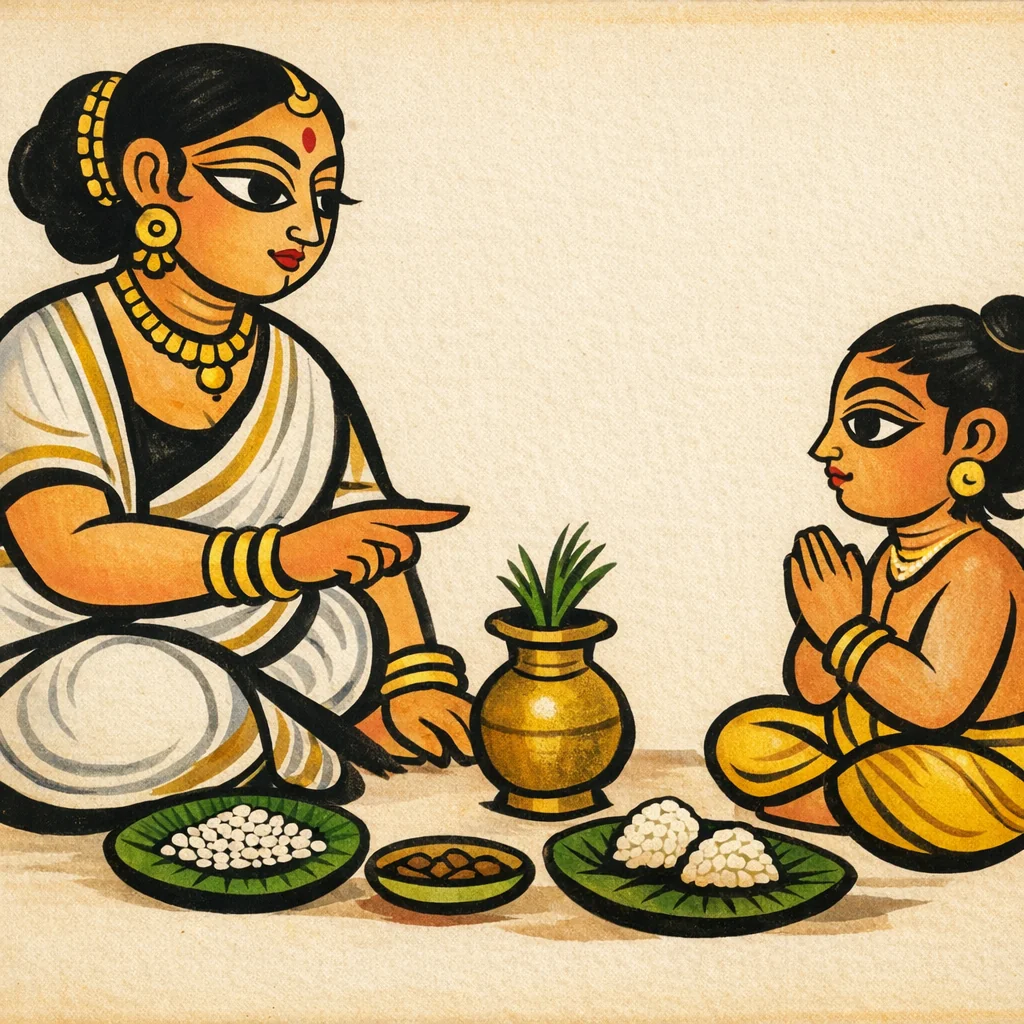
Adhyaya 30: Madālasā’s Instruction on Household Duties and Naimittika–Śrāddha Rites
मदालसोपदेशः (Madālasopadeśaḥ)
Dattatreya's Story
In Adhyaya 30, Madālasā instructs on the dharma of household life—honoring one’s husband, parents, and guests, keeping the home pure, giving dāna rightly, and managing work and wealth with integrity. She also sets forth the proper observance of Naimittika–Śrāddha, the occasion-based ancestral rites performed at prescribed times, to be done with faith, purity, and orderly ritual as a sacred duty that brings merit and blessing.
Key Content Points
Focus Keywords
Shlokas in Adhyaya 30
Verse 1
इति श्रीमार्कण्डेयपुराणे मदालसोपदेशो नामोनत्रिंशोऽध्यायः । त्रिंशोऽध्यायः । मदालसोवाच नित्यं नैमित्तकञ्चैव नित्यनैमित्तिकं तथा । गृहस्थस्य तु यत् कर्म तन्निशामय पुत्रक ॥
Thus ends the twenty-ninth chapter called ‘Madālasa’s Instruction’ in the Śrī Mārkaṇḍeya Purāṇa. Now begins the thirtieth chapter. Madālasa said: The duties of a householder are of three kinds—daily (nitya), occasional (naimittika), and those that are both daily-and-occasional (nitya-naimittika). Listen to them, my son.
Verse 2
पञ्चयज्ञाश्रितं नित्यं यदेतत् कथितं तव । नैमित्तिकं तथैवान्यत् पुत्रजन्मक्रियादिकम् ॥
What has been explained to you as the daily duty is based on the five sacrifices (pañca-yajñas). And the occasional duties are of another kind—such as the rites connected with a son’s birth and similar ceremonies.
Verse 3
नित्यनैमित्तिकं ज्ञेयं पर्वश्राद्धादि पण्डितैः । तत्र नैमित्तिकं वक्ष्ये श्राद्धमभ्युदयं तव ॥
The learned should understand that rites such as the śrāddha performed on festival or seasonal occasions (parva-śrāddha) belong to the class of nitya-naimittika duties. Among these, I shall now describe to you the naimittika śrāddha called the abhyudaya (auspicious) śrāddha.
Verse 4
पुत्रजन्मनि यत्कार्यं जातकर्मसमं नरैः । विवाहादौ च कर्तव्यं सर्वं सम्यक् क्रिमोदितम् ॥
At the birth of a son, whatever is to be done by men—on a par with the jātakarma rite—and likewise at marriage and similar occasions, all that should be performed properly, as has been prescribed.
Verse 5
पितरश्चात्र सम्पूज्याः ख्याताः नन्दीमुखास्तु ये । पिण्डांश्च दधिसंमिश्रान् दद्याद् यवसमन्वितान् ॥
Here, the Pitṛs—known as the Nandīmukha Pitṛs—are to be duly worshipped; and one should offer piṇḍas mixed with curd and accompanied with barley.
Verse 6
उदङ्मुखः प्राङ्मुखो वा यजमानः समाहितः । वैश्वदेवविहीनं तत् केचिदिच्छन्ति मानवाः ॥
The sacrificer (yajamāna), being composed, should face either north or east. Some people prefer that this rite be performed without the Vaiśvadeva offering.
Verse 7
युग्माश्चात्र द्विजाः कार्यास्ते च पूज्याः प्रदक्षिणम् । एतन्नैमित्तिकं वृद्धौ तथान्यच्चौर्ध्वदेहिकम् ॥
Here, the twice-born (brāhmaṇas) should be engaged in even numbers, and they are to be honored with circumambulation. This is an occasional (naimittika) rite for times of prosperity/increase; and so too are other post-funeral (aurdhvadehika) rites.
Verse 8
मृताहनि च कर्तव्यमेकोद्दिष्टं शृणुष्व तत् । दैवहीनं तथा कार्यं तथैवैकपवित्रकम् ॥
On the day of death, the ekoddiṣṭa (single-dedication) śrāddha should be performed—listen to its procedure. It is to be done without the deity-portion (daiva), and likewise with a single pavitra (ritual ring/grass purifier).
Verse 9
आवाहनं न कर्तव्यमग्नौकरणवर्जितम् । प्रेतस्य पिण्डमेकञ्च दद्यादुच्छिष्टसन्निधौ ॥
No invocation (āvāhana) should be performed; it should be done without the agni-karaṇa rite. One should give a single piṇḍa for the preta, in the vicinity of the remnants (ucchiṣṭa).
Verse 10
तिलोदकं चापसव्यं तन्नामस्मरणान्वितम् । अक्षय्यममुकस्येति स्थाने विप्रविसर्जने ॥
One should offer sesame-water (tilodaka) with the sacred thread worn in the apasavya manner, accompanied by remembrance of his name. At the proper point—when dismissing the brāhmaṇas—one should say: ‘May this be imperishable for so-and-so.’
Verse 11
अभिरण्यतामिति ब्रूयाद् ब्रूयुस्ते 'भिरताः स्म ह । प्रतिमासं भवेदेतत् कार्यमावात्सरं नरैः ॥
He should say, ‘May there be delight/abundance (abhiraṇyatām).’ They (the brāhmaṇas) should reply, ‘We indeed are delighted (abhiratāḥ sma).’ This rite should be performed by men every month, for a full year.
Verse 12
अथ संवत्सरे पूर्णे यदा वा क्रियते नरैः । सपिण्डीकरणं कार्यं तस्यापि विधिरुच्यते ॥
Then, when a full year is completed—or whenever it is performed by men—the rite of sapiṇḍīkaraṇa should be done; its procedure too is now stated.
Verse 13
तच्चापि दैवरहितमेकाऽर्घ्यैकपवित्रकम् । नैवाग्नौकरणं तत्र तच्चावाहनवर्जितम् ॥
That ekoddiṣṭa rite too is performed without offerings to the gods; it has a single arghya offering and a single pavitra (a ring of kuśa grass). In it there is no use of fire-rites (homa), and it is also without invocations (āvāhana).
Verse 14
अपसव्यञ्च तत्रापि भोजयेदयुजो द्विजान् । विशेषस्तत्र चान्योऽस्ति प्रतिमासं क्रियाधिकः ॥
There too, in the apasavya manner (leftward, for the pitṛs), one should feed an odd number of twice-born (brāhmaṇas). Another special point is mentioned: the rite is to be performed each month with added observance (vrata).
Verse 15
तं कथ्यमानमेकाग्रो वदन्त्याऽ मे निशामय । तिलगन्धोदकैर्युक्तं तत्र पात्रचतुष्टयम् ॥
Listen attentively to me as I explain it. There, one should arrange a set of four vessels, furnished with sesame (tila) and scented water.
Verse 16
कुर्यात् पितॄणां त्रितयमेकं प्रेतस्य पुत्रक । पात्रत्रये प्रेतपात्रमर्घ्यञ्चैव प्रसेचयेत् ॥
One should prepare three (offerings) for the three pitṛs, and one for the preta, O son. Upon the three vessels—and upon the preta-vessel as well—one should pour the arghya libation.
Verse 17
ये समाना इति जपन् पूर्ववच्छेषमाचरेत् । स्त्रीणामप्येवमेवैतदेकोद्दिष्टमुदाहृतम् ॥
Reciting the words ‘ye samānāḥ …’, one should perform the remainder just as previously stated. This ekoddiṣṭa procedure is declared to be the same for women as well.
Verse 18
सपिण्डीकरणं तासां पुत्राभावे न विद्यते । प्रतिसंवत्सरं कार्यमेकोद्दिष्टं नरैः स्त्रियाः ॥
For those women, when there is no son, the rite of sapiṇḍīkaraṇa is not prescribed. Instead, men should perform for that woman an annual ekoddiṣṭa rite.
Verse 19
मृताहनि यथान्यायं नॄणां यद्वदिहोदितम् । पुत्राभावे सपिण्डास्तु तदभावे सहोदकाः ॥
On the day of death, the procedure for men is as stated here according to rule. If there is no son, the sapiṇḍa relatives should do it; if they are absent, then the sahodaka kin should do so.
Verse 20
मातुः सपिण्डा ये च स्युर्ये च मातुः सहोदकाः । कुर्युरेनं विधिं सम्यगपुत्रस्य सुतासुतः ॥
Those who are the mother’s sapiṇḍas and those who are the mother’s sahodakas should properly perform this rite for one who has no son; even the daughter’s son may do it.
Verse 21
कुर्युर्मातामहायैवं पुत्रिकास्तनयास्तथा । द्व्यामुष्यायणसंज्ञास्तु मातामहपितामहान् ॥
Thus should the sons of an appointed daughter (putrikā) perform the rites for their maternal grandfather as well. Those known as dvyāmuṣyāyaṇas, belonging to both lineages, also perform rites for the maternal grandfather and the paternal grandfather.
Verse 22
पूजयेयुर्यथान्यायं श्राद्धैर्नैमित्तिकैरपि । सर्वाभावे स्त्रियः कुर्युः स्वभर्तॄणाममन्त्रकम् ॥
They should honor the departed according to rule, even by occasional (naimittika) śrāddhas. If all eligible performers are absent, women should perform for their husbands an amantraka rite, without Vedic mantras.
Verse 23
तदभावे च नृपतिः कारयेत् स्वकुटुम्बिना । तज्जातीयैर्नरैः सम्यग् दाहाद्याः सकलाः क्रियाः ॥
And if those proper relatives or performers are not available, the king should have all the rites—beginning with cremation—duly carried out by his own household (servants and retainers), or by men of the same jāti (community).
Verse 24
सर्वेषामेव वर्णानां बान्धवो नृपतिर्यतः । एतास्ते कथिता वत्स ! नित्यनैमित्तकास्तथा ॥
For the king is, in truth, a kinsman to all the varṇas. Thus, dear child, these (rites) have been explained to you as the nitya and the naimittika duties—obligatory and occasion-based.
Verse 25
क्रियां श्राद्धाश्रयामन्यां नित्यनैमित्तिकीं शृणु । दर्शस्तत्र निमित्तं वै कालश्चन्द्रक्षयात्मकः । नित्यतां नियतः कालस्तस्याः संसूचयत्यथ ॥
Now hear of another rite connected with śrāddha, which is both regular and occasion-based. There the ‘darśa’ (new-moon day) is indeed the occasion; its time is marked by the waning and ending of the moon. And the fixed, regulated time thereby indicates its regular recurrence.
Frequently Asked Questions
It systematizes household dharma by distinguishing obligatory action into nitya, naimittika, and nitya-naimittika categories, then applies this taxonomy to the ethics of ancestral obligation—how and by whom śrāddha and post-death rites must be performed to maintain social and ritual continuity.
The chapter outlines ekoddiṣṭa to be done on the day of death and then monthly for a year, using features such as tilodaka with name-remembrance and apasavya performance, typically without āvāhana and agnikaraṇa; after the year (or when duly performed), sapiṇḍīkaraṇa is prescribed to integrate the departed into the ancestral (pitṛ) collective, with specific vessel/offerings arrangements and brāhmaṇa-feeding rules.
This Adhyāya is not part of the Devi Mahātmyam (Adhyāyas 81–93) and does not advance a Manvantara chronology; its relevance lies instead in dharma-śāstric ritual architecture within the Madālasā discourse, especially the household and funerary śrāddha framework and kinship-based ritual authority.