Adhyaya 304
Yājñavalkya on the Unity of Sāṃkhya and Yoga and the Marks of Meditative Composure
Upa-parva: Mokṣa-dharma Parva (Mokṣadharma)
Yājñavalkya addresses a royal interlocutor and presents Yoga-knowledge after having taught Sāṃkhya, asserting that no knowledge equals Sāṃkhya and no strength equals Yoga, yet both are ultimately one when understood in truth. He argues that what yogins perceive is also seen by Sāṃkhyas, and that the true knower recognizes their essential unity. The chapter introduces an esoteric description of Yoga characterized as subtle and “eightfold/with eight qualities” (aṣṭaguṇa), distinguishing practice modes described as saguṇa and nirguṇa. Practical elements include dhāraṇā (mental fixation) and prāṇāyāma (breath-regulation), with a caution that certain breath-release patterns can aggravate vāta and should not be pursued improperly. A regimen of repeated “impulses/efforts” (codanā) at specific night-watches is noted. The method proceeds through progressive withdrawal and reintegration: restraining the five sense-objects, collecting the sense-faculties into mind, mind into ahaṃkāra, ahaṃkāra into buddhi, and buddhi into prakṛti, culminating in contemplation of the stainless, infinite, unwounded puruṣa/brahman. Finally, Yājñavalkya lists observable markers of the ‘yukta’ (integrated meditator): calm sleep after satisfaction, steadiness like a lamp in windless space, immovability like a rock under rain, non-reactivity amid loud sounds, and one-pointed focus likened to carrying a full oil-vessel up steps without spilling. The culmination is brahma-vision and the claim that this constitutes the definitive characterization of Yoga.
Chapter Arc: राजा जनक के समक्ष वसिष्ठ/कराल जीव की अनवरत यात्राओं का रहस्य खोलते हैं—कैसे वह एक-एक धाम (लोक/योनि) से सहस्रों धामों तक भटकता हुआ मरण-पर्यन्त चक्र में गिरता है। → उपमा चन्द्रमा की आती है: जैसे चन्द्रमा की कलाएँ बार-बार क्षीण और पूर्ण होती हैं, वैसे ही जीव की कलाएँ (अवयव/तत्त्व-सम्बन्ध) अज्ञान के कारण बार-बार बनती-बिगड़ती हैं। पंद्रह कलाओं का उद्भव और ‘सोलहवीं कला’ के साथ प्रकृति-संयोग का बन्धन—यहीं से पुनर्जन्म का तर्क कसता जाता है। → निर्णायक बिन्दु यह है कि ‘सोलहवीं कला’—अव्यक्त/प्रकृति-सम्बन्धी देह-बीज—का क्षय ही मोक्ष कहलाता है; और यह क्षय ‘प्रतिबोध’ (विवेक-जागरण) से होता है। साथ ही 25वें तत्त्व (महानात्मा/पुरुष) की निर्मलता बताकर कहा जाता है कि संगति/सेवन से शुद्ध भी अशुद्ध-सा और बुद्ध भी अबुद्ध-सा हो सकता है। → जनक के लिए निष्कर्ष स्पष्ट किया जाता है: त्रिगुणात्मक प्रकृति का सेवन त्रिगुणता बढ़ाता है; विवेकशील संग विवेक जगाता है; अज्ञान-सेवन बन्धन बढ़ाता है। अतः मोक्ष का उपाय बाह्य कर्मकाण्ड नहीं, बल्कि प्रकृति-संयोग की पहचान और उसका क्षय—विवेक द्वारा—है।
Shlokas
Verse 1
अपन क्रात बछ। अर: - किसी-किसी टीकाकारने 'सिध्मा' का अर्थ 'खाँसी' और “दमा” भी किया है। परंतु कोष-प्रसिद्ध अर्थ 'सफेद दाग या सेहुँँवा' ही है। चतुर्राधिकत्रिशततमो< ध्याय: प्रकृतिके संसर्गदोषसे जीवका पतन वसिष्ठ उवाच एवमप्रतिबुद्धत्वादबुद्धजनसेवनात् । सर्गकोटि सहस्राणि पतनान्तानि गच्छति,वसिष्ठजी कहते हैं--राजन्! इस तरह अज्ञानके कारण अज्ञानी पुरुषोंका संग करनेसे जीवका निरन्तर पतन होता है तथा उसे हजारों-करोड़ बार जन्म लेने पड़ते हैं
Vasiṣṭha said: “O King, in this way—through remaining unawakened (to true discernment) and through associating with the ignorant—a living being undergoes continual decline, passing through countless cycles of creation, ending again and again in downfall.”
Verse 2
धाम्ना धामसहस््राणि मरणान्तानि गच्छति । तिर्यग्योनिमनुष्यत्वे देवलोके तथैव च,वह पशु-पक्षी, मनुष्य तथा देवताओंकी योनियोंमें तथा एक स्थानसे सहसौरों स्थानोंमें बारंबार मरकर जाता और जन्म लेता है
Vasiṣṭha said: By the force of its own acquired condition (dhāman), the embodied being passes through thousands of abodes, each ending in death. Thus it repeatedly dies and is born again—among animal wombs, among human states, and likewise in the worlds of the gods.
Verse 3
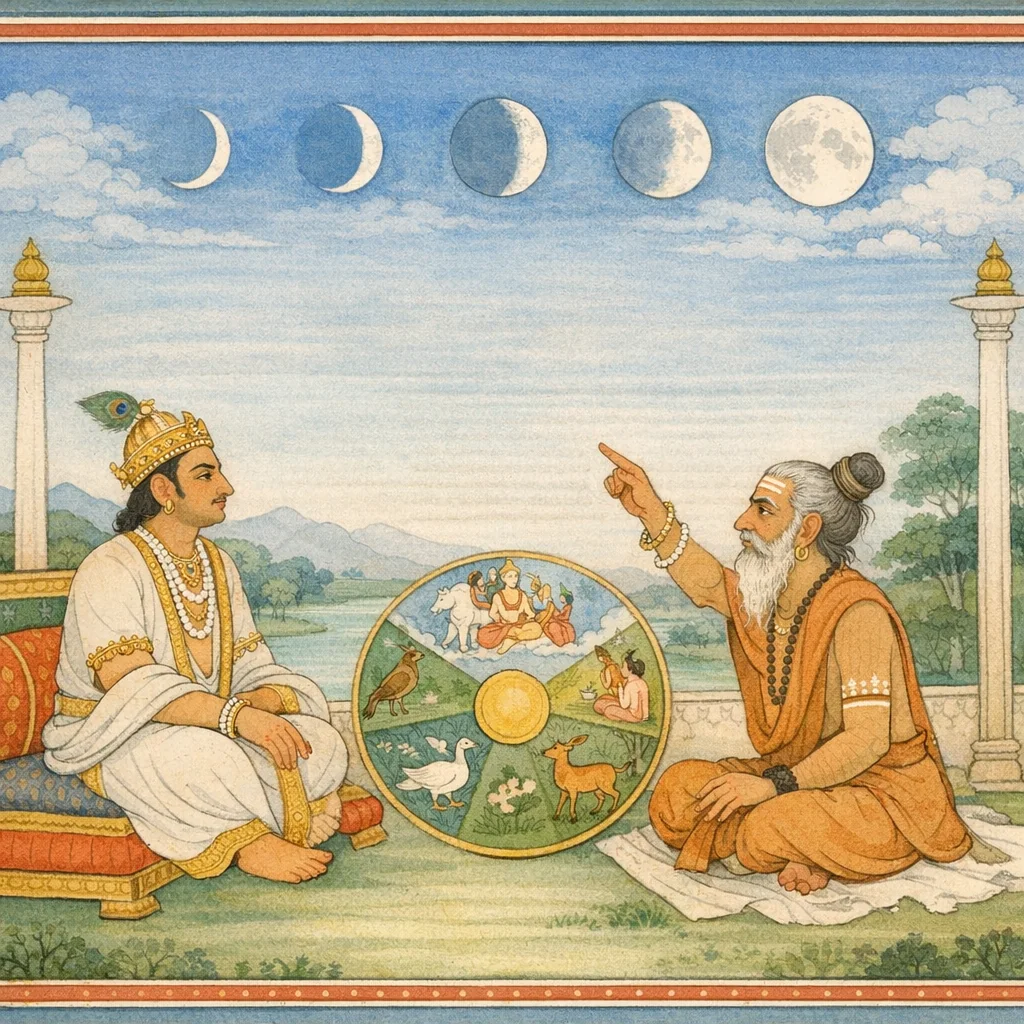
चन्द्रमा इव भुतानां पुनस्तत्र सहस्रश: । लीयतेडप्रतिबुद्धत्वादेवमेष हाबुद्धिमान्,जैसे चन्द्रमाका सहस्रों बार क्षय और सहस्(्रों बार वृद्धि होती रहती है, उसी प्रकार अज्ञानी जीव भी अज्ञानवश ही सहस्रों बार लयको प्राप्त होता है (और जन्म लेता है)
Vasiṣṭha said: “Just as the moon among beings is seen to wane and wax again and again, so too the ignorant embodied self—because it has not awakened to true knowledge—repeatedly dissolves (dies) and is born again, thousands of times. This ceaseless return is driven not by fate but by unawakened understanding.”
Verse 4
कला पज्चदशी योनिस्तद्धाम प्रतिबुध्यते । नित्यमेतद् विजानीहि सोम॑ वै षोडशीं कलाम्,राजन! चन्द्रमाकी पंद्रह कलाओंके समान जीवोंकी पंद्रह कलाएँ ही उत्पत्तिके स्थान हैं। अज्ञानी जीव उन्हींको अपना आश्रय समझता है; परंतु उसकी जो सोलहवीं कला है, उसको तुम नित्य समझो। वह चन्द्रमाकी अमा नामक सोलहवीं कलाके समान है
Vasiṣṭha said: “The fifteenfold kalā is the womb—the source in which beings arise—and the ignorant awaken only to that abode, taking it as their support. But know this always, O king: there is also a sixteenth kalā, the Soma principle—subtle and enduring—like the moon’s sixteenth phase (amā), beyond the changing fifteen.”
Verse 5
कलायां जायते5जसंं पुन: पुनरबुद्धिमान् । धाम तस्योपयुञ्जन्ति भूय एवोपजायते,अज्ञानी जीव सदा बारंबार उन्हीं कलाओंमें स्थित हुआ जन्म ग्रहण करता है। वे ही कलाएँ जीवके आश्रय लेनेयोग्य हैं, अतः जीवका उन्हींसे पुनः-पुनः जन्म होता रहता है
Vasiṣṭha said: The ignorant self is born again and again within those very kalās. Taking them as its abode and support, it comes to birth once more—repeatedly—because it continues to cling to them as its resting-place.
Verse 6
षोडशी तु कला सूक्ष्मा स सोम उपधार्यताम् | न तूपयुज्यते देवै्देवानुपयुनक्ति सा,अमा नामक जो सोलहवीं सूक्ष्म कला है, वही सोम है अर्थात् जीवकी प्रकृति है, यह तुम निश्चितरूपसे जान लो। देवतालोग अर्थात् अन्तःकरण और इन्द्रियगण जिनको पंद्रह कलाओंके नामसे कहा गया, वे उस सोलहवीं कलाका उपयोग नहीं कर सकते; किंतु वे सोलहवीं कला अर्थात् उन सबकी कारणभूता प्रकृति ही उनका उपयोग करती है
Vasiṣṭha said: The sixteenth, exceedingly subtle kalā is to be firmly understood as Soma itself—i.e., the living being’s own primal nature. The “gods”—meaning the inner faculties and the senses, spoken of as the fifteen kalās—cannot make use of that sixteenth principle; rather, that sixteenth kalā, the causal Nature underlying them all, is what employs and directs them.
Verse 7
एतामक्षपयित्वा हि जायते नृपसत्तम । सा हास्य प्रकृतिर्दृष्टा तत्क्षयान्मोक्ष उच्यते,नृपश्रेष्ठ जीव अपने अज्ञानवश उस सोलहवीं कलारूप प्रकृतिके संयोगका क्षय नहीं कर पाता, इसलिये बारंबार जन्म ग्रहण करता है। वह ही कला जीवकी प्रकृति अर्थात् उत्पत्तिका कारण देखी गयी है। उसके संयोगका क्षय होनेपर ही मोक्षकी प्राप्ति बतायी जाती है
Vasiṣṭha said: “O best of kings, because the embodied being does not bring about the exhaustion of this bonding principle, he is born again and again. That very portion is seen as his prakṛti—the causal source of his arising. When that conjunction is exhausted, liberation is declared to occur.”
Verse 8
तदेव षोडशकल देहमव्यक्तसंज्ञकम् । ममायमिति मन्वानस्तत्रैव परिवर्तते,(मूल प्रकृति, दस इन्द्रियाँ--एक प्राण और चार प्रकारका अन्तःकरण-इन) सोलह कलाओंसे युक्त जो यह सूक्ष्मशरीर है, इसे “यह मेरा है” ऐसा माननेके कारण अज्ञानी जीव उसीमें भटकता रहता है
Vasiṣṭha said: That very body—subtle in nature and known as the “unmanifest” (avyakta)—is endowed with sixteen parts. Mistaking it with the thought, “This is mine,” the ignorant living being keeps revolving within it alone, wandering again and again in the same limited identification.
Verse 9
पजञ्चविंशो महानात्मा तस्यैवाप्रतिबोधनात् | विमलस्य विशुद्धस्य शुद्धाशुद्धनिषेवणात्,पचीसवाँ तत्त्वरूप जो महान् आत्मा है, वह निर्मल एवं विशुद्ध है। उसको न जाननेके कारण तथा शुद्ध-अशुद्ध वस्तुओंके सेवनसे वह निर्मल, संगरहित आत्मा भी शुद्ध और अशुद्ध वस्तुओंके सदृश हो जाता है। पृथ्वीनाथ! अविवेकीके संगसे विवेकशील भी अविवेकी हो जाता है
Vasiṣṭha said: “The twenty-fifth principle—the great Self—is in itself stainless and perfectly pure. Yet, through failure to recognize it, and through association with and indulgence in what is pure and impure, that Self, though truly untainted and unattached, appears as if it were like the pure and the impure. O lord of the earth, by keeping company with the undiscriminating, even one who possesses discernment becomes undiscriminating.”
Verse 10
अशुद्ध एव शुद्धात्मा तादृग् भवति पार्थिव । अबुद्धसेवनाच्चापि बुद्धो<प्यबुद्धतां ब्रजेत्,पचीसवाँ तत्त्वरूप जो महान् आत्मा है, वह निर्मल एवं विशुद्ध है। उसको न जाननेके कारण तथा शुद्ध-अशुद्ध वस्तुओंके सेवनसे वह निर्मल, संगरहित आत्मा भी शुद्ध और अशुद्ध वस्तुओंके सदृश हो जाता है। पृथ्वीनाथ! अविवेकीके संगसे विवेकशील भी अविवेकी हो जाता है
Vasiṣṭha said: “O king, even a self that is intrinsically pure comes to appear as impure, taking on the character of what it associates with. And by keeping company with the unwise, even a discerning person may fall into undiscerning ways.”
Verse 11
तथैवाप्रतिबुद्धो 5पि विज्ञेयो नृपसत्तम । प्रकृतेस्त्रिगुणायास्तु सेवनात् त्रिगुणो भवेत्,नृपश्रेष्ठ) इसी प्रकार मूर्ख भी विवेकशीलका संग करनेसे विवेकशील हो जाता है, ऐसा समझना चाहिये। त्रिगुणात्मिका प्रकृतिके सम्बन्धसे निर्गुण आत्मा भी त्रिगुणमय-सा हो जाता है
Vasiṣṭha said: “In the same way, O best of kings, even one who is not yet awakened should be understood to become discerning through association with the discerning. Likewise, by contact and continual involvement with Prakṛti, which is constituted of the three guṇas, even the guṇa-transcendent Self comes to appear as though it were made of the three guṇas.”
Verse 304
इति श्रीमहाभारते शान्तिपर्वणि मोक्षधर्मपर्वणि वसिष्ठकरालजनकसंवादे चतुरधिकत्रिशततमो<ध्याय:
Thus, in the Śrī Mahābhārata, within the Śānti Parva—specifically the Mokṣa-dharma section—ends the dialogue involving Vasiṣṭha, Karāla, and Janaka: the three-hundred-and-fourth chapter. This is a concluding colophon marking the close of a unit of teaching on liberation-oriented dharma conveyed through their conversation.
Frequently Asked Questions
It claims that Sāṃkhya and Yoga are not ultimately separate: the same reality is apprehended by both, and the genuine tattvavit recognizes their unity rather than treating them as competing systems.
Dhāraṇā is presented as a mind-centered discipline and prāṇāyāma as a regulated breath practice (described as saguṇa), with a caution that certain modes of breath-release can increase vāta and therefore should not be undertaken improperly.
Rather than a formal phalaśruti, the chapter offers a meta-claim: knowing these defining marks and this method is treated as sufficient characterization of Yoga, after which the wise regard themselves as kṛtakṛtya (their purpose accomplished).