Adhyaya 137
अविश्वास-निति: ब्रह्मदत्त–पूजनी-संवादः (Policy of Caution: The Brahmadatta–Pūjanī Dialogue)
Upa-parva: Rājadharmānuśāsana (Instruction on Kingship and Statecraft)
Yudhiṣṭhira challenges the practicality of the maxim “do not trust enemies,” arguing that excessive suspicion can paralyze kingship and asking how victory is possible without reliance. Bhīṣma responds with an exemplum set in Kāmpilya: the bird Pūjanī lives in King Brahmadatta’s inner quarters and bears a son; around the same time the queen bears a prince. Pūjanī brings two strengthening fruits—one for her son and one for the prince. Later, the young prince kills Pūjanī’s son during play. Grief-stricken, Pūjanī denounces the instability of kṣatriya goodwill and retaliates by blinding the prince, then argues that trust is unsafe where prior injury exists. Brahmadatta proposes that mutual retaliation balances the account and urges her to stay; Pūjanī insists that enmity persists, often transmitting through descendants, and that conciliation can conceal unresolved hostility. The dialogue expands into analytic claims: types and sources of enmity, the limits of wealth, harsh speech, or appeasement in extinguishing hostility, and the tension between “kāla (time) as determinant” versus moral agency and responsibility. Pūjanī concludes that given structural vulnerability and recurring risk, withdrawal from unsafe association is prudent; Bhīṣma closes by presenting the exchange as instruction on distrust as a security principle within rājadharma.
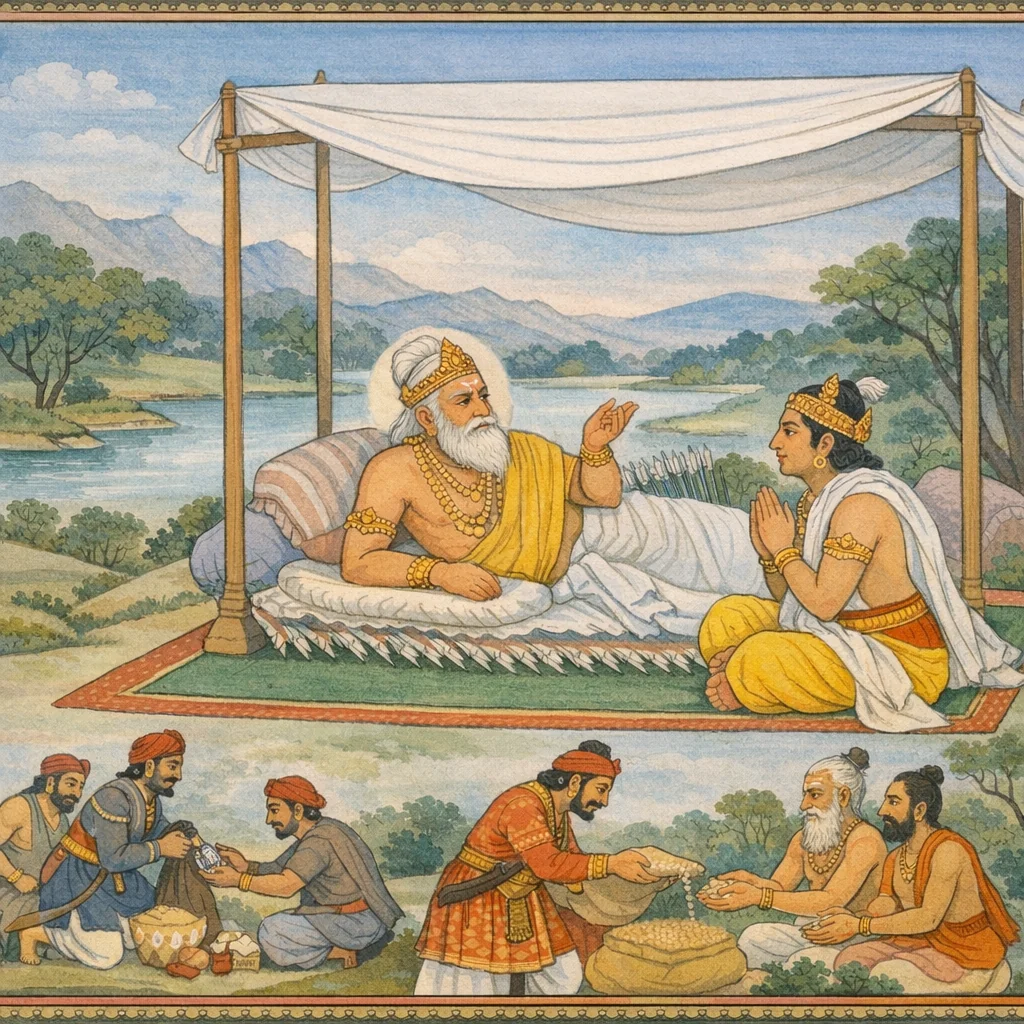
Chapter Arc: Yudhishthira’s unquiet mind turns from victory’s ashes to governance: in scarcity and disorder, whose wealth may a king take, whose must he never touch, and how should he behave toward each class of men? Bhishma answers by invoking ancient gathas—old, hard-won rules for a ruler in distress. → Bhishma draws a sharp boundary around protected wealth: the king must not seize the property of yajna-performing, dharma-abiding Brahmanas, nor what is truly ‘devasva’ (consecrated to the gods). Yet the kingdom must be sustained; the Kshatriya is charged with maintaining order and sacrifice itself. The tension tightens: the ruler’s need for revenue versus the moral peril of predation. → The doctrine of ‘righteous seizure’ is stated with force: the Kshatriya may take from dacoits, the idle, and those who do not honor gods, ancestors, or men with offerings—wealth that is called ‘anarthaka’ (purposeless) in their hands. Most pointedly, the king who takes from the wicked and gives to the good is praised as one who has crossed over into the full knowledge of dharma. → Bhishma frames kingship as transformative stewardship: like cutting what is inedible to cook what is edible, the ruler may employ harsh means to preserve the nourishing core of society—sacrifice, protection, and the support of the virtuous. The king’s taking is justified only when yoked to public good: strength for defense and wealth for yajna and welfare, never for private greed.
Shlokas
Verse 1
ऑपन--माज बछ। अि<-छऋाय षट्त्रिशर्दाधिकशततमो< ध्याय: राजा किसका धन ले और किसका न ले तथा किसके साथ कैसा बर्ताव करे--इसका विचार भीष्म उवाच अत्र गाथा ब्रह्मगीता: कीर्तयन्ति पुराविद: । येन मार्गेण राजा वै कोशं संजनयत्युत,भीष्मजी कहते हैं--युधिष्ठिर! जिस मार्ग या उपायसे राजा अपना खजाना भरता है, उसके विषयमें प्राचीन इतिहासके जानकारलोग ब्रह्माजीकी कही हुई कुछ गाथाएँ कहा करते हैं
Bhīṣma said: “In this matter, the learned authorities on ancient tradition recite certain verses known as the ‘Brahma-gītās.’ They explain the path and means by which a king rightly builds up the royal treasury—an inquiry that bears directly on how he should take revenue, from whom he should not take it, and how he ought to conduct himself toward different people.”
Verse 2
न धन यज्ञशीलानां हार्य देवस्वमेव च । दस्यूनां निष्क्रियाणां च क्षत्रियो हर्तुमहति,राजाको यज्ञानुष्ठान करनेवाले द्विजोंका धन नहीं लेना चाहिये। इसी प्रकार उसे देवसम्पत्तिमें भी हाथ नहीं लगाना चाहिये। वह लुटेरों तथा अकर्मण्य मनुष्योंके धनका अपहरण कर सकता है
“A Kṣatriya king should not take the wealth of the twice-born who are devoted to sacrifice (yajña), nor should he lay hands on property belonging to the gods (devadravya). But he may confiscate the wealth of robbers and of those who are idle and do no work.”
Verse 3
इमा: प्रजा: क्षत्रियाणां राज्यभोगाश्व भारत | धन हि क्षत्रियस्यैव द्वितीयस्य न विद्यते
Bhīṣma said: “O Bhārata, these subjects themselves—and the enjoyments that come from sovereignty—are the Kṣatriya’s wealth. For a Kṣatriya has no ‘second’ wealth apart from this.”
Verse 4
अभोग्याश्लौषधीश्कछित्त्वा भोग्या एव पचन्त्युत,राजन! जो खानेयोग्य नहीं हैं, उन ओषधियों या वृक्षोंको काटकर मनुष्य उनके द्वारा खानेयोग्य ओषधियोंको पकाते हैं। इसी प्रकार जो देवताओं, पितरों और मनुष्योंका हविष्यके द्वारा पूजन नहीं करता है, उसके धनको धर्मज्ञ पुरुषोंने व्यर्थ बताया है। अतः धर्मात्मा राजा ऐसे धनको छीन ले और उसके द्वारा प्रजाका पालन करे, किंतु वैसे धनसे राजा अपना कोश न भरे
Bhishma said: “O King, people cut down inedible herbs or trees and, by means of them, cook what is edible. In the same way, the wealth of one who does not worship the gods, the ancestors, and human beings through offerings is declared futile by those who know dharma. Therefore, a righteous king should seize such wealth and use it to maintain the people; yet he should not fill his own treasury with that kind of wealth.”
Verse 5
यो वै न देवान् न पितृन् न मर्त्यान हविषार्चति । अनर्थकं धन तत्र प्राहुर्धमविदो जना:,राजन! जो खानेयोग्य नहीं हैं, उन ओषधियों या वृक्षोंको काटकर मनुष्य उनके द्वारा खानेयोग्य ओषधियोंको पकाते हैं। इसी प्रकार जो देवताओं, पितरों और मनुष्योंका हविष्यके द्वारा पूजन नहीं करता है, उसके धनको धर्मज्ञ पुरुषोंने व्यर्थ बताया है। अतः धर्मात्मा राजा ऐसे धनको छीन ले और उसके द्वारा प्रजाका पालन करे, किंतु वैसे धनसे राजा अपना कोश न भरे
Bhishma said: He who does not worship the gods, the ancestors, or human beings with sacrificial offerings—his wealth, in that case, is declared fruitless by those who know dharma. For wealth gains meaning only when it is used in rightful giving and sustaining the sacred and social order; otherwise it becomes barren, like labor spent on what cannot truly nourish.
Verse 6
हरेत् तद् द्रविणं राजन् धार्मिक: पृथिवीपति: । ततः प्रीणयते लोक॑ न कोशं तद्विधं नृप:,राजन! जो खानेयोग्य नहीं हैं, उन ओषधियों या वृक्षोंको काटकर मनुष्य उनके द्वारा खानेयोग्य ओषधियोंको पकाते हैं। इसी प्रकार जो देवताओं, पितरों और मनुष्योंका हविष्यके द्वारा पूजन नहीं करता है, उसके धनको धर्मज्ञ पुरुषोंने व्यर्थ बताया है। अतः धर्मात्मा राजा ऐसे धनको छीन ले और उसके द्वारा प्रजाका पालन करे, किंतु वैसे धनसे राजा अपना कोश न भरे
Bhishma said: “O king, a righteous ruler, the lord of the earth, should confiscate such wealth. With it he should satisfy and sustain the people; but, O ruler, he should not fill his own treasury with wealth of that kind.”
Verse 7
असाधुभ्यो<र्थमादाय साधुभ्यो य: प्रयच्छति । आत्मानं संक्रमं कृत्वा कृत्स्नधर्मविदेव सः,जो राजा दुष्टोंस धन छीनकर उसे श्रेष्ठ पुरुषोंमें बाँट देता है, वह अपने-आपको सेतु बनाकर उन सबको पार कर देता है। उसे सम्पूर्ण धर्मोका ज्ञाता ही मानना चाहिये
Bhishma said: He who takes wealth away from the wicked and gives it to the virtuous—making his own self a bridge for others to cross—should be regarded as one who truly knows the whole of dharma. The verse frames righteous kingship as active moral redistribution: restraining wrongdoers and supporting the good, not for personal gain but for the protection and uplift of society.
Verse 8
तथा तथा जयेल्लोकान् शक््त्या चैव यथा यथा | उद्धिज्जा जन्तवो यद्वधच्छुक्लजीवा यथा यथा,धर्मज्ञ राजा अपनी शक्तिके अनुसार उसी-उसी तरह लोकोंपर विजय प्राप्त करे, जैसे उद्भिज्ज जन्तु (वृक्ष आदि) अपनी शक्तिके अनुसार आगे बढ़ते हैं तथा जैसे वज्कीट आदि क्षुद्र जीव बिना ही निमित्तके उत्पन्न हो जाते हैं, वैसे ही बिना ही कारणके यज्ञहीन कर्तव्यविरोधी मनुष्य भी राज्यमें उत्पन्न हो जाते हैं। अत: राजाको चाहिये कि मच्छर, डाँस और चींटी आदि कीटोंके साथ जैसा बर्ताव किया जाता है, वही बर्ताव उन सत्कर्मविरोधियोंके साथ करे, जिससे धर्मका प्रचार हो
Bhishma said: “Let a king who knows dharma win over realms in proportion to his strength, step by step—just as udbhijja beings (plants and the like) spread according to their inherent power. And as tiny creatures arise without any evident cause, so too within a kingdom there appear men who are without sacrifice and opposed to duty. Therefore the king should deal with such opponents of good conduct as one deals with pests like mosquitoes, gnats, and ants—so that dharma may be upheld and made to flourish.”
Verse 9
अनिमित्तात् सम्भवन्ति तथायज्ञ: प्रजायते,धर्मज्ञ राजा अपनी शक्तिके अनुसार उसी-उसी तरह लोकोंपर विजय प्राप्त करे, जैसे उद्भिज्ज जन्तु (वृक्ष आदि) अपनी शक्तिके अनुसार आगे बढ़ते हैं तथा जैसे वज्कीट आदि क्षुद्र जीव बिना ही निमित्तके उत्पन्न हो जाते हैं, वैसे ही बिना ही कारणके यज्ञहीन कर्तव्यविरोधी मनुष्य भी राज्यमें उत्पन्न हो जाते हैं। अत: राजाको चाहिये कि मच्छर, डाँस और चींटी आदि कीटोंके साथ जैसा बर्ताव किया जाता है, वही बर्ताव उन सत्कर्मविरोधियोंके साथ करे, जिससे धर्मका प्रचार हो
Bhishma said: “Some beings arise without any evident cause; so too does the absence of sacrifice come to be. A king who knows dharma should win over the peoples of the world in a manner proportionate to his own strength—just as plants and other ‘sprouting’ beings grow according to their capacity. And just as tiny creatures such as ants and insects appear without any apparent occasion, so also, without any clear reason, there arise within a kingdom men who are without sacrifice and who act against what ought to be done. Therefore a king should deal with those who oppose good conduct in the same way one deals with pests like mosquitoes, gnats, and ants—so that dharma may be propagated.”
Verse 10
यथैव दंशमशकं यथा चाण्डपिपीलिकम् | सैव वृत्तिरयज्ञेषु यथा धर्मो विधीयते,धर्मज्ञ राजा अपनी शक्तिके अनुसार उसी-उसी तरह लोकोंपर विजय प्राप्त करे, जैसे उद्भिज्ज जन्तु (वृक्ष आदि) अपनी शक्तिके अनुसार आगे बढ़ते हैं तथा जैसे वज्कीट आदि क्षुद्र जीव बिना ही निमित्तके उत्पन्न हो जाते हैं, वैसे ही बिना ही कारणके यज्ञहीन कर्तव्यविरोधी मनुष्य भी राज्यमें उत्पन्न हो जाते हैं। अत: राजाको चाहिये कि मच्छर, डाँस और चींटी आदि कीटोंके साथ जैसा बर्ताव किया जाता है, वही बर्ताव उन सत्कर्मविरोधियोंके साथ करे, जिससे धर्मका प्रचार हो
Bhishma said: “Just as one deals with biting flies and mosquitoes, and likewise with tiny ants, so too should be the policy toward those who live without sacrifice and stand opposed to duty—according to what dharma prescribes. A dharma-knowing king should extend his control over the people in proportion to his strength, yet he must also restrain and remove those who undermine righteous conduct, so that the rule of dharma is established and protected in the realm.”
Verse 11
यथा हाकस्माद् भवति भूमौ पांसुर्विलोलित: । तथैवेह भवेद् धर्म: सूक्ष्म: सूक्ष्मतरस्तथा,जिस प्रकार अकस्मात् पृथ्वीकी धूलको लेकर सिलपर पीसा जाय तो वह और भी महीन ही होती है, उसी प्रकार विचार करनेसे धर्मका स्वरूप उत्तरोत्तर सूक्ष्म जान पड़ता है
Bhishma said: “Just as dust on the earth, when suddenly taken up and ground upon a stone, becomes finer and finer, so too in this world dharma, when examined and reflected upon, is understood to be subtle—indeed, ever more subtle.”
Verse 36
तदस्य स्याद् बलार्थ वा धन यज्ञार्थमेव च । भरतनन्दन! ये समस्त प्रजाएँ क्षत्रियोंकी हैं। राज्यभोग भी क्षत्रियोंके ही हैं और सारा धन भी उन्हींका है, दूसरेका नहीं है; किंतु वह धन उसकी सेनाके लिये है या यज्ञानुष्ठानके लिये
Bhishma said: “That wealth should be regarded as meant either for strength—namely, the maintenance of the army—or else solely for the performance of sacrifices. O descendant of Bharata, all the subjects are under the Kshatriyas; the enjoyments of sovereignty too belong to the Kshatriyas, and all wealth is theirs, not another’s. Yet that wealth is not for private indulgence: it is to sustain the king’s forces or to uphold sacred rites.”
Verse 135
इस प्रकार श्रीमहाभारत शान्तिपर्वके अन्तर्गत आपद्धर्मपर्वमें कायव्यका चरित्रविषयक एक सौ पैतीसवाँ अध्याय पूरा हुआ
Thus ends the one hundred and thirty-fifth chapter of the Āpaddharma section within the Śānti Parva of the Śrī Mahābhārata, dealing with the account of Kāyavya’s life and conduct. This closing colophon marks the completion of a didactic unit in Bhīṣma’s instruction, framing the narrative as guidance on right action—especially the discernment of dharma under conditions of distress.
Verse 136
इति श्रीमहाभारते शान्तिपर्वणि आपद्धर्मपर्वणि षट्त्रिंशदधिकशततमो< ध्याय: ।। १३६ || इस प्रकार श्रीमहाभारत शान्तिपर्वके अन्तर्गत आपद्धर्मपर्वमें एक सौ छत्तीयवाँ अध्याय पूरा हुआ
Thus, in the Śrī Mahābhārata, within the Śānti Parvan—specifically in the section on dharma in times of distress (Āpaddharma Parvan)—the one hundred and thirty-sixth chapter concludes.
Frequently Asked Questions
The dilemma is whether a ruler can ethically and effectively govern while maintaining distrust toward adversaries: balancing necessary cooperation against security risks when prior harm suggests future betrayal.
The chapter teaches that trust must be conditional and evidence-based; where serious injury has occurred, appeasement and proximity can be strategically hazardous because hostility may remain latent and re-emerge.
No formal phalaśruti is stated; the meta-function is exemplary—Bhīṣma frames the narrative as a didactic case to resolve Yudhiṣṭhira’s doubt about the utility and limits of distrust within rājānīti.