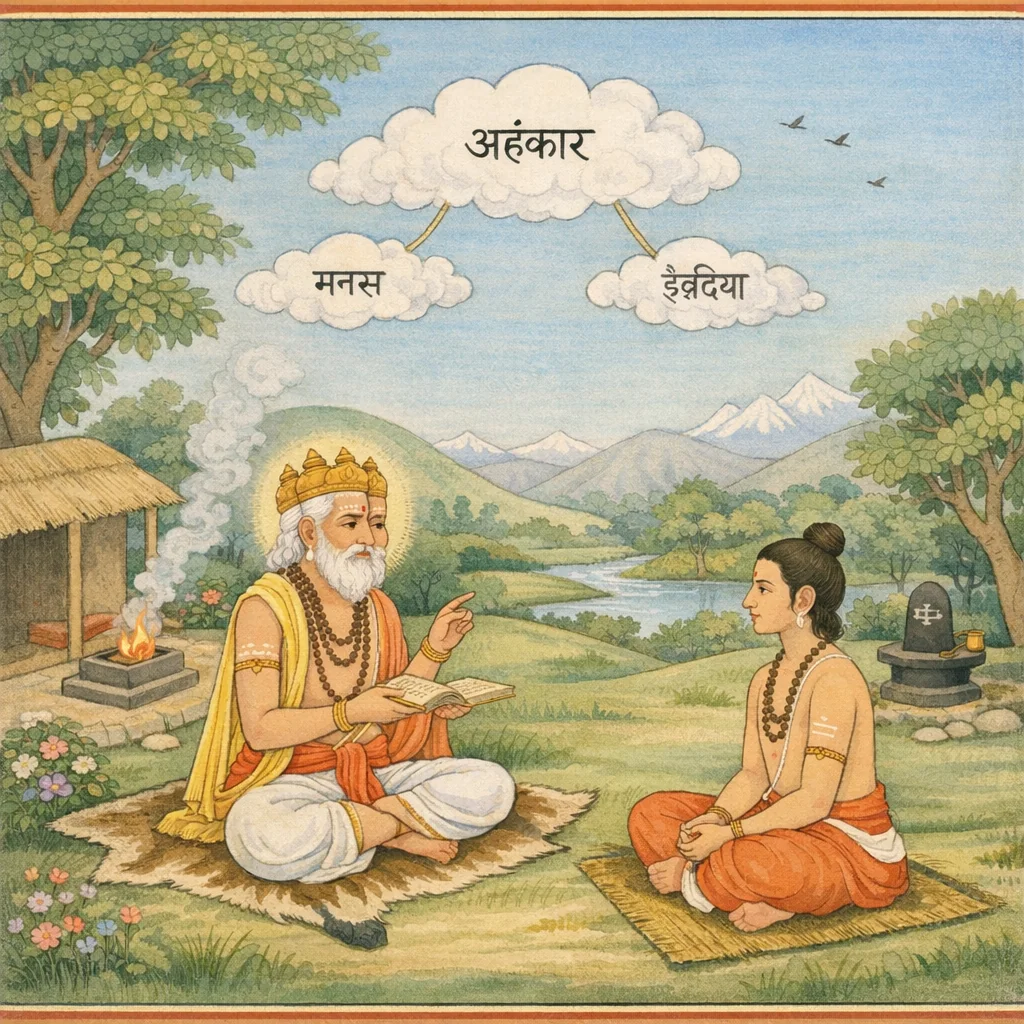
Adhyaya 41
Ahaṃkāra as the Second Creation: Brahmā’s Cosmological Instruction (अहंकार-प्राधान्येन सृष्टिवर्णनम्)
Upa-parva: Āśvamedha-anuśāsana (Cosmological and Ritual Instruction Segment)
This chapter is a compact cosmological exposition attributed to Brahmā. It identifies the emergence of a ‘great primordial ahaṃkāra’ as a decisive generative moment, described as a second creation (dvitīyaḥ sargaḥ) arising with the notion “I” (aham). Ahaṃkāra is characterized as bhūtādi (a source-principle for elements/creatures) and as vaikārika (transformative/modifying), with tejas (radiant potency) and cetanā-dhātu (a substrate of sentience) associated with its operative energy. The discourse links this principle to the origination of devas and to the formation of mind, portraying it as an ‘abhimantṛ’—the appropriator that claims phenomena as “mine/I,” thereby enabling differentiated activity. The chapter also delineates an enduring locus (sanātana loka) for sages devoted to adhyātma-jñāna, self-cultivation, and disciplined study (svādhyāya), suggesting a soteriological horizon parallel to cosmogenesis. The concluding verse highlights ahaṃkāra’s role in ‘drawing forth’ guṇas and generating the moving world, animating all processes by its own tejas.
Chapter Arc: गुरु-शिष्य संवाद में ब्रह्मा ‘महान् पूर्व-अहंकार’ की उत्पत्ति का उद्घोष करते हैं—‘अहम्’ की पहली तरंग कैसे समस्त सृष्टि-व्यवस्था का बीज बनती है। → अहंकार के नाम-रूप और कार्य-कारण का विस्तार होता है: वह ‘भूतादि’ (भूत-विकारों का आदि कारण) है, ‘वैकारिक’ (विकार-प्रवर्तक) है, ‘तैजस’ (रजोगुण-प्रेरित तेज) है, और चेतन आत्मा को आधार बनाकर प्रजासर्ग को चलाता है। → निर्णायक प्रतिपादन: अहंकार ही इन्द्रियों (श्रोत्रादि) और मन का उत्पत्ति-स्थान है, स्वयं देवस्वरूप होकर त्रिलोकी का कर्ता-सा प्रतीत होता है; अपने तेज से जगत को रंजित/प्रेरित कर समस्त चेष्टाओं को गतिमान करता है। → अध्याय अहंकार के स्वरूप को एक सृष्टि-यंत्र के रूप में स्थिर करता है—गुणों को ग्रहण कर भूतों की रचना कराने वाला, मन-इन्द्रियों का मूल, और जगत-व्यवहार का प्रवर्तक—जिससे शिष्य के लिए ‘मैं’ की पहचान और उसके प्रभाव का बोध स्पष्ट हो जाता है। → अहंकार के उद्गम और विश्व-व्यापार में उसकी सत्ता स्थापित होने के बाद अगला स्वाभाविक प्रश्न उभरता है—इस ‘अहम्’ से परे आत्म-स्थित होने का उपाय क्या है?
Shlokas
Verse 1
भस्न्ैमा रन () अमसन- एकचत्वारिशो< ध्याय: अहंकारकी उत्पत्ति और उसके स्वरूपका वर्णन ब्रह्मोवाच य उत्पन्नो महान् पूर्वमहंकार: स उच्यते । अहमित्येव सम्भूतो द्वितीय: सर्ग उच्यते,ब्रह्माजीने कहा--महर्षियो! जो पहले महत्तत्त्व उत्पन्न हुआ था, वही अहंकार कहा जाता है। जब वह अहंरूपमें प्रादुर्भूत होता है, तब वह दूसरा सर्ग कहलाता है
Brahmā said: “O great seers, that primordial ‘Mahān’ (the Great Principle) which first arose is what is called ahaṃkāra (the ego-principle). When it manifests specifically as the sense of ‘I’—as ‘aham’—that emergence is described as the second creation.”
Verse 2
अहंकारश्न भूतादिवैंकारिक इति स्मृत: । तेजसश्नैतना धातु: प्रजासर्ग: प्रजापति:
Vāyu-deva said: “Ahaṅkāra (the principle of ‘I’-sense) is remembered as the vaikarika source from which the elements and their modifications proceed. From tejas (the fiery principle) arises the dhātu called ‘cetanā’ (sentience/animation); and Prajāpati is the agent of the creation of beings.”
Verse 3
यह अहंकार भूतादि विकारोंका कारण है, इसलिये वैकारिक माना गया है। यह रजोगुणका स्वरूप है, इसलिये तैजस् है। इसका आधार चेतन आत्मा है। सारी प्रजाकी सृष्टि इसीसे होती है, इसलिये इसको प्रजापति कहते हैं ।। देवानां प्रभवों देवो मनसश्न त्रिलोककृत् । अहमित्येव तत्सर्वमभिमन्ता स उच्यते
Vāyu said: Ahaṃkāra is deemed vaikarika because it is the cause of the elements and their modifications. It is of the nature of rajas, and thus is called taijas; its support is the sentient Self. From it arises the creation of all beings, and therefore it is called Prajāpati. He is the divine source from whom even the gods arise—the lord of the mind and the maker of the three worlds. Because he appropriates everything with the notion “I,” claiming all as “mine” and “myself,” he is called the principle of I-sense, ahaṃkāra.
Verse 4
यह श्रोत्रादि इन्द्रियरूप देवोंका और मनका उत्पत्ति-स्थान एवं स्वयं भी देवस्वरूप है, इसलिये इसे त्रिलोकीका कर्त्ता माना गया है। यह सम्पूर्ण जगत् अहंकारस्वरूप है, इसलिये यह अभिमन्ता कहा जाता है ।। अध्यात्मज्ञानतृप्तानां मुनीनां भावितात्मनाम् | स्वाध्यायक्रतुसिद्धानामेष लोक: सनातन:,जो अध्यात्मज्ञानमें तृप्त, आत्माका चिन्तन करनेवाले और स्वाध्यायरूपी यज्ञमें सिद्ध हैं, उन मुनिजनोंको यह सनातन लोक प्राप्त होता है
Vāyu said: For sages who are satisfied through inner spiritual knowledge, who have disciplined and contemplated the Self, and who have attained perfection through the sacrifice that is sacred study, this is the eternal realm that becomes their destined attainment.
Verse 5
अहंकारेणाहरतो गुणानिमान् भूतादिरेवं सृूजते स भूतकृत् वैकारिक: सर्वमिदं विचेष्टते स्वतेजसा रज्जयते जगत् तथा,समस्त भूतोंका आदि और सबको उत्पन्न करनेवाला वह अहंकारका आधारभूत जीवात्मा अहंकारके द्वारा सम्पूर्ण गुणोंकी रचना करता है और उनका उपभोग करता है। यह जो कुछ भी चेष्टाशील जगत् है, वह विकारोंके कारणरूप अहंकारका ही स्वरूप है। वह अहंकार ही अपने तेजसे सारे जगत्को रजोमय (भोगोंका इच्छुक) बनाता है
Vāyu said: “The self, taking support in egoity (ahaṅkāra), fashions these very guṇas and then appropriates them for experience. That maker of beings—beginning with the elements—brings forth creation in this way. Indeed, all this moving, striving world is but the form of that ego-principle as the cause of modifications; and by its own potency it tinges the whole universe with rajas, driving it toward desire and enjoyment.”
Verse 40
इस प्रकार श्रीमह्ाभारत आश्वमेधिकपव॑के अन्तर्गत अनुगीतापर्वनें गुरु-शिष्य- संवादविषयक चालीसवाँ अध्याय पूरा हुआ
Thus, in the Śrī Mahābhārata, within the Aśvamedhika Parva, the fortieth chapter of the Anugītā section—concerning the dialogue between teacher and disciple—comes to its conclusion. This closing formula marks the completion of a unit of instruction, emphasizing the transmission of dharma through disciplined teaching and attentive listening.
Verse 41
इति श्रीमहाभारते आश्वमेधिके पर्वणि अनुगीतापर्वणि गुरुशिष्यसंवादे एकचत्वारिंशो5 ध्याय:,इस प्रकार श्रीमह्याभारत आश्वमेधिकपर्वके अन्तर्गत अनुगीतापर्वमें गुरु-शिष्य- संवादविषयक इकतालीसवाँ अध्याय पूरा हुआ
Thus, in the Śrī Mahābhārata, within the Āśvamedhika Parva—specifically in the Anugītā section—ends the forty-first chapter, presented as a dialogue between teacher and disciple. This closing colophon marks the completion of that unit of instruction, framing the preceding discourse as a structured transmission of ethical and spiritual guidance.
Frequently Asked Questions
It addresses the mechanism by which undifferentiated reality becomes experienced as personal agency—how the rise of “I” (ahaṃkāra) enables appropriation, differentiation, and the ensuing chain of action within the world.
The teaching locates worldly activity in the dynamics of self-sense: understanding ahaṃkāra and its interaction with guṇas clarifies how cognition and action arise, while adhyātma-jñāna and disciplined practice orient the practitioner toward a stable, non-transient aim.
No explicit phalaśruti formula is stated in these verses; the implied meta-commentary is structural—by contrasting cosmogenic activity with the ‘sanātana’ locus of realized sages, it suggests the soteriological value of insight into ahaṃkāra for liberation-oriented understanding.