Adhyaya 86
ध्यानयज्ञः, संसार-विष-निरूपणम्, पाशुपतयोगः, परा-अपरा विद्या, चतुर्वस्था-विचारः (अध्यायः ८६)
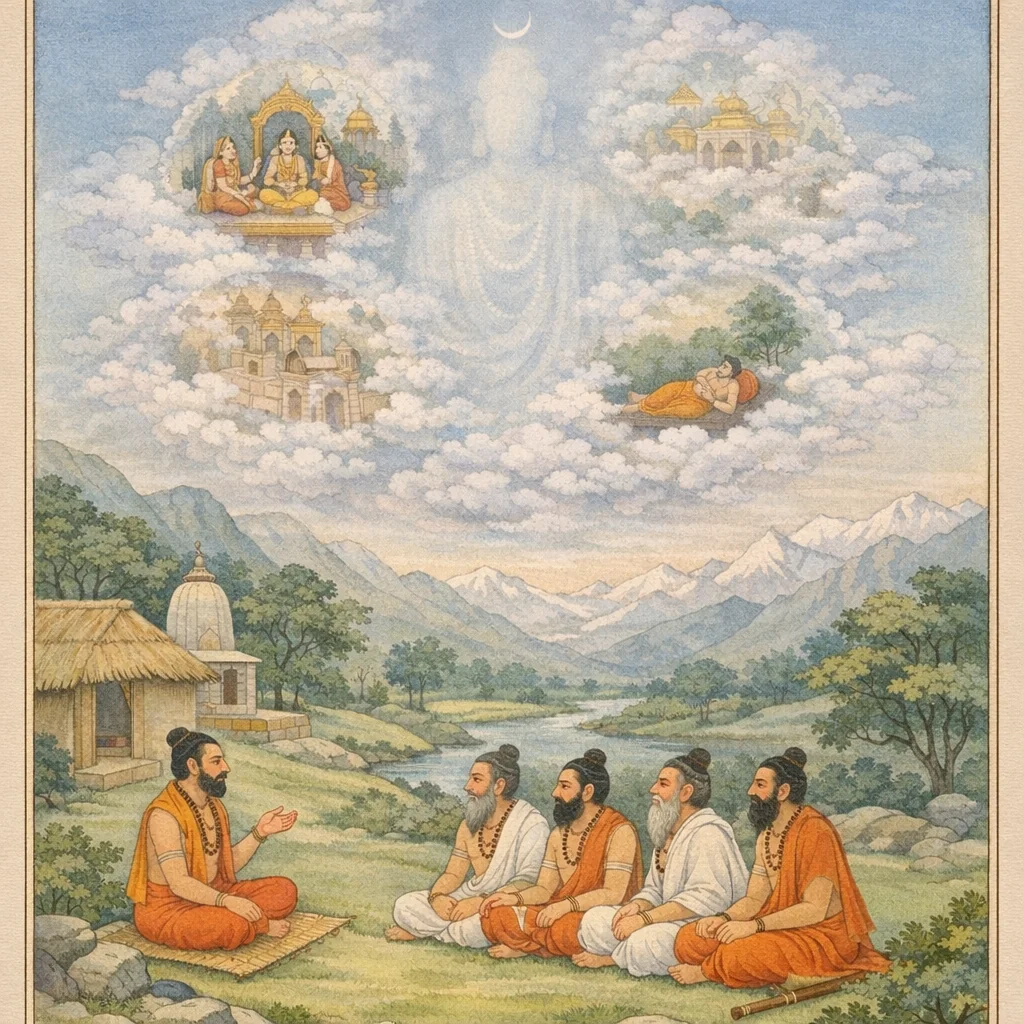
In response to the Ṛṣis, Sūta conveys Śiva’s teaching that the true “poison” is saṃsāra, sustained by ignorance, desire, and karmic embodiment. The chapter surveys duḥkha as universal—from womb-life and human stages to animal existence, political struggle, rivalry in deva-loka, and even the impermanence of svarga—thus establishing vairāgya. It then turns to the way out: Pāśupata-vrata and yoga grounded in pañcārtha-jñāna, declaring that jñāna alone burns sin and severs karma. A parā/aparā vidyā framework follows, leading into yogic inwardness: the heart-lotus, nāḍīs and prāṇas, and the four states (jāgrat, svapna, suṣupti, turīya), culminating in Śiva as turīyātīta and the antar-yāmin. Meditation is detailed with ethical restraints (ahiṃsā, satya, brahmacarya, aparigraha) and element–deity contemplations mapping bhūta-tattva to Śiva’s forms. The chapter concludes that jñāna-dhyāna is the sole remedy for saṃsāra and promises brahma-sāyujya to those who study or hear this teaching, preparing for later Śaiva praxis and Pañcākṣara-centered mantra contemplation.
Shlokas
Verse 1
इति श्रीलिङ्गमहापुराणे पूर्वभागे पञ्चाक्षरमाहात्म्यं नाम पञ्चाशीतितमो ऽध्यायः ऋषय ऊचुः जपाच्छ्रेष्ठतमं प्राहुर् ब्राह्मणा दग्धकिल्बिषाः विरक्तानां प्रबुद्धानां ध्यानयज्ञं सुशोभनम्
Thus, in the Śrī Liṅga Mahāpurāṇa (Pūrvabhāga), the eighty‑sixth chapter called “The Greatness of the Five‑Syllable Mantra.” The sages said: “Brahmins whose sins have been burned away declare japa to be the highest practice. For the detached and awakened, the sacrifice that is meditation (dhyāna‑yajña) shines as the most auspicious worship.”
Verse 2
तस्माद्वदस्व सूताद्य ध्यानयज्ञमशेषतः विस्तारात्सर्वयत्नेन विरक्तानां महात्मनाम्
Therefore, O Sūta, speak now—completely and in full detail—about the sacrificial worship that is meditation (dhyāna‑yajña), with every care, for those great‑souled renunciants who are free from attachment.
Verse 3
तेषां तद्वचनं श्रुत्वा मुनीनां दीर्घसत्त्रिणाम् रुद्रेण कथितं प्राह गुहां प्राप्य महात्मनाम्
Having heard the words of those sages who had long performed sacrificial rites, he reached the cave of the great‑souled ones and spoke what Rudra had declared, conveying Śiva’s teaching as the means by which the bound paśu (soul) turns toward Pati (the Lord).
Verse 4
संहृत्य कालकूटाख्यं विषं वै विश्वकर्मणा सूत उवाच गुहां प्राप्य सुखासीनं भवान्या सह शङ्करम्
After the poison called Kālakūṭa had been gathered up and contained by Viśvakarman, Sūta said: “Having reached the cave, I beheld Śaṅkara seated in ease, together with Bhavānī.”
Verse 5
मुनयः संशितात्मानः प्रणेमुस्तं गुहाश्रयम् अस्तुवंश् च ततः सर्वे नीलकण्ठमुमापतिम्
The sages, their selves well-disciplined, bowed to the Lord who abides in the cave; then all together they praised Nīlakaṇṭha, the consort of Umā.
Verse 6
अत्युग्रं कालकूटाख्यं संहृतं भगवंस्त्वया अतः प्रतिष्ठितं सर्वं त्वया देव वृषध्वज
O Blessed Lord, by You the exceedingly fierce poison known as Kālakūṭa has been contained. Therefore, O God—Bull-bannered (Vṛṣadhvaja)—by You alone all things have been firmly established and set in order.
Verse 7
तेषां तद्वचनं श्रुत्वा भगवान्नीललोहितः प्रहसन्प्राह विश्वात्मा सनन्दनपुरोगमान्
Hearing their words, the Blessed Lord Nīlalohita—the indwelling Self of the universe—smiled and addressed those led by Sanandana.
Verse 8
किमनेन द्विजश्रेष्ठा विषं वक्ष्ये सुदारुणम् संहरेत्तद्विषं यस्तु स समर्थो ह्यनेन किम्
“What use is this, O best of the twice-born? I shall speak of a most dreadful poison. Whoever can truly remove and destroy that poison—he alone is capable; what need has he for anything else?”
Verse 9
चुर्से ओफ़् संसार न विषं कालकूटाख्यं संसारो विषमुच्यते तस्मात्सर्वप्रयत्नेन संहरेत सुदारुणम्
The curse of saṃsāra is not the poison called Kālakūṭa; saṃsāra itself is said to be poison. Therefore, with every effort one should destroy this most dreadful bondage, so that the Paśu (the bound soul) may turn toward Pati—Lord Śiva, the Liberating Lord.
Verse 10
संसारो द्विविधः प्रोक्तः स्वाधिकारानुरूपतः पुंसां संमूढचित्तानाम् असंक्षीणः सुदारुणः
Samsara is declared to be of two kinds, in accordance with each person’s spiritual eligibility (adhikāra). For those Paśu whose minds are thoroughly deluded, this worldly round is unexhausted, harsh, and relentless.
Verse 11
ईषणारागदोषेण सर्गो ज्ञानेन सुव्रताः तद्वशादेव सर्वेषां धर्माधर्मौ न संशयः
O you of excellent vows, creation proceeds under the fault of desire and attachment, even though it is grounded in knowledge. Under the sway of that impulse, for all beings, dharma and adharma arise—of this there is no doubt.
Verse 12
असन्निकृष्टे त्वर्थे ऽपि शास्त्रं तच्छ्रवणात्सताम् बुद्धिमुत्पादयत्येव संसारे विदुषां द्विजाः
Even when its meaning is not immediately grasped, the Śāstra—when heard—surely generates right understanding in the hearts of the good. In this world, O learned twice-born, it awakens discerning intelligence in the wise.
Verse 13
तस्माद्दृष्टानुश्रविकं दुष्टमित्युभयात्मकम् संत्यजेत्सर्वयत्नेन विरक्तः सो ऽभिधीयते
Therefore, knowing both the seen (worldly enjoyments) and the heard-of (heaven-promising rewards) to be flawed—of a dual nature—one should abandon them with every effort. Such a person is called truly dispassionate (virakta), fit to turn from paśa (bondage) toward Pati, Lord Śiva.
Verse 14
शास्त्रमित्युच्यते भागं श्रुतेः कर्मसु तद्द्विजाः मूर्धानं ब्रह्मणः सारम् ऋषीणां कर्मणः फलम्
O twice-born ones, that portion of Śruti which pertains to ritual action is called Śāstra. It is the crown of Brahman-knowledge, the essence distilled by the seers, and the ripened fruit of their disciplined sacred deeds.
Verse 15
ननु स्वभावः सर्वेषां कामो दृष्टो न चान्यथा श्रुतिः प्रवर्तिका तेषाम् इति कर्मण्यतद्विदः
Surely, kāma—desire—is seen as the natural disposition of all beings, and it is not otherwise. Therefore the Vedic revelation, Śruti, serves as an impeller for them—so think those who do not truly understand the principle of karma.
Verse 16
निवृत्तिलक्षणो धर्मः समर्थानाम् इहोच्यते तस्मादज्ञानमूलो हि संसारः सर्वदेहिनाम्
Here, for those who are capable, dharma marked by nivṛtti—turning back from worldly engagement—is taught. Therefore, for all embodied paśu, saṃsāra is indeed rooted in ajñāna, ignorance.
Verse 17
कला संशोषमायाति कर्मणान्यस्वभावतः सकलस्त्रिविधो जीवो ज्ञानहीनस्त्वविद्यया
Through karma, and contrary to its own true nature, the soul’s innate power, kalā, becomes dried up. Thus the embodied jīva—threefold in its conditioned modes—remains bereft of right knowledge because of avidyā, ignorance.
Verse 18
नारकी पापकृत्स्वर्गी पुण्यकृत् पुण्यगौरवात् व्यतिमिश्रेण वै जीवश् चतुर्धा संव्यवस्थितः
The bound soul, paśu, becomes hell-bound by committing sin and heaven-bound by performing merit—according to the predominance and weight of its puṇya. Thus, through the mixture of puṇya and pāpa, the jīva is established in a fourfold condition of destiny.
Verse 19
उद्भिज्जः स्वेदजश्चैव अण्डजो वै जरायुजः एवं व्यवस्थितो देही कर्मणाज्ञो ह्यनिर्वृतः
The embodied soul (paśu) is classified as born from sprouts, from sweat, from eggs, and from the womb. Thus established in embodiment, it remains ignorant through karma and does not attain true quiescence (nirvṛti)—until it turns toward the Lord (Pati), Śiva, who severs the bond (pāśa).
Verse 20
प्रजया कर्मणा मुक्तिर् धनेन च सतां न हि त्यागेनैकेन मुक्तिः स्यात् तदभावाद्भ्रमत्यसौ
Liberation is not attained by progeny, nor by ritual action, nor by wealth—even for the virtuous. Nor does liberation arise from renunciation alone; lacking true knowledge and Śiva-realization, the soul (paśu) merely wanders in delusion.
Verse 21
एवेर्य्थिन्ग् इस् दुःख एवमज्ञानदोषेण नानाकर्मवशेन च षट्कौशिकं समुद्भूतं भजत्येष कलेवरम्
Thus, everything is suffering indeed. Through the fault of ignorance (ajñāna) and under the compulsion of diverse karmas, the bound soul (paśu) takes on this body, arisen from the six sheaths (ṣaṭ-kauśika), as a consequence of bondage (pāśa).
Verse 22
गर्भे दुःखान्यनेकानि योनिमार्गे च भूतले कौमारे यौवने चैव वार्द्धके मरणे ऽपि वा
In the womb there are many sufferings; and again in the passage through the birth-canal and upon the earth. In childhood, in youth, in old age, and even at the time of dying—suffering persists. Thus the bound soul (paśu), fettered by the bonds (pāśa) of embodiment, wanders in saṃsāra until it turns to the Lord (Pati), Śiva.
Verse 23
विचारतः सतां दुःखं स्त्रीसंसर्गादिभिर् द्विजाः दुःखेनैकेन वै दुःखं प्रशाम्यतीह दुःखिनः
O twice-born ones, by discernment the noble recognize the suffering that arises from attachment—beginning with entanglement in sensual company. Here, for the afflicted soul (paśu), one sorrow is quelled only by another sorrow, until dispassion (vairāgya) awakens and the bonds (pāśa) begin to fall away under the Lord (Pati).
Verse 24
न जातु कामः कामानाम् उपभोगेन शाम्यति हविषा कृष्णवर्त्मेव भूय एवाभिवर्धते
Desire is never quenched by the enjoyment of desired objects; like a fire fed with oblations, it only grows all the more. Therefore the paśu (bound soul) should restrain kāma through vairāgya and turn the mind toward Pati—Lord Śiva—who alone severs the pāśa (bondage).
Verse 25
तस्माद्विचारतो नास्ति संयोगादपि वै नृणाम् अर्थानाम् अर्जने ऽप्येवं पालने च व्यये तथा
Therefore, upon reflection, there is no true certainty for human beings—even when circumstances seem favorable—regarding wealth: whether in acquiring it, in protecting it, or likewise in spending it. Hence the paśu (bound soul) should not cling to artha as though it were stable, but seek refuge in the Lord (Pati) who alone is unwavering.
Verse 26
पैशाचे राक्षसे दुःखं याक्षे चैव विचारतः गान्धर्वे च तथा चान्द्रे सौम्यलोके द्विजोत्तमाः
In the Paiśāca and Rākṣasa realms there is suffering; and in the Yakṣa realm too, upon reflection, it is so. In the Gandharva and likewise in the lunar (Cāndra) world it is the same; but in the gentle Saumya-loka, O best of the twice-born, the condition is more auspicious.
Verse 27
प्राजापत्ये तथा ब्राह्मे प्राकृते पौरुषे तथा क्षयसातिशयाद्यैस्तु दुःखैर्दुःखानि सुव्रताः
In the Prajāpatya realm, and likewise in the Brahmā-world; in the Prākṛta (material) condition and also in the Pauruṣa (individualized) state—O you of noble vows—sufferings arise through pains such as loss and excess, and thus sorrow begets further sorrow.
Verse 28
तानि भाग्यान्यशुद्धानि संत्यजेच्च धनानि च तस्मादष्टगुणं भोगं तथा षोडशधा स्थितम्
Therefore, one should renounce those impure fortunes and the wealth born of them. From such purified, dharmic conduct, enjoyment becomes eightfold and is indeed established in sixteen graded modes—refined and ordered—under the discipline that leads the paśu away from pāśa and toward the Lord (Pati), Śiva.
Verse 29
चतुर्विंशत्प्रकारेण संस्थितं चापि सुव्रताः द्वात्रिंशद्भेदमनघाश् चत्वारिंशद्गुणं पुनः
O you of noble vows and stainless conduct, the Liṅga is established in twenty-four modes; it is further spoken of as having thirty-two distinct varieties, and again as possessing forty qualities.
Verse 30
तथाष्टचत्वारिंशच्च षट्पञ्चाशत्प्रकारतः चतुःषष्टिविधं चैव दुःखमेव विवेकिनः
Thus, the discerning speak of suffering (duḥkha) as forty-eight kinds, and also as fifty-six in its modes; indeed it is further understood as sixty-fourfold—seen through viveka, it is nothing but duḥkha that binds the paśu under pāśa until refuge is taken in Pati, Śiva.
Verse 31
पार्थिवं च तथाप्यं च तैजसं च विचारतः वायव्यं च तथा व्यौम[ं] मानसं च यथाक्रमम्
One should understand, with due discernment, the Liṅga as of earth, of water, of fire, of wind, and of ether—and likewise as mental—each in its proper order.
Verse 32
आभिमानिकमप्येवं बौद्धं प्राकृतमेव च दुःखमेव न संदेहो योगिनां ब्रह्मवादिनाम्
Thus, even the path rooted in ego-sense (ahaṃkāra), as well as the Buddhist and merely worldly (prākṛta) outlooks, are nothing but suffering—of this there is no doubt—for Yogins and for those who uphold Brahman, the Supreme Reality.
Verse 33
गौणं गणेश्वराणां च दुःखमेव विचारतः आदौ मध्ये तथा चान्ते सर्वलोकेषु सर्वदा
On careful reflection, even the secondary (worldly) status of Śiva’s Gaṇeśvaras is marked only by suffering—at the beginning, in the middle, and at the end—indeed in all worlds, at all times.
Verse 34
वर्तमानानि दुःखानि भविष्याणि यथातथम् दोषदुष्टेषु देशेषु दुःखानि विविधानि च
The sufferings that are present, and those yet to come—just as they truly are—arise in lands corrupted by faults; and there, manifold forms of misery prevail.
Verse 35
न भावयन्त्यतीतानि ह्य् अज्ञाने ज्ञानमानिनः क्षुद्व्याधेः परिहारार्थं न सुखायान्नमुच्यते
Those who are truly ignorant yet fancy themselves as knowers do not reflect upon what has gone before. Food is spoken of not as a pleasure, but as a means to ward off the disease of hunger.
Verse 36
यथेतरेषां रोगाणाम् औषधं न सुखाय तत् शीतोष्णवातवर्षाद्यैस् तत्तत्कालेषु देहिनाम्
Just as medicine meant for other diseases is not for pleasure, so too—amid cold, heat, wind, rain, and the like—each embodied being must apply what is appropriate to that particular season and time. (So also in Śiva’s path: discipline and worship bear fruit only when aligned with fitness, place, and proper occasion.)
Verse 37
दुःखमेव न संदेहो न जानन्ति ह्यपण्डिताः स्वर्गे ऽप्येवं मुनिश्रेष्ठा ह्य् अविशुद्धक्षयादिभिः
Indeed, it is suffering alone—there is no doubt. The unlearned do not recognize this. O best of sages, even in heaven it is so, because of factors such as impurity and the wearing away of merit.
Verse 38
रोगैर् नानाविधैर् ग्रस्ता रागद्वेषभयादिभिः छिन्नमूलतरुर्यद्वद् अवशः पतति क्षितौ
Overpowered by many kinds of diseases—and by attachment, aversion, fear, and the like—the bound soul falls helplessly to the earth, just as a tree whose roots have been cut collapses to the ground.
Verse 39
पुण्यवृक्षक्षयात्तद्वद् गां पतन्ति दिवौकसः दुःखाभिलाषनिष्ठानां दुःखभोगादिसंपदाम्
When the “tree of merit” is exhausted, even the dwellers of heaven likewise fall down to the earth. For those fixed in craving and in choosing suffering, their so‑called “prosperity” is nothing but experiences such as the enjoyment of pain and its consequences.
Verse 40
अस्मात्तु पततां दुःखं कष्टं स्वर्गाद्दिवौकसाम् नरके दुःखमेवात्र नरकाणां निषेवणात्
But for those who fall from that state, the suffering is grievous—painful indeed for the dwellers of Svarga when they descend. And in Naraka, suffering alone is experienced here, for it arises from abiding in the hell-realms as the fruit of one’s own karma.
Verse 41
विहिताकरणाच्चैव वर्णिनां मुनिपुङ्गवाः
And by the very non-performance of what is enjoined in the Vedic discipline, O best of sages, the people of the varṇas fall into deviation—thereby strengthening the bonds (pāśa) that obstruct the paśu (soul) from turning toward Pati, Lord Śiva.
Verse 42
यथा मृगो मृत्युभयस्य भीत उच्छिन्नवासो न लभेत निद्राम् एवं यतिर्ध्यानपरो महात्मा संसारभीतो न लभेत निद्राम्
Just as a deer, terrified by the fear of death, with its shelter and safety cut off, cannot find sleep—so too the great-souled renunciant (yati), devoted to meditation (dhyāna), frightened of saṃsāra, cannot find sleep.
Verse 43
कीटपक्षिमृगाणां च पशूनां गजवाजिनाम् दृष्टम् एवासुखं तस्मात् त्यजतः सुखमुत्तमम्
In insects, birds, deer and other beasts—indeed even in elephants and horses—this has been plainly seen: worldly enjoyment culminates in suffering. Therefore, for one who abandons such pleasures, the highest happiness arises—the bliss born of turning the paśu away from pāśa and toward Pati, Lord Śiva.
Verse 44
वैमानिकानामप्येवं दुःखं कल्पाधिकारिणाम् स्थानाभिमानिनां चैव मन्वादीनां च सुव्रताः
O you of excellent vows, thus even the Vaimānikas—celestial beings who roam the heavenly mansions—suffer; so too those who hold authority over a Kalpa, and those who take pride in their appointed stations—even the Manus and the rest. When the cosmic cycle turns, every status is bound to sorrow.
Verse 45
देवानां चैव दैत्यानाम् अन्योन्यविजिगीषया दुःखमेव नृपाणां च राक्षसानां जगत्त्रये
Through the mutual craving to conquer one another, there arises only suffering—for the Devas and the Daityas alike, and for kings and Rakshasas as well—throughout the three worlds.
Verse 46
श्रमार्थमाश्रमश्चापि वर्णानां परमार्थतः आश्रमैर्न च देवैश् च यज्ञैः सांख्यैर्व्रतैस् तथा
The āśramas are instituted for disciplined striving, and the varṇas too, in their ultimate intent. Yet the Supreme Reality is not attained merely by āśrama-observances, nor by worship of the gods, nor by sacrifices, nor by Sāṅkhya analysis, nor even by vows—when these are divorced from the direct turning toward Pati, Śiva.
Verse 47
उग्रैस्तपोभिर् विविधैर् दानैर्नानाविधैरपि न लभन्ते तथात्मानं लभन्ते ज्ञानिनः स्वयम्
By fierce austerities of many kinds, and by charities of diverse sorts as well, one does not attain the Self in that direct way; the knowers of Truth, through wisdom itself, realize the Self by their own inner awakening.
Verse 48
पाशुपतव्रत अस् एस्चपे फ़्रोम् संसार तस्मात्सर्वप्रयत्नेन चरेत्पाशुपतव्रतम् भस्मशायी भवेन्नित्यं व्रते पाशुपते बुधः
The Pāśupata-vrata is a means of escape from saṃsāra; therefore, with every effort one should undertake the Pāśupata discipline. In that Pāśupata observance, the wise aspirant should ever abide in sacred ash (bhasma)—making it a constant support—so that the paśu (bound soul) may move toward Pati’s grace and freedom from pāśa (bondage).
Verse 49
पञ्चार्थज्ञानसम्पन्नः शिवतत्त्वे समाहितः कैवल्यकरणं योगविधिकर्मच्छिदं बुधः
The wise one—endowed with knowledge of the fivefold principles (pañcārtha) and absorbed in the reality of Śiva—cuts off karma through the ordained discipline of Yoga, thereby bringing about kaivalya, absolute liberation.
Verse 50
पञ्चार्थयोगसम्पन्नो दुःखान्तं व्रजते सुधीः परया विद्यया वेद्यं विदन्त्यपरया न हि
The wise one, endowed with the Yoga of the five categories (pañcārtha), reaches the end of suffering. For the Knowable—the Supreme Pati, Śiva—is truly known by the higher knowledge (parā-vidyā), and not by the lower knowledge (aparā-vidyā).
Verse 51
द्वे विद्ये वेदितव्ये हि परा चैवापरा तथा अपरा तत्र ऋग्वेदो यजुर्वेदो द्विजोत्तमाः
O best of the twice-born, two kinds of knowledge are indeed to be known—the higher (parā) and the lower (aparā). Among these, the lower knowledge consists of the Ṛgveda and the Yajurveda (and the Vedic disciplines allied to them).
Verse 52
सामवेदस्तथाथर्वो वेदः सर्वार्थसाधकः शिक्षा कल्पो व्याकरणं निरुक्तं छन्द एव च
The Sāma Veda and likewise the Atharva Veda—these Vedas accomplish every sacred purpose. And the auxiliary disciplines too: Śikṣā (phonetics), Kalpa (ritual procedure), Vyākaraṇa (grammar), Nirukta (etymology), and Chandas (metrics).
Verse 53
ज्योतिषं चापरा विद्या पराक्षरमिति स्थितम् तददृश्यं तदग्राह्यम् अगोत्रं तदवर्णकम्
Astrology (Jyotiṣa) is counted as the lower knowledge (aparā-vidyā); but the Supreme Imperishable, Parākṣara, stands apart. That Reality is unseen and cannot be grasped; it belongs to no lineage and admits of no defining description—thus is the nature of Pati, Śiva, beyond all pāśa-bound categories.
Verse 54
तदचक्षुस्तदश्रोत्रं तदपाणि अपादकम् तदजातमभूतं च तदशब्दं द्विजोत्तमाः
O best of the twice-born, That Supreme Pati—Śiva—is without eyes and without ears; without hands and without feet; unborn and not a product of becoming; and beyond sound, transcending all marks of the senses.
Verse 55
अस्पर्शं तदरूपं च रसगन्धविवर्जितम् अव्ययं चाप्रतिष्ठं च तन्नित्यं सर्वगं विभुम्
He is beyond touch and beyond form, devoid of taste and smell; imperishable and without any fixed support—eternal, all-pervading, the sovereign Lord (Vibhu), the supreme Pati who transcends the senses.
Verse 56
महान्तं तद् बृहन्तं च तदजं चिन्मयं द्विजाः अप्राणममनस्कं च तदस्निग्धमलोहितम्
O twice-born ones, That is the Great and the Vast; unborn and made of pure Consciousness (cinmaya). It is without vital breath and without mind—unclinging, and free from all redness: passion, blood, and material coloration.
Verse 57
अप्रमेयं तदस्थूलम् अदीर्घं तदनुल्बणम् अह्रस्वं तदपारं च तदानन्दं तदच्युतम्
That Supreme Pati, Lord Śiva, is immeasurable—neither gross nor extended; neither excessive nor deficient; neither short nor bounded. He is of the nature of bliss (ānanda), and He is Acyuta, the imperishable and unfailing One.
Verse 58
अनपावृतमद्वैतं तदनन्तमगोचरम् असंवृतं तदात्मैकं परा विद्या न चान्यथा
Supreme Knowledge is that Reality which is unobscured and non-dual (advaita)—endless and beyond the reach of the senses; unveiled, and one with the Self (Ātman). This alone is the higher wisdom, and nothing else.
Verse 59
परापरेति कथिते नैवेह परमार्थतः अहमेव जगत्सर्वं मय्येव सकलं जगत्
When one speaks here of the “higher” and the “lower,” in the ultimate truth there is no such division. I alone am this entire universe, and in Me alone this whole cosmos abides.
Verse 60
मत्त उत्पद्यते तिष्ठन् मयि मय्येव लीयते मत्तो नान्यदितीक्षेत मनोवाक्पाणिभिस् तथा
From Me it is born; sustained, it abides; and in Me alone it dissolves. Therefore one should recognize no other reality apart from Me—by mind, by speech, and by the actions of the hands as well.
Verse 61
सर्वमात्मनि संपश्येत् सच्चासच्च समाहितः सर्वं ह्यात्मनि संपश्यन् न बाह्ये कुरुते मनः
Collected in contemplation, one should behold everything within the Self—both the manifest (sat) and the unmanifest (asat). For when one truly sees all in the Self, the mind no longer runs outward toward external objects.
Verse 62
४ स्ततेस् ओफ़् मिन्द् अधोदृष्ट्या वितस्त्यां तु नाभ्यामुपरितिष्ठति हृदयं तद्विजानीयाद् विश्वस्यायतनं महत्
With the gaze directed downward, one should know the Heart that abides a span above the navel. That Heart is to be understood as the great abode of the universe—where Pati (Śiva) is realized within the pashu when the pasha of distraction is stilled.
Verse 63
हृदयस्यास्य मध्ये तु पुण्डरीकमवस्थितम् धर्मकन्दसमुद्भूतं ज्ञाननालं सुशोभनम्
In the very center of this heart there abides a lotus. Born from the root-bulb of dharma, its radiant stalk is knowledge (jñāna)—shining beautifully (as the inner support for contemplation of Pati, Śiva).
Verse 64
ऐश्वर्याष्टदलं श्वेतं परं वैराग्यकर्णिकम् छिद्राणि च दिशो यस्य प्राणाद्याश् च प्रतिष्ठिताः
White is the eight-petalled lotus of divine sovereignty (aiśvarya); its supreme pericarp is dispassion (vairāgya). Its apertures are the directions, and within it the vital currents beginning with prāṇa are firmly established—thus is the Lord’s (Pati’s) inner seat to be contemplated.
Verse 65
प्राणाद्यैश्चैव संयुक्तः पश्यते बहुधा क्रमात् दशप्राणवहा नाड्यः प्रत्येकं मुनिपुङ्गवाः
United with prāṇa and the other vital currents, the yogin perceives in many ways, step by step. O best of sages, in each region (of the subtle body) there are nāḍīs that carry the tenfold prāṇa.
Verse 66
द्विसप्ततिसहस्राणि नाड्यः सम्परिकीर्तिताः नेत्रस्थं जाग्रतं विद्यात् कण्ठे स्वप्नं समादिशेत्
The nāḍīs are declared to be seventy-two thousand in number. Know the waking state (jāgrat) as abiding in the eyes; and the dream state (svapna) is taught as abiding in the throat.
Verse 67
सुषुप्तं हृदयस्थं तु तुरीयं मूर्धनि स्थितम् जाग्रे ब्रह्मा च विष्णुश् च स्वप्ने चैव यथाक्रमात्
Deep sleep (suṣupti) abides in the heart, while the Fourth (turīya) is established at the crown of the head. In the waking state, Brahmā and Viṣṇu are present; and in dream as well—each in due order—according to their respective functions.
Verse 68
ईश्वरस्तु सुषुप्ते तु तुरीये च महेश्वरः वदन्त्य् एवम् अथान्ये ऽपि समस्तकरणैः पुमान्
In deep sleep (suṣupti) He is spoken of as Īśvara; and in the fourth state (turīya) as Maheśvara. Thus do some declare; and others also say that the Person (Puruṣa) is present through the totality of the faculties—all organs and instruments of knowing and acting.
Verse 69
वर्तमानस्तदा तस्य जाग्रदित्यभिधीयते मनोबुद्धिर् अहङ्कारं चित्तं चेति चतुष्टयम्
When the embodied being is engaged with the present outer condition, that state is called “waking” (jāgrat). In it the fourfold inner instrument functions: mind (manas), intellect (buddhi), ego-sense (ahaṅkāra), and citta, the storehouse of impressions.
Verse 70
यदा व्यवस्थितस्त्वेतैः स्वप्न इत्यभिधीयते करणानि विलीनानि यदा स्वात्मनि सुव्रताः
When, through these inner operations, one becomes established in what is called the dream-state—when the instruments of cognition and action dissolve back into one’s own Self—O you of noble vows, that condition is termed svapna (dream).
Verse 71
सुषुप्तः करणैर्भिन्नस् तुरीयः परिकीर्त्यते परस्तुरीयातीतो ऽसौ शिवः परमकारणम्
When one abides in deep sleep (suṣupti), dissociated from the instruments of cognition, that condition is spoken of as the Fourth (turīya). Yet beyond even that Fourth—transcending all states—is Śiva, the Supreme Cause, the Pati who stands apart from pāśa (bondage) and the paśu (bound soul).
Verse 72
जाग्रत्स्वप्नसुषुप्तिश् च तुरीयं चाधिभौतिकम् आध्यात्मिकं च विप्रेन्द्राश् चाधिदैविकमुच्यते
O best of sages, waking, dream, deep sleep, and the fourth (turīya) are taught as adhibhautika, the objective and elemental domain. Likewise, the inner (ādhyātmika) and the divine (ādhidaivika) are also declared as modes of this same threefold reality.
Verse 73
तत्सर्वमहम् एवेति वेदितव्यं विजानता बुद्धीन्द्रियाणि विप्रेन्द्रास् तथा कर्मेन्द्रियाणि च
One who truly knows should understand: “All of that is verily I alone”—both the organs of cognition (buddhīndriyas), O best of Brahmins, and likewise the organs of action (karmendriyas).
Verse 74
मनोबुद्धिर् अहङ्कारश् चित्तं चेति चतुष्टयम् अध्यात्मं पृथगेवेदं चतुर्दशविधं स्मृतम्
Mind, intellect, ego-sense, and citta—the storehouse of mental impressions—this fourfold set is taught as the distinct inner domain (adhyātma); and this adhyātma is remembered as fourteenfold when its inner classification is fully analyzed.
Verse 75
द्रष्टव्यं चैव श्रोतव्यं घ्रातव्यं च यथाक्रमम् रसितव्यं मुनिश्रेष्ठाः स्पर्शितव्यं तथैव च
O best of sages, one should engage the faculties of perception in their proper order—seeing, hearing, and smelling; likewise tasting and touching—so that the senses become disciplined instruments on the Śaiva path, not bonds of pāśa.
Verse 76
मन्तव्यं चैव बोद्धव्यम् अहंकर्तव्यमेव च तथा चेतयितव्यं च वक्तव्यं मुनिपुङ्गवाः
O best of sages, one should duly reflect, truly understand, rightly undertake one’s duties, keep the mind consciously attentive, and then speak—so that the bound soul (paśu) moves toward the Lord (Pati) through disciplined intention and speech.
Verse 77
आदातव्यं च गन्तव्यं विसर्गायितमेव च आनन्दितव्यमित्येते ह्य् अधिभूतमनुक्रमात्
In due sequence within the adhibhūta (the realm of gross, elemental experience) these are to be undertaken: receiving what is to be taken up, proceeding to what is to be reached, releasing/letting go (as in an act of emission), and finally rejoicing, resting in delight.
Verse 78
आदित्यो ऽपि दिशश्चैव पृथिवी वरुणस् तथा वायुश्चन्द्रस् तथा ब्रह्मा रुद्रः क्षेत्रज्ञ एव च
He is also the Sun; the very Directions; the Earth; Varuṇa; the Wind; the Moon; Brahmā; Rudra; and indeed the Kṣetrajña—the indwelling Knower of the field in all beings. Thus the one Pati, Śiva, pervades all deities and all tattvas as their inner Self.
Verse 79
अग्निरिन्द्रस् तथा विष्णुर् मित्रो देवः प्रजापतिः आधिदैविकमेवं हि चतुर्दशविधं क्रमात्
Agni, Indra, Viṣṇu, Mitra, Deva, and Prajāpati—thus, in due sequence, the presiding divine order (ādhidaivika) is taught as fourteenfold. In Shaiva understanding, these are functional governors within māyā, while the Pati, Śiva, remains the transcendent Lord beyond all enumerations.
Verse 80
राज्ञी सुदर्शना चैव जिता सौम्या यथाक्रमम् मोघा रुद्रामृता सत्या मध्यमा च द्विजोत्तमाः
O best of twice-born sages, in due order these are His epithets: the Sovereign (Rājñī), the One of auspicious vision (Sudarśanā), the Ever-Victorious (Jitā), the Gentle and Benevolent (Saumyā), the Unfailing (Moghā), the Rudra-form (Rudrāmṛtā), Amṛtā—the immortal nectar, Satyā—Truth itself, and Madhyamā—the One who abides in the Middle, beyond extremes.
Verse 81
नाडी राशिशुका चैव असुरा चैव कृत्तिका भास्वती नाडयश्चैताश् चतुर्दशनिबन्धनाः
“Nāḍī, Rāśiśukā, Asurā, Kṛttikā, and Bhāsvatī”—these nāḍīs are spoken of as the fourteen ‘bindings’ (nibandhanas) that regulate the cosmic order.
Verse 82
वायवो नाडिमध्यस्था वाहकाश् च चतुर्दश प्राणो व्यानस्त्वपानश् च उदानश् च समानकः
Within the channels (nāḍīs) abide the vital airs; they are the fourteen carriers. They are prāṇa, vyāna, apāna, udāna, and samāna.
Verse 83
वैरम्भश् च तथा मुख्यो ह्य् अन्तर्यामः प्रभञ्जनः कूर्मकश् च तथा श्येनः श्वेतः कृष्णस् तथानिलः
He is Vairambha, and also the Chief; He is the Inner Ruler (Antaryāmin), the mighty Wind that shatters (Prabhañjana). He is Kūrmaka and Śyena; He is the White and the Black, and likewise Anila—the very Breath-Wind. Thus the Lord (Pati), pervading as prāṇa and vāyu, governs the paśu (the bound soul) from within and loosens the pāśas (bonds) through His sovereign power.
Verse 84
नाग इत्येव कथिता वायवश् च चतुर्दश यश्चक्षुःष्वथ द्रष्टव्ये तथादित्ये च सुव्रताः
They are indeed declared to be the Nāgas; and the Vāyavas are said to be fourteen. Those who preside over the eyes and the very act of seeing, and likewise those connected with Āditya (the solar principle)—all are steadfast in their sacred vows.
Verse 85
नाड्यां प्राणे च विज्ञाने त्व् आनन्दे च यथाक्रमम् हृद्याकाशे य एतस्मिन् सर्वस्मिन्नन्तरे परः
In the nāḍīs, in the vital breath (prāṇa), in cognition, and then in bliss—step by step—He who abides in the heart-space (hṛd-ākāśa), the Supreme One, dwells as the Transcendent within all this inner experience.
Verse 86
आत्मा एकश् च चरति तमुपासीत मां प्रभुम् अजरं तमनन्तं च अशोकममृतं ध्रुवम्
The one Self (Ātman) moves through all; therefore one should worship Me, the Lord (Pati)—unaging, endless, sorrowless, deathless, and steadfast.
Verse 87
चतुर्दशविधेष्वेव संचरत्येक एव सः लीयन्ते तानि तत्रैव यदन्यं नास्ति वै द्विजाः
He alone—the one Supreme Pati—moves within the fourteenfold modes of manifestation; and into Him alone they dissolve again, for, O twice-born ones, there exists nothing whatsoever apart from Him.
Verse 88
एक एव हि सर्वज्ञः सर्वेशस्त्वेक एव सः एष सर्वाधिपो देवस् त्व् अन्तर्यामी महाद्युतिः
He alone is truly omniscient; He alone is the Lord of all. This radiant Deva is sovereign over everything—the Antaryāmin, the Inner Ruler abiding within all beings; the supreme Pati who governs all paśus while remaining self-luminous.
Verse 89
उपास्यमानः सर्वस्य सर्वसौख्यः सनातनः उपास्यति न चैवेह सर्वसौख्यं द्विजोत्तमाः
When the Eternal One—Śiva, the Pati who is the very fullness of all bliss—is worshipped by all, He in turn bestows grace worthy of worship; yet in this world, O best of the twice-born, that complete and unbroken bliss is not attained except through His liberating favor.
Verse 90
उपास्यमानो वेदैश् च शास्त्रैर्नानाविधैरपि न वैष वेदशास्त्राणि सर्वज्ञो यास्यति प्रभुः
Though worshipped through the Vedas and through many kinds of śāstras, the Lord—omniscient and supreme—does not become attainable merely by Vedic and scriptural learning.
Verse 91
अस्यैवान्नमिदं सर्वं न सो ऽन्नं भवति स्वयम् स्वात्मना रक्षितं चाद्याद् अन्नभूतं न कुत्रचित्
All this is indeed His food; yet He Himself does not become ‘food’ for another. Guarded by His own Self, He may partake of what has become food, but nowhere does He ever become an object to be consumed.
Verse 92
सर्वत्र प्राणिनामन्नं प्राणिनां ग्रन्थिरस्म्यहम् प्रशास्ता नयनश्चैव पञ्चात्मा स विभागशः
“Everywhere, I am the food that sustains living beings; I am also the vital knot within beings (the binding point of embodied life). I am the inner ruler who governs, and I am the seeing power as well. In differentiated manifestation, that Lord is fivefold in essence.”
Verse 93
अन्नमयो ऽसौ भूतात्मा चाद्यते ह्यन्नमुच्यते प्राणमयश्चेन्द्रियात्मा संकल्पात्मा मनोमयः
This embodied self is called ‘annamaya’ (made of food), for it is sustained by food and is itself spoken of as food. It is also ‘prāṇamaya’ (made of vital breath) as the life-force, ‘indriyātmā’ as the power of perception and action, and ‘manomaya’ (made of mind) as the inner self whose very nature is saṅkalpa—volition and intention.
Verse 94
कालात्मा सोम एवेह विज्ञानमय उच्यते सदानन्दमयो भूत्वा महेशः परमेश्वरः
Here, Soma—whose very Self is Time—is declared to be of the nature of higher consciousness (vijñāna). Becoming the embodiment of eternal bliss, He is Mahesha, the Supreme Lord (Parameśvara).
Verse 95
सो ऽहम् एवं जगत्सर्वं मय्येव सकलं स्थितम् परतन्त्रं स्वतन्त्रे ऽपि तदभावाद्विचारतः
“I am That (the Supreme Lord). Thus, this entire universe is established in Me alone. Though it appears independent, upon true discernment it is in fact dependent—because, without Me, it has no being at all.”
Verse 96
एकत्वमपि नास्त्येव द्वैतं तत्र कुतस्त्वहो एवं नास्त्यथ मर्त्यं च कुतो ऽमृतमजोद्भवः
In That—the supreme Reality of Shiva—even ‘oneness’ is not established; so how could duality exist there at all? And if such categories do not apply, then what could be called ‘mortal’; and how could there be ‘immortal,’ O Ajo-udbhava (Brahmā, born from the Unborn)?
Verse 97
अज्ञान = सोउर्चे ओफ़् संसार नान्तःप्रज्ञो बहिःप्रज्ञो न चोभयगतस् तथा न प्रज्ञानघनस्त्वेवं न प्राज्ञो ज्ञानपूर्वकः
Ignorance is the very stream that carries one into saṃsāra. Bound by it, the pashu is neither inwardly awakened nor outwardly awakened, nor established in both; nor is awareness dense and steady. Thus one is not truly wise—until right knowledge arises first, as the cause of liberation.
Verse 98
विदितं नास्ति वेद्यं च निर्वाणं परमार्थतः निर्वाणं चैव कैवल्यं निःश्रेयसमनामयम्
In the highest truth, Nirvāṇa is not something already known, nor an object to be newly known. In its ultimate sense, Nirvāṇa itself is Kaivalya—the faultless, sorrowless Highest Good (niḥśreyasa), free from all affliction (anāmaya).
Verse 99
अमृतं चाक्षरं ब्रह्म परमात्मा परापरम् निर्विकल्पं निराभासं ज्ञानं पर्यायवाचकम्
“Immortal,” “imperishable,” “Brahman,” “Supreme Self,” and “higher-and-lower,” as well as “without conceptual divisions” and “without worldly appearance”—all these are synonymous expressions for the one Knowledge (jñāna) that signifies the Supreme Lord (Pati).
Verse 100
प्रसन्नं च यदेकाग्रं तदा ज्ञानमिति स्मृतम् अज्ञानमितरत्सर्वं नात्र कार्या विचारणा
When the mind is serene and one-pointed, that state is remembered as true knowledge (jñāna). Everything else is ignorance—on this there is no need for further debate.
Verse 101
इत्थं प्रसन्नं विज्ञानं गुरुसंपर्कजं ध्रुवम् रागद्वेषानृतक्रोधं कामतृष्णादिभिः सदा
Thus, the clear and tranquil higher knowledge (vijñāna)—born of contact with the Guru—becomes steady and certain. Yet the bound soul (paśu) is continually disturbed by attachment and aversion, falsehood and anger, and by desire, thirsting, and the like; these bonds (pāśas) ever tug at the mind.
Verse 102
अपरामृष्टमद्यैव विज्ञेयं मुक्तिदं त्विदम् अज्ञानमलपूर्वत्वात् पुरुषो मलिनः स्मृतः
Just as liquor not sanctified by contact with purifying rites is understood as unfit, so too this teaching is to be known as a giver of liberation: for the embodied soul (puruṣa), being first covered by the impurity of ignorance (ajñāna-mala), is indeed remembered as “stained.”
Verse 103
तत्क्षयाद्धि भवेन्मुक्तिर् नान्यथा जन्मकोटिभिः ज्ञानमेकं विना नास्ति पुण्यपापपरिक्षयः
Liberation arises only from the complete exhaustion of bondage-producing karma; it does not come otherwise, even across crores of births. Without the one true Knowledge (jñāna) there is no final dissolution of merit and sin.
Verse 104
ज्ञानम् एवाभ्यसेत् तस्मान् मुक्त्यर्थं ब्रह्मवित्तमाः ज्ञानाभ्यासाद्धि वै पुंसां बुद्धिर्भवति निर्मला
Therefore, the best among the knowers of Brahman should cultivate knowledge alone for the sake of liberation; for by steady practice of jñāna, a person’s intellect becomes purified and stainless.
Verse 105
तस्मात्सदाभ्यसेज्ज्ञानं तन्निष्ठस्तत्परायणः ज्ञानेनैकेन तृप्तस्य त्यक्तसंगस्य योगिनः
Therefore one should constantly cultivate liberating jñāna, abiding firmly in it and taking it as one’s sole refuge. For the yogin who is satisfied with knowledge alone and has renounced all attachment, that very jñāna becomes the direct means to freedom from pāśa (bondage) and to steadfast orientation toward Pati—Lord Śiva.
Verse 106
कर्तव्यं नास्ति विप्रेन्द्रा अस्ति चेत्तत्त्वविन्न च इह लोके परे चापि कर्तव्यं नास्ति तस्य वै
O foremost of Brahmins, for the knower of Reality (tattva) there remains no compulsory duty at all; whether in this world or in the next, no binding ‘ought-to-be-done’ exists for him—this is indeed the truth.
Verse 107
जीवन्मुक्तो यतस् तस्माद् ब्रह्मवित् परमार्थतः ज्ञानाभ्यासरतो नित्यं ज्ञानतत्त्वार्थवित् स्वयम्
Therefore, he is liberated while still embodied: in the highest truth he is a knower of Brahman—ever devoted to the practice of liberating jñāna, and himself a direct knower of the real meaning of the principles of jñāna.
Verse 108
कर्तव्याभ्यासमुत्सृज्य ज्ञानमेवाधिगच्छति वर्णाश्रमाभिमानी यस् त्यक्तक्रोधो द्विजोत्तमाः
O best of the twice-born, one who has abandoned anger and yet remains firmly established in the discipline of varṇa and āśrama—relinquishing mere mechanical repetition of duties—attains true knowledge alone. Through that jñāna, the bound soul (paśu) is led beyond pāśa toward the Lord (Pati), Śiva.
Verse 109
अन्यत्र रमते मूढः सो ऽज्ञानी नात्र संशयः संसारहेतुरज्ञानं संसारस्तनुसंग्रहः
The deluded fool delights in what is other than Śiva; he is truly without right knowledge—of this there is no doubt. Avidyā, ignorance, is the cause of saṃsāra, and saṃsāra is the soul’s taking up and clinging to embodiment, accumulating body after body.
Verse 110
मोक्षहेतुस् तथा ज्ञानं मुक्तः स्वात्मन्यवस्थितः अज्ञाने सति विप्रेन्द्राः क्रोधाद्या नात्र संशयः
Knowledge (jñāna) is indeed the direct cause of liberation (mokṣa). The liberated one abides firmly established in his own Self. But when avidyā persists, O foremost of Brahmins, anger and the other afflictive impulses arise—of this there is no doubt.
Verse 111
क्रोधो हर्षस् तथा लोभो मोहो दम्भो द्विजोत्तमाः धर्माधर्मौ हि तेषां च तद्वशात्तनुसंग्रहः
O best of the twice-born, anger, exhilaration, greed, delusion, and hypocrisy—together with dharma and adharma—belong to embodied beings. Under their sway the soul takes on and maintains a body, thus continuing in embodied existence.
Verse 112
शरीरे सति वै क्लेशः सो ऽविद्यां संत्यजेद्बुधः अविद्यां विद्यया हित्वा स्थितस्यैव च योगिनः
So long as one abides in the body, affliction (kleśa) surely persists; therefore the wise should abandon avidyā. Casting off avidyā through vidyā, true knowledge, the yogin becomes firmly established in his own steady state, free from the bonds of pāśa.
Verse 113
क्रोधाद्या नाशमायान्ति धर्माधर्मौ च वै द्विजाः तत्क्षयाच्च शरीरेण न पुनः सम्प्रयुज्यते
O twice-born ones, wrath and the like come to destruction, and so too do dharma and adharma. When these are exhausted, the soul is not joined again to a body; its bondage is cut, and it rests in the freedom that belongs to the Lord (Pati).
Verse 114
स एव मुक्तः संसाराद् दुःखत्रयविवर्जितः एवं ज्ञानं विना नास्ति ध्यानं ध्यातुर् द्विजर्षभाः
He alone is truly liberated from saṁsāra, free from the threefold suffering. Therefore, O best of the twice-born, without true Knowledge there can be no meditation for the meditator.
Verse 115
ज्ञानं गुरोर्हि संपर्कान् न वाचा परमार्थतः चतुर्व्यूहमिति ज्ञात्वा ध्याता ध्यानं समभ्यसेत्
True Knowledge is gained through close association with the Guru, not merely through words in the ultimate sense. Therefore, having understood the doctrine of the fourfold formation (caturvyūha), the meditator should steadily undertake contemplation.
Verse 116
सहजागन्तुकं पापम् अस्थिवागुद्भवं तथा ज्ञानाग्निर्दहते क्षिप्रं शुष्केन्धनम् इवानलः
Whether sin is innate or acquired, and even if it arises from the body’s very bones and from speech as well, the fire of liberating Knowledge burns it away swiftly, as flame consumes dry fuel. In Shaiva Siddhānta, jñāna kindles the Pati-given power that severs pāśa and purifies the paśu.
Verse 117
ज्ञानात्परतरं नास्ति सर्वपापविनाशनम् अभ्यसेच्च सदा ज्ञानं सर्वसंगविवर्जितः
Nothing is higher than liberating Knowledge; it destroys all sins. Therefore, free from every attachment, one should constantly cultivate this Knowledge—so that the paśu (bound soul) is released from pāśa (bondage) and turns toward Pati (Śiva).
Verse 118
ज्ञानिनः सर्वपापानि जीर्यन्ते नात्र संशयः क्रीडन्नपि न लिप्येत पापैर्नानाविधैरपि
For the knower (jñānin), all sins are worn away—of this there is no doubt. Even while engaging playfully in worldly activity, he is not tainted by sins of many kinds.
Verse 119
इम्पोर्तन्चे ओफ़् ध्यान ज्ञानं यथा तथा ध्यानं तस्माद्ध्यानं समभ्यसेत् ध्यानं निर्विषयं प्रोक्तम् आदौ सविषयं तथा
Just as true knowledge (jñāna) arises through meditation (dhyāna), therefore one should diligently practice meditation. Meditation is taught as ultimately objectless (nirviṣaya), though in the beginning it is practiced with an object (saviṣaya).
Verse 120
षट्प्रकारं समभ्यस्य चतुःषड्दशभिस् तथा तथा द्वादशधा चैव पुनः षोडशधा क्रमात्
Having thoroughly mastered the worship in six modes, one should then perform it in the set of twenty-four as well; likewise in twelve divisions, and thereafter again in sixteen—progressively, in due order.
Verse 121
द्विधाभ्यस्य च योगीन्द्रो मुच्यते नात्र संशयः शुद्धजांबूनदाकारं विधूमाङ्गारसन्निभम्
By this twofold discipline, the lord of Yogins is liberated—of this there is no doubt. He beholds the Linga-principle as pure, like refined gold, and like a smokeless ember—radiant, subtle, and stainless.
Verse 122
पीतं रक्तं सितं विद्युत् कोटिकोटिसमप्रभम् अथवा ब्रह्मरन्ध्रस्थं चित्तं कृत्वा प्रयत्नतः
With disciplined effort, one should fix the mind either upon the inner radiance—yellow, red, or white—shining like the splendor of millions upon millions of lightning flashes, or else establish the consciousness in the Brahma-opening (brahmarandhra) at the crown. Thus the bound soul (paśu) is led toward the Lord (Pati) through yogic one-pointedness.
Verse 123
न सितं वासितं पीतं न स्मरेद् ब्रह्मविद् भवेत् अहिंसकः सत्यवादी अस्तेयी सर्वयत्नतः
A knower of Brahman should not crave or even recollect intoxicating, perfumed, or stimulating drinks; thus he becomes established in Brahma-knowledge. With all effort, let him be non-violent, a speaker of truth, and free from stealing—disciplined in the restraints that purify the paśu (bound soul) for devotion to Pati, Śiva.
Verse 124
परिग्रहविनिर्मुक्तो ब्रह्मचारी दृढव्रतः संतुष्टः शौचसम्पन्नः स्वाध्यायनिरतः सदा
Free from possessiveness and acquisition, steadfast in brahmacarya and firm in vow, contented and endowed with purity, ever devoted to svādhyāya—such a disciplined seeker is fit for Śiva’s path, loosening the pāśa that binds the paśu (soul) and turning toward the Pati (Lord).
Verse 125
मद्रक्तश्चाभ्यसेद्ध्यानं गुरुसंपर्कजं ध्रुवम् न बुध्यति तथा ध्याता स्थाप्य चित्तं द्विजोत्तमाः
O best of the twice-born, only one devoted to Me should practice the steady meditation that arises from communion with the Guru; otherwise, even if the meditator fixes the mind, he does not truly comprehend Reality (tattva).
Verse 126
न चाभिमन्यते योगी न पश्यति समन्ततः न घ्राति न शृणोत्येव लीनः स्वात्मनि यः स्वयम्
The yogin does not assume egoic self-identification; he does not look outward in any direction. He does not smell, nor does he even hear—he who, by himself, is absorbed into his own Self. Thus the bound soul, ceasing outward-going cognition, turns from pāśa toward the inner realization of Pati.
Verse 127
न च स्पर्शं विजानाति स वै समरसः स्मृतः पार्थिवे पटले ब्रह्मा वारितत्त्वे हरिः स्वयम्
He no longer cognizes even touch; such a one is remembered as established in samarasya—perfect inner equanimity. In the earthy stratum the presiding power is Brahmā, and in the principle of water it is Hari (Viṣṇu) himself.
Verse 128
वाह्नेये कालरुद्राख्यो वायुतत्त्वे महेश्वरः सुषिरे स शिवः साक्षात् क्रमादेवं विचिन्तयेत्
In the principle of fire He is Kālarudra; in the principle of wind He is Maheśvara. In the hollow space within, that very Śiva is present directly. Thus one should contemplate Him step by step in this sequence.
Verse 129
क्षितौ शर्वः स्मृतो देवो ह्य् अपां भव इति स्मृतः रुद्र एव तथा वह्नौ उग्रो वायौ व्यवस्थितः
In the earth the Deva is remembered as Śarva; in the waters he is remembered as Bhava. In fire he is indeed Rudra, and in the wind he abides as Ugra. Thus the one Pati, Śiva, is immanent within the elements while remaining the transcendent Lord of all paśus.
Verse 130
भीमः सुषिरनाके ऽसौ भास्करे मण्डले स्थितः ईशानः सोमबिम्बे च महादेव इति स्मृतः
He is remembered as Bhīma, abiding in the sun’s orb within the Suṣira-nāka; and as Īśāna within the lunar disc—thus is he known as Mahādeva.
Verse 131
पुंसां पशुपतिर्देवश् चाष्टधाहं व्यवस्थितः काठिन्यं यत्तनौ सर्वं पार्थिवं परिगीयते
For embodied beings, the Deva Paśupati is established here as the eightfold principle. Whatever hardness is found in the body—everything of that nature is proclaimed to be the earthly (pārthiva) element.
Verse 132
आप्यं द्रवमिति प्रोक्तं वर्णाख्यो वह्निरुच्यते यत्संचरति तद्वायुः सुषिरं यद्द्विजोत्तमाः
Water is declared to be the principle of fluidity; fire is spoken of as that which manifests colour and form. That which moves about is called Wind; and that which is hollow—O best of the twice-born—is Space (ākāśa).
Verse 133
तदाकाशं च विज्ञानं शब्दजं व्योमसंभवम् तथैव विप्रा विज्ञानं स्पर्शाख्यं वायुसंभवम्
That is space (ākāśa) and the cognition born of sound, arising from the ether. Likewise, O twice-born sages, the cognition known as touch arises from air (vāyu).
Verse 134
रूपं वाह्नेयमित्युक्तम् आप्यं रसमयं द्विजाः गन्धाख्यं पार्थिवं भूयश् चिन्तयेद्भास्करं क्रमात्
“Form” (rūpa) is said to belong to fire; “taste” (rasa) to the waters; and “fragrance” (gandha) is named as belonging to earth. O twice-born ones, then contemplate Bhāskara, the Sun, in due sequence, purifying perception through the elements in Liṅga-worship and inner discipline.
Verse 135
नेत्रे च दक्षिणे वामे सोमं हृदि विभुं द्विजाः आजानु पृथिवीतत्त्वम् आनाभेर् वारिमण्डलम्
O twice-born ones, place Soma in the right and left eyes, and the all-pervading Lord in the heart. From the navel down to the knees contemplate the earth-principle, and in the navel region envision the sphere of waters.
Verse 136
आकण्ठं वह्नितत्त्वं स्याल् ललाटान्तं द्विजोत्तमाः वायव्यं वै ललाटाद्यं व्योमाख्यं वा शिखाग्रकम्
O best of the twice-born, up to the throat contemplate the principle of Fire; up to the end of the forehead contemplate the principle of Air; and at the crown of the head establish the principle called Ether (Space), thus arranging the tattvas in the body for Śiva-worship.
Verse 137
हंसाख्यं च ततो ब्रह्म व्योम्नश्चोर्ध्वं ततः परम् व्योमाख्यो व्योममध्यस्थो ह्य् अयं प्राथमिकः स्मरेत्
Above the expanse of space (vyoman) is Brahman known as Haṃsa; beyond that, higher still, is the Brahman called Vyoma, abiding in the very midst of the sky. This is the primary, first contemplation to be remembered.
Verse 138
न जीवः प्रकृतिः सत्त्वं रजश्चाथ तमः पुनः महांस्तथाभिमानश् च तन्मात्राणीन्द्रियाणि च
Neither the individual soul (paśu), nor Prakṛti, nor the guṇas—sattva, rajas, and tamas—nor Mahat, nor ahaṅkāra, nor the tanmātras and the sense-faculties are the Supreme Lord. All these belong to the realm of pāśa, bondage; Śiva alone is the transcendent Pati.
Verse 139
व्योमादीनि च भूतानि नैवेह परमार्थतः व्याप्य तिष्ठद्यतो विश्वं स्थाणुरित्यभिधीयते
Space and the other elements are not, in truth, the ultimate realities here. Since He pervades the whole universe and yet remains firmly established, unchanging, He is called Sthāṇu—the Immovable Lord, Śiva, the Pati who upholds all while transcending all.
Verse 140
उदेति सूर्यो भीतश् च पवते वात एव च द्योतते चन्द्रमा वह्निर् ज्वलत्यापो वहन्ति च
In awe the Sun rises; the Wind blows; the Moon shines; Fire blazes; and the Waters flow—each performs its ordained function, governed by the Lord (Pati) who, by His power, binds and releases the pashu (soul).
Verse 141
दधाति भूमिराकाशम् अवकाशं ददाति च तदाज्ञया ततं सर्वं तस्माद्वै चिन्तयेद्द्विजाः
Earth upholds the sky and grants beings their space to dwell; yet all this is spread out and ordered only by His command. Therefore, O twice-born, contemplate that Supreme Lord—Pati, the all-pervading Śiva.
Verse 142
तेनैवाधिष्ठितं तस्माद् एतत्सर्वं द्विजोत्तमाः सर्वरूपमयः शर्व इति मत्वा स्मरेद्भवम्
Therefore, O best of the twice-born, since all this is upheld and governed by Him alone, one should remember Bhava (Śiva), understanding that Śarva is the Lord who pervades every form—the Pati, the inner ruler of all that appears as the world.
Verse 143
संसारविषतप्तानां ज्ञानध्यानामृतेन वै प्रतीकारः समाख्यातो नान्यथा द्विजसत्तमाः
O best of the twice-born, for beings scorched by the poison of saṃsāra, the remedy is declared to be none other than the nectar of spiritual knowledge and meditative contemplation—there is no other cure.
Verse 144
ज्ञानं धर्मोद्भवं साक्षाज् ज्ञानाद् वैराग्यसंभवः वैराग्यात्परमं ज्ञानं परमार्थप्रकाशकम्
Knowledge arises directly from dharma; from knowledge, dispassion (vairāgya) is born. From dispassion comes the supreme knowledge that illumines the highest truth—leading the paśu (bound soul) toward the Pati (Śiva) by loosening the pāśa (bonds).
Verse 145
ज्ञानवैराग्ययुक्तस्य योगसिद्धिर्द्विजोत्तमाः योगसिद्ध्या विमुक्तिः स्यात् सत्त्वनिष्ठस्य नान्यथा
O best of the twice-born, for one endowed with true knowledge and dispassion (vairāgya), yogic perfection (yoga-siddhi) arises. Through that perfection comes liberation (mukti)—only for one firmly established in sattva; not otherwise.
Verse 146
तमोविद्यापदच्छन्नं चित्रं यत्पदमव्ययम् सत्त्वशक्तिं समास्थाय शिवमभ्यर्चयेद्द्विजाः
That imperishable Reality (pada) appears wondrous, though veiled by the station of tamas and ignorance (avidyā). Therefore, O twice-born, abiding in the power of sattva (sattva-śakti), one should worship Śiva—the Pati who loosens the pāśa that bind the paśu.
Verse 147
यः सत्त्वनिष्ठो मद्भक्तो मदर्चनपरायणः सर्वतो धर्मनिष्ठश् च सदोत्साही समाहितः
He who is established in sattva, devoted to Me (mad-bhakta), intent on My worship (mad-arcana), steadfast in dharma in every way, ever-energetic, and inwardly collected—such a one is My true devotee.
Verse 148
सर्वद्वन्द्वसहो धीरः सर्वभूतहिते रतः ऋजुस्वभावः सततं स्वस्थचित्तो मृदुः सदा
Steady, enduring all pairs of opposites, the wise one delights in the welfare of every being. Straight in nature, ever inwardly composed, and always gentle—such is the disposition of the Śaiva who moves toward Pati (Śiva) while loosening the pāśa that bind the paśu.
Verse 149
अमानी बुद्धिमाञ्छान्तस् त्यक्तस्पर्धो द्विजोत्तमाः सदा मुमुक्षुर्धर्मज्ञः स्वात्मलक्षणलक्षणः
O best of the twice-born, the seeker of liberation is ever without craving for honor, endowed with true discernment, tranquil, and free from rivalry. He knows dharma and is known by the marks of Self-realization—turning inward toward the Pati (Śiva), who is the very nature of one’s own ātman.
Verse 150
ऋणत्रयविनिर्मुक्तः पूर्वजन्मनि पुण्यभाक् जरायुक्तो द्विजो भूत्वा श्रद्धया च गुरोः क्रमात्
Freed from the three debts, meritorious from a former birth, and having become a mature twice-born, he then—endowed with faith—proceeds according to the ordered discipline laid down by the Guru.
Verse 151
अन्यथा वापि शुश्रूषां कृत्वा कृत्रिमवर्जितः स्वर्गलोकमनुप्राप्य भुक्त्वा भोगाननुक्रमात्
Or else, having rendered sincere service—free from pretence—he attains the world of heaven; and there, in due order, he enjoys the pleasures that come as the fruits of his deeds.
Verse 152
आसाद्य भारतं वर्षं ब्रह्मविज्जायते द्विजाः संपर्काज्ज्ञानमासाद्य ज्ञानिनो योगविद्भवेत्
Having reached Bhārata-varṣa, the twice-born becomes a knower of Brahman. Through sacred association one attains true knowledge; and, having attained knowledge, one becomes a realized sage—skilled in Yoga.
Verse 153
क्रमो ऽयं मलपूर्णस्य ज्ञानप्राप्तेर्द्विजोत्तमाः तस्मादनेन मार्गेण त्यक्तसंगो दृढव्रतः
O best of the twice-born, this is the graded method by which a being filled with mala (impurity) attains true knowledge. Therefore, by following this very path—renouncing attachment and remaining firm in vow—one reaches jñāna that leads the bound soul (paśu) toward the Lord (Pati), Śiva.
Verse 154
संसारकालकूटाख्यान् मुच्यते मुनिपुङ्गवाः एवं संक्षेपतः प्रोक्तं मया युष्माकमच्युतम्
O foremost of sages, one is released from the so‑called “kālakūṭa”—the deadly poison of saṃsāra. Thus, in brief, I have declared to you this unfailing teaching: by turning to Pati, Śiva, the paśu (bound soul) is freed from pāśa (bondage).
Verse 155
ज्ञानस्यैवेह माहात्म्यं प्रसंगादिह शोभनम् एवं पाशुपतं योगं कथितं त्वीश्वरेण तु
Here, in this auspicious context, the greatness of liberating knowledge has been beautifully set forth. Thus, indeed, the Pāśupata Yoga has been taught by Īśvara himself.
Verse 156
न देयं यस्य कस्यापि शिवोक्तं मुनिपुङ्गवाः दातव्यं योगिने नित्यं भस्मनिष्ठाय सुप्रियम्
O best of sages, what has been enjoined by Śiva should not be given to just anyone; it should always be bestowed upon a yogin—one steadfast in the observance of sacred ash (bhasma)—for such a devotee is exceedingly dear to the Lord.
Verse 157
यः पठेच्छृणुयाद्वापि संसारशमनं नरः स याति ब्रह्मसायुज्यं नात्र कार्या विचारणा
Any person who recites—or even listens to—this teaching that pacifies saṃsāra attains brahma-sāyujya, complete union with the Supreme Reality (Śiva as Pati); of this there is no need for further doubt or deliberation.
Frequently Asked Questions
A discipline where meditation itself functions as sacrifice: the mind is withdrawn from externality, purified by jnana and ethical restraints, and offered into single-pointed contemplation of Shiva as the inner Self (antar-yamin), culminating in nirviṣaya (objectless) absorption.
The text emphasizes living the Pāśupata-vrata with bhakti and renunciation—often marked by bhasma-related observance (bhasma-nishtha), jnana of Shiva-tattva, and yogic method that cuts karma—supported by yamas such as ahiṃsā, satya, asteya, brahmacarya, and aparigraha.
Aparā vidyā includes Vedas and auxiliary disciplines (śikṣā, kalpa, vyākaraṇa, nirukta, chandas, jyotiṣa), while parā vidyā is the direct knowledge of the imperceptible, attributeless reality—identified here with Shiva as the non-dual ground and inner ruler.
Jāgrat, svapna, suṣupti, and turīya are presented as experiential strata, with Shiva affirmed as turīyātīta (beyond the fourth), enabling the practitioner to recognize all cognition and embodiment as resting in one supreme consciousness.