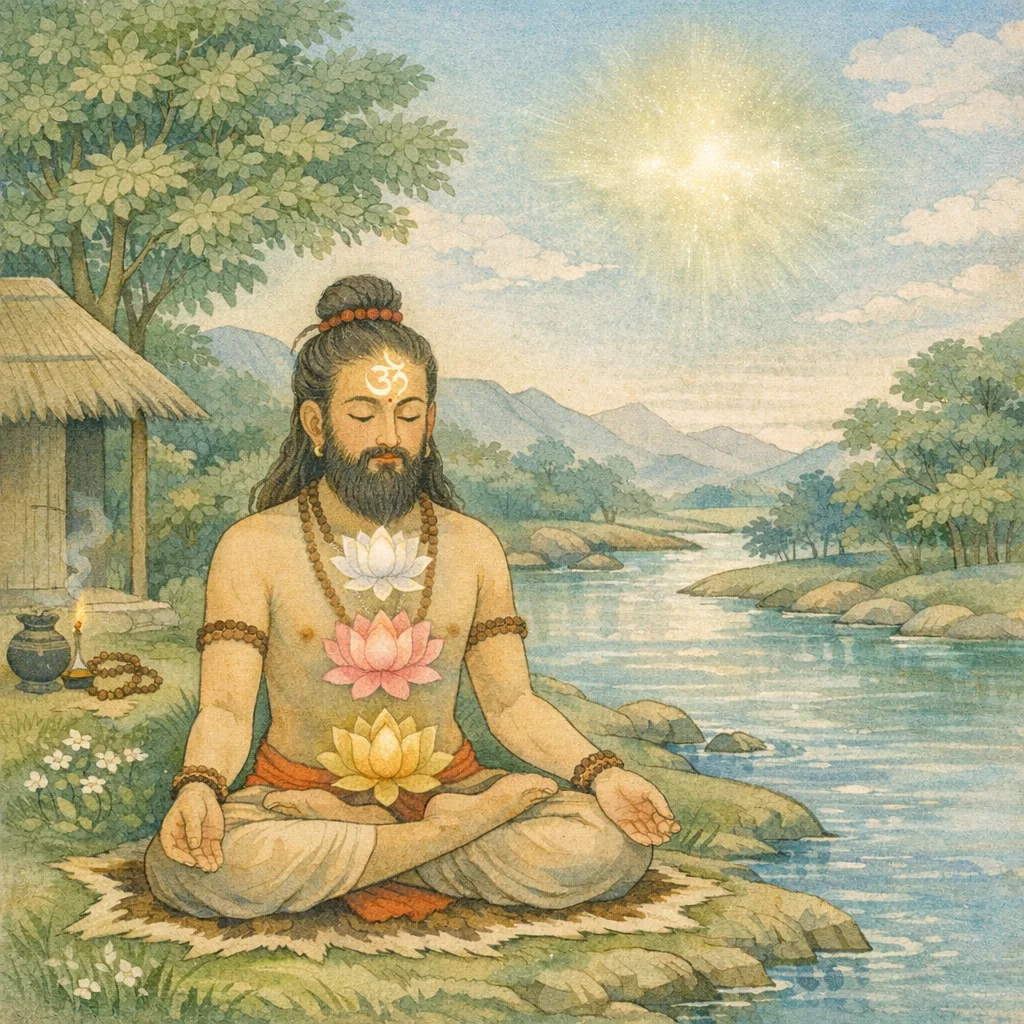
Adhyaya 8
Adhyaya 8: Yogasthanas, Ashtanga Yoga, Pranayama-Siddhi, and Shiva-Dhyana leading to Samadhi
Sūta describes the yogasthānas within the body (especially near the navel, the throat, and between the brows) and defines yoga as self-knowledge gained through one-pointed concentration, ultimately dependent on Śiva’s prasāda (grace). He equates “yoga” with Mahēśvara’s nirvāṇa-state and teaches that sins are burnt away by jñāna and by restraining the senses. He then sets forth the aṣṭāṅga path—yama, niyama, āsana, prāṇāyāma, pratyāhāra, dhāraṇā, dhyāna, samādhi—detailing yama/niyama (ahiṃsā, satya, asteya, brahmacarya, aparigraha; śauca, tapas, dāna, svādhyāya, vows, fasting, silence, ritual bathing, and more). A major section explains prāṇāyāma: mātrā counts, grades, signs, and the pacification (prasāda) of the vāyus and buddhi, leading through śānti–praśānti–dīpti–prasāda. The chapter culminates in Śaiva meditation: contemplating Oṃ as flame-like purity, visualizing lotuses/maṇḍalas, placing Śiva in the heart, navel, and brow, and finally meditating on Śiva as the nirguṇa, indescribable, unborn Brahman. Thus it establishes the ethical, physiological, and contemplative prerequisites for steady realization of Śiva.
Shlokas
Verse 1
सूत उवाच संक्षेपतः प्रवक्ष्यामि योगस्थानानि साम्प्रतम् कल्पितानि शिवेनैव हिताय जगतां द्विजाः
Sūta said: “Now I shall succinctly describe the sacred abodes of Yoga—those very seats established by Śiva himself for the welfare of the worlds, O twice-born sages.”
Verse 2
गलादधो वितस्त्या यन् नाभेरुपरि चोत्तमम् योगस्थानमधो नाभेर् आवर्तं मध्यमं भ्रुवोः
That region lying a span below the throat and above the navel is declared the supreme inner seat. Below the navel is the station of Yoga; the navel-whorl is the middle point; and between the eyebrows too is shown a central focus for inward concentration.
Verse 3
सर्वार्थज्ञाननिष्पत्तिर् आत्मनो योग उच्यते एकाग्रता भवेच्चैव सर्वदा तत्प्रसादतः
Yoga is declared to be the soul’s attainment of complete knowledge of all aims and truths. From His grace alone—Śiva’s—unwavering one-pointedness of mind arises at all times.
Verse 4
प्रसादस्य स्वरूपं यत् स्वसंवेद्यं द्विजोत्तमाः वक्तुं न शक्यं ब्रह्माद्यैः क्रमशो जायते नृणाम्
O best of the twice-born, the true nature of prasāda—Śiva’s divine grace—is knowable only by direct inner realization; even Brahmā and the other gods cannot fully express it in words. In human beings it arises gradually, step by step.
Verse 5
योगशब्देन निर्वाणं माहेशं पदमुच्यते तस्य हेतुरृषेर्ज्ञानं ज्ञानं तस्य प्रसादतः
By the word “yoga” is meant Nirvāṇa—the supreme station of Maheśa. The cause of attaining it is the seer’s liberating knowledge; and that knowledge arises only by His grace, Śiva’s.
Verse 6
ज्ञानेन निर्दहेत्पापं निरुध्य विषयान् सदा निरुद्धेन्द्रियवृत्तेस्तु योगसिद्धिर्भविष्यति
By liberating knowledge one should burn away sin; and by constantly restraining the sense-objects, when the movements of the senses are fully checked, success in Yoga will surely arise—leading the bound soul (paśu) away from pāśa and toward the Lord (Pati), Śiva.
Verse 7
योगो निरोधो वृत्तेषु चित्तस्य द्विजसत्तमाः साधनान्यष्टधा चास्य कथितानीह सिद्धये
O best of the twice-born, Yoga is the restraint of the mind amid its fluctuations; and for attaining success in it, its eightfold disciplines are taught here.
Verse 8
यमस्तु प्रथमः प्रोक्तो द्वितीयो नियमस् तथा तृतीयमासनं प्रोक्तं प्राणायामस्ततः परम्
Yama is declared to be the first limb; Niyama is likewise the second. Āsana is taught as the third, and after that comes Prāṇāyāma—regulation of the vital breath—as the next discipline.
Verse 9
प्रत्याहारं पञ्चमो वै धारणा च ततः परा ध्यानं सप्तममित्युक्तं समाधिस्त्वष्टमः स्मृतः
Pratyāhāra is indeed the fifth limb; thereafter comes dhāraṇā. Dhyāna is declared to be the seventh, and samādhi is remembered as the eighth—thus the higher stages of Pāśupata-yoga leading the paśu (bound soul) toward the Lord (Pati).
Verse 10
तपस्युपरमश्चैव यम इत्यभिधीयते अहिंसा प्रथमो हेतुर् यमस्य यमिनां वराः
Restraint (yama) is declared to be the very culmination of tapas; and among the disciplines of restraint, O best of the self-controlled, non-violence (ahiṃsā) is its foremost cause and foundation.
Verse 11
सत्यमस्तेयमपरं ब्रह्मचर्यापरिग्रहौ नियमस्यापि वै मूलं यम एव न संशयः
Truthfulness, non-stealing, non-acceptance of what is not rightfully one’s own, celibate discipline, and non-possessiveness—indeed, Yama (ethical restraint) alone is the very root even of Niyama (observances); of this there is no doubt.
Verse 12
आत्मवत् सर्वभूतानां हितायैव प्रवर्तनम् अहिंसैषा समाख्याता या चात्मज्ञानसिद्धिदा
To act solely for the welfare of all beings, beholding them as one’s own Self—this alone is declared to be ahiṃsā (non-injury); and it is this that grants the attainment of Self-knowledge, leading the bound soul (paśu) toward the Lord (Pati).
Verse 13
दृष्टं श्रुतं चानुमितं स्वानुभूतं यथार्थतः कथनं सत्यमित्युक्तं परपीडाविवर्जितम्
Truth is declared to be speech that accurately states what is seen, heard, inferred, and directly realized—spoken as it truly is, and entirely free from causing harm to others.
Verse 14
नाश्लीलं कीर्तयेदेवं ब्राह्मणानामिति श्रुतिः परदोषान् परिज्ञाय न वदेदिति चापरम्
Thus, the Śruti declares for brāhmaṇas: one should not recount what is obscene or indecent. And another teaching says: even after discerning the faults of others, one should not speak of them.
Verse 15
अनादानं परस्वानाम् आपद्यपि विचारतः मनसा कर्मणा वाचा तदस्तेयं समासतः
Not taking what belongs to another—even in times of distress—after due discernment, in thought, deed, and speech: this, in brief, is non-stealing (asteya).
Verse 16
मैथुनस्याप्रवृत्तिर्हि मनोवाक्कायकर्मणा ब्रह्मचर्यमिति प्रोक्तं यतीनां ब्रह्मचारिणाम्
For renunciates and vowed celibates, brahmacarya is declared to be complete non-engagement in sexual union—restrained in mind, speech, and bodily action—so that the bound soul (paśu) loosens the fetters (pāśa) and becomes fit for the grace of the Lord (Pati), Śiva.
Verse 17
इह वैखानसानां च विदाराणां विशेषतः सदाराणां गृहस्थानं तथैव च वदामि वः
Here I shall tell you, in particular, the proper mode of household life for the Vaikhānasas and the Vidāras—those who live as married householders—so that their gṛhastha-dharma may become a support for devotion to Pati, Śiva.
Verse 18
स्वदारे विधिवत्कृत्वा निवृत्तिश्चान्यतः सदा मनसा कर्मणा वाचा ब्रह्मचर्यमिति स्मृतम्
Brahmacarya is declared to be this: engaging lawfully with one’s own wedded spouse, and maintaining constant restraint from all others—through mind, deed, and speech.
Verse 19
मेध्या स्वनारी सम्भोगं कृत्वा स्नानं समाचरेत् एवं गृहस्थो युक्तात्मा ब्रह्मचारी न संशयः
After lawful union with his own wife, a purified householder should duly bathe. Thus disciplined and inwardly collected, the gṛhastha is indeed a brahmacārin—there is no doubt.
Verse 20
अहिंसाप्येवमेवैषा द्विजगुर्वग्निपूजने विधिना यादृशी हिंसा सा त्वहिंसा इति स्मृता
Thus, even this is called non-violence: in the worship of the twice-born, the Guru, and the sacred Fire, whatever ‘violence’ is performed according to prescribed rite is remembered in the tradition as truly non-violence—because it is regulated by Dharma and oriented toward the Lord (Pati).
Verse 21
स्त्रियः सदा परित्याज्याः सङ्गं नैव च कारयेत् कुणपेषु यथा चित्तं तथा कुर्याद्विचक्षणः
Women (as objects of sensual attachment) should always be renounced; one should not cultivate association (that inflames desire). The discerning seeker should train the mind to regard them as one would a corpse—thereby cutting the pasha (bond) of passion and moving toward Pati, Śiva.
Verse 22
विण्मूत्रोत्सर्गकालेषु बहिर्भूमौ यथा मतिः तथा कार्या रतौ चापि स्वदारे चान्यतः कुतः
As one restrains the mind and turns it outward to a proper place when relieving oneself of feces and urine on open ground, so too should one keep the same guarded discipline in sexual union—only with one’s own lawful wife; how could it ever be proper elsewhere?
Verse 23
अङ्गारसदृशी नारी घृतकुम्भसमः पुमान् तस्मान्नारीषु संसर्गं दूरतः परिवर्जयेत्
A woman is like a live ember, and a man like a pot filled with ghee; therefore one should avoid entangling association with women even from afar, lest the bound soul (paśu) be scorched by passion and further tied by the bonds (pāśa).
Verse 24
भोगेन तृप्तिर्नैवास्ति विषयाणां विचारतः तस्माद्विरागः कर्तव्यो मनसा कर्मणा गिरा
Upon discerning the true nature of sense-objects, one finds that enjoyment never brings real satisfaction. Therefore dispassion (virāga) must be cultivated—by mind, by action, and by speech—so that the bound soul (paśu) may loosen the bonds (pāśa) and turn toward the Lord (Pati), Śiva.
Verse 25
न जातु कामः कामानाम् उपभोगेन शाम्यति हविषा कृष्णवर्त्मेव भूय एवाभिवर्धते
Desire for sense-objects is never quenched by indulging in those very objects; like a fire fed with oblations (havis), it only blazes up all the more.
Verse 26
तस्मात्त्यागः सदा कार्यस् त्व् अमृतत्वाय योगिना अविरक्तो यतो मर्त्यो नानायोनिषु वर्तते
Therefore the yogin should always practise renunciation (tyāga) for the sake of attaining immortality. For the mortal who lacks dispassion continues to wander through many wombs—bound as a paśu by the pāśas of attachment—until he turns toward the Pati, Śiva.
Verse 27
त्यागेनैवामृतत्वं हि श्रुतिस्मृतिविदां वराः कर्मणा प्रजया नास्ति द्रव्येण द्विजसत्तमाः
O best among the knowers of Śruti and Smṛti, O foremost of the twice-born—immortality is attained only through renunciation. It is not gained by ritual action, nor by progeny, nor by wealth. Renunciation alone loosens the pāśa (bondage) of the paśu (soul) and turns it toward Pati, Śiva, who grants liberation.
Verse 28
तस्माद्विरागः कर्तव्यो मनोवाक्कायकर्मणा ऋतौ ऋतौ निवृत्तिस्तु ब्रह्मचर्यमिति स्मृतम्
Therefore, dispassion (virāga) should be cultivated through the actions of mind, speech, and body. And abstinence at each season—periodic restraint of sensual activity—is remembered as brahmacarya. By such self-mastery the paśu loosens the pāśa and becomes fit for the grace of Pati, Śiva.
Verse 29
यमाः संक्षेपतः प्रोक्ता नियमांश् च वदामि वः शौचमिज्या तपो दानं स्वाध्यायोपस्थनिग्रहः
The yamas have been stated briefly; now I shall tell you the niyamas: purity (śauca), worship (ijyā), austerity (tapas), charitable giving (dāna), self-study/recitation (svādhyāya), and restraint of the generative impulse (upastha-nigraha).
Verse 30
व्रतोपवासमौनं च स्नानं च नियमा दश नियमः स्यादनीहा च शौचं तुष्टिस्तपस् तथा
The ten niyamas are said to be: sacred observance (vrata), fasting (upavāsa), silence (mauna), ritual bathing (snāna), freedom from craving (anīhā), purity (śauca), inner contentment (tuṣṭi), and austerity (tapas)—disciplines that steady the paśu for devotion to Pati, Śiva.
Verse 31
जपः शिवप्रणीधानं पद्मकाद्यं तथासनम् बाह्यमाभ्यन्तरं प्रोक्तं शौचमाभ्यन्तरं वरम्
Japa and complete surrender to Śiva (śiva-praṇidhāna), along with postures such as Padmaka (Padmāsana) and the like, are taught. Purification is said to be of two kinds—external and internal; but internal purity is the higher one.
Verse 32
बाह्यशौचेन युक्तः संस् तथा चाभ्यन्तरं चरेत् आग्नेयं वारुणं ब्राह्मं कर्तव्यं शिवपूजकैः
Endowed with outward purity, one should also cultivate inner purity. Therefore, the worshippers of Śiva must duly perform the purifications pertaining to Fire, Water, and the Brahmanic (Vedic) principle.
Verse 33
स्नानं विधानतः सम्यक् पश्चाद् आभ्यन्तरं चरेत् आ देहान्तं मृदालिप्य तीर्थतोयेषु सर्वदा
Having performed the bath correctly according to rule, one should thereafter undertake inner purification. Smearing cleansing earth over the body from head to foot, one should always bathe in the waters of sacred tīrthas, so that the paśu (bound soul) becomes fit to worship Pati, Lord Śiva.
Verse 34
अवगाह्यापि मलिनो ह्य् अन्तः शौचविवर्जितः शैवला झषका मत्स्याः सत्त्वा मत्स्योपजीविनः
Even after immersing in water, one remains inwardly impure if devoid of true purity (śauca). Algae, fish, and other aquatic creatures live in water, yet mere dwelling in it does not make them pure. Likewise, external bathing without inner cleansing does not free the paśu from pāśa; only inner śauca aligned with devotion to Pati, Śiva, purifies.
Verse 35
सदावगाह्य सलिले विशुद्धाः किं द्विजोत्तमाः तस्मादाभ्यन्तरं शौचं सदा कार्यं विधानतः
O best of the twice-born, even if you bathe again and again in water, how can you be truly purified? Therefore, inner purity must always be cultivated according to the ordained rule, so that the paśu may loosen the pāśa and turn toward Pati, Śiva.
Verse 36
आत्मज्ञानाम्भसि स्नात्वा सकृदालिप्य भावतः सुवैराग्यमृदा शुद्धः शौचमेवं प्रकीर्तितम्
Having bathed in the waters of Self-knowledge (ātma-jñāna), and having once anointed oneself inwardly with true intent, one is purified by the clay of noble dispassion (vairāgya). This alone is declared to be purity (śauca).
Verse 37
शुद्धस्य सिद्धयो दृष्टा नैवाशुद्धस्य सिद्धयः न्यायेनागतया वृत्त्या संतुष्टो यस्तु सुव्रतः
Siddhis are seen to arise for one who is pure; for the impure, siddhis do not arise at all. But the one of noble vow who remains content with a livelihood obtained by righteous means becomes fit for the Shaiva path that leads the bound soul (paśu) toward the Lord (Pati), Śiva.
Verse 38
संतोषस्तस्य सततम् अतीतार्थस्य चास्मृतिः चान्द्रायणादिनिपुणस् तपांसि सुशुभानि च
For him there is constant contentment and no brooding recollection of what has passed; he is skilled in observances such as the Cāndrāyaṇa, and he performs auspicious austerities—beautiful in discipline—dedicated to Pati (Śiva), loosening the bonds (pāśa) of the paśu (soul).
Verse 39
स्वाध्यायस्तु जपः प्रोक्तः प्रणवस्य त्रिधा स्मृतः वाचिकश्चाधमो मुख्य उपांशुश्चोत्तमोत्तमः
Svādhyāya is declared to be japa; and the japa of the Praṇava (Oṁ) is remembered as threefold. The spoken recitation (vācika) is the lowest; the mental recitation is the principal; and the whispered recitation (upāṁśu) is the best of the best.
Verse 40
मानसो विस्तरेणैव कल्पे पञ्चाक्षरे स्मृतः तथा शिवप्रणीधानं मनोवाक्कायकर्मणा
In the prescribed ritual order, the inner worship of the mind is taught in full through the Pañcākṣara; and likewise one should establish complete dedication to Śiva through mind, speech, and bodily action.
Verse 41
शिवज्ञानं गुरोर्भक्तिर् अचला सुप्रतिष्ठिता निग्रहो ह्यपहृत्याशु प्रसक्तानीन्द्रियाणि च
Steadfast knowledge of Śiva, and unwavering, well-established devotion to the Guru—together with self-restraint, swiftly withdrawing the sense-faculties that rush toward their objects—this is the discipline that leads the bound soul (paśu) toward the Lord (Pati).
Verse 42
विषयेषु समासेन प्रत्याहारः प्रकीर्तितः चित्तस्य धारणा प्रोक्ता स्थानबन्धः समासतः
In brief, withdrawal from the objects of the senses is declared to be pratyāhāra. And dhāraṇā is taught as the fixing of the mind—summarily, binding it to a single place of contemplation.
Verse 43
तस्याः स्वास्थ्येन ध्यानं च समाधिश् च विचारतः तत्रैकचित्तता ध्यानं प्रत्ययान्तरवर्जितम्
From the steadiness (svāsthya) of that discipline, one should discern meditation and samādhi by reflection. There, meditation is the single-pointedness of mind—free from any intervening cognition—resting on the one Reality: Pati, Śiva.
Verse 44
चिद्भासमर्थमात्रस्य देहशून्यमिव स्थितम् समाधिः सर्वहेतुश् च प्राणायाम इति स्मृतः
Prāṇāyāma is remembered as abiding as though devoid of the body—resting solely in the power of consciousness’ radiance. It is samādhi itself and the universal cause, the chief means, for all yogic attainments.
Verse 45
प्राणः स्वदेहजो वायुर् यमस्तस्य निरोधनम् त्रिधा द्विजैर्यमः प्रोक्तो मन्दो मध्योत्तमस् तथा
Prāṇa is the vital wind born within one’s own body; yama is the restraint of that prāṇa. The twice-born have taught this yama as threefold—mild, middling, and supreme—according to the aspirant’s capacity in yogic discipline.
Verse 46
प्राणापाननिरोधस्तु प्राणायामः प्रकीर्तितः प्राणायामस्य मानं तु मात्राद्वादशकं स्मृतम्
The restraint of prāṇa and apāna is proclaimed as prāṇāyāma. The measured standard for prāṇāyāma is remembered as twelve mātrās, units of time.
Verse 47
नीचो द्वादशमात्रस्तु उद्धातो द्वादशः स्मृतः मध्यमस् तु द्विरुद्धातश् चतुर्विंशतिमात्रकः
The ‘low’ (short) Liṅga is of twelve mātrās; the ‘raised’ (taller) one is also remembered as twelve. The ‘middle’ type, however, is twice the raised measure—twenty-four mātrās—fit for orderly worship that steadies the paśu (bound soul) and turns it toward Pati (Śiva).
Verse 48
मुख्यस्तु यस्त्रिरुद्धातः षट्त्रिंशन्मात्र उच्यते प्रस्वेदकम्पनोत्थानजनकश्च यथाक्रमम्
But the principal (vāyu), when it is thrice impelled upward, is said to measure thirty-six mātrās; and, in due sequence, it becomes the cause of sweating, trembling, and rising (of the body/energy).
Verse 49
आनन्दोद्भवयोगार्थं निद्राघूर्णिस्तथैव च रोमाञ्चध्वनिसंविद्धस्वाङ्गमोटनकम्पनम्
For the sake of union born of bliss, there arises a drowsy swaying; and the body, thrilled with horripilation and resonant utterance, begins to twist and tremble—these are the bodily signs accompanying yogic absorption in Pati (Śiva).
Verse 50
भ्रमणं स्वेदजन्या सा संविन्मूर्छा भवेद्यदा तदोत्तमोत्तमः प्रोक्तः प्राणायामः सुशोभनः
When there arises a swoon of awareness—accompanied by dizziness and sweat born of the practice—then that prāṇāyāma is declared the most excellent of the excellent, radiant in its attainment.
Verse 51
सगर्भो ऽगर्भ इत्युक्तः सजपो विजपः क्रमात् इभो वा शरभो वापि दुराधर्षो ऽथ केसरी
He is called ‘Sagarbha’ and also ‘Agarbha’—with form and yet beyond all wombs. In due order He is ‘Sajapa’ and ‘Vijapa’, the Lord of mantra that is uttered and the mantra that resounds unuttered within. He is the Elephant and the Śarabha as well—invincible, unassailable—and also the Lion, the sovereign who overpowers all bonds of the paśu and stands as Pati, the supreme Protector.
Verse 52
गृहीतो दम्यमानस्तु यथास्वस्थस्तु जायते तथा समीरणो ऽस्वस्थो दुराधर्षश् च योगिनाम्
When it is seized and disciplined, it becomes steady and well-established; likewise, when the vital Wind (prāṇa) is undisciplined, it remains unsteady and is exceedingly difficult for yogins to overcome.
Verse 53
न्यायतः सेव्यमानस्तु स एवं स्वस्थतां व्रजेत् यथैव मृगराङ्नागः शरभो वापि दुर्मदः
When one is served in accordance with justice and right conduct, he thus returns to steadiness and well-being—just as even a wildly intoxicated beast, whether a raging elephant or a fierce śarabha, is brought under control.
Verse 54
कालान्तरवशाद्योगाद् दम्यते परमादरात् तथा परिचयात्स्वास्थ्यं समत्वं चाधिगच्छति
Through sustained practice over time, and through yoga pursued with the highest reverence, the mind becomes restrained. By continued familiarity with that discipline, one attains inner steadiness and an evenness of vision—fit for the Pāśu (soul) to loosen the bonds (pāśa) under the grace of Pati, Śiva.
Verse 55
योगादभ्यसते यस्तु व्यसनं नैव जायते एवमभ्यस्यमानस्तु मुनेः प्राणो विनिर्दहेत्
For one who practices Yoga, no calamity or addiction-born downfall arises. When practiced in this way, the sage’s vital breath (prāṇa), refined by discipline, burns up the impurities that bind the pashu (individual soul).
Verse 56
मनोवाक्कायजान् दोषान् कर्तुर्देहं च रक्षति संयुक्तस्य तथा सम्यक् प्राणायामेन धीमतः
For the wise practitioner who is properly integrated in yoga, correct prāṇāyāma protects against the faults born of mind, speech, and body, and also safeguards the practitioner’s body—thus supporting the pashu (individual soul) in its disciplined approach toward Pati (Śiva).
Verse 57
दोषात्तस्माच्च नश्यन्ति निश्वासस्तेन जीर्यते प्राणायामेन सिध्यन्ति दिव्याः शान्त्यादयः क्रमात्
Therefore the defects are destroyed; the outgoing breath is restrained, and the vital force is refined. Through prāṇāyāma, the divine attainments—beginning with serenity—are accomplished gradually, in due order.
Verse 58
शान्तिः प्रशान्तिर्दीप्तिश् च प्रसादश् च तथा क्रमात् आदौ चतुष्टयस्येह प्रोक्ता शान्तिरिह द्विजाः
Peace (śānti), deep tranquillity (praśānti), radiant brilliance (dīpti), and gracious favor (prasāda) are taught here in due sequence. Of this fourfold set, O twice-born sages, peace (śānti) is declared first.
Verse 59
सहजागन्तुकानां च पापानां शान्तिर् उच्यते प्रशान्तिः संयमः सम्यग् वचसामिति संस्मृता
For sins that arise innately (sahaja) as well as those that come from external causes (āgantuka), the means of pacification is declared. True appeasement is remembered as right restraint—complete self-control—and the disciplined, truthful governance of one’s speech.
Verse 60
प्रकाशो दीप्तिरित्युक्तः सर्वतः सर्वदा द्विजाः सर्वेन्द्रियप्रसादस्तु बुद्धेर्वै मरुतामपि
He is called ‘Prakāśa’ (the all-revealing Light) and ‘Dīpti’ (radiance). O twice-born ones, He is everywhere and at all times; and He alone is the clarity and gracious steadiness of all the senses—and even the lucid power of the intellect, including that of the Maruts (the storm-gods).
Verse 61
प्रसाद इति सम्प्रोक्तः स्वान्ते त्विह चतुष्टये प्राणो ऽपानः समानश् च उदानो व्यान एव च
This is declared to be “prasāda” (inner clarity and grace) within one’s own inner being; here, in this set, are the five vital currents—prāṇa, apāna, samāna, udāna, and vyāna.
Verse 62
नागः कूर्मस्तु कृकलो देवदत्तो धनंजयः एतेषां यः प्रसादस्तु मरुतामिति संस्मृतः
Nāga, Kūrma, Kṛkala, Devadatta, and Dhanaṃjaya—these are the vital airs. The harmonizing grace (prasāda) that steadies and governs them is remembered as the “Maruts,” the life-winds.
Verse 63
प्रयाणं कुरुते तस्माद् वायुः प्राण इति स्मृतः अपानयत्यपानस्तु आहारादीन् क्रमेण च
Because it causes the forward movement, that vital wind is remembered as Prāṇa. But Apāna, in due order, carries downward and expels food and the rest, sustaining the paśu within the bonds of pāśa until it turns toward the Lord (Pati), Śiva.
Verse 64
व्यानो व्यानामयत्यङ्गं व्याध्यादीनां प्रकोपकः उद्वेजयति मर्माणि उदानो ऽयं प्रकीर्तितः
Vyāna pervades and agitates the limbs, becoming a provoker of ailments and other disorders; it disturbs the vital points (marmas). This is declared to be Udāna in its manifest, agitating mode.
Verse 65
समं नयति गात्राणि समानः पञ्च वायवः उद्गारे नाग आख्यातः कूर्म उन्मीलने तु सः
Among the five vital airs, Samāna brings the limbs into balance and harmony. In the act of belching it is known as Nāga, and in the opening of the eyes it is called Kūrma.
Verse 66
कृकलः क्षुतकायैव देवदत्तो विजृम्भणे धनंजयो महाघोषः सर्वगः स मृते ऽपि हि
Even after death, the vital currents remain operative: Kṛkala is the force behind sneezing; Kṣutakāya is the principle of hunger itself; Devadatta governs yawning; Dhanañjaya is the mighty-sounding wind, all-pervading in the body.
Verse 67
इति यो दशवायूनां प्राणायामेन सिध्यति प्रसादो ऽस्य तुरीया तु संज्ञा विप्राश्चतुष्टये
Thus, when one perfects mastery over the ten vital airs through prāṇāyāma, a state of grace arises within; among the four conditions taught to the wise, this is known as the “fourth” (turīya).
Verse 68
विस्वरस्तु महान् प्रज्ञो मनो ब्रह्मा चितिः स्मृतिः ख्यातिः संवित्ततः पश्चाद् ईश्वरो मतिरेव च
From Universal Being (Viśvaras) arises the Great Principle (Mahān) and luminous intelligence (Prajñā); then come Mind (Manas) and the creative ordinance (Brahmā). Thereafter appear Cognition (Citi), Memory (Smṛti), Recognition (Khyāti), and integrated Awareness (Saṃvitti). Following these is the Lordly principle (Īśvara), and finally the decisive intellect (Mati) as well.
Verse 69
बुद्धेरेताः द्विजाः संज्ञा महतः परिकीर्तिताः अस्या बुद्धेः प्रसादस्तु प्राणायामेन सिध्यति
These are declared to be the “twice-born” offspring of the intellect (buddhi)—the exalted powers spoken of by the great. The serenity and clarity of this intellect is accomplished through prāṇāyāma; thus the bound soul (paśu) becomes fit for the Lord (Pati).
Verse 70
विस्वरो विस्वरीभावो द्वंद्वानां मुनिसत्तमाः अग्रजः सर्वतत्त्वानां महान्यः परिमाणतः
O best of sages, He is the Lord of the universe and the very becoming of the universe; transcending all pairs of opposites, He is the First-born before all tattvas, and though immeasurable, He is called the Great One (Mahān), the measure underlying all measures.
Verse 71
यत्प्रमाणगुहा प्रज्ञा मनस्तु मनुते यतः बृहत्त्वाद् बृंहणत्वाच्च ब्रह्मा ब्रह्मविदांवराः
The sages, foremost among the knowers of Brahman, declare Him to be “Brahmā”: for within Him lies the hidden measure (pramāṇa) of all cognition; the mind can conceive only upon His ground; and because He is vast (bṛhat) and causes expansion (bṛṃhaṇa), enlarging being and knowledge.
Verse 72
सर्वकर्माणि भोगार्थं यच्चिनोति चितिः स्मृता स्मरते यत्स्मृतिः सर्वं संविद्वै विन्दते यतः
That which gathers all actions for the sake of experience is called citi, the collecting intellect. That by which one remembers is smṛti, memory. And that from which all this is truly known and ascertained is saṁvid, Consciousness itself—the inner light by which the paśu knows its experiences even while bound by pāśa.
Verse 73
ख्यायते यत्त्विति ख्यातिर् ज्ञानादिभिर् अनेकशः सर्वतत्त्वाधिपः सर्वं विजानाति यदीश्वरः
He is called “Khyāti” because He makes all things known; through knowledge and the like He is revealed in many ways. That Lord, Īśvara—the sovereign over all tattvas—fully knows everything.
Verse 74
मनुते मन्यते यस्मान् मतिर्मतिमतांवराः अर्थं बोधयते यच्च बुध्यते बुद्धिरुच्यते
O best among the thoughtful: that by which one reflects and forms notions is called mati, cognitive reflection. And that by which meaning is made known—and by which one truly apprehends—is called buddhi, the discriminative intellect.
Verse 75
अस्या बुद्धेः प्रसादस्तु प्राणायामेन सिध्यति दोषान्विनिर्दहेत्सर्वान् प्राणायामादसौ यमी
The serenity and clarity of this intellect is accomplished through prāṇāyāma. By prāṇāyāma the disciplined yogin burns away all defects, thus becoming a true observer of yama, established in restraint.
Verse 76
पातकं धारणाभिस्तु प्रत्याहारेण निर्दहेत् विषयान्विषवद्ध्यात्वा ध्यानेनानीश्वरान् गुणान्
By the practices of dhāraṇā, concentration, one burns away sin; by pratyāhāra, withdrawal of the senses, one consumes it entirely. Seeing sense-objects as poison, and by dhyāna, meditation, transcending the non-sovereign guṇas of prakṛti, the paśu is led from pāśa toward the Lord, the Pati—Śiva.
Verse 77
समाधिना यतिश्रेष्ठाः प्रज्ञावृद्धिं विवर्धयेत् स्थानं लब्ध्वैव कुर्वीत योगाष्टाङ्गानि वै क्रमात्
By samādhi, the foremost ascetics should foster the increase of true discernment. Having obtained a proper seat and place, one should then practice—step by step—the eight limbs of Yoga in due order.
Verse 78
लब्ध्वासनानि विधिवद् योगसिद्ध्यर्थम् आत्मवित् आदेशकाले योगस्य दर्शनं हि न विद्यते
Having properly established the prescribed postures for the attainment of yogic perfection, the knower of the Self understands that at the moment of mere instruction, the direct vision of Yoga is not yet attained.
Verse 79
अग्न्यभ्यासे जले वापि शुष्कपर्णचये तथा जन्तुव्याप्ते श्मशाने च जीर्णगोष्ठे चतुष्पथे
Near a fire-practice ground, in water, upon a heap of dry leaves, in a creature-infested cremation ground, in an abandoned cowshed, and at a four-way crossroads—these places are indicated as unsuitable for the settled observances of Śiva’s discipline, for they disturb steadiness of mind and the purity required for worship and yoga.
Verse 80
सशब्दे सभये वापि चैत्यवल्मीकसंचये अशुभे दुर्जनाक्रान्ते मशकादिसमन्विते
In a noisy place, or a place of fear; near shrines or anthills where heaps gather; in an inauspicious spot; where wicked men prevail; or where mosquitoes and the like abound—worship should not be performed there.
Verse 81
नाचरेद्देहबाधायां दौर्मनस्यादिसम्भवे सुगुप्ते तु शुभे रम्ये गुहायां पर्वतस्य तु
One should not undertake austerity or spiritual practice in a place that harms the body or gives rise to dejection and other disturbances. Rather, one should practice in a well-concealed, auspicious, and delightful mountain-cave—fit for steady contemplation on Pati (Śiva) and for loosening the bonds (pāśa) of the paśu (soul).
Verse 82
भवक्षेत्रे सुगुप्ते वा भवारामे वने ऽपि वा गृहे तु सुशुभे देशे विजने जन्तुवर्जिते
Whether in a well-guarded sacred precinct of Bhava (Śiva), or in Bhava’s garden, or even in a forest—or within one’s own home—one should choose a most auspicious place: secluded, quiet, and free from disturbing creatures. There, with the mind withdrawn from pāśa (bondage), the paśu (individual soul) may approach the Pati (Lord Śiva) through disciplined worship of the Liṅga.
Verse 83
अत्यन्तनिर्मले सम्यक् सुप्रलिप्ते विचित्रिते दर्पणोदरसंकाशे कृष्णागरुसुधूपिते
In a place made exceedingly pure—well-smeared, properly prepared, and beautifully adorned—shining like the inside of a mirror and fragrant with the fine incense of black agaru, the worship of the Liṅga should be arranged.
Verse 84
नानापुष्पसमाकीर्णे वितानोपरि शोभिते फलपल्लवमूलाढ्ये कुशपुष्पसमन्विते
The pavilion above was made splendid, strewn with many kinds of flowers—rich with fruits, tender shoots, and roots—and furnished as well with kuśa grass and blossoms. Thus the sacred space was prepared for worship of the Liṅga, the sign of Pati (Śiva), by which the paśu (bound soul) is led beyond pāśa (bondage).
Verse 85
समासनस्थो योगाङ्गान्य् अभ्यसेद्धृषितः स्वयम् प्रणिपत्य गुरुं पश्चाद् भवं देवीं विनायकम्
Seated in a steady posture, the aspirant should himself practice the limbs of yoga with courageous resolve. After first bowing to the Guru, he should then reverently worship Bhava (Śiva), the Devī (Śakti), and Vināyaka—thus aligning the paśu (individual soul) to the grace of the Pati (Lord) and loosening the bonds of pāśa (bondage).
Verse 86
योगीश्वरान् सशिष्यांश् च योगं युञ्जीत योगवित् आसनं स्वस्तिकं बद्ध्वा पद्ममर्धासनं तु वा
The knower of Yoga should yoke himself to Yoga together with the lordly Yogins and their disciples. Having assumed a steady posture—binding the Svastika-seat, or else the Lotus-seat, or even the half-seat—he should commence the discipline.
Verse 87
समजानुस् तथा धीमान् एकजानुरथापिवा समं दृढासनो भूत्वा संहृत्य चरणावुभौ
Let the wise practitioner sit with both knees level, or with one knee raised; established in a firm and even seat, let him draw in and compose both feet—thus setting bodily restraint as a support for contemplation directed to Śiva.
Verse 88
संवृतास्योपबद्धाक्ष उरो विष्टभ्य चाग्रतः पार्ष्णिभ्यां वृषणौ रक्षंस् तथा प्रजननं पुनः
With the mouth closed and the eyes restrained, bracing the chest forward, he should guard the testes with the heels and likewise protect the generative organ—thus maintaining disciplined control of vital energy.
Verse 89
किंचिदुन्नामितशिर दन्तैर्दन्तान्न संस्पृशेत् सम्प्रेक्ष्य नासिकाग्रं स्वं दिशश्चानवलोकयन्
With the head slightly raised, he should not let the teeth touch. Fixing his gaze on the tip of his own nose, he should not look about in the directions—thus steadying the senses for Śaiva contemplation of the Pati, Lord Śiva.
Verse 90
तमः प्रच्छाद्य रजसा रजः सत्त्वेन छादयेत् ततः सत्त्वस्थितो भूत्वा शिवध्यानं समभ्यसेत्
Veiling tamas with rajas, and then covering rajas with sattva, one should become established in sattva; thereafter, abiding in that clarity, one should diligently practice meditation on Śiva—the Pati who liberates the paśu from pāśa.
Verse 91
ओंकारवाच्यं परमं शुद्धं दीपशिखाकृतिम् ध्यायेद्वै पुण्डरीकस्य कर्णिकायां समाहितः
Steady and collected, one should meditate upon the supremely pure Reality denoted by the syllable Oṃ—visualized as the crest of a flame—within the lotus’s central pericarp.
Verse 92
नाभेरधस्ताद्वा विद्वान् ध्यात्वा कमलमुत्तमम् त्र्यङ्गुले चाष्टकोणं वा पञ्चकोणमथापि वा
The wise practitioner should meditate on the supreme lotus below the navel, and there contemplate a yantric form—either an octagon or even a pentagon—measured to three finger-breadths.
Verse 93
त्रिकोणं च तथाग्नेयं सौम्यं सौरं स्वशक्तिभिः सौरं सौम्य तथाग्नेयम् अथ वानुक्रमेण तु
One should also fashion the triangular (yoni) figure; then, by one’s own invoked Śaktis, place in due order the Agneya (fiery), the Saumya (lunar, cooling), and the Saura (solar) powers—again arranging the Saura, Saumya, and Agneya in proper sequence.
Verse 94
आग्नेयं च ततः सौरं सौम्यमेवं विधानतः अग्नेरधः प्रकल्प्यैवं धर्मादीनां चतुष्टयम्
Then, in the prescribed manner, one should arrange the Agneya (fire) sector, thereafter the Saura (solar) and the Saumya (lunar) sectors. Beneath Agni, one should similarly establish the fourfold set beginning with Dharma, so that the Linga-maṇḍala is completed in orderly consecration for the worship of Pati (Śiva).
Verse 95
गुणत्रयं क्रमेणैव मण्डलोपरि भावयेत् सत्त्वस्थं चिन्तयेद्रुद्रं स्वशक्त्या परिमण्डितम्
One should, in due order, contemplate the three guṇas upon the ritual maṇḍala. Then one should meditate on Rudra established in sattva—encircled and adorned by His own Śakti—as the supreme Pati who presides over the guṇas.
Verse 96
नाभौ वाथ गले वापि भ्रूमध्ये वा यथाविधि ललाटफलिकायां वा मूर्ध्नि ध्यानं समाचरेत्
One should duly undertake meditation (dhyāna) on Śiva—placing the contemplation at the navel, or at the throat, or at the space between the eyebrows according to the prescribed method; or else at the frontal cranial region, or at the crown of the head.
Verse 97
द्विदले षोडशारे वा द्वादशारे क्रमेण तु दशारे वा षडस्रे वा चतुरस्रे स्मरेच्छिवम्
In a two-petalled lotus, or in a wheel of sixteen spokes, or in due order in one of twelve; again in one of ten spokes, or in a six-cornered or four-cornered maṇḍala—there one should contemplate Lord Śiva as Pati, the One who loosens the pāśa that bind the paśu.
Verse 98
कनकाभे तथागारसंनिभे सुसिते ऽपि वा द्वादशादित्यसंकाशे चन्द्रबिम्बसमे ऽपि वा
It may be golden-hued, or like a radiant crystal mansion; it may be perfectly white; it may blaze like the brilliance of twelve suns; or it may be serene and cool like the orb of the moon.
Verse 99
विद्युत्कोटिनिभे स्थाने चिन्तयेत्परमेश्वरम् अग्निवर्णे ऽथवा विद्युद् वलयाभे समाहितः
With the mind fully collected, one should contemplate Parameśvara in a locus blazing like ten million lightnings—either in a fire-hued radiance, or as a circle of lightning-like brilliance.
Verse 100
वज्रकोटिप्रभे स्थाने पद्मरागनिभे ऽपि वा नीललोहितबिम्बे वा योगी ध्यानं समभ्यसेत्
Let the yogin steadily practice meditation—either in a place blazing with the radiance of millions of vajras, or in a space resembling the glow of ruby (padmarāga), or upon the icon-form of Nīlalohita—so that the paśu may turn inward toward Pati, beyond all pāśa.
Verse 101
महेश्वरं हृदि ध्यायेन् नाभिपद्मे सदाशिवम् चन्द्रचूडं ललाटे तु भ्रूमध्ये शंकरं स्वयम्
Let the sādhaka meditate on Maheśvara in the heart; on Sadāśiva in the lotus of the navel; on Candracūḍa upon the forehead; and, in the space between the eyebrows, on Śaṅkara Himself—Pati, the inner Lord who loosens the pāśa that bind the paśu.
Verse 102
दिव्ये च शाश्वतस्थाने शिवध्यानं समभ्यसेत् निर्मलं निष्कलं ब्रह्म सुशान्तं ज्ञानरूपिणम्
In a divine, eternal sanctified place, one should diligently practice meditation on Śiva—on that Brahman which is stainless, partless (niṣkala), perfectly tranquil, and whose very essence is pure consciousness (jñāna).
Verse 103
अलक्षणमनिर्देश्यम् अणोरल्पतरं शुभम् निरालम्बम् अतर्क्यं च विनाशोत्पत्तिवर्जितम्
Auspicious Śiva is without defining marks and cannot be indicated by words; subtler than the subtlest atom, supportless, beyond the reach of reasoning, and free from both arising and perishing.
Verse 104
कैवल्यं चैव निर्वाणं निःश्रेयसम् अनुत्तमम् अमृतं चाक्षरं ब्रह्म ह्य् अपुनर्भवम् अद्भुतम्
It is Kaivalya indeed—Nirvāṇa, the unsurpassed highest good (niḥśreyasa): the Deathless, the Imperishable Brahman; truly the wondrous state in which there is no return to rebirth.
Verse 105
महानन्दं परानन्दं योगानन्दमनामयम् हेयोपादेयरहितं सूक्ष्मात्सूक्ष्मतरं शिवम्
He is Śiva—Great Bliss, Supreme Bliss, the bliss realized through Yoga; free from all affliction, beyond rejection and acceptance, subtler than the subtlest.
Verse 106
स्वयंवेद्यमवेद्यं तच् छिवं ज्ञानमयं परम् अतीन्द्रियम् अनाभासं परं तत्त्वं परात्परम्
That Śiva is self-revealing yet not an object to be known by ordinary means; He is the supreme mass of consciousness (jñāna), beyond the senses, without worldly appearance, the highest Reality, transcending even the highest.
Verse 107
सर्वोपाधिविनिर्मुक्तं ध्यानगम्यं विचारतः अद्वयं तमसश्चैव परस्तात्संस्थितं परम्
That Supreme Reality is free from all upādhis (limiting adjuncts); it is attained through meditation and discerning inquiry. Non-dual, it stands beyond darkness (tamas) and abides as the Transcendent Supreme—Śiva, the Pati who liberates the bound pashu from pāśa.
Verse 108
मनस्येवं महादेवं हृत्पद्मे वापि चिन्तयेत् नाभौ सदाशिवं चापि सर्वदेवात्मकं विभुम्
Thus one should contemplate Mahādeva within the mind, or meditate upon Him in the lotus of the heart; and likewise contemplate Sadāśiva in the navel—He, the all-pervading Lord (Vibhū) who embodies the essence of all the gods.
Verse 109
देहमध्ये शिवं देवं शुद्धज्ञानमयं विभुम् कन्यसेनैव मार्गेण चोद्घातेनापि शंकरम्
Within the body one should realize Śiva—the Deva, the all-pervading Lord (Vibhū) whose very nature is pure knowledge. By the subtle inner path (kanyasa), and also by the method of awakening (udghāta), one attains Śaṅkara.
Verse 110
क्रमशः कन्यसेनैव मध्यमेनापि सुव्रतः उत्तमेनापि वै विद्वान् कुम्भकेन समभ्यसेत्
Observing the sacred vow, the wise practitioner should train in kumbhaka (breath-retention) gradually—first in the lower measure, then in the middle, and thereafter in the highest—advancing step by step in disciplined practice.
Verse 111
द्वात्रिंशद् रेचयेद्धीमान् हृदि नाभौ समाहितः रेचकं पूरकं त्यक्त्वा कुम्भकं च द्विजोत्तमाः
O best of the twice-born, the wise practitioner—steadfastly collected with awareness centered in the heart and the navel—should perform thirty-two rechakas (exhalations); then, setting aside both rechaka and pūraka (inhalation), he should abide in kumbhaka (breath-retention).
Verse 112
साक्षात्समरसेनैव देहमध्ये स्मरेच्छिवम् एकीभावं समेत्यैवं तत्र यद्रससम्भवम्
By immediate, undivided sameness (samarasa), one should remember Śiva within this very body. Having thus entered into oneness (ekībhāva), whatever bliss-essence (rasa) is born there—know it as the arising of Śiva-consciousness, wherein the Paśu (soul) moves toward the Pati (Lord) by loosening the bonds (pāśa).
Verse 113
आनन्दं ब्रह्मणो विद्वान् साक्षात्समरसे स्थितः धारणा द्वादशायामा ध्यानं द्वादश धारणम्
The knower, established directly in the one-taste (non-dual) essence, realizes the bliss (ānanda) of Brahman. Concentration (dhāraṇā) is said to last for twelve yāmas, and meditation (dhyāna) is defined as twelve such concentrations.
Verse 114
ध्यानं द्वादशकं यावत् समाधिर् अभिधीयते अथवा ज्ञानिनां विप्राः सम्पर्कादेव जायते
Meditation (dhyāna) continued through a twelvefold measure is declared to be samādhi; or else, O brāhmaṇas, samādhi arises simply from contact with the knowers of Reality—those established in Śiva as Pati, beyond the bonds (pāśa) of the Paśu (soul).
Verse 115
प्रयत्नाद्वा तयोस्तुल्यं चिराद्वा ह्यचिराद्द्विजाः योगान्तरायास् तस्याथ जायन्ते युञ्जतः पुनः
O twice-born sages, whether by sustained effort or by an equal capacity of practice, whether after a long time or quickly—when one again takes up the discipline of Yoga, obstacles to Yoga then arise for that practitioner.
Verse 116
नश्यन्त्य् अभ्यासतस् ते ऽपि प्रणिधानेन वै गुरोः
Even those impediments and faults are destroyed through steady practice—indeed, by devoted surrender and disciplined reliance upon the Guru.
Frequently Asked Questions
Key yogasthānas are described around the navel region (including below/above the navel), the throat area, and the space between the eyebrows; later instructions also place Śiva-dhyāna in the heart-lotus, navel-lotus, brow, forehead, and crown according to method and capacity.
Yama emphasizes restraint and non-harm (ahiṃsā) as foundational, alongside satya, asteya, brahmacarya, and aparigraha; niyama includes śauca (especially inner purity), worship/ijyā, tapas, dāna, svādhyāya/japa, sensory control, vows/fasting, silence, and regulated bathing—framed as supports for Śiva-prasāda and meditative steadiness.
Prāṇāyāma is quantified by mātrā counts (notably 12, 24, and 36), with gradations from lower to principal practice; signs such as perspiration, trembling, and deeper physiological/mental transformations are described as the practice matures toward steadiness and higher absorption.
Meditation culminates in contemplating Oṃkāra as a pure flame-like form and then Śiva as the stainless, partless, indescribable nirguṇa Brahman—beyond origination and destruction—while also permitting structured visualizations (lotus/maṇḍala) to stabilize attention leading to dhyāna and samādhi.