Adhyaya 74
Vibhaga 1, Adhyaya 74 — ब्रह्मप्रोक्तलिङ्गार्चनविधिः (Materials, Classes, and Fruits of Linga-Worship)
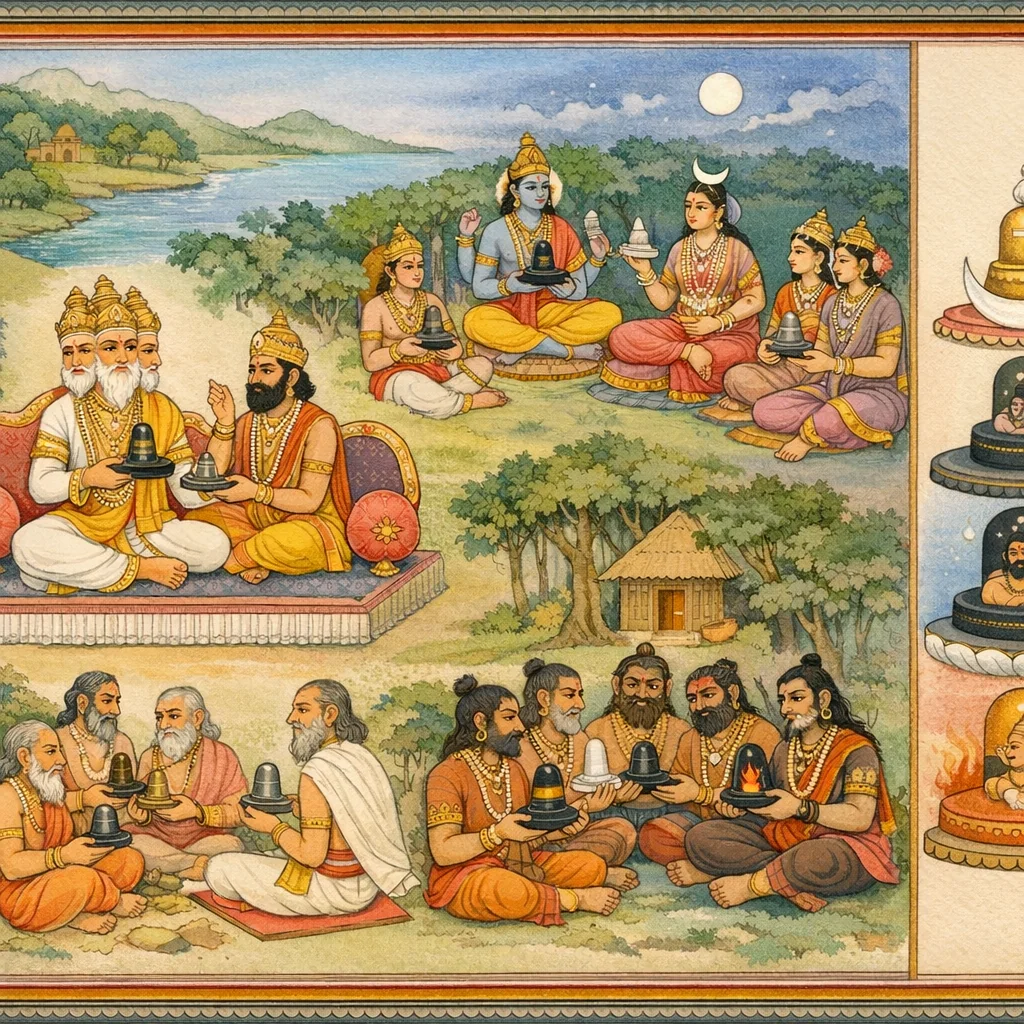
Within the Sūta dialogue, this chapter discloses a distinctive limb of Linga-worship. At Brahmā’s command, Viśvakarmā fashioned Lingas of specific materials according to each deity’s rightful sphere—Viṣṇu received an indranīla Linga, Indra a padmarāga, Varuṇa a sphāṭika (crystal), Soma a mauktika (pearl); the daityas an iron Linga; the Mātṛs a sand Linga; the Rudras an ash Linga; the munis a kuśa-tip Linga, and so on. It then sets forth the classification of “six kinds of Linga” (stone, gem, metal, wood, clay, and temporary) and proclaims the fruits of each. In the contemplative structure of Linga-tattva, Brahmā is at the base, Viṣṇu in the middle, Rudra above, and above him Sadāśiva as Praṇava; the vedī (altar-base) is harmonized with Mahādevī established as the three guṇas. The chapter praises the great merit of installing the Linga (ascent through worlds, increase of tejas) and concludes by distinguishing sakala and niṣkala: for sādhakas the worshipful is the embodied, attributed form, while for yogins the object of meditation is the attributeless Śiva.
Shlokas
Verse 1
इति श्रीलिङ्गमहापुराणे पूर्वभागे ब्रह्मप्रोक्तलिङ्गार्चनविधिर् नाम त्रिसप्ततितमो ऽध्यायः सूत उवाच देइत्य् => लिङ्ग लिङ्गानि कल्पयित्वैवं स्वाधिकारानुरूपतः विश्वकर्मा ददौ तेषां नियोगाद्ब्रह्मणः प्रभोः
Thus, in the Śrī Liṅga-Mahāpurāṇa (Pūrvabhāga), in the seventy-fourth chapter entitled “The Procedure of Liṅga-Worship as taught by Brahmā,” Sūta said: “In this manner Viśvakarmā fashioned various forms of Liṅgas, each suited to the devotee’s eligibility and office, and—by the command of Lord Brahmā—bestowed them upon those beings.”
Verse 2
इन्द्रनीलमयं लिङ्गं विष्णुना पूजितं सदा पद्मरागमयं शक्रो हैमं विश्रवसः सुतः
A Liṅga made of indranīla (blue sapphire) is ever worshipped by Viṣṇu; Śakra (Indra) worships one made of padmarāga (ruby); and the son of Viśravas worships a golden Liṅga—thus each venerates Śiva, the Pati, through the sacred emblem that releases the paśu from the pāśa.
Verse 3
विश्वेदेवास् तथा रौप्यं वसवः कान्तिकं शुभम् आरकूटमयं वायुर् अश्विनौ पार्थिवं सदा
Likewise, silver is associated with the Viśvedevas; the Vasus with auspicious, radiant materials; Vāyu with a copper-alloy; and the Aśvins ever with what is earthy—thus the substances used in sacred installation are aligned with specific divine powers in service of Pati, the Lord.
Verse 4
स्फाटिकं वरुणो राजा आदित्यास्ताम्रनिर्मितम् मौक्तिकं सोमराड् धीमांस् तथा लिङ्गमनुत्तमम्
King Varuṇa, lord of the waters, established a crystal (sphaṭika) Liṅga; the Ādityas established one fashioned of copper; and the wise Soma, the Moon-king, established an unsurpassed Liṅga made of pearl—thus these deities honored the Supreme Pati through distinct sacred emblems.
Verse 5
अनन्ताद्या महानागाः प्रवालकमयं शुभम् दैत्या ह्ययोमयं लिङ्गं राक्षसाश् च महात्मनः
The great Nāgas beginning with Ananta offered an auspicious Liṅga made of coral; the Daityas offered a Liṅga made of iron; and the Rākṣasas too, O great-souled one—each according to their nature—honored the Supreme Pati through the Liṅga.
Verse 6
त्रैलोहिकं गुह्यकाश् च सर्वलोहमयं गणाः चामुण्डा सैकतं साक्षान् मातरश् च द्विजोत्तमाः
O best of the twice-born, there were Gaṇas of the three worlds and the mysterious Guhyakas; there were also hosts of Gaṇas as though their bodies were made of every kind of metal. Cāmuṇḍā too was present, as well as the Sāikatas, and the Mothers (Mātṛkās) themselves—manifest in person.
Verse 7
दारुजं नैरृतिर् भक्त्या यमो मारकतं शुभम् नीलाद्याश् च तथा रुद्राः शुद्धं भस्ममयं शुभम्
With devotion, Nairṛti, guardian of the south‑west, receives the bhasma born of wood; Yama receives the auspicious emerald‑hued bhasma. Likewise, the Rudras beginning with Nīla receive the pure and blessed bhasma—formed of sacred ash.
Verse 8
लक्ष्मीवृक्षमयं लक्ष्मीर् गुहो वै गोमयात्मकम् मुनयो मुनिशार्दूलाः कुशाग्रमयम् उत्तमम्
Lakṣmī is to be worshipped in the form of the Lakṣmī‑tree; Guha (Skanda) indeed is to be fashioned from cow‑dung. O tiger‑like sages, the munis are to be represented in the finest form made from the tips of kuśa‑grass—thus are the ritual substitutes taught for sacred worship.
Verse 9
वामाद्याः पुष्पलिङ्गं तु गन्धलिङ्गं मनोन्मनी सरस्वती च रत्नेन कृतं रुद्रस्य वाग्भवा
Vāmā and the other Śaktis offered a Liṅga made of flowers; Manonmanī offered a Liṅga made of fragrance. Sarasvatī—who is the very power of Rudra’s speech—fashioned a jewel‑made Liṅga and offered it in worship.
Verse 10
दुर्गा हैमं महादेवं सवेदिकमनुत्तमम् उग्रा पिष्टमयं सर्वे मन्त्रा ह्याज्यमयं शुभम्
Durgā fashioned an unsurpassed Mahādeva of gold, complete with a Vedic altar. The fierce Goddess (Ugrā) prepared the entire sacred arrangement from kneaded flour; and the auspicious mantras were offered together with ghee—thus making the rite wholly Vaidika and fit for Śiva’s worship.
Verse 11
वेदाः सर्वे दधिमयं पिशाचाः सीसनिर्मितम् लेभिरे च यथायोग्यं प्रसादाद्ब्रह्मणः पदम्
All the Vedas obtained a state formed of curd, and the Piśācas obtained a state fashioned of lead; and each, according to its fitness, attained its appointed station by the grace of Brahmā. Thus, by ordained allotment, beings move within their respective bounds under the Lord’s dispensation.
Verse 12
बहुनात्र किमुक्तेन चराचरमिदं जगत् शिवलिङ्गं समभ्यर्च्य स्थितमत्र न संशयः
What need is there to say more here? This entire universe, moving and unmoving, stands firmly established through the proper worship of the Śiva-liṅga—of this there is no doubt.
Verse 13
त्य्पेस् ओफ़् लिङ्गस् अच्च्। तो मतेरिअल् षड्विधं लिङ्गमित्याहुर् द्रव्याणां च प्रभेदतः तेषां भेदाश्चतुर्युक्तचत्वारिंशदिति स्मृताः
They declare that the Liṅga is of six kinds, according to distinctions of material substance (dravya). Of these, the traditional divisions are remembered to be forty-four in total.
Verse 14
शैलजं प्रथमं प्रोक्तं तद्धि साक्षाच्चतुर्विधम् द्वितीयं रत्नजं तच्च सप्तधा मुनिसत्तमाः
First, the mountain-born (stone) Liṅga is declared; indeed it is directly of four kinds. Second is the gem-born Liṅga, and that, O best of sages, is of seven kinds.
Verse 15
तृतीयं धातुजं लिङ्गम् अष्टधा परमेष्ठिनः तुरीयं दारुजं लिङ्गं तत्तु षोडशधोच्यते
The third is the metal-made Liṅga; for the Creator (Parameṣṭhin), it is taught in eightfold forms. The fourth is the wooden Liṅga; that, indeed, is declared to be of sixteen kinds.
Verse 16
मृन्मयं पञ्चमं लिङ्गं द्विधा भिन्नं द्विजोत्तमाः षष्ठं तु क्षणिकं लिङ्गं सप्तधा परिकीर्तितम्
O best of the twice-born, the fifth is the earthen (clay-made) Liṅga, which is described as being of two distinct kinds. The sixth is the momentary (temporary) Liṅga, which is proclaimed to be of seven kinds.
Verse 17
श्रीप्रदं रत्नजं लिङ्गं शैलजं सर्वसिद्धिदम् धातुजं धनदं साक्षाद् दारुजं भोगसिद्धिदम्
A Liṅga made of gemstones bestows śrī—auspicious prosperity. A Liṅga made of stone grants all siddhis. A Liṅga made of metal bestows wealth directly, and a Liṅga made of wood brings the accomplishment of worldly enjoyments.
Verse 18
मृन्मयं चैव विप्रेन्द्राः सर्वसिद्धिकरं शुभम् शैलजं चोत्तमं प्रोक्तं मध्यमं चैव धातुजम्
O best of Brahmins, the earthen (clay) Liṅga is auspicious and a bestower of all siddhis. The stone-born Liṅga is declared the highest, while the metal-made Liṅga is said to be of the middle grade.
Verse 19
बहुधा लिङ्गभेदाश् च नव चैव समासतः मूले ब्रह्मा तथा मध्ये विष्णुस्त्रिभुवनेश्वरः
The classifications of the Liṅga are many; yet, in brief, they are summed as nine. In its base is Brahmā, and in its middle is Viṣṇu, the lord of the three worlds; thus the Liṅga is understood as the cosmic seat where all deities abide under Pati (Śiva).
Verse 20
रुद्रोपरि महादेवः प्रणवाख्यः सदाशिवः लिङ्गवेदी महादेवी त्रिगुणा त्रिमयांबिका
Beyond Rudra stands Mahādeva—Sadāśiva, renowned as the Praṇava (Oṃ). And the Great Goddess is the Liṅga’s pedestal (vedī); she is the three guṇas themselves, the Mother who pervades the triad.
Verse 21
तया च पूजयेद्यस्तु देवी देवश् च पूजितौ शैलजं रत्नजं वापि धातुजं वापि दारुजम्
Whoever worships in that manner, worships both the Goddess and the God. He may worship a Liṅga made of stone, or of jewels, or of metal, or even of wood.
Verse 22
मृन्मयं क्षणिकं वापि भक्त्या स्थाप्य फलं शुभम् सुरेन्द्राम्भोजगर्भाग्नियमाम्बुपधनेश्वरैः
Even if one, with devotion, installs a clay Liṅga—even a temporary one—the auspicious fruit of that act is affirmed by the Lords of the directions: Indra, the Lotus-born (Brahmā), Agni, Yama, Varuṇa, Kubera, and Īśāna.
Verse 23
सिद्धविद्याधराहीन्द्रैर् यक्षदानवकिन्नरैः स्तूयमानः सुपुण्यात्मा देवदुन्दुभिनिःस्वनैः
Praised by the foremost among the Siddhas and Vidyādharas, and also by Yakṣas, Dānavas, and Kinnaras, that supremely meritorious one was celebrated amid the resounding beats of the gods’ kettledrums.
Verse 24
भूर्भूवःस्वर्महर्लोकान् क्रमाद् वै जनतः परम् तपः सत्यं पराक्रम्य भासयन् स्वेन तेजसा
Ascending in due order beyond Bhūḥ, Bhuvaḥ, Svaḥ, and Mahar—surpassing even Janas, Tapas, and Satya—He illumines all by His own innate splendour, the sovereign radiance of the Supreme Pati.
Verse 25
लिङ्गस्थापनसन्मार्गनिहितस्वायतासिना आशु ब्रह्माण्डमुद्भिद्य निर्गच्छन्निर्विशङ्कया
With his self-controlled sword set upon the true path of installing the Liṅga, he swiftly split open the cosmic shell and went forth without the least doubt—steadfast in the Lord (Pati) who frees the bound soul (paśu) from bondage (pāśa).
Verse 26
शैलजं रत्नजं वापि धातुजं वापि दारुजम् मृन्मयं क्षणिकं त्यक्त्वा स्थापयेत्सकलं वपुः
Whether fashioned from stone, gemstones, metal, or wood, one should abandon the clay Liṅga—being perishable—and establish the complete, embodied form (sakala-vapuḥ) of the Lord for worship.
Verse 27
विधिना चैव कृत्वा तु स्कन्दोमासहितं शुभम् कुन्दगोक्षीरसंकाशं लिङ्गं यः स्थापयेन्नरः
Whoever, following the prescribed rite, fashions and installs an auspicious Liṅga together with Skanda and Umā—radiant like jasmine blossoms and white as cow’s milk—establishes the mark of Pati (Śiva) in a form fit for worship and grace-bestowal.
Verse 28
नृणां तनुं समास्थाय स्थितो रुद्रो न संशयः दर्शनात्स्पर्शनात्तस्य लभन्ते निर्वृतिं नराः
Assuming a human body, Rudra abides among beings—of this there is no doubt. By merely beholding Him and by His touch, people attain nirvṛti: deep pacification and relief from the bonds of suffering.
Verse 29
तस्य पुण्यं मया वक्तुं सम्यग्युगशतैरपि शक्यते नैव विप्रेन्द्रास् तस्माद् वै स्थापयेत् तथा
O best of Brahmins, even if I were to speak for hundreds of yugas, I still could not fully declare the merit born of that act. Therefore, one should indeed install the Liṅga in that very manner, so that the bound soul (paśu) may turn toward Pati, Lord Śiva, and loosen the bonds (pāśa) through worship.
Verse 30
सर्वेषामेव मर्त्यानां विभोर्दिव्यं वपुः शुभम् सकलं भावनायोग्यं योगिनामेव निष्कलम्
For all mortal beings, the Lord’s divine and auspicious form is to be approached as ‘sakala’ (with parts), fit for contemplative meditation; but for Yogins alone, that very Lord is realized as ‘niṣkala’ (partless), beyond all limiting attributes.
Frequently Asked Questions
Śailaja (stone), Ratnaja (gem), Dhātuja (metal), Dāruja (wood), Mṛnmaya (clay/earth), and Kṣaṇika (temporary/ephemeral), each further subdivided with specified counts.
The chapter assigns material-specific lingas to devas and other beings (e.g., Vishnu—indranīla, Indra—padmarāga, Varuna—sphaṭika, Soma—mauktika, Daityas—iron). This frames worship as adhikāra-based (fitness/role-based) and teaches that devotion can be expressed through diverse, context-appropriate sacred supports.
It indicates that for general devotees the ‘sakala’ (complete, worship-worthy form) is installed and adored, while for yogins the ultimate contemplation is ‘niṣkala’ (formless Shiva), showing ritual worship and contemplative realization as complementary paths.