Adhyaya 62
ग्रहसंख्यावर्णनम् — ध्रुवस्य तपोबलात् ध्रुवस्थानप्राप्तिः
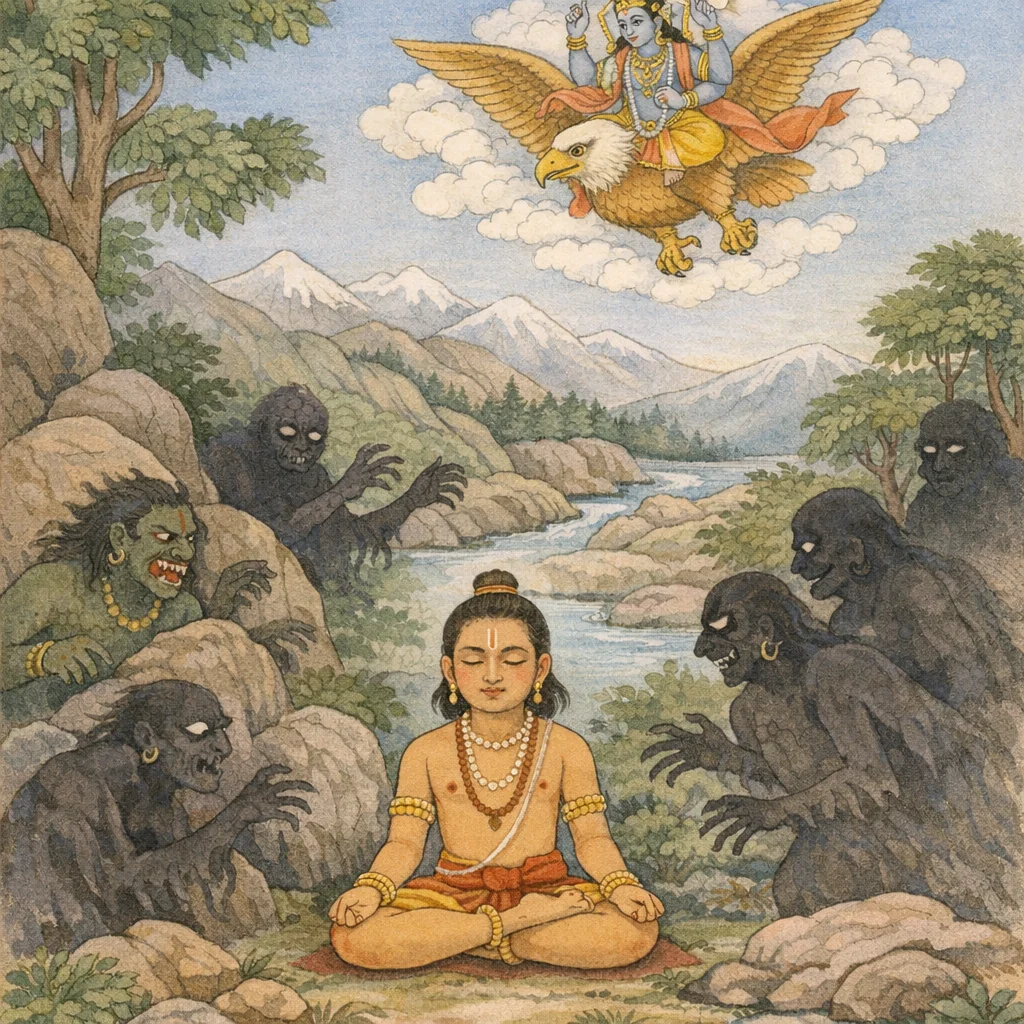
The sages ask Sūta how, by Viṣṇu’s grace, Dhruva became the “peg of the planets,” the unmoving center of the stars. Sūta recounts Mārkaṇḍeya’s tale: Dhruva is born to King Uttānapāda through his two queens; scorned by Suruci, he grieves, heeds his mother Sunīti’s counsel, and goes to the forest. Taught by Viśvāmitra, he performs a year of tapas, living on leaves, roots, and fruits, and japa-ing the Pranava-linked mantra “Namo’stu Vāsudevāya”; rākṣasas, vetālas, and other obstacles cannot shake him. Viṣṇu, riding Garuḍa, appears and, touching him with the conch, grants true knowledge; Dhruva offers praise and seeks a boon, and Viṣṇu bestows the “Dhruva-sthāna.” With devas, gandharvas, and siddhas, Dhruva is स्थापित there with his mother. The phalaśruti declares: by bowing to Vāsudeva one attains Dhruva’s realm/steadfast state, becoming like Dhruva.
Shlokas
Verse 1
इति श्रीलिङ्गमहापुराणे पूर्वभागे ग्रहसंख्यावर्णनं नामैकषष्टितमो ऽध्यायः ऋषय ऊचुः कथं विष्णोः प्रसादाद्वै ध्रुवो बुद्धिमतां वरः मेढीभूतो ग्राहाणां वै वक्तुमर्हसि सांप्रतम्
Thus, in the Śrī Liṅga Mahāpurāṇa, in the Pūrva-bhāga, begins the chapter called “Enumeration of the Planets.” The sages said: “Now tell us—how did Dhruva, the best among the wise, by the grace of Viṣṇu, become the fixed pivot, the cosmic axis for the planets?”}]}
Verse 2
सूत उवाच एतमर्थं मया पृष्टो नानाशास्त्रविशारदः मार्कण्डेयः पुरा प्राह मह्यं शुश्रूषवे द्विजाः
Sūta said: When I inquired into this matter, the sage Mārkaṇḍeya—well-versed in many śāstras—once explained it to me, O twice-born seers, as I listened with devoted attentiveness and a spirit of reverent service.
Verse 3
मार्कण्डेय उवाच सार्वभौमो महातेजाः सर्वशस्त्रभृतां वरः उत्तानपादो राजा वै पालयामास मेदिनीम्
Mārkaṇḍeya said: King Uttānapāda—sovereign of the realm, mighty in splendor, foremost among all who bear arms—truly protected and governed the earth.
Verse 4
तस्य भार्याद्वयम् अभूत् सुनीतिः सुरुचिस् तथा अग्रजायामभूत्पुत्रः सुनीत्यां तु महायशाः
He had two wives—Sunīti and also Suruci. From the elder queen a son was born; and from Sunīti, too, a son of great renown was born.
Verse 5
ध्रुवो नाम महाप्राज्ञः कुलदीपो महामतिः कदाचित् सप्तवर्षे ऽपि पितुरङ्कम् उपाविशत्
There was a boy named Dhruva—highly discerning, the lamp of his lineage, and of great resolve. Once, though only seven years old, he went and sat upon his father’s lap.
Verse 6
सुरुचिस्तं विनिर्धूय स्वपुत्रं प्रीतिमानसा न्यवेशयत्तं विप्रेन्द्रा ह्य् अङ्कं रूपेण मानिता
Suruci pushed him away and, her heart delighted, seated her own son upon her lap. O foremost among the twice-born, she—honored for her beauty—was held in reverence by the eminent.
Verse 7
अलब्ध्वा स पितुर्धीमान् अङ्कं दुःखितमानसः मातुः समीपमागम्य रुरोद स पुनः पुनः
Unable to obtain his wise father’s embrace, his mind oppressed by sorrow, he went near his mother and wept again and again.
Verse 8
रुदन्तं पुत्रमाहेदं माता शोकपरिप्लुता सुरुचिर्दयिता भर्तुस् तस्याः पुत्रो ऽपि तादृशः
The mother, overwhelmed by sorrow, spoke thus to her crying son. She was Suruci, beloved of her husband—and her son too was of the same nature as she.
Verse 9
मम त्वं मन्दभाग्याया जातः पुत्रो ऽप्यभाग्यवान् किं शोचसि किमर्थं त्वं रोदमानः पुनः पुनः
You are my son, born of me—an ill-fated woman—yet you too are unfortunate. Why do you grieve? For what reason do you weep again and again?
Verse 10
संतप्तहृदयो भूत्वा मम शोकं करिष्यसि स्वस्थस्थानं ध्रुवं पुत्र स्वशक्त्या त्वं समाप्नुयाः
With a heart scorched by anguish, you will become the cause of my sorrow. Yet, O son, by your own inner power you shall surely attain your firm, rightful station—your stable abode.
Verse 11
इत्युक्तः स तु मात्रा वै निर्जगाम तदा वनम् विश्वामित्रं ततो दृष्ट्वा प्रणिपत्य यथाविधि
Thus instructed by his mother, he then set out for the forest. On seeing Viśvāmitra, he bowed down in full prostration in the proper manner, honouring the guru and the sacred law that purifies the bound soul (paśu) through disciplined conduct.
Verse 12
उवाच प्राञ्जलिर्भूत्वा भगवन् वक्तुमर्हसि सर्वेषामुपरिस्थानं केन प्राप्स्यामि सत्तम
With palms joined in reverence, he said: “O Bhagavān, deign to tell me—by what means, O best among the virtuous, shall I attain the station that stands above all?”
Verse 13
पितुरङ्के समासीनं माता मां सुरुचिर्मुने व्यधूनयत्स तं राजा पिता नोवाच किंचन
O sage, when I was seated on my father’s lap, my mother Suruci pushed me away; and the king—my father—said nothing to her at all.
Verse 14
एतस्मात् कारणाद् ब्रह्मंस् त्रस्तो ऽहं मातरं गतः सुनीतिराह मे माता मा कृथाः शोकमुत्तमम्
“For this very reason, O Brahmin, I became afraid and went to my mother. My mother Sunīti said to me: ‘Do not give yourself over to the deepest sorrow.’”
Verse 15
स्वकर्मणा परं स्थानं प्राप्तुमर्हसि पुत्रक तस्या हि वचनं श्रुत्वा स्थानं तव महामुने
“By your own righteous action you are fit to attain the supreme abode, dear child. Indeed, O great sage, having heard her command, that destined station becomes yours.”
Verse 16
प्राप्तो वनमिदं ब्रह्मन्न् अद्य त्वां दृष्टवान्प्रभो तव प्रसादात् प्राप्स्ये ऽहं स्थानमद्भुतमुत्तमम्
O Brahman, today I have reached this forest and beheld you, O Lord. By your grace alone, I shall attain the wondrous, supreme abode.
Verse 17
इत्युक्तः स मुनिः श्रीमान् प्रहसन्न् इदम् अब्रवीत् राजपुत्र शृणुष्वेदं स्थानमुत्तममाप्स्यसि
Thus addressed, the illustrious sage—smiling—said: “O prince, listen to this; by it you shall attain the highest abode.”
Verse 18
आराध्य जगतामीशं केशवं क्लेशनाशनम् दक्षिणाङ्गभवं शंभोर् महादेवस्य धीमतः
Having worshipped Keśava—the Lord of the worlds, the destroyer of afflictions—who is manifested as the right-side limb of Śambhu, the wise Mahādeva bestows grace.
Verse 19
जप नित्यं महाप्राज्ञ सर्वपापविनाशनम् इष्टदं परमं शुद्धं पवित्रममलं परम्
O greatly wise one, recite it daily—this japa destroys all sins, bestows what is cherished, and is supremely pure: most sanctifying, stainless, and transcendent.
Verse 20
ब्रूहि मन्त्रमिमं दिव्यं प्रणवेन समन्वितम् नमो ऽस्तु वासुदेवाय इत्येवं नियतेन्द्रियः
With the senses restrained, one should recite this divine mantra joined with the Praṇava: “Om—salutations to Vāsudeva.” Thus steadied in discipline, the paśu (bound soul) is readied for bhakti, culminating in the recognition of the Supreme Lord (Pati).
Verse 21
ध्यायन्सनातनं विष्णुं जपहोमपरायणः इत्युक्तः प्रणिपत्यैनं विश्वामित्रं महायशाः
Meditating on the eternal Viṣṇu, devoted to japa and the fire-offering (homa), the illustrious one—having thus spoken—bowed down to the great-souled Viśvāmitra.
Verse 22
प्राङ्मुखो नियतो भूत्वा जजाप प्रीतमानसः शाकमूलफलाहारः संवत्सरमतन्द्रितः
Facing east, disciplined and self-restrained, he performed japa with a mind filled with bhakti. Living only on vegetables, roots, and fruits, he continued this practice for a full year without negligence—steadfastly turning the paśu (individual soul) toward Pati, Lord Śiva.
Verse 23
जजाप मन्त्रमनिशम् अजस्रं स पुनः पुनः वेताला राक्षसा घोराः सिंहाद्याश् च महामृगाः
He performed unbroken japa of the mantra—unceasingly, again and again, without pause. Then dreadful vetālas and rākṣasas, and great beasts—lions and the like—appeared as terrifying impediments; yet before steadfast mantra-practice they are rendered powerless.
Verse 24
तमभ्ययुर्महात्मानं बुद्धिमोहाय भीषणाः जपन् स वासुदेवेति न किंचित् प्रत्यपद्यत
The dreadful ones rushed upon that great-souled being to bewilder his discernment; yet he, repeating the mantra “Vāsudeva,” did not yield in the least.
Verse 25
सुनीतिर् अस्य या माता तस्या रूपेण संवृता पिशाचि समनुप्राप्ता रुरोद भृशदुःखिता
Then a piśācī came, disguising herself in the very form of Sunīti—his mother—and, overwhelmed with intense sorrow, she wept aloud.
Verse 26
मम त्वमेकः पुत्रो ऽसि किमर्थं क्लिश्यते भवान् मामनाथामपहाय तप आस्थितवानसि
“You are my only son. Why do you afflict yourself in this way? Abandoning me—left without refuge—you have taken to austerity (tapas).”}]}
Verse 27
एवमादीनि वाक्यानि भाषमाणां महातपाः अनिरीक्ष्यैव हृष्टात्मा हरेर्नाम जजाप सः
As such words were being spoken, the great ascetic—without even looking back—his heart brimming with joy, began to repeat in japa the Name of Hari.
Verse 28
ततः प्रशेमुः सर्वत्र विघ्नरूपाणि तत्र वै ततो गरुडमारुह्य कालमेघसमद्युतिः
Then, in that place, the obstacle-forms everywhere were pacified. Thereafter, the Lord, dark as a rain-cloud, mounted Garuḍa and departed—showing that when Pati (the Lord) is propitiated, the pāśa-bonds that arise as vighnas subside of themselves.
Verse 29
सर्वदेवैः परिवृतः स्तूयमानो महर्षिभिः आययौ भगवान्विष्णुः ध्रुवान्तिकम् अरातिहा
Surrounded by all the gods and praised by the great seers, the Blessed Lord Viṣṇu—destroyer of foes—came into the presence of Dhruva. In the Śaiva understanding, even such divine descents unfold by the will of Pati (Śiva), who alone loosens the pāśa-bonds and grants steadiness to the paśu (soul).
Verse 30
समागतं विलोक्याथ को ऽसावित्येव चिन्तयन् पिबन्निव हृषीकेशं नयनाभ्यां जगत्पतिम्
Then, seeing the Lord arrive, he reflected, “Who indeed is this?”—and with his two eyes, as though drinking Him in, he beheld Hṛṣīkeśa, the Lord of the worlds. In that very beholding, the bound paśu (soul) is drawn toward the Supreme Pati, as the senses turn inward and recognition awakens.
Verse 31
जपन् स वासुदेवेति ध्रुवस्तस्थौ महाद्युतिः शङ्खप्रान्तेन गोविन्दः पस्पर्शास्यं हि तस्य वै
Dhruva—radiant with great splendor—stood absorbed in the mantra “Vāsudeva.” Govinda touched Dhruva’s mouth with the tip of His conch, bestowing sanctified speech and the power of realization. In Śaiva Siddhānta terms, this marks the descent of grace (anugraha) by Pati, loosening the paśu’s pāśa-bonds and turning japa into liberating knowledge.
Verse 32
ततः स परमं ज्ञानम् अवाप्य पुरुषोत्तमम् तुष्टाव प्राञ्जलिर्भूत्वा सर्वलोकेश्वरं हरिम्
Then, having attained the supreme knowledge of the Purushottama, he—standing with joined palms in añjali—praised Hari, the Lord who rules over all the worlds.
Verse 33
प्रसीद देवदेवेश शङ्खचक्रगदाधर लोकात्मन् वेदगुह्यात्मन् त्वां प्रपन्नो ऽस्मि केशव
Be gracious, O Devadeveśa, Lord of the gods—bearer of conch, discus, and mace; O Soul of the worlds, whose true nature is the hidden essence of the Veda. I have taken refuge in You, O Keśava.
Verse 34
न विदुस्त्वां महात्मानं सनकाद्या महर्षयः तत्कथं त्वामहं विद्यां नमस्ते भुवनेश्वर
Even the great sages—Sanaka and the rest—do not truly know You, O Great-Souled One. How then could I comprehend You? Salutations to You, O Lord of the worlds.
Verse 35
तमाह प्रहसन्विष्णुर् एहि वत्स ध्रुवो भवान् स्थानं ध्रुवं समासाद्य ज्योतिषाम् अग्रभुग् भव
Smiling, Viṣṇu said to him: “Come, dear child. You shall indeed become Dhruva. Attaining the fixed, steadfast station, become the foremost among the luminaries.”
Verse 36
मात्रा त्वं सहितस्तत्र ज्योतिषां स्थानमाप्नुहि मत्स्थानमेतत्परमं ध्रुवं नित्यं सुशोभनम्
Accompanied by your mother, attain there the station among the celestial lights. This is My own supreme abode—Dhruva, fixed, eternal, and exceedingly radiant.
Verse 37
तपसाराध्य देवेशं पुरा लब्धं हि शङ्करात् वासुदेवेति यो नित्यं प्रणवेन समन्वितम्
Having worshipped the Lord of the gods through austerity, he formerly received from Śaṅkara the sacred utterance: the ever-recited formula “Vāsudeva,” conjoined with the praṇava “Oṃ”.
Verse 38
नमस्कारसमायुक्तं भगवच्छब्दसंयुतम् जपेदेवं हि यो विद्वान् ध्रुवं स्थानं प्रपद्यते
The wise person who performs japa in this manner—joined with reverent prostration and accompanied by the utterance “Bhagavān”—certainly attains the steadfast, unchanging state.
Verse 39
ततो देवाः सगन्धर्वाः सिद्धाश् च परमर्षयः मात्रा सह ध्रुवं सर्वे तस्मिन् स्थाने न्यवेशयन्
Then the Devas—together with the Gandharvas, the Siddhas, and the supreme seers—installed Dhruva, along with his mother, in that very place, establishing him in the ordained station by divine assent.
Verse 40
विष्णोराज्ञां पुरस्कृत्य ज्योतिषां स्थानमाप्तवान् एवं ध्रुवो महातेजा द्वादशाक्षरविद्यया
Honouring Viṣṇu’s command and placing it foremost, Dhruva attained the station among the celestial luminaries. Thus that greatly radiant Dhruva reached his exalted state through the twelve-syllabled sacred formula (dvādaśākṣara-vidyā).
Verse 41
अवाप महतीं सिद्धिम् एतत्ते कथितं मया
He attained great siddhi (spiritual accomplishment). Thus has this been explained to you by me.
Verse 42
सूत उवाच तस्माद्यो वासुदेवाय प्रणामं कुरुते नरः स याति ध्रुवसालोक्यं ध्रुवत्वं तस्य तत्तथा
Sūta said: Therefore, the man who bows in reverence to Vāsudeva attains Dhruva’s realm (sālokya) and gains the state of steadfast permanence (dhruvatva); for him it is indeed so.
Frequently Asked Questions
Dhruva is instructed to chant a divine mantra ‘प्रणवेन समन्वितम्’—centered on ‘नमोऽस्तु वासुदेवाय’—with disciplined senses (नियतेन्द्रिय), constant japa, and a pure austere diet.
Narratively it is the supreme, stable astral station among the luminaries (ज्योतिषाम् अग्रभुक्). Symbolically it represents unwavering steadiness born of tapas, single-pointed devotion, and divine grace—an inner ‘fixedness’ that supports higher realization.