Adhyaya 34
Adhyaya 34: भस्ममहात्म्यं—अग्नीषोमात्मक-शिवतत्त्वं तथा पाशुपतव्रतप्रशंसा
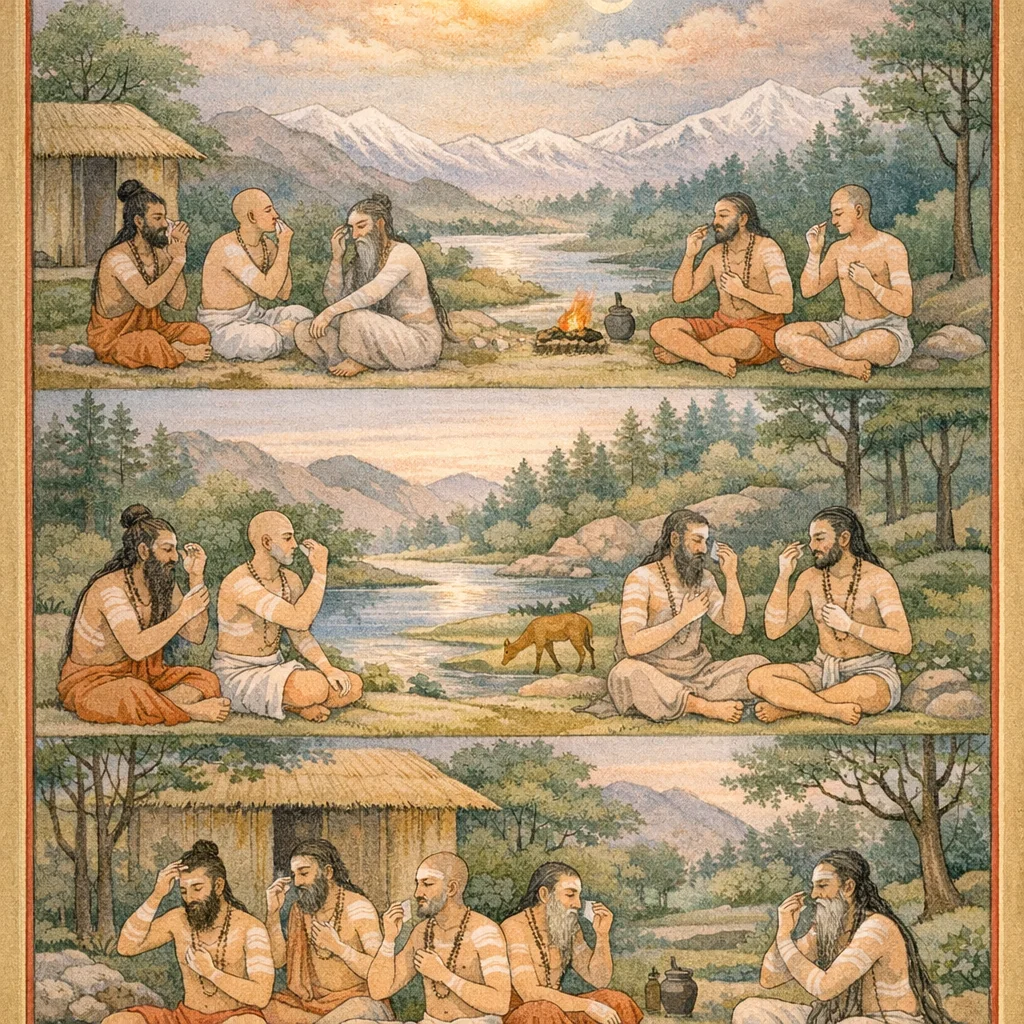
Śiva reveals Himself as the Agni–Soma essence and explains the origin and purifying power of bhasma (sacred ash): the world is burned by fire and becomes ash, the most holy; when revered with auspicious intent as “bhasma,” it destroys all sins. Bhasma is called “My potency,” a representation of Śiva-Śakti, and its protective use in homes, even in a lying-in chamber, is shown as accepted custom. By bathing with bhasma one becomes pure in soul, conquers anger and the senses, draws near to Śiva, and does not return to rebirth, turning toward liberation. The Paśupata vow and its yoga are then praised as pre-established and unsurpassed, and it is taught that the inner “covering”—forbearance, steadfastness, ahiṃsā, dispassion, and equality in honor and dishonor—is superior to outer garments. Thrice-daily bhasma bathing burns sin, brings connection with Śaiva gaṇas, and points to the path of siddhi or immortality. Finally, the text concludes that Śiva’s devoted ascetics—matted-haired, shaven, naked, or unkempt—are not to be reviled but to be honored as Śiva Himself.
Shlokas
Verse 1
इति श्रीलिङ्गमहापुराणे पूर्वभागे ऋषिवाक्यं नाम त्रयस्त्रिंशो ऽध्यायः श्रीभगवानुवाच एतद्वः सम्प्रवक्ष्यामि कथा सर्वस्वमद्य वै अग्निर्ह्यहं सोमकर्ता सोमश्चाग्निमुपाश्रितः
Thus, in the Śrī Liṅga Mahāpurāṇa, in the Pūrva-bhāga, in the section called “Ṛṣivākya,” chapter thirty-three, the Blessed Lord said: “Today I shall fully declare to you this narrative, the very essence of the teaching. I indeed am Agni, the maker of Soma; and Soma, in turn, abides dependent upon Agni.”
Verse 2
कृतमेतद्वहत्यग्निर् भूयो लोकसमाश्रयात् असकृत्त्वग्निना दग्धं जगत् स्थावरजङ्गमम्
Having accomplished that act, Agni blazes forth again, taking refuge in the worlds; and repeatedly, by that very fire, the entire universe—both the immovable and the moving—is burned up. In this cyclic burning, the pashu-bound cosmos is withdrawn by Kāla’s flame under the sovereignty of Pati, Śiva.
Verse 3
भस्मसाद्विहितं सर्वं पवित्रमिदमुत्तमम् भस्मना वीर्यमास्थाय भूतानि परिषिञ्चति
All this—when consecrated into the state of sacred ash (bhasma)—becomes the highest purifier. Endowed with the potency of bhasma, one sanctifies all beings by sprinkling or anointing them, for it bears the power of Śiva as Pati, who burns away the pāśa of impurity.
Verse 4
अग्निकार्यं च यः कृत्वा करिष्यति त्रियायुषम् भस्मना मम वीर्येण मुच्यते सर्वकिल्बिषैः
Whoever, having performed the fire-rite (agni-kārya), thereafter observes the vow for the span of three lifetimes—by that sacred ash, infused with My divine potency, is released from all sins. Thus the paśu, purified of pāśa, becomes fit for the grace of Pati.
Verse 5
भासत इत्येव यद्भस्म शुभं भावयते च यत् भक्षणात् सर्वपापानां भस्मेति परिकीर्तितम्
It is called “bhasma” because it shines (bhāsata) and is contemplated as auspicious; and because, by consuming—burning up—all sins, it is praised as “bhasma”, that which reduces impurities to ash.
Verse 6
ऊष्मपाः पितरो ज्ञेया देवा वै सोमसंभवाः अग्नीषोमात्मकं सर्वं जगत्स्थावरजङ्गमम्
Know the Pitṛs (ancestral beings) as “drinkers of heat”, and the Devas indeed as born of Soma. All this universe—both the immovable and the moving—is of the very nature of Agni and Soma.
Verse 7
अहमग्निर्महातेजाः सोमश्चैषा महांबिका अहमग्निश् च सोमश् च प्रकृत्या पुरुषः स्वयम्
“I am Agni, of immense radiance; and this Great Mother is Soma. I myself am both Agni and Soma—indeed, by my own nature I am the Puruṣa, the Supreme Conscious Lord Himself.”
Verse 8
तस्माद्भस्म महाभागा मद्वीर्यमिति चोच्यते स्ववीर्यं वपुषा चैव धारयामीति वै स्थितिः
Therefore, O greatly fortunate ones, this sacred ash is called “My vīrya, My potency.” The established truth is this: “I uphold My own power within My very body.”
Verse 9
तदाप्रभृति लोकेषु रक्षार्थमशुभेषु च भस्मना क्रियते रक्षा सूतिकानां गृहेषु च
From that time onward, in the worlds, for the sake of protection—and also against inauspicious influences—protection is performed by means of sacred ash; likewise, in the homes of women who have just given birth, ash is employed as a protective rite.
Verse 10
भस्मस्नानविशुद्धात्मा जितक्रोधो जितेन्द्रियः मत्समीपं समागम्य न भूयो विनिवर्तते
One whose inner being is purified by the ash-bath, who has conquered anger and mastered the senses—having come near to Me—does not return again (to bondage and repeated wandering).
Verse 11
व्रतं पाशुपतं योगं कापिलं चैव निर्मितम् पूर्वं पाशुपतं ह्येतन् निर्मितं तदनुत्तमम्
He established the Pāśupata vow and the Kapila yoga. Indeed, this Pāśupata discipline was instituted first; it is the unsurpassed path that leads the bound soul (paśu) from pāśa to the Lord, Paśupati.
Verse 12
शेषाश्चाश्रमिणः सर्वे पश्चात्सृष्टाः स्वयंभुवा सृष्टिरेषा मया सृष्टा लज्जामोहभयात्मिका
Thereafter, all the remaining āśramins (those fit for the disciplines of the āśramas) were created by Svayambhū (Brahmā). This creation, brought forth by Me, is characterized by lajjā (modesty), moha (delusion), and bhaya (fear)—the very marks of bound souls (paśu) under the grip of pāśa.
Verse 13
नग्ना एव हि जायन्ते देवता मुनयस् तथा ये चान्ये मानवा लोके सर्वे जायन्त्यवाससः
Indeed, the gods and the sages are born unclothed; and so too all other human beings in the world—everyone is born without garments.
Verse 14
इन्द्रियैरजितैर्नग्नो दुकूलेनापि संवृतः तैरेव संवृतैर्गुप्तो न वस्त्रं कारणं स्मृतम्
One whose senses are unconquered is truly naked, even if covered in fine cloth. But one who is restrained and guarded by those very senses is well-protected; it is not clothing that is held to be the real cause (of modesty and purity).
Verse 15
क्षमा धृतिरहिंसा च वैराग्यं चैव सर्वशः तुल्यौ मानावमानौ च तदावरणमुत्तमम्
Forbearance, steadfastness, non-violence, and universal dispassion—along with viewing honor and dishonor as equal: this is the supreme protective veil (āvaraṇa) for the seeker.
Verse 16
भस्मस्नानेन दिग्धाङ्गो ध्यायते मनसा भवम् यद्यकार्यसहस्राणि कृत्वा यः स्नाति भस्मना
Smeared over the body through a bath of sacred ash, one should contemplate Bhava (Śiva) in the mind; even if a person has committed thousands of improper acts, the one who bathes with bhasma is purified.
Verse 17
तत्सर्वं दहते भस्म यथाग्निस्तेजसा वनम् तस्माद् यत्नपरो भूत्वा त्रिकालमपि यः सदा
That (disciplined Śaiva practice) burns all of it into ash, just as fire—by its own blazing power—consumes a forest. Therefore, one should become steadfast in effort and, at the three daily junctions, continually perform the observance.
Verse 18
भस्मना कुरुते स्नानं गाणपत्यं स गच्छति समाहृत्य क्रतून् सर्वान् गृहीत्वा व्रतमुत्तमम्
He who bathes with bhasma, the sacred ash, attains the state of belonging to Śiva’s Gaṇas (gāṇapatya). As though he had gathered the fruits of all Vedic sacrifices, he upholds the supreme vow and, by the Śaiva path, draws near to Pati, the Lord.
Verse 19
ध्यायन्ति ये महादेवं लीलासद्भावभाविताः उत्तरेणार्यपन्थानं ते ऽमृतत्वमवाप्नुयुः
Those who meditate upon Mahādeva, their inner being suffused with the true intent of his divine līlā, and who proceed by the higher, noble path (ārya-panthā), attain amṛtatva—the deathless state—through the grace of Pati, Lord of beings.
Verse 20
दक्षिणेन च पन्थानं ये श्मशानानि भेजिरे अणिमा गरिमा चैव लघिमा प्राप्तिरेव च
Those who took the southern path and resorted to the cremation-grounds attained the yogic perfections: aṇimā (becoming minute), garimā (becoming heavy), laghimā (becoming light), and prāpti (the power of attainment).
Verse 21
इच्छा कामावसायित्वं तथा प्राकाम्यमेव च ईक्षणेन च पन्थानं ये श्मशानानि भेजिरे अणिमा गरिमा चैव लघिमा प्राप्तिरेव च
They attained sovereign mastery of will (icchā) and the unfailing fulfillment of intention (kāmāvasāyitva), along with prākāmya, free access to desired states. By mere glance they could determine the path and move through the cremation-grounds without obstruction. They also gained the yogic perfections: aṇimā, garimā, laghimā, and prāpti.
Verse 22
इन्द्रादयस् तथा देवाः कामिकव्रतमास्थिताः ऐश्वर्यं परमं प्राप्य सर्वे प्रथिततेजसः
Indra and the other gods, having undertaken the Kāmika observance (Kāmika-vrata), attained the supreme aiśvarya, the highest lordly power; all of them became renowned for their radiance, through the grace of Pati (Śiva), bestower of sovereignty and splendor.
Verse 23
व्यपगतमदमोहमुक्तरागस् तमोरजोदोषविवर्जितस्वभावः परिभवमिदमुत्तमं विदित्वा पशुपतियोगपरो भवेत्सदैव
Casting off pride and delusion, freed from attachment, and established in a nature untouched by the faults of tamas and rajas, one should know the supreme worthlessness of worldly rank; and always become devoted to Pāśupata Yoga, seeking Pati—Lord Śiva—who alone releases the paśu (soul) from the pāśa (bond).
Verse 24
इमं पाशुपतं ध्यायन् सर्वपापप्रणाशनम् यः पठेच्च शुचिर्भूत्वा श्रद्दधानो जितेन्द्रियः
Whoever, having become pure, self-controlled, and full of faith, recites this Pāśupata teaching while meditating upon it—the destroyer of all sins—is freed from the bonds that bind the paśu (individual soul) and is led toward the grace of Pati, Lord Śiva.
Verse 25
सर्वपापविशुद्धात्मा रुद्रलोकं स गच्छति ते सर्वे मुनयः श्रुत्वा वसिष्ठाद्या द्विजोत्तमाः
He whose inner self has been purified of all sins attains Rudra’s world. Hearing this, all those sages—the foremost among the twice-born, led by Vasiṣṭha—received the teaching with reverence.
Verse 26
भस्मपाण्डुरदिग्धाङ्गा बभूवुर्विगतस्पृहाः रुद्रलोकाय कल्पान्ते संस्थिताः शिवतेजसा
Smeared all over with sacred ash (bhasma) and thus pale in hue, they became free from craving; and at the end of the aeon they were established in Rudra’s world, upheld by the radiance (tejas) of Śiva.
Verse 27
तस्मान्न निन्द्याः पूज्याश्च विकृता मलिना अपि रूपान्विताश् च विप्रेन्द्राः सदा योगीन्द्रशङ्कया
Therefore, the foremost Brahmanas should never be reviled; they should be honored—whether deformed, impure, or even endowed with beauty—always out of reverence and cautious awe for the power of great yogins.
Verse 28
बहुना किं प्रलापेन भवभक्ता द्विजोत्तमाः संपूज्याः सर्वयत्नेन शिववन्नात्र संशयः
What is the use of much talk? O best of the twice-born, the devotees of Bhava (Śiva) should be honored with every effort—indeed, as one honors Śiva Himself; of this there is no doubt.
Verse 29
मलिनाश्चैव विप्रेन्द्रा भवभक्ता दृढव्रताः दधीचस्तु यथा देवदेवं जित्वा व्यवस्थितः
O best of Brahmins, though outwardly dust-stained and austere, they were devotees of Bhava (Śiva), firm in their vows—just as Dadhīci, having conquered even the “god of gods” through tapas, stood unwavering in his established resolve.
Verse 30
नारायणं तथा लोके रुद्रभक्त्या न संशयः तस्मात्सर्वप्रयत्नेन भस्मदिग्धतनूरुहाः
In this world, even Nārāyaṇa is known as devoted to Rudra—of this there is no doubt. Therefore, with every effort, let the votaries bear the marks of Śiva, keeping the body and its hairs smeared with sacred ash (bhasma).
Verse 31
जटिनो मुण्डिनश्चैव नग्ना नानाप्रकारिणः संपूज्याः शिववन्नित्यं मनसा कर्मणा गिरा
Those with matted locks, those with shaven heads, and those who are unclad—ascetics of many outward types—are to be honored always as one would honor Śiva Himself, by mind, by deed, and by speech.
Frequently Asked Questions
Because the text frames Bhasma as the purified residue of cosmic Agni—an emblem of Shiva’s transformative power that burns impurities; thus wearing/applying Bhasma signifies bearing Shiva’s potency and protection.
Trikala-bhasma-snāna, jita-krodha (conquest of anger), jita-indriya (sense control), Bhava-dhyāna, and inner ‘coverings’ like kṣamā, dhṛti, ahiṃsā, vairāgya, and equanimity toward honor/disgrace.
It discourages condemnation based on external form, asserting that steadfast Shiva-bhakti and yoga-intent make such devotees worthy of worship ‘like Shiva’ regardless of being vikṛta or malina.