Adhyaya 31
देवदारुवनौकसां प्रति ब्रह्मोपदेशः—लिङ्गलक्षण-प्रतिष्ठा-विधिः, शिवमायारूपदर्शनं, स्तुतिः
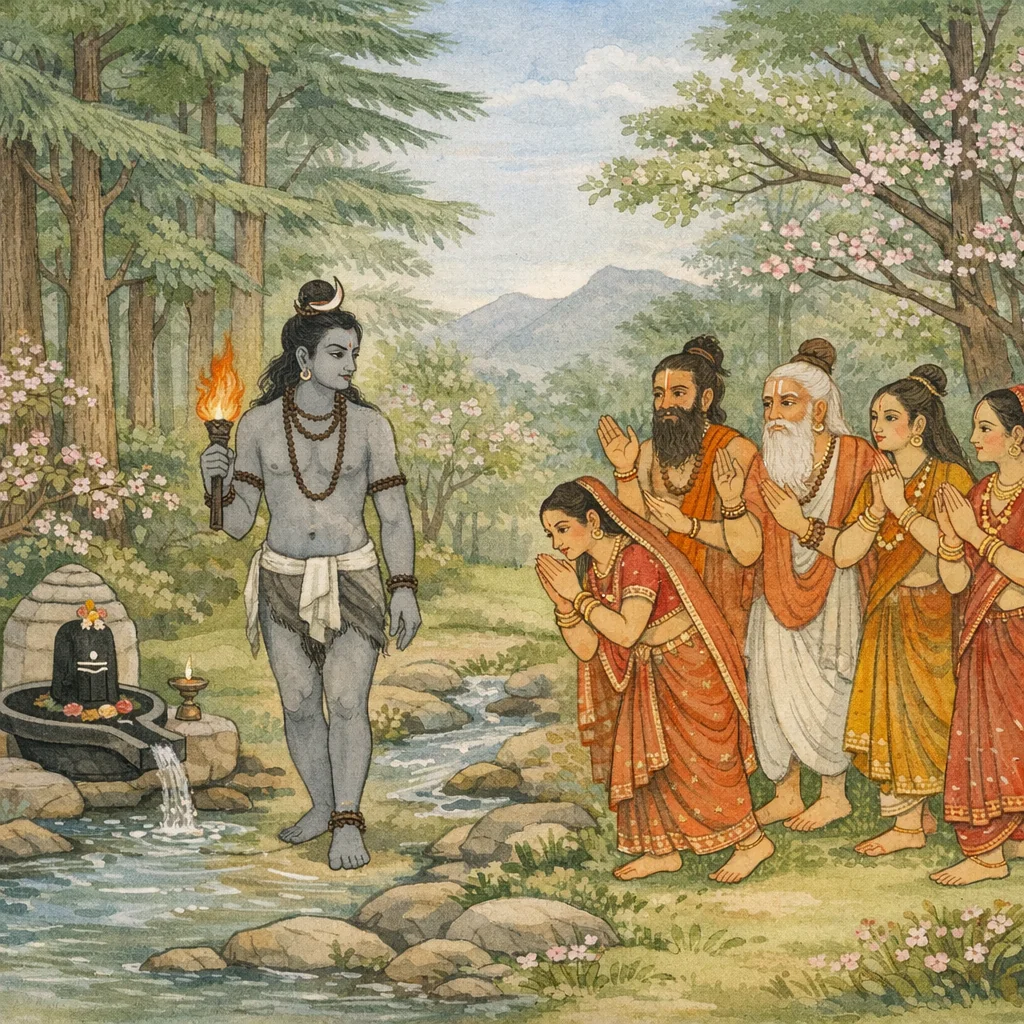
Sanatkumara asks how the sages of Devadaruvana gained refuge through Shiva’s grace. The account replies with Brahma’s teaching: Mahadeva alone is the Supreme Lord, ruler of gods, rishis, and pitrs; at pralaya he becomes Time (Kala), withdraws beings, and by his own tejas recreates the world. The chapter then gives ritual guidance: a qualified worshipper should fashion a Shiva Linga with proper marks and proportions—round, square, eight-angled, or sixteen-angled—set a proportionate vedika with a gomukhi outlet and surrounding pattika, choose auspicious materials, install it correctly, place a kalasha at the center, and perform consecration, abhisheka, and sprinkling with pure substances. The sages practice austerity and worship for a year; in spring Shiva appears in a deliberately startling guise—ash-smeared, naked, carrying a firebrand, acting paradoxically—revealing his yogamaya. With their families they worship, confess faults of body, speech, and mind, and praise Rudra’s cosmic forms and sovereignty. Pleased, Shiva grants divine sight to behold his true three-eyed form, showing that darshana follows humility and right upasana.
Shlokas
Verse 1
इति श्रीलिङ्गमहापुराणे पूर्वभागे त्रिंशो ऽध्यायः सनत्कुमार उवाच कथं भवप्रसादेन देवदारुवनौकसः प्रपन्नाः शरणं देवं वक्तुमर्हसि मे प्रभो
Thus, in the Śrī Liṅga Mahāpurāṇa, in the Pūrva-bhāga, the thirtieth chapter concludes. Sanatkumāra said: “O Lord, please tell me how, by the grace of Bhava (Śiva), the dwellers of the Devadāru forest surrendered and took refuge in the Divine Lord.”
Verse 2
शैलादिरुवाच तानुवाच महाभागान् भगवान् आत्मभूः स्वयम् देवदारुवनस्थांस्तु तपसा पावकप्रभान्
Śailādi said: Then the self-born Lord Brahmā (Ātmabhū) himself addressed those great-souled sages dwelling in the Devadāru forest—ascetics radiant like fire through the power of their austerities (tapas).
Verse 3
पितामह उवाच एष देवो महादेवो विज्ञेयस्तु महेश्वरः न तस्मात्परमं किंचित् पदं समधिगम्यते
Pitāmaha (Brahmā) said: “He alone is to be known as God—Mahādeva, Maheśvara, the Great Lord. Beyond Him no higher state, goal, or abode can be attained.”}]}
Verse 4
देवानां च ऋषीनां च पितॄणां चैव स प्रभुः सहस्रयुगपर्यन्ते प्रलये सर्वदेहिनः
He alone is the Sovereign (Pati) of the Devas, the Ṛṣis, and the Pitṛs; and at the dissolution at the end of a thousand yugas, He presides over the destiny of all embodied beings.
Verse 5
संहरत्येष भगवान् कालो भूत्वा महेश्वरः एष चैव प्रजाः सर्वाः सृजत्येकः स्वतेजसा
Becoming Mahēśvara as Time itself, this Blessed Lord withdraws and dissolves the cosmos; and that very One—alone, by His own radiance—again brings forth all beings. In Śaiva Siddhānta, He is Pati, sovereign over both sṛṣṭi and saṃhāra, while the paśus move within His order.
Verse 6
एष चक्री च वज्री च श्रीवत्सकृतलक्षणः योगी कृतयुगे चैव त्रेतायां क्रतुर् उच्यते
He bears the discus and the thunderbolt, and is marked with the auspicious Śrīvatsa. In the Kṛta Yuga he is spoken of as the supreme Yogin; in the Tretā Yuga he is called Kratu, the very embodiment of Vedic sacrifice.
Verse 7
द्वापरे चैव कालाग्निर् धर्मकेतुः कलौ स्मृतः रुद्रस्य मूर्तयस्त्वेता ये ऽभिध्यायन्ति पण्डिताः
In the Dvāpara age, Rudra is remembered as Kālāgni, and in the Kali age He is known as Dharmaketu. These are the manifested forms of Rudra upon which the learned contemplate—recognizing the one Pati appearing through distinct yuga-forms to govern dharma and burn away pāśa (bondage).
Verse 8
चतुरस्रं बहिश्चान्तर् अष्टास्रं पिण्डिकाश्रये वृत्तं सुदर्शनं योग्यम् एवं लिङ्गं प्रपूजयेत्
Let the Liṅga be worshipped in this proper form: outwardly it should be four-sided; within, it should be eight-angled; firmly supported upon the piṇḍikā (base); and circular, auspicious to behold, and fit for ritual use—thus should one duly perform worship of the Liṅga.
Verse 9
तमो ह्यग्नी रजो ब्रह्मा सत्त्वं विष्णुः प्रकाशकम् मूर्तिरेका स्थिता चास्य मूर्तयः परिकीर्तिताः
Tamas is indeed Agni; rajas is Brahmā; and sattva—the illumining—is Viṣṇu. Yet His reality is one and ever-abiding; these three are proclaimed as His manifested forms.
Verse 10
यत्र तिष्ठति तद्ब्रह्म योगेन तु समन्वितम् तस्माद्धि देवदेवेशम् ईशानं प्रभुमव्ययम्
Wherever That (Supreme Reality) abides, there indeed is Brahman—inseparably united with Yoga. Therefore one should revere Īśāna, the Lord of the lords of the gods, the sovereign Master who is imperishable.
Verse 11
आराधयन्ति विप्रेन्द्रा जितक्रोधा जितेन्द्रियाः लिङ्गं कृत्वा यथान्यायं सर्वलक्षणसंयुतम्
The foremost Brahmins—having conquered anger and mastered the senses—worship (Śiva) by fashioning the Liṅga in the proper, prescribed manner, endowed with all the auspicious marks (of a valid Liṅga).
Verse 12
अङ्गुष्ठमात्रं सुशुभं सुवृत्तं सर्वसंमतम् समनाभं तथाष्टास्रं षोडशास्रम् अथापि वा
A Śiva-liṅga may be made the size of a thumb—beautiful and well-rounded, approved by all. It should be proportionate with a central navel-like mark, and it may be fashioned with eight edges, or even with sixteen edges.
Verse 13
सुवृत्तं मण्डलं दिव्यं सर्वकामफलप्रदम् वेदिका द्विगुणा तस्य समा वा सर्वसंमता
One should fashion a perfectly circular, divine maṇḍala, bestowing the fruits of all desired aims. The altar-platform (vedikā) should be twice its measure—or else equal to it—this is accepted by all as the proper rule.
Verse 14
गोमुखी च त्रिभागैका वेद्या लक्षणसंयुता पट्टिका च समन्ताद्वै यवमात्रा द्विजोत्तमाः
O best of the twice-born, the pedestal (vedī) should be fashioned in the “cow-mouth” (gomukhī) form, divided into three parts and endowed with the prescribed marks; and all around it there should be a surrounding band (paṭṭikā) measuring one yava (a barley-grain).
Verse 15
सौवर्णं राजतं शैलं कृत्वा ताम्रमयं तथा वेदिकायाश् च विस्तारं त्रिगुणं वै समन्ततः
Having fashioned the sacred pedestal-stone in gold, in silver, and likewise in copper, one should make the altar-platform (vedikā) extend to three times its measure on all sides, so that the worship of the Liṅga is established with due proportion and sanctity.
Verse 16
वर्तुलं चतुरस्रं वा षडस्रं वा त्रिरस्रकम् समन्तान्निर्व्रणं शुभ्रं लक्षणैस्तत् सुलक्षितम्
The Śiva-liṅga may be circular, square, hexagonal, or triangular; it should be flawless on every side, pure and bright. Endowed with these auspicious marks, it is said to be well-characterized for worship—fit for the reverent approach of the paśu (bound soul) toward Pati (Śiva), the Lord.
Verse 17
प्रतिष्ठाप्य यथान्यायं पूजालक्षणसंयुतम् कलशं स्थापयेत्तस्य वेदिमध्ये तथा द्विजाः
Having duly installed it according to the prescribed rule, and ensuring it is furnished with the proper marks and requisites of worship, the twice-born should then place the ritual water-pot (kalaśa) for that rite in the very center of the altar. In this way, through orderly pūjā, one approaches Pati (Śiva), and the pāśa-bonds that bind the paśu (soul) are loosened.
Verse 18
सहिरण्यं सबीजं च ब्रह्मभिश् चाभिमन्त्रितम् सेचयेच्च ततो लिङ्गं पवित्रैः पञ्चभिः शुभैः
Then one should sprinkle the Śiva-liṅga with the five auspicious purifying offerings—prepared together with gold and sacred seeds, and consecrated by Brahmanas through mantra—thus sanctifying the emblem of Pati, the Lord who loosens the pāśa-bonds of the paśu (soul).
Verse 19
पूजयेच्च यथालाभं ततः सिद्धिमवाप्स्यथ समाहिताः पूजयध्वं सपुत्राः सह बन्धुभिः
Worship the Lord in the form of the Liṅga according to whatever means are at hand; then you shall attain siddhi, spiritual accomplishment. With a mind made steady, perform this worship together with your sons and your kinsmen, so that the paśu, the individual soul, may draw toward the grace of Pati, Śiva, and the pāśa, the bonds, may be loosened.
Verse 20
सर्वे प्राञ्जलयो भूत्वा शूलपाणिं प्रपद्यत ततो द्रक्ष्यथ देवेशं दुर्दर्शमकृतात्मभिः
“All of you, with hands folded in añjali, take refuge in the Trident-bearing Lord. Then you shall behold the Lord of the Devas—He who is hard to perceive for those whose inner being is not purified.”
Verse 21
यं दृष्ट्वा सर्वमज्ञानम् अधर्मश् च प्रणश्यति ततः प्रदक्षिणं कृत्वा ब्रह्माणममितौजसम्
On beholding Him, all ignorance and all adharma are destroyed. Then, having performed pradakṣiṇa, the reverent circumambulation, he approached Brahmā of immeasurable splendor.
Verse 22
सम्प्रस्थिता वनौकास्ते देवदारुवनं ततः आराधयितुमारब्धा ब्रह्मणा कथितं यथा
Then those forest-dwellers set out for the Devadāru forest, and began their worship exactly as Brahmā had instructed, directing their effort to propitiate the Lord, Pati, through the prescribed bhakti.
Verse 23
स्थण्डिलेषु विचित्रेषु पर्वतानां गुहासु च नदीनां च विविक्तेषु पुलिनेषु शुभेषु च
In wondrous, consecrated level places, in the caves of mountains, and on auspicious, solitary sandbanks along rivers—there one should dwell and perform worship.
Verse 24
शैवालशोभनाः केचित् केचिदन्तर्जलेशयाः केचिद्दर्भावकाशास्तु पादाङ्गुष्ठाग्रधिष्ठिताः
Some are adorned with river-moss; some lie hidden within the waters; some abide in the spaces of kuśa-grass; and some are established upon the very tip of the great toe—subtle stations of embodied souls (paśu) moving under the bonds (pāśa) within the Lord’s (Pati’s) manifest creation.
Verse 25
दन्तोलूखलिनस्त्वन्ये अश्मकुट्टास् तथा परे स्थानवीरासनास्त्वन्ये मृगचर्यारताः परे
Some Śaiva ascetics live on what is ground by their own teeth, while others crush their food with stones. Some remain fixed in standing and in the heroic yogic seat (vīrāsana), and others delight in the observance of moving about like deer—each pursuing austerities for Pati, Lord Śiva, liberator of the bound soul (paśu) from bondage (pāśa).
Verse 26
कालं नयन्ति तपसा पूजया च महाधियः एवं संवत्सरे पूर्णे वसन्ते समुपस्थिते
The great-souled sages pass their time in tapas (austerity) and in worship. Thus, when a full year had been completed, the season of spring (vasanta) arrived.
Verse 27
ततस्तेषां प्रसादार्थं भक्तानाम् अनुकम्पया देवः कृतयुगे तस्मिन् गिरौ हिमवतः शुभे
Then, to bestow grace upon those devotees—moved by compassion—the Lord manifested in that Kṛta-yuga upon the auspicious mountain of Himavān.
Verse 28
देवदारुवनं प्राप्तः प्रसन्नः परमेश्वरः भस्मपांसूपदिग्धाङ्गो नग्नो विकृतलक्षणः
The Supreme Lord (Pati), serene and self-fulfilled, came to the Devadāru forest—his limbs smeared with sacred ash (bhasma) and dust, unclad, bearing an outwardly strange appearance.
Verse 29
उल्मुकव्यग्रहस्तश् च रक्तपिङ्गललोचनः क्वचिच्च हसते रौद्रं क्वचिद्गायति विस्मितः
With a blazing firebrand in his restless hand, and with eyes reddish-brown and tawny, he sometimes laughs with a fierce, Rudra-like roar, and at other times—strangely wondrous—he bursts into sacred song.
Verse 30
क्वचिन्नृत्यति शृङ्गारं क्वचिद्रौति मुहुर्मुहुः आश्रमे ह्यटते भैक्ष्यं याचते च पुनः पुनः
At times he dances as though enamoured; at times he weeps again and again. In the hermitage he wanders, begging for alms, asking repeatedly—outwardly seeming erratic, yet inwardly abiding unwaveringly in Śiva, the Pati, beyond the pāśa that binds the paśu (the soul).
Verse 31
मायां कृत्वा तथारूपां देवस्तद्वनम् आगतः ततस्ते मुनयः सर्वे तुष्टुवुश् च समाहिताः
Having projected such a form through His divine māyā, the Lord entered that forest. Thereupon all those sages, composed and inwardly collected, praised Him with hymns.
Verse 32
अद्भिर् विविधमाल्यैश् च धूपैर्गन्धैस्तथैव च सपत्नीका महाभागाः सपुत्राः सपरिच्छदाः
With water, with many kinds of garlands, and likewise with incense and fragrant offerings, the fortunate devotees—together with their wives, their sons, and all proper attendants and requisites—should worship the Liṅga, established in reverence toward Pati (Śiva), who liberates the paśu from the bondage of pāśa.
Verse 33
मुनयस्ते तथा वाग्भिर् ईश्वरं चेदम् अब्रुवन् अज्ञानाद्देवदेवेश यदस्माभिर् अनुष्ठितम्
Then those sages addressed the Lord with these words: “O Īśvara, O Lord of the gods, whatever has been performed by us in ignorance—may it be forgiven and set right by Your grace.”
Verse 34
कर्मणा मनसा वाचा तत्सर्वं क्षन्तुमर्हसि चरितानि विचित्राणि गुह्यानि गहनानि च
By deed, by mind, and by speech—may You forgive all of that. For Your deeds are wondrous, secret, and unfathomably profound.
Verse 35
ब्रह्मादीनां च देवानां दुर्विज्ञेयानि ते हर अगतिं ते न जानीमो गतिं नैव च नैव च
O Hara, even for Brahmā and the gods, Your reality is exceedingly hard to comprehend. We do not know Your ‘non-going’ (the transcendence beyond all paths), nor indeed do we know Your ‘going’—Your immanent course within all worlds.
Verse 36
विश्वेश्वर महादेव यो ऽसि सो ऽसि नमो ऽस्तु ते स्तुवन्ति त्वां महात्मानो देवदेवं महेश्वरम्
O Viśveśvara, Mahādeva—whatever You are, You alone are that; salutations to You. The great-souled ones praise You as Maheśvara, the God of gods.
Verse 37
नमो भवाय भव्याय भावनायोद्भवाय च अनन्तबलवीर्याय भूतानां पतये नमः
Salutations to Bhava—auspicious and ever-becoming; to the Lord who is the very power of becoming and the source from whom manifestation arises; to Him of endless strength and valor—salutations to the Pati, the sovereign Lord of all beings (bhūtas).
Verse 38
संहर्त्रे च पिशङ्गाय अव्ययाय व्ययाय च गङ्गासलिलधाराय आधाराय गुणात्मने
Salutations to the Dissolver; to the tawny-hued Lord; to the Imperishable, and also to Him who brings about dissolution; to Him who bears the streaming current of the Ganga’s waters; to the Support of all; to Him whose very being is the play of the guṇas—yet who remains the Supreme Pati beyond bondage.
Verse 39
त्र्यंबकाय त्रिनेत्राय त्रिशूलवरधारिणे कन्दर्पाय हुताशाय नमो ऽस्तु परमात्मने
Homage to the Supreme Self—Tryambaka, the Three‑Eyed Lord, bearer of the trident and the boon‑bestowing hand; to Him who is sacred desire turning the paśu toward liberation, and the inner fire that consumes the pāśa of bondage.
Verse 40
शङ्कराय वृषाङ्काय गणानां पतये नमः दण्डहस्ताय कालाय पाशहस्ताय वै नमः
Homage to Śaṅkara, whose emblem is the Bull, Lord of the Gaṇas. Homage to Him who bears the staff of chastisement—Kāla, Time itself—and homage to Him who holds the pāśa, binding and releasing the bound paśus.
Verse 41
वेदमन्त्रप्रधानाय शतजिह्वाय वै नमः भूतं भव्यं भविष्यं च स्थावरं जङ्गमं च यत्
Salutations to Him who stands foremost as the very essence of the Vedic mantras, to the Hundred‑tongued Lord. Whatever is past, present, and future—whatever is immobile and whatever moves—all is pervaded and known by the Pati, the Supreme Śiva.
Verse 42
तव देहात्समुत्पन्नं देव सर्वमिदं जगत् पासि हंसि च भद्रं ते प्रसीद भगवंस्ततः
O Deva, this entire universe has arisen from Your own body. You preserve it, and You also dissolve it. Auspiciousness to You—therefore, O Bhagavān, Pati, be gracious to us.
Verse 43
अज्ञानाद्यदि विज्ञानाद् यत् किंचित् कुरुते नरः तत्सर्वं भगवानेव कुरुते योगमायया
Whether from ignorance or even from limited knowledge, whatever a person does—all of it is truly done by the Bhagavān alone, through His Yogamāyā, the divine power that governs embodied action.
Verse 44
एवं स्तुत्वा तु मुनयः प्रहृष्टैरन्तरात्मभिः याचन्त तपसा युक्ताः पश्यामस्त्वां यथापुरा
Thus, having praised Him, the sages—whose inmost hearts were filled with joy—implored the Lord, steadfast in austerity: “May we behold You again, as in former times.”
Verse 45
ततो देवः प्रसन्नात्मा स्वमेवास्थाय शङ्करः रूपं त्र्यक्षं च संद्रष्टुं दिव्यं चक्षुरदात्प्रभुः
Then the Lord—Shankara, serene and wholly pleased—abiding in his own sovereign nature, granted divine sight, so that his tri-eyed, transcendent form could be truly beheld.
Verse 46
लब्धदृष्ट्या तया दृष्ट्वा देवदेवं त्रियंबकम् पुनस्तुष्टुवुरीशानं देवदारुवनौकसः
Having regained that true vision and beholding the God of gods—Tryambaka—the dwellers of the Devadāru forest once again praised Īśāna, the Supreme Lord (Pati) who dispels the bonds (pāśa) of the soul (paśu).
Frequently Asked Questions
The chapter lists auspicious Linga shapes and profiles—round (suvrtta/vrtta), square (caturasra), and multi-angled forms such as aṣṭāśra and ṣoḍaśāra—emphasizing that worship should be done only after crafting a linga that is properly proportioned and ‘sarvalakṣaṇa-saṁyuta’ (endowed with correct marks).
Install the linga according to rule, construct a proportionate vedika with gomukhi outlet and surrounding pattika, place a kalasha in the middle of the altar, consecrate with mantras, and sprinkle/perform abhisheka using five pure (pavitra) substances; worship with water, garlands, incense, and fragrances, culminating in surrender to Shulapani and pradakshina.
The text frames it as yogamaya: Shiva adopts a paradoxical, ascetic, ash-smeared, naked guise to test surface judgments, dissolve the sages’ ignorance, and redirect them from mere external certainty to repentance, devotion, and true recognition of the Lord beyond conventional appearances.