Adhyaya 26
स्नानविधिः — गायत्र्यावाहन, सूर्यवन्दन, तर्पण, पञ्चमहायज्ञ, भस्मस्नान, मन्त्रस्नान
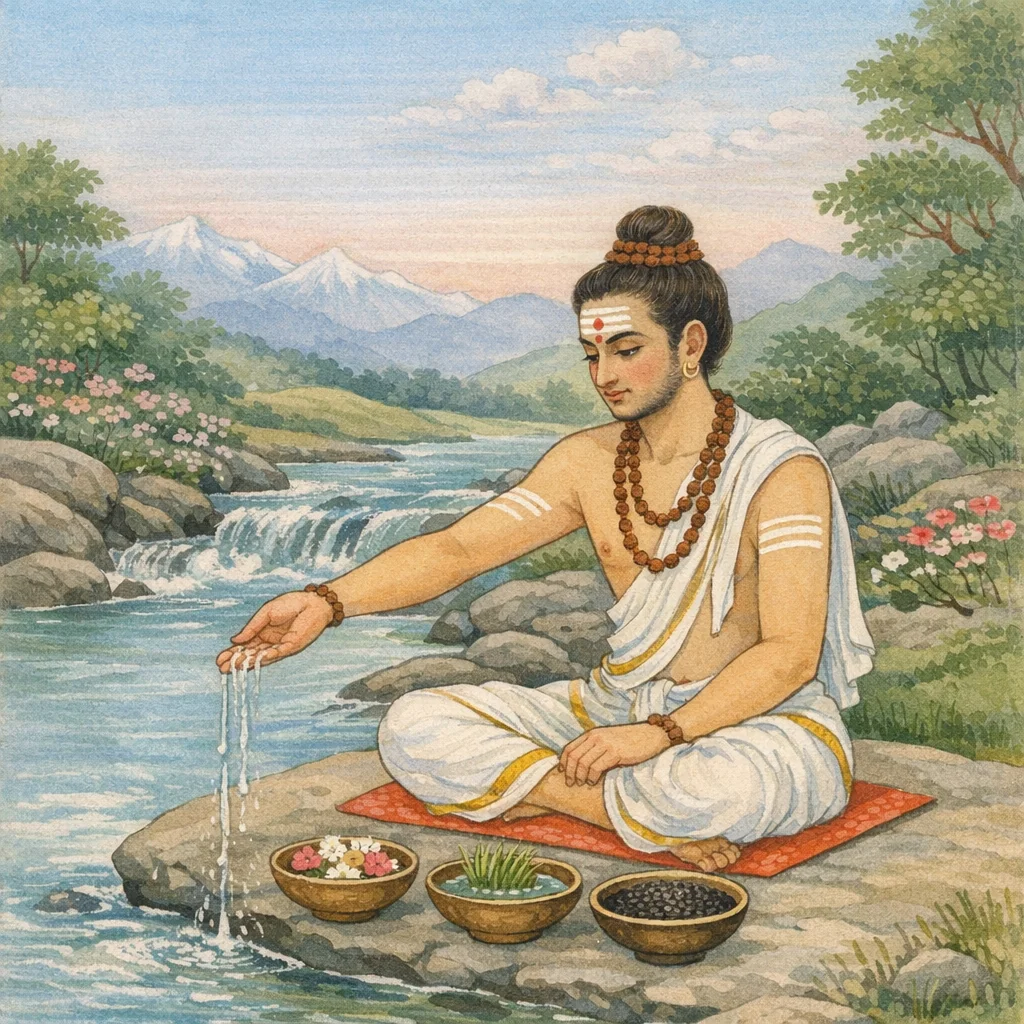
Nandī teaches a complete daily purification sequence that readies the aspirant for Śiva-centered worship. It begins by invoking Gāyatrī (Veda-mātā) and offering pādya, ācamanīya, and arghya, followed by prāṇāyāma and praṇava-japa in graded counts and a respectful dismissal. The practitioner then performs Sūrya-vandana with Vedic sūktas and circumambulation, and undertakes systematic tarpana for devas, ṛṣis, and pitṛs using prescribed offerings (flowers/water, kuśa-water, tila-water) with correct upavīta positions and finger-mudrā rules. The chapter frames the pañca-mahāyajña (brahma-, deva-, bhūta-, mānuṣya-, pitṛ-yajña), exalting brahma-yajña as supreme and warning of demerit if neglected, and explains brahma-yajña-ācamanam with symbolic touches honoring the Vedas, Purāṇas, Itihāsas, and Kalpas. It concludes with external washing, bhasma-snana from properly performed homa, pañcabrahma-mantra consecration of the limbs, and mantra-snana with Āpo-hiṣṭhā and related ṛk/yajus/sāman mantras, affirming that even brief, sincere practice leads toward the highest state and bridges ritual purity to deeper Śaiva sādhana.
Shlokas
Verse 1
इति श्रीलिङ्गमहापुराणे पूर्वभागे स्नानविधिर्नाम पञ्चविंशो ऽध्यायः नन्द्युवाच आवाहयेत्ततो देवीं गायत्रीं वेदमातरम् आयातु वरदा देवीत्य् अनेनैव महेश्वरीम्
Thus, in the Śrī Liṅga Mahāpurāṇa, in the Pūrvabhāga, begins the chapter called “The Procedure of Ritual Bathing.” Nandī said: “Then one should invoke the Goddess Gāyatrī, the Mother of the Vedas, with this very formula: ‘May the boon-bestowing Goddess, the Great Sovereign Lady (Maheśvarī), come.’”
Verse 2
पाद्यमाचमनीयं च तस्याश्चार्घ्यं प्रदापयेत् प्राणायामत्रयं कृत्वा समासीनः स्थितो ऽपि वा
He should offer water for washing the feet (pādya) and water for ritual sipping (ācamanīya), and then reverently present arghya to that Śiva-Liṅga. Having performed the threefold prāṇāyāma, he may worship, seated in calm composure or even while standing.
Verse 3
सहस्रं वा तदर्धं वा शतमष्टोत्तरं तु वा गायत्रीं प्रणवेनैव त्रिविधेष्वेकमाचरेत्
One should perform japa of the Gāyatrī joined with the Pranava (Oṃ): either a thousand times, or half of that, or one hundred and eight times—choosing one of these three measures. By such disciplined repetition, the paśu (bound soul) is led toward purity and fitness for the grace of Pati (Śiva).
Verse 4
अर्घ्यं दत्त्वा समभ्यर्च्य प्रणम्य शिरसा स्वयम् उत्तमे शिखरे देवीत्य् उक्त्वोद्वास्य च मातरम्
Having offered arghya-water, worshipped her with due reverence, and bowing with his head, he himself—saying, “O Devī, (remain) upon this supreme peak”—then duly dismissed the Mother from the rite (udvāsa).
Verse 5
प्राच्यालोक्याभिवन्द्येशां गायत्रीं वेदमातरम् कृताञ्जलिपुटो भूत्वा प्रार्थयेद्भास्करं तथा
Facing east, one should bow to the revered Gāyatrī, the Mother of the Vedas. Then, with hands joined in añjali, one should likewise pray to Bhāskara (the Sun), as part of the disciplined observance that purifies the paśu and prepares it for Śiva-worship.
Verse 6
उदुत्यं च तथा चित्रं जातवेदसमेव च अभिवन्द्य पुनः सूर्यं ब्रह्माणं च विधानतः
Having duly recited the hymns “Ud utyam,” “Citra,” and “Jātavedas,” one should again offer reverent salutations—according to proper rule—to Sūrya and to Brahmā. Thus the worshipper aligns outer Vedic observance with inner Śaiva discipline, preparing the paśu to approach Pati (Śiva) by loosening the pasha (bondage) born of ritual negligence.
Verse 7
तथा सौराणि सूक्तानि ऋग्यजुःसामजानि च जप्त्वा प्रदक्षिणं पश्चात् त्रिः कृत्वा च विभावसोः
Likewise, having recited the solar hymns and the mantras born of the Ṛg, Yajus, and Sāma Vedas, one should then perform pradakṣiṇā; thereafter, one should circumambulate the sacred fire, Vibhāvasu (Agni), three times.
Verse 8
आत्मानं चान्तरात्मानं परमात्मानमेव च अभिवन्द्य पुनः सूर्यं ब्रह्माणं च विभावसुम्
Having first bowed to the Self, the Inner Self, and indeed the Supreme Self, one should again offer reverence to Sūrya, to Brahmā, and to Vibhāvasu (Agni), so that the paśu (individual soul) is aligned with the Pati (Śiva) through purified awareness and Vedic rite.
Verse 9
मुनीन् पितॄन् यथान्यायं स्वनाम्नावाहयेत्ततः सर्वानावाहयामीति देवानावाह्य सर्वतः
Then, in the proper ritual manner, he should invoke the sages and the Pitṛs by their respective names. Thereafter, saying, “I invoke all,” he should invoke the Devas from all directions, establishing the sacred assembly for Śiva’s worship.
Verse 10
तर्पयेद्विधिना पश्चात् प्राङ्मुखो वा ह्युदङ्मुखः ध्यात्वा स्वरूपं तत्तत्त्वम् अभिवन्द्य यथाक्रमम्
Afterwards, facing either the east or the north, one should duly perform tarpaṇa (ritual libations). Having meditated upon His essential form as the very principle of Reality (Śiva-tattva), one should then offer reverent salutations in the proper sequence.
Verse 11
देवानां पुष्पतोयेन ऋषीणां तु कुशांभसा पितॄणां तिलतोयेन गन्धयुक्तेन सर्वतः
For the Devas, one should offer water mixed with flowers; for the Ṛṣis, water sanctified with kuśa-grass; and for the Pitṛs, water mixed with sesame—everywhere accompanied by fragrance. Thus the worship is made complete, for all offerings ultimately gather into the one Lord, Pati (Śiva), who receives them through proper rite.
Verse 12
यज्ञोपवीती देवानां निवीती ऋषितर्पणम् प्राचीनावीती विप्रेन्द्र पितॄणां तर्पयेत् क्रमात्
Wearing the sacred thread (yajñopavīta) in the upavīta manner, one should offer tarpaṇa to the Devas; wearing it in the nivīta manner, one should offer tarpaṇa to the Ṛṣis; and wearing it in the prācīnāvīta manner, O best of brāhmaṇas, one should in due order offer tarpaṇa to the Pitṛs.
Verse 13
अङ्गुल्यग्रेण वै धीमांस् तर्पयेद्देवतर्पणम् ऋषीन् कनिष्ठाङ्गुलिना श्रोत्रियः सर्वसिद्धये
The intelligent practitioner, trained in the Veda, should offer tarpaṇa to the Devas with the fingertips; and to the Ṛṣis with the little finger—so that, within the discipline of Śiva-worship, every spiritual accomplishment is fulfilled.
Verse 14
पितॄंस्तु तर्पयेद् विद्वान् दक्षिणाङ्गुष्ठकेन तु तथैवं मुनिशार्दूल ब्रह्मयज्ञं यजेद् द्विजः
The learned should offer tarpaṇa to the Pitṛs with the right thumb. In the same way, O tiger among sages, the twice-born should perform the Brahma-yajña, upholding sacred knowledge as an offering aligned with Pati, the Lord who releases the bound paśu from the fetters of pāśa.
Verse 15
देवयज्ञं च मानुष्यं भूतयज्ञं तथैव च पितृयज्ञं च पूतात्मा यज्ञकर्मपरायणः
Pure in heart and steadfast in sacrificial duty, he performs the Deva-yajña, the human rite of hospitality, the Bhūta-yajña for beings, and the Pitṛ-yajña as well—thus sustaining dharma and ultimately leading the bound paśu toward the Lord Pati, Śiva.
Verse 16
स्वशाखाध्ययनं विप्र ब्रह्मयज्ञ इति स्मृतः अग्नौ जुहोति यच्चान्नं देवयज्ञ इति स्मृतः
O brāhmaṇa, the study of one’s own Vedic recension is remembered as the Brahma-yajña. And whatever food-offering one pours into the sacred fire is remembered as the Deva-yajña.
Verse 17
सर्वेषामेव भूतानां बलिदानं विधानतः भूतयज्ञ इति प्रोक्तो भूतिदः सर्वदेहिनाम्
The duly prescribed offering of bali to all beings is declared to be the Bhūta-yajña; it is the sacred act that bestows welfare and sustenance upon all embodied souls (paśu).
Verse 18
सदारान् सर्वतत्त्वज्ञान् ब्राह्मणान् वेदपारगान् प्रणम्य तेभ्यो यद्दत्तम् अन्नं मानुष उच्यते
Food that is offered—after bowing—to Brahmanas who live with their wives, who know all tattvas, and who have crossed to the far shore of the Vedas, is declared to be a gift of the “human” (mānuṣa) class.
Verse 19
पितॄन् उद्दिश्य यद्दत्तं पितृयज्ञः स उच्यते एवं पञ्च महायज्ञान् कुर्यात् सर्वार्थसिद्धये
Whatever is offered with the Ancestors (Pitṛs) in mind is called the Pitṛ-yajña. Thus one should perform the five great sacrifices, for the accomplishment of all aims—upholding dharma and purifying the paśu (bound soul) for the grace of Pati, Lord Śiva.
Verse 20
सर्वेषां शृणु यज्ञानां ब्रह्मयज्ञः परः स्मृतः ब्रह्मयज्ञरतो मर्त्यो ब्रह्मलोके महीयते
Hear of all sacrifices: Brahma-yajña is remembered as the highest. A mortal devoted to Brahma-yajña is honored in Brahma-loka, for the discipline of sacred knowledge and recitation purifies the paśu (bound soul) and turns it toward the Supreme Pati.
Verse 21
ब्रह्मयज्ञेन तुष्यन्ति सर्वे देवाः सवासवाः ब्रह्मा च भगवान्विष्णुः शङ्करो नीललोहितः
By the Brahma-yajña—the sacred offering of Vedic recitation and study—all the gods, together with Indra, are satisfied; so too are Brahmā, Lord Viṣṇu, and Śaṅkara, the blue-and-red-hued Rudra Nīlalohita. Thus Brahma-yajña becomes a means of harmonizing the deities under the sovereignty of Pati (Śiva), loosening the pāśa born of neglect of dharma for the paśu (bound soul).
Verse 22
वेदाश् च पितरः सर्वे नात्र कार्या विचारणा ग्रामाद्बहिर्गतो भूत्वा ब्राह्मणो ब्रह्मयज्ञवित्
The Vedas and all the Pitṛs are truly present there—let no doubt be entertained. Therefore, a Brāhmaṇa who knows the Brahma‑yajña should go outside the village and perform the sacred recitation, honoring the Veda as the very support of dharma.
Verse 23
यावत् त्वदृष्टम् अभवद् उटजानां छदं नरः प्राच्यामुदीच्यां च तथा प्रागुदीच्यामथापि वा
So long as the man had not yet seen the thatched coverings of the ascetics’ leaf-huts—whether in the east, the north, or even in the north‑eastern quarter—he continued searching on.
Verse 24
पुण्यमाचमनं कुर्याद् ब्रह्मयज्ञार्थमेव तत् प्रीत्यर्थं च ऋचां विप्राः त्रिः पीत्वा प्लाव्य प्लाव्य च
For the sake of the Brahma‑yajña alone one should perform the purifying ācamana. And, O brāhmaṇas, to please the Vedic ṛc‑verses, one should sip the water three times, each time rinsing the mouth again and again.
Verse 25
यजुषां परिमृज्यैवं द्विः प्रक्षाल्य च वारिणा प्रीत्यर्थं सामवेदानाम् उपस्पृश्य च मूर्धनि
Thus, after wiping oneself in accordance with the Yajur‑vedic procedure and washing twice with water, one should, for the delight of the Sāma‑Veda, touch that sanctified water to the crown of the head—thereby completing inner and outer purification before approaching the worship of Pati, Lord Śiva.
Verse 26
स्पृशेदथर्ववेदानां नेत्रे चाङ्गिरसां तथा नासिके ब्राह्मणो ऽङ्गानां क्षाल्य क्षाल्य च वारिणा
Having repeatedly rinsed his limbs with water, the Brāhmaṇa should perform a Vedic nyāsa: touching the eyes with the Atharvaveda and likewise invoking the Aṅgiras tradition; and he should touch the nose as part of this limb‑consecration, thereby purifying the senses for Śiva‑worship.
Verse 27
अष्टादशपुराणानां ब्रह्माद्यानां तथैव च तथा चोपपुराणानां सौरादीनां यथाक्रमम्
In due sequence (yathākramam), I shall set forth the eighteen Mahāpurāṇas beginning with the Brahma (Brahmādyāḥ), and likewise the subsidiary Upapurāṇas beginning with the Saura, in their proper order.
Verse 28
पुण्यानामितिहासानां शैवादीनां तथैव च श्रोत्रे स्पृशेद्धि तुष्ट्यर्थं हृद्देशं तु ततः स्पृशेत्
When hearing meritorious sacred narratives—especially Śaiva accounts—one should touch the ears for inner contentment and receptivity; thereafter one should touch the region of the heart, establishing within it the dharma that was heard, where devotion (bhakti) to Pati, Lord Śiva, is to be seated.
Verse 29
कल्पादीनां तु सर्वेषां कल्पवित्कल्पवित्तमाः एवमाचम्य चास्तीर्य दर्भपिञ्जूलम् आत्मनः
But the best among the knowers of the kalpas—those most skilled in all ritual ordinances—thus perform ācamana (purificatory sipping) and spread out for themselves a bundle of darbha grass, preparing the seat for the rite of Śiva worship.
Verse 30
कृत्वा पाणितले धीमान् आत्मनो दक्षिणोत्तरम् हेमाङ्गुलीयसंयुक्तो ब्रह्मबन्धयुतो ऽपि वा
The wise worshipper should arrange the ritual act upon his own palms, right and left in due order—adorned with a golden ring, and, if desired, also wearing the sacred band (brahma-bandha).
Verse 31
विधिवद्ब्रह्मयज्ञं च कुर्यात्सूत्री समाहितः अकृत्वा च मुनिः पञ्च महायज्ञान्द्विजोत्तमः
With a collected mind, the Sūtrī (reciter of sacred tradition) should duly perform the Brahma-yajña. O best of the twice-born, even a sage is not considered complete in his dharma if he has not performed the five great sacrifices (pañca mahāyajña)—duties that purify the paśu (bound soul) and turn it toward the Pati, Lord Śiva.
Verse 32
भुक्त्वा च सूकराणां तु योनौ वै जायते नरः तस्मात्सर्वप्रयत्नेन कर्तव्याः शुभमिच्छता
Having undergone the karmic fruition of such deeds, a man is indeed born in the womb of swine. Therefore, one who seeks the auspicious—release from pāśa and the grace of the Pati, Śiva—should, with every effort, do only what is wholesome and in accord with dharma.
Verse 33
ब्रह्मयज्ञादथ स्नानं कृत्वादौ सर्वथात्मनः तीर्थं संगृह्य विधिवत् प्रविशेच्छिबिरं वशी
After completing the Brahma-yajña, he should first bathe, establishing full purity of self. Then, having duly gathered sanctified tīrtha-water according to rule, the self-controlled one should enter the ritual enclosure in proper form.
Verse 34
बहिरेव गृहात्पादौ हस्तौ प्रक्षाल्य वारिणा भस्मस्नानं ततः कुर्याद् विधिवद् देहशुद्धये
Outside the house, having washed the feet and hands with water, one should then perform bhasma-snāna—the ash-bath—in the prescribed manner for purification of the body, so that the embodied paśu becomes fit for Śiva’s worship.
Verse 35
शोध्य भस्म यथान्यायं प्रणवेनाग्निहोत्रजम् ज्योतिः सूर्य इति प्रातर् जुहुयादुदिते यतः
Having duly purified the sacred ash obtained from the Agnihotra, at sunrise in the morning one should offer oblations with the Pranava (Oṃ), uttering the mantra “Light—Sun,” for from Him the rising radiance proceeds.
Verse 36
ज्योतिरग्निस् तथा सायं सम्यक् चानुदिते मृषा तस्मादुदितहोमस्थं भसितं पावनं शुभम्
The fire kindled at dawn is the true sacred fire; the evening fire, if not properly established, is unreliable. Therefore, the ash obtained from the dawn oblation is purifying and auspicious, fit to be borne in Śiva’s worship as the mark of the Pati who frees the paśu from pāśa.
Verse 37
नास्ति सत्यसमं यस्माद् असत्यं पातकं च यत् ईशानेन शिरोदेशं मुखं तत्पुरुषेण च
Since nothing equals truth, and falsehood is indeed a grave sin, know that Īśāna presides over the region of the head, and Tatpuruṣa presides over the face—thus the Lord, Pati Śiva, governs the very limbs of embodied beings through His cosmic aspects.
Verse 38
उरोदेशमघोरेण गुह्यं वामेन सुव्रताः सद्येन पादौ सर्वाङ्गं प्रणवेनाभिषेचयेत्
O well-disciplined votaries, consecrate (bathe) the chest-region with the Aghora-mantra, the secret part with the Vāma-mantra, the feet with the Sadyojāta-mantra, and the entire body with the Praṇava (Oṁ).
Verse 39
ततः प्रक्षालयेत्पादं हस्तं ब्रह्मविदां वरः व्यपोह्य भस्म चादाय देवदेवमनुस्मरन्
Thereafter, the best among the knowers of Brahman should wash his feet and hands; then, having removed impurities and taken up the sacred ash (bhasma), he should remember the God of gods, Śiva.
Verse 40
मन्त्रस्नानं ततः कुर्याद् आपोहिष्ठादिभिः क्रमात् पुण्यैश्चैव तथा मन्त्रैर् ऋग्यजुःसामसंभवैः
Then one should perform a mantra-bath in due order, beginning with the hymn “Āpo hi ṣṭhā…”, and likewise with other auspicious mantras drawn from the Ṛg, Yajur, and Sāma Vedas—so that the worshipper becomes ritually and inwardly purified for the adoration of Pati, Lord Śiva.
Verse 41
द्विजानां तु हितायैवं कथितं स्नानमद्य ते संक्षिप्य यः सकृत्कुर्यात् स याति परमं पदम्
Thus, for the welfare of the twice-born, this sacred bathing discipline has been taught to you today. Whoever performs it even once—according to this concise instruction—attains the Supreme Abode (parama pada), the state of Pati, Lord Śiva.
Frequently Asked Questions
Gayatri invocation with offerings → pranayama and Om-based japa → arghya and respectful closure → Surya-vandana with Vedic suktas and pradakshina → tarpana to devas/rishis/pitrs → Pancha Mahayajna (with Brahma Yajna highlighted) → external washing → bhasma-snana → Panchabrahma-mantra limb consecration → mantra-snana (Apo-hishtha, etc.).
By substances (flowers/water for devas, kuśa-water for ṛṣis, tila-water with fragrance for pitṛs), by upavīta orientation (yajñopavītī/nivītī/prācīnāvītī), and by finger usage (deva with fingertip, ṛṣi with little finger, pitṛ with right thumb).
Brahma-yajña (study/recitation of one’s Vedic śākhā), Deva-yajña (offerings into fire), Bhūta-yajña (bali for beings), Mānuṣya-yajña (feeding/serving learned brāhmaṇas and guests), Pitṛ-yajña (offerings dedicated to ancestors).
They ritually consecrate body-parts: Īśāna for head, Tatpuruṣa for face, Aghora for chest, Vāma for the hidden/secret region, Sadyojāta for feet, with praṇava (Om) pervading all—turning bathing into Shaiva sacralization.