Adhyaya 18
विष्णुरुवाच—एकाक्षर-प्रणव-लिङ्ग-व्याप्ति-शिवस्तोत्रम्
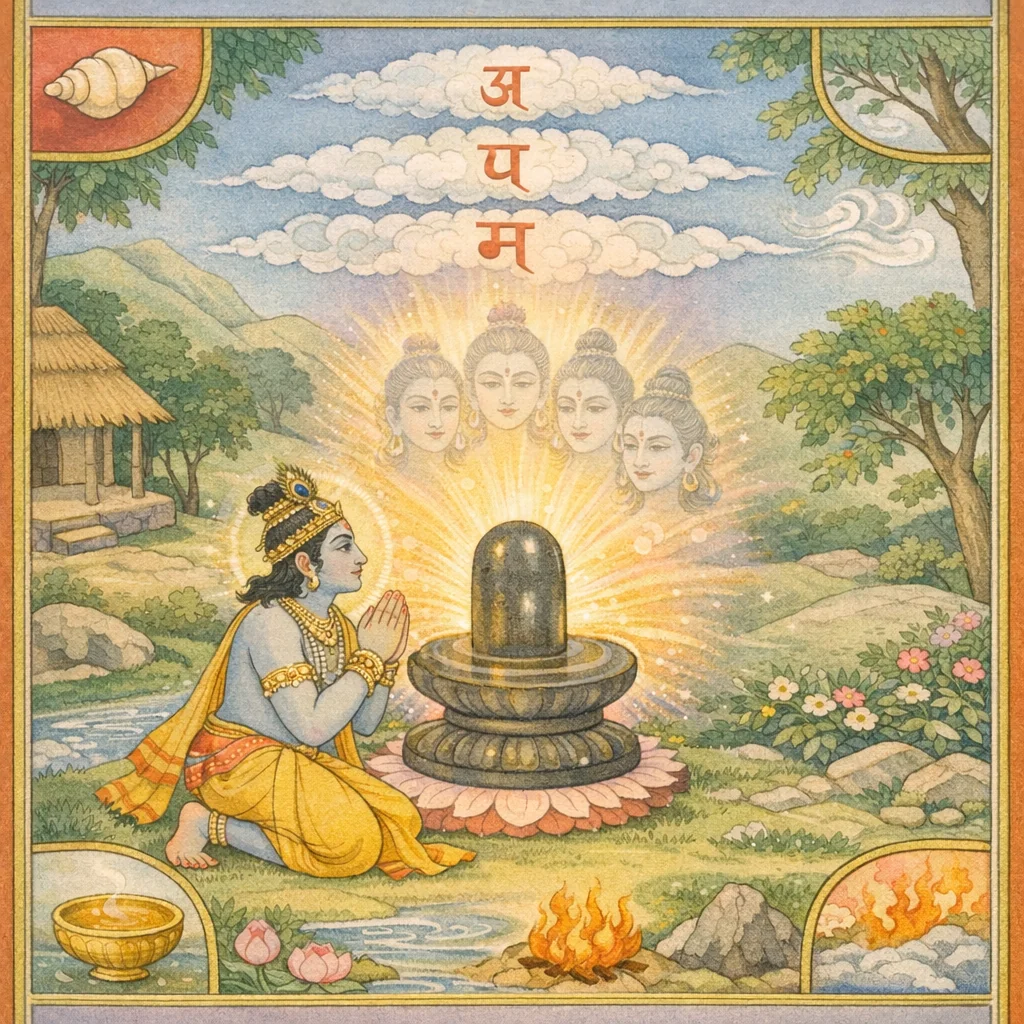
This chapter is a continuous stotra in which Viṣṇu praises Rudra–Śiva through the Ekākṣara Pranava (A-U-M): A as Rudra/ātmarūpa, U as Ādi-deva/vidyā-deha, and M as the third principle—Śiva/Paramātman—radiant like Sūrya, Agni, and Soma. The hymn then proclaims Śiva as lord of the Rudras, as the Pañcabrahma faces (Sadyojāta, Vāmadeva, Aghora, Īśāna), and as the Liṅga—ūrdhva (uplifted, transcendent) and liṅgin (bearer of the mark). A sweeping cosmological catalogue follows: Śiva pervades fire, wind, water, earth, space, and the tanmātras (sound, touch, taste, smell), yet remains beyond form—arūpa and still surūpa. It ends with a phalaśruti: reciting or teaching it to Veda-knowing brāhmaṇas destroys sins and raises the devotee toward Brahma-loka, preparing the next discourse to move from praise into practice and doctrinal clarification.
Shlokas
Verse 1
विष्णुर् उवाच एकाक्षराय रुद्राय अकारायात्मरूपिणे उकारायादिदेवाय विद्यादेहाय वै नमः
Viṣṇu said: Salutations to Rudra, the One-Syllabled (Pranava); salutations to Him as the letter ‘A’, whose very form is the Self; salutations to Him as the letter ‘U’, the Primordial Deva; and salutations to Him whose body is Vidyā, pure Knowledge.
Verse 2
तृतीयाय मकाराय शिवाय परमात्मने सूर्याग्निसोमवर्णाय यजमानाय वै नमः
Salutations to Śiva—the Supreme Self—who is the third ‘Ma’ (m-kāra), whose radiance bears the hues of the Sun, Fire, and Moon, and who is the true Yajamāna, the inner Lord who receives and sanctifies all sacrifice.
Verse 3
अग्नये रुद्ररूपाय रुद्राणां पतये नमः शिवाय शिवमन्त्राय सद्योजाताय वेधसे
Salutations to Agni, who bears the form of Rudra; salutations to the Pati, Lord of the Rudras. Salutations to Śiva, the very essence of the Śiva-mantra; to Sadyojāta, Vedhas, the Creator who ordains all.
Verse 4
वामाय वामदेवाय वरदायामृताय ते अघोरायातिघोराय सद्योजाताय रंहसे
Salutations to You—the Beautiful One, Vāmadeva; the Bestower of boons, the Immortal. Salutations to Aghora and to Ati-ghora; and to Sadyojāta, the Lord swift in action.
Verse 5
ईशानाय श्मशानाय अतिवेगाय वेगिने नमो ऽस्तु श्रुतिपादाय ऊर्ध्वलिङ्गाय लिङ्गिने
Homage to Īśāna—He who abides in the cremation-ground; to the supremely swift, the ever-speeding One. Homage to Him whose very feet are the Śruti, the Vedas; to the Upright Liṅga; and to the Liṅgin, Lord who bears and masters the Liṅga.
Verse 6
हेमलिङ्गाय हेमाय वारिलिङ्गाय चांभसे शिवाय शिवलिङ्गाय व्यापिने व्योमव्यापिने
Salutations to the Golden Liṅga, to the Golden One; to the Water-Liṅga and to the very Waters. Salutations to Śiva and to the Śiva-Liṅga—to Him who pervades all, who pervades even the vast expanse of space.
Verse 7
वायवे वायुवेगाय नमस्ते वायुव्यापिने तेजसे तेजसां भर्त्रे नमस्तेजो ऽधिव्यापिने
Salutations to You as Vāyu—the force and swiftness of the wind, all-pervading as air. Salutations to You as Tejas—the radiant power, sustainer of all splendors, pervading all as the inner brilliance.
Verse 8
जलाय जलभूताय नमस्ते जलव्यापिने पृथिव्यै चान्तरिक्षाय पृथिवीव्यापिने नमः
Salutations to You as Water, as the very tattva of Water, and as the One who pervades all waters. Salutations to You as Earth and as the mid-space (antarikṣa), and to the One who pervades the whole earth.
Verse 9
शब्दस्पर्शस्वरूपाय रसगन्धाय गन्धिने गणाधिपतये तुभ्यं गुह्याद्गुह्यतमाय ते
Salutations to You—whose very nature is sound and touch; who are the essence of taste and fragrance; who are the Fragrant One Himself; the Lord of the Gaṇas (Gaṇādhipati); and the most secret of the secret.
Verse 10
अनन्ताय विरूपाय अनन्तानामयाय च शाश्वताय वरिष्ठाय वारिगर्भाय योगिने
Salutations to the Infinite One, the Lord of countless forms; to Him who is free from all beginningless afflictions; to the Eternal and the Supreme; to the One who bears the cosmic waters within Himself; to the great Yogi—Śiva, the Pati who liberates the paśus from the bondage of pāśa.
Verse 11
संस्थितायाम्भसां मध्ये आवयोर्मध्यवर्चसे गोप्त्रे हर्त्रे सदा कर्त्रे निधनायेश्वराय च
Salutations to Īśvara—who abides in the midst of the waters, who is the inner radiance between us both; who is the Protector and the Withdrawer, the ever-acting Doer, and the Lord of the final Dissolution.
Verse 12
अचेतनाय चिन्त्याय चेतनायासहारिणे अरूपाय सुरूपाय अनङ्गायाङ्गहारिणे
Salutations to Śiva—who is beyond inertness, yet is contemplated even by the inert; who removes ahaṃkāra, the sense of “I,” from the conscious. Salutations to the Formless, who is the source of all beautiful form; to the Bodiless, who draws all embodiedness back into Himself.
Verse 13
भस्मदिग्धशरीराय भानुसोमाग्निहेतवे श्वेताय श्वेतवर्णाय तुहिनाद्रिचराय च
Salutations to the Lord whose body is anointed with sacred ash; who is the inner cause and sustaining principle of the Sun, the Moon, and Fire; who is the White One, radiant in white hue, and who dwells and moves upon the Snowy Mountain, Himālaya.
Verse 14
सुश्वेताय सुवक्त्राय नमः श्वेतशिखाय च श्वेतास्याय महास्याय नमस्ते श्वेतलोहित
Salutations to You, supremely white and of auspicious countenance; salutations to You whose crest is white. Salutations to You, white-faced and great-faced—obeisance to You, O Śvetalohita, the White-and-Red Lord.
Verse 15
सुताराय विशिष्टाय नमो दुन्दुभिने हर शतरूपविरूपाय नमः केतुमते सदा
Salutations to the Star-like Radiant One, the Most Excellent; salutations to Hara, the Drum-like Lord who resounds as the cosmic proclamation. O Hara—homage to You who assume a hundred forms and yet are beyond form; homage always to You, the Banner of Consciousness, the ever-radiant Sign.
Verse 16
ऋद्धिशोकविशोकाय पिनाकाय कपर्दिने विपाशाय सुपाशाय नमस्ते पाशनाशिने
Salutations to You—who are prosperity itself, who remove sorrow and are untouched by sorrow; to the Bearer of the Pināka bow, to the Lord with matted locks; to Him who is beyond bondage and whose noose is auspicious—O Destroyer of the pāśa, the fetters that bind the pashu, the individual soul.
Verse 17
सुहोत्राय हविष्याय सुब्रह्मण्याय सूरिणे सुमुखाय सुवक्त्राय दुर्दमाय दमाय च
Salutations to the Auspicious Sacrificer, to Him who is the very oblation; to the benefactor of sacred prayer and right order; to the wise seer; to the One of gracious face and noble speech; to the unconquerable, and to the One who disciplines and restrains.
Verse 18
कङ्काय कङ्करूपाय कङ्कणीकृतपन्नग सनकाय नमस्तुभ्यं सनातन सनन्दन
Salutations to You—the Kanka, who assumes the form of Kanka, and who wears serpents as ornaments. O Ancient One, O Sanandana, obeisance to You who abide as Sanaka, the ever-pure sage.
Verse 19
सनत्कुमारसारङ्गम् आरणाय महात्मने लोकाक्षिणे त्रिधामाय नमो विरजसे सदा
Salutations always to the Stainless One—praised by Sanatkumāra and the sages; abiding in the sacred forest-solitude; the Great-Souled Lord, the Eye of the worlds; shining as Tridhāma, the Threefold Abode, the transcendent ground of the three states.
Verse 20
शङ्खपालाय शङ्खाय रजसे तमसे नमः सारस्वताय मेघाय मेघवाहन ते नमः
Homage to You as Śaṅkhapāla, the guardian power; homage to You as Śaṅkha, the auspicious Conch; homage to You as Rajas and as Tamas. Homage to You as the Lord of Sarasvatī, of sacred knowledge; as the Cloud, and as the Cloud-borne One—salutations to You.
Verse 21
सुवाहाय विवाहाय विवादवरदाय च नमः शिवाय रुद्राय प्रधानाय नमोनमः
Salutations to Śiva—who grants auspicious conveyance and auspicious leading, who sanctifies the rite of marriage, and who bestows boons even amid disputes. Salutations again and again to the benevolent Śiva, to Rudra, and to the Supreme Pradhāna, the primordial ground of manifestation; as Pati, He releases the paśu (bound soul) from pāśa (bondage).
Verse 22
त्रिगुणाय नमस्तुभ्यं चतुर्व्यूहात्मने नमः संसाराय नमस्तुभ्यं नमः संसारहेतवे
Salutations to You who preside over the three guṇas; salutations to You whose being is the fourfold manifestation. Salutations to You as saṃsāra itself, and salutations to You as the very cause of saṃsāra.
Verse 23
मोक्षाय मोक्षरूपाय मोक्षकर्त्रे नमोनमः आत्मने ऋषये तुभ्यं स्वामिने विष्णवे नमः
Salutations again and again to the Lord who is Liberation, whose very nature is Liberation, and who bestows Liberation. To You—Self itself, the seer-sage within, the sovereign Master (manifest also as Viṣṇu)—I bow.
Verse 24
नमो भगवते तुभ्यं नागानां पतये नमः ओङ्काराय नमस्तुभ्यं सर्वज्ञाय नमो नमः
Salutations to You, the Blessed Lord—salutations to the Sovereign (Pati) of the Nāgas. Salutations to You who are the sacred Oṃkāra; salutations again and again to the All-knowing One.
Verse 25
सर्वाय च नमस्तुभ्यं नमो नारायणाय च नमो हिरण्यगर्भाय आदिदेवाय ते नमः
Salutations to You who are the All; salutations also to Nārāyaṇa; salutations to Hiraṇyagarbha. O Primordial Deva—salutations to You.
Verse 26
नमो ऽस्त्वजाय पतये प्रजानां व्यूहहेतवे महादेवाय देवानाम् ईश्वराय नमो नमः
Salutations to the Unborn—Lord (Pati) of all beings—who is the causal ground of manifestation and orderly emanation; to Mahādeva, the Sovereign Lord of the gods: again and again, I bow.
Verse 27
शर्वाय च नमस्तुभ्यं सत्याय शमनाय च ब्रह्मणे चैव भूतानां सर्वज्ञाय नमो नमः
Salutations to You as Śarva; salutations to You as the Truth and as the Pacifier who grants quiescence. Salutations to You, the Brahman—the inner ground of all beings—and to the Omniscient Lord; again and again, I bow.
Verse 28
महात्मने नमस्तुभ्यं प्रज्ञारूपाय वै नमः चितये चितिरूपाय स्मृतिरूपाय वै नमः
Salutations to You, O Great-Souled Lord (Mahātman); salutations to You whose very form is supreme wisdom. Salutations to Consciousness itself (Cit), to Him whose form is awareness; and salutations to Him whose form is sacred memory (Smṛti).
Verse 29
ज्ञानाय ज्ञानगम्याय नमस्ते संविदे सदा शिखराय नमस्तुभ्यं नीलकण्ठाय वै नमः
Salutations to You who are Knowledge itself, and to You who are attained only through true knowledge—ever as Saṃvid, pure Consciousness. Salutations to You, the Supreme Summit (Śikhara); salutations indeed to You, O Nīlakaṇṭha, the Blue-throated Lord.
Verse 30
अर्धनारीशरीराय अव्यक्ताय नमोनमः एकादशविभेदाय स्थाणवे ते नमः सदा
Salutations again and again to Ardhanārīśvara, whose body is half Woman, and to the Unmanifest (Avyakta). Ever do I bow to You, O Sthāṇu, who manifests in eleven distinct modes.
Verse 31
नमः सोमाय सूर्याय भवाय भवहारिणे यशस्कराय देवाय शङ्करायेश्वराय च
Salutations to Him who is Soma and Sūrya; to Bhava, the remover of worldly becoming; to the Deva who bestows glory; to Śaṅkara, the auspicious One; and to Īśvara, the Supreme Lord—Pati who frees the paśu from the bonds of pāśa.
Verse 32
नमो ऽंबिकाधिपतये उमायाः पतये नमः हिरण्यबाहवे तुभ्यं नमस्ते हेमरेतसे
Salutations to the Lord of Ambikā, to the consort of Umā. Salutations to You, O Hiraṇyabāhu, the golden-armed One; salutations to You, O Hemaretas, whose seed is of gold—Śiva, the Pati who transcends all bonds.
Verse 33
नीलकेशाय वित्ताय शितिकण्ठाय वै नमः कपर्दिने नमस्तुभ्यं नागाङ्गाभरणाय च
Salutations to the Lord of dark-blue tresses, the Lord who is true wealth; salutations indeed to the White-throated One (Śitikaṇṭha). Salutations to You, O Kapardin, the matted-haired Lord, and to Him whose very limbs are adorned with serpents.
Verse 34
वृषारूढाय सर्वस्य हर्त्रे कर्त्रे नमोनमः वीररामातिरामाय रामनाथाय ते विभो
Salutations again and again to You, O Lord who rides the Bull—You who are the Creator and the Withdrawer of all. O all-pervading Master, salutations to You as the heroic Rāma, the surpassingly delightful Rāma, the Lord of Rāma (Rāmanātha).
Verse 35
नमो राजाधिराजाय राज्ञामधिगताय ते नमः पालाधिपतये पालाशाकृन्तते नमः
Homage to You, Rājādhirāja, Emperor of emperors—attained and acknowledged even by all kings. Homage to You, Lord of protectors; homage to You, the cutter of the palāśa-branch—He who removes obstacles and subdues what must be restrained.
Verse 36
नमः केयूरभूषाय गोपते ते नमोनमः नमः श्रीकण्ठनाथाय नमो लिकुचपाणये
Salutations to You, the One adorned with armlets; salutations again and again to You, O Lord and Protector of beings. Salutations to Śrīkaṇṭha, the revered Lord of the blue throat; salutations to the One who bears the likuca-fruit in His hand.
Verse 37
भुवनेशाय देवाय वेदशास्त्र नमो ऽस्तु ते सारङ्गाय नमस्तुभ्यं राजहंसाय ते नमः
Salutations to You, Lord of the worlds, the radiant Deva—homage to You as the very essence of the Veda and Śāstra. O Sāraṅga, I bow to You; O royal Haṃsa (Rājahaṃsa), to You be my reverent salutations.
Verse 38
कनकाङ्गदहाराय नमः सर्पोपवीतिने सर्पकुण्डलमालाय कटिसूत्रीकृताहिने
Salutations to Him who bears golden armlets and necklaces; salutations to the Lord whose sacred thread is a serpent; to Him whose earrings and garlands are serpents; and to Him who has made a serpent His girdle at the waist.
Verse 39
वेदगर्भाय गर्भाय विश्वगर्भाय ते शिव ब्रह्मोवाच विररामेति संस्तुत्वा ब्रह्मणा सहितो हरिः
Salutations to You, O Śiva—You who are the womb of the Vedas, the very womb of all manifestation, and the womb of the universe. Having thus praised (Śiva), Hari (Viṣṇu), together with Brahmā, fell silent; and Brahmā said, “Let it cease.”
Verse 40
एतत्स्तोत्रवरं पुण्यं सर्वपापप्रणाशनम् यः पठेच्छ्रावयेद्वापि ब्राह्मणान् वेदपारगान्
This supremely excellent hymn is holy and destroys all sins. Whoever recites it—or causes it to be heard by Brāhmaṇas who are masters of the Vedas—gains that purifying merit; for śravaṇa and pāṭha lead the bound soul (paśu) toward the grace (anugraha) of Pati, Śiva, who severs the pāśa of bondage.
Verse 41
स याति ब्रह्मणो लोके पापकर्मरतो ऽपि वै तस्माज्जपेत्पठेन्नित्यं श्रावयेद्ब्राह्मणाञ्छुभान्
Even one devoted to sinful actions attains the world of Brahmā. Therefore one should daily perform japa and recitation, and cause auspicious Brāhmaṇas to hear it; for such śravaṇa purifies the paśu (bound soul) and loosens the pāśa (bondage) through the grace of Pati, Śiva.
Verse 42
सर्वपापविशुद्ध्यर्थं विष्णुना परिभाषितम्
For the sake of purification from all sins, this has been expressly declared by Viṣṇu—so that the bound soul (paśu) may become fit for Śiva’s grace (anugraha).
Frequently Asked Questions
It interprets A-U-M as a theological ladder: A as Rudra/ātman-aspect, U as the primordial divine principle and vidyā-body, and M as Śiva/Paramātman—thereby making Pranava a concise mantra of Śiva’s totality (immanence + transcendence).
The phalaśruti states that reading, reciting, or causing it to be heard—especially in the presence of Veda-versed brāhmaṇas—destroys sins (sarva-pāpa-praṇaśana), purifies karma, and supports ascent toward higher lokas, ultimately orienting the sādhaka toward mokṣa.