Adhyaya 17
Adhyaya 17: लिङ्गोद्भव—ब्रह्मविष्ण्वहङ्कार-शमनं, ओंकार-प्रादुर्भावः, मन्त्र-तत्त्वं च
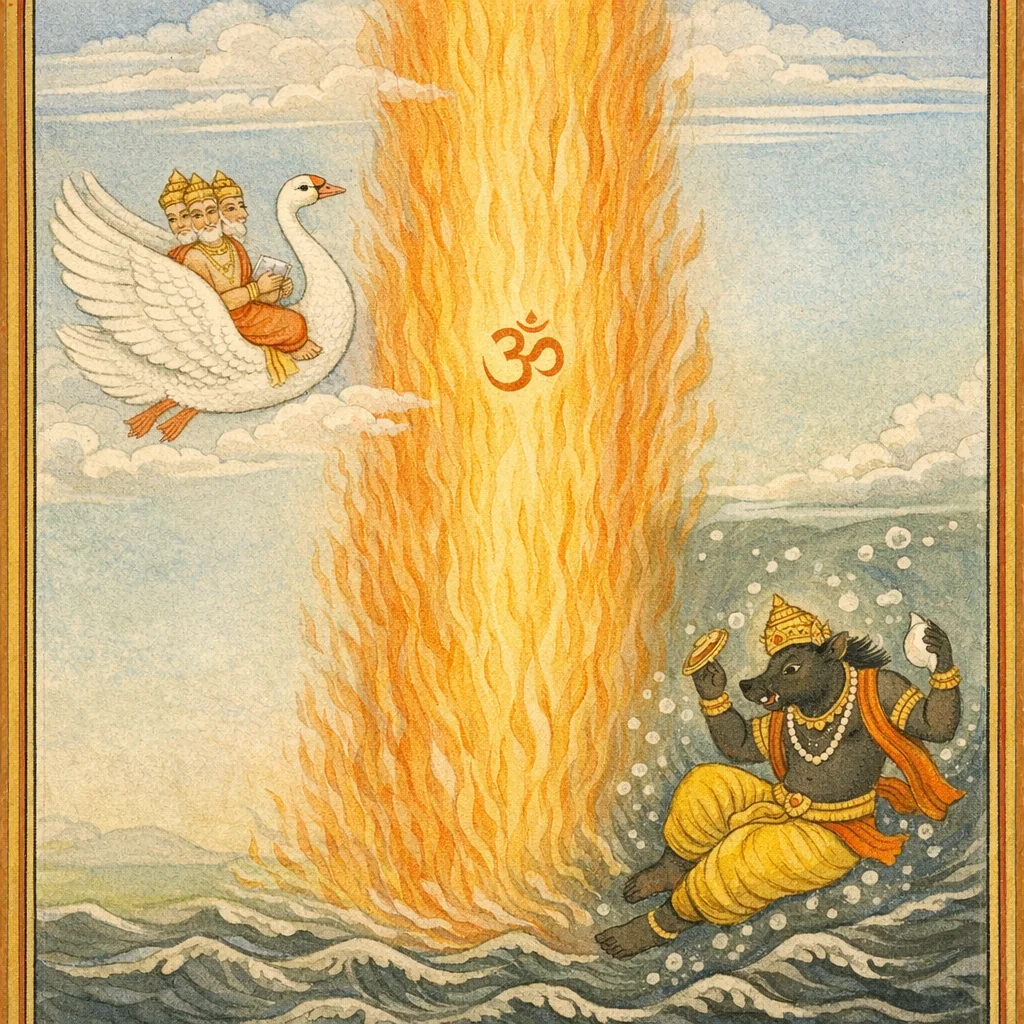
Suta concludes the earlier cosmographic account by praising the merit of hearing and reciting it. The Rishis then ask the central Shaiva mystery: what the Linga is, who the Lingin (bearer of the Linga) is, and why Shiva is worshipped as the Linga. Brahma explains that primordial Pradhana is called “Linga” and the supreme Lord is the “Lingin,” and describes pralaya when all beings are dissolved and only cosmic reality remains in the dark ocean. Brahma and Vishnu quarrel over creatorship, but an immeasurable, blazing Linga appears, ending their pride and awakening true knowledge. Brahma becomes Hamsa to seek the summit and Vishnu becomes Varaha to seek the base; both fail and return humbled. From the Linga arises the sonic revelation of Oṃ—A, U, M, nāda, and the transcendent turiya—linking Veda, mantra, and cosmogony (bīja–yoni, the golden egg, and the worlds’ emergence). Shiva’s word-formed body is mapped onto phonemes and mantras (ṛg–yajus–sāman–atharva streams with ritual and healing functions). Finally Vishnu and Brahma offer stuti to Maheshvara, teaching that the Linga’s infinitude corrects ego and that worship through mantra and insight leads to liberation.
Shlokas
Verse 1
सूत उवाच एवं संक्षेपतः प्रोक्तः सह्यादीनां समुद्भवः यः पठेच्छृणुयाद्वापि श्रावयेद्वा द्विजोत्तमान्
Sūta said: Thus, in brief, the origin of the Sahya and the other sacred mountain ranges has been declared. Whoever recites it, hears it, or causes the best of the twice-born to hear it, gains the fruit of this holy narration.
Verse 2
स याति ब्रह्मसायुज्यं प्रसादात्परमेष्ठिनः ऋषय ऊचुः कथं लिङ्गमभूल्लिङ्गे समभ्यर्च्यः स शङ्करः
By the grace of Parameṣṭhin (Brahmā), he attains brahma-sāyujya—identity with Brahman. The ṛṣis said: “How did the Liṅga come to be? And how is Śaṅkara—Pati, the Lord ever worthy of worship—properly adored in the Liṅga?”
Verse 3
किं लिङ्गं कस् तथा लिङ्गी सूत वक्तुमिहार्हसि रोमहर्षण उवाच एवं देवाश् च ऋषयः प्रणिपत्य पितामहम्
“What is the Liṅga, and who indeed is the Liṅgin—the Lord who bears the Liṅga? O Sūta, you are fit to explain this here.” Romaharṣaṇa said: “Thus the Devas and the Ṛṣis, having bowed down, approached Pitāmaha (Brahmā).”
Verse 4
अपृच्छन् भगवंल्लिङ्गं कथमासीदिति स्वयम् लिङ्गे महेश्वरो रुद्रः समभ्यर्च्यः कथं त्विति
They questioned the venerable Liṅga itself: “How did you come to be?” And again they asked: “In what manner is Mahēśvara—Rudra, Pati, the Lord abiding in the Liṅga—properly to be worshipped?”
Verse 5
किं लिङ्गं कस् तथा लिङ्गी सो ऽप्याह च पितामहः पितामह उवाच प्रधानं लिङ्गमाख्यातं लिङ्गी च परमेश्वरः
Asked, “What is the Liṅga, and who is the Liṅgī (the Bearer of the Liṅga)?” Pitāmaha (Brahmā) replied: “Pradhāna—the primordial matrix of Nature—is declared to be the Liṅga; and the Liṅgī is Parameśvara, the Supreme Lord (Pati), who transcends it and rules over it.”
Verse 6
रक्षार्थमंबुधौ मह्यं विष्णोस्त्वासीत् सुरोत्तमाः वैमानिके गते सर्गे जनलोकं सहर्षिभिः
For my protection in the ocean, O foremost among the gods, the saving power of Viṣṇu was there for me. And when the creation of the celestial beings proceeded, Janaloka was reached together with the ṛṣis.
Verse 7
स्थितिकाले तदा पूर्णे ततः प्रत्याहृते तथा चतुर्युगसहस्रान्ते सत्यलोकं गते सुराः
When the ordained period of cosmic maintenance was completed and dissolution (pralaya) drew near, at the end of a thousand cycles of the four yugas the Devas departed to Satyaloka.
Verse 8
विनाधिपत्यं समतां गते ऽन्ते ब्रह्मणो मम शुष्के च स्थावरे सर्वे त्व् अनावृष्ट्या च सर्वशः
When my sovereignty as Brahmā came to an end and all things fell into a state of sameness, every immovable being was parched everywhere through the complete absence of rain. In such a collapse of order, the Paśu (bound souls) are left helpless without the grace of the Pati, Lord Śiva.
Verse 9
पशवो मानुषा वृक्षाः पिशाचाः पिशिताशनाः गन्धर्वाद्याः क्रमेणैव निर्दग्धा भानुभानुभिः
Beasts, human beings, trees, piśācas, flesh-eating beings, and gandharvas and the rest—one after another—were scorched in due order by those blazing rays, as if by suns upon suns.
Verse 10
एकार्णवे महाघोरे तमोभूते समन्ततः सुष्वापांभसि योगात्मा निर्मलो निरुपप्लवः
In the single, dreadful cosmic ocean, with darkness spread on every side, the Yogic Self—the Supreme Pati, Śiva—lay in yogic repose upon the waters, stainless, undisturbed, and without agitation.
Verse 11
सहस्रशीर्षा विश्वात्मा सहस्राक्षः सहस्रपात् सहस्रबाहुः सर्वज्ञः सर्वदेवभवोद्भवः
He is the Thousand-headed One, the Soul of the universe, with a thousand eyes and a thousand feet. With a thousand arms He is omniscient—the primordial source from whom the very existence and arising of all the gods proceed.
Verse 12
हिरण्यगर्भो रजसा तमसा शङ्करः स्वयम् सत्त्वेन सर्वगो विष्णुः सर्वात्मत्वे महेश्वरः
By rajas He is Hiraṇyagarbha, the cosmic creator; by tamas He is Śaṅkara Himself. By sattva He pervades all as Viṣṇu; and as the Self of all, He is Maheśvara—the supreme Pati beyond the guṇas.
Verse 13
कालात्मा कालनाभस्तु शुक्लः कृष्णस्तु निर्गुणः नारायणो महाबाहुः सर्वात्मा सदसन्मयः
He is the very Self of Time, and also the One whose navel is Time; He is the White and the Dark—yet He is beyond the guṇas. That mighty-armed Nārāyaṇa is the Self of all, pervading both being and non-being.
Verse 14
तथाभूतमहं दृष्ट्वा शयानं पङ्कजेक्षणम् मायया मोहितस्तस्य तमवोचममर्षितः
Seeing Him lying thus—lotus-eyed—I was deluded by His māyā; and, stirred by impatience, I spoke to Him in vexation.
Verse 15
कस्त्वं वदेति हस्तेन समुत्थाप्य सनातनम् तदा हस्तप्रहारेण तीव्रेण स दृढेन तु
Saying, “Who are you?”, he lifted his hand against the Eternal, the Sanātana; then, with a fierce and forceful blow of the hand, he struck.
Verse 16
प्रबुद्धो ऽहीयशयनात् समासीनः क्षणं वशी ददर्श निद्राविक्लिन्ननीरजामललोचनः
Awakened from his serpent-couch, the self-controlled Lord sat upright for a moment; with lotus-pure eyes still moist from sleep, he looked about—steady in mastery of the senses.
Verse 17
मामग्रे संस्थितं भासाध्यासितो भगवान् हरिः आह चोत्थाय भगवान् हसन्मां मधुरं सकृत्
Then the Blessed Lord Hari—seated upon radiant splendor—stood up before me and, smiling, spoke to me once in gentle, sweet words.
Verse 18
स्वागतंस्वागतं वत्स पितामह महाद्युते तस्य तद्वचनं श्रुत्वा स्मितपूर्वं सुरर्षभाः
“Welcome—welcome, dear child! O Pitāmaha of great splendour!” Hearing those words, the foremost among the Devas replied with gentle smiles, honoring the cosmic order while keeping their intent upon the Supreme Pati, Śiva, beyond all created ranks.
Verse 19
रजसा बद्धवैरश् च तमवोचं जनार्दनम् भाषसे वत्स वत्सेति सर्गसंहारकारणम्
But, bound by rajas and fastened in hostility, he spoke to Janārdana: “Why do you address me as ‘son, son’? You who are the very cause of creation and dissolution.”
Verse 20
माम् इहान्तःस्मितं कृत्वा गुरुः शिष्यमिवानघ कर्तारं जगतां साक्षात् प्रकृतेश् च प्रवर्तकम्
O sinless one, having looked upon me here with an inward smile, the Guru treated me like a disciple before the Master—revealing in person the Creator of the worlds, Pati (Śiva), who sets Prakṛti into motion.
Verse 21
सनातनमजं विष्णुं विरिञ्चिं विश्वसंभवम् विश्वात्मानं विधातारं धातारं पङ्कजेक्षणम्
He beheld the Eternal and Unborn—Viṣṇu; and Viriñci (Brahmā), the source of the universe—who is the Soul within all, the Ordainer and Sustainer, the lotus-eyed Lord. Yet in the Linga Purāṇa’s Śaiva vision, these cosmic offices are upheld only by the grace of Pati (Śiva), the supreme Lord beyond all functions.
Verse 22
किमर्थं भाषसे मोहाद् वक्तुमर्हसि सत्वरम् सो ऽपि मामाह जगतां कर्ताहमिति लोकय
“Why do you speak out of delusion? Speak quickly what ought to be said.” He, too, addressed me: “O world, I am the maker of the worlds.”
Verse 23
भर्ता हर्ता भवान् अङ्गाद् अवतीर्णो ममाव्ययात् विस्मृतो ऽसि जगन्नाथं नारायणमनामयम्
You are the sustainer and the withdrawer; you have descended from my imperishable body—yet you have forgotten the Lord of the worlds, Nārāyaṇa, the stainless, disease-free One.
Verse 24
पुरुषं परमात्मानं पुरुहूतं पुरुष्टुतम् विष्णुमच्युतमीशानं विश्वस्य प्रभवोद्भवम्
He is the Puruṣa, the Supreme Self—invoked by many and praised by many; the all-pervading Viṣṇu, the Unfallen (Acyuta), the sovereign Lord (Īśāna), the very source from whom the universe arises and by whom it is brought forth.
Verse 25
तवापराधो नास्त्यत्र मम मायाकृतं त्विदम् शृणु सत्यं चतुर्वक्त्र सर्वदेवेश्वरो ह्ययम्
There is no fault of yours here; this indeed is wrought by My Māyā. Hear the truth, O Four-faced One: He is truly the Lord of all the gods.
Verse 26
कर्ता नेता च हर्ता च न मयास्ति समो विभुः अहमेव परं ब्रह्म परं तत्त्वं पितामह
I am the doer, the guide, and the withdrawer; there is none equal to Me, O all-pervading one. I alone am the Supreme Brahman, the highest Reality—O Pitāmaha.
Verse 27
अहमेव परं ज्योतिः परमात्मा त्वहं विभुः यद्यद्दृष्टं श्रुतं सर्वं जगत्यस्मिंश्चराचरम्
I alone am the Supreme Light; I am the all-pervading Lord, the Inner Self. Whatever in this world—moving and unmoving—has been seen or heard, all of it is pervaded by Me and rests in Me.
Verse 28
तत्तद्विद्धि चतुर्वक्त्र सर्वं मन्मयमित्यथ मया सृष्टं पुराव्यक्तं चतुर्विंशतिकं स्वयम्
Know this, O four-faced Brahmā: all this is pervaded by Me alone. In the beginning I Myself brought forth the unmanifest, and from it the twenty-four principles became manifest.
Verse 29
नित्यान्ता ह्यणवो बद्धाः सृष्टाः क्रोधोद्भवादयः प्रसादाद्धि भवानण्डान्य् अनेकानीह लीलया
The atomic souls (aṇu), though beginningless in their continuity, are created as bound (by pāśa), along with the wrath-born and other beings. Yet by Your grace, O Lord, You manifest many cosmic eggs (brahmāṇḍas) here—merely as Your divine play (līlā).
Verse 30
सृष्टा बुद्धिर्मया तस्याम् अहङ्कारस्त्रिधा ततः तन्मात्रापञ्चकं तस्मान् मनः षष्ठेन्द्रियाणि च
From that primordial principle I brought forth Buddhi (intellect). Within Buddhi, thereafter, Ahaṅkāra (the ego-principle) arose in threefold form. From that threefold Ahaṅkāra came the five tanmātras (subtle elements), and from it also the mind, together with the six sense-powers.
Verse 31
आकाशादीनि भूतानि भौतिकानि च लीलया इत्युक्तवति तस्मिंश् च मयि चापि वचस् तथा
When he declared—playfully, as divine līlā—that the elements beginning with ether and all elemental products arise as mere sport, those very words held true both in him and in me as well.
Verse 32
आवयोश्चाभवद्युद्धं सुघोरं रोमहर्षणम् प्रलयार्णवमध्ये तु रजसा बद्धवैरयोः
Between us there arose a battle—most dreadful and hair‑raising—within the ocean of dissolution itself, for our enmity had been bound fast by rajas, the force of passion.
Verse 33
एतस्मिन्नन्तरे लिङ्गम् अभवच्चावयोः पुरः विवादशमनार्थं हि प्रबोधार्थं च भास्वरम्
In the meantime, a radiant Liṅga manifested before us, indeed to pacify the dispute and to awaken us to the truth—revealing the presence of Pati (Śiva) beyond contention.
Verse 34
ज्वालामालासहस्राढ्यं कालानलशतोपमम् क्षयवृद्धिविनिर्मुक्तम् आदिमध्यान्तवर्जितम्
Abounding in thousands of garlands of flames, like hundreds of the fires of Time (kālāgni), it was free from decay and increase, and devoid of beginning, middle, and end.
Verse 35
अनौपम्यमनिर्देश्यम् अव्यक्तं विश्वसंभवम् तस्य ज्वालासहस्रेण मोहितो भगवान् हरिः
Incomparable, beyond all description, unmanifest, and the very source from which the universe arises—by the thousandfold flames of that mysterious Liṅga, the Lord Hari (Viṣṇu) was bewildered.
Verse 36
मोहितं प्राह मामत्र परीक्षावो ऽग्निसंभवम् अधोगमिष्याम्यनलस्तंभस्यानुपमस्य च
Deluded, he spoke to me there: “Let there be a test of this fire-born marvel. I shall go downward—to seek the limit of this incomparable pillar of fire.”
Verse 37
भवानूर्ध्वं प्रयत्नेन गन्तुमर्हसि सत्वरम् एवं व्याहृत्य विश्वात्मा स्वरूपमकरोत्तदा
“You should swiftly strive to go upward with full effort.” Having spoken thus, the Universal Self—Pati, the all-pervading Lord—then assumed His own manifested form.
Verse 38
वाराहमहमप्याशु हंसत्वं प्राप्तवान्सुराः तदाप्रभृति मामाहुर्ह् अंसं हंसो विराडिति
“I too, having become the Boar (Varāha), swiftly attained the state of the Swan (Haṃsa). From that time onward, the Devas have addressed me as Aṃsa, Haṃsa, and Virāṭ.”
Verse 39
हंसहंसेति यो ब्रूयान् मां हंसः स भविष्यति सुश्वेतो ह्यनलाक्षश् च विश्वतः पक्षसंयुतः
Whoever repeatedly utters to Me, “Haṃsa, Haṃsa,” shall become a haṃsa—pure, radiant-white, marked by the sign of the inner Fire, and endowed with wings on every side—fit to move freely beyond bondage through the grace of Pati (Śiva).
Verse 40
मनो ऽनिलजवो भूत्वा गतो ऽहं चोर्ध्वतः सुराः नारायणो ऽपि विश्वात्मा नीलाञ्जनचयोपमम्
Swift as thought and quick as the wind, I ascended upward together with the gods. Even Nārāyaṇa, the indwelling Ātman of the universe, beheld that Reality like a vast mass of dark collyrium—an immeasurable, unfathomable sign, the Liṅga, beyond all reach.
Verse 41
दशयोजनविस्तीर्णं शतयोजनमायतम् मेरुपर्वतवर्ष्माणं गौरतीक्ष्णाग्रदंष्ट्रिणम्
It was ten yojanas in breadth and a hundred yojanas in length—its body vast like Mount Meru—pale in hue, and bearing sharp, pointed tusks at its fore.
Verse 42
कालादित्यसमाभासं दीर्घघोणं महास्वरम् ह्रस्वपादं विचित्राङ्गं जैत्रं दृढम् अनौपमम्
He appeared with the radiance of the Sun at the end of Time—long-snouted, thunder-voiced, short-footed, and wondrous-limbed; invincible in conquest, firm and unshakable, truly without equal—an awe-inspiring manifestation of Pati (Śiva) that overwhelms the paśu bound by pāśa.
Verse 43
वाराहमसितं रूपम् आस्थाय गतवानधः एवं वर्षसहस्रं तु त्वरन्विष्णुरधोगतः
Assuming a dark-hued form as Varāha, the Boar, Viṣṇu went downward. Thus, hastening on, Viṣṇu continued descending for a thousand years, seeking the lower limit of the endless Liṅga.
Verse 44
नापश्यदल्पमप्यस्य मूलं लिङ्गस्य सूकरः तावत्कालं गतो ह्यूर्ध्वम् अहमप्यरिसूदनः
The Boar (Viṣṇu) did not perceive even the slightest trace of the Liṅga’s root. For that same length of time, I too—O slayer of foes—went upward, seeking its summit.
Verse 45
सत्वरं सर्वयत्नेन तस्यान्तं ज्ञातुमिच्छया श्रान्तो ह्यदृष्ट्वा तस्यान्तम् अहङ्कारादधोगतः
Hastening with every effort, desiring to know its limit, he grew weary; and, not beholding that limit, he fell downward—brought low by his own egoism.
Verse 46
तथैव भगवान् विष्णुः श्रान्तः संत्रस्तलोचनः सर्वदेवभवस्तूर्णम् उत्थितः सः महावपुः
Likewise, the Blessed Lord Viṣṇu—wearied, his eyes trembling with awe—rose up at once. That great-bodied One, the source from whom the hosts of gods arise, stood before the supreme Sign, acknowledging the overwhelming majesty of the Pati (Śiva) revealed as the Liṅga.
Verse 47
समागतो मया सार्धं प्रणिपत्य महामनाः मायया मोहितः शंभोस् तस्थौ संविग्नमानसः
He came together with me and, bowing down, that great-souled one—bewildered by Śambhu’s Māyā—stood there, his mind shaken with apprehension.
Verse 48
पृष्ठतः पार्श्वतश्चैव चाग्रतः परमेश्वरम् प्रणिपत्य मया सार्धं सस्मार किमिदं त्विति
Bowing to Parameśvara—from behind, from the sides, and from the front—together with me, he reflected: “What indeed is this?”
Verse 49
तदा समभवत्तत्र नादो वै शब्दलक्षणः ओमोमिति सुरश्रेष्ठाः सुव्यक्तः प्लुतलक्षणः
Then, in that very place, there arose the primordial nāda—the sound whose very nature is Śabda. The foremost of the Devas perceived it clearly as the elongated, resonant utterance “Oṁ, Oṁ,” the seed-sound pointing to the Supreme Pati (Śiva).
Verse 50
किमिदं त्विति संचिन्त्य मया तिष्ठन्महास्वनम् लिङ्गस्य दक्षिणे भागे तदापश्यत्सनातनम्
Thinking, “What indeed is this?”, I stood listening to that mighty reverberation; then, on the southern side of the Linga, I beheld the Eternal One—Pati (Śiva), the beginningless reality beyond decay.
Verse 51
आद्यवर्णमकारं तु उकारं चोत्तरे ततः मकारं मध्यतश्चैव नादान्तं तस्य चौमिति
The first sound is ‘A’, followed thereafter by ‘U’; ‘M’ stands in the middle, and it culminates in nāda, the subtle resonance. This whole is expressed as ‘Om’—the Pranava, the sonic form of Pati (Śiva) revered in Śaiva Siddhānta.
Verse 52
सूर्यमण्डलवद्दृष्ट्वा वर्णमाद्यं तु दक्षिणे उत्तरे पावकप्रख्यम् उकारं पुरुषर्षभः
Beholding it like the orb of the Sun, the best of men perceived the primordial letter ‘A’ on the southern side; and on the northern side he perceived the letter ‘U’, radiant like fire—revealing the mantra-form of the Linga, wherein Pati (Śiva) is known through sacred sound.
Verse 53
शीतांशुमण्डलप्रख्यं मकारं मध्यमं तथा तस्योपरि तदापश्यच् छुद्धस्फटिकवत् प्रभुम्
He beheld the middle syllable “Ma,” resplendent like the orb of the cool-rayed moon; and above that, he then perceived the Lord—luminous and pure, shining like flawless crystal—Pati, the sovereign beyond the bonds of pāśa.
Verse 54
तुरीयातीतम् अमृतं निष्कलं निरुपप्लवम् निर्द्वन्द्वं केवलं शून्यं बाह्याभ्यन्तरवर्जितम्
He is beyond even the Fourth state (turīya)—deathless, partless, and without disturbance; free from all dualities, the One-alone. This ‘śūnya’ is not a lack, but the transcendence of all categories—devoid of both outer and inner limitations.
Verse 55
सबाह्याभ्यन्तरं चैव सबाह्याभ्यन्तरस्थितम् आदिमध्यान्तरहितम् आनन्दस्यापि कारणम्
That Supreme is both without and within, abiding as the indwelling reality of all that is outside and inside. Without beginning, middle, or end, It is indeed the cause and ground of bliss (ānanda).
Verse 56
मात्रास्तिस्रस्त्वर्धमात्रं नादाख्यं ब्रह्मसंज्ञितम् ऋग्यजुःसामवेदा वै मात्रारूपेण माधवः
There are three mātrās, and the half-mātrā is called Nāda, known as Brahman. Truly, the Ṛg-, Yajur-, and Sāma-vedas abide in the form of these measures; thus Mādhava is present as the very structure of the mātrās.
Verse 57
वेदशब्देभ्य एवेशं विश्वात्मानमचिन्तयत् तदाभवदृषिर्वेद ऋषेः सारतमं शुभम्
From the very sounds of the Veda, the seer contemplated Īśa—Śiva, the Inner Self of the universe. From that contemplation, the Veda itself manifested as a Ṛṣi, becoming for the sage the most excellent and auspicious essence.
Verse 58
तेनैव ऋषिणा विष्णुर् ज्ञातवान् परमेश्वरम् देव उवाच चिन्तया रहितो रुद्रो वाचो यन्मनसा सह
Through that very Ṛṣi, Viṣṇu came to know the Supreme Lord (Parameśvara). The Deva said: “Rudra is free from all mental constructions; He is beyond speech, and beyond even the mind.”
Verse 59
अप्राप्य तं निवर्तन्ते वाच्यस्त्वेकाक्षरेण सः एकाक्षरेण तद्वाच्यम् ऋतं परमकारणम्
Unable to reach Him, words turn back. Yet He is indicated by a single syllable; by that one syllable He is signified—He is Ṛta, the Supreme Cause.
Verse 60
सत्यमानन्दममृतं परं ब्रह्म परात्परम् एकाक्षरादकाराख्यो भगवान्कनकाण्डजः
He is Truth itself—Bliss itself—Deathless; the Supreme Brahman, transcending even the transcendent. From the One Imperishable Syllable He is known as the sound “A”; that Blessed Lord, born from the golden cosmic egg, is the Pati (Lord) beyond all.
Verse 61
एकाक्षरादुकाराख्यो हरिः परमकारणम् एकाक्षरान्मकाराख्यो भगवान्नीललोहितः
From the single syllable “U” is Hari, the supreme causal principle; and from the single syllable “Ma” is the Blessed Nīlalohita—Lord Śiva Himself.
Verse 62
सर्गकर्ता त्वकाराख्यो ह्य् उकाराख्यस्तु मोहकः मकाराख्यस् तयोर् नित्यम् अनुग्रहकरो ऽभवत्
The creator of manifestation is said to be the one denoted by the syllable “A”; the one denoted by “U” is the deluder who casts beings into bewilderment. But the one denoted by “M” ever becomes the bestower of grace to them both—revealing the Pati (Lord) who frees the bound soul (paśu) from bondage (pāśa).
Verse 63
मकाराख्यो विभुर्बीजी ह्य् अकारो बीजमुच्यते उकाराख्यो हरिर्योनिः प्रधानपुरुषेश्वरः
“Ma” is the all-pervading Lord, the seed-bearing principle; “A” is declared to be the seed itself. “U” is Hari as the womb (yoni)—the Lord over Pradhāna (primordial Nature) and Puruṣa (the conscious soul).
Verse 64
बीजी च बीजं तद्योनिर् नादाख्यश् च महेश्वरः बीजी विभज्य चात्मानं स्वेच्छया तु व्यवस्थितः
Mahādeva is Himself the Seed-bearer and the Seed; He is also the Womb of that seed, and He is the Lord known as Nāda (the primordial Sound). Dividing His own Self as the Seed-bearer, He abides established by His own free will.
Verse 65
अस्य लिङ्गादभूद्बीजम् अकारो बीजिनः प्रभोः उकारयोनौ निक्षिप्तम् अवर्धत समन्ततः
From this Liṅga arose the seed—the letter “A,” belonging to the Seed-bearing Lord. When that seed was placed in the womb of “U,” it expanded on every side, revealing the all-pervading unfoldment of Pati (Śiva) through Śakti as the ground of creation.
Verse 66
सौवर्णमभवच्चाण्डम् आवेष्ट्याद्यं तदक्षरम् अनेकाब्दं तथा चाप्सु दिव्यमण्डं व्यवस्थितम्
Then that primordial, imperishable Principle was enclosed, and a golden cosmic Egg came into being. For many years it remained set within the waters, established as a divine sphere—an ordered enclosure for the unfolding of creation under the Lord, Pati.
Verse 67
ततो वर्षसहस्रान्ते द्विधा कृतमजोद्भवम् अण्डम् अप्सु स्थितं साक्षाद् आद्याख्येनेश्वरेण तु
Then, at the end of a thousand years, the Unborn Lord—Īśvara, known as the Primal One—directly split the self-arisen cosmic Egg, which was resting in the waters, into two.
Verse 68
तस्याण्डस्य शुभं हैमं कपालं चोर्ध्वसंस्थितम् जज्ञे यद्द्यौस्तदपरं पृथिवी पञ्चलक्षणा
From that cosmic Egg, the auspicious golden upper shell arose as heaven (Dyauḥ); and from the other part was born the earth, marked by five defining characteristics. Thus the ordered worlds manifested under the ordinance of Pati (Śiva), while the paśus (souls) later experience them according to their bonds (pāśa).
Verse 69
तस्मादण्डोद्भवो जज्ञे त्व् अकाराख्यश्चतुर्मुखः स स्रष्टा सर्वलोकानां स एव त्रिविधः प्रभुः
From that source was born the four-faced one, arisen from the cosmic Egg and known as “A-kāra.” He is the creator of all the worlds, and that very Lord appears in a threefold manner (manifestation, maintenance, and withdrawal)—all under the sovereignty of Pati, Śiva.
Verse 70
एवमोमोमिति प्रोक्तम् इत्याहुर्यजुषां वराः यजुषां वचनं श्रुत्वा ऋचः सामानि सादरम्
“Thus, ‘Om, Om’ is proclaimed,” said the foremost among the Yajus-chanters. Hearing the Yajus utterance, the Ṛk-verses and the Sāman-chants replied in reverent unison, harmonizing in sacred praise of the Supreme Pati, Śiva.
Verse 71
एवमेव हरे ब्रह्मन्न् इत्याहुः श्रुतयस्तदा ततो विज्ञाय देवेशं यथावच्छ्रुतिसंभवैः
“So indeed it is, O Hari; O Brahmā!”—thus the Śrutis declared at that time. Thereupon, by means born of revelation, the Vedic testimonies, they rightly recognized the Lord of the Devas—Śiva—just as He truly is.
Verse 72
मन्त्रैर्महेश्वरं देवं तुष्टाव सुमहोदयम् आवयोः स्तुतिसंतुष्टो लिङ्गे तस्मिन्निरञ्जनः
With sacred mantras they praised Mahādeva Maheśvara, the God of supreme greatness. Pleased by their hymn, the stainless Lord—free from all taint—became manifest in that very Liṅga, as Pati who liberates the paśu from their pāśa.
Verse 73
दिव्यं शब्दमयं रूपम् आस्थाय प्रहसन् स्थितः अकारस्तस्य मूर्धा तु ललाटं दीर्घमुच्यते
Assuming a divine form made of sacred sound, He stood there, smiling. Of that sound-formed presence, the syllable “A” is declared to be the head, and the long, extended brow is spoken of as His forehead.
Verse 74
इकारो दक्षिणं नेत्रम् ईकारो वामलोचनम् उकारो दक्षिणं श्रोत्रम् ऊकारो वाममुच्यते
The syllable ‘i’ is said to be the right eye; the syllable ‘ī’ the left eye. The syllable ‘u’ is the right ear, and the syllable ‘ū’ is declared to be the left.
Verse 75
ऋकारो दक्षिणं तस्य कपोलं परमेष्ठिनः वामं कपोलम् ॠकारो ऌ ॡ नासापुटे उभे
The syllable Ṛ is the right cheek of the Supreme Lord (Parameṣṭhin); the syllable Ṝ is the left cheek; and the syllables Ḷ and Ḹ are both nostrils. Thus the sacred sounds are established as the very limbs of Pati, the Lord beyond bondage.
Verse 76
एकारम् ओष्ठमूर्द्ध्वश् च ऐकारस्त्वधरो विभोः ओकारश् च तथौकारो दन्तपङ्क्तिद्वयं क्रमात्
The letter E is the upper lip; the letter AI is the lower lip of the all-pervading Lord (Vibhu). In due order, the letters O and AU are His two rows of teeth.
Verse 77
अमस्तु तालुनी तस्य देवदेवस्य धीमतः कादिपञ्चाक्षराण्यस्य पञ्च हस्तानि दक्षिणे
For that wise Deva of devas, His palate and related parts are to be understood as sacred. On His right side are five hands, corresponding to the five syllables beginning with “ka”, signifying Pati as the source and governor of mantra, ritual power, and cosmic functions.
Verse 78
चादिपञ्चाक्षराण्येवं पञ्च हस्तानि वामतः टादिपञ्चाक्षरं पादस् तादिपञ्चाक्षरं तथा
Thus, the five syllables beginning with “ca” are placed as the five hands on the left side. The five syllables beginning with “ṭa” are set as the feet, and likewise the five syllables beginning with “ta” as well.
Verse 79
पकारमुदरं तस्य फकारः पार्श्वमुच्यते बकारो वामपार्श्वं वै भकारं स्कन्धमस्य तत्
In that mystic body-form of the sacred Liṅga-mantra, the syllable “pa” is said to be His belly; “pha” is declared to be His side; “ba” indeed is His left side; and “bha” is His shoulder.
Verse 80
मकारं हृदयं शंभोर् महादेवस्य योगिनः यकारादिसकारान्तं विभोर्वै सप्त धातवः
The syllable “ma” is proclaimed as the very heart of Śambhu—Mahādeva, the supreme Yogi. And the series of letters beginning with “ya” and ending with “sa” are indeed the seven dhātus (constituent principles) of that all-pervading Lord.
Verse 81
हकार आत्मरूपं वै क्षकारः क्रोध उच्यते तं दृष्ट्वा उमया सार्धं भगवन्तं महेश्वरम्
“The syllable ‘ha’ is indeed said to be the very form of the Self, while the syllable ‘kṣa’ is declared to signify wrath. Beholding that Blessed Mahādeva—Maheśvara—together with Umā…”
Verse 82
प्रणम्य भगवान् विष्णुः पुनश्चापश्यदूर्द्ध्वतः ओङ्कारप्रभवं मन्त्रं कलापञ्चकसंयुतम्
Having bowed in reverence, Lord Viṣṇu again looked upward and beheld a mantra arising from the sacred Oṅkāra, endowed with the five kalās (divine phases).
Verse 83
शुद्धस्फटिकसंकाशं सुभाष्टत्रिंशदक्षरम् मेधाकरम् अभूद्भूयः सर्वधर्मार्थसाधकम्
Again it became radiant like pure crystal—an auspicious (mantra/form) of thirty‑eight syllables—bestowing luminous intelligence and serving as the means to accomplish all dharma and artha.
Verse 84
गायत्रीप्रभवं मन्त्रं हरितं वश्यकारकम् चतुर्विंशतिवर्णाढ्यं चतुष्कलमनुत्तमम्
A mantra born of the Gāyatrī is taught: green-hued and endowed with the power of vaśya (sacred attraction and subduing). It is filled with twenty‑four syllables, possessed of four kalās, and is unsurpassed.
Verse 85
अथर्वमसितं मन्त्रं कलाष्टकसमायुतम् अभिचारिकमत्यर्थं त्रयस्त्रिंशच्छुभाक्षरम्
He then speaks of a dark (asita) Atharvanic mantra, endowed with the eight kalās, exceedingly potent for abhicāra (rites of coercion or warding), and composed of thirty-three auspicious syllables.
Verse 86
यजुर्वेदसमायुक्तं पञ्चत्रिंशच्छुभाक्षरम् कलाष्टकसमायुक्तं सुश्वेतं शान्तिकं तथा
United with the Yajurveda, it consists of thirty-five auspicious syllables; endowed with the eight kalās, it is supremely white and of a śāntika, pacifying nature. Thus is that Śiva-mantra connected with the Liṅga described.
Verse 87
त्रयोदशकलायुक्तं बालाद्यैः सह लोहितम् सामोद्भवं जगत्याद्यं वृद्धिसंहारकारणम्
Endowed with the thirteen kalās, accompanied by the youthful and other forms, and radiant red, that self-arisen (svayambhū) primordial Principle of the universe becomes the very cause of both expansion and withdrawal (dissolution, saṃhāra).
Verse 88
वर्णाः षडधिकाः षष्टिर् अस्य मन्त्रवरस्य तु पञ्च मन्त्रांस् तथा लब्ध्वा जजाप भगवान् हरिः
This excellent mantra consists of sixty-six syllables. Having likewise obtained the five mantras, the Blessed Lord Hari (Viṣṇu) repeated them in japa, directing that mantra-power toward the Supreme Pati who is revealed as the Liṅga.
Verse 89
अथ दृष्ट्वा कलावर्णम् ऋग्यजुःसामरूपिणम् ईशानमीशमुकुटं पुरुषास्यं पुरातनम्
Then they beheld the Lord, radiant with divine splendour, embodying the forms of the Ṛg, Yajus, and Sāma Vedas—Īśāna, the Supreme Ruler crowned with sovereignty, the Ancient One whose face is the cosmic Puruṣa: the primordial Pati beyond time.
Verse 90
अघोरहृदयं हृद्यं वामगुह्यं सदाशिवम् सद्यः पादं महादेवं महाभोगीन्द्रभूषणम्
Aghora is His heart—ever auspicious and dear; Vāma is His hidden inner mystery—Sadāśiva Himself; and Sadyojāta is His feet—Mahādeva, adorned with the great serpent-lords as His ornaments.
Verse 91
विश्वतः पादवदनं विश्वतो ऽक्षिकरं शिवम् ब्रह्मणो ऽधिपतिं सर्गस्थितिसंहारकारणम्
I worship Śiva who is all-pervading—whose feet and faces are everywhere, whose eyes and hands are everywhere—who is the Lord even of Brahmā, and who is the causal ground of creation, preservation, and dissolution.
Verse 92
तुष्टाव पुनरिष्टाभिर् वाग्भिर् वरदमीश्वरम्
He again praised the Lord—Īśvara, the bestower of boons—with cherished and auspicious words of adoration.
Frequently Asked Questions
It appears suddenly in the pralaya-ocean as a self-luminous, immeasurable Linga—adorned with countless flames, resembling many kalāgnis—free from decay and growth, and without beginning, middle, or end. Its purpose is explicitly dispute-pacification (vivāda-śamana) and spiritual awakening (prabodha).
Oṃ is shown as manifesting on/through the Linga with A (south), U (north), M (middle), culminating in nāda and the transcendental turiya beyond phonation. From the one imperishable syllable arise differentiated powers associated with creation, delusion/operation, and grace—presented as a mantra-cosmology where Veda and worlds unfold from sacred sound under Maheshvara.
While not a procedural puja-manual here, the chapter frames correct worship as (1) humility and surrender (ending egoic rivalry), (2) mantra-centered contemplation beginning with Oṃ and Veda-derived stuti, and (3) recognition of Shiva as the all-pervading inner reality (sarvātman). The ‘rule’ is alignment of mind, speech, and understanding with the Linga’s infinitude and Shiva’s anugraha.