Adhyaya 15
Aghora-Mantra Japa: Graded Expiations, Pañcagavya Purification, and Homa for Mahāpātaka-Nivṛtti
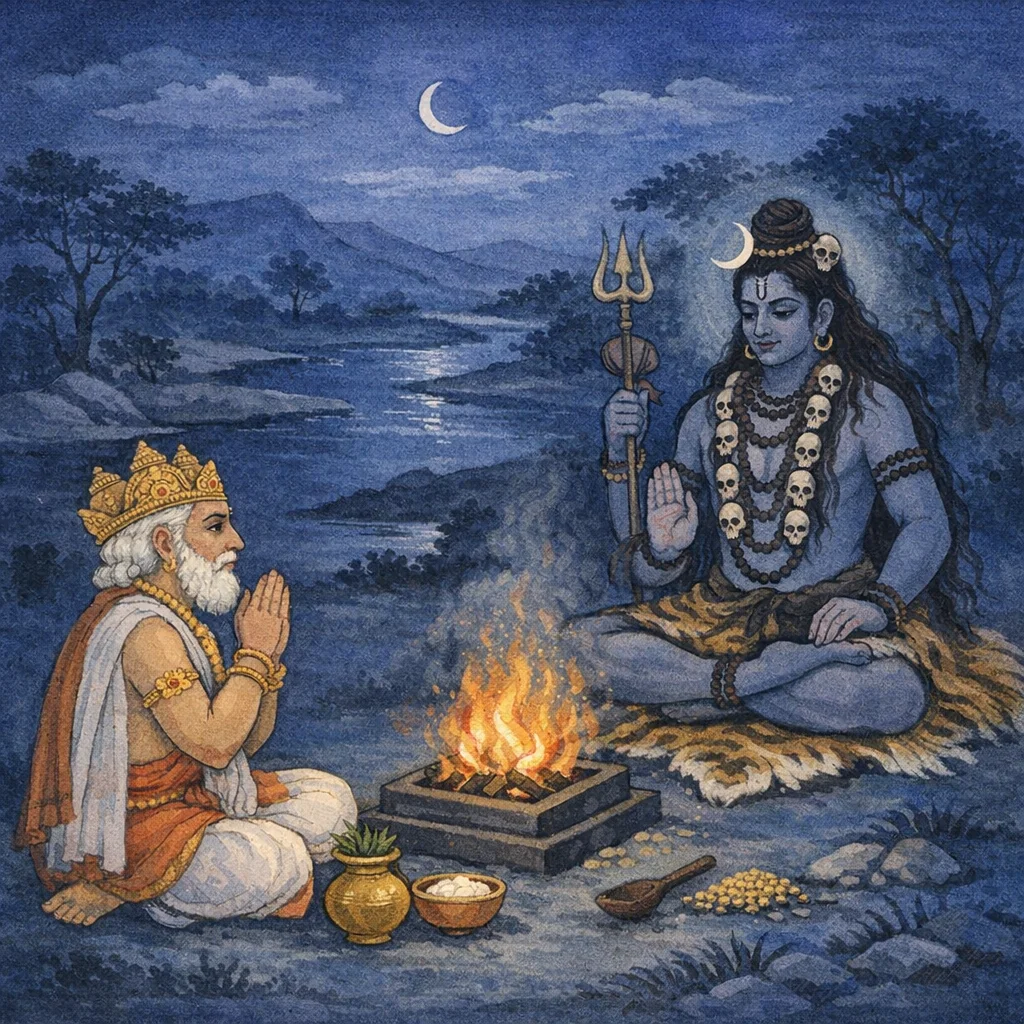
Sūta relates that in a terrifying, dark-hued kalpa Brahmā praises Śiva, who grants anugraha and declares that in this very form he surely dissolves sins. Śiva then classifies wrongdoing—mahāpātakas, upapātakas, and faults of mind, speech, and body, including inherited or incidental impurities—and prescribes Aghora-mantra japa as the remedy, assigning graded counts according to intention and the mode of recitation (mānasa, vācika, upāṃśu). Specific scales are given for grave sins such as brahmahatyā, vīrahatyā, bhrūṇahatya, mātṛhatyā, go-hatyā, kṛtaghnatā, violence against women, surāpāna, and suvarṇa-steya, including sins incurred through association. The chapter then lays out a ritual protocol: Rudra-gāyatrī, preparation of pañcagavya (go-mūtra, go-maya, kṣīra, dadhi, ghṛta) and kuśodaka in prescribed vessels, and a homa with ghṛta, caru, samidhs, tila, yava, and vrīhi, followed by bathing, drinking the mixture before Śiva, and Brahma-japa. It concludes that even extreme offenders can be purified—sometimes instantly despite long karmic histories—and urges daily japa for universal purification, introducing sustained Śaiva discipline as a normative path rather than a mere emergency expiation.
Shlokas
Verse 1
सूत उवाच ततस्तस्मिन् गते कल्पे कृष्णवर्णे भयानके तुष्टाव देवदेवेशं ब्रह्मा तं ब्रह्मरूपिणम्
Sūta said: Then, when that dreadful kalpa of dark hue had passed, Brahmā praised the Lord of the gods—Deva-Deveśa (Śiva), whose very form is Brahman, the supreme Pati beyond all pāśa and paśu.
Verse 2
अनुगृह्य ततस्तुष्टो ब्रह्माणमवदद्धरः अनेनैव तु रूपेण संहरामि न संशयः
Then, having shown grace and being pleased, the Bearer (Śiva) spoke to Brahmā: “Indeed, by this very form I bring about dissolution (saṃhāra)—of this there is no doubt.”
Verse 3
ब्रह्महत्यादिकान् घोरांस् तथान्यानपि पातकान् हीनांश्चैव महाभाग तथैव विविधान्यपि
O noble one, this discipline of Śiva destroys dreadful sins beginning with brahma-hatyā, as well as other transgressions—minor, degraded, and of many kinds—cutting through the pāśa (bondage) that binds the paśu (embodied soul) and turning it toward Pati, Lord Śiva.
Verse 4
उपपातकमप्येवं तथा पापानि सुव्रत मानसानि सुतीक्ष्णानि वाचिकानि पितामह
“In the same manner, O you of excellent vow, even the upapātakas (secondary transgressions) and other sins—those committed in the mind, and those committed through harsh and cutting speech—are to be understood (and treated) thus, O Pitāmaha.”
Verse 5
कायिकानि सुमिश्राणि तथा प्रासंगिकानि च बुद्धिपूर्वं कृतान्येव सहजागन्तुकानि च
Actions are of many kinds: bodily acts; those that are mixed in motive and outcome; those that arise incidentally from circumstance; those performed deliberately with prior intention; and those that are innate or that arise adventitiously. Knowing these distinctions, the paśu (bound soul) discerns the workings of pāśa and turns its agency toward the Lord (Pati), Śiva.
Verse 6
मातृदेहोत्थितान्येवं पितृदेहे च पातकम् संहरामि न संदेहः सर्वं पातकजं विभो
O Lord, I dissolve the sins that have arisen from the mother’s body, and likewise the sins connected with the father’s body. Of this there is no doubt: You consume every fault born of wrongdoing, O Mighty One.
Verse 7
लक्षं जप्त्वा ह्यघोरेभ्यो ब्रह्महा मुच्यते प्रभो तदर्धं वाचिके वत्स तदर्धं मानसे पुनः
O Lord, even a slayer of a brāhmaṇa is released by completing one hundred thousand recitations of the Aghora mantra. O dear one, if recited aloud, half that number suffices; and if performed mentally, again half of that.
Verse 8
चतुर्गुणं बुद्धिपूर्वे क्रोधादष्टगुणं स्मृतम् वीरहा लक्षमात्रेण भ्रूणहा कोटिमभ्यसेत्
The expiation is said to be fourfold when a deed is done with prior deliberation; but when it is committed out of anger, it is remembered as eightfold. One who has slain a hero should undertake the prescribed practice to the measure of one hundred thousand; but one who has slain an embryo should undertake it to the measure of ten million.
Verse 9
मातृहा नियुतं जप्त्वा शुध्यते नात्र संशयः गोघ्नश्चैव कृतघ्नश् च स्त्रीघ्नः पापयुतो नरः
Even one who has slain his mother becomes purified by performing a niyuta of japa—of this there is no doubt. So too, the killer of a cow, the ungrateful betrayer of benefactors, and the slayer of a woman—though burdened with sin—can be cleansed through Śiva-oriented repetition.
Verse 10
अयुताघोरमभ्यस्य मुच्यते नात्र संशयः सुरापो लक्षमात्रेण बुद्ध्याबुद्ध्यापि वै प्रभो
By repeatedly practising japa of the Aghora mantra ten thousand times, one is liberated—of this there is no doubt. Even a drinker of intoxicants is freed by performing it one hundred thousand times, whether done knowingly or unknowingly, O Lord.
Verse 11
मुच्यते नात्र संदेहस् तदर्धेन च वारुणीम् अस्नाताशी सहस्रेण अजपी च तथा द्विजः
He is liberated—of this there is no doubt. Even by half of that observance one gains the merit of the Vāruṇī rite. Even a twice-born who has not bathed and has eaten, or one who is without japa, is purified by performing it a thousand times.
Verse 12
अहुताशी सहस्रेण अदाता च विशुध्यति ब्राह्मणस्वापहर्ता च स्वर्णस्तेयी नराधमः
Even one who lives on food taken without offering it to the sacred fire becomes purified through a thousand acts of expiation; and so too does one who withholds charity. But the one who steals a brāhmaṇa’s property, and the thief of gold—such a person is the lowest among men.
Verse 13
नियुतं मानसं जप्त्वा मुच्यते नात्र संशयः गुरुतल्परतो वापि मातृघ्नो वा नराधमः
Having performed a niyuta of mental japa, one is liberated—of this there is no doubt. Even a man sunk in the gravest bonds of sin—one who violates the guru’s bed, or even a matricide, that lowest of men—can be released from pāśa through such inner recitation centered on Śiva.
Verse 14
ब्रह्मघ्नश् च जपेदेवं मानसं वै पितामह संपर्कात्पापिनां पापं तत्समं परिभाषितम्
O Pitāmaha, even a slayer of a brāhmaṇa should mentally repeat the Divine Lord’s Name; for it is declared that through contact with sinners one incurs sin of an equal measure. Therefore inner japa is prescribed as purification.
Verse 15
तथाप्ययुतमात्रेण पातकाद्वै प्रमुच्यते संसर्गात्पातकी लक्षं जपेद्वै मानसं धिया
Even so, by merely ten thousand repetitions of the Śiva-mantra one is indeed released from sin. But a sinner tainted through corrupt association should mentally repeat it a hundred thousand times, with steady, purified intellect.
Verse 16
उपांशु यच्चतुर्धा वै वाचिकं चाष्टधा जपेत् पातकादर्धमेव स्याद् उपपातकिनां स्मृतम्
One should repeat the mantra in a low voice (upāṁśu) fourfold, and aloud (vācika) eightfold. It is taught that for those burdened by secondary sins (upapātakas), the fruit is only half of that gained in the case of grave sins (pātakas).
Verse 17
तदर्धं केवले पापे नात्र कार्या विचारणा ब्रह्महत्या सुरापानं सुवर्णस्तेयमेव च
For a sin that is sheer evil, half of the stated expiation applies—there is no need for further deliberation. Such are: Brahmin-slaying, drinking intoxicants, and the theft of gold.
Verse 18
कृत्वा च गुरुतल्पं च पापकृद्ब्राह्मणो यदि रुद्रगायत्रिया ग्राह्यं गोमूत्रं कापिलं द्विजाः
O twice-born ones, if a Brahmin—having become a doer of sin—commits the grave offence of violating the teacher’s bed (gurutaḷpa), then, taking the Rudra-Gāyatrī as the purifying mantra, he should partake of the urine of a tawny Kapilā cow as expiation. By the mantra-power of Rudra, the paśu (bound soul) turns back from pāśa (impurity and demerit) toward Pati, the Lord Śiva.
Verse 19
गन्धद्वारेति तस्या वै गोमयं स्वस्थम् आहरेत् तेजो ऽसि शुक्तम् इत्याज्यं कापिलं संहरेद्बुधः
Reciting the mantra that begins “gandha-dvāre…”, he should bring pure, wholesome cow-dung. Reciting “tejo ’si…”, the wise practitioner should also collect ājya—clarified butter—from a tawny Kapilā cow, fit to be offered in Śiva’s worship.
Verse 20
आप्यायस्वेति च क्षीरं दधिक्राव्णेति चाहरेत् गव्यं दधि नवं साक्षात् कापिलं वै पितामह
Uttering the mantra “Āpyāyasva,” one should offer milk; and reciting “Dadhikrāvan,” one should bring fresh cow-curd—indeed, the direct and pure Kapilā offering, O Pitāmaha—fit for Rudra’s rite.
Verse 21
देवस्य त्वेति मन्त्रेण संग्रहेद्वै कुशोदकम् एकस्थं हेमपात्रे वा कृत्वाघोरेण राजते
Reciting the mantra that begins “devasya tva…”, one should gather the kuśa-consecrated water and keep it collected in one place—preferably in a golden vessel. Thus prepared, it shines with the power of the Aghora invocation, fit for the Lord (Pati)’s purifying service in Liṅga-worship.
Verse 22
ताम्रे वा पद्मपात्रे वा पालाशे वा दले शुभे सकूर्चं सर्वरत्नाढ्यं क्षिप्त्वा तत्रैव काञ्चनम्
In a copper vessel, or in a lotus-shaped bowl, or upon an auspicious palāśa leaf, one should place the kuśa-brush used for ritual sprinkling, richly adorned with all manner of gems; and there, in that very place, one should also set gold—an offering for Liṅga-worship—honoring Pati, the Lord who grants release to the paśu-souls bound by the pāśa.
Verse 23
जपेल्लक्षमघोराख्यं हुत्वा चैव घृतादिभिः घृतेन चरुणा चैव समिद्भिश् च तिलैस् तथा
One should repeat the Aghora-mantra a hundred thousand times, and then perform a fire-offering with ghee and other oblations—offering ghee, caru (cooked sacrificial rice), sacred fuel-sticks (samidh), and sesame—thus completing the rite for Mahādeva’s grace and the cutting of the pāśa-bonds that bind the paśu (individual soul).
Verse 24
यवैश् च व्रीहिभिश्चैव जुहुयाद्वै पृथक्पृथक् प्रत्येकं सप्तवारं तु द्रव्यालाभे घृतेन तु
One should offer oblations separately with barley and with rice; and each of these offerings is to be made seven times. If the prescribed materials are unavailable, one should perform the offering with ghee instead.
Verse 25
हुत्वाघोरेण देवेशं स्नात्वाघोरेण वै द्विजाः अष्टद्रोणघृतेनैव स्नाप्य पश्चाद्विशोध्य च
Having offered oblations to the Lord of the gods with the Aghora-mantra, the twice-born should then bathe the Deity with the Aghora-mantra; next, they should anoint Him in ablution with eight droṇas of ghee as abhiṣeka, and thereafter perform the rites of purification.
Verse 26
अहोरात्रोषितः स्नातः पिबेत्कूर्चं शिवाग्रतः ब्राह्मं ब्रह्मजपं कुर्याद् आचम्य च यथाविधि
Having observed discipline through day and night and then bathed, one should, in Śiva’s presence, sip the sanctified kūrca-water; then, performing ācamana as prescribed, one should undertake the Brāhma rite—japa of the sacred Brahman-mantra—so that the paśu (bound soul) is purified to approach Pati, Lord Śiva.
Verse 27
एवं कृत्वा कृतघ्नो ऽपि ब्रह्महा भ्रूणहा तथा वीरहा गुरुघाती च मित्रविश्वासघातकः
Having acted thus, even one who is ungrateful—whether a slayer of a brāhmaṇa, a killer of an embryo, a murderer of a hero, a killer of one’s guru, or a betrayer of a friend’s trust—incurs the gravest bonds of pāpa, binding the paśu (individual soul) in saṃsāra and obstructing approach to Pati, Lord Śiva.
Verse 28
स्तेयी सुवर्णस्तेयी च गुरुतल्परतः सदा मद्यपो वृषलीसक्तः परदारविधर्षकः
A thief; a stealer of gold; one ever given to violating the guru’s bed; a drinker of intoxicants; one attached to a woman of impure conduct; and one who violates another’s wife—such a person moves in grievous adharma and deepens the bonds (pāśa) that bind the paśu (soul) away from Pati, Śiva.
Verse 29
ब्रह्मस्वहा तथा गोघ्नो मातृहा पितृहा तथा देवप्रच्यावकश्चैव लिङ्गप्रध्वंसकस् तथा
Likewise, one who steals what belongs to a brāhmaṇa, one who kills a cow, one who slays one’s mother, and one who slays one’s father; also one who causes the fall of the gods from their divine station, and one who destroys the Liṅga—such acts are counted among the gravest offenses, bringing severe bondage (pāśa) upon the paśu through contempt of Pati.
Verse 30
तथान्यानि च पापानि मानसानि द्विजो यदि वाचिकानि तथान्यानि कायिकानि सहस्रशः
Likewise, if a twice-born person commits other sins—mental, verbal, or bodily—countless in their variety, they too are to be understood as binding the paśu through pāśa until purified by right discipline and Śiva-oriented atonement.
Verse 31
कृत्वा विमुच्यते सद्यो जन्मान्तरशतैरपि एतद्रहस्यं कथितम् अघोरेशप्रसंगतः
Having performed it, one is liberated at once, even if bound by hundreds of births. This secret teaching has been revealed in connection with Aghoreśa (Lord Aghora), the Pati who cuts the pāśa that binds the paśu.
Verse 32
तस्माज्जपेद्द्विजो नित्यं सर्वपापविशुद्धये
Therefore, a twice-born should perform japa every day for the thorough purification of all sins. Thus the pāśa (bondage) that binds the paśu (soul) is loosened, and it turns toward Pati, Lord Śiva.
Frequently Asked Questions
It presents graded efficacy and corresponding counts: mental (mānasa) and verbal (vācika) recitation are measured differently, and upāṃśu (low/whispered) is given a distinct scaling—establishing a hierarchy of discipline and intentionality for prāyaścitta.
Brahmahatyā, surāpāna, suvarṇa-steya, and gurutalpa are explicitly named; the remedy centers on Aghora-mantra japa with specified counts, supported by pañcagavya-based purification and homa, culminating in bathing and devotional observances before Śiva.
Collection and use of pañcagavya items, kuśodaka in specified vessels, homa offerings (ghṛta, caru, samidh, tila, yava, vrīhi) in repeated cycles, followed by bathing, drinking the prepared mixture before Śiva, and performing Brahma-japa as per rule (yathā-vidhi).