Adhyaya 14
अघोरस्य प्रादुर्भावः कुमारकचतुष्टयं च योगमार्गः
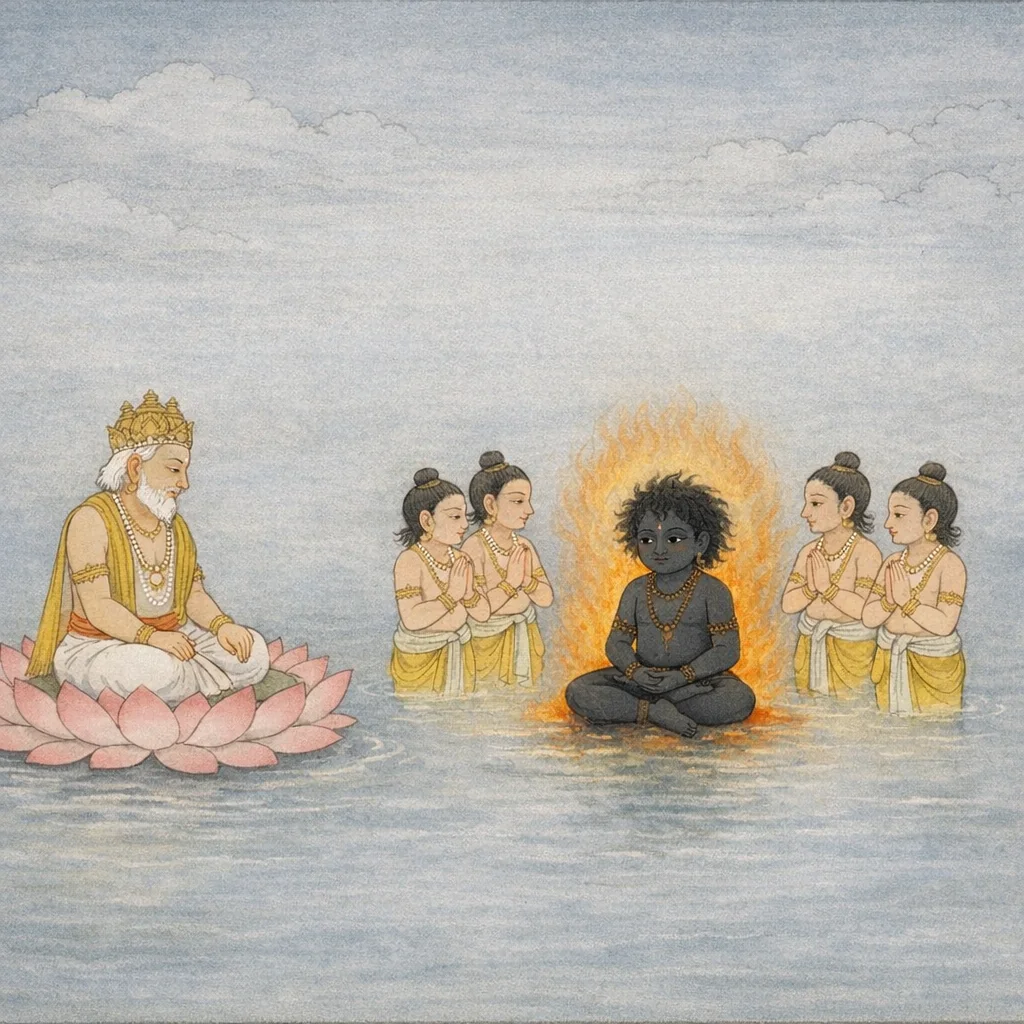
Sūta recounts a former kalpa: after the yellow-hued Svayambhū departs, a new kalpa begins. In the ekārṇava, Brahmā, wishing to create beings, becomes anxious and enters deep dhyāna. From that meditation arises a childlike, dark yet blazing manifestation—Aghora/Maheśvara—clad in black and shining with self-born tejas. Brahmā bows and, through prāṇāyāma and inner absorption, establishes Maheśvara in his heart, seeking the brahma-rūpa truth behind the vision. Aghora grants darśana again, and from his side emerge four kumārakas, likewise dark-hued and radiant. After a thousand divine years of yogic upāsanā to the Supreme Lord, they transmit mahāyoga to disciples. By yoga, the accomplished enter Śiva by mind alone, attaining the pure, nirguṇa station identified with the Lord of the universe. The chapter ends with a general promise: any wise aspirant who contemplates Mahādeva through this yoga proceeds to the imperishable Rudra, preparing for the next teaching on methods of Śiva-upāsanā and realization.
Shlokas
Verse 1
सूत उवाच ततस्तस्मिन्गते कल्पे पीतवर्णे स्वयंभुवः पुनरन्यः प्रवृत्तस्तु कल्पो नाम्नासितस्तु सः
Sūta said: When that aeon had passed—the kalpa marked by the golden hue of the Self-born (Brahmā)—another kalpa then commenced, known by a distinct name.
Verse 2
एकार्णवे तदा वृत्ते दिव्ये वर्षसहस्रके स्रष्टुकामः प्रजा ब्रह्मा चिन्तयामास दुःखितः
When all had become a single cosmic ocean (ekārṇava) and a thousand divine years had passed, Brahmā—desiring to bring forth beings—brooded in sorrow, contemplating how creation might begin.
Verse 3
तस्य चिन्तयमानस्य पुत्रकामस्य वै प्रभोः कृष्णः समभवद्वर्णो ध्यायतः परमेष्ठिनः
As that Lord Parameṣṭhin (Brahmā) contemplated, desiring progeny, a dark (kṛṣṇa) hue manifested in him while he remained absorbed in meditation.
Verse 4
अथापश्यन्महातेजाः प्रादुर्भूतं कुमारकम् कृष्णवर्णं महावीर्यं दीप्यमानं स्वतेजसा
Then the mighty one beheld a divine child suddenly manifested—dark-hued, of immense potency—blazing by the force of his own innate splendor. In Shaiva understanding, such self-luminous emergence signals the presence of Pati, whose power is not borrowed but self-established, surpassing all created lights.
Verse 5
कृष्णांबरधरोष्णीषं कृष्णयज्ञोपवीतिनम् कृष्णेन मौलिना युक्तं कृष्णस्रगनुलेपनम्
He is described as wearing dark garments and a dark turban, bearing a dark sacred thread; his head is adorned with a dark crest, and he is decorated with dark garlands and unguents—revealing the Lord (Pati) whose very form absorbs and transcends all colors and qualities, while remaining the inner ruler of all beings (paśus).
Verse 6
स तं दृष्ट्वा महात्मानम् अघोरं घोरविक्रमम् ववन्दे देवदेवेशम् अद्भुतं कृष्णपिङ्गलम्
Seeing that Great Soul—Aghora in essence yet possessed of awe-inspiring might—he bowed down to the Lord of the lords of gods, the wondrous One, dark-hued with tawny-golden radiance.
Verse 7
प्राणायामपरः श्रीमान् हृदि कृत्वा महेश्वरम् मनसा ध्यानुयुक्तेन प्रपन्नस्तु तमीश्वरम्
Steadfast in prāṇāyāma, that noble one installed Maheśvara within the heart; with a mind yoked to meditation, he surrendered himself to that Lord (Pati).
Verse 8
अघोरं तु ततो ब्रह्मा ब्रह्मरूपं व्यचिन्तयत् तथा वै ध्यायमानस्य ब्रह्मणः परमेष्ठिनः
Then Brahmā contemplated the Aghora—Shiva’s non-terrific, auspicious principle—as the very form of Brahman. Thus, while Parameṣṭhin Brahmā remained absorbed in meditation, his awareness settled into that supreme reality beyond fear and bondage.
Verse 9
प्रददौ दर्शनं देवो ह्य् अघोरो घोरविक्रमः अथास्य पार्श्वतः कृष्णाः कृष्णस्रगनुलेपनाः
Then the God—Aghora, whose valor is awe-inspiring—granted His sacred darśana. And at His sides appeared dark-hued divine powers, adorned with dark garlands and anointed with dark unguents.
Verse 10
चत्वारस्तु महात्मानः संबभूवुः कुमारकाः कृष्णः कृष्णशिखश्चैव कृष्णास्यः कृष्णवस्त्रधृक्
Then four great-souled Kumāras came into being—one dark-hued, one with a dark crest of hair, one dark-faced, and one clad in dark garments—signifying the Lord’s veiling power that binds the paśu (individual soul) with pasha, until Pati (Śiva) reveals the liberating knowledge.
Verse 11
ततो वर्षसहस्रं तु योगतः परमेश्वरम् उपासित्वा महायोगं शिष्येभ्यः प्रददुः पुनः
Thereafter, for a thousand years, they worshipped Parameśvara through Yoga; and having attained the Great Yoga, they again transmitted that Mahāyoga to their disciples.
Verse 12
योगेन योगसम्पन्नाः प्रविश्य मनसा शिवम् अमलं निर्गुणं स्थानं प्रविष्टा विश्वमीश्वरम्
Perfected in Yoga, they entered Śiva through the mind—entering that stainless, attribute-less state—and thus entered the Lord who is sovereign over the entire universe.
Verse 13
एवमेतेन योगेन ये ऽपि चान्ये मनीषिणः चिन्तयन्ति महादेवं गन्तारो रुद्रमव्ययम्
Likewise, by this very Yoga, other wise contemplatives meditate upon Mahādeva; and, having so contemplated, they attain Rudra—the imperishable Lord (Pati) beyond decay.
Frequently Asked Questions
The narrative presents Aghora as the revelatory form through which the nirguṇa Lord becomes accessible to the creator-god: the ‘dark’ iconography marks transcendence beyond guṇas, while the blazing tejas signals divine self-luminosity that authorizes creation and instruction.
They are four childlike emanations associated with Aghora’s presence, who undertake prolonged upāsanā and then transmit mahāyoga to disciples—functioning as mediating teachers of Śiva-realization rather than merely mythic attendants.
Prāṇāyāma joined to manasa-dhyāna (placing Maheśvara in the heart) and sustained upāsanā, culminating in mental entry into Śiva and realization of the amalā, nirguṇa station.