Adhyaya 12
रक्तकल्पे वामदेवदर्शनं चतुर्कुमारोत्पत्तिः
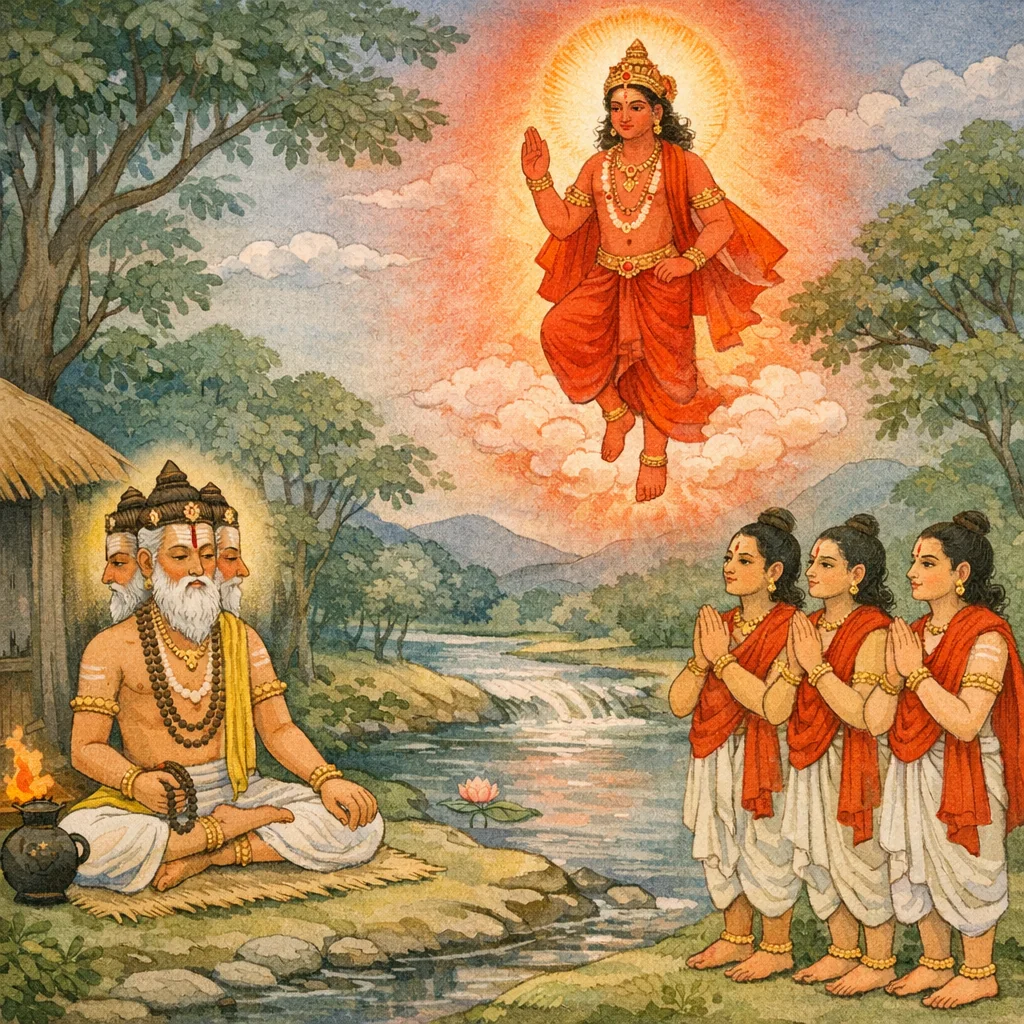
Suta recounts the “Rakta Kalpa”: Brahma, longing for sons, enters profound meditation and beholds a radiant Kumara adorned in red, whom he recognizes through higher contemplation as Mahadeva (Vamadeva). Brahma praises and bows to Shiva, and Shiva affirms that such a vision arises from bhakti and the power of dhyana, promising that through repeated striving across kalpas Brahma will realize Shiva as the true sustainer of the world. From this Shaiva encounter arise four pure, Brahma-like Kumaras—Viraja, Vibahu, Vishoka, and Vishvabhavana—marked by red garments and sacred unctions, devoted to Brahmahood and the Vamadeva principle. After a thousand years they teach complete dharma for the welfare of worlds and disciples, then merge back into Rudra, showing liberation as re-entry into the imperishable. The chapter ends with an assurance: twice-born seekers who yoke themselves to Vamadeva and behold Mahadeva with devotion become sinless brahmacharis and attain Rudraloka, a realm difficult to return from, preparing the next discourse on sustained Shaiva practice and its cosmic-spiritual fruits.
Shlokas
Verse 1
सूत उवाच ततस्त्रिंशत्तमः कल्पो रक्तो नाम प्रकीर्तितः ब्रह्मा यत्र महातेजा रक्तवर्णमधारयत्
Sūta said: Thereafter, the thirtieth Kalpa is proclaimed as the “Rakta” Kalpa, in which Brahmā of great radiance assumed a red hue.
Verse 2
ध्यायतः पुत्रकामस्य ब्रह्मणः परमेष्ठिनः प्रादुर्भूतो महातेजाः कुमारो रक्तभूषणः
As Brahmā, the Parameṣṭhin, meditated with longing for a son, there manifested a mighty, radiant Kumāra, adorned with red ornaments.
Verse 3
रक्तमाल्याम्बरधरो रक्तनेत्रः प्रतापवान् स तं दृष्ट्वा महात्मानं कुमारं रक्तवाससम्
Wearing red garlands and red garments, with reddish eyes and blazing with splendor, Brahmā beheld that great-souled Kumāra, himself clad in red robes.
Verse 4
परं ध्यानं समाश्रित्य बुबुधे देवमीश्वरम् स तं प्रणम्य भगवान् ब्रह्मा परमयन्त्रितः
Taking refuge in supreme meditation, Brahmā awakened to the true realization of the Lord—Īśvara, the Divine. Having bowed to Him, the Blessed Brahmā stood wholly governed by that Supreme Power, in accord with the Lord’s will.
Verse 5
वामदेवं ततो ब्रह्मा ब्रह्म वै समचिन्तयत् तथा स्तुतो महादेवो ब्रह्मणा परमेश्वरः
Then Brahmā contemplated Vāmadeva—the Supreme Brahman itself. Thus Brahmā praised Mahādeva, the Paramēśvara, recognizing Him as the transcendent Pati beyond all created orders.
Verse 6
प्रतीतहृदयः सर्व इदमाह पितामहम् ध्यायता पुत्रकामेन यस्मात्ते ऽहं पितामह
With his heart fully satisfied, he said all this to the Grandsire (Brahmā): “Because you contemplated with the desire for a son, therefore I am your Grandsire.”
Verse 7
दृष्टः परमया भक्त्या स्तुतश् च ब्रह्मपूर्वकम् तस्माद्ध्यानबलं प्राप्य कल्पे कल्पे प्रयत्नतः
Beheld with supreme devotion and praised—Brahmā leading the hymn—thereafter, by attaining the power born of meditation, one should strive with steady effort in every aeon, kalpa after kalpa, toward the Pati, the Lord.
Verse 8
वेत्स्यसे मां प्रसंख्यातं लोकधातारमीश्वरम् ततस्तस्य महात्मानश् चत्वारस्ते कुमारकाः
You shall come to know Me as the renowned Lord—the Upholder of the worlds, the Īśvara. Thereafter, from him will arise four great-souled youths, your Kumāras.
Verse 9
संबभूवुर्महात्मानो विशुद्धा ब्रह्मवर्चसः विरजाश् च विबाहुश् च विशोको विश्वभावनः
Then there came forth great-souled beings—utterly purified and radiant with brahmanic splendor: Viraja, Vibāhu, Viśoka, and Viśvabhāvana—fit to serve the Pati (Śiva) in the unfolding of creation, unbound by the grosser pāśa of sorrow and stain.
Verse 10
ब्रह्मण्या ब्रह्मणस्तुल्या वीरा अध्यवसायिनः रक्तांबरधराः सर्वे रक्तमाल्यानुलेपनाः
They were devoted to the sacred power of Brahman, equal to Brahmā himself—heroic and steadfast in resolve. All wore red garments, were adorned with red garlands, and were anointed with red unguents.
Verse 11
रक्तकुङ्कुमलिप्ताङ्गा रक्तभस्मानुलेपनाः ततो वर्षसहस्रान्ते ब्रह्मत्वे ऽध्यवसायिनः
With their bodies smeared with red saffron-paste and anointed with red sacred ash, they remained unwavering in their resolve; and at the completion of a thousand years they became firmly established in Brahmahood—an orientation to the Supreme Pati through Shaiva discipline.
Verse 12
गृणन्तश् च महात्मानो ब्रह्म तद्वामदैविकम् अनुग्रहार्थं लोकानां शिष्याणां हितकाम्यया
Those great-souled ones praised that Brahman—Vāmadeva, the divine aspect—so that grace might descend upon the worlds, and out of a desire for the welfare of their disciples.
Verse 13
धर्मोपदेशमखिलं कृत्वा ते ब्रह्मणः प्रियाः पुनरेव महादेवं प्रविष्टा रुद्रमव्ययम्
Having delivered the complete instruction on dharma, those beloved of Brahmā entered once again into Mahādeva—into Rudra, the imperishable Lord—merging back into the Pati who transcends decay and change.
Verse 14
ये ऽपि चान्ये द्विजश्रेष्ठा युञ्जाना वाममीश्वरम् प्रपश्यन्ति महादेवं तद्भक्तास् तत्परायणाः
O best of the twice-born, others too—who, through disciplined yogic application, contemplate the Lord in His Vāma aspect, united with Śakti—behold Mahādeva directly. They are His devotees, wholly devoted to Him as their supreme refuge.
Verse 15
ते सर्वे पापनिर्मुक्ता विमला ब्रह्मचारिणः रुद्रलोकं गमिष्यन्ति पुनरावृत्तिदुर्लभम्
All those brahmacārins—freed from sin and made pure—shall go to Rudra’s world, a state from which return to repeated birth is hard to obtain.
Frequently Asked Questions
The red-adorned Kumar is an epiphanic manifestation of Mahadeva identified with Vamadeva; Brahma recognizes him through higher meditation and offers stuti, after which Shiva explains the role of devotion and dhyana in such realization.
The text states that such devotees become freed from sin, established in purity and brahmacharya, and attain Rudraloka—described as a destination where return (punaravritti) is difficult—indicating a liberation-oriented result grounded in devotion and grace.