Adhyaya 106
विनायकोत्पत्तिः / ताण्डव-प्रसङ्गः (दारुक-वधः, काली-उत्पत्तिः, क्षेत्रपालोत्पत्तिः)
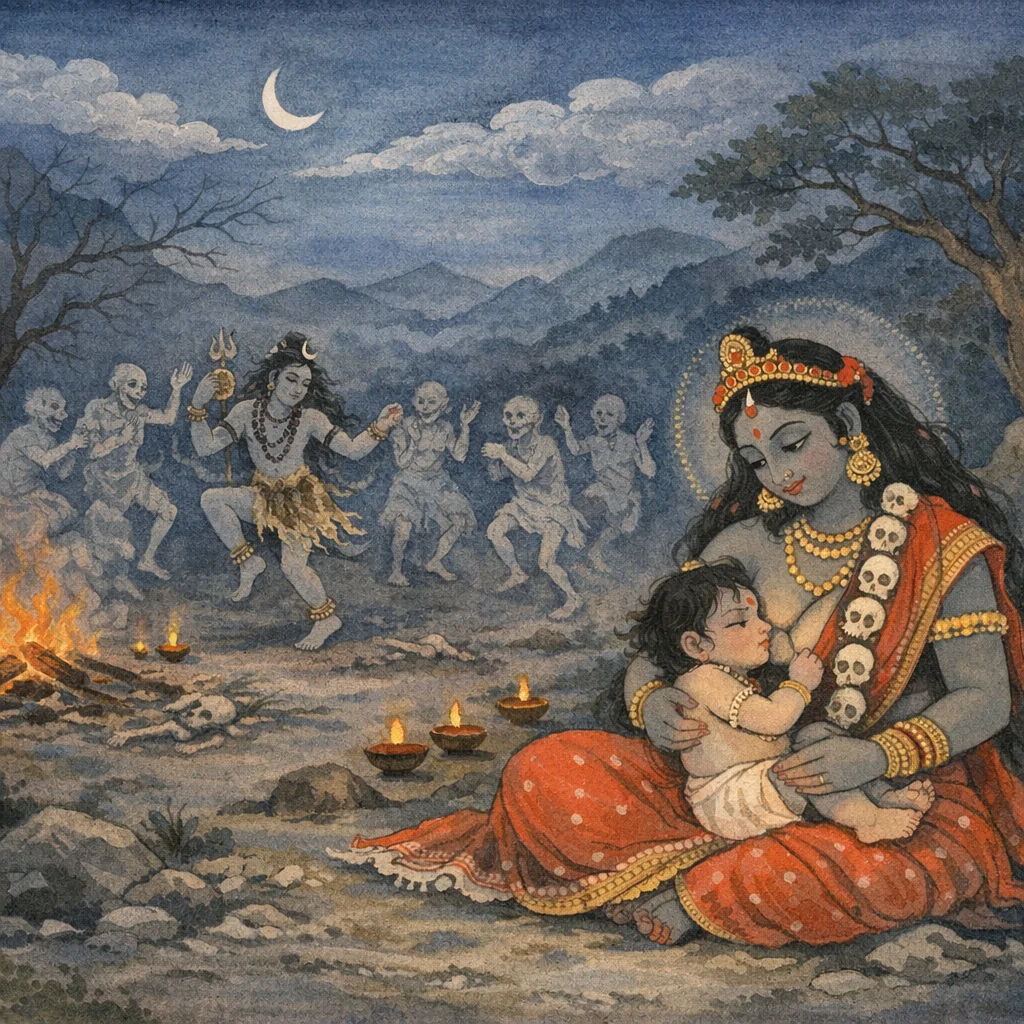
The sages ask why Śambhu (Śiva) began His dance and wish to hear the episode connected with Skanda’s elder brother. Sūta recounts the asura Dāruka, who, empowered by austerities, tormented devas and brāhmaṇas. Brahmā and the gods take refuge in Umāpati and beg for Dāruka’s destruction. Śiva prays to Girijā; the Devī enters His body and becomes a fierce form of Śakti. From the third eye Śiva brings forth Kālī (Kālakāṇṭhī); she slays Dāruka, yet her wrath-fire throws the world into turmoil. Then Śiva appears in the cremation ground as a crying child; the Goddess nurses Him and her fury is calmed. The child becomes Kṣetrapāla, guardian of the sacred precinct, and the Aṣṭamūrti are indicated. At last, at twilight, Mahādeva performs the Tāṇḍava with hosts of pretas; the Devī drinks the nectar of the dance and is pleased. The gods bow to Kālī and Pārvatī, and this narrative sets the ground for the coming exposition on Vināyaka and the lineage of protective deities.
Shlokas
Verse 1
इति श्रीलिङ्गमहापुराणे पूर्वभागे विनायकोत्पत्तिर्नाम पञ्चाधिकशततमो ऽध्यायः ऋषय ऊचुः नृत्यारम्भः कथं शंभोः किमर्थं वा यथातथम् वक्तुमर्हसि चास्माकं श्रुतः स्कन्दाग्रजोद्भवः
Thus, in the Śrī Liṅga Mahāpurāṇa, in the Pūrvabhāga, begins the one-hundred-and-sixth chapter called “The Origin of Vināyaka.” The sages said: “O Śambhu (Śiva), how did You begin Your dance, and for what purpose—tell us exactly as it occurred. We have heard of the manifestation of Skanda’s elder-born (Vināyaka); therefore, explain it to us.”
Verse 2
सूत उवाच दारुको ऽसुरसम्भूतस् तपसा लब्धविक्रमः सूदयामास कालाग्निर् इव देवान्द्विजोत्तमान्
Sūta said: Dāruka, born of the asuras and empowered through austerity, began to harass and destroy the devas and the foremost of the twice-born, like the Kālāgni fire at the end of an age. When dharma is thus oppressed, the paśu (bound souls) are driven deeper into pāśa (bondage) until they seek refuge in Pati, the Lord—Śiva.
Verse 3
दारुकेण तदा देवास् ताडिताः पीडिता भृशम् ब्रह्माणं च तथेशानं कुमारं विष्णुमेव च
Then, struck and grievously tormented by Dāruka, the Devas—in their distress—approached Brahmā, Īśāna (the Lord), Kumāra (Skanda), and also Viṣṇu.
Verse 4
यममिन्द्रमनुप्राप्य स्त्रीवध्य इति चासुरः स्त्रीरूपधारिभिः स्तुत्यैर् ब्रह्माद्यैर्युधि संस्थितैः
Reaching Yama and Indra, that Asura was declared “one who must be slain”—while, on the battlefield, Brahmā and the other gods stood there offering hymns, having assumed female forms.
Verse 5
बाधितास्तेन ते सर्वे ब्रह्माणं प्राप्य वै द्विजाः विज्ञाप्य तस्मै तत्सर्वं तेन सार्धमुमापतिम्
Afflicted by him, all those twice-born approached Brahmā and reported everything to him—together with the account concerning Umāpati (Śiva), the Lord united with Umā.
Verse 6
सम्प्राप्य तुष्टुवुः सर्वे पितामहपुरोगमाः ब्रह्मा प्राप्य च देवेशं प्रणम्य बहुधा नतः
Having reached Him, all—led by Pitāmaha (Brahmā)—praised the Lord of the gods; and Brahmā, approaching Deva-īśa, again and again bowed down in reverent prostration.
Verse 7
दारुणो भगवान्दारुः पूर्वं तेन विनिर्जिताः निहत्य दारुकं दैत्यं स्त्रीवध्यं त्रातुमर्हसि
O Bhagavān, the fierce Lord called “Dāru”, we were once overcome by him. Having slain the daitya Dāruka, you should protect those women marked for slaughter.
Verse 8
विज्ञप्तिं ब्रह्मणः श्रुत्वा भगवान् भगनेत्रहा देवीमुवाच देवेशो गिरिजां प्रहसन्निव
Having heard Brahmā’s supplication, the Blessed Lord—Bhaganetraghna, destroyer of Bhaga’s eye, the Lord of the gods—spoke to the Goddess Girijā as though with a gentle smile.
Verse 9
भवतीं प्रार्थयाम्यद्य हिताय जगतां शुभे वधार्थं दारुकस्यास्य स्त्रीवध्यस्य वरानने
O auspicious One, for the welfare of the worlds I entreat you today—O fair-faced Lady—to bring about the slaying of this Dāruka, who is destined to be slain by a woman.
Verse 10
अथ सा तस्य वचनं निशम्य जगतो ऽरणिः विवेश देहे देवस्य देवेशी जन्मतत्परा
Then she—Deveśī, the divine Lady, the very araṇi (churning-rod of fire) of the worlds—having heard his command, entered into the body of the God, intent upon the manifestation of the birth that was to arise.
Verse 11
एकेनांशेन देवेशं प्रविष्टा देवसत्तमम् न विवेद तदा ब्रह्मा देवाश्चेन्द्रपुरोगमाः
Entering the Lord of the Devas by but a single fraction of His power, they could not comprehend Him at all—neither Brahmā nor the Devas led by Indra perceived the Supreme Deity as He truly is.
Verse 12
गिरिजां पूर्ववच्छंभोर् दृष्ट्वा पार्श्वस्थितां शुभाम् मायया मोहितस्तस्याः सर्वज्ञो ऽपि चतुर्मुखः
Seeing Girijā, as before, standing auspiciously at Śambhu’s side, the four-faced Brahmā—though all-knowing—was deluded by Her māyā.
Verse 13
सा प्रविष्टा तनुं तस्य देवदेवस्य पार्वती कण्ठस्थेन विषेणास्य तनुं चक्रे तदात्मनः
Pārvatī entered into the body of that God of gods; and by the poison held in His throat, she then fashioned His body into the very likeness of her own being—manifesting her oneness with Him.
Verse 14
तां च ज्ञात्वा तथाभूतां तृतीयेनेक्षणेन वै ससर्ज कालीं कामारिः कालकण्ठीं कपर्दिनीम्
Knowing her to be in that state, Kāma’s foe (Śiva) indeed, by the power of His third eye, brought forth Kālī—dark-hued, time-devouring, and bearing matted locks—so that the Lord (Pati) might subdue the forces that bind the worlds.
Verse 15
जाता यदा कालिमकालकण्ठी जाता तदानीं विपुला जयश्रीः देवेतराणामजयस्त्वसिद्ध्या तुष्टिर्भवान्याः परमेश्वरस्य
When Kālimā—dark-hued, the consort of Nīlakaṇṭha—manifested, at that very moment abundant glory of victory arose. The non-devas (the asuric hosts) met with defeat as their aims were thwarted; and Bhavānī was pleased—so too was Parameśvara, the Supreme Lord.
Verse 16
जातां तदानीं सुरसिद्धसंघा दृष्ट्वा भयाद् दुद्रुवुर् अग्निकल्पाम् कालीं गरालंकृतकालकण्ठीम् उपेन्द्रपद्मोद्भवशक्रमुख्याः
Then, seeing Kālikā newly arisen—blazing like fire, her dark throat adorned with a dreadful garland—the hosts of Devas and Siddhas fled in fear, led by Upendra (Viṣṇu), Padmodbhava (Brahmā), and Śakra (Indra).
Verse 17
तथैव जातं नयनं ललाटे सितांशुलेखा च शिरस्युदग्रा कण्ठे करालं निशितं त्रिशूलं करे करालं च विभूषणानि
Just so, an eye manifested upon the forehead; and upon the crown appeared a lofty streak like the white moon. At the throat there arose a fearsome, sharp trident; and in the hand as well appeared awe-inspiring ornaments—tokens of the Lord as Pati, the transcendent ruler beyond all bonds (pāśa).
Verse 18
सार्धं दिव्यांबरा देव्याः सर्वाभरणभूषिताः सिद्धेन्द्रसिद्धाश् च तथा पिशाचा जज्ञिरे पुनः
Together with the Goddess—radiant in divine garments and adorned with every ornament—there again came forth the Siddhas, along with the lordly Siddhas, and also the Piśācas. Thus, as creation unfolded under Pati (Śiva) and Śakti, even subtle orders of beings manifested according to their own nature and karmic bonds (pāśa).
Verse 19
आज्ञया दारुकं तस्याः पार्वत्याः परमेश्वरी दानवं सूदयामास सूदयन्तं सुराधिपान्
By the command of that Pārvatī, the Supreme Goddess Mahēśvarī, she struck down the Dānava Dāruka, who was tormenting the lords of the Devas. Thus Śakti, ever one with Pati (Śiva), protected the cosmic order by removing the force of bondage (pāśa) that oppressed the divine hosts.
Verse 20
संरंभातिप्रसंगाद् वै तस्याः सर्वमिदं जगत् क्रोधाग्निना च विप्रेन्द्राः संबभूव तदातुरम्
O best of Brahmins, due to the overpowering surge of her impetuous wrath, this entire world became afflicted—scorched and distressed by the fire of anger.
Verse 21
भवो ऽपि बालरूपेण श्मशाने प्रेतसंकुले रुरोद मायया तस्याः क्रोधाग्निं पातुम् ईश्वरः
Even Bhava (Śiva), taking the form of a child, wept—by His own māyā—in a cremation ground thronged with spirits, so that the Lord might drink in and extinguish Her fire of wrath.
Verse 22
तं दृष्ट्वा बालमीशानं मायया तस्य मोहिता उत्थाप्याघ्राय वक्षोजं स्तनं सा प्रददौ द्विजाः
Seeing Īśāna appear as a child, she was deluded by His māyā. Lifting Him up and drawing Him to her breast, she offered Him her milk—O twice-born sages.
Verse 23
स्तनजेन तदा सार्धं कोपमस्याः पपौ पुनः क्रोधेनानेन वै बालः क्षेत्राणां रक्षको ऽभवत्
Then, along with the milk from her breast, he again drank in her anger. By that very wrath, the child became the guardian of the sacred fields—a kṣetrapāla who wards Śiva’s domain from harm.
Verse 24
मूर्तयो ऽष्टौ च तस्यापि क्षेत्रपालस्य धीमतः एवं वै तेन बालेन कृता सा क्रोधमूर्छिता
Even for that wise Kṣetrapāla there are eight manifested forms. Thus it was accomplished by the boy; she was overcome and stupefied by the swoon of wrath.
Verse 25
कृतमस्याः प्रसादार्थं देवदेवेन ताण्डवम् संध्यायां सर्वभूतेन्द्रैः प्रेतैः प्रीतेन शूलिना
To bestow grace upon her, the God of gods performed the Tāṇḍava at twilight; the Trident-bearing Lord, well pleased, was attended by all the chiefs of the bhūtas and the hosts of pretas.
Verse 26
पीत्वा नृत्यामृतं शंभोर् आकण्ठं परमेश्वरी ननर्त सा च योगिन्यः प्रेतस्थाने यथासुखम्
Having drunk up to her throat the nectar of Śambhu’s dance, the Supreme Goddess danced; and the yoginīs too danced at ease in the cremation-ground, the haunt of spirits.
Verse 27
तत्र सब्रह्मका देवाः सेन्द्रोपेन्द्राः समन्ततः प्रणेमुस्तुष्टुवुः कालीं पुनर्देवीं च पार्वतीम्
There, all the gods—along with Brahmā, and with Indra and Upendra (Viṣṇu) on every side—bowed down in reverence and praised Kāḷī; and again they extolled the Goddess as Pārvatī.
Verse 28
एवं संक्षेपतः प्रोक्तं ताण्डवं शूलिनः प्रभोः योगानन्देन च विभोस् ताण्डवं चेति चापरे
Thus, in brief, the Tāṇḍava of the Lord who bears the trident has been declared. Some, however, also call this very dance of the all-pervading Lord the “Tāṇḍava of Yogic Bliss (Yogānanda).”
Frequently Asked Questions
Kali is manifested to accomplish the destruction of the boon-protected Daruka (notably framed as ‘strī-vadhya’), signifying Shiva’s controlled release of Shakti’s fierce power for dharma-protection—followed by the necessity of pacifying that power to restore cosmic balance.
It dramatizes divine upaya (skillful means): Shiva uses māyā to redirect and absorb the destructive ‘krodhāgni’ into a protective function, transforming uncontrolled fury into kshetra-raksha (guardianship), a template for inner anger’s sublimation in sadhana.
The text presents Tandava as a prasāda-hetu act that delights and pacifies, while also being described as ‘yogānanda-tāṇḍava’—linking outward divine dance with inward yogic bliss and restoration of sattva.