Adhyaya 1
नैमिषारण्ये सूतागमनम् — लिङ्गमाहात्म्यभूमिका तथा शब्दब्रह्म-ओङ्कार-लिङ्गतत्त्वम्
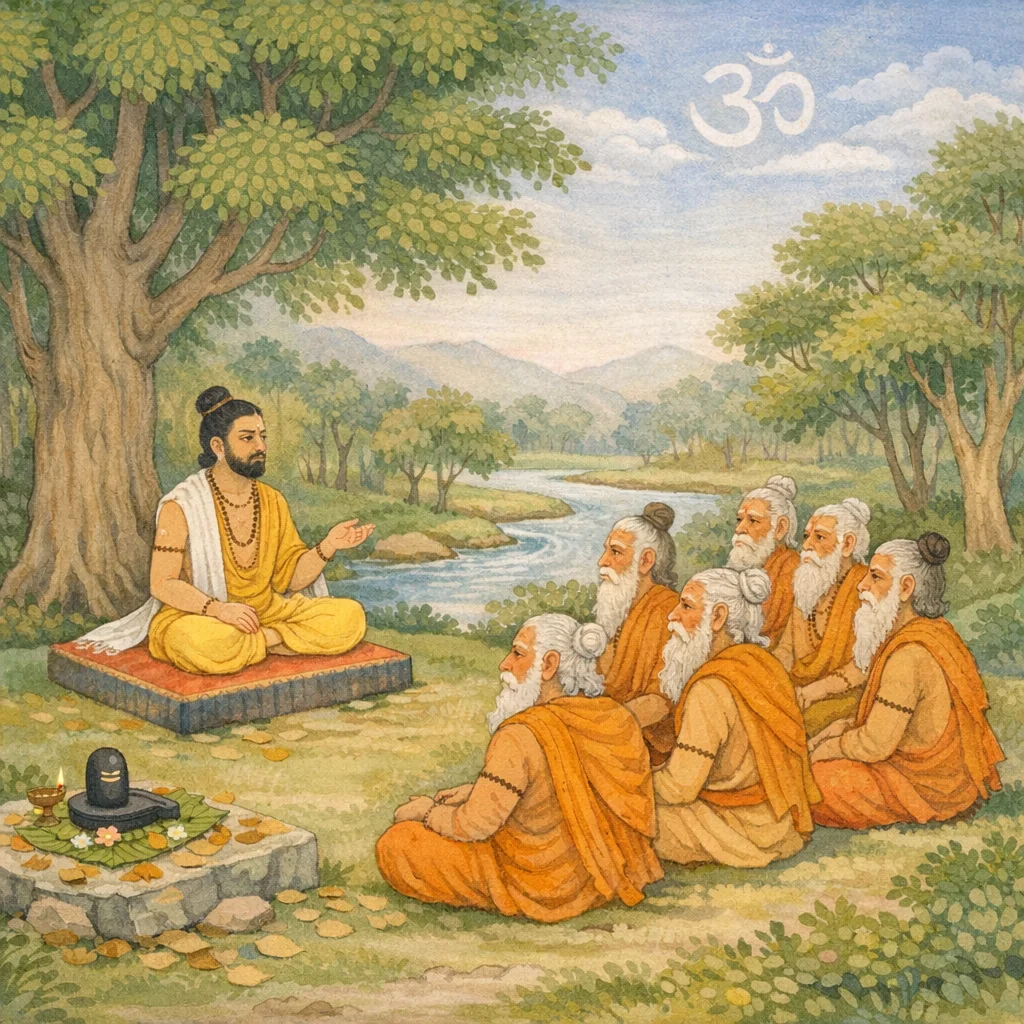
This chapter tells how Nārada, after worshipping the Liṅga at many sacred places, arrives at the forest of Naimiṣāraṇya. The sages of Naimiṣa honor him and, on seeing Sūta Romaharṣaṇa—Vyāsa’s disciple—request him to recite the Purāṇic saṃhitā filled with the Liṅga’s māhātmya. Sūta bows to the three deities and to Vyāsa, then sets forth the philosophical ground of liṅga-tattva: the principle as Śabda-Brahman, of the nature of Oṃkāra, endowed with the Vedāṅgas, transcending Pradhāna and Puruṣa; within the play of the three guṇas, sattva manifests as Viṣṇu, rajas as Hiraṇyagarbha, tamas as Kāla-Rudra, while in the nirguṇa state it is affirmed as Maheśvara. This prologue steadies the flow of later chapters on the Liṅga’s manifestation, the līlā of creation and dissolution, and the rites of Liṅga worship.
Shlokas
Verse 1
लिङ्गपुराण, १-१०८ (ग्रेतिल्) लिङ्गपुराण, १-१०८ हेअदेर् थिस् फ़िले इस् अन् ह्त्म्ल् त्रन्स्फ़ोर्मतिओन् ओफ़् स_लिग्गपुरन१-१०८।xम्ल् wइथ् अ रुदिमेन्तर्य् हेअदेर्। फ़ोर् अ मोरे एxतेन्सिवे हेअदेर् प्लेअसे रेफ़ेर् तो थे सोउर्चे फ़िले। दत एन्त्र्य्: मेम्बेर्स् ओफ़् थे सन्स्क्नेत् प्रोजेच्त् चोन्त्रिबुतिओन्: मेम्बेर्स् ओफ़् थे सन्स्क्नेत् प्रोजेच्त् दते ओफ़् थिस् वेर्सिओन्: २०२०-०७-३१ सोउर्चे: बोम्बय् : वेन्कतेस्वर स्तेअम् प्रेस्स् १९०६। पुब्लिस्हेर्: गऺत्तिन्गेन् रेगिस्तेर् ओफ़् एलेच्त्रोनिच् तेxत्स् इन् इन्दिअन् लन्गुअगेस् (ग्रेतिल्), सुब् गऺत्तिन्गेन् लिचेन्चे: थिस् ए-तेxत् wअस् प्रोविदेद् तो ग्रेतिल् इन् गोओद् फ़ैथ् थत् नो चोप्य्रिघ्त् रिघ्त्स् हवे बेएन् इन्फ़्रिन्गेद्। इफ़् अन्योने wइस्हेस् तो अस्सेर्त् चोप्य्रिघ्त् ओवेर् थिस् फ़िले, प्लेअसे चोन्तच्त् थे ग्रेतिल् मनगेमेन्त् अत् ग्रेतिल्(अत्)सुब्(दोत्)उनि-गोएत्तिन्गेन्(दोत्)दे। थे फ़िले wइल्ल् बे इम्मेदिअतेल्य् रेमोवेद् पेन्दिन्ग् रेसोलुतिओन् ओफ़् थे च्लैम्। दिस्त्रिबुतेद् उन्देर् अ च्रेअतिवे चोम्मोन्स् अत्त्रिबुतिओन्-नोन्चोम्मेर्चिअल्-स्हरेअलिके ४।० इन्तेर्नतिओनल् लिचेन्से। इन्तेर्प्रेतिवे मर्कुप्: रेमर्क्स् नोतेस्: थिस् फ़िले हस् बेएन् च्रेअतेद् ब्य् मस्स् चोन्वेर्सिओन् ओफ़् ग्रेतिल्ऽस् सन्स्क्रित् चोर्पुस् फ़्रोम् लिप्१_औ।ह्त्म् । दुए तो थे हेतेरोगेनेइत्य् ओफ़् थे सोउर्चेस् थे हेअदेर् मर्कुप् मिघ्त् बे सुबोप्तिमल्। फ़ोर् थे सके ओफ़् त्रन्स्परेन्च्य् थे हेअदेर् ओफ़् थे लेगच्य् फ़िले इस् दोचुमेन्तेद् इन् थे <नोते> एलेमेन्त् बेलोw: लिन्ग-पुरन, पर्त् १ (अध्य्। १-१०८) बसेद् ओन् थे एदितिओन् बोम्बय् : वेन्कतेस्वर स्तेअम् प्रेस्स् १९०६ इन्पुत् ब्य् मेम्बेर्स् ओफ़् थे सन्स्क्नेत्-प्रोजेच्त् (www।सन्स्क्नेत्।ओर्ग्) रेविसेद् ब्य् ओलिवेर् हेल्ल्wइग् अच्चोर्दिन्ग् तो थे एद्। चल्चुत्त, १९६० (गुरुमन्दल् सेरिएस् नो। xव्) तेxत् wइथ् पद मर्केर्स् थिस् ग्रेतिल् वेर्सिओन् हस् बेएन् चोन्वेर्तेद् फ़्रोम् अ चुस्तोम् देवनगरि एन्चोदिन्ग्। चोन्सेक़ुएन्त्ल्य्, मन्य् wओर्द् बोउन्दरिएस् अरे नोत् मर्केद् ब्य् स्पचेस्। रेविसिओन्स्: २०२०-०७-३१: तेइ एन्चोदिन्ग् ब्य् मस्स् चोन्वेर्सिओन् ओफ़् ग्रेतिल्ऽस् सन्स्क्रित् चोर्पुस् तेxत् नमो रुद्राय हरये ब्रह्मणे परमात्मने प्रधानपुरुषेशाय सर्गस्थित्यन्तकारिणे
Salutations to Rudra—Hara—Brahman, the Supreme Self; to the Lord of Pradhāna (primordial Nature) and Puruṣa (the conscious principle), who brings about creation, sustenance, and dissolution.
Verse 2
नारदो ऽभ्यर्च्य शैलेशे शङ्करं सङ्गमेश्वरे हिरण्यगर्भे स्वर्लीने ह्य् अविमुक्ते महालये
Having duly worshipped Śaṅkara—the Lord of the mountain (Śaileśa), the Lord of the confluence (Saṅgameśvara), Hiraṇyagarbha, the One absorbed in the heavenly realm, and the Great Abode called Avimukta—Nārada continued his sacred observances.
Verse 3
रौद्रे गोप्रेक्षके चैव श्रेष्ठे पाशुपते तथा विघ्नेश्वरे च केदारे तथा गोमायुकेश्वरे
In Raudra, in Goprekṣaka, in the most excellent (Śreṣṭha), in Pāśupata, and likewise in Vighneśvara; in Kedāra as well, and also in Gomāyukeśvara—the Lord is worshipped in these sacred seats, manifest as the Liṅga.
Verse 4
हिरण्यगर्भे चन्द्रेशे ईशान्ये च त्रिविष्टपे शुक्रेश्वरे यथान्यायं नैमिषं प्रययौ मुनिः
Having duly paid reverence—according to sacred propriety—to Hiraṇyagarbha (Brahmā), to Candra as Lord, to Īśāna, to the gods in Svarga (Triviṣṭapa), and to Śukreśvara, the sage then proceeded to Naimiṣa.
Verse 5
नैमिषेयास्तदा दृष्ट्वा नारदं हृष्टमानसाः समभ्यर्च्यासनं तस्मै तद्योग्यं समकल्पयन्
Then the sages of Naimiṣāraṇya, seeing Nārada and rejoicing in heart, duly honored him and arranged for him a fitting seat.
Verse 6
सो ऽपि हृष्टो मुनिवरैर् दत्तं भेजे तदासनम् सम्पूज्यमानो मुनिभिः सुखासीनो वरासने
Delighted, he accepted the seat offered by the foremost sages; duly honoured by those munis, he sat at ease upon that excellent seat—fit for the transmission of Śiva-tattva, wherein the Pati is revealed and the paśus are guided beyond pāśa.
Verse 7
चक्रे कथां विचित्रार्थां लिङ्गमाहात्म्यमाश्रिताम् एतस्मिन्नेवकाले तु सूतः पौराणिकः स्वयम्
At that very time, Sūta himself—the Purāṇic narrator—composed a narrative of wondrous import, grounded in the Mahātmyā (supreme greatness) of the Śiva-liṅga.
Verse 8
जगाम नैमिषं धीमान् प्रणामार्थं तपस्विनाम् तस्मै साम च पूजां च यथावच्चक्रिरे तदा
The wise one went to Naimiṣa, seeking to bow in reverence to the ascetic sages; and then, in due and proper form, they offered him courteous greetings and performed worship in accordance with sacred rule.
Verse 9
नैमिषेयास्तु शिष्याय कृष्णद्वैपायनस्य तु अथ तेषां पुराणस्य शुश्रूषा समपद्यत
Then the sages of Naimiṣāraṇya, becoming devoted attendants to the disciple of Kṛṣṇa Dvaipāyana (Vyāsa), attained a reverent eagerness to hear that Purāṇa—so that the truth of Pati (Śiva) which liberates the paśu from pāśa might be rightly received.
Verse 10
दृष्ट्वा तम् अतिविश्वस्तं विद्वांसं रोमहर्षणम् अपृच्छंश्च ततः सूतम् ऋषिं सर्वे तपोधनाः
Seeing Romaharṣaṇa—highly trustworthy and learned—the sages, rich in austerity, then questioned that Sūta, the seer, so that the path to the Supreme Lord (Pati) and freedom from bondage (pāśa) might be clearly known.
Verse 11
पुराणसंहितां पुण्यां लिङ्गमाहात्म्यसंयुताम् नैमिषेया ऊचुः त्वया सूत महाबुद्धे कृष्णद्वैपायनो मुनिः
The sages of Naimiṣāraṇya said: “O Sūta of great intellect, the holy Purāṇic compendium, endowed with the greatness of the Liṅga, was imparted to you by the sage Kṛṣṇa-Dvaipāyana (Vyāsa).”
Verse 12
उपासितः पुराणार्थं लब्धा तस्माच्च संहिता तस्माद्भवन्तं पृच्छामः सूत पौराणिकोत्तमम्
Having duly studied the purport of the Purāṇas and thereby obtained this saṁhitā, we now question you, O Sūta—foremost among Purāṇic sages—so that the truth of Pati (Śiva), the release of the paśu (bound soul), and the cutting of pāśa (bondage) may be clearly known.
Verse 13
पुराणसंहितां दिव्यां लिङ्गमाहात्म्यसंयुताम् नारदो ऽप्यस्य देवस्य रुद्रस्य परमात्मनः
This divine Purāṇic compendium, endowed with the greatness of the Liṅga—even Nārada too proclaimed it, concerning that God Rudra, the Supreme Self.
Verse 14
क्षेत्राण्यासाद्य चाभ्यर्च्य लिङ्गानि मुनिपुङ्गवः इह संनिहितः श्रीमान् नारदो ब्रह्मणः सुतः
Having reached the sacred kṣetras and tīrthas and duly worshipped the Śiva-liṅgas, the best among sages—illustrious Nārada, the son of Brahmā—was present here.
Verse 15
भवभक्तो भवांश्चैव वयं वै नारदस्तथा अस्याग्रतो मुनेः पुण्यं पुराणं वक्तुमर्हसि
You are a devotee of Bhava (Śiva), and you truly abide in devotion to Bhava; and we too—Nārada as well—are the same. Therefore, in the presence of this sage, you should rightly expound the holy Purāṇa, meritorious and Śiva-oriented.
Verse 16
सफलं साधितं सर्वं भवता विदितं भवेत् एवमुक्तः स हृष्टात्मा सूतः पौराणिकोत्तमः
“All has become fruitful; everything has been duly accomplished—may it be fully known to you.” Thus addressed, Sūta, the foremost expounder of the Purāṇas, rejoiced in his heart and prepared to speak.
Verse 17
अभिवाद्याग्रतो धीमान् नारदं ब्रह्मणः सुतम् नैमिषेयांश्च पुण्यात्मा पुराणं व्याजहार सः
After respectfully saluting the wise Nārada, son of Brahmā, and the holy sages of Naimiṣāraṇya before him, that pure-souled narrator then expounded the Purāṇa.
Verse 18
सूत उवाच नमस्कृत्य महादेवं ब्रह्माणं च जनार्दनम् मुनीश्वरं तथा व्यासं वक्तुं लिङ्गं स्मराम्यहम्
Sūta said: Having bowed to Mahādeva, to Brahmā and to Janārdana (Viṣṇu), and also to the lord of sages and to Vyāsa, I now recollect the supreme Liṅga in order to expound it—that Liṅga is Pati, who liberates the bound souls (paśus) from the fetters (pāśas).
Verse 19
शब्दं ब्रह्मतनुं साक्षाच् छब्दब्रह्मप्रकाशकम् वर्णावयवम् अव्यक्तलक्षणं बहुधा स्थितम्
Sound itself is directly the body of Brahman—the revealer of the Śabda-Brahman. It is constituted of letters and their parts, marked by the unmanifest (avyakta), and yet it abides in many modes.
Verse 20
अकारोकारमकारं स्थूलं सूक्ष्मं परात्परम् ओङ्काररूपम् ऋग्वक्त्रं समजिह्वासमन्वितम्
He is A, U, and M—the gross and the subtle, the Supreme beyond the beyond—whose very form is Oṁ; whose face is the Ṛg-Veda, endowed with a well-formed tongue of sacred utterance.
Verse 21
यजुर्वेदमहाग्रीवम् अथर्वहृदयं विभुम् प्रधानपुरुषातीतं प्रलयोत्पत्तिवर्जितम्
I bow to the all-pervading Lord, whose mighty “neck” is the Yajurveda and whose “heart” is the Atharvaveda—who transcends both Pradhāna (primordial Nature) and Puruṣa (the individual conscious principle), and is untouched by creation or dissolution.
Verse 22
तमसा कालरुद्राख्यं रजसा कनकाण्डजम् सत्त्वेन सर्वगं विष्णुं निर्गुणत्वे महेश्वरम्
Through tamas He is known as Kālarudra; through rajas, as the Golden-Egg-born (Brahmā); through sattva, as all-pervading Viṣṇu; and in His transcendent state beyond the guṇas, He is Maheśvara.
Verse 23
प्रधानावयवं व्याप्य सप्तधाधिष्ठितं क्रमात् पुनः षोडशधा चैव षड्विंशकम् अजोद्भवम्
Pervading Pradhāna and its constituents, it is established in a sevenfold order in due sequence; again it becomes sixteenfold, and then the uncreated, unborn twenty-sixfold principle arises.
Verse 24
सर्गप्रतिष्ठासंहारलीलार्थं लिङ्गरूपिणम् प्रणम्य च यथान्यायं वक्ष्ये लिङ्गोद्भवं शुभम्
Having bowed in the proper manner to the Lord who assumes the form of the Liṅga for the divine play of creation, establishment, and dissolution, I shall now expound the auspicious manifestation of the Liṅga (Liṅgodbhava).
Frequently Asked Questions
अत्र सूतः लिङ्गं ‘सर्ग–स्थिति–संहारलीलार्थं’ परतत्त्वस्य प्रतीकं/स्वरूपं च इति प्रतिपादयति; एतादृशं तत्त्वाधिष्ठानं स्थापयित्वा एव ‘लिङ्गोद्भव’ (अनन्तस्तम्भ/ज्योतिस्तम्भ) कथायाः दार्शनिकं अर्थविस्तारं सम्भवति।
लिङ्गतत्त्वं नाद-स्वरूपेण ‘शब्दब्रह्म’ इति निरूप्यते; ओङ्कारः तस्य संक्षेपचिह्नं, वेदस्वर-परम्परया प्रकाशकं च। अनेन लिङ्गपूजा ध्यान-उपासना-तत्त्वविचारसमन्विता भवति, केवलं बाह्यकर्म न।