Adhyaya 39
Narmadā–Tīrtha-Māhātmya: Sequence of Sacred Fords and Their Fruits
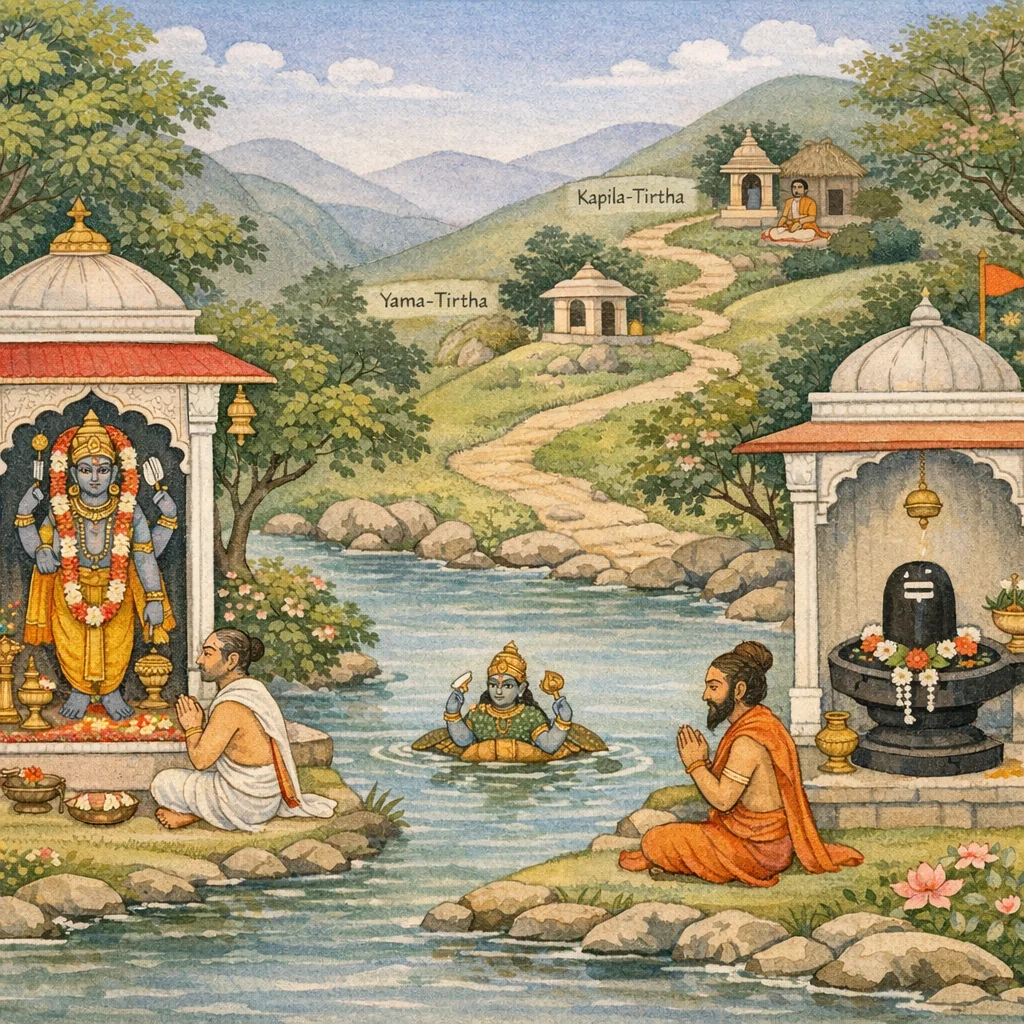
Continuing the Uttara-bhāga’s pilgrimage teaching, Mārkaṇḍeya speaks to Yudhiṣṭhira and begins a detailed Narmadā-māhātmya. He first glorifies Narmadā as Rudra-born, sin-destroying, and universally praised, then sets out a sequence of tīrthas on both banks, each with a prescribed observance—bathing, fasting, worship, dāna, śrāddha, tarpaṇa, circumambulation—and a stated phala: removal of sins, freedom from debts, healing, kingship, ascent to Rudraloka/Viṣṇuloka/Brahmaloka/Sūryaloka/Somaloka, even non-rebirth. The chapter weaves Śaiva–Vaiṣṇava harmony: Śiva-liṅgas predominate, yet Hari is expressly worshipped at Śakra-tīrtha for Viṣṇuloka, and Nārāyaṇa is said to manifest as a liṅga for the sages’ worship. Its climax is Śukla-tīrtha, unsurpassed for cleansing grave sins and granting liberation through vows tied to lunar dates and saṅkrānti. The closing extends the route to further fords—Yama-tīrtha, Eraṇḍī, Kārṇāṭikeśvara, Kapilā-tīrtha, and the Gaṇeśvara/Gaṅgeśvara region—preparing the next chapter’s continuation of Narmadā’s sacred geography and ritual calendar.
Shlokas
Verse 1
इति श्रीकूर्मपुराणे षट्साहस्त्र्यां संहितायामुपरिविभागे अष्टात्रिशो ऽध्यायः मार्कण्डेय उवाच नर्मदा सरितां श्रेष्ठा सर्वपापविनाशिनी / मुनिभिः कथिता पूर्वमीश्वरेण स्वयंभुवा
Thus, in the Śrī Kūrma Purāṇa, in the Ṣaṭsāhasrī Saṃhitā, in the latter division—here ends the thirty-eighth chapter. Mārkaṇḍeya said: “The Narmadā is the foremost among rivers, the destroyer of all sins—praised from ancient times by the sages, and even by the Self-born Lord (Brahmā) himself.”
Verse 2
मुनिभिः संस्तुता ह्येषा नर्मदा प्रवरा नदी / रुद्रगात्राद् विनिष्क्रान्ता लोकानां हितकाम्यया
Truly, this Narmadā is praised by the sages as the foremost of rivers. She issued forth from Rudra’s own body, desiring the welfare of all the worlds.
Verse 3
सर्वपापहरा नित्यं सर्वदेवनमस्कृता / संस्तुता देवगन्धर्वैरप्यरोभिस्तथैव च
Ever removing all sins, and bowed to by all the gods, she is praised by the Devas and Gandharvas, and likewise by the Apsarases.
Verse 4
उत्तरे चैव तत्कूले तीर्थं त्रैलोक्यविश्रुतम् / नाम्ना भद्रेश्वरं पुण्यं सर्वपापहरं शुभम् / तत्र स्नात्वा नरो राजन् दैवतैः सह मोहते
And on the northern bank of that river, O King, there is a sacred ford renowned throughout the three worlds, named Bhadreśvara—holy, auspicious, and the remover of all sins. Bathing there, O King, a man rejoices together with the gods.
Verse 5
ततो गच्छेत राजेन्द्र तीर्थमाम्रातकेश्वरम् / तत्र स्नात्वा नरो राजन् गोसहस्रफलं लभेत्
Then, O best of kings, one should proceed to the sacred ford of Āmrātakeśvara. Having bathed there, O King, a man attains merit equal to the gift of a thousand cows.
Verse 6
ततो ऽङ्गारेश्वरं गच्छेन्नियतो नियताशनः / सर्वपापविशुद्धात्मा रुद्रलोके महीयते
Thereafter one should go to Aṅgāreśvara, disciplined and restrained in diet; purified within from all sins, one is honored in Rudra’s world (Rudraloka).
Verse 7
ततो गच्छेत राजेन्द्र केदारं नाम पुण्यदम् / तत्र स्नात्वोदकं कृत्वा सर्वान् कामानवाप्नुयात्
Then, O best of kings, one should go to the holy place called Kedāra, the giver of merit. Having bathed there and duly performed the rites of water-offering, one attains the fulfillment of all desired aims.
Verse 8
पिप्पलेशं ततो गच्छेत् सर्वपापविनाशनम् / तत्र स्नात्वा महाराज रुद्रलोके महीयते
Then one should go to Pippaleśa, the destroyer of all sins. Having bathed there, O great king, a person is honored in Rudra’s world (Rudraloka).
Verse 9
ततो गच्छेत राजेन्द्र विमलेश्वरमुत्तमम् / तत्र प्राणान् परित्यज्य रुद्रलोकमवाप्नुयात्
Then, O best of kings, one should go to the supremely excellent shrine of Vimaleśvara. Having there relinquished one’s life-breaths, one attains the world of Rudra (Śiva).
Verse 10
ततः पुष्करिणीं गच्छेत् स्नानं तत्र समाचरेत् / स्नातमात्रो नरस्तत्र इन्द्रस्यार्धासनं लभेत्
Thereafter one should go to the sacred lotus-pond (Puṣkariṇī) and duly perform bathing there. By merely bathing in that place, a man attains a seat equal to half the sovereignty of Indra.
Verse 11
ततो गच्छेत राजेन्द्र शूलभेदमिति श्रुतम् / तत्र स्नात्वार्चयेद् देवं गोसहस्रफलं लभेत्
Then, O best of kings, one should proceed to the sacred place known—so it is heard—as Śūlabheda. Having bathed there and worshipped the Deity, one obtains the merit equal to the gift of a thousand cows.
Verse 12
ततो गच्छेत राजेन्द्र बलितीर्थमनुत्तम् / तत्र स्नात्वा नरो राजन् सिहासनपतिर्भवेत्
Then, O lord of kings, one should proceed to the unsurpassed Bali-tīrtha. Having bathed there, O King, a man becomes master of the throne and attains sovereign authority.
Verse 13
शक्रतीर्थं ततो गच्छेत् कूले चैव तु दक्षिणे / उपोष्य रजनीमेकां स्नानं कृत्वा यथाविधि
Then one should go to Śakra-tīrtha on the southern bank; having observed a fast for a single night, one should bathe there in the prescribed manner.
Verse 14
आराधयेन्महायोगं देवं नारायणं हरिम् / गोसहस्रफलं प्राप्य विष्णुलोकं स गच्छति
Whoever worships the Lord Nārāyaṇa—Hari, the Great Yogin (Mahāyoga) Himself—attains merit equal to gifting a thousand cows, and thereafter goes to Viṣṇu’s world.
Verse 15
ऋषितीर्थं ततो गत्वा सर्वपापहरं नृणाम् / स्नातमात्रो नरस्तत्र शिवलोके महीयते
Then, having gone to Ṛṣi-tīrtha—which removes all sins of men—a person, merely by bathing there, is honored in the world of Śiva.
Verse 16
नारदस्य तु तत्रैव तीर्थं परमशोभनम् / स्नातमात्रो नरस्तत्र गोसहस्रफलं लभेत्
Right there is Nārada’s supremely splendid sacred ford. A man who merely bathes there obtains merit equal to gifting a thousand cows.
Verse 17
यत्र तप्तं तपः पूर्वं नारदेन सुरर्षिणा / प्रतीस्तस्य ददौ योगं देवदेवो महेश्वरः
In that very place where the divine sage Nārada had formerly performed ardent austerities, Maheśvara, the God of gods, being pleased, bestowed upon him the discipline of Yoga.
Verse 18
ब्रह्मणा निर्मितं लिङ्गं ब्रह्मेश्वरमिति श्रुतम् / यत्र स्नात्वा नरो राजन् ब्रह्मलोके महीयते
That liṅga is said to have been fashioned by Brahmā and is renowned as “Brahmeśvara.” O King, one who bathes there is honored and exalted in the world of Brahmā (Brahmaloka).
Verse 19
ऋणतीर्थं ततो गच्छेत् स ऋणान्मुच्यते ध्रुवम् / महेश्वरं ततो गच्छेत् पर्याप्तं जन्मनः फलम्
Then one should go to Ṛṇa-tīrtha; by that, one is certainly freed from debts. After that, one should go to Maheśvara; there the fruit of one’s birth becomes fully sufficient—fulfilled in its purpose.
Verse 20
भीमेश्वरं ततो गच्छेत् सर्वव्याधिविनाशनम् / स्नातमात्रो नरस्तत्र सर्वदुःखैः प्रमुच्यते
Thereafter one should go to Bhīmeśvara, the destroyer of all diseases. Merely by bathing there, a person is freed from every sorrow.
Verse 21
ततो गच्छेत राजेन्द्र पिङ्गलेश्वरमुत्तमम् / अहोरात्रोपवासेन त्रिरात्रफलमाप्नुयात्
Then, O best of kings, one should proceed to the supreme shrine of Piṅgaleśvara. By fasting for a full day and night there, one attains the merit equal to a three-night observance.
Verse 22
तस्मिंमस्तीर्थे तु राजेन्द्र कपिलां यः प्रयच्छति / यावन्ति तस्या रोमाणि तत्प्रसूतिकुलेषु च / तावद् वर्षसहस्राणि रुद्रलोके महीयते
O best of kings, whoever donates a tawny cow at that sacred ford—for as many hairs as are upon her body, and in the lineages born from her offspring—for that many thousands of years he is honored in Rudra’s world.
Verse 23
यस्तु प्राणपरित्यागं कुर्यात् तत्र नराधिप / अक्षयं मोदते कालं यावच्चन्द्रदिवाकरौ
But whoever, O king, relinquishes his life there rejoices in imperishable bliss for as long as the moon and the sun endure.
Verse 24
नर्मदातटमाश्रित्य तिष्ठन्ते ये तु मानवाः / ते मृताः स्वर्गमायान्ति सन्तः सुकृतिनो यथा
Those who take refuge on the bank of the Narmadā and dwell there—when they die, they go to heaven, like the virtuous and meritorious.
Verse 25
ततो दीप्तेश्वरं गच्छेद् व्यासतीर्थं तपोवनम् / निवर्तिता पुरा तत्र व्यासभीता महानदी / हुङ्कारिता तु व्यासेन दक्षिणेन ततो गता
Then one should go to Dīpteśvara, to Vyāsa-tīrtha in the forest of austerities. Long ago the great river there was turned back, afraid of Vyāsa; and when Vyāsa uttered the commanding huṅkāra, it thereafter flowed southward.
Verse 26
प्रदक्षिणं तु यः कुर्यात् तस्मिंस्तीर्थे युधिष्ठिर / प्रीतस्तस्य भवेद् व्यासो वाञ्छितं लभते फलम्
O Yudhiṣṭhira, whoever performs pradakṣiṇā (circumambulation) at that sacred ford becomes dear to Vyāsa; and he obtains the desired fruit of his intention.
Verse 27
ततो गच्छेत राजेन्द्र इक्षुनद्यास्तु संगमम् / त्रैलोक्यविश्रुतं पुण्यं तत्र सन्निहितः शिवः / तत्र स्तनात्वा नरो राजन् गाणपत्यमवाप्नुयात्
Then, O best of kings, one should go to the confluence of the Ikṣu River, a holy place renowned throughout the three worlds. There Śiva is especially present; and having bathed there, O king, a man attains the state of Gaṇapati, a leader among Śiva’s gaṇas.
Verse 28
स्कन्दतीर्थं ततो गच्छेत् सर्वपापप्रणाशनम् / आजन्मनः कृतं पापं स्नातस्तीव्रं व्यपोहति
Then one should go to Skanda-tīrtha, the destroyer of all sins. Having bathed there, a person powerfully washes away even the sins committed from birth onward.
Verse 29
तत्र देवाः सगन्धर्वा भवात्मजमनुत्तमम् / उपासते महात्मानं स्कन्दं शक्तिधिरं प्रभुम्
There the gods, together with the Gandharvas, worship Skanda—the unsurpassed son of Bhava (Śiva)—that great-souled Lord, the mighty wielder of the spear (Śakti).
Verse 30
ततो गच्छेदाङ्गिरसं स्नानं तत्र समाचरेत् / गोसहस्रफलं प्राप्य रुद्रलोकं स गच्छति
Then one should go to the Āṅgirasa bathing-place and properly perform the sacred bath there. Having obtained merit equal to the gift of a thousand cows, one proceeds to Rudra’s world.
Verse 31
अङ्गिरा यत्र देवेशं ब्रह्मपुत्रो वृषध्वजम् / तपसाराध्य विश्वेशं लब्धवान् योगमुत्तमम्
In that very place, Aṅgiras—the son of Brahmā—worshipped through austerity the Lord of the gods, the all-ruling Lord of the universe, Śiva the Bull-bannered; and he obtained the supreme Yoga.
Verse 32
कुशतीर्थं ततो गच्छेत् सर्वपापप्रणाशनम् / स्नानं तत्र प्रकुर्वोत अश्वमेधफलं लभेत्
Then one should go to Kuśa-tīrtha, the sacred ford that destroys all sins. Bathing there, one gains merit equal to that of the Aśvamedha sacrifice.
Verse 33
कोटितीर्थं ततो गच्छेत् सर्वपापप्रणाशनम् / तत्र स्त्रात्वा नरो राज्यं लभते नात्र संशयः
Then one should go to Koṭitīrtha, the sacred ford that destroys all sins. Bathing there, a man attains kingship—of this there is no doubt.
Verse 34
चन्द्रभागां ततो गच्छेत् स्नानं तत्र समाचरेत् / स्नातमात्रो नरस्तत्र सोमलोके महीयते
Then one should go to the Chandrabhāgā River and duly perform a sacred bath there. Merely by bathing there, a man is honored and exalted in Soma’s world, the lunar realm.
Verse 35
नर्मदादक्षिणे कूले संगमेश्वरमुत्तमम् / तत्र स्नात्वा नरो राजन् सर्वयज्ञफलं लभेत्
On the southern bank of the Narmadā is the supreme holy place called Saṅgameśvara. O King, by bathing there one attains the merit that is the fruit of all sacrifices.
Verse 36
नर्मदायोत्तरे कूले तीर्थं परमशोभनम् / आदित्यायतनं रम्यमीश्वरेण तु भाषितम्
On the northern bank of the Narmadā there is a supremely splendid tīrtha—the delightful shrine of Āditya, the Sun—proclaimed by Īśvara Himself.
Verse 37
तत्र स्नात्वा तु राजेन्द्र दत्त्वा दानं तु शक्तितः / तस्य तीर्थप्रभावेण लभते चाक्षयं फलम्
O best of kings, having bathed there and given charity according to one’s capacity, a person—by the sanctifying power of that sacred tīrtha—attains an imperishable reward.
Verse 38
दरिद्रा व्याधिता ये तु ये च दुष्कृतकारिणः / मुच्यन्ते सर्वपापेभ्यः सूर्यलोकं प्रयान्ति च
Even those who are impoverished, afflicted by disease, or who have committed wrongful deeds are freed from all sins, and they attain the realm of Sūrya, the Sun.
Verse 39
मार्गेश्वरं ततो गच्छेत् स्नानं तत्र समाचरेत् / स्नातमात्रो नरस्तत्र स्वर्गलोकमवाप्नुयात्
Then one should proceed to Mārgeśvara and duly perform the ritual bath there. A man who bathes there—even once—attains the heavenly world.
Verse 40
ततः पश्चिमतो गच्छेन्मरुदालयमुत्तमम् / तत्र स्नात्वा तु राजेन्द्र शुचिर्भूत्वा प्रयत्नतः
Then one should proceed westward to the excellent sacred place called Marudālaya. Having bathed there, O best of kings, one should become purified with earnest effort.
Verse 41
काञ्चनं तु द्विजो दद्याद् यथाविभवविस्तरम् / पुष्पकेण विमानेन वायुलोकं स गच्छति
But if a twice-born man gives gold in accordance with the full extent of his means, he goes to the world of Vāyu, conveyed in a flower-adorned celestial chariot.
Verse 42
ततो गच्छेत राजेन्द्र अहल्यातीर्थमुत्तमम् / स्नानमात्रादप्सरोभिर्मोदते कालमक्षयम्
Then, O best of kings, one should go to the supremely holy Ahalyā-tīrtha. By bathing there alone, one rejoices in the company of the apsarās for imperishable time.
Verse 43
चैत्रमासे तु संप्राप्ते शुक्लपक्षे त्रयोदशी / कामदेवदिने तस्मिन्नहल्यां यस्तु पूजयेत्
When the month of Caitra arrives, on the thirteenth lunar day (trayodaśī) of the bright fortnight—on that day sacred to Kāmadeva—whoever worships Ahalyā with devotion…
Verse 44
यत्र तत्र नरोत्पन्नो वरस्तत्र प्रियो भवेत् / स्त्रीवल्लभो भवेच्छ्रीमान् कामदेव इवापरः
Wherever such an excellent man is born, there he becomes beloved. He becomes dear to women, endowed with prosperity and radiance—like another Kāmadeva.
Verse 45
अयोध्यां तु समासाद्य तीर्थं शक्रस्य विश्रुतम् / स्नातमात्रो नरस्तत्र गोसहस्रफलं लभेत्
Having reached Ayodhyā—the celebrated sacred ford associated with Śakra (Indra)—a man who merely bathes there obtains the merit equivalent to the gift of a thousand cows.
Verse 46
सोमतीर्थं ततो गच्छेत् स्नानं तत्र समाचरेत् / स्नातमात्रो नरस्तत्र सर्वपापैः प्रमुच्यते
Then one should go to Somatīrtha and duly perform the sacred bath there. The moment a person bathes in that place, he is released from all sins.
Verse 47
सोमग्रहे तु राजेन्द्र पापक्षयकरं भवेत् / त्रैलोक्यविश्रुतं राजन् सोमतीर्थं महाफलम्
O best of kings, at the time of Soma-graha (a lunar observance, especially an eclipse), it becomes a cause for the destruction of sins. O king, the Somatīrtha—renowned throughout the three worlds—bestows great fruit.
Verse 48
यस्तु चान्द्रायणं कुर्यात् तत्र तीर्थे समाहितः / सर्वपापविशुद्धात्मा सोमलोकं स गच्छति
Whoever performs the Cāndrāyaṇa vow there, at that sacred ford, with a collected mind—his inner self purified of all sins—goes to the realm of Soma (the Moon).
Verse 49
अग्निप्रवेशं यः कुर्यात् सोमतीर्थे नराधिप / जले चानशनं वापि नासौ मर्त्यो ऽभिजायते
O king, whoever enters the fire at Soma-tīrtha—or even undertakes fasting unto death in its waters—does not take birth again as a mortal.
Verse 50
स्तम्भतीर्थं ततो गच्छेत् स्नानं तत्र समाचरेत् / स्नातमात्रो नरस्तत्र सोमलोके महीयते
Then one should go to Stambha-tīrtha and duly perform the ritual bath there. By bathing there even once, a person is honored and exalted in Soma’s world (the lunar realm).
Verse 51
ततो गच्छेत राजेन्द्र विष्णुतीर्थमनुत्तमम् / योधनीपुरमाख्यातं विष्णोः स्थानमनुत्तमम्
Then, O best of kings, one should proceed to the unsurpassed sacred ford of Viṣṇu—known as Yodhanīpura—an incomparable abode of Viṣṇu.
Verse 52
असुरा योधितास्तत्र वासुदेवेन कोटिशः / तत्र तीर्थं समुत्पन्नं विष्णुश्रीको भवेदिह / अहोरात्रोपवासेन ब्रह्महत्यां व्यपोहति
There Vāsudeva fought the Asuras in their millions. From that deed a sacred tīrtha arose; in this place one is endowed with the glory and good fortune of Viṣṇu. By fasting for a full day and night, even the sin of brahmahatyā—slaying a Brahmin—is dispelled.
Verse 53
नर्मदादक्षिणे कूले तीर्थं परमशोभनम् / कामतीर्थमिति ख्यातं यत्र कामोर्ऽचयद् भवम्
On the southern bank of the Narmadā stands a supremely splendid tīrtha. It is famed as Kāma-tīrtha, where Kāma, the god of desire, worshipped Bhava (Śiva).
Verse 54
तस्मिंस्तीर्थे नरः स्नात्वा उपवासपरायणः / कुसुमायुधरूपेण रुद्रोलोके महीयते
Having bathed at that tīrtha and devoted oneself to fasting, one is honored in Rudra’s world, assuming the form of Kusumāyudha—the Flower-Weaponed one (Kāma).
Verse 55
ततो गच्छेत राजेन्द्र ब्रह्मतीर्थमनुत्तमम् / उमाहकमिति ख्यातं तत्र संतर्पयेत् पितॄन्
Then, O best of kings, one should go to the unsurpassed Brahma-tīrtha, famed as Umāhaka; there one should offer the rites that satisfy the Pitṛs, the ancestral spirits.
Verse 56
पौर्णमास्याममावास्यां श्र्धं कुर्याद् यथाविधि / गजरूपा शिला तत्र तोयमध्ये व्यवस्थिता
On the full-moon day and on the new-moon day, one should perform the śrāddha rite according to the prescribed rule. There, in the midst of the water, stands a stone shaped like an elephant, firmly set in place.
Verse 57
तस्मिंस्तु दापयेत् पिण्डान् वैशाख्यान्तु विशेषतः / स्नात्वा समाहितमना दम्भमात्सर्यवर्जितः / तृप्यन्ति पितरस्तस्य यावत् तिष्ठति मेदिनी
On that occasion one should have piṇḍa-offerings made, especially in the month of Vaiśākha. Having bathed, with a mind well-collected, free from ostentation and envy, his ancestors remain satisfied for as long as the earth endures.
Verse 58
सिद्धेश्वरं ततो गच्छेत् स्नानं तत्र समाचरेत् / स्नातमात्रो नरस्तत्र गाणपत्यपदं लभेत्
Then one should go to Siddheśvara and duly perform the ritual bath there. By bathing there alone, a man attains the state of a Gaṇapatya—belonging to Gaṇapati’s divine sphere.
Verse 59
ततो गच्छेत राजेन्द्र लिङ्गो यत्र जनार्दनः / तत्र स्नात्वा तु राजेन्द्र विष्णुलोके महीयते
Then, O king of kings, one should proceed to that liṅga where Janārdana (Viṣṇu) is present. Having bathed there, O king, one is honored and glorified in Viṣṇu’s world (Viṣṇuloka).
Verse 60
यत्र नारायणो देवो मुनोनां भावितात्मनाम् / स्वात्मानं दर्शयामास लिङ्गं तत् परमं पदम्
That is the place where Lord Nārāyaṇa, the God, revealed His own Self to sages of purified and contemplative minds; there, that very self-manifestation as the (divine) Liṅga is the supreme abode.
Verse 61
अङ्कोलं तु ततो गच्छेत् सर्वपापविनाशनम् / स्नानं दानं च तत्रैव ब्राह्मणानां च भोजनम् / पिण्डप्रिदानं च कृतं प्रेत्यानन्तफलप्रदम्
Then one should go to Ankola, the destroyer of all sins. There one should bathe, give gifts, and feed the brāhmaṇas; and when piṇḍa-offerings are made, they bestow inexhaustible fruit after death.
Verse 62
त्रैयम्बकेन तोयेन यश्चरुं श्रपयेत् ततः / अङ्कोलमूले दद्याच्च पिण्डांश्चैव यथाविधि / तारिताः पितरस्तेन तृप्यन्त्याचन्द्रतारकम्
Whoever cooks the sacred rice-offering (caru) with water consecrated to Tryambaka (Śiva), and—according to rule—offers the piṇḍas at the root of the aṅkola tree: by that act the Pitṛs are delivered, and they remain satisfied as long as the moon and stars endure.
Verse 63
ततो गच्छेत राजेन्द्र तापसेश्वरमुत्तमम् / तत्र स्नात्वा तु राजेन्द्र प्राप्नुयात् तपसः फलम्
Then, O king of kings, one should go to the supreme Tapaseśvara—the Lord of ascetics. Having bathed there, O best of kings, one attains the fruit of tapas (austerity).
Verse 64
शुक्लतीर्थं ततो गच्छेत् सर्वपापविनाशनम् / नास्ति तेन सम तीर्थं नर्मदायां युधिष्ठिर
Then one should proceed to Śukla-tīrtha, the destroyer of all sins. O Yudhiṣṭhira, in the realm of the Narmadā there is no sacred ford equal to it.
Verse 65
दर्शनात् स्पर्शनात् तस्य स्नानदानतपोजपात् / होमाच्चैवोपवासाच्च शुक्लतीर्थे महत् फलम्
At Śukla-tīrtha, great spiritual fruit arises from merely beholding it and touching it, and also from bathing there, giving gifts (dāna), undertaking tapas, reciting japa, performing homa (fire-offerings), and observing fasts (upavāsa).
Verse 66
योजनं तत् स्मृतं क्षेत्रं देवगन्धर्वसेवितम् / शुक्लतीर्थमिति ख्यातं सर्वपापविनाशनम्
That sacred region is said to extend for a yojana, and it is frequented by the gods and Gandharvas. It is renowned as Śukla-tīrtha, the holy ford that destroys all sins.
Verse 67
पादपाग्रेण दृष्टेन ब्रह्महत्यां व्यपोहति / देव्या सह सदा भर्गस्तत्र तिष्ठति शङ्करः
By merely beholding it, even from the very tip of one’s foot, the sin of brahma-hatyā—the gravest impurity of slaying a brāhmaṇa—is dispelled. There Śaṅkara, Bharga himself, ever abides together with the Goddess (Devī).
Verse 68
कृष्णपक्षे चतुर्दश्यां वैशाखे मासि सुव्रत / कैलासाच्चाभिनिष्क्रम्य तत्र सन्निहितो हरः
O noble observer of vows, on the fourteenth day (caturdaśī) of the dark fortnight (kṛṣṇa-pakṣa) in the month of Vaiśākha, Hara (Śiva) departs from Kailāsa and is then especially present there.
Verse 69
देवदानवगन्धर्वाः सिद्धविद्याधरास्तथा / गणाश्चाप्सरसां नागास्तत्र तिष्ठन्ति पुङ्गव
O best of men, there abide the gods, the Dānavas, and the Gandharvas; likewise the Siddhas and Vidyādharas—together with the divine Gaṇas, the Apsarases, and the Nāgas.
Verse 70
रजकेन यथा वस्त्रं शुक्लं भवति वारिणा / आजन्मनि कृतं पापं शुक्लतीर्थे व्यपोहति / स्नानं दानं तपः श्राद्धमनन्तं तत्र दृश्यते
Just as a washerman makes a garment white with water, so at Śuklatīrtha the sins accumulated from birth are washed away. There, the fruits of bathing, charity (dāna), austerity (tapas), and śrāddha—offerings to the ancestors—are beheld as limitless.
Verse 71
शुक्लतीर्थात् परं तीर्थं न भूतं न भविष्यति / पूर्वे वयसि कर्माणि कृत्वा पापानि मानवः / अहोरात्रोपवासेन शुक्लतीर्थे व्यपोहति
No holy place is higher than Śuklatīrtha—none has existed before, and none will arise in the future. One who committed sinful acts earlier in life can wipe them away at Śuklatīrtha by observing a complete fast for one day and night (ahorātra-upavāsa).
Verse 72
कार्तिकस्य तु मासस्य कृष्णपक्षे चतुर्दशी / घृतेन स्नापयेद् देवमुपोष्य परमेश्वरम् / एकविंशत्कुलोपेतो न च्यवेदैश्वरात् पदात्
On the fourteenth lunar day (caturdaśī) of the dark fortnight in the month of Kārtika, having observed a fast, one should bathe Lord Parameśvara with ghee. Endowed with merit that uplifts twenty-one generations of one’s lineage, one does not fall away from the sovereign state of aiśvarya.
Verse 73
तपसा ब्रह्मचर्येण यज्ञदानेन वा पुनः / न तां गतिमवाप्नोति शुक्लतीर्थे तु यां लभेत्
Neither by austerity (tapas), nor by the celibate discipline of brahmacarya, nor again by sacrifices and gifts, does one attain that blessed state of progress which is gained at the holy ford called Śukla-tīrtha.
Verse 74
शुक्लतीर्थं महातीर्थमृषिसिद्धनिषेवितम् / तत्र स्नात्वा नरो राजन् पुनर्जन्म न विन्दति
Śukla-tīrtha is a great sacred ford, frequented by sages (ṛṣis) and perfected beings (siddhas). O King, a man who bathes there does not meet with rebirth again.
Verse 75
अयने वा चतुर्दश्यां संक्रान्तौ विषुवे तथा / स्नात्वा तु सोपवासः सन् विजितात्मा समाहितः
On the solstitial days (ayana), on the fourteenth lunar day, at saṅkrānti (the Sun’s ingress), and likewise at the equinox (viṣuva)—having bathed and remaining in a fast, self-controlled and composed—one should keep the mind firmly collected.
Verse 76
दानं दद्याद् यथाशक्ति प्रीयेतां हरिशङ्करौ / एतत् तीर्थप्रभावेण सर्वं भवति चाक्षयम्
One should give charity according to one’s capacity, so that Hari and Śaṅkara are pleased. By the power of this tīrtha, all such merit becomes imperishable (akṣaya).
Verse 77
अनाथं दुर्गतं विप्रं नाथवन्तमथापि वा / उद्वादयति यस्तीर्थे तस्य पुण्यफलं शृणु
Hear the fruit of merit: whoever, at a sacred tīrtha, lifts up and aids a brāhmaṇa—whether destitute and without support, or even already protected—wins great spiritual merit.
Verse 78
यावत् तद्रोमसंख्या तु तत्प्रसूतिकुलेषु च / तावद् वर्षसहस्राणि रुद्रलोके महीयते
For as many thousands of years as there are hairs upon that sacred form, and likewise as many as are counted in its lines of progeny, for that very span one is honored and exalted in Rudra’s world, Rudraloka.
Verse 79
ततो गच्छेत राजेन्द्र यमतीर्थ मनुत्तमम् / कृष्णपक्षे चतुर्दश्यां माघमासे युधिष्ठिर / स्नानं कृत्वा नक्तभीजी न पश्येद् योनिसङ्कटम्
Thereafter, O best of kings, one should go to the supremely excellent Yama-tīrtha. O Yudhiṣṭhira, on the fourteenth lunar day (caturdaśī) of the dark fortnight in Māgha, having bathed there and observed the naktabhojī vow (eating only at night), one does not behold the anguish of entering the womb again.
Verse 80
ततो गच्छेत राजेन्द्र एरण्डीतीर्थमुत्तमम् / संगमे तु नरः स्नायादुपवासपरायणः / ब्राह्मणं भोजयेदेकं कोटिर्भवति भोजिताः
Then, O best of kings, one should proceed to the excellent sacred ford called Eraṇḍī-tīrtha. At its confluence a man should bathe, devoted to fasting; and if he feeds even a single brāhmaṇa there, it is as though a koṭi—ten million—have been fed.
Verse 81
एरण्डीसंगमे स्नात्वा भक्तिभावात् तुरञ्जितः / मृत्तिकां शिरसि स्थाप्य अवगाह्य च तज्जलम् / नर्मदोदकसंमिश्रं मुच्यते सर्वकिल्बिषैः
Having bathed at the confluence of the Eraṇḍī, and being swiftly stirred by devotional feeling, one should place sacred clay upon the head and immerse in that water. By bathing in that water mingled with the waters of the Narmadā, one is released from all sins and demerit.
Verse 82
ततो गच्छेत राजेन्द्र तीर्थं कार्णाटिकेश्वरम् / गङ्गावतरते तत्र दिने पुण्ये न संशयः
Then, O best of kings, one should go to the sacred ford called Kārṇāṭikeśvara. On an auspicious day the Gaṅgā descends there—of this there is no doubt.
Verse 83
तत्र स्नात्वा च पीत्वा च दत्त्वा चैव यथाविधि / सर्वपापविनिर्मुक्तो ब्रह्मलोके महीयते
Having bathed there, drunk the sacred water there, and given gifts in the prescribed manner, one becomes completely freed from all sins and is honored in the world of Brahman.
Verse 84
नन्दितीर्थं ततो गच्छेत् स्नानं तत्र समाचरेत् / प्रीयते तस्य नन्दीशः सोमलोके महीयते
Then one should go to Nanditīrtha and duly perform the sacred bath there; by that act Nandīśa (Śiva, the Lord of Nandin) is pleased with him, and he is honored in the realm of Soma (the lunar world).
Verse 85
ततो गच्छेत राजेन्द्र तीर्थं त्वनरकं शुभम् / तत्र स्नात्वा नरो राजन् नरकं नैव पश्यति
Thereafter, O best of kings, one should go to the auspicious sacred ford called Anaraka. Having bathed there, O King, a man never beholds hell.
Verse 86
तस्मिंस्तीर्थे तु राजेन्द्र स्वान्यस्थीनि विनिक्षिपेत् / रूपवान् जायते लोके धनभोगसमन्वितः
O king of kings, one should deposit one’s own bones at that sacred ford; in the world one is born handsome, endowed with wealth and the capacity to enjoy its comforts.
Verse 87
ततो गच्छेत राजेन्द्र कपिलातीर्थ मुत्तमम् / तत्र स्नात्वा नरो राजन् गोसहस्रफलं लभेत्
Then, O best of kings, one should go to the excellent sacred ford called Kapilā-tīrtha. Having bathed there, O King, a person attains merit equal to the gift of a thousand cows.
Verse 88
ज्येष्ठमासे तु संप्राप्ते चतुर्दश्यां विशेषतः / तत्रोपोष्य नरो भक्त्या दद्याद् दीपं घृतेन तु
When the month of Jyeṣṭha arrives—especially on the fourteenth lunar day (Caturdaśī)—one should observe a fast and, with devotion, offer a lamp filled with ghee.
Verse 89
घृतेन स्नापयेद् रुद्रं सघृतं श्रीफलं दहेत् / घण्टाभरणसंयुक्तां कपिलां वै प्रदापयेत्
One should bathe Rudra with clarified butter (ghee), and then offer into the fire a coconut (śrīphala) along with ghee. One should also, indeed, gift a tawny kapilā cow adorned with a bell and ornaments.
Verse 90
सर्वाभरणसंयुक्तः सर्वदेवनमस्कृतः / शिवतुल्यबलो भूत्वा शिववत् क्रीडते चिरम्
Adorned with every divine ornament and honored by all the gods, he becomes endowed with strength equal to Śiva’s; and, like Śiva himself, he sports in divine freedom for a long time.
Verse 91
अङ्गारकदिने प्राप्ते चतुर्थ्यां तु विशेषतः / स्नापयित्वा शिवं दद्याद् ब्राह्मणेभ्यस्तु भोजनम्
When the day of Aṅgāraka (Tuesday) arrives—especially when it coincides with the fourth lunar day (Caturthī)—one should bathe (the image of) Śiva and then offer a meal to the Brāhmaṇas.
Verse 92
सर्वभोगसमायुक्तो विमानैः सार्वकामिकैः / गत्वा शक्रस्य भवनं शक्रेण सह मोदते
Endowed with every delight, and borne by wish-fulfilling celestial vimānas, he goes to the abode of Śakra (Indra) and rejoices there in Indra’s company.
Verse 93
ततः स्वर्गात् परिभ्रष्टो धनवान् भोगवान् भवेत् / अङ्गारकनवम्यां तु अमावास्यां तथैव च / स्नापयेत् तत्र यत्नेन रूपवान् सुभगो भवेत्
Thereafter, even if one should fall away from heaven, one becomes wealthy and an enjoyer of prosperity. And on Aṅgāraka-navamī (the ninth lunar day associated with Mars) as well as on amāvāsyā (the new-moon day), if one carefully performs the prescribed bathing there, one becomes handsome and fortunate.
Verse 94
ततो गच्छेत राजेन्द्र गणेश्वरमनुत्तमम् / श्रावणे मासी संप्राप्ते कृष्णपक्षे चतुर्दशी
Then, O best of kings, one should proceed to the unsurpassed shrine of Gaṇeśvara, when the month of Śrāvaṇa has arrived—on the caturdaśī, the fourteenth lunar day of the dark fortnight.
Verse 95
स्नातमात्रो नरस्तत्र रुद्रलोके महीयते / पितॄणां तर्पणं कृत्वा मुच्यते ऽसावॄणत्रयात्
A man who has merely bathed there is honored in Rudra’s realm (Rudra-loka). And having performed tarpaṇa, the libations for the ancestors, he is freed from the threefold debt.
Verse 96
गङ्गेश्वरसमीपे तु गङ्गावदनमुत्तमम् / अकामो वा सकामो वा तत्र स्नात्वा तु मानवः / आजन्मजनितैः पापैर्मुच्यते नात्र संशयः
Near Gaṅgeśvara lies the most excellent “Mouth of the Gaṅgā” (Gaṅgā-vadana). Whether one bathes there without desire or with a particular desire, a person is freed from sins accumulated since birth—of this there is no doubt.
Verse 97
तस्य वै पश्चिमे देशे समीपे नातिदूरतः / दशाश्वमेधिकं तीर्थं त्रिषु लोकेषु विश्रुतम्
To its west, close by and not far away, lies the sacred ford called Daśāśvamedhika, renowned throughout the three worlds.
Verse 98
उपोष्य रजनीमेकां मासि भाद्रपदे शुभे / अमावस्यां नरः स्नात्वा पूजयेद् वृषभध्वजम्
In the auspicious month of Bhādrapada, having fasted for a single night, one should bathe on the new-moon day (Amāvasyā) and then worship Vṛṣabhadhvaja—Lord Śiva, whose banner bears the bull.
Verse 99
काञ्चनेन विमानेन किङ्किणीजालमालिना / गत्वा रुद्रपुरं रम्यं रुद्रेण सह मोदते
Mounted on a golden celestial car adorned with a net of tinkling bells, he goes to the delightful city of Rudra and rejoices there in the company of Rudra (Śiva).
Verse 100
सर्वत्र सर्वदिवसे स्नानं तत्र समाचरेत् / पितॄणां तर्पणं कुर्यादश्वमेधफलं लभेत्
Wherever one may be, one should perform the daily bath there; and one should offer tarpaṇa—libations to the ancestors—thereby attaining merit equal to that of an Aśvamedha sacrifice.
Frequently Asked Questions
Narmadā is portrayed as Rudra-born and universally venerated; her waters, banks, and associated tīrthas function as direct instruments of pāpa-kṣaya, capable of removing even grave impurities when joined with vrata, dāna, and disciplined intention.
While many stations are Śiva-liṅga tīrthas promising Rudraloka, the text also prescribes explicit worship of Nārāyaṇa for Viṣṇuloka and describes Nārāyaṇa’s self-revelation in liṅga form—treating devotional forms as interoperable rather than competing.
Snāna with restraint, fasting (single night, full day-night, naktabhojī), charity according to means, feeding brāhmaṇas, pradakṣiṇā, and Pitṛ rites (tarpaṇa/śrāddha/piṇḍa) are presented as sādhanā that transforms tīrtha contact into durable spiritual merit.
Śukla-tīrtha is declared unequalled in the Narmadā region—effective through sight, touch, bath, gifts, japa, homa, and fasts; it is associated with specific calendrical observances and is said to wash away sins from birth and even prevent rebirth.
It offers a graded spectrum of fruits: from health, beauty, prosperity, debt-release, and kingship to heavenly worlds and finally non-rebirth—indicating that the same tīrtha discipline, intensified by vrata and purity, can culminate in liberation.