Adhyaya 27
Vānaprastha-Dharma: Forest Discipline, Vaikhānasa Austerities, and Śiva-Āśrama as the Liberative Refuge
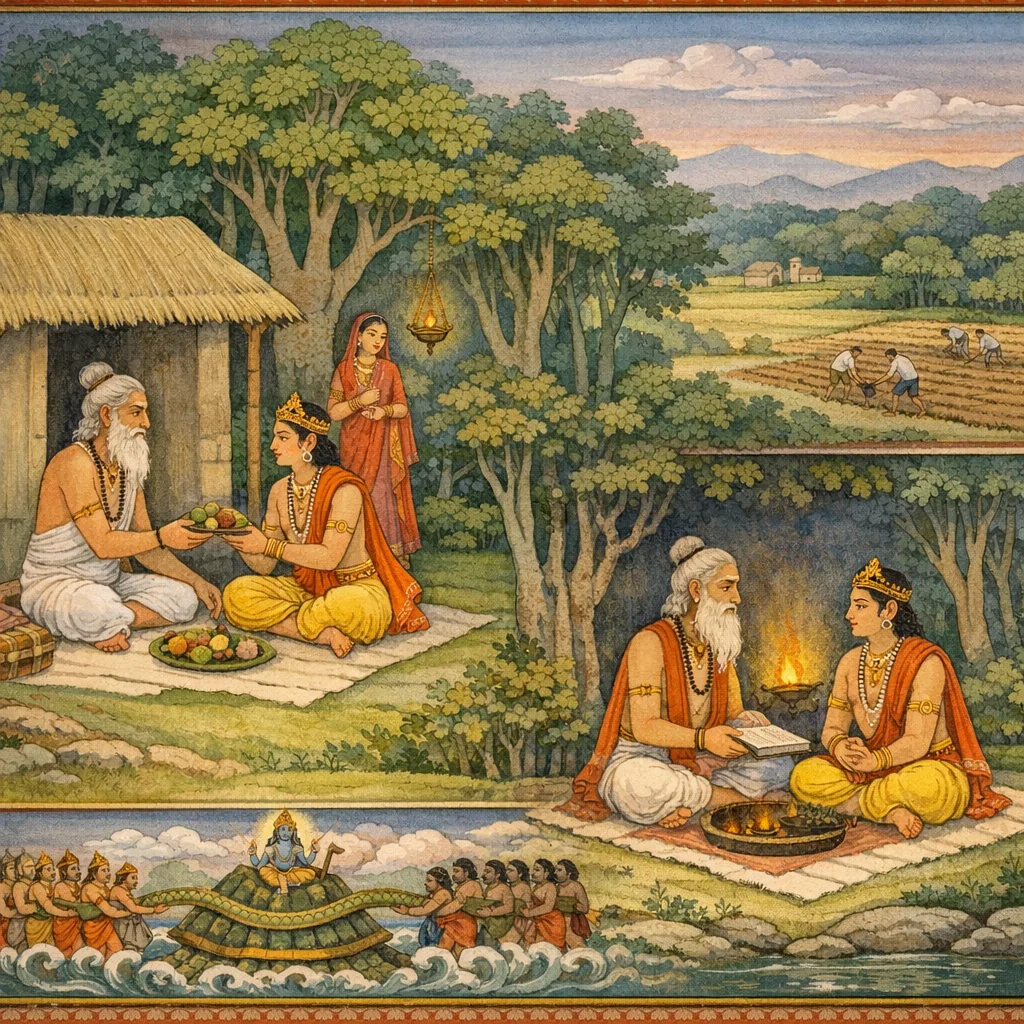
Concluding the prior section and continuing Vyāsa’s instruction, this chapter moves the seeker from the latter phase of gṛhastha into vānaprastha, prescribing the auspicious time of departure and the disciplined rule of the forest-dweller. It sets out daily conduct—honoring guests, bathing, worship, svādhyāya, restrained speech—along with Vedic fire-rites and lunar and seasonal sacrifices. Strict dietary laws emphasize the purity of forest-born foods, forbidding village produce, ploughed-field crops, and specified prohibited items. The teaching then rises to graded austerities (seasonal tapas, kṛcchra-like observances), yama-niyama, and Yoga with Rudra-recitation, Upaniṣadic study (Atharvaśiras), and Vedānta discipline. A central turn is the internalization of the sacred fires into the Self, shifting from external ritual to meditative realization, and it finally outlines end-of-life renunciation options (mahāprāsthāna, anaśana, entering fire) under brahmārpaṇa-vidhi. It culminates by affirming that refuge in the blessed Śiva-āśrama destroys accumulated inauspiciousness and grants the supreme Paramaiśvara state, preparing for deeper renunciant and mokṣa-oriented teachings to follow.
Shlokas
Verse 2
निक्षिप्य भार्यां पुत्रेषु गच्छेद् वनमथापि वा / दृष्ट्वापत्यस्य चापत्यं जर्जरीकृतविग्रहः
Having entrusted his wife to his sons, he should depart to the forest as well. And when—his body worn and broken—he beholds the children of his own children, he should turn toward the forest-life (vānaprastha) as the next stage of dharma.
Verse 3
शुक्लपक्षस्य पूर्वाह्ने प्रशस्ते चोत्तरायणे / गत्वारण्यं नियमवांस्तपः कुर्यात् समाहितः
In the bright fortnight, in the forenoon, at an auspicious time, and during uttarāyaṇa—the sun’s northward course—one should go to the forest. Disciplined in observances and with a collected mind, one should undertake austerity (tapas).
Verse 4
फलमूलानि पूतानि नित्यमाहारमाहरेत् / यताहारो भवेत् तेन पूजयेत् पितृदेवताः
One should regularly take as food purified fruits and roots. Whatever one’s regulated diet may be, by that very pure sustenance one should worship the ancestral deities, the Pitṛs.
Verse 5
पूजयित्वातिथिं नित्यं स्नात्वा चाभ्यर्चयेत् सुरान् / गृहादाहृत्य चाश्नीयादष्टौ ग्रासान् समाहितः
Having honored a guest each day, and having bathed, one should worship the gods. Then, bringing food from within one’s own home, one should eat eight mouthfuls, remaining composed and attentive.
Verse 6
जटाश्च बिभृयान्नित्यं नखरोमाणि नोत्सृजेत् / स्वाध्यायं सर्वदा कुर्यान्नियच्छेद् वाचमन्यतः
He should ever bear the matted locks (jaṭā) and not neglect the trimming of nails and bodily hair. He should constantly practice svādhyāya (sacred self-study) and restrain his speech from worldly and frivolous talk.
Verse 7
अग्निहोत्रं च जुहुयात् पञ्चयज्ञान् समाचरेत् / मुन्यन्नैंर्विविधैर्मेध्यैः शाकमूलफलेन वा
He should offer the Agnihotra oblation and duly perform the five great sacrifices. He should subsist on pure foods fit for sages—of various kinds—or else on vegetables, roots, and fruits.
Verse 8
चीरवासा भवेन्नित्यं स्नायात् त्रिषवणं शुचिः / सर्वभूतानुकम्पी स्यात् प्रतिग्रहविवर्जितः
He should always wear simple garments of bark or plain cloth, bathe in purity at the three daily junctions, be compassionate toward all beings, and refrain from accepting gifts that bind or compromise him.
Verse 9
दर्शेन पौर्णमासेन यजेत् नियतं द्विजः / ऋक्षेष्वाग्रयणे चैव चातुर्मास्यानि चाहरेत् / उत्तरायणं च क्रमशो दक्षस्यायनमेव च
A disciplined twice-born should regularly perform the Darśa and Paurṇamāsa sacrifices at new and full moon. He should also perform the Āgrayaṇa rite at the proper lunar asterisms and observe the seasonal offerings of Cāturmāsya. Likewise, in due order, he should perform the rites for the Sun’s northern course (Uttarāyaṇa) and for its southern course (Dakṣiṇāyana).
Verse 10
वासन्तैः शारदैर्मेध्यैर्मुन्यन्नैः स्वयमाहृतैः / पुरोडाशांश्चरूंश्चैव विधिवन्निर्वपेत् पृथक्
With pure, ritually fit foods of spring and autumn—sage-like fare gathered by one’s own hand—one should, in due rule, prepare and offer separately the sacrificial cakes (puroḍāśa) and the cooked oblations (caru).
Verse 11
देवताभ्यश्च तद् हुत्वा वन्यं मेध्यतरं हविः / शेषं समुपभुञ्जीत लवणं च स्वयं कृतम्
Having offered that oblation to the deities, one should take as the sacrificial food what is born of the forest and even more purifying; then one should partake of what remains, together with salt prepared by oneself.
Verse 12
वर्जयेन्मधुमांसानि भौमानि कवकानि च / भूस्तृणं शिग्रुकं चैव श्लेष्मातकफलानि च
One should avoid honey and meat; also earth-born foods such as mushrooms and fungi; likewise bhūstṛṇa (a ground-growing herb), śigruka (moringa), and the fruits of the śleṣmātaka tree.
Verse 13
न फालकृष्टमश्नीयादुत्सृष्टमपि केनचित् / न ग्रामजातान्यार्तो ऽपि पुष्पाणि च फलानि च
He should not eat what has been obtained by ploughing (produce from tilling), nor what has been thrown away by anyone. Even when distressed, he should not take flowers or fruits that are village-grown (belonging to settled habitation).
Verse 14
श्रावणेनैव विधिना वह्निं परिचरेत् सदा / न द्रुह्येत् सर्वभूतानि निर्द्वन्द्वो निर्भयो भवेत्
By the very discipline prescribed through sacred hearing (śravaṇa), one should always tend the sacrificial fire. One should not bear malice toward any being; becoming free from the pairs of opposites, one becomes fearless.
Verse 15
न नक्तं किञ्चिदश्नीयाद् रात्रौ ध्यानपरो भवेत् / जितेन्द्रियो जितक्रोधस्तत्त्वज्ञानविचिन्तकः / ब्रह्मचारी भवेन्नित्यं न पत्नीमपि संश्रयेत्
One should not eat anything at night; at night one should be devoted to meditation. With senses conquered and anger subdued, one should contemplate the knowledge of reality (tattva-jñāna). One should ever live as a brahmacārin, not even resorting to a wife.
Verse 16
यस्तु पत्न्या वनं गत्वा मैथुनं कामतश्चरेत् / तद् व्रतं तस्य लुप्येत प्रायश्चित्तीयते द्विजः
But if a twice-born man, having gone to the forest with his wife, engages in sexual union out of desire, then his vow is deemed broken; that brāhmaṇa must undertake expiation (prāyaścitta).
Verse 17
तत्र यो जायते गर्भो न संस्पृश्यो द्विजातिभिः / न हि वेदे ऽधिकारो ऽस्य तद्वंशेप्येवमेव हि
A child conceived there is not to be touched by the twice-born; for he has no entitlement to the Veda—and the same rule applies likewise to his lineage.
Verse 18
अधः शयीत सततं सावित्रीजाप्यतत्परः / शरण्यः सर्वभूतानां संविभागपरः सदा
He should always sleep on a low bed, be devoted to the japa of the Sāvitrī (Gāyatrī) mantra, become a refuge for all beings, and remain constantly intent on fair distribution and sharing.
Verse 19
परिवादं मृषावादं निद्रालस्यं विवर्जयेत् / एकाग्निरनिकेतः स्यात् प्रोक्षितां भूमिमाश्रयेत्
One should avoid slander, false speech, excessive sleep, and sloth. Let him maintain a single sacred fire, live without a fixed dwelling, and rest upon ground ritually sprinkled for purification.
Verse 20
मृगैः सह चरेद् वासं तैः सहैव च संवसेत् / शिलायां शर्करायां वा शयीत सुसमाहितः
Let him dwell and move about in the forest along with the deer, living as they live; and, composed and fully attentive, let him lie down to rest upon bare rock or upon gravel.
Verse 21
सद्यः प्रक्षालको वा स्यान्माससंचयिको ऽपि वा / षण्मासनिचयो वा स्यात् समानिचय एव वा
He may be one who purifies himself at once, or one who accumulates the expiation for a month; or he may accumulate it for six months, or indeed for a full year.
Verse 22
त्यजेदाश्वयुजे मासि संपन्नं पूर्वसंचितम् / जीर्णानि चैव वासांसि शाकमूलफलानि च
In the month of Āśvayuja, one should give up (or donate) the provisions stored from earlier, as well as worn-out garments, and also renounce vegetables, roots, and fruits.
Verse 23
दन्तोलूखलिको वास्यात् कापोतीं वृत्तिमाश्रयेत् / अश्मकुट्टो भवेद् वापि कालपक्वभुगेव वा
He may live by the ‘tooth-and-mortar’ way, subsisting on what is scarcely obtained, or adopt a ‘pigeon-like’ livelihood; or he may become an aśma-kuṭṭa, preparing food by pounding with a stone, or else live only on what ripens in its proper season.
Verse 24
नक्तं चान्न समश्नीयाद् दिवा चाहृत्य शक्तितः / चतुर्थकालिको वा स्यात् स्याद्वाप्यष्टमकालिकः
He should not eat at night; rather, having procured food by day according to his capacity, he may live by eating in the fourth part of the day—or even in the eighth part of the day.
Verse 25
चान्द्रायणविधानैर्वा शुक्ले कृष्णे च वर्तयेत् / पक्षे पक्षे समश्नीयाद् यवागूं क्वथितां सकृत्
Or else, following the prescriptions of the Cāndrāyaṇa observance, one should discipline oneself through the bright and dark fortnights; and in each fortnight one should take, just once, an equal measure of cooked barley-gruel.
Verse 26
पुष्पमूलफलैर्वापि केवलैर्वर्तयेत् सदा / स्वाभाविकैः स्वयं शीर्णैर्वैखानसमते स्थितः
Established in the Vaikhānasa discipline, he should always sustain himself solely on flowers, roots, and fruits—especially those naturally available and fallen of themselves.
Verse 27
भूमौ वा परिवर्तेत तिष्ठेद् वा प्रपदैर्दिनम् / स्थानासनाभ्यां विहरेन्न क्वचिद् धैर्यमुत्सृजेत्
He may roll upon the ground, or stand all day upon the tips of his feet; he may pass his time by alternately standing and sitting—yet in no circumstance should he abandon steadfastness (dhairya).
Verse 28
ग्रीष्मे पञ्चतपाश्च स्याद् वर्षास्वभ्रावकाशकः / आर्द्रवासास्तु हेमन्ते क्रमशो वर्धयंस्तपः
In summer one should undertake the ‘five-fire’ austerity; in the rainy season one should remain in the open beneath the clouds; and in winter one should wear damp garments—thus, season by season, progressively intensifying one’s tapas.
Verse 29
उपस्पृश्य त्रिषवणं पितृदेवांश्च तर्पयेत् / एकपादेन तिष्ठेत मरीचीन् वा पिबेत् तदा
Having performed ācamana and the thrice-daily rite (at the three sandhyās), one should offer libations (tarpana) to the Fathers and the Gods. Then, as a discipline, one may stand on a single foot, or even ‘drink’ the sun’s rays (marīci) as a vow of restraint.
Verse 30
पञ्चाग्निर्धूमपो वा स्यादुष्मपः सोमपो ऽपि वा / पयः पिबेच्छुक्लपक्षे कृष्णापक्षे तु गोमयम् / शीर्णपर्णाशनो वा स्यात् कृच्छ्रैर् वा वर्तयेत् सदा
One may undertake the ‘five-fire’ austerity (pañcāgni), or live by ‘drinking smoke’, or by ‘drinking hot vapour’, or even by subsisting on soma. In the bright fortnight (śukla pakṣa) one should drink milk; but in the dark fortnight (kṛṣṇa pakṣa) one should take cow-dung. Or one may live on fallen, withered leaves; thus one should always maintain oneself through severe expiatory disciplines (kṛcchra).
Verse 31
योगाभ्यासरतश्च स्याद् रुद्राध्यायी भवेत् सदा / अथर्वशिरसो ऽध्येता वेदान्ताभ्यासतत्परः
He should be devoted to the practice of Yoga, ever engaged in the recitation and contemplation of Rudra. He should study the Atharvaśiras (Upaniṣad) and remain intent on the sustained discipline of Vedānta.
Verse 32
यमान् सेवेत सततं नियमांश्चाप्यतन्द्रितः / कृष्णाजिनी सोत्तरीयः शुक्लयज्ञोपवीतवान्
He should constantly practise the yamas and, without negligence, the niyamas as well; wearing a black-deer skin with an upper garment, and bearing a white sacrificial sacred thread.
Verse 33
अथ चाग्नीन् समारोप्य स्वात्मनि ध्यानतत्परः / अनग्निरनिकेतः स्यान्मुनिर्मोक्षपरो भवेत्
Then, having inwardly installed the sacred fires within his own Self and becoming wholly devoted to meditation on the Ātman, he should live without external fire and without a fixed dwelling; such a sage becomes intent upon liberation.
Verse 34
तापसेष्वेव विप्रेषु यात्रिकं भैक्षमाहरेत् / गृहमेधिषु चान्येषु द्विजेषु वनवासिषु
A traveler on pilgrimage should seek alms only from Brahmins who are ascetics; and likewise from other twice-born men—whether householders or forest-dwellers.
Verse 35
ग्रामादाहृत्य वाश्नीयादष्टौ ग्रासान् वने वसन् / प्रतिगृह्य पुटेनैव पाणिना शकलेन वा
Living in the forest, one should obtain food from the village and eat only eight mouthfuls. Having accepted it, one should take it only in the hollow of the hands—either with cupped palms, with the hand itself, or by means of a small piece used as a scoop.
Verse 36
विविधाश्चोपनिषद आत्मसंसिद्धये जपेत् / विद्याविशेषान् सावित्रीं रुद्राध्यायं तथैव च
For the perfect realization of the Self, one should recite the various Upaniṣads; and likewise cultivate the special sacred knowledges—such as the Sāvitrī (Gāyatrī) and the Rudrādhyāya as well.
Verse 37
महाप्रास्थानिकं चासौ कुर्यादनशनं तु वा / अग्निप्रवेशमन्यद् वा ब्रर्ह्मार्पणविधौ स्थितः
Established in the discipline of offering oneself to Brahman (brahmārpaṇa-vidhi), he may undertake the Great Departure (mahāprāsthāna), or observe fasting unto death (anaśana); or he may enter fire—or perform another such final act—while remaining fixed in that Brahman-offering rite.
Verse 38
यस्तु सम्यगिममाश्रमं शिवं संश्रयेदशिवपुञ्जनाशनम् / तापसः स परमैश्वरं पदं याति यत्र जगतो ऽस्य संस्थितिः
But the ascetic who, in the right manner, takes refuge in this blessed Śiva-āśrama—the destroyer of accumulated inauspiciousness—attains the supreme Lordly state, the Paramaiśvara abode, wherein the very stability of this universe is grounded.
Frequently Asked Questions
The shift is defined by a ritually timed forest-departure, adoption of regulated austerity and forest-born diet, continued Vedic obligations (fire-rites and seasonal/lunar sacrifices), and increasing restraint that culminates in yogic meditation and internalization of the sacred fires.
It begins with meticulous śrauta-smārta observances and purity disciplines, then progressively intensifies tapas and ethical restraints, finally directing the practitioner to Rudra-upāsanā, Upaniṣadic recitation, Vedānta discipline, and the inward installation of fires—signaling a movement from external rite to internal realization.
Śiva-āśrama is presented as the refuge that destroys accumulated inauspiciousness and stabilizes the seeker in the liberative goal; it frames the culmination of disciplined Varnāśrama as a Śaiva-Vedāntic attainment of the Paramaiśvara state.