Adhyaya 19
Sūrya-vaṃśa Genealogy and the Supremacy of Tapas: Gāyatrī-Japa, Rudra-Darśana, and Śatarudrīya Upadeśa
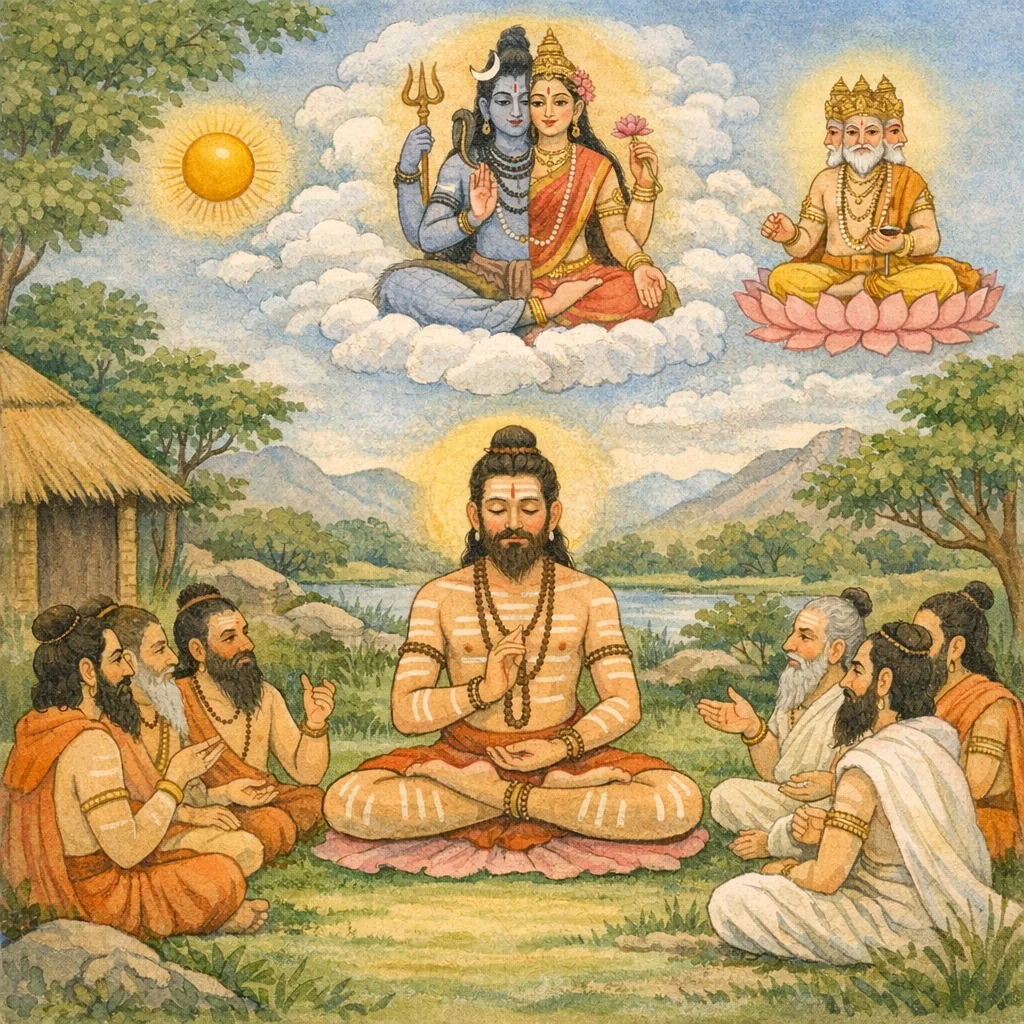
The chapter moves from cosmic beginnings into ordered human history by listing Sūrya’s wives and offspring and tracing the Sūrya-vaṃśa from Manu through Ikṣvāku and successive kings down to Māndhātṛ and later heirs. A turn comes when a later king seeks a righteous son and is instructed to worship Nārāyaṇa/Vāsudeva, showing bhakti as the source of lineage and dharma. The focus then shifts to an exemplary royal sage who, after conquest and an Aśvamedha, asks the assembled ṛṣis whether yajña, tapas, or renunciation yields the highest good; they agree that duties and sacrifice mature toward forest-life, yet tapas is repeatedly proclaimed the scriptural essence leading to liberation. The king hands rule to his son (maintaining varṇa-ordered governance), undertakes long Gāyatrī-japa, and receives Brahmā’s boon of extended life. With further discipline he beholds Rudra as Ardhanārīśvara/Nīlakaṇṭha, is taught Śatarudrīya-japa and ash-observance, and finally ascends through Brahmā’s station and the solar orb toward Maheśvara—ending with a śravaṇa-phala promise and opening the way for continued dharma-yoga synthesis.
Shlokas
Verse 1
इति श्रीकूर्मपुराणे षट्साहस्त्र्यां संहितायां पूर्वविभागे अष्टादशो ऽध्यायः सूत उवाच अदितिः सुषुवे पुत्रमादित्यं कश्यपात् प्रभुम् / तस्यादित्यस्य चैवसीद् भार्याणां तु चतुष्टयम् / संज्ञा राज्ञी प्रभा छाया पुत्रांस्तासां निबोधत
Thus, in the Śrī Kūrma Purāṇa, in the Ṣaṭsāhasrī Saṃhitā, in the Pūrva-bhāga, begins the eighteenth chapter. Sūta said: Aditi bore from Kaśyapa a son, Āditya, the Lord. And that Āditya had four wives—Saṃjñā, Rājñī, Prabhā, and Chāyā. Now hear the sons born to them.
Verse 2
संज्ञा त्वाष्ट्री च सुषुवे सूर्यान्मनुमनुत्तमम् / यमं च यमुनां चैव राज्ञी रैवतमेव च
Saṃjñā, the daughter of Tvaṣṭṛ, bore to Sūrya the most excellent Manu; and also Yama and Yamunā, as well as Rājñī and Raivata.
Verse 3
प्रभा प्रभातमादित्याच्छाया सावर्णमात्मजम् / शनिं च तपतीं चैव विष्टिं चैव यथाक्रमम्
From Āditya (the Sun) were born Prabhā and Prabhāta; and from Chāyā were born Sāvarṇa (her son), as well as Śani, Tapatī, and Viṣṭi—each in due order.
Verse 4
मनोस्तु प्रथमस्यासन् नव पुत्रास्तु संयमाः / इक्ष्वाकुर्नभगश्चैव धृष्टः शर्यातिरेव च
Of the first Manu there were nine sons, steadfast in self-restraint—Ikṣvāku, Nabhaga, Dhṛṣṭa, and also Śaryāti among them.
Verse 5
नरिष्यन्तश्च नाभागो ह्यरिष्टः कारुषकस्तथा / पृषध्रश्च महातेजा नवैते शक्रसन्निभाः
And there were Nariṣyanta, Nābhāga, Ariṣṭa, and also Kāruṣaka; and Pṛṣadhra of mighty splendor. These nine were comparable to Śakra (Indra) in prowess.
Verse 6
इला ज्येष्ठा वरिष्ठा च सोमवंशविवृद्धये / बुधस्य गत्वा भवनं सोमपुत्रेण संगता
Ilā—eldest and most excellent—went to the dwelling of Budha for the increase of the Lunar Dynasty; and, uniting with that son of Soma, became the cause of its growth.
Verse 7
असूत सौम्यजं देवी पुरूरवसमुत्तमम् / पितॄणां तृप्तिकर्तारं बुधादिति हि नः श्रुतम्
The goddess bore the excellent Purūravas, the son of Saumya (Budha). We have heard that he was born of Budha and became the one who satisfies the Pitṛs through ancestral rites and offerings.
Verse 8
संप्राप्य पुंस्त्वममलं सुद्युम्न इति विश्रुतः / इला पुत्रत्रयं लेभे पुनः स्त्रीत्वमविन्दत
Having regained flawless manhood, he became renowned as Sudyumna. From Ilā he begot three sons, and thereafter he again obtained the state of womanhood.
Verse 9
उत्कलश्च गयश्चैव विनताश्वस्तथैव च / सर्वे ते ऽप्रतिमप्रख्याः प्रपन्नाः कमलोद्भवम्
Utkala and Gaya, and likewise Vinatāśva as well—all of them, famed as without equal—took refuge in the Lotus-born (Brahmā).
Verse 10
इक्ष्वाकोश्चाभवद् वीरो विकुक्षिर्नाम पार्थिवः / ज्येष्ठः पुत्रशतस्यापि दश पञ्च च तत्सुताः
From Ikṣvāku there arose a heroic king named Vikukṣi. Though Ikṣvāku had a hundred sons, Vikukṣi was the eldest; and Vikukṣi had fifteen sons.
Verse 11
तेषाञ्ज्येष्ठः ककुत्स्थो ऽभूत् काकुत्स्थो हि सुयोधनः / सुयोधनात् पृथुः श्रीमान् विश्वकश्च पृथोः सुतः
Among them, the eldest was Kakutstha; Kakutstha indeed was also known as Suyodhana. From Suyodhana was born the illustrious Pṛthu, and Viśvaka was the son of Pṛthu.
Verse 12
विश्वकादार्द्रको धीमान् युवनाश्वस्तु तत्सुतः / स गोकर्णमनुप्राप्य युवनाश्वः प्रतापवान्
From Viśvakā was born the wise Ārdraka, and his son was Yuvanāśva. That valiant Yuvanāśva, radiant with royal splendor, journeyed forth and reached Gokarṇa.
Verse 13
दृष्ट्वा तु गौतमं विप्रं तपन्तमनलप्रभम् / प्रणम्य दण्डवद् भूमौ पुत्रकामो महीपतिः / अपृच्छत् कर्मणा केन धार्मिकं प्राप्नुयात् सुतम्
Seeing the brahmin-sage Gautama, blazing with austerity like fire, the king—desiring a son—bowed full-length upon the earth. He then asked: “By what action may one obtain a righteous son, in accord with Dharma?”
Verse 14
गौतम उवाच आराध्य पूर्वपुरुषं नारायणमनामयम् / अनादिनिधनं देवं धार्मिकं प्राप्नुयात् सुतम्
Gautama said: Having worshipped Nārāyaṇa—the primeval Person, free from all affliction, the beginningless and endless God, the upholder of dharma—one obtains a righteous son, devoted to the path of dharma.
Verse 15
यस्य पुत्रः स्वयं ब्रह्मा पौत्रः स्यान्नीललोहितः / तमादिकृष्णमीशानमाराध्याप्नोति सत्सुतम्
He whose son becomes Brahmā himself, and whose grandson becomes Nīlalohita (Rudra)—by worshipping that Īśāna, the Primal Dark One (Ādikṛṣṇa), one attains a virtuous and excellent son.
Verse 16
न यस्य भगवान् ब्रह्मा प्रभावं वेत्ति तत्त्वतः / तमाराध्य हृषीकेशं प्राप्नुयाद्धार्मिकं सुतम्
He whose true majesty even the blessed Brahmā does not fully comprehend—by worshipping that Hṛṣīkeśa, one may obtain a righteous son, abiding in dharma.
Verse 17
स गौतमवचः श्रुत्वा युवनाश्वो महीपतिः / आराधयन्महायोगं वासुदेवं सनातनम्
Having heard Gautama’s words, King Yuvanāśva—the ruler of the earth—began to worship the Eternal Vāsudeva, the Supreme Lord realized through the Great Yoga (mahāyoga).
Verse 18
तस्य पुत्रो ऽभवद् वीरः श्रावस्तिरिति विश्रुतः / निर्मिता येन श्रावस्तिर्गौडदेशे महापुरी
His son was born a valiant hero, renowned by the name Śrāvastī; it was he who founded the great city of Śrāvastī in the land of Gauḍa.
Verse 19
तस्माच्च बृहदश्वो ऽभूत् तस्मात् कुवलयाश्वकः / धुन्धुमारत्वमगमद् धुन्धुं हत्वा महासुरम्
From him was born Bṛhad-aśva; and from him was born Kuvalayāśvaka. Having slain the great asura Dhundhu, he attained the sacred epithet “Dhundhumāra,” the slayer of Dhundhu.
Verse 20
धुन्धुमारस्य तनयास्त्रयः प्रोक्ता द्विजोत्तमाः / दृढाश्वश्चैव दण्डाश्वः कपिलाश्वस्तथैव च
O best of Brahmins, Dhundhumāra is said to have had three sons: Dṛḍhāśva, Daṇḍāśva, and Kapilāśva.
Verse 21
दृढाश्वस्य प्रमोदस्तु हर्यश्वस्तस्य चात्मजः / हर्यश्वस्य निकुम्भस्तु निकुम्भात् संहताश्वकः
From Dṛḍhāśva was born Pramoda, and his son was Haryaśva. From Haryaśva was born Nikumbha, and from Nikumbha came Saṃhatāśvaka.
Verse 22
कृशाश्वश्च रणाश्वश्च संहताश्वस्य वै सुतौ / युवनाश्वो रणाश्वस्य शक्रतुल्यबलो युधि
Kṛśāśva and Raṇāśva were indeed the two sons of Saṃhatāśva. And Yuvanāśva, the son of Raṇāśva, possessed strength in battle equal to that of Śakra (Indra).
Verse 23
कृत्वा तु वारुणीमिष्टिमृषीणां वै प्रसादतः / लेभे त्वप्रतिमं पुत्रं विष्णुभक्तमनुत्तमम् / मान्धातारं महाप्राज्ञं सर्वशस्त्रभृतां वरम्
Then, having performed the Vāruṇī sacrificial rite, and by the very grace of the seers, he obtained an incomparable son—Māndhātṛ—supreme among devotees of Viṣṇu, greatly wise, and the foremost of all who bear weapons.
Verse 24
मान्धातुः पुरुकुत्सो ऽभूदम्बरीषश्च वीर्यवान् / मुचुकुन्दश्च पुण्यात्मा सर्वे शक्रसमा युधि
From Māndhātṛ was born Purukutsa; and Ambarīṣa, mighty in valor; and Mucukunda, a king of righteous soul—each of them, in battle, was equal to Śakra (Indra).
Verse 25
अम्बरीषस्य दायादो युवनाश्वो ऽपरः स्मृतः / हरितो युवनाश्वस्य हारितस्तत्सुतो ऽभवत्
From Ambarīṣa there arose another heir named Yuvanāśva. From Yuvanāśva was born Harita, and Harita’s son was Hārita.
Verse 26
पुरुकुत्सस्य दायादस्त्रसदस्युर्महायशाः / नर्मदायां समुत्पन्नः संभूतिस्तत्सुतो ऽभवत्
From Purukutsa was born the illustrious heir Trasadasyu. And on the banks of the Narmadā there arose Saṃbhūti, who became his son.
Verse 27
विष्णुवृद्धः सुतस्तस्य त्वनरण्यो ऽभवत् परः / बृहदशवो ऽनरण्यस्य हर्यश्वस्तत्सुतो ऽभवत्
His son was Viṣṇuvṛddha; and from him was born the eminent Anaraṇya. Anaraṇya’s son was Bṛhadaśva, and Bṛhadaśva’s son was Haryaśva.
Verse 28
सो ऽतीव धार्मिको राजा कर्दमस्य प्रजापतेः / प्रसादाद्धार्मिकं पुत्रं लेभे सूर्यपरायणम्
That king—exceedingly righteous—by the grace of Prajāpati Kardama obtained a virtuous son, devoted to Sūrya (the Sun).
Verse 29
स तु सूर्यं समभ्यर्च्य राजा वसुमनाः शुभम् / लेभे त्वप्रतिमं पुत्रं त्रिधन्वानमरिन्दमम्
Having duly worshipped Sūrya, the king Vasumanā—of noble and prosperous mind—obtained an incomparable son, Tridhanvā, the destroyer of foes.
Verse 30
अयजच्चाश्वमेधेन शत्रून् जित्वा द्विजोत्तमाः / स्वाध्यायवान् दानशीलस्तितिक्षुर्धर्मतत्परः
Having conquered his enemies, that foremost of the twice-born performed the Aśvamedha sacrifice. He was devoted to Vedic study, generous in giving, patient in endurance, and wholly intent on dharma.
Verse 31
ऋषयस्तु समाजग्मुर्यज्ञवाटं महात्मनः / वसिष्ठकश्यपमुखा देवाश्चेन्द्रपुरोगमाः
Then the sages assembled in the great-souled one’s sacrificial arena—led by Vasiṣṭha and Kaśyapa—and the gods also arrived, with Indra at their head.
Verse 32
तान् प्रणम्य महाराजः पप्रच्छ विनयान्वितः / समाप्य विधिवद् यज्ञं वसिष्ठादीन् द्विजोत्तमान्
Having bowed to them, the great king—endowed with humility—questioned the foremost Brahmin sages such as Vasiṣṭha, after duly completing the sacrifice according to prescribed rite.
Verse 33
वसुमना उवाच किंस्विच्छेयस्करतरं लोके ऽस्मिन् ब्राह्मणर्षभाः / यज्ञस्तपो वा संन्यासो ब्रूत मे सर्ववेदिनः
Vasumanā said: “O best of Brahmins, what indeed brings about the highest good in this world—sacrificial worship (yajña), ascetic austerity (tapas), or renunciation (saṃnyāsa)? Tell me, O all-knowing ones.”
Verse 34
वसिष्ठ उवाच अधीत्य वेदान् विधिवत् पुत्रानुत्पाद्य धर्मतः / इष्ट्वा यज्ञेश्वरं यज्ञैर् गच्छेद वनमथात्मवान्
Vasiṣṭha said: Having duly studied the Vedas, begotten sons in accordance with dharma, and worshipped Yajñeśvara, the Lord of sacrifice, through sacred rites, the self-possessed man should then depart for the forest as a vānaprastha.
Verse 35
पुलस्त्य उवाच आराध्य तपसा देवं योगिनं परमेष्ठिनम् / प्रव्रजेद् विधिवद् यज्ञैरिष्ट्वा पूर्वं सुरोत्तमान्
Pulastya said: Having worshipped by tapas the divine Supreme Lord—the master of yogins and the Highest Ordainer—and having first duly offered sacrifices to the foremost of the gods, one should then renounce the world in the prescribed manner.
Verse 36
पुलह उवाच यमाहुरेकं पुरुषं पुराणं परमेश्वरम् / तमाराध्य सहस्त्रांशुं तपसा मोक्षमाप्नुयात्
Pulaha said: He whom they declare to be the one, ancient Puruṣa, the Supreme Lord—by worshipping that Thousand-rayed One and by tapas, one attains mokṣa, liberation.
Verse 37
जमदग्निरुवाच अजस्य नाभावध्येकमीश्वरेण समर्पितम् / बीजं भगवता येन स देवस्तपसेज्यते
Jamadagni said: “That single, incomparable seed, placed by the Lord within the lotus-navel of the Unborn—by which Bhagavān brings forth creation: that very Deva is to be worshipped through tapas.”
Verse 38
विश्वामित्र उवाच यो ऽग्निः सर्वात्मको ऽनन्तः स्वयंभूर्विश्वतोमुखः / स रुद्रस्तपसोग्रेण पूज्यते नेतरैर्मखैः
Viśvāmitra said: That Fire who is the Self of all, infinite, self-existent, and facing every direction—He is Rudra, and He is truly worshipped by the fierce power of tapas, not by other sacrificial rites alone.
Verse 39
भरद्वाज उवाच यो यज्ञैरिज्यते देवो जातवेदाः सनातनः / स सर्वदैवततनुः पूज्यते तपसेश्वरः
Bharadvāja said: That eternal Deity—Jātavedas—worshipped through the rites of yajña, is the very embodiment of all the gods; as the Lord of tapas, he is ever to be revered.
Verse 40
अत्रिरुवाच यतः सर्वमिदं जातं यस्यापत्यं प्रजापतिः / तपः सुमहदास्थाय पूज्यते स महेश्वरः
Atri said: “From whom this entire universe is born, whose offspring is even Prajāpati—that Mahēśvara, established in exceedingly great tapas, is worshipped.”
Verse 41
गौतम उवाच यतः प्रधानपुरुषौ यस्य शक्तिमयं जगत् / स देवदेवस्तपसा पूजनीयः सनातनः
Gautama said: He from whom Pradhāna and Puruṣa arise, and whose power pervades this universe—He, the God of gods, the Eternal One, is to be worshipped through tapas.
Verse 42
कश्यप उवाच सहस्त्रनयनो देवः साक्षी स तु प्रजापतिः / प्रसीदति महायोगी पूजितस्तपसा परः
Kaśyapa said: “The thousand-eyed God is the witnessing Presence; indeed he is Prajāpati. That Supreme Great Yogi is pleased when he is worshipped through the highest tapas.”
Verse 43
क्रतुरुवाच प्राप्ताध्ययनयज्ञस् लब्धपुत्रस्य चैव हि / नान्तरेण तपः कश्चिद्धर्मः शास्त्रेषु दृश्यते
Kratu said: Even for one who has attained Vedic study and sacrificial merit, and even for one blessed with sons, the scriptures show no dharma that exists apart from tapas.
Verse 44
इत्याकर्ण्य स राजर्षिस्तान् प्रणम्यातिहृष्टधीः / विसर्जयित्वा संपूज्य त्रिधन्वानमथाब्रवीत्
Thus having heard, the royal sage—his mind greatly delighted—bowed to those seers. Then, after respectfully taking leave of them and duly honoring Tridhanvan, he spoke.
Verse 45
आराधयिष्ये तपसा देवमेकाक्षराह्वयम् / प्राणं बृहन्तं पुरुषमादित्यान्तरसंस्थितम्
By austerity I shall worship the Deity known as the One-Syllabled (Ekākṣara)—the vast Life-breath (Prāṇa), the Great Person (Mahāpuruṣa), who abides within the Sun (Āditya).
Verse 46
त्वं तु धर्मरतो नित्यं पालयैतदतन्द्रितः / चातुर्वर्ण्यसमायुक्तमशेषं क्षितिमण्डलम्
But you, ever devoted to dharma, should guard and govern—without negligence—this entire circle of the earth, duly ordered according to the four varṇas.
Verse 47
एवमुक्त्वा स तद्राज्यं निधायात्मभवे नृपः / जगामारण्यमनघस्तपश्चर्तुमनुत्तमम्
Having spoken thus, that blameless king entrusted his kingdom to his own son, and went to the forest to undertake unsurpassed austerities.
Verse 48
हिमवच्छिखरे रम्ये देवदारुवने शुभे / कन्दमूलफलाहारो मुन्यन्नैरयजत् सुरान्
On a lovely peak of the Himālaya, in an auspicious grove of deodars, the sage—living on roots, tubers, and fruits—worshipped the gods with the simple food of ascetics.
Verse 49
संवत्सरशतं साग्रं तपोनिर्धूतकल्मषः / जजाप मनसा देवीं सावित्ररिं वेदमातरम्
Having cleansed his impurities by austerity, he mentally performed japa of the Goddess Sāvitrī—the Mother of the Vedas—for a full hundred years and more.
Verse 50
तस्यैवं जपतो देवः स्वयंभूः परमेश्वरः / हिरण्यगर्भो विश्वात्मा तं देशमगमत् स्वयम्
As he continued in such mantra-recitation, the God—Self-born, the Supreme Lord—Hiraṇyagarbha, the Soul of the universe, Himself came to that very place.
Verse 51
दृष्ट्वा देवं समायान्तं ब्रह्माणं विश्वतोमुखम् / ननाम शिरसा तस्य पादयोर्नाम कीर्तयन्
Seeing the god Brahmā approaching—whose faces are turned to all directions—he bowed his head at Brahmā’s feet, chanting his name in praise.
Verse 52
नमो देवाधिदेवाय ब्रह्मणे परमात्मने / हिर्ण्यमूर्तये तुभ्यं सहस्त्राक्षाय वेधसे
Salutations to the God beyond all gods—to Brahman, the Supreme Self. Salutations to You whose form is golden, to the thousand‑eyed Lord, to Vedhas, the Creator who ordains all.
Verse 53
नमो धात्रे विधात्रे च नमो वेदात्ममूर्तये / सांख्ययोगाधिगम्याय नमस्ते ज्ञानमूर्तये
Salutations to the Sustainer and the Ordainer; salutations to You whose very form is the Veda. Salutations to You realized through Sāṅkhya and Yoga; salutations to You, the embodiment of divine knowledge.
Verse 54
नमस्त्रिमूर्तये तुभ्यं स्त्रष्ट्रे सर्वार्थवेदिने / पुरुषाय पुराणाय योगिनां गुरवे नमः
Salutations to You, the Lord of three forms (Trimūrti); to the Creator, knower of all meanings and aims. Salutations to the primordial Puruṣa, the Ancient One, the Guru of yogins.
Verse 55
ततः प्रसन्नो भगवान् विरिञ्चो विश्वभावनः / वरं वरय भद्रं ते वरदो ऽस्मीत्यभाषत
Then the blessed Viriñca (Brahmā), nurturer of the universe, became pleased and spoke: “Choose a boon; may auspiciousness be yours. I am a giver of boons.”
Verse 56
राजोवाच जपेयं देवदेवेश गायत्रीं वेदमातरम् / भूयो वर्षशतं साग्रं तावदायुर्भवेन्मम
The King said: “O Lord of the gods, if I were to repeat in japa the Gāyatrī—the Mother of the Vedas—would my lifespan increase to a full hundred years and beyond?”
Verse 57
बाढमित्याह विश्वात्मा समालोक्य नराधिपम् / स्पृष्ट्वा कराभ्यां सुप्रीतस्तत्रैवान्तरधीयत
“So be it,” said the Universal Self. Gazing upon the king, and touching him with both hands in gracious delight, he vanished then and there.
Verse 58
सो ऽपि लब्धवरः श्रीमान् जजापातिप्रसन्नधीः / शान्तस्त्रिषवणस्नायी कन्दमूलफलाशनः
He too—endowed with the boon and possessed of auspicious fortune—performed japa with a mind made clear and gracious by the Lord of creatures. Tranquil in nature, he bathed at the three daily junctures and lived on roots, tubers, and fruits.
Verse 59
तस्य पूर्णे वर्षशते भगवानुग्रदीधितिः / प्रादुरासीन्महायोगी भानोर्मण्डलमध्यतः
When his hundred years were fully completed, the Blessed One—Ugradīdhiti, the great Yogin—manifested, appearing from the very midst of the Sun’s orb.
Verse 60
तं दृष्ट्वा वेदविदुषं मण्डलस्थं सनातनम् / स्वयंभुवमनाद्यन्तं ब्रह्माणं विस्मयं गतः
Seeing him—Brahmā, the Self-born—master of the Vedas, seated within the sacred sphere (maṇḍala), eternal, without beginning or end, he was struck with profound wonder.
Verse 61
तुष्टाव वैदिकैर्मन्त्रैः सावित्र्या च विशेषतः / क्षणादपश्यत् पुरुषं तमेव परमेश्वरम्
He praised the Lord with Vedic mantras—especially with the Sāvitrī (Gāyatrī). In an instant he beheld that very Puruṣa, the Supreme Lord (Parameśvara).
Verse 62
चतुर्मुखं जटामौलिमष्टहस्तं त्रिलोचनम् / चन्द्रावयवलक्षमाणं नरनारीतनुं हरम्
He beheld Hara (Shiva): four-faced, with matted locks piled as a crown, eight-armed, and three-eyed—marked with the moon as an ornament—whose very body was of both man and woman (the Ardhanārīśvara form).
Verse 63
भासयन्तं जगत् कृत्स्नं नीलकण्ठं स्वरश्मिभिः / रक्ताम्बरधरं रक्तं रक्तमाल्यानुलेपनम्
I beheld the Blue-throated Lord, illuminating the entire universe with His own rays—clad in red garments, radiant in red, adorned with red garlands and red unguents.
Verse 64
तद्भावभावितो दृष्ट्वा सद्भावेन परेण हि / ननाम शिरसा रुद्रं सावित्र्यानेन चैव हि
Seeing Him, whose vision was wholly permeated by that very divine state, he—filled with the highest pure devotion—bowed his head to Rudra, and likewise offered reverence through the Sāvitrī (Gāyatrī) formula.
Verse 65
नमस्ते नीलकण्ठाय भास्वते परमेष्ठिने / त्रयीमयाय रुद्राय कालरूपाय हेतवे
Salutations to You, O Nīlakaṇṭha—radiant, the Supreme Lord; to Rudra who is embodied as the three Vedas; to the causal Principle who assumes the form of Time.
Verse 66
तदा प्राह महादेवो राजानं प्रीतमानसः / इमानि मे रहस्यानि नामानि शृणु चानघ
Then Mahādeva, his mind filled with delight, spoke to the king: “O sinless one, listen to these secret names of Mine.”
Verse 67
सर्ववेदेषु गीतानि संसारशमनानि तु / नमस्कुरुष्व नृपते एभिर्मां सततं शुचिः
In all the Vedas are sung those hymns that quell worldly bondage. Therefore, O King, remaining ever pure, continually offer salutations to Me through these (Vedic praises).
Verse 68
अध्यायं शतरुद्रीयं यजुषां सारमुद्धृतम् / जपस्वानन्यचेतस्को मय्यासक्तमना नृप
O king, recite the Śatarudrīya chapter—drawn forth as the very essence of the Yajurveda—doing japa with an undistracted mind, your heart firmly attached to Me.
Verse 69
ब्रह्मचारी मिताहारो भस्मनिष्ठः समाहितः / जपेदामरणाद् रुद्रं स याति परमं पदम्
A brahmacārin—moderate in food, established in sacred ash (bhasma), and inwardly collected—should repeat Rudra’s name/mantra until death; such a one attains the Supreme State.
Verse 70
इत्युक्त्वा भगवान् रुद्रो भक्तानुग्रहकाम्यया / पुनः संवत्सरशतं राज्ञे ह्यायुरकल्पयत्
Having spoken thus, the Blessed Lord Rudra—wishing to bestow grace upon his devotee—again ordained for the king a lifespan of a hundred years.
Verse 71
दत्त्वास्मै तत् परं ज्ञानं वैराग्यं परमेश्वरः / क्षणादन्तर्दधे रुद्रस्तदद्भुतमिवाभवत्
Bestowing upon him that supreme knowledge and the highest dispassion (vairāgya), Parameśvara Rudra vanished in an instant—an event that seemed truly wondrous.
Verse 72
राजापि तपसा रुद्रं जजापानन्यमानसः / भस्मच्छन्नस्त्रिषवणं स्नात्वा शान्तः समाहितः
The king too, through tapas (austere discipline), repeated Rudra with an undivided mind. Smeared with sacred ash (bhasma), bathing at the three daily times (trisavana), he remained tranquil and firmly collected in meditation.
Verse 73
जपतस्तस्य नृपतेः पूर्णे वर्षशते पुनः / योगप्रवृत्तिरभवत् कालात् कालात्मकं परम्
As that king continued his japa, when a full hundred years were completed again, the current of Yoga arose in him once more—through Kāla, Time, the Supreme Reality whose very nature is Time.
Verse 74
विवेश तद् वेदसारं स्थानं वै परमेष्ठिनः / भानोः स मण्डलं शुभ्रं ततो यातो महेश्वरम्
He entered that abode which is the very essence of the Vedas—the supreme station of Parameṣṭhin (Brahmā). Then he reached the radiant, pure orb of the Sun, and from there he went on to Mahādeva (Maheśvara).
Verse 75
यः पठेच्छृणुयाद् वापि राज्ञश्चरितमुत्तमम् / सर्वपापविनिर्मुक्तो ब्रह्मलोके महीयते
Whoever recites, or even listens to, this excellent account of the king’s noble conduct is freed from all sins and is honored in the world of Brahmā (Brahmaloka).
Frequently Asked Questions
The sages present a staged dharma: Vedic study, progeny, and yajña mature into forest-life, but they repeatedly emphasize tapas as the decisive essence that perfects merit and leads to liberation; renunciation is framed as meaningful when preceded by fulfilled sacrificial and social obligations.
The narrative uses Gāyatrī-japa to open Vedic realization that culminates in a Shaiva theophany, expressing samanvaya. Rudra instructs continual salutation through Vedic hymns, prescribes Śatarudrīya-japa with undistracted devotion, and commends brahmacarya, moderation, and bhasma as a direct path to the Supreme State.