Adhyaya 8
Hymns to Nārāyaṇa: Humility, Bhakti, Yoga, and the Guṇas
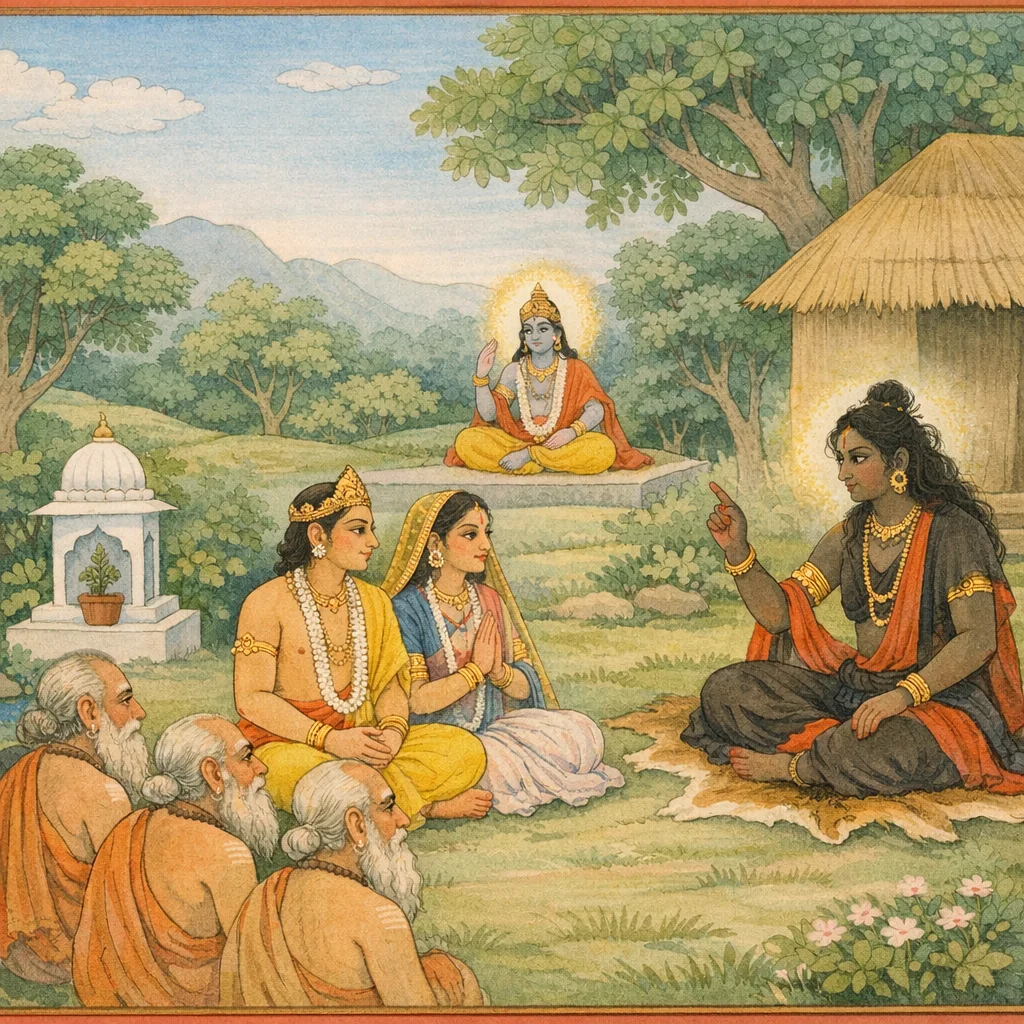
After the sacrificial setting is completed and the prior discourse has arisen, the narrative turns into a sequence of stotras. Mitra, lord of birds, praises Nārāyaṇa as the cosmic source, confessing his ignorance and declaring that even gods and ṛṣis cannot fully know Vāsudeva. When Mitra falls silent, Tārā extols single-hearted devotees who abandon attachment and remain absorbed in hearing and retelling Viṣṇu-rooted sacred kathā. A protective plea is voiced for one fallen into a dreadful state; then Nirṛti teaches that yoga, bhakti, service to the virtuous, and knowledge joined with vairāgya lead to the supreme goal, while mind-restraint alone is lauded as powerful for Viṣṇu’s devotees. Pravāhya affirms that association with Uttamaśloka’s kathā is a liberating “nectar-medicine,” followed by a statement on equality of state and companionship. The text lists Koṇādhipa, Nirṛti, Prāvahī, and Pravahapriyā as guṇic manifestations arising from Parjanya. Finally, Viṣvaksena—born after Anantara—hymns Hari, teaching steadfast devotion, sincere reverence for the guru-paramparā up to Brahmā, and compassionate regard for living beings (including Tulasi). Garuḍa ends in humbled silence, acknowledging his inferiority before the Lord and setting a devotional tone for the next doctrinal movement.
Shlokas
Verse 1
नाम सप्तमो ऽध्यायः क्रतोरनन्तरं जातो मित्रो (श्रो) नाम खगेश्वर / नारायणं जगद्योनिं स्तोतुं समुपचक्रमे
After the sacrifice (Kratu), the seventh chapter came into being. Then the lord of birds, named Mitra (as heard), began to offer praise to Nārāyaṇa, the womb-source of the universe.
Verse 2
मित्र उवाच / नतोस्म्यज्ञस्त्वच्चरणारविन्दं भवच्छिदं स्वस्त्ययनं भवच्छिदे / वेद स्वयं भगवान्वासुदेवो नाहं नाग्निर्न त्रिदेवा मुनीन्द्राः
Mitra said: “Though I am ignorant, I bow to the lotus of Your feet—You who cut through worldly becoming, the auspicious refuge of one who seeks liberation. Truly, only the blessed Lord Vāsudeva knows this in full; not I, nor Agni, nor the three gods, nor even the foremost of sages.”
Verse 3
अथापरे भागवतप्रधाना यदा न जानीयुरथापरे कुतः / मां पाहि नित्यं परतोप्यधीश विश्वामित्रान्न्यून एवेति नित्यम् / अहं पर्जन्यार्द्विगुण एव नित्यमतो मम स्तवने नास्ति शक्तिः
“Some, the foremost devotees of the Lord, may understand You; but if even they do not, how could others? Protect me always, O Supreme Lord beyond all; truly I am ever inferior, even to Viśvāmitra. I am but a tiny portion, like a fraction beside a rain-cloud’s abundance; therefore I have no power to offer You fitting praise.”
Verse 4
एवं स्तुत्वा हरिं मित्रस्तूष्णीमास तदा खग / तदनन्तरजा तारा स्तोतुं समुपचक्रमे
Thus, having praised Hari, Mitra—the bird Khaga—fell silent. After that, Tārā, born thereafter, began to offer praise.
Verse 5
तारोवाच अनन्येन तु भावेन भक्तिं कुर्वन्ति ये दृढाम् / त्वत्कृते त्यक्तकर्माणस्त्यक्तस्वजनबान्धवाः
Tārā said: Those who, with an undivided heart, cultivate steadfast devotion—who, for Your sake, have abandoned worldly duties and even renounced attachment to their own kinsmen and relations.
Verse 6
त्वदाश्रयां कथां श्रुत्वा (दृष्ट्वा) शृण्वन्ति कथयन्ति च / तथैते साधवो विष्णो सर्वसंगविवर्जिताः
Having heard (or beheld) the sacred narrative that rests in You, they listen to it and also recount it. Thus, O Viṣṇu, those holy ones remain completely free from all worldly attachments.
Verse 7
तन्मध्ये पतितां पाहि सदा मित्रसमां प्रभो / तारानन्तरजः प्राह निरृतिश्च खगेश्वर
“Protect her who has fallen into that dreadful region, O Lord—she who is ever like a friend.” Thus spoke Tārānantaraja; and Nirṛti also, O lord of birds (Garuda).
Verse 8
निरृतिरुवाच / योगेन त्वय्यर्पितया च भक्त्या संयान्ति लोकाः परमां गतिं च / आसेवया सर्वगुणाधिकानां ज्ञानेन वैराग्ययुतेनदवे
Nirṛti said: Through yoga, and through devotion (bhakti) offered to You, beings attain the supreme destination. By serving those who excel in all virtues, and by knowledge united with dispassion (vairāgya), they reach the divine state.
Verse 9
चित्तस्य निग्रहेणैव विष्णोर्यान्ति परं पदम् / अतो मां पाहि दयया सदा तारासमं प्रभो / तदनन्तरजा स्तोतुं प्रावही तं प्रचक्रमे
By the mere restraint of the mind, devotees of Viṣṇu attain the supreme abode. Therefore, O Lord, protect me always with compassion—O Master, radiant like the stars. Then, immediately thereafter, she began to praise Him and commenced that hymn.
Verse 10
प्रवाह्युवाच / सुताः प्रसंगेन भवन्ति वीर्यात्तव प्रसादात्परमाः सम्पदश्च / या ह्युत्तमश्लोकरसायनाः कथास्तत्सेवनादास्त्वपवर्गवर्त्मनि
Pravāhya said: “Through association (with you), sons become endowed with true vigor, and by your grace the highest prosperities arise. For those narratives that are the ‘nectar-medicine’ of Uttamaśloka (the Supreme Lord)—by devoted listening and service to them—one becomes established on the path that leads to liberation.”
Verse 11
भक्तिर्भवेत्सर्वदा देवदेव सदाप्यहं निरृतेः साम्यमेव / सहर्भाष्यकोमित्रः त्कयीतारः प्रकीर्तिताः
May there be constant devotion (bhakti) to Devadeva, the God of gods; even then, one is said to attain only an equality of state with Nirṛti. Those who are “companions in speech” and “associates and friends” are thus spoken of.
Verse 12
कोणाधिपो निरृतिश्च प्रावही प्रवहप्रिया / चत्वार एते पर्जन्यात्त्रिगुणाः परिकीर्तिताः
Koṇādhipa and Nirṛti, together with Prāvahī and Pravahapriyā—these four are declared to be the threefold qualities (triguṇas) arising from Parjanya, the rain-bearing principle.
Verse 13
तदनन्तरजान्वक्ष्ये ताञ्छृणु त्वं खगेश्वर / प्रवाहभार्यानन्तरजो विष्वक्सेनोथपार्षदः / वायुपुत्रो महाभागः हरिं स्तोतुं प्रचक्रमे
Next I shall describe the one born thereafter—listen, O lord of birds, Garuḍa. Then Viṣvaksena, the Lord’s attendant, born after Anantara from Pravāhā his wife, that noble son of Vāyu, began to hymn Hari (Viṣṇu).
Verse 14
विष्वक्सेन उवाच / भगवान्मोक्षदः कृष्णः पूर्णानन्दो सदायदि / यदि स्यात्परमा भक्तिर्ह्य परोक्षत्वसाधना
Viṣvaksena said: If one ever abides in the Lord—Kṛṣṇa, the giver of liberation, complete and blissful—then, when supreme devotion arises, it becomes the means to His direct realization (aparokṣa).
Verse 15
तथा स्वगुरुमारभ्य ब्रह्मान्तेषु च साधुषु / तद्योग्यतानुसारेण भक्तिर्निष्कपटा यदि
Likewise, beginning with one’s own spiritual teacher and extending up to Brahmā and the holy ones, if devotion is offered without deceit, in accord with each one’s worthiness, that devotion becomes spiritually efficacious.
Verse 16
तुलस्यादिषु जीवेषु यदि स्यात्प्रीतिरण्डज / संस्मृतिश्च तदा नाशी भूयादेव न संशयः
O egg-born one (Garuḍa), if there is loving devotion toward living beings such as Tulasi and the like, and if remembrance (of the Lord and dharma) is present, then the destroyer of sin surely arises—there is no doubt.
Verse 17
एवं स्तुत्त्वा महाभागो विष्वक्से नो महाप्रभो / तूष्णीं बभूव गरुड प्राञ्जलिर्नम्रकन्धरः / मित्रादहं न्यून एव नात्र कार्या विचारणा
Having thus praised the great Lord Viṣvaksena, the noble Garuḍa fell silent—hands folded in reverence, his neck bowed in humility—thinking: “Compared to my friend (the Lord), I am indeed inferior; there is no need for deliberation about this.”
Frequently Asked Questions
The chapter presents them as complementary: devotion to Viṣṇu is central, while knowledge joined with dispassion is listed alongside yoga and service to the virtuous as a route to the divine state. The implied model is integrative—bhakti stabilizes and purifies, while jñāna–vairāgya clarifies and detaches, together orienting the practitioner toward mokṣa.
Nirṛti’s statement highlights citta-nirodha as a direct means because devotion naturally gathers the mind; when the mind is restrained and fixed on Viṣṇu, attachment loosens and the path to the supreme abode becomes accessible. The text frames this not as mere technique but as devotion-powered discipline.
Viṣvaksena teaches a graded, sincere (without deceit) offering of devotion according to worthiness, reflecting a Purāṇic ethic of honoring spiritual authority and the sacred lineage. This frames bhakti as socially and cosmologically ordered—rooted in guru-sevā and extending to the highest cosmic teacher figures—while remaining ultimately directed toward Hari.
The verse links remembrance and affectionate regard (including toward sacred beings like Tulasi) with the arising of a ‘destroyer of sin’—i.e., purification through dhārmic devotion. It indicates bhakti expressed through reverence to Viṣṇu’s sacred associates/symbols and compassionate conduct, making devotion ethical and embodied rather than purely internal.