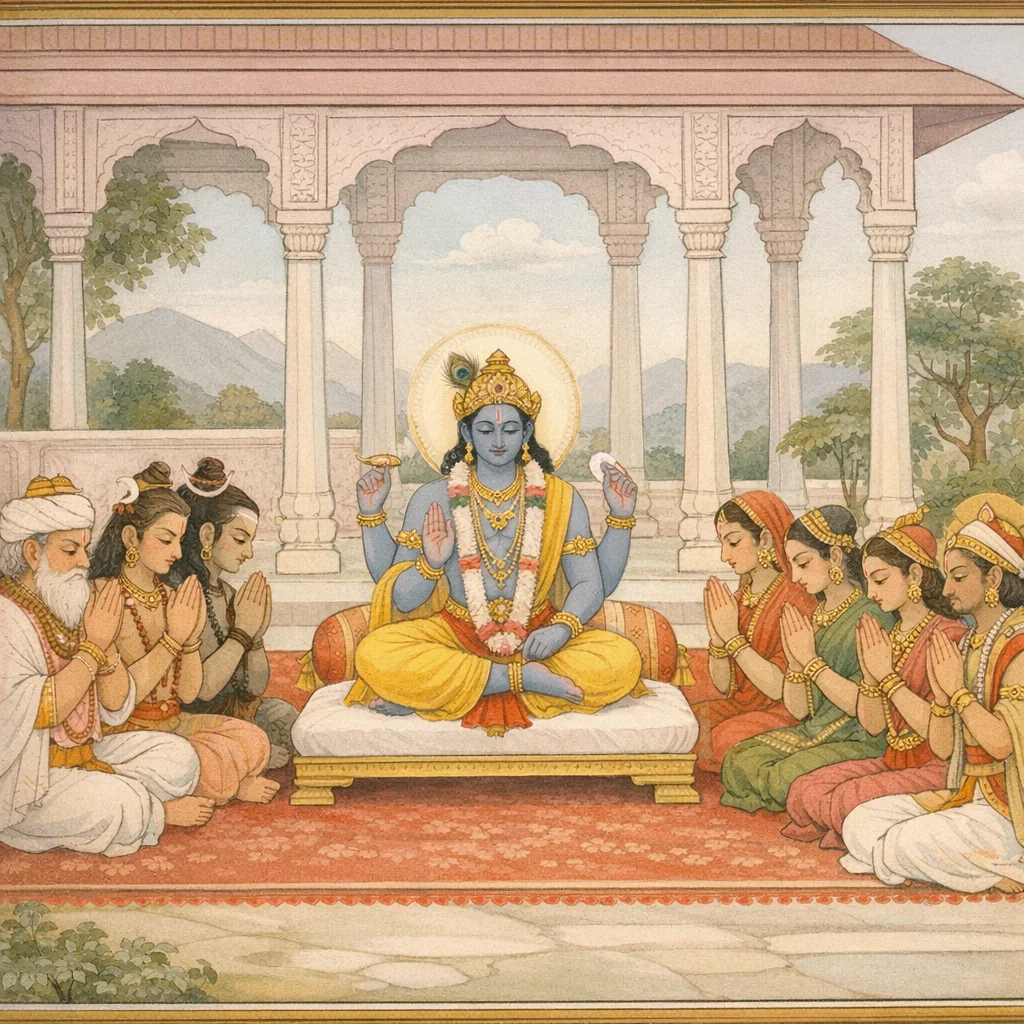
Adhyaya 6
Hari-stuti by Śrī, Brahmā, Vāyu, Sarasvatī, Śeṣa, Garuḍa, Rudra, Vāruṇī and Pārvatī (Humility, Surrender, and the Power of the Name)
Continuing the prior account of presiding powers within tattvas and bodily functions, the chapter turns from metaphysical mapping to devotional response: the assembled divine powers praise Hari (Viṣṇu), whose qualities are both conceivable and inconceivable. Śrī (Lakṣmī) takes exclusive refuge at His lotus-feet and seeks protection; Brahmā admits his limited power and prays to be freed from “I” and “mine,” asking for steady wisdom and sense-restraint directed to Viṣṇu. Vāyu teaches an integrated bhakti discipline—making sleep, waking, duty, and offerings into worship—and declares that daily recitation pleases Hari and makes all aims attainable. Sarasvatī says that hearing such praise cuts attachment to the body and the chain of rebirth, while acknowledging that even great beings cannot fully know Viṣṇu’s essence. Then Śeṣa, Garuḍa, Rudra, Vāruṇī, and finally Pārvatī offer their hymns with the same humility; Pārvatī especially proclaims the saving power of the single Name “Nārāyaṇa.” The chapter closes by framing devotion as grace-born, ego-less, and liberation-oriented, preparing the way for later teaching where bhakti becomes the key to Purāṇic understanding and practice.
Shlokas
Verse 1
नाम पञ्चमो ऽध्यायः श्रीकृष्ण उवाच / तत्रतत्र स्थितास्तत्त्वे तत्तत्तत्त्वाभिमानिनः / स्वेस्वे ह्यायतने स्वाङ्गे तदर्थं च खगेश्वर
Śrī Kṛṣṇa said: In every place within the tattvas they remain stationed—each presiding power identifying with its own principle. Indeed, each abides in its own seat within its own limb of the body, for that very function, O Lord of Birds, Garuḍa.
Verse 2
हरिं नारायणं सम्यक् स्तोतुं समुपचक्रिरे / चिन्त्याचिन्त्यगुणे विष्णौ विरुद्धाः संति सद्गुणाः
They then began to praise Hari—Nārāyaṇa—properly. In Viṣṇu, whose qualities are both conceivable and inconceivable, even noble virtues can appear mutually opposed.
Verse 3
एकैकशोह्यनन्तास्ते तद्गुणानां स्तुतौ मम / क्व शक्तिरिति बुद्ध्या सा व्रीडयावनताब्रवीत्
Each of Your qualities, one by one, is truly endless; as for me, in praising those virtues—where is my capacity? Thinking thus, she, bowed down in modesty, spoke.
Verse 4
श्रीरुवाच / नतास्मि ते नाथ पदारविन्दं न वेद चान्यच्चरणादृते तव / त्वयीश्वरे संति गुणाः श्रुतास्तु तथाश्रुताः संति च देवदेव
Śrī said: O Lord, I bow to Your lotus-feet; apart from Your feet I know no other refuge. In You, the Supreme Īśvara, divine qualities indeed abide—as the śruti have heard and proclaimed, O God of gods.
Verse 5
सम्यक् सृष्टं स्वायतनं च दत्वा गोविन्द दामोदर मां च पाहि / स्तुत्या मदीयश्च सुखकपूर्णः प्रियो जनो नास्ति तथा त्वदन्यः
Having rightly created the world and granting each being its proper abode, O Govinda, O Dāmodara—protect me as well. By my praise my heart is filled with happiness; for there is no beloved for me like You—none other than You.
Verse 6
ब्रह्मोवाच / लक्ष्मीपते सर्वजगन्निवास त्वं ज्ञानसिंधुः क्व च विश्वमूर्ते / अहं क्व चाज्ञस्तव वै शक्तिरस्ति ह्यज्ञोहं वै ह्यल्पशक्तिर्ममास्ति
Brahmā said: O Lord of Lakṣmī, abode of all the worlds—you are an ocean of knowledge, O Cosmic-Form. What am I, and what is my ignorance? Truly, Your power is supreme; I am indeed ignorant, and my power is but little.
Verse 7
लक्ष्म्याश्चैव ज्ञानवैराग्यभक्ति ह्यत्यल्पमद्धा मयि सर्वदैव / तव प्रसादादस्ति जगन्निवास तत्र स्वामित्वं नास्ति विष्णो सदैव
Even Lakṣmī, and likewise knowledge, dispassion, and devotion—my true, steady faith in You is exceedingly little, O Viṣṇu. Yet by Your grace there is refuge in You, the abode of the universe; for in that surrendered state there is never any sense of “ownership,” O Viṣṇu, at all times.
Verse 8
न देहि त्वं सर्वदा मे मुरारे अहंममत्वं प्राप्यमेतावदेव / गम्यज्ञानं योग्यगुणे रमेश प्रमादो वा नास्तिनास्त्यद्य नित्य
O Murāri, do not ever grant me the sense of “I” and “mine”; let this alone be my attainment. O Lord of Ramā, endowed with fitting virtues, grant me knowable, realizable wisdom—so that no negligence may arise, neither today nor ever.
Verse 9
तन्मे हृषीकाणि पतन्त्यसत्पथे पदारविन्दे तु पतन्तु सर्वदा / लक्ष्म्या ह्यहं कोटिगुणेन हीनः स्तोतुं सामर्थ्यं नास्ति मे सुप्रसीद
If my senses are falling onto the untrue path, then let them instead fall—always—upon Your lotus-feet. I am deficient in fortune by tens of millions; I have no capability to praise You adequately. Be gracious to me.
Verse 10
तदा वायुर्देवदेवो महात्मा दृष्ट्वा विष्णु भक्तिसंवर्धितात्मा
Then Vāyu, the great-souled divine lord, seeing this and being inwardly strengthened by devotion to Viṣṇu, acted accordingly.
Verse 11
स्नहोत्थरावः स्खलिताक्षरस्तं मुञ्चन्कणान्प्राञ्जलिराबभाषे / वायुरुवाच / एते हि देवास्तव भृत्यभूताः पदारविन्दं परमं सुदुर्लभम्
His voice choked with affection, his syllables faltering, tears falling, he spoke with folded hands. Vāyu said: “Truly, these gods have become Your servants; yet Your supreme lotus-feet are exceedingly difficult to attain.”
Verse 12
चतुर्विधान्पुरुषार्थान्रमेश संप्रार्थये तच्च सदापि देव / दृष्ट्वा हरेः सैव मायैव तावत्सुकारणं किञ्चिदन्यन्न चास्ति
O Rameśa, Lord of Lakṣmī, I ever pray to You for the four aims of human life. Yet, having beheld Hari, I understand that only His Māyā stands as the proximate cause—there is nothing whatsoever besides that.
Verse 13
अतो नाहं प्रदयोपि भूमन् भवत्पदांभोजनिषवणोत्सुकः / लोकस्य कृष्णाद्विमुखस्य कर्मणा अपुण्यशीलस्य सुदुः खितस्य
Therefore, O exalted Lord, I do not wish to grant any boon—being eager only to serve Your lotus feet—for the sake of one who has turned away from Kṛṣṇa, whose conduct is impious, and who, by his own actions, has fallen into grievous suffering.
Verse 14
अनुग्रहार्थं च तवावतारो नान्यश्च किञ्चित्पुरुषार्थस्तवेश / गोभूसुराणां च महीरुहाणां तथा सुराणां प्रवरावतारैः
O Lord, Your descent as avatāra is solely for the sake of grace; You have no other personal aim at all. Through Your supreme incarnations, You uplift and protect cows, brāhmaṇas, the earth and its trees, and likewise the gods.
Verse 15
क्षेमोपकाराणि च वासुदेव क्रीडन्विधत्ते न च किञ्चिदन्यत् / मनो न तृप्यत्यपि शंसतां नः सुकर्ममौलेश्चरितामृतानि
O Vāsudeva, You playfully bestow welfare and beneficent help, and You do nothing else. Even as we praise You, our mind is not satiated—so nectar-like are the life-deeds of the Lord, the crest-jewel of righteous action.
Verse 16
अच्छिन्नभक्तस्य हि मे मुकुन्द सदा भक्तिं देहि पादारविन्दे / सदा तदेवास्तु न किञ्चिदन्यद्यत्र त्वमासीः पुरुषे देवदेव
O Mukunda, for me whose devotion is unbroken, grant constant devotion at Your lotus feet. Let that alone ever be—nothing else—wherein You abide, O Supreme Person, O God of gods.
Verse 17
अहं च तत्रास्मि तव प्रसादाद्यत्रास्म्यहं तत्र भवान्महाप्रभो / व्यंसिर्ममेयं च शरीरमध्ये चतुर्मुखश्चैव न चैततदन्यैः
By Your grace I am there; wherever I am, O great Lord, there You are as well. This my inner measure and extension is within the body; and the four-faced Brahmā too is truly present—yet others do not know this.
Verse 18
मदीयनिद्रा तव वन्दनं प्रभो मदीययामाचरणं प्रदक्षिणम् / मदीयव्याख्याहरणं स्तुतिः स्यादेवं विदित्वा च समर्पयामि
O Lord, let my sleep be an act of reverence to You; let my waking conduct be my circumambulation of You. Let the carrying out of my duties and actions be my hymn of praise. Knowing thus, I offer everything to You.
Verse 19
मद्ब्रृद्धियोग्यं च पदार्थजातं दृष्ट्वा हरेः प्रतिमा एव तच्च / इत्थं मत्वाहं सर्वदा देवदेव तत्रस्थितान्हरिरूपान् भजिष्ये
Seeing the whole collection of things as fit for my growing understanding, I recognize that all of it is indeed an image—an embodied manifestation—of Hari. Thinking thus, O God of gods, I shall always worship the forms of Hari that abide there, in all things.
Verse 20
यच्चन्दनं यत्तु पुष्पं च धूपं वस्त्रं च यद्भक्ष्यभोज्यादिकं च / एतत्सर्वं विष्णुप्रीत्यर्थमेवेत्येतद्व्रतं सर्वदा वै करिष्ये
Whatever sandalwood I offer, whatever flowers and incense, whatever cloth, and whatever foods and drinks and the like—may all of it be only for the pleasure of Lord Viṣṇu. This vow I shall indeed observe at all times.
Verse 21
अवैष्णवान्दूषयिष्ये सदाहं सद्वैष्णवान्पा (ल्लां) लयिष्ये मुरारे / विष्णुद्रुहां छेदयिष्ये च जिह्वां तच्छृण्वतां पूरयिष्ये त्रपूल्काः
“I shall ever revile the non‑Vaiṣṇavas; and, O Murāri, I shall swallow up the true Vaiṣṇavas. I shall cut out the tongues of those who hate Viṣṇu; and I shall fill with shame and filth those who listen to such talk.”
Verse 22
एतादृशी शक्तिर्ममास्ति देव तव प्रसादाद्ब्र लिनोपि विष्णो / अथापि नाहं स्तवने समर्थः लक्ष्म्या ह्यहं कोटिगुणैर्विहीनः
“O Lord, such power is mine only by Your grace, O mighty Viṣṇu. Yet I am not able to praise You adequately, for I am bereft of Lakṣmī and of countless virtues.”
Verse 23
एतत्स्तोत्रं ह्यर्थयेच्चैव या नः तत्र प्रीतिर्ह्यक्षया मे सदा स्यात् / स्तोत्रं ह्येतत्पाठयन्तीह लोके ते वैष्णवास्ते च हरिप्रियाश्च
“Whoever seeks the fruit of this hymn—may my affection for that person be everlasting. Those who recite this very hymn here in the world are truly devotees of Viṣṇu, and they are dear to Hari.”
Verse 24
कुर्वन्ति ये पठनं नित्यमेव समर्पयिष्यति सदा हरौ च / तेषां हरिः प्रीयते केशवोलं हरौ प्रसन्ने किमलभ्यमस्ति
“Those who perform this recitation daily and continually offer it to Hari—Hari, the Keśava, becomes pleased with them. And when Hari is pleased, what indeed is there that cannot be attained?”
Verse 25
एवं स्तुत्वा वलदेवो महात्मा तूष्णीं स्थितः प्राञ्जलिरग्रतो हरेः / सरस्वत्युवाच / को वा रसज्ञो भगवन् मुरारे हरे गुणस्तवनात्कीर्तनाद्वा
“Having thus praised Hari, the great‑souled Baladeva stood silently before Him with folded hands. Sarasvatī then said: ‘O Blessed Lord, Murāri—O Hari—who indeed can be a true knower of rasa, merely by praising or singing Your qualities?’”
Verse 26
अलंबुद्धिं प्राप्नुयाद्देवदेव ब्रह्मादिभिः सर्वदा स्तूयमान / यः कर्णनाडीं पुरुषस्य यातो भवप्रदां देहरतिं छिनत्ति
He who, entering through a man’s ear-channel, cuts off the soul’s attachment to the body—the craving that bestows further becoming (rebirth)—attains unwavering, steadfast understanding, O God of gods, ever praised by Brahmā and the other deities.
Verse 27
न केवलं देहरतिं छिनत्त्यसद्गृहक्षेत्रभार्यासुतेषु नित्यम् / पश्वादिरूपेषु धनादिकेषु अनर्घ्यरत्नेषु प्रियं छिनात्ति
Death does not merely cut off one’s delight in the body; it relentlessly severs what one holds dear in false attachments—house and land, wife and children, cattle and the like, wealth and possessions, even priceless jewels.
Verse 28
अनं तवेदप्रतिपादितोपि लक्ष्मीर्न वै वेद तव स्वरूपम् / चतुर्मुखो नैव वेद न वायुरसौ न वेत्तीति किमत्र चित्रम्
O Ananta! Though the Vedas speak of You, even Lakṣmī does not truly know Your essential nature. Four-faced Brahmā does not know it, nor does Vāyu. If they do not know—what is surprising in that?
Verse 29
एतादृशस्य स्तवने क्वास्ति शक्तिर्मम प्रभो ब्रह्मवाय्वोः सकाशात् / शतैर्गुणैः सर्वदा न्यूनतास्ति अतो हरे दयया मां च पाहि
O Lord, where is there any ability in me to offer praise of such a kind? Compared to Brahmā and Vāyu, I am always inferior by hundreds of qualities. Therefore, O Hari, out of compassion, protect me as well.
Verse 30
एवं स्तुत्वा हरिं सा तु तूष्णीमास खगश्वर / भारती तु तदा स्तोतुं हरिं समुपचक्रमे
Thus, having praised Hari, she then fell silent, O lord of birds. Thereupon Bhāratī (Sarasvatī) began to hymn Hari.
Verse 31
भारत्युवाच / ब्रह्मेश लक्ष्मीश हरे मुरारे गुणांस्तव श्रद्दधानस्य नित्यम् / तथा स्तुवन्तोस्य विवर्धमानां मतिं च नित्यं विषयेष्वसत्सु
Bhāratī said: O Lord of Brahmā, Lord of Lakṣmī, O Hari, slayer of Mura—may Your virtues ever abide in one who has faith. And for the one who praises You thus, may his understanding continually increase, and may his mind never again be fixed upon unreal, perishable sense-objects.
Verse 32
कुर्वन्ति वैराग्यममुत्र लोके ततः परं भक्तिदृढां तथैव / ततः परं चैव हरेः प्रसन्नतां कुर्वन्ति नित्यं तव देवदेव
In that other world, they cultivate dispassion; thereafter they develop steadfast devotion. Beyond that, they continually attain the gracious favor of Hari—O God of gods.
Verse 33
तेनापरोक्षं च भवेच्च तस्य अतो गुणानां स्तवने च मे रतिः / सा तु प्रजाता पुरुषस्य नित्यं संसारदुः खं तु तदाच्छिनत्ति
Through that (direct realization), He becomes immediately present to him; therefore my delight is in praising His virtues. When that devotion is born in a person, it continually cuts off the sorrow of worldly transmigration.
Verse 34
विच्छिन्नदुः खस्य तदाधिकारिण आनन्दरूपाख्यफलं ददाति / हरेर्गुणानस्तुवतां च पापं तेषां हि पुण्यं च तथा क्षिणोति
To one whose suffering has been cut off and who is fit for it, it grants the fruit known as bliss (ānanda). But for those who do not praise the virtues of Hari, it diminishes their sin—and likewise diminishes their merit as well.
Verse 35
एवं विदित्वा परमो गुरुर्मम वायुर्दयालुर्मम वल्लभश्च / हरेर्गुणान्सर्वगुणप्रसारान्ममैव योग्यान्सुखमुख्यभूतान्
Having understood thus, I know that Vāyu is my supreme teacher—compassionate and dear to me; and that the qualities of Hari, from which all virtues spread, are indeed fit for me, chief among them being the joy born of devotion.
Verse 36
उद्धृत्य पुण्येभ्य इवार्तबन्धुः शिवश्च नो द्रुह्यति पुण्यकीर्तिम् / तव प्रसादाच्च श्रियः प्रसादाद्वायोः प्रसादाच्च ममास्ति नित्यम्
Like a kinsman to the distressed, he has uplifted me by merit; and Śiva does not oppose my sacred renown. By your grace, by the grace of Śrī (Fortune), and by the grace of Vāyu, this blessing abides with me always.
Verse 37
यद्यत्करोत्येव सदैव वायुस्तत्तत्करोत्येव सदैव नित्यम् / वायोर्विरोधं न करोति देवः स तद्विरोधं च करोति नित्यम्
Whatever Vāyu does at any time, the deity does that very same—always, unfailingly. The deity does not oppose Vāyu; and whoever sets himself against Vāyu meets opposition continuously.
Verse 38
हरेर्विरोधं न करोति वायुर्वायोर्विरोधं न करोति विष्णुः / वायोः प्रसादान्ममनास्ति किञ्चिदतानभावश्च तव प्रसादात्
Vāyu does not oppose Hari, and Viṣṇu does not oppose Vāyu. By Vāyu’s grace I lack nothing; and by your grace, O Lord, my unassailable nature is secured.
Verse 39
यथैव मूलं च तथावतारे दुः खादिकं नास्ति समीरणस्य / वायुस्तथान्ये च उभौ मुकुन्दस्तथावतारेषु न दुः खरूपौ
Just as Samīraṇa (the Wind), in its very source and in its manifestations, has no suffering and the like, so too are Vāyu and the other divine beings; likewise Mukunda (Viṣṇu), in His descents (avatāras), is never of the nature of suffering.
Verse 40
अशक्तवद्दृश्यते वायुदेवः युगानुसारांल्लोकधर्मांस्तु रक्षन् / नरावतारे तत्र देवे मुरारे ह्यशक्तता नेति विचं तनीयम्
Vāyu-deva appears as though powerless, while safeguarding the world’s dharma in accordance with the yugas. But when Murāri (Viṣṇu) Himself descends in a human incarnation, one should understand that in truth there is no weakness at all in Him.
Verse 41
अवताररूपे यमदुः खादिकं च न चिन्तनीयं ज्ञानिभिर्देवदेव / अहं कदाचित्सुखनाशप्रदेशे दैत्यांस्तथा मारयितुं गतोस्मि
O God of gods, the wise need not fear the torments of Yama, for I Myself have gone to those regions to slay the demons there.
Verse 42
नैतावता मम वायोश्च नित्यं दुः खातनं नैव संचितनीयम् / एतादृशोहं स्तवनेनु कास्ति शक्तिर्गुणानां मधुसूदन प्रभो / वायोः सकाशाच्च गुणेन हीना संसाररूपे मुक्तरूपे च देव
It is not that I alone, nor Vayu, should constantly bear this burden of suffering. O Lord Madhusudana, what power do I truly have to describe Your qualities?
Verse 43
एवं स्तुत्वा भारती तु तूष्णीमास खगेश्वर / तदनन्तरजः शेषः प्राञ्जलिः प्राह केशवम्
Having thus praised Him, Bharati fell silent, O Lord of Birds. Thereafter Shesha, with folded hands, spoke to Keshava.
Verse 44
शेष उवाच / नाहं च जाने तव पादमूलं रुद्रो न वेत्ति गरुडो न वेद / अहं वाण्याः शतगुणांशहीनो दत्त्वा ह्यायतनं पाहि मां वासुदेव
I do not know the root of Your feet; Rudra does not know, nor does Garuda. Protect me, O Vasudeva.
Verse 45
एवं स्तुत्वा सशेषस्तु तूष्णीमास खगेश्वर / तदनन्तरजो वीशः स्तोतुं समुपचक्रमे
Thus, having offered praise, Shesha fell silent, O Lord of Birds; then, immediately thereafter, the Lord began to offer praise.
Verse 46
गरुड उवाच / तव पदोः स्तुतिं किं करोम्यहं मम पदांबुजे ह्यर्पितं मनः / कथमहं मुखे पक्षियोनिजः कथमेवङ्गुणा नीडितुं क्षमः
Garuḍa said: “How can I praise Your two feet? For my mind has already been offered upon the lotus of Your feet. How can I—born among birds, with a beak for a mouth—properly describe such exalted qualities?”
Verse 47
एवं स्तुत्वा तु गरुडस्तूष्णीमास नयान्वितः / तदनन्तरजो रुद्रस्तोतुं समुपचक्रमे
Having thus offered praise, Garuḍa—endowed with discernment—fell silent. Immediately thereafter, Rudra began to chant his hymn of praise.
Verse 48
रुद्र उवाच / या वै तवेश भगवन्न विदाम भूमन् भक्तिर्ममास्तु शिवपादसरोजमूले / छन्नापि सा ननु सदा न ममास्ति देव तेनाद्रुहं तव विरुद्धमतः करोमि
Rudra said: “O Lord, O Bhagavān, O all-pervading Great Being—may my bhakti abide at the root of Śiva’s lotus-feet. Yet, O God, that devotion does not remain in me always, even when hidden within; therefore I sometimes act contrary to Your will, though I am not truly hostile.”
Verse 49
सर्वान्न बुद्धिसहितस्य हरे मुरारे का शक्तिरस्ति वचने मम मूढबुद्धेः / वाण्या सदा शतगुणेन विहीनमेनं मां पाहि चेश मम चायतनं च दत्त्वा
O Hari, O Murāri—You who are endowed with all knowledge and perfect intelligence—what power have I, of deluded understanding, in speech? In expression I am ever a hundredfold deficient. Protect me, O Lord, and grant me also a worthy support, a true abode for my utterance.
Verse 50
एवं स्तुत्वा स रुद्रस्तु तूष्णीमास द्विजोत्तमः / शेषानन्तरजा देवी वारुणी वाक्यमब्रवीत्
Having thus offered praise, Rudra fell silent, O best of the twice-born. Then the goddess Vāruṇī—born after Śeṣa and Ananta—spoke these words.
Verse 51
वारुण्युवाच / लक्ष्मीपते ब्रह्मपते मनोः पतेगिरः पते रुद्रपते नृणां पते / गुणांस्तव स्तोतुमहं समर्था न पार्वती नापि सुपर्णपत्नी
Vāruṇī said: O Lord of Lakṣmī, Lord of Brahmā, Lord of Manu, Lord of Speech, Lord of Rudra, and Lord of men—none can fully praise Your virtues; neither Pārvatī nor even the wife of Suparṇa (Garuḍa).
Verse 52
शेषादहं दशगुणैर्विहीना मां पाहि नित्यं जगतामधीश
Compared to what remains, I am tenfold lacking in virtues; O Lord of the worlds, protect me always.
Verse 53
एवं स्तुत्वा वारुणी तु तूष्णीमास खगेश्वर / तदनन्तरजा ब्राह्मी सौपर्णी ह्युपचक्रमे
Having thus offered praise, Vāruṇī fell silent, O lord of birds. Then, immediately afterward, the Brahmī power of the son of Suparṇā (Garuḍa) began to act.
Verse 54
सौपर्ण्युवाच / स्तोतुं गुणांस्तव हरे जगदी शवाचा श्रोतुं हरे तव कथां श्रवणे न शक्तिः / यस्तत्त्वनुं स्मरति देव तव स्वरूपं को वै नु वेद भुवि तं भगवत्पदार्थम्
Sauparṇya (Garuḍa) said: O Hari, Lord of the universe—my speech has no power to praise Your qualities, nor do my ears have the capacity to fully hear Your divine accounts. O Deva, whoever truly remembers Your essential form—who on earth could fail to know that supreme reality belonging to the Blessed Lord?
Verse 55
अतो गुणस्तवने नास्ति शक्तिर्वीन्द्राहदं दशगुणैरवरा च नित्यम्
Therefore, there is no power in me to adequately praise Your qualities; and my capacity is always inferior—tenfold—compared to Indra and the rest.
Verse 56
एवं स्तुत्वा तु सौपर्णी तूष्णीमास खगेश्वर / रुद्रानन्तरजा स्तोतुं गिरिजा तूपचक्रमे
Having thus offered praise, Sauparṇī (Garuḍa), the lord of birds, fell silent. Then Girijā (Pārvatī), born after Rudra, began to offer her hymn of praise.
Verse 57
पार्वत्युवाच गोविन्द नारायण वासुदेव त्वया हि मे किञ्चिदपि प्रयोजनम् / नास्त्येव स्वामिन्न च नाम वाचा सौभाग्यरूपः सर्वदा एक एव
Pārvatī said: “O Govinda, O Nārāyaṇa, O Vāsudeva—truly, I have no need of anything apart from You. O Lord, there is nothing else here, not even a mere name or word; for You alone are the very form of auspicious fortune, ever the One without a second.”
Verse 58
नारायणेति तव नाम च एकमेव वैराग्यभक्तिविभवे परमं समर्थाम् / असंख्यब्रह्मादिकहत्यनाशाने गुर्वङ्गनाकोटिविनाशने च
The single utterance of Your name—“Nārāyaṇa”—is supremely powerful in granting the wealth of devotion and dispassion; and it can destroy sins such as countless slayings of Brahmins and the like, and even the ruinous sin equal to violating the wife of one’s guru in crores.
Verse 59
नामाधिकारिणी चाहं गुणानां च महाप्रभो / स्तवने नास्ति मे शक्ती रुद्राद्दशगुणैरहम्
O great Lord, I preside over names and also over qualities; yet I have no strength to praise You adequately—I am, even so, tenfold inferior to Rudra.
Verse 60
अवरा च सदास्म्येव नात्र कार्या विचारणा / एवं स्तुत्वा सा गिरिजा स्तूष्णीमास खगेश्वर
“I am indeed the lesser one, always; there is no need for deliberation here.” Having thus offered praise, Girijā (Pārvatī) then remained silent, O lord of birds (Garuḍa).
Frequently Asked Questions
It is a request for release from egoic appropriation (ahaṅkāra and mamakāra), which fuels bondage by turning experience into possession and identity. The prayer reframes liberation as belonging to Hari rather than owning outcomes—so surrender becomes the stable ground for knowledge, vigilance (apramāda), and devotion.
Sarasvatī describes śravaṇa as transformative cognition: sacred praise enters through hearing, then ‘cuts’ attachment to the body and its cravings, which are presented as the generator of further becoming (punarbhava/saṃsāra). The mechanism is not mere information but reorientation of desire and identity toward Hari.
The text states that those who recite the hymn daily and offer it to Hari become dear to Keśava; when Hari is pleased, nothing is unattainable. This frames the fruit as grace-mediated: the practice culminates in divine favor rather than mechanical merit alone.
She presents nāma as concentrated potency: uttering “Nārāyaṇa” grants bhakti and vairāgya and destroys even grave sins. Within Purāṇic devotion, the name functions as an accessible locus of the Lord’s presence, especially for those lacking elaborate ritual capacity.