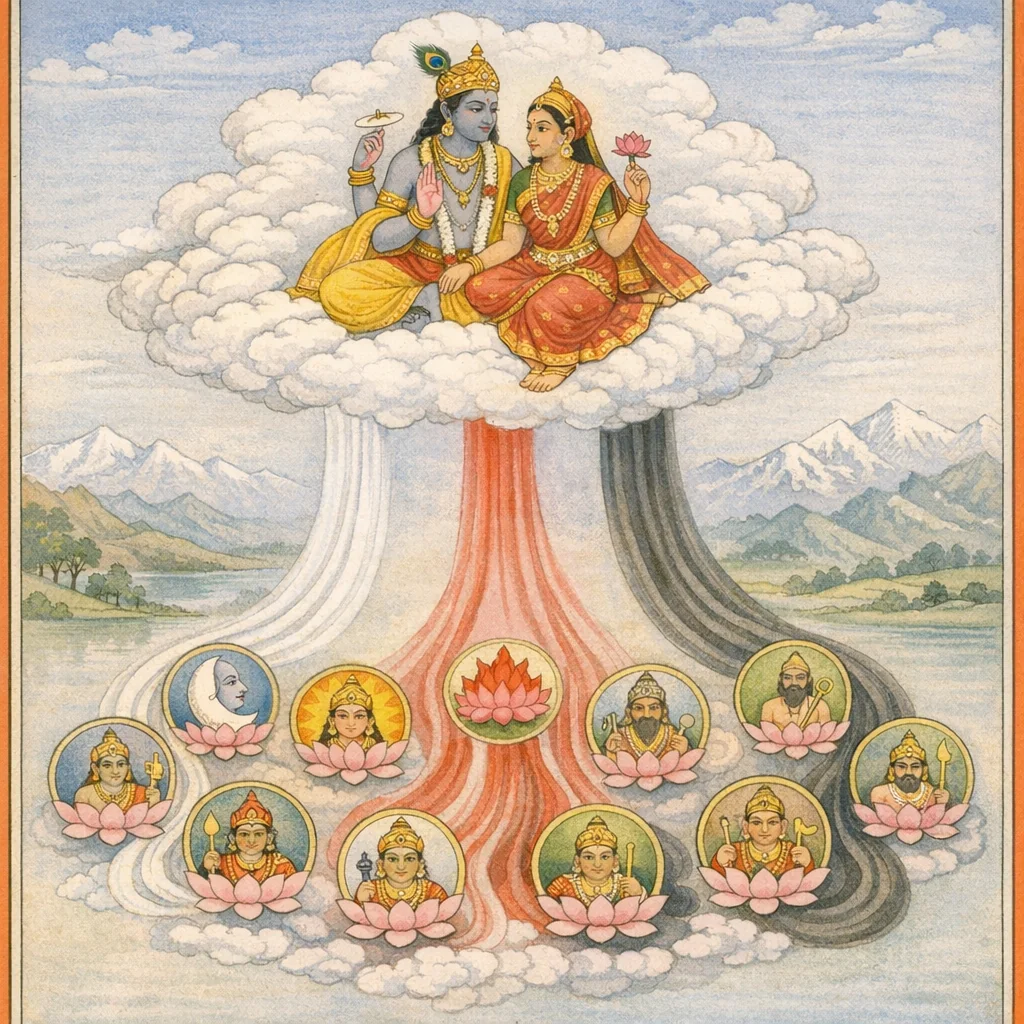
Adhyaya 5
Ahaṅkāra-Tripartition and the Rise of Indriyas, Devatās, and Cosmic Administrators
The chapter closes the previous adhyāya and continues the cosmogonic sequence: Hari, with Lakṣmī, enters and agitates the mahat-tattva, from which arises ahaṅ-tattva (ahaṅkāra), the principle of “I”-ness structured as knowledge, substance, and activity. Ahaṅkāra divides into three modes—vaikārika (sāttvika), taijasa (rājasa), and tāmasa—with Rudra described as threefold, regulating these modalities. Hari abides especially in the taijasa ahaṅkāra and stirs it to become “tenfold” as the faculties (jñānendriyas and karmendriyas), detailing their presiding deities and order of manifestation. The text then offers extensive enumerations: deities and pairs linked to mind and senses, the ten Rudras and six Ādityas, the Viśvedevas, Ṛbhus, Pitṛ-classes, Manus, and other progenitors—each as functional overseers within the tattva-system. The adhyāya concludes by reaffirming that after creating these presiding deities, Hari (with Ramā) enters the tattvas themselves, preparing for later chapters on further emanations and the operational cosmos built upon this metaphysical architecture.
Shlokas
Verse 1
नाम चतुर्थो ऽध्यायः एतादृशे महत्तत्त्वे लक्ष्म्या सह हरिः स्वयम् / प्रविवेश महाभाग क्षोभयामास वै हरिः
“(Thus ends) the fourth chapter.” Then, into that great cosmic principle (mahat-tattva), Hari Himself—together with Lakṣmī—entered, O greatly fortunate one; indeed, Hari set it into agitation, stirring it into activity.
Verse 2
अहन्तत्त्वमभूत्तस्माज्ज्ञानद्रव्यक्रियात्मकम् / अहङ्कारसमुत्पत्तावेकांशस्तमसि स्मृतः
From that arose the principle of ‘I’-ness (ahantattva), constituted of knowledge, substance, and activity. In the manifestation of ego (ahaṅkāra), one portion is traditionally said to belong to tamas (inertia/darkness).
Verse 3
तद्दशांशाधिकरजस्तद्दशांशाधिकं प्रभो / सत्त्वमित्युच्यते सद्भिर्ह्येतदात्मा त्वहं स्मृतम्
That which exceeds rajas by one-tenth, and again exceeds it by one-tenth, O Lord—this is called sattva by the wise; and this, indeed, is remembered as the Self—‘you’ and ‘I’.
Verse 4
अहन्तत्त्वाभिमानी तु आदौ शेषो बभूवह / सहस्राब्दाच्च पश्चात्तौ जातौ खगहरौ द्विज
He who presides over the principle of “I”-sense (ahaṅtattva) first became Śeṣa; and after a thousand years, O twice-born one (dvija), those two were born as Garuḍa and Hari.
Verse 5
अहन्तत्त्वे खग ह्येषु प्रविष्टो हरिरव्ययः / क्षोभयामास भगवाल्लङ्क्ष्म्या सह हरिः स्वयम्
O bird Garuḍa, the imperishable Hari entered into these principles of egoity (ahaṅkāra); and the Blessed Lord Hari Himself, together with Lakṣmī, stirred them into creative agitation.
Verse 6
वैकारिकस्तामसश्च तैजसश्चेत्यहं त्रिधा / त्रिधा बभूव रुद्रोपि यतस्तेषां नियामकः
I—the cosmic principle—became threefold as the vaikārika, the tāmasa, and the taijasa. Rudra too became threefold, for he is the regulator and controller of these three.
Verse 7
वैकारिकस्थितो रुद्रो वैकारिक इति स्मृतः / तामसे तु स्थितो रुद्रस्तामसो ह्यभिधीयते
Rudra abiding in the vaikārika state is remembered as “Vaikārika”; but Rudra abiding in the tāmasa state is indeed called “Tāmasa”.
Verse 8
तैजसे तु स्थितो रुद्रो लोके वै तैजसः स्मृतः / तैजसे तु ह्यहन्तत्त्वे लक्ष्म्या सह हरिः स्वयम्
In the taijasa state, Rudra is established; indeed, in that realm he is known as “Taijasa”. And in the taijasa principle of “I”-sense (ahaṅtattva), Hari Himself abides together with Lakṣmī.
Verse 9
विशित्वा क्षोभयामास तदासौ दशधा त्वभूत् / श्रोत्रं चक्षुः स्पर्शनं च रसनं घ्राणमेव च
Having entered into it, he stirred it; then it became tenfold—namely the faculties of hearing, sight, touch, taste, and smell (and the rest).
Verse 10
वाक्पाणिपादं पायुश्च उपस्थेति दश स्मृताः / वैकारिके ह्यहन्तत्त्वे प्रविश्य क्षोभयद्धरिः
Speech, hands, feet, the anus, and the generative organ—these are remembered as the ten (organs). Entering the vaikārika aspect of the principle of ‘I’-ness (ahaṅkāra), Hari set it into agitation, thereby initiating their functions.
Verse 11
महत्तत्त्वादिमा अदाविन्द्रियाणां च देवताः / एकादशविधा आसन्क्रमेण तु खगेश्वर
O Lord of birds (Garuda), beginning from Mahat-tattva, the presiding deities of the sense-faculties arose in the beginning, in due order, as elevenfold.
Verse 12
मनोभिमानि नी ह्यादौ वारुणी त्वभवत्तदा / अनन्तरं च सौपर्णी गौरोजापि तथैव च
At the beginning, Manobhimānī and Nī indeed became Vāruṇī at that time; thereafter, Sauparṇī and likewise Gaurojā also came into being.
Verse 13
शेषादनन्तरास्तासां दशवर्षादनंरम् / उत्पत्तिरिति विज्ञेयं क्रमेण तु खगेश्वर
After the remainder (of the previously stated period), their subsequent arising should be understood to occur after ten years—step by step, O Lord of birds (Garuda).
Verse 14
मनोभिमानिनावन्याविन्द्रकामौ प्रजज्ञतुः / तार्क्ष्य ह्यनन्तरौ ज्ञेयौ मुक्तौ संसार एव च
From Manobhimaninī, another pair—Indra and Kāma—was born. And, O Tārkṣya (Garuda), those two who arose immediately thereafter are to be known as liberated, even while abiding within worldly existence (saṃsāra).
Verse 15
ततस्त्वगात्मा ह्यभवत्सोहं कारिक ईरितः / ततः पाण्यात्मकाश्चैव जज्ञिरे पक्षिसत्तम
Then the principle of skin—an outer sense-faculty of the body—came into being; this is declared as “I am That,” O Kārikā. Thereafter, O best of birds (Garuda), the hands too were born as embodied faculties.
Verse 16
शची रतिश्चानिरुद्धस्तथा स्वायंभुवो मनुः / बृहस्पतिस्तथा दक्ष एते पाण्यात्मकाः स्मृताः
Śacī, Rati, Aniruddha, Svāyambhuva Manu, Bṛhaspati, and Dakṣa—these are remembered as belonging to the category called “Pāṇyātmaka.”
Verse 17
दक्षस्यानन्तरं जज्ञे प्रवाहो नाम चाण्डज / स एवोक्तश्चातिंवाहो यापयत्यात्मचोदितः
After Dakṣa, there was born an egg-born being named Pravāha, O egg-born one. He is also spoken of as Atiṁvāha; impelled by his own inner prompting, he carries beings onward upon their course.
Verse 18
हस्तादनन्तरं ज्ञेयो न तु शच्यादिवत्स्मृतः / ततोभवन्महाभाग चक्षुरिद्रियमात्मनः
Immediately after the hand, one should understand the next faculty to arise; it is not to be remembered as something like Śacī and the rest. Then, O greatly fortunate one, the eye—this sense-faculty (indriya)—manifests for the embodied self.
Verse 19
स्वायंभुवमनोर्भार्या शतरूपा यमस्तथा / चन्द्रसूर्यौ तु चत्त्वारश्चक्षुरिन्द्रियमानिनः
The wife of Svāyambhuva Manu is Śatarūpā; and likewise there is Yama. The Moon and the Sun, and the four guardians of the directions, are regarded as the presiding deities of the sense of sight.
Verse 20
चन्द्रः श्रोत्राभिमानीति तथा ज्ञेयः खगेश्वर / जिह्वेन्द्रियात्मा वरुणः सूर्यस्यानन्तरोभवत्
O lord of birds, know that the Moon presides over the sense of hearing. Varuṇa, as the indwelling deity of the tongue (taste), comes next after the Sun.
Verse 21
वागिन्द्रियाभिमानिन्यो ह्यभवन्वरुणादनु / दक्षपत्नी प्रसूतिश्च भृगुरग्निस्तर्थव च
Indeed, the presiding powers identified with the organ of speech arose following Varuṇa. And Dakṣa’s wife Prasūti, as well as Bhṛgu and Agni, likewise came into being.
Verse 22
तत्र वैते महात्मानो वागिन्द्रियनियामकाः / ये क्रव्यादादयश्चोक्तास्तेनन्तत्त्वनियामकाः
There, indeed, those great-souled beings are regulators of speech and the senses. Those who are spoken of as Kravyādas and the like are, for that reason, regulators of the final principles at the end (of life).
Verse 23
साम्यत्वाच्च तथैवोक्तिर्न तु तत्त्वाभिमानितः / उपस्थमानिनो वीन्द्र बभूवुस्तदनन्तरम्
Because of their similarity, the statement is made in the same way—not from any pride in knowing the true reality. Then, O lord of birds, those who were arrogant about the sexual organ arose thereafter.
Verse 24
विश्वामित्रो वसिष्टोत्रिर्मरीचिः पुलहः क्रतुः / पुलस्त्योङ्गिरसश्चैव तथा वैवस्वतो मनुः
Viśvāmitra, Vasiṣṭha, Atri, Marīci, Pulaha, Kratu, Pulastya, and Aṅgiras—together with Vaivasvata Manu—are named here.
Verse 25
मन्वादयोनन्तसंख्या उपस्थात्मान ईरिताः / पायोश्च मानिनो वीन्द्र जज्ञिरे तदनन्तरम्
“The Manus and other progenitors, countless in number, were declared to have arisen from the generative organ. Thereafter, O lord of birds (Garuda), those proud beings were born from the anus.”
Verse 26
सूर्येषु द्वादशस्वेको मित्रस्तारा गुरोः प्रिया / कोणाधिपो निरृतिश्च प्रवहप्रिया
Among the Sun’s twelve forms, one is called Mitra. Tārā is dear to Guru (Bṛhaspati). Nirṛti is lord of the inauspicious corner-direction, and Pravahā is beloved there.
Verse 27
चत्त्वार एते पक्षीन्द्र वायुतत्त्वाभिमानिनः / घ्राणाभिमानिनः सर्वे जज्ञिरे द्विजसत्तम
O king of birds, these four are identified with the principle of air; all of them preside over the sense of smell, and were born, O best of the twice-born.
Verse 28
विष्ववसेनो वायुपुत्रौ ह्यश्विनौ गणपस्तथा / वित्तपः सप्त वसव उक्तो ह्याग्निस्तथाष्टमः
Viśvavasu (the Gandharva), the two Aśvins—sons of Vāyu—Gaṇapa as well; Vittapa; and the seven Vasus are declared—Agni is spoken of as the eighth.
Verse 29
सत्यानां शृणु नामानि द्रोणः प्राणो ध्रुवस्तथा / अर्के दोषस्तथा वस्कः सप्तमस्तु विभावसुः
Listen to the names of the Satya, the truthful ones: Droṇa, Prāṇa, and likewise Dhruva; and in the solar sphere (Arka) are Doṣa and Vaska; the seventh indeed is Vibhāvasu.
Verse 30
दशरुद्रास्तथा ज्ञेया मूलरुद्रो भवः स्मृतः / दश रुद्रस्य नामानि शृणुष्व द्विजसत्तम
Know, moreover, that there are ten Rudras; and the primordial Rudra is remembered as Bhava. O best of the twice-born, listen to the ten names of Rudra.
Verse 31
रैवन्तेयस्तथा भीमो वामदेवो वृषाकपिः / अजैकपादहिर्वुध्न्यो बहुरूपो महानिति
“Raivanteya, and also Bhīma; Vāmadeva; Vṛṣākapi; Ajā‑ekapād; Ahirbudhnya; Bahurūpa; and Mahān”—thus are these names recited.
Verse 32
दश रुद्रा इति प्रोक्ताः षडादित्याञ्छृणु द्विज / उरुक्रमस्तथा शक्रो विवस्वान्वरुणस्तथा
Thus the ten Rudras have been declared. Now hear, O twice-born one, of the six Ādityas: Urukrama, Śakra, Vivasvān, and Varuṇa (among them).
Verse 33
पर्जन्योतिबाहुरेत उक्ताः पूर्वं द्विजोत्तम / पर्जन्यव्यतिरिक्तास्तु पञ्चैवोक्ता न संशयः
O best of the twice-born, the rains called Parjanya, Uti, Bāhu, and Reta were described earlier. Apart from Parjanya, there are indeed five other kinds that have been taught—of this there is no doubt.
Verse 34
गङ्गासमस्तु पर्जन्य इति चोक्तः खगेश्वर / सविता ह्यर्यमा धाता पूषा त्वष्टा तथा भगः
“May the Gaṅgā be auspicious; thus is Parjanya, the rain-god, declared,” O lord of birds. Likewise Savitṛ, Aryaman, Dhātṛ, Pūṣan, Tvaṣṭṛ, and Bhaga are invoked and acknowledged.
Verse 35
चत्वारिंशत्तथा सप्त महतः परिकीर्तिताः / द्वावुक्ताविति विज्ञेयो प्रवहोतिवहस्तथा
Thus, forty-seven of the “great” (streams or divisions) are declared; and it should be understood that two more are also spoken of—namely Pravaha and Ativaha.
Verse 36
तथा दशविधा ज्ञेया विश्वेदेवाः खगेश्वर / शृणु नामानि तेषां तु पुरूरवार्द्रवसंज्ञकौ
Likewise, O lord of birds, the Viśvedevas are to be understood as tenfold. Now listen to their names—beginning with Purūravas and Ārdrava.
Verse 37
धूरिलोचनसंज्ञौ द्वौ क्रतुदक्षेतिसंज्ञकौ / द्वौ सत्यवसुसंज्ञौ च कामकालकसंज्ञकौ
Two are named Dhūriloċana; two are called Kratu and Dakṣa; two are named Satya and Vasu; and two more are called Kāma and Kālaka.
Verse 38
एवं दशविधा ज्ञेया विश्वेदेवाः प्रकीर्तिताः / तथा ऋभुगणश्चोक्तस्तथा च पितरस्त्रयः
Thus, the Viśvedevas are to be known as tenfold, as proclaimed. Likewise the group of the Ṛbhus is mentioned, and so too the three classes of the Pitṛs (ancestors).
Verse 39
द्यावा पृथिव्यौ विज्ञेयौ एते च षडशीतयः / देवाः प्रजज्ञिरे सर्वे नासिकद्रियमानिनः
Know Heaven (Dyauḥ) and Earth (Pṛthivī), and know also these eighty-six principles (tattvas). From them all the gods were born—those who preside over and identify with the faculty of smell, the nasal sense.
Verse 40
आकाशस्याभिमानी तु गणपः सुदाहृतः / उभयत्राभि मानीति ज्ञेयं तत्त्वार्थवेदिभिः
The presiding ego-principle of space (ākāśa) is well known as Gaṇapa. Those who know the true purport of the tattvas understand that he is ‘the one who identifies’ in both ways, in both aspects.
Verse 41
विष्वक्सेनं विना सर्वे जयाद्या विष्णुपार्षदाः / अभवन्समहीनाश्च विष्वक्सेनादनन्तरम्
Without Viṣvaksena, all of Viṣṇu’s attendants—beginning with Jaya and others—were deprived of their proper station and dignity, immediately after Viṣvaksena.
Verse 42
एतेपि नासिकायाश्च अवान्तरनियामकाः / अतस्ते तत्त्वमानिभ्यो ह्यवरास्ते प्रकीर्तिताः
These too are subordinate regulators of the nose; therefore they are declared to be inferior to those regarded as the fundamental principles (tattvas).
Verse 43
स्पर्शतत्त्वाभिमानी तु अपानश्चेत्युदाहृतः / रूपाभिमानी संजज्ञे व्यानो नाम महान्प्रभो
The presiding power that identifies with the principle of touch is declared to be Apāna. And from identification with the principle of form arose the great one named Vyāna, O mighty Lord.
Verse 44
रसात्मक उदानश्च समानो गन्धनामकः / अपां नाथाश्च चत्वारो मरुतः परिकीर्तिताः
Udāna is declared to be of the nature of taste (rasa), and Samāna is known by the name “Gandha,” the sense of smell. The four Maruts, too, are proclaimed as the lords of the waters.
Verse 45
जयाद्यनन्तरान्वक्ष्ये समुत्पन्नान्खगेश्वर / प्रधानाग्रे प्रथमजः पावकः समुदाहृतः
O lord of birds, I shall now describe those that arose thereafter. At the very beginning of primordial Pradhāna, the first-born is declared to be Pāvaka—Fire.
Verse 46
भृगोर्महर्षेः पुत्रश्च च्यवनः समुदाहृतः / बृहस्पतेश्च पुत्रस्तु उतथ्यः परिकीर्तितः
Cyavana is declared to be the son of the great sage Bhṛgu; and Utathya is renowned as the son of Bṛhaspati.
Verse 47
रैवतश्चाक्षुषश्चैव तथा स्वारोचिषः स्मृतः / उत्तमो ब्रह्मसावर्णी रुद्रसावर्णिरेव च
Raivata and Cākṣuṣa are mentioned, and likewise Svārociṣa is remembered; also the Manus named Uttama, Brahma-sāvarṇi, and Rudra-sāvarṇi.
Verse 48
देवसावर्णिसावर्णिरिन्द्रसावर्णिरेवच / तथैव दक्षसावर्णिर्धर्मभावर्णिरेव च
Likewise are Devasāvarṇi and Sāvarṇi; Indrasāvarṇi as well; and in the same manner Dakṣasāvarṇi and Dharmabhāvarṇi too.
Verse 49
एकादशविधा ह्येवं मनवः परिकीर्तिताः / पितॄणां सप्तकं चैवेत्याद्याः संजज्ञिरे खग
Thus the Manus are proclaimed to be of eleven kinds; and likewise the sevenfold host of the Pitṛs, the ancestral fathers. From these primordial beings, O Bird (Garuda), the earliest lineages came into being.
Verse 50
तदनन्तरमुत्पन्नास्तेभ्यो नीचाः शृणु द्विज / वरुणस्य पत्नी गङ्गा पर्जन्याख्यो विभावसुः
After that, hear, O twice-born one, of those who were born from them as the later progeny: Gaṅgā became the wife of Varuṇa, and Vibhāvasu came to be known by the name Parjanya.
Verse 51
यमभार्या श्यामला तु ह्यनिरुद्धप्रिया विराट् / ब्रह्माण्डमानिनी सैव ह्युषानाम्ना सुशब्दिता
Yama’s wife is Śyāmalā; she is also dear to Aniruddha and is known as Virāṭ. She who takes pride in the cosmic egg (the universe) is indeed renowned by the sweet-sounding name Uṣā.
Verse 52
रोहिणी चन्द्रभार्योक्ता सूर्यभार्या तु संज्ञका / एता गङ्गादिषटूसंख्या जज्ञिरे विनतासुत
Rohiṇī is said to be the wife of the Moon (Candra), and Saṃjñā the wife of the Sun (Sūrya). These—six in number, beginning with Gaṅgā—were born, O son of Vinatā (Garuda).
Verse 53
गङ्गाद्यनन्तरं जज्ञे स्वाहा वै मन्त्रदेवता / स्वाहानामाग्निभार्योक्ता गङ्गादिभ्योधमा श्रुता
After Gaṅgā and the others was born Svāhā, the very goddess who presides over mantra-offerings. Svāhā is spoken of as the wife of Agni; and she is heard of as the most excellent among those beginning with Gaṅgā.
Verse 54
स्वाहानन्तरजो ज्ञेयो ज्ञानात्मा बुधनामकः / बुधस्तु चन्द्रपुत्रो यः स्वाहाया अधमः स्मृतः
Know that the one born immediately after Svāhā is Budha, whose very nature is knowledge. Yet Budha—known as the son of the Moon—is also remembered as the youngest, the last-born among Svāhā’s offspring.
Verse 55
उषा नाम तथा जज्ञे बुधस्यानन्तरं खग / उषानामा भिमानी तु ह्यश्विभार्या प्रकीर्तिता
O bird (Garuḍa), after Budha, one named Uṣā was born. Uṣā—also known as Bhimānī—is celebrated as the wife of the Aśvins.
Verse 56
बुधाधमा सा विज्ञेया नात्र कार्या विचारणा / ततः शनैश्चरो जज्ञे पृथिव्यात्मेति विश्रुतः
She is to be known as Budhādhamā; there is no need for further deliberation on this. Thereafter Śanaiścara (Saturn) was born, renowned as the very soul of the Earth.
Verse 57
उषाधमस्तु विज्ञेयस्ततो जज्ञेथ पुष्करः / कर्माभिमानी विज्ञेयः शनैश्चर इतीरितः
Know Uṣādhama as such; thereafter Puṣkara was born. And Śanaiścara (Saturn) is to be known as the presiding power that identifies itself with karma—thus it is declared.
Verse 58
तत्त्वाभिमानिनो देवानेवं सृष्ट्वा हरिः स्वयम् / प्रविवेश स देवेशस्तत्त्वेषु रमया सहा
Thus, having created the deities who preside over and identify with the cosmic principles (tattvas), Hari Himself—the Lord of the gods—entered into those very principles, together with Ramā (Śrī/Lakṣmī).
Frequently Asked Questions
The chapter presents the organ-faculties as a tenfold set, encompassing the five jñānendriyas (hearing, sight, touch, taste, smell) and the five karmendriyas (speech, hands, feet, anus, generative organ), with Hari ‘entering’ and activating their functional emergence.
Rudra is presented as a regulator/controller across the three guṇic modalities of ahaṅkāra. Hence he is spoken of as established in the vaikārika, tāmasa, and taijasa states, reflecting governance of different functional layers of manifestation.
These lists function as a cosmological index of ‘administrative’ powers—devatās and progenitors mapped onto tattvas and indriya-functions. The intent is not mere genealogy but a systems-level account of how cosmic operations are staffed and regulated within the created order.