Adhyaya 22
Kāraṇānvēṣaṇam: The 32 Marks of Hari, Defects (Doṣas), Death-Omens, and Hari’s Omnipresence in Social & Household Life
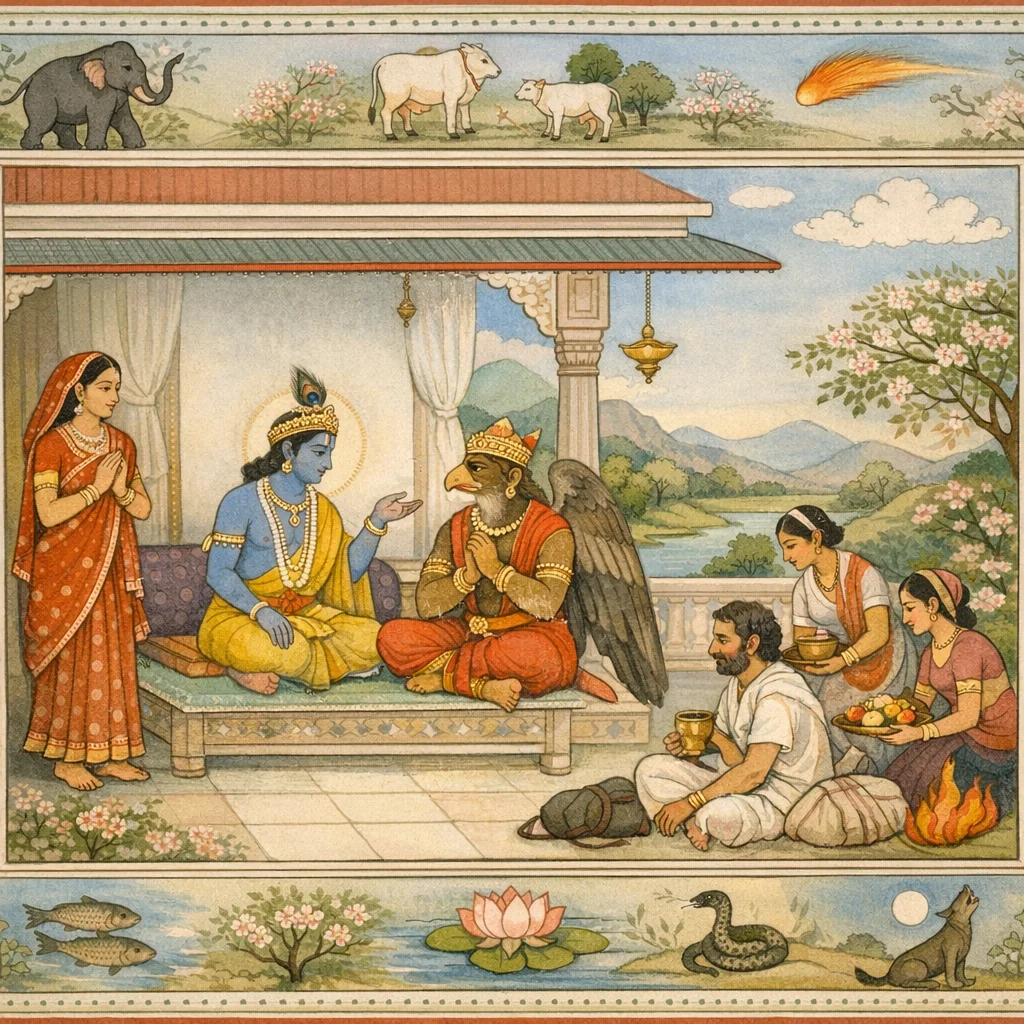
Continuing the didactic dialogue between Kṛṣṇa and Garuḍa, the chapter opens with Lakṣmaṇā/Sulakṣmaṇā as an archetype of auspicious embodiment and frames a theme of discernment: identity and destiny are inferred through qualities, dharma, and sustained inquiry. Kṛṣṇa then enumerates the thirty-two auspicious marks (lakṣaṇas) of Nārāyaṇa—reflected also in Lakṣmī—explaining that such marks are understood comparatively among devas and other classes of beings. The text expands into a graded taxonomy, assigning differing numbers of marks and corresponding defects (doṣas) to deities, cosmic forces, and social types, while warning of inauspicious signs and death-omens. A key theological correction follows: Hari’s attributes are limitless, so outward signs cannot exhaust the Divine. The discourse turns to practical dharma: offerings may become fruitless when the recipient is unknown, but always succeed when made with awareness of Hari’s omnipresence, for He abides in guests, kin, animals, and all varṇas. The chapter closes by transitioning to Kṛṣṇa’s forthcoming account of his marriages (from Lakṣmaṇā toward Jāmbavatī), linking conduct, devotion (bhakti), and narrative causality.
Shlokas
Verse 1
हेतुनिरूपणं नामैकविंशो ऽध्यायः श्रीकृष्ण उवाच / या लक्ष्मणा पूर्वसर्गे खगेन्द्र पुत्री ह्यभूद्वह्निवेदस्य वेत्तुः / सुलक्षणैः संयुतत्वाद्यतः सा सुलक्ष्मणेति प्रथिता खगेन्द्र
“The chapter called ‘Inquiry into Causes’ (the twenty-first),” said Śrī Kṛṣṇa: In a former cycle of creation, O Lord of Birds, there was a woman named Lakṣmaṇā, daughter of Garuḍa and wife of the knower of the Veda of Fire (Agni). Endowed with excellent auspicious marks, O Garuḍa, she became renowned by the name “Su-lakṣmaṇā,” the well-marked one.
Verse 2
यथा लक्ष्मीर्लक्षणैः सा सुपूर्णा यथा हरिर्लक्षणैर्वै सुपूर्णः / यथा वायुर्लक्षणैः पूर्ण एव यथा गायत्री लक्षणैः सा सुपूर्णा
Just as Lakṣmī is wholly endowed with auspicious marks, and just as Hari (Viṣṇu) is truly complete in divine attributes; just as Vāyu is complete in his defining qualities, so too Gāyatrī is perfectly complete in her marks and attributes.
Verse 3
यथा रुद्राद्या लक्षणैर्वै प्रपूर्णा रुद्रादिल्लक्ष्मणा चैव पूर्णा / गुणेनैवं धर्मतः किञ्चिदेव तथानुसंधानाद्व्रियते नाम चापि
Just as Rudra and the other deities are fully characterized by their distinctive marks, and indeed complete with the signs beginning with Rudra, so too a being is determined—at least in part—by qualities (guṇas) and by dharma; and through sustained inquiry and contemplation, even the very “name” (identity) is ascertained.
Verse 4
तस्मा दाहुर्लक्ष्मणेत्येव सर्वे तल्लक्षणं शृणु चादौ खगेन्द्र / नारायणे पूर्णगुणे रमेशे द्वात्रिंशत्संख्यानि सुलक्षणानि
Therefore all speak of them as “lakṣaṇas” (auspicious marks). O Lord of birds (Garuḍa), listen first to their characteristics: in Nārāyaṇa—complete in all virtues, the Lord of Ramā (Lakṣmī)—there are thirty-two auspicious marks in number.
Verse 5
संत्येव पक्षीन्द्र वदाम्यनु क्रमान्मत्तः श्रुत्वा मोक्षमाप्नोति नित्यम् / यः सप्तपादः षण्णवत्यङ्गुलोङ्गश्चतुर्हस्तः पुरुषस्तीक्ष्णदन्तः
They indeed exist, O lord of birds; I shall describe them in due order. Hearing this from me, one ever attains moksha. There is a fierce man—seven feet tall, with a body measuring ninety-six finger-breadths, four-armed, and sharp-toothed.
Verse 6
य एतत्सर्वं मिलितं चैकमेव हरेर्विष्णोर्लक्षणं चाहुरार्याः / मुखं स्त्रिग्धं वर्तुलं पुष्टिरूपं द्वितीयं तल्लक्षणं चाहुरार्याः
The noble ones say that when all these features are found together as a single whole, they are the distinguishing marks of Hari—Viṣṇu. They also declare that the face should be smooth and lustrous, round, and full in appearance; this is the second sign.
Verse 7
हनुर्यस्यानुन्नतं चास्ति वीन्द्र तल्लक्षणं प्राहुरार्यास्तृतीयम् / यद्दन्ता वै तीक्ष्णसूक्ष्माश्च संति तल्लक्षणं चाहुरार्याश्चतुर्थम्
O best of birds (Garuda), the noble ones declare as the third sign that the jaw is not raised. And they declare as the fourth sign that the teeth are indeed sharp and fine.
Verse 8
यस्याधरे रक्तिमा त्वस्ति वीन्द्र तल्लक्षणं पञ्चमं चाहुरार्याः / यस्य हस्ता अतिरक्ताः खगेन्द्र तल्लक्षणं प्राहुरार्याश्च पष्ठम्
O best of birds (Garuda), the noble sages declare as the fifth sign that the lower lip bears a reddish hue. And, O lord of birds, they also proclaim as the sixth sign that the hands are exceedingly red.
Verse 9
यस्मिन्नखाः संति रक्ताः सुशोभास्तल्लक्षणं सप्तमं चाहुरार्याः / यस्मिन्कपोले रक्तिमा त्वस्ति वीन्द्र तल्लक्षणं ह्यष्टमं प्राहुरार्या
The wise declare as the seventh sign that the nails are red and beautifully lustrous. And, O best of birds (Garuda), when there is a rosy redness upon the cheeks, the noble ones proclaim this as the eighth sign.
Verse 10
यस्मिन्करे शङ्खचक्रादिरेखा वर्तन्ते तन्नवमं प्राहुरार्याः / यस्यो दरं तन्तुरूपं सुपुष्टं वलित्रयैरङ्कितं सुंदरं च
The noble sages proclaim as the ninth, most excellent mark that hand upon which appear lines like the conch, the discus, and other auspicious emblems. Blessed too is one whose abdomen is well-shaped and firm like a cord, beautifully inscribed with three folds.
Verse 11
तल्लक्षणं दशमं प्राहुरार्या एकादशं निम्ननाभिं तदाहुः / ऊरुद्वयं यस्य च मांसलं वै तल्लक्षणं द्वादशं प्राहुरार्याः
The noble sages declare that to be the tenth mark; the eleventh, they say, is one whose navel is depressed. And one whose pair of thighs is truly fleshy—this the noble sages proclaim as the twelfth mark.
Verse 12
कटिर्हि दीर्घा पृथुलास्ति यस्य त्रयोदशं लक्ष्म तदाहुरार्याः / यस्यास्ति मुष्को सुपरिष्ठितो वै चतुर्दशं लक्ष्म तदाहुरार्याः
One whose waist and hips are long and broad—this, the noble ones say, is the thirteenth distinguishing mark. And one whose testicles are well-set and properly positioned—this indeed, the noble ones say, is the fourteenth mark.
Verse 13
समुन्नतं शिश्रमथो हि लक्ष्म यस्यास्ति तत् पञ्चदशं वदन्ति / सुताम्रकं पादतलं खगेन्द्र तल्लक्षणं षोडशं प्राहुरार्याः
They say the fifteenth auspicious mark is that the organ is well-raised and well-formed. And, O Lord of Birds, Garuda, the sixteenth mark spoken of by the noble ones is that the soles of the feet are gently coppery-red.
Verse 14
निम्नौ च गुल्फौ सप्तदशं तदाहुर्ग्री वारूपं प्राहुरष्टादशं च / एकोनविंशं त्वक्षिपद्मं सुरक्तं प्राहुर्बाहुं जानु विंशं तथैव
They say the seventeenth mark concerns the lower part and the ankles; the eighteenth, they declare, is the neck and one’s bearing. The nineteenth is the lotus-like eye, intensely red; and likewise they state the twentieth to be the arm and the knee.
Verse 15
विस्तीर्णोरश्चैकविंशं तदाहुः सिंहास्कन्धं द्व्युत्तरं विंशमाहुः / त्रयोविंशं सूक्ष्ममास्यं तदाहुश्चतुर्विशं सुप्रसन्ने च दृष्टी
They declare the twenty-first auspicious mark to be a broad chest; the twentieth, lion-like shoulders. The twenty-third is a refined, well-proportioned face; and the twenty-fourth is a gaze that is calm and radiant with serene clarity.
Verse 16
ह्रस्वं लिङ्गं मार्दवं चापि वीन्द्र तल्लक्षणं पञ्चविंशं वदन्ति / समौ च पादौ कटिजानु चोरू षड्विंशमाहुश्च समे च जङ्घे
O best of birds, Garuda, they declare as the twenty-fifth mark a small genital organ and a softness of the body. As the twenty-sixth mark they state that the feet are even, and likewise the hips, knees, and thighs are well-proportioned; the shanks too are uniform.
Verse 17
समानहस्तौ समकर्णौ मिलित्वा द्वात्रिंशत्कं लक्षणं प्राहुरार्याः / द्वात्रिंशत्कं लक्षणं वै मुकुन्दे द्वात्रिंशत्कं लक्षणं वै रमायाम्
When the hands are equal and the ears are symmetrical, the noble ones declare the full set of thirty-two auspicious marks. Indeed, these thirty-two marks are in Mukunda (Viṣṇu), and these same thirty-two marks are in Ramā (Lakṣmī) as well.
Verse 18
द्वात्रिंशत्कं लक्षणं ब्रह्मणोपि तद्भारत्याः प्रवदन्त्येव सत्यम् / तथा च शङ्का सममेव चक्रिणेत्येवं सदामा कुरु निर्णयं ब्रुवे
The set of thirty-two distinguishing marks is declared true—by Brahmā and by Bhāratī (Sarasvatī) as well. Yet, O Cakrin, Lord who bears the discus, doubt still remains the same; therefore, O Sadāmā, make a clear determination—I shall state it.
Verse 19
एकस्य वै लक्षणस्यापि विष्णोर्लक्ष्मीरन्तं नैव सम्यक् प्रपेदे / अतोनन्तैर्लक्षणैः संयुतं च हरिं चाहुर्लक्षणज्ञाः सदैव
Even Lakṣmī could not fully reach the limit of even a single characteristic of Viṣṇu. Therefore, the knowers of divine marks always declare Hari to be endowed with infinite attributes.
Verse 20
जानाति लक्ष्मीर्लक्षणं वायुरूपे स्वापेक्षया ह्यतिरिक्तं खगेन्द्र / स्वलक्षणापेक्षया भारती तु शतैर्गुणैरधिका वेधसोपि
O Khagendra (Garuḍa), Lakṣmī recognizes the distinguishing mark in the form of Vāyu as surpassing her own; and Bhāratī (Sarasvatī), when weighed by her defining attribute, is a hundredfold superior—even to Vedhas (Brahmā).
Verse 21
खगेन्द्र तस्माल्लक्षणे साम्यचित्तं विश्वादीनां सर्वदा मा कुरुष्व / अष्टाविंशतिं प्राहू रुद्रादिकानां भ्रूनेत्रयोर्लक्षणेनैव हीनाः
O lord of birds, therefore never assume that the Viśvas and the other groups are all alike merely from outward marks. It is said that twenty‑eight among the Rudra‑class and related beings are, by that very criterion, deficient in the distinguishing sign of the brow and the (third) eye.
Verse 22
अलक्षणं मन्यते यद्धि तस्य दुर्लक्षणं नैव तच्चिन्तनीयम् / अष्टाविंशतिं लक्षणं वै हरस्य न भारतीवच्चिन्तनीयं खगेन्द्र
O Khagendra, whatever one imagines to be a “mark” of Him is in truth markless; therefore no inferior or defective “sign” of Him should be contemplated. Rather, the twenty‑eight characteristics of Hari are to be meditated upon as a sacred object—not merely as speech or poetic talk (Bhāratī), but as holy contemplation.
Verse 23
अतो हरः क्रोधरूपी सदैव तयोरभावात्सत्यमुक्तं तथैतत् / अतो द्वयं नास्ति रुद्रे खगेन्द्र शिश्रोदरे किञ्चिदाधिक्यमस्ति
Therefore Hara (Rudra) is ever of the nature of wrath; and because those two qualities are absent in him, what has been said is indeed true. Hence, O king of birds, there is no duality in Rudra; only regarding the liṅga and the belly is there said to be a slight excess, a certain prominence.
Verse 24
सप्ताधिकैर्विशतिलक्षणैस्तु समायुताः स्वस्त्रियो लक्ष्मणाद्याः / षड्वविंशत्या लक्षणैश्चापि युक्ता वारुण्याद्या पञ्चविंशैश्च चन्द्रः
Women such as Lakṣmaṇā and others are described as endowed with more than twenty auspicious bodily marks. Vāruṇī and others are said to possess twenty‑six such marks, and the Moon, Candra, is described as having twenty‑five.
Verse 25
अर्थश्चतुर्विंशतिभिश्चैव युक्तो नासावायोर्द्व्यधिका विंशतिश्च लक्षणैश्चैकविंशत्या शची युक्ता न संशयः
Artha is endowed with twenty-four qualities; the nostrils and the vital wind (vāyu) bear twenty-two signs; and Śacī is adorned with twenty-one auspicious marks—of this there is no doubt.
Verse 26
प्रवाहा विंशकैर्युक्ता यम एकोनविंशकैः / पाश्यष्टादशभिर्युक्तो दशसप्तयुतो ऽनलः
The division called Pravāhā is associated with twenty (units). Yama is associated with nineteen. Pāśyā is associated with eighteen; and Anala is associated with seventeen.
Verse 27
वैवस्वतः षोडशभिमित्रः पञ्चदशैर्युतः / चत्रुर्विंशैस्तु धनपः पावकस्तु त्रयोदशैः
Vaivasvata (Yama) is accompanied by sixteen; Mitra is joined with fifteen. Dhanapa (Kubera) is with twenty-four, and Pāvaka (Agni) with thirteen.
Verse 28
गङ्गा द्वादशभिर्युक्ता बुध एकादशैर्युतः / शनिस्तु दशसंख्याकैः पुष्करो नवभिर्युतः
The holy Gaṅgā is associated with twelve (units); Budha (Mercury) with eleven; Śani (Saturn) with ten; and Puṣkara, the sacred tīrtha, with nine.
Verse 29
अष्टभिश्चैव संयुक्ताः सप्तभिः पितरस्तथा
Likewise, the Pitṛs—the ancestral Fathers—are said to be arranged in conjunction with eight groups and also with seven groups.
Verse 30
षड्भिश्च देवगन्धर्वाः पञ्चभिस्तदनन्तराः / चतुर्भैः क्षितिपाः प्रोक्तास्त्रिभिरन्ये च संयुताः
The Deva-Gandharvas are said to be endowed with six (qualities). Those who follow after them possess five. The earthly rulers (kṣitipās) are described as having four, and others are united with three.
Verse 31
उदरे किञ्चिदाधिक्ये ह्रस्वे पादे च कर्णयोः / शिखाधिक्यं विना विप्र भार्यायां च शिवस्य च
O brāhmaṇa, a slight fullness in the belly, shortness in the feet and in the ears—yet without any excess of the head-tuft (śikhā)—are marks spoken of in the case of a wife, and also in the case of Śiva.
Verse 32
लक्ष्मणायां पञ्च दोषाः शिरोगुल्फादिकं विना / नाभ्याधिक्ये सहैवाष्टौ दोषाः संत्यतिवाहिके
In the set of bodily marks (lakṣaṇas), there are five defects—excluding those connected with the head, ankle, and the like. But when the navel is excessive (abnormally prominent), there are, along with these, eight defects; such a condition is said to be an ‘ativāhika’ (a severe, overrunning affliction).
Verse 33
जङ्घाधिक्ये सहैवाष्टौ दोषाः शच्याः सदा स्मृताः / एवमेव हि दोषाश्चाप्यूहनीयाः खगेश्वर
O Khageśvara (lord of birds), when there is an excess (abnormal prominence) of the shanks/legs, eight defects are traditionally remembered as being indicated; in the same way, other defects too should be inferred from bodily marks.
Verse 34
दुर्लक्षणैः सदा वीन्द्र संश्रुतैस्तत्त्वविद्भवेत् / महोदरो लंबनाभिरीषामात्रोग्रदंष्ट्रकः
O best of birds, by carefully heeding these constant, ill-omened signs one becomes a knower of the truth: big-bellied, with a hanging navel, and possessed of fierce fangs—though the body is only of moderate measure.
Verse 35
अन्धकूपगभीराक्षो लंबकर्णौष्ठनासिकः / लंबगुल्फो वक्रपादः कुनखी श्यावदन्तकः
He has eyes sunk deep like a dark well; his ears, lips, and nose hang long. His ankles are elongated, his feet are crooked; his nails are misshapen, and his teeth are darkened.
Verse 36
दीर्घजङ्घो दीर्घशिश्रस्त्वेकाण्डश्चैकनासिकः / रक्तश्मश्रू रक्तरोमा वक्रास्यः संप्रकीर्तितः
He is described as having long shanks and an elongated organ; with a single testicle and only one nostril; with a red beard and reddish body-hair; and with a crooked, distorted mouth.
Verse 37
दग्धपर्व तसंकाशो रक्तपृष्ठः कलिः स्मृतः / अलोमांसो ऽलोमशिरा रक्तगण्डकपोलकः
Kali is described as one whose joints appear as if burnt, whose back is blood-red; hairless in flesh and hairless on the head, with cheeks and cheekbones stained red with blood.
Verse 38
ललाटे पाण्डुता नित्यं वामस्कन्धे करे खग / क्रूरदृष्टिर्दृष्टिपादस्तथा वै घर्घरस्वरः
If there is constant pallor on the forehead, a bird settles on the left shoulder or hand, the gaze becomes harsh, the eyes seem to fall, and the voice turns rasping—these are indeed signs.
Verse 39
अत्याशी चातिपानश्च स्तनौ शुष्कफलोपमौ / ऊरौ नवाञ्जिकारोमः तथा पृष्ठे च मस्तके
One who overeats and one who drinks to excess—such a person’s breasts become like dried fruits; and hair like fresh collyrium appears on the thighs, as well as on the back and the head.
Verse 40
ललाटे त्रीणि दीर्घे तु समे द्वौ संप्रकीर्तितौ / सर्पाकारस्तु यो मत्स्यस्तस्य शिश्रे प्रकीर्तितः
On the forehead, three marks are said to be auspicious when they are long; two are praised when they are even. And a fish-shaped mark resembling a serpent is declared to be a sign upon his male organ.
Verse 41
पादत्राणोपमो मत्स्यो रसनाग्रे प्रकीर्तितः / शिश्राकारश्च यो मत्स्यो गुदे तस्य प्रशस्यते
A fish-shaped mark resembling a sandal is said to be auspicious on the tip of the tongue; and a fish-shaped mark resembling the male organ is deemed especially commendable when found at the anus.
Verse 42
वृश्चिकाकारमत्स्यस्तु पदोस्तस्य प्रशस्यते / श्वाकारश्चापि मत्स्यो वै मुखे तस्य प्रकीर्तितः
A fish-shaped mark resembling a scorpion is praised when it appears on his feet; and a fish-shaped mark resembling a dog is said to be upon his face.
Verse 43
हस्ते तु बहुरेखाः स्युर्लोम नासापुटे स्मृतम् / अतिदीर्घं तु चाङ्गुष्ठं कनिष्ठं चातिदीर्घकम्
If there are many lines on the hand, and hair is seen in the nostrils, and if the thumb is excessively long and the little finger too is overly long—these are described as bodily marks used for judging a person’s nature and destiny.
Verse 44
दुर्लक्षणं त्वे वमादि कलावस्ति ह्यनेकशः / सुलक्षणान्यनेकानि मयि संति खगेश्वर
O lord of birds (Garuda), in you there are many parts marked by inauspicious signs—such as those on the left side and the like; yet in me also there are many auspicious marks.
Verse 45
द्वात्रिंशल्लक्षणं विष्णोर्ब्रह्माद्यापेक्षयैव तत् / सहाभिप्राय गर्भेण ब्रह्मणोक्तं तव प्रभो
The thirty-two marks of Viṣṇu are truly understood only with reference to Brahmā and the other deities. O Lord, Brahmā has proclaimed them to you, with the intended inner meaning implicitly contained therein.
Verse 46
ब्रह्मोक्तस्य मयोक्तस्य विरोधो नास्ति सत्तम / मयोक्तस्यैव स व्यासः कंबुग्रीवः प्रदर्श्यते
O best of the virtuous, there is no contradiction between what Brahmā has spoken and what I have spoken. Indeed, that Vyāsa, whose neck is like a conch, is shown to be the very one who proclaims the teaching I have given.
Verse 47
रक्ताधरं रक्त तालु चैकीकृत्य मयोदितम् / अतो विरोधो नास्त्येव तथा ज्ञानात्प्रतीयते
I spoke by combining the expressions “red lips” and “red palate” into a single statement; therefore there is truly no contradiction—so it is understood through right knowledge.
Verse 48
सप्ताधिकैर्विंशतिलक्षणैस्तु समायुता याः स्त्रियो लक्ष्मणाद्याः
Women who are endowed with twenty marks, together with seven additional signs, beginning with auspicious features, are said to possess fortunate characteristics.
Verse 49
भगे नेत्रे च हस्ते च स्तने कुक्षौ तथैव च / भारत्यपेक्षया पञ्चभिर्न्यूना त्वस्ति लक्षणैः
In the genital region, in the eyes, in the hands, in the breasts, and likewise in the belly—compared with a Bhāratī (Indian woman)—you are lacking by five bodily marks.
Verse 50
न रुद्रवन्न चान्यानि लक्षणानि खगेश्वर / षड्विंशत्या लक्षणैश्चापि युक्ता वारुण्याः षड्लक्षणैश्चैव हीना
O lord of birds, it bears neither the marks associated with Rudra nor the other auspicious signs. Though it is said to possess twenty-six characteristics, the Varuṇī type is specifically described as lacking six.
Verse 51
कर्णे कुक्षौ नासिकाकेशपाशे गुल्फे भगे किञ्चिदाधिक्यमस्ति / इन्द्रो युक्तः पञ्चविंशत्या खगेन्द्र सदा हीनो लक्षणैः सप्तसंख्यैः
In the ear, the belly, the nose, the lock of hair, the ankle, and the genital organ there is a slight excess. O Khagendra, Indra is endowed with twenty-five features, yet he is always deficient by seven marks.
Verse 52
हस्ते पादे उदरे कर्णयोश्च शिश्रे गुल्फे त्वधरोष्ठेधिकं च / चतुर्विंशत्या लक्षणैश्चापि युक्तो नास्तिक्यवायुस्तद्वदेवाष्टभिश्च
When the wind-force associated with unbelief (nāstikya-vāyu) arises, it manifests especially in the hands, feet, belly, ears, the generative organ, the ankles, and most strongly in the lower lip. It is recognized by twenty-four characteristic signs, and likewise by another set of eight additional indications.
Verse 53
नाभ्यां गुल्फे हनुरर्ङ्घ्योश्च स्कन्धे द्विजे नेत्रे त्वधरोष्ठेधिकं च / त्रयोविंशत्या लक्षणैश्चापि युक्ता शची तथा नवदोषैश्च युक्ता
From the navel, the ankles, the chin and feet, the shoulders, the teeth, the eyes, and also the lower lip—these are examined. Endowed with twenty-three auspicious marks, such a woman is said to be like Śacī; yet she may also be associated with nine blemishes (doṣas).
Verse 54
भगे केशे ह्यधरोष्ठे च कर्णे जङ्घे गण्डे वक्षसि गुल्फयोश्च / तथोत्तरोष्ठे किञ्चिदाधिक्यमस्ति एवं विजानीहि खगेन्द्रसत्तम
In the genital region, in the hair, in the lower lip, in the ear, in the shank, in the cheek, in the chest, and in the ankles—know that there is also a slight excess in the upper lip. Understand it thus, O best of the lordly birds, Garuda.
Verse 55
द्वाविंशत्या लक्षणैः संयुतस्तु दशभिर्देषैः प्रवहो नाम वायुः / तथाङ्गुष्ठे किञ्चिदाधिक्यमस्ति विंशत्येकादशभिर्देषतोर्कः
The vital wind called Pravaha is endowed with twenty-two marks and extends through ten measures (deśas). In the thumb there is a slight excess; and Arka, another vital current, extends by measure through twenty-one deśas.
Verse 56
तद्विंशत्या लक्षणैः संयुतस्तु तदा दोषेर्द्वादशभिश्च युक्तः / एकोनविंशत्या लक्षणैश्चापि युक्तस्त्रयोदशभिस्तदभावैर्युतोग्निः
Then, when one is endowed with twenty such marks, one is also associated with twelve bodily doṣas (humoral faults). Likewise, when one is endowed with nineteen marks, the digestive fire, Agni, is connected with thirteen states defined by the absence of those (faults/marks).
Verse 57
अष्टादशभिर्लक्षणैः संयुतस्तु वैवस्वतस्तदभावैश्चतुर्दशभिः / मित्रस्तु सप्तदशभिर्लक्षणैः संयुतः खग
O bird (Garuda), Vaivasvata (Yama) is endowed with eighteen distinguishing marks and is characterized by the absence of fourteen (other) marks; but Mitra is endowed with seventeen distinguishing marks.
Verse 58
सदोषैः पञ्चदशभिः संयुक्तो नात्र संशयः / तैश्च षोडशभिर्युक्तो धनपो नात्र संशयः
Endowed with fifteen doṣas—of this there is no doubt—one becomes united with them; and endowed with those sixteen, one becomes Dhanapa, a lord of wealth—of this too there is no doubt.
Verse 59
तदभावैः षोडशभिः संयुक्तः संप्रकीर्तितः / तैः पञ्चदशभिश्चैव युक्तोग्रेज्यष्ठपुत्रकः
One who is associated with those sixteen conditions of absence is declared so in the tradition; and one who is associated with fifteen of them is described as ‘Agrejya’, the elder or foremost among the eight kinds of sons (putrakas).
Verse 60
तैः सप्तदशभिर्देषैः संयुक्तो नात्र संशयः / तैश्चतुर्दशभिश्चैव गङ्गा संपरिकीर्तिता
He is joined to those seventeen sacred regions—of this there is no doubt. And joined to those fourteen as well, the Gaṅgā is expressly proclaimed and praised as being associated.
Verse 61
तथाष्टादशभिर्देषैः संयुता नात्र संशयः / तैस्त्रयोदशभिश्चैव संयुतो बुध एव तु
Likewise, it is conjoined with eighteen divisions—of this there is no doubt. And when conjoined with those thirteen, it is indeed Budha (Mercury) that is indicated.
Verse 62
दोषैरेकोनविंशत्या संयुतो नात्र संशयः / शनिर्विंशतिदोषेण युतो द्वादशलक्षणैः
He is certainly afflicted with nineteen faults—of this there is no doubt. And Śani (Saturn), endowed with twenty faults, is marked by twelve characteristic signs.
Verse 63
लक्षणैश्चैकादशभिः पुष्करः परिकीर्तितः / एकविंशतिसंख्याकैरसद्भावैः प्रकीर्तितः
Puṣkara is described as being characterized by eleven distinguishing marks; it is also said to be identified by twenty-one enumerated conditions of deficiency (inauspicious features).
Verse 64
दशभिर्लक्षणैर्युक्ताः पितरो ये चिराः खग / त्रयोविंशतिदोषैश्च संयुता नात्र संशयः
O Khaga (Garuda), those Pitṛs (ancestors) who endure for a long time are characterized by ten distinguishing marks, and they are also associated with twenty-three defects—of this there is no doubt.
Verse 65
अष्टभिर्लक्षणैर्युक्ता देवगन्धर्वसत्तमाः / दोषैश्चतुर्विंशतिभिः संयुक्ताः परिकीर्तिताः
The foremost among the Devas and the Gandharvas are said to be endowed with eight distinguishing marks, and are also described as associated with twenty‑four defects.
Verse 66
सप्तलक्षणसंयुक्ता गन्धर्वा मानुषातमकाः / यैस्तु पञ्चविंशतिभिर्देषैः संयुक्ताः प्रकीर्तिताः
The Gandharvas are said to be of human-like nature, endowed with seven distinguishing marks; and they are also described as characterized by twenty‑five specific features.
Verse 67
षद्गुणैः क्षितिपा युक्ता षड्विंशत्या च दोषतः / तदन्ये पञ्चभिर्युक्ताश्चतुर्भिः केचिदेव च
Kings are endowed with six virtues, yet they are also marked by twenty‑six faults. Other rulers possess only five (virtues), and some indeed only four.
Verse 68
त्रिभिः केच्चित्ततो हीना न संति खगसत्तम / यस्मिन्नरे क्षितिपे वा खगेन्द्र आधिक्यं यद्दृश्यते लक्षणस्य
O best of birds, some are deficient by three (marks); yet there are none entirely without them. In whatever man—whether an ordinary person or a king, O lord of birds—an excess of auspicious characteristics is seen, that indicates superiority in those signs.
Verse 69
न ते नरा नैव ते वै क्षितीशाः सर्वे नैव ह्युत्तमाः सर्वदैव / ये देवा ये च दैत्याश्च सर्वेप्येवं खगाधिप
O Lord of birds (Garuda), neither ordinary men nor even kings are always the highest; likewise, neither the gods nor the demons are eternally supreme—indeed, all of them are subject to this same truth.
Verse 70
लक्षणालक्षणैश्चैव क्रमेणोक्ता न संशयः / लक्षणैः सप्तविंशत्यालक्षणैः संयुताः खग
O Bird (Garuda), the marks and the counter-marks have been set forth in due order—there is no doubt. They are said to be endowed with twenty-seven marks, together with the corresponding non-marks.
Verse 71
अतः सलक्षणा ज्ञेया द्वात्रिंशल्लक्षणैर्न हि / पितुर्गृहे वर्धमाना सदापि स्वकुटुंबं श्रेष्ठयितुं खगेन्द्र
Therefore, O Khagendra (Garuda), a truly auspicious woman should not be judged merely by the thirty-two outward signs; even while growing up in her father’s house, she is ever inclined to uplift and ennoble her own future family.
Verse 72
उवाच सा पितरं दीयमानमन्नादिकं त्रमित्रादिकेषु / सदापि ये त्वनुसंधानेन युक्ता अन्तर्गते तत्रतत्र स्थिते च
She said to her father: “The food and other offerings that are given—among friends, relatives, and the like—reach those who are ever connected through mindful remembrance; and the recipient, though inwardly present, remains established here and there, wherever the intention places it.”
Verse 73
अज्ञातत्वे चान्नपानादिकं च दत्तं संतो व्यर्थमेवं वदन्ति / हरिं वक्ष्ये तत्रतत्र स्थितं चं तं वै शृणु त्वादरेणाद्य नित्यम्
When the recipient is unknown, even offerings of food and drink—though given by the virtuous—are said to become fruitless in this way. Therefore I shall speak of Hari, who is present there and everywhere; listen to Him with reverence, from today onward, always.
Verse 74
बालो हरिर्बालरूपेण कृष्णः क्षीरादिकं नवनीतं घृतं च / गृह्णाति नित्यं भूषणं वस्त्रजातमेवं दद्यात्सर्वदा विष्णुतुष्ट्यै
Hari—Krishna in the form of a child—ever accepts milk and milk-products, fresh butter and ghee, and also ornaments and garments. Therefore one should always offer such gifts for the satisfaction of Vishnu.
Verse 75
मित्रैर्हरिः केशवाख्यो मुकुन्दो भुङ्क्ते दत्तं त्वन्नप्रानादिकं च / पूर्वं दद्यात्सर्वदा वै गृहस्थो धन्यो भवेदन्यथा व्यर्थमेव
Hari—known as Keśava, Mukunda—partakes, through the mouths of guests and friends, of the food, water, and other life-sustaining offerings that are given. Therefore a householder should always give first; then he is truly blessed—otherwise all is in vain.
Verse 76
गृह्णाति नित्यं माधवाख्यो हरिश्चेत्येवं ज्ञात्वा देयमन्नादिकं च / एवं ज्ञात्वा दीयमानेन नित्यं प्रीणाति विष्णुर्नान्यथा व्यर्थमेव
Knowing that Hari—called Mādhava—accepts such offerings daily, one should give food and the like. When it is given regularly with this understanding, Viṣṇu is truly pleased; otherwise it becomes fruitless.
Verse 77
गृहे नित्यं वासुदेवो हरिस्तु प्रीणाति नित्यं तत्र तिष्ठन्सुपर्ण / एवं ज्ञात्वा स्वगृहं सर्वदैव अलङ्कुर्याद्धातुरूपैः सदैव
O Suparṇa (Garuda), in a home Lord Vāsudeva—Hari—ever remains present and is continually pleased there. Knowing this, one should always keep one’s house adorned at all times with forms made of metal (sacred icons/ornaments).
Verse 78
गोविन्दाख्यस्तिष्ठति वष्णवानां पुत्रैर्युतस्तिष्ठति वासुदेवः / मित्रे मुकुन्दः शालके चानिरूद्धो नारायणो द्विजवर्ये सदास्ति
Among the Vaiṣṇavas He abides as ‘Govinda’; together with His sons He abides as ‘Vāsudeva’. In a friend He is ‘Mukunda’, and in a sister’s son He is ‘Aniruddha’. In the best of the twice-born (brāhmaṇas) He ever abides as ‘Nārāyaṇa’.
Verse 79
गोष्ठे च नित्यं विष्णुरूपी हरिस्तु अश्वे सदा तिष्ठति वामनाख्यः / संकर्षणः शूद्रवर्णे सदास्ति वैश्ये प्रद्युम्नस्तिष्ठति सर्वदैव
In the cowshed, Hari abides continually in the form of Viṣṇu; in the horse, He always stands as the One known as Vāmana. Saṅkarṣaṇa is ever present among those of the Śūdra varṇa, and among the Vaiśyas Pradyumna abides at all times.
Verse 80
जनार्दनः क्षत्त्रजातौ सदास्ति दाशेषु नित्यं महिदासो हरिस्तु / मह्यां नित्यं तिष्ठति सर्वदैव ह्युपेन्द्राख्यो हरिरेकः सुपर्ण
Janārdana ever abides among the Kṣatriyas; among fishermen and boatmen Hari is always known as Mahidāsa. In the earth too He stands eternally at all times—He, the one Hari, famed as Upendra, O Suparṇa (Garuda).
Verse 81
गजे सदा तिष्ठति चक्रपाणिः सदान्तरे तिष्ठति विश्वरूपः / नित्यं शुनि तिष्ठति भूतभावनः पिपीलकायामपि सर्वदैव
In the elephant, the wielder of the discus (Viṣṇu) ever abides; within the elephant’s very being, the Universal Form is present. In the dog too, the Sustainer of all beings constantly dwells; and even in an ant, He is always there.
Verse 82
त्रिविक्रमो हरिरूप्यन्तरिक्षे सर्वजातावनन्तरूपी हरिश्च / हरेर्न वर्णोस्ति न गोत्रमस्ति न जातिरीशे सर्वरूपे विचित्रे
In the mid-region of space is Hari in the form of Trivikrama; Hari is of all beings and of endless forms. For Hari has no caste-color (varṇa), no lineage (gotra), and no fixed birth-status (jāti)—the Lord is wondrous, assuming every form.
Verse 83
एवं ज्ञात्वा सर्वदा लक्ष्मणा तु हरिं सदा प्रीणयामास देवी / सपर्यया वै क्रियमाणया हरिः पतिर्ममस्य दिति चिन्तयाना
Knowing this, the goddess Lakṣmaṇā (Lakṣmī) always delighted Hari at all times. While she continually performed worship and service, Hari—thinking, “I am her lord”—was pleased.
Verse 84
तत्याज देहं विष्णुपतित्वकामा मद्रेषु वै वीन्द्र पुत्री प्रजाता / स्वयंवरे लक्ष्मणाया अहं च भित्त्वा लक्ष्यं भूपतीन्द्रावयित्वा
Born among the Madras as the daughter of Indra, she—desiring Viṣṇu as her husband—gave up her body. And I too, at Lakṣmaṇā’s svayaṃvara, pierced the target and thereby overcame the kings of the earth.
Verse 85
पाणिग्रहं लक्ष्मणायाश्च कृत्वा गत्वा पुरीं रमयामास देवी / तथैवाहं जांबवत्या विवाहं मत्पत्नीत्वे कारणं त्वां ब्रवीमि
Having taken Lakṣmaṇā’s hand in marriage and then going to the city, the Goddess delighted that place. In the same way, I shall tell you the reason why I married Jāmbavatī and how she became My wife.
Frequently Asked Questions
The list functions as a canonical template of auspicious embodiment (for contemplation and comparison), while also demonstrating that even these marks do not exhaust Hari’s ananta-guṇas (infinite attributes).
Ariṣṭa-lakṣaṇas are inauspicious signs and death-portents (e.g., changes in voice, gaze, pallor, abnormal bodily features) used as traditional indicators of impending danger or mortality.
It states that offerings can become fruitless when the recipient is unknown, but become efficacious when given with the understanding that Hari is present everywhere and accepts through guests, friends, and household relations.
It cautions against judging an auspicious woman merely by external ‘thirty-two signs,’ emphasizing her dhārmic disposition and her tendency to elevate the future family even from her father’s home.