Adhyaya 121
Cāturmāsya Observances—Commencement, Austerities, and Fruits
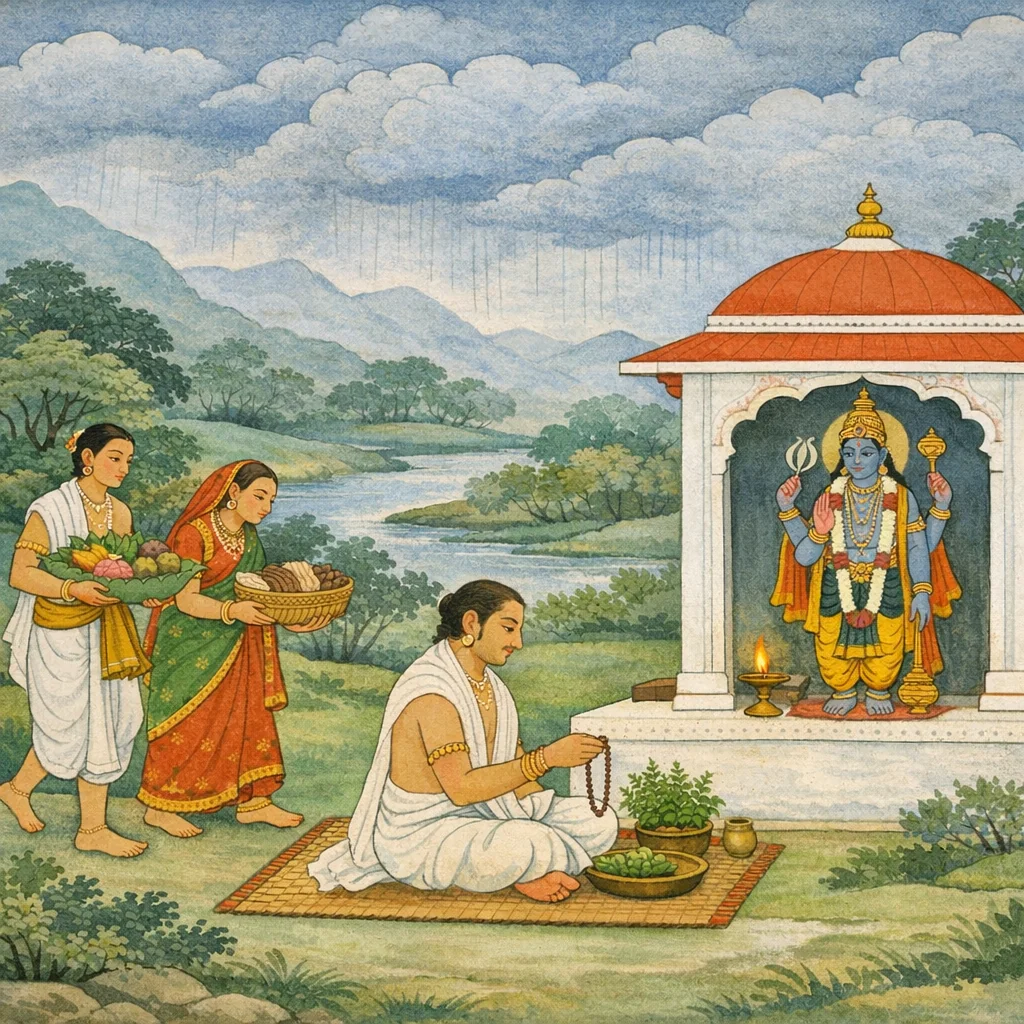
Continuing the Purāṇic stress on dharma through vrata and bhakti, Brahmā explains how to begin Cāturmāsya on an auspicious Ekādaśī connected with Āṣāḍha’s full-moon season. The votary first worships and petitions Keśava for obstacle-free success, even asking that the vow be completed by grace should death intervene. The observance is defined as an integrated discipline—bathing, ācamana, pūjā, mantra-japa, and regulated living—said to destroy sin. Austerities are graded: four months of eka-bhakta worship yields Viṣṇu-loka; abstaining from liquor, meat, intoxicants, and oil brings Viṣṇu’s favor and Kṛcchra-like merit. Fasts of one night and three nights are linked to heavenly mobility and Śvetadvīpa, while major penances (Cāndrāyaṇa, Prājāpatya, Parāka) are tied to Viṣṇu’s abode and liberation. The chapter closes with sāttvic supports—barley, dairy, pañcagavya, fruits and roots—preparing for later procedural details and month-by-month refinements of vrata practice.
Shlokas
Verse 1
नाम विंशत्युत्तरशततमो ऽध्यायः ब्रह्मोवाच / चातुर्मास्यव्रतान्यूचे एकादश्यां समाचरेत् / आषाढ्यां पौर्णमास्यां वा सर्वेणहरिमर्च्यच
Chapter 121. Brahmā said: “I shall describe the Cāturmāsya observances. One should undertake them on Ekādaśī, or on the full-moon day of Āṣāḍha, and worship Hari with complete devotion.”
Verse 2
इदं व्रतं मया देव गृहीतं पुरतस्तव / निर्विघ्नं सिद्धिमाप्नोतु प्रसन्ने त्वयि केशव
O Lord, I have undertaken this vow before You. May it attain success without obstacles, for You, O Keśava, are graciously pleased.
Verse 3
गृहीते ऽस्मिन्व्रते देव यद्यपूर्णे म्रियाम्यहम् / तन्मे भवतु सम्पूर्णं त्वत्प्रसादाज्जनार्दन
O Lord, if I should die while this vow is still unfinished, then by Your grace—O Janārdana—may it become complete for me.
Verse 4
एवमभ्यर्च्य गृह्णीयाद्व्रतार्चनजपादिकम् / सर्वाघं च क्षयं याति चिकीर्षेद्यो हरेर्व्रतम्
Having thus worshipped, one should undertake the observances—worship, repetition of mantra, and related disciplines. Whoever wishes to perform the vow of Hari thereby causes all sin to be destroyed.
Verse 5
स्नात्वायोभ्यच्य गृह्णीयाद्व्रतार्चनजपादिकम् / स्नात्वा यच्चतुरो मासानेकभक्तेन पूजयेत् / विष्णुं स याति विष्णोर्व लोकं मलविवर्जितम्
After bathing and performing ācamana, one should undertake the observances—vows, worship, and recitation. Whoever, having bathed, worships Viṣṇu for the four months with a single daily meal (eka-bhakta) attains the world of Viṣṇu, free from impurity.
Verse 6
मद्यमांससुरात्यगी वेदविद्धरिपूजनात् / तैलवर्जि विष्णुलोकं विष्णुभाक्कृच्छ्रपादकृत्
One who renounces liquor, meat, and all intoxicants, who knows the Veda and worships Hari, and who abstains from oil, attains Viṣṇu’s world; becoming a recipient of Viṣṇu’s grace, he gains the fruit of the Kṛcchra penance.
Verse 7
एकरात्रोपवासाच्च देवो वैमानिको भवेत् / श्वेतद्वीपं त्रिरात्रात्तु व्रजेत्षष्ठान्नकृन्नरः
By fasting for a single night, one becomes a celestial being who moves in a heavenly aerial car. But the person who observes a three-night fast—taking food only at the proper sixth time—goes to Śvetadvīpa.
Verse 8
चान्द्रायणाद्धरेर्धाम लभेन्मुक्तिमयाचिताम् / प्राजापत्यं विष्णुलोकं पराकव्रतकृद्धरिम्
By performing the Cāndrāyaṇa observance one attains Hari’s abode and an unasked-for liberation; by the Prājāpatya rite one reaches Viṣṇu’s world; and one who undertakes the Parāka vow attains Hari.
Verse 9
सक्तुयावकभिक्षाशी पयोदधिघृताशनः / गोमूत्रयावकाहारः पञ्चगव्यकृताशनः / शाकमलफलाद्याशी रसवर्जो च विष्णुभाक्
Living on alms of barley and parched flour, eating only milk, curd, and ghee; taking barley mixed with cow’s urine as food; subsisting on preparations of the five products of the cow; eating vegetables, roots, and fruits, and abstaining from rich tastes—such a person becomes a recipient of Lord Viṣṇu’s grace.
Frequently Asked Questions
Eka-bhakta (taking a single daily meal) is presented as a sustained four-month discipline paired with Viṣṇu worship; its stated fruit is reaching Viṣṇu’s world, described as free from impurity—indicating purification through regulated consumption and devotion.
The chapter links these abstentions to Viṣṇu’s grace and equates the merit to the Kṛcchra penance, implying that renunciation of tamasic/rajasik indulgences functions as tapas that purifies karma and aligns the practitioner with sattva, making them fit for Viṣṇu-loka.
A one-night fast is said to yield celestial status and heavenly travel; a three-night fast leads to Śvetadvīpa. Cāndrāyaṇa is associated with Hari’s abode and an ‘unasked-for’ liberation, Prājāpatya with Viṣṇu’s world, and Parāka with attaining Hari.