Adhyaya 119
Agastya Arghya Vrata—Timing, Mantra, and Dāna फल
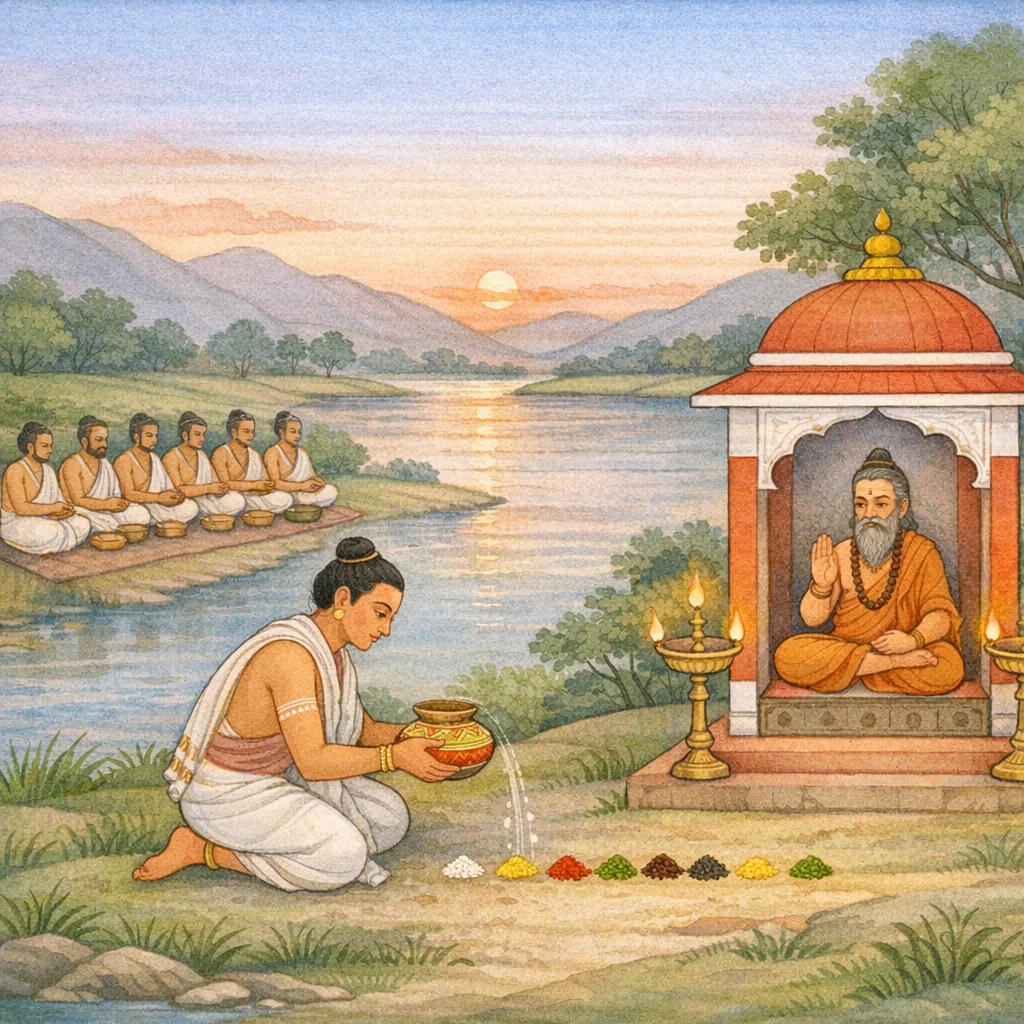
Continuing the ācāra-centered sequence of vows and ritual rules, Brahmā teaches a specific observance for Sage Agastya that grants both worldly enjoyment and liberation. It must be performed before sunrise within an auspicious three-day period, following a disciplined course: worship of the sacred image, offering arghya to Agastya, and keeping vigil at pradoṣa. The offerings are detailed—curd, akṣata, fruits, flowers—ending with a five-coloured ornamented gift together with gold and silver. The central arghya is done with the mantra beginning “Agastyaḥ khanamāna…”, using a vessel holding seven grains, anointed with curd and sandalpaste, and supported by a hymn praising Agastya’s Kumbha-yoni birth and Mitra–Varuṇa lineage. The chapter concludes by allowing Śūdra and women to participate through renunciatory giving, while requiring formal dāna to a brāhmaṇa (water-pot with gold and honorarium) and feeding seven brāhmaṇas; practiced for a year, it is said to yield the full merit and sets the pattern for later vrata sections that unite mantra, timing, and charity into a complete sādhanā.
Shlokas
Verse 1
शततमो ऽध्यायः ब्रह्मोवाच / अगस्त्यार्घ्यव्रतं वक्ष्ये भुक्तिमुक्तिप्रदायकम् / अप्राप्ते भास्करे कन्यां सति भागे त्रिभिर्दिनैः
Brahmā said: “I shall explain the Agastya arghya-vrata, which bestows both worldly enjoyment and liberation. When the Sun has not yet risen, and when three days remain within the proper period, one should (perform it) with a maiden (kanyā)….”
Verse 2
अर्घ्यं दद्यादगस्त्याय मूर्तिं संपूज्य वै मुने ! / काशपुष्पमयीं कुम्भे प्रदोषे कृतजागरः
O sage, after duly worshipping the sacred image (mūrti), one should offer arghya—the reverent water-offering—to Agastya. At pradoṣa, the twilight hour, having kept vigil, one should place in a kumbha (pot) an offering made of kāśa-flowers.
Verse 3
दध्यक्षताद्यैः संपूज्य उपोष्य फलपुष्पकैः / पञ्चवर्णसमायुक्तं हेमरौप्यसमन्वितम्
Having worshipped fully with curd, unbroken rice (akṣata), and the like—observing a fast (upavāsa)—and offering fruits and flowers, one should present an item adorned with five colours and furnished with gold and silver.
Verse 4
सप्तधान्ययुतं पात्रं दधिचन्दनचर्चितम् / अगस्त्यः खनमानेति मन्त्रेणार्घ्यं प्रिदापयेत्
One should offer the arghya (ritual water-offering) with the mantra beginning “Agastyaḥ khanamāna…”, using a vessel filled with seven kinds of grains and anointed with curd and sandalpaste.
Verse 5
खासपुष्पप्रतीकाश अग्निमारुतसम्भव ! / मित्रावारुणयोः पुत्त्रो कुम्भयोने नमो ऽस्तु ते
O radiant one, shining like the khāsa-flower, born of fire and wind—son of Mitra and Varuṇa, O you whose womb was a jar (Kumbha-yoni), may my salutations be to you.
Verse 6
शूद्रस्त्र्यादिरनेनैव त्यजेद्धान्यं फलं रसम् / दद्याद्द्विजातये कुम्भं सहिरण्यं सदक्षिणम् / भोजयेच्च द्विजान्सप्त वर्षं कृत्वा तु सर्वभाक्
By this very observance, a Śūdra, a woman, and others should renounce (offer up) grain, fruit, and juices; one should give to a twice-born (brāhmaṇa) a water-pot (kumbha) along with gold and a proper dakṣiṇā (honorarium). And one should feed seven brāhmaṇas; having performed this for a year, one becomes entitled to all its religious merit.
Frequently Asked Questions
Within Purāṇic vrata symbolism, grains represent sustenance, prosperity, and the maintenance of life; specifying sapta-dhānya sacralizes abundance and completeness, making the arghya both a devotional offering and a ritualized pledge to uphold dharma through nourishment and charity.
Fasting disciplines desire and concentrates devotion (upavāsa as tapas), while dāna and feeding brāhmaṇas externalize merit through ethical redistribution; together, they are presented as purifying karma (reducing attachment and selfishness) and generating puṇya that supports both worldly stability and liberation-oriented spiritual refinement.