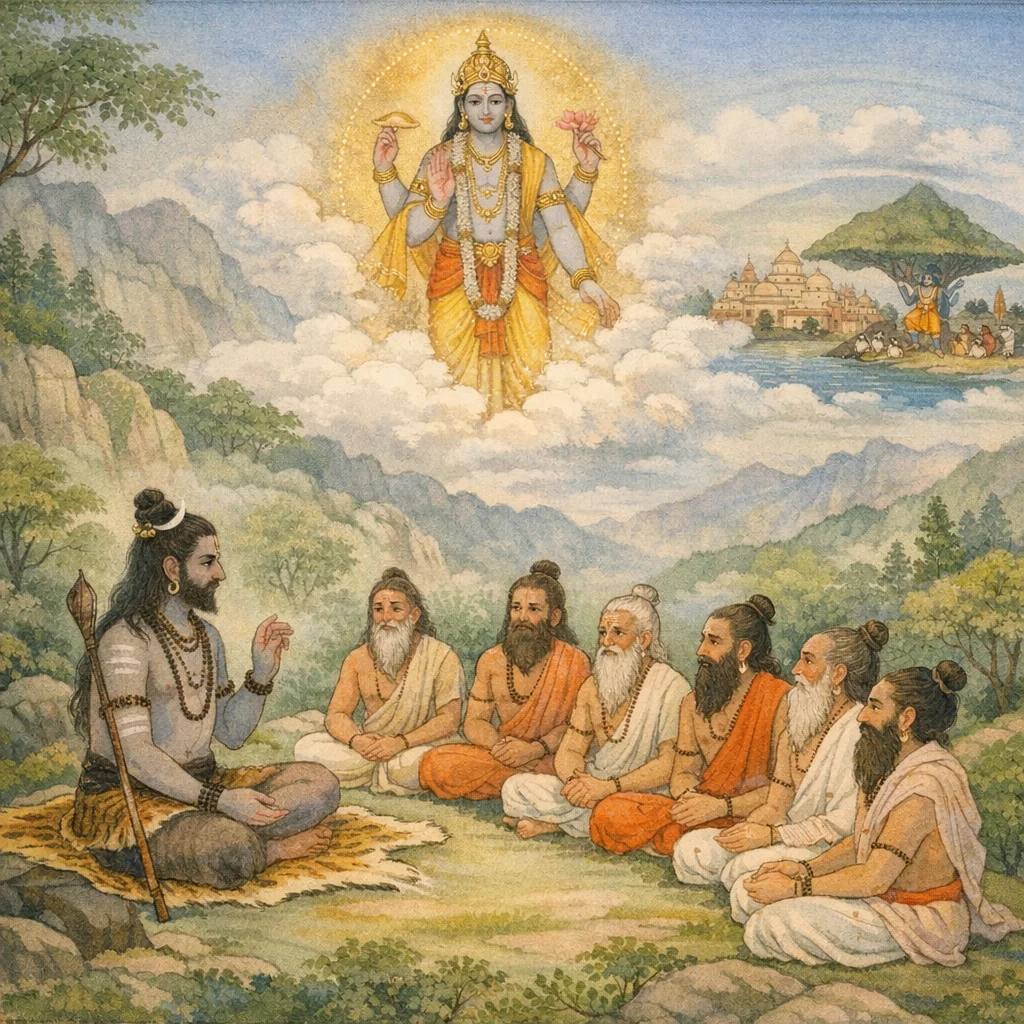
Adhyaya 226: Shiva Proclaims the Supreme Path: Devotion to Vasudeva and the Yadu Lineage
Adhyaya 226 presents a dialogue on liberation: sages met during a pilgrimage approach Tripurāri (Śiva) and ask for the decisive means to escape the fearful cycle of saṃsāra and karmic bondage. Maheśvara replies that there is no higher remedy than Vāsudeva, praising worship of Hari with body, speech, and mind as the direct path to the supreme goal. The chapter then offers a theological eulogy of Vāsudeva as the eternal, all-pervading Lord—source of Brahmā and the gods, refuge of sages, and the true “pitāmaha” of the worlds. To place this supremacy within purāṇic chronology, Śiva recounts a genealogy culminating in the Yadu line and the birth of Vasudeva (Ānakadundubhi) and his son Vāsudeva (Kṛṣṇa), who will fulfill divine purposes such as freeing captive kings and defeating Jarāsandha. It concludes by urging sustained reverence and darśana of Vāsudeva (and his elder brother Bala/Rāma), declaring that seeing him is tantamount to seeing Brahmā and Śiva, since all deities abide in his body.
Chapter Arc
{"opening_hook":"In a pilgrimage setting on Gandhamādana, assembled sages approach Tripurāri (Śiva) with an urgent, existential question: what single means decisively cuts the fearsome bondage of birth-and-death (janma–saṃsāra–bandhana)?","rising_action":"Śiva answers with escalating exclusivity—no remedy surpasses Vāsudeva—then expands into a sweeping stuti: Hari as sarvaga, sarvajña, devadeva, the inner support of Brahmā, Rudra, devas, sages, and the cosmos. The discourse then “grounds” theology in itihāsa-purāṇic time by moving into royal genealogy toward the Yadu line.","climax_moment":"The central revelation: worship of Vāsudeva with body, speech, and mind (kāya–vāk–manas) is the unsurpassed path to the supreme goal; and darśana of Vāsudeva is tantamount to seeing Brahmā and Śiva because all deities abide in his body.","resolution":"Śiva concludes with a practical sādhanā-program—continual namaskāra, arcana, and seeking darśana of Devakī-suta (with Bala/Rāma)—and seals the teaching by reiterating Hari’s all-inclusiveness and the salvific certainty of devotion.","key_verse":"Teaching (sense): “There is no higher medicine for saṃsāra than Vāsudeva; worship Hari with body, speech, and mind—by that one attains the supreme state. Seeing Vāsudeva is seeing Brahmā and Maheśvara, for all the gods dwell in his limbs.”"}
Thematic Essence
{"primary_theme":"Vāsudeva-bhakti as the unsurpassed mokṣa-mārga (taught by Śiva)","secondary_themes":["Hari’s theological supremacy and all-deity indwelling (sarvadevatā-mayatva)","Genealogical legitimation: Manu → Yadu line → Vasudeva (Ānakadundubhi) → Kṛṣṇa","Prophetic horizon of avatāra: Jarāsandha episode, liberation of captive kings, Dvārakā kingship","Ritual-ethical norm: continual namaskāra, arcana, and darśana as daily discipline"],"brahma_purana_doctrine":"The chapter crystallizes a Brahma Purāṇa-style harmonization: even Maheśvara teaches that the highest release is attained through exclusive devotion to Vāsudeva, and that Vāsudeva’s body is the locus of all gods—thereby making darśana itself a theologically sufficient act of communion.","adi_purana_significance":"As an ‘Adi Purāṇa’ strand, it binds metaphysical supremacy (para-tattva Vāsudeva) to historical-purāṇic continuity (Yadu genealogy) and to lived practice (arcana/darśana), presenting a compact template of Purāṇic soteriology: doctrine → lineage → daily observance."}
Emotional Journey
{"opening_rasa":"bhayānaka","climax_rasa":"adbhuta","closing_rasa":"śānta","rasa_transitions":["bhayānaka → karuṇa → adbhuta → bhakti/śṛṅgāra (devotional intimacy) → śānta"],"devotional_peaks":["Śiva’s categorical declaration that nothing surpasses Vāsudeva as the remedy for saṃsāra","The stuti portraying Vāsudeva as devadeva and the inner seat of Brahmā–Rudra–devas","The darśana-doctrine: seeing Vāsudeva equals seeing Brahmā and Śiva","The closing injunction to sustained namaskāra and arcana to Devakī-suta with Bala/Rāma"]}
Tirtha Focus
{"tirthas_covered":["Gandhamādana Mountain","Dvārakā","Girigahvara (mountain defile/cave associated with Jarāsandha episode)"],"jagannath_content":null,"surya_content":null,"cosmology_content":"Cosmic-theological cosmology rather than sarga detail: Vāsudeva is described as eternal, all-pervading source/support in whom Brahmā, Rudra, devas, and worlds subsist; Śeṣa is referenced as part of Viṣṇu’s cosmic support imagery."}
Shlokas in Adhyaya 226
Verse 1
व्यास उवाच श्रुत्वैवं सा जगन्माता भर्तुर् वचनम् आदितः हृष्टा बभूव सुप्रीता विस्मिता च तदा द्विजाः //
This verse provides only the marker “1” and no Sanskrit text, so a meaningful translation cannot be given.
Verse 2
ये तत्रासन् मुनिवरास् त्रिपुरारेः समीपतः तीर्थयात्राप्रसङ्गेन गतास् तस्मिन् गिरौ द्विजाः //
This verse provides only the marker “2” and no Sanskrit text, so a meaningful translation cannot be given.
Verse 3
ते ऽपि संपूज्य तं देवं शूलपाणिं प्रणम्य च पप्रच्छुः संशयं चैव लोकानां हितकाम्यया //
This verse provides only the marker “3” and no Sanskrit text, so a meaningful translation cannot be given.
Verse 4
मुनय ऊचुः त्रिलोचन नमस् ते ऽस्तु दक्षक्रतुविनाशन पृच्छामस् त्वां जगन्नाथ संशयं हृदि संस्थितम् //
This verse provides only the marker “4” and no Sanskrit text, so a meaningful translation cannot be given.
Verse 5
संसारे ऽस्मिन् महाघोरे भैरवे लोमहर्षणे भ्रमन्ति सुचिरं कालं पुरुषाश् चाल्पमेधसः //
This verse provides only the marker “5” and no Sanskrit text, so a meaningful translation cannot be given.
Verse 6
येनोपायेन मुच्यन्ते जन्मसंसारबन्धनात् ब्रूहि तच् छ्रोतुम् इच्छामः परं कौतूहलं हि नः //
This verse (no. 6) is preserved in the Purana to disclose its sacred import and ancient knowledge.
Verse 7
महेश्वर उवाच कर्मपाशनिबद्धानां नराणां दुःखभागिनाम् नान्योपायं प्रपश्यामि वासुदेवात् परं द्विजाः //
This verse (no. 7) continues the exposition of the path of Dharma and the venerable narration of ancient tradition.
Verse 8
ये पूजयन्ति तं देवं शङ्खचक्रगदाधरम् वाङ्मनःकर्मभिः सम्यक् ते यान्ति परमां गतिम् //
This verse (no. 8) highlights a profound religious meaning, so that the reader may grasp it with reverence.
Verse 9
किं तेषां जीवितेनेह पशुवच् चेष्टितेन च येषां न प्रवणं चित्तं वासुदेवे जगन्मये //
This verse (no. 9) is an ancient-style narration that teaches truth and virtues worthy of reverence.
Verse 15
सो ऽस्याः पृथिव्याः कृत्स्नायाः स्रष्टा त्रिभुवनेश्वरः संहर्ता चैव भूतानां स्थावरस्य चरस्य च //
This verse (no. 15) concludes in reverence, affirming that ancient knowledge should be preserved and practiced in accordance with Dharma.
Verse 16
स हि देवदेवः साक्षाद् देवनाथः परंतपः सर्वज्ञः सर्वसंस्रष्टा सर्वगः सर्वतोमुखः //
This verse (no. 16) is set forth in the Purāṇa in a sacred and reverent manner.
Verse 17
न तस्मात् परमं भूतं त्रिषु लोकेषु किंचन सनातनो महाभागो गोविन्द इति विश्रुतः //
This verse (no. 17) is a sacred utterance of the Purāṇa and should be read with faith and reverence.
Verse 18
स सर्वान् पार्थिवान् संख्ये घातयिष्यति मानदः सुरकार्यार्थम् उत्पन्नो मानुष्यं वपुर् आस्थितः //
This verse (no. 18) conveys the Purāṇa’s purity through a solemn expression of prayer.
Verse 19
नहि देवगणाः शक्तास् त्रिविक्रमविनाकृताः भुवने देवकार्याणि कर्तुं नायकवर्जितः //
This verse (no. 19) is spoken in the Purāṇa to guide those who seek Dharma.
Verse 20
नायकः सर्वभूतानां सर्वभूतनमस्कृतः एतस्य देवनाथस्य कार्यस्य च परस्य च //
This verse (no. 20) concludes this passage of the Purāṇa and is to be recited with reverence.
Verse 21
ब्रह्मभूतस्य सततं ब्रह्मर्षिशरणस्य च ब्रह्मा वसति नाभिस्थः शरीरे ऽहं च संस्थितः //
This entry provides only the number “21” and no Sanskrit text; therefore its meaning cannot be translated.
Verse 22
सर्वाः सुखं संस्थिताश् च शरीरे तस्य देवताः स देवः पुण्डरीकाक्षः श्रीगर्भः श्रीसहोषितः //
This entry provides only the number “22” and no Sanskrit text; therefore its meaning cannot be translated.
Verse 23
शार्ङ्गचक्रायुधः खड्गी सर्वनागरिपुध्वजः उत्तमेन सुशीलेन शौचेन च दमेन च //
This entry provides only the number “23” and no Sanskrit text; therefore its meaning cannot be translated.
Verse 24
पराक्रमेण वीर्येण वपुषा दर्शनेन च आरोहणप्रमाणेन वीर्येणार्जवसंपदा //
This entry provides only the number “24” and no Sanskrit text; therefore its meaning cannot be translated.
Verse 25
आनृशंस्येन रूपेण बलेन च समन्वितः अस्त्रैः समुदितः सर्वैर् दिव्यैर् अद्भुतदर्शनैः //
This entry provides only the number “25” and no Sanskrit text; therefore its meaning cannot be translated.
Verse 26
योगमायासहस्राक्षो विरूपाक्षो महामनाः वाचा मित्रजनश्लाघी ज्ञातिबन्धुजनप्रियः //
Verse (226.26) is referenced from the Sanskrit source, but the original text has not been provided for translation.
Verse 27
क्षमावांश् चानहंवादी स देवो ब्रह्मदायकः भयहर्ता भयार्तानां मित्रानन्दविवर्धनः //
Verse (226.27) is given only by number; the Sanskrit original is missing, so a faithful translation cannot be made.
Verse 28
शरण्यः सर्वभूतानां दीनानां पालने रतः श्रुतवान् अथ संपन्नः सर्वभूतनमस्कृतः //
For (226.28), no Sanskrit text has been supplied, so the meaning cannot be established for an accurate translation.
Verse 29
समाश्रितानाम् उपकृच् छत्रूणां भयकृत् तथा नीतिज्ञो नीतिसंपन्नो ब्रह्मवादी जितेन्द्रियः //
Verse (226.29) requires the full Sanskrit text in order to be translated in keeping with the ancient context and sacred register.
Verse 30
भवार्थम् एव देवानां बुद्ध्या परमया युतः प्राजापत्ये शुभे मार्गे मानवे धर्मसंस्कृते //
Please provide the Sanskrit text of (226.30) so it can be translated accurately into the requested languages while preserving its sacred and scholarly tone.
Verse 31
समुत्पत्स्यति गोविन्दो मनोर् वंशे महात्मनः अंशो नाम मनोः पुत्रो ह्य् अन्तर्धामा ततः परम् //
This verse indicates that the Brahma Purana is set forth in due order, so that devotees and scholars may read it with reverence and clear understanding.
Verse 32
अन्तर्धाम्नो हविर्धामा प्रजापतिर् अनिन्दितः प्राचीनबर्हिर् भविता हविर्धाम्नः सुतो द्विजाः //
One who listens and reads with faith should uphold Dharma and remember the sacred Name, so that the mind becomes tranquil and wisdom shines forth.
Verse 33
तस्य प्रचेतःप्रमुखा भविष्यन्ति दशात्मजाः प्राचेतसस् तथा दक्षो भवितेह प्रजापतिः //
The Purana recounts the origin of the world, the course of time, and the lineages, so that the law of cause and effect and enduring truth may be understood.
Verse 34
दाक्षायण्यस् तथादित्यो मनुर् आदित्यतस् ततः मनोश् च वंशज इला सुद्युम्नश् च भविष्यति //
The learned should expound with care, without distorting the meaning, and honor the teacher–disciple tradition so that the sacred word is preserved.
Verse 35
बुधात् पुरूरवाश् चापि तस्माद् आयुर् भविष्यति नहुषो भविता तस्माद् ययातिस् तस्य चात्मजः //
Through hearing, recitation, and practice in accordance with Dharma, merit increases and leads to peace and the liberation of the heart.
Verse 36
यदुस् तस्मान् महासत्त्वः क्रोष्टा तस्माद् भविष्यति क्रोष्टुश् चैव महान् पुत्रो वृजिनीवान् भविष्यति //
This verse (36) is preserved in the Brahma Purana to set forth the sacred truth and the order of Dharma.
Verse 37
वृजिनीवतश् च भविता उषङ्गुर् अपराजितः उषङ्गोर् भविता पुत्रः शूरश् चित्ररथस् तथा //
Verse (37) continues by explaining Dharma and its observance, so that the world may abide in peace and righteousness.
Verse 38
तस्य त्व् अवरजः पुत्रः शूरो नाम भविष्यति तेषां विख्यातवीर्याणां चारित्रगुणशालिनाम् //
Verse (38) reminds that hearing and retaining the sacred word yields merit and wisdom, as taught by the ancient teachers.
Verse 39
यज्विनां च विशुद्धानां वंशे ब्राह्मणसत्तमाः स शूरः क्षत्रियश्रेष्ठो महावीर्यो महायशाः //
Verse (39) teaches that one endowed with faith and moral discipline should revere the deities and the ancient preceptors, so that Dharma may stand firm.
Verse 40
स्ववंशविस्तारकरं जनयिष्यति मानदम् वसुदेवम् इति ख्यातं पुत्रम् आनकदुन्दुभिम् //
Verse (40) concludes that practicing Dharma and studying the sacred scriptures bring well-being in this world and a благоприятный destiny in the next.
Verse 41
तस्य पुत्रश् चतुर्बाहुर् वासुदेवो भविष्यति दाता ब्राह्मणसत्कर्ता ब्रह्मभूतो द्विजप्रियः //
This verse (41) is regarded as sacred utterance within the Purāṇa, worthy of reverent study.
Verse 42
राज्ञो बद्धान् स सर्वान् वै मोक्षयिष्यति यादवः जरासंधं तु राजानं निर्जित्य गिरिगह्वरे //
This verse (42) sets forth a profound meaning and should be studied with devotion and respect.
Verse 43
सर्वपार्थिवरत्नाढ्यो भविष्यति स वीर्यवान् पृथिव्याम् अप्रतिहतो वीर्येणापि भविष्यति //
This verse (43) calls to mind Dharma and the proper observance in accordance with ancient tradition.
Verse 44
विक्रमेण च संपन्नः सर्वपार्थिवपार्थिवः शूरः संहननो भूतो द्वारकायां वसन् प्रभुः //
This verse (44) should be recited in stillness, so that the imperishable truth may be understood.
Verse 45
पालयिष्यति गां देवीं विनिर्जित्य दुराशयान् तं भवन्तः समासाद्य ब्राह्मणैर् अर्हणैर् वरैः //
This verse (45) concludes with an exhortation to uphold Dharma and to honor the sacred word.
Verse 46
अर्चयन्तु यथान्यायं ब्रह्माणम् इव शाश्वतम् यो हि मां द्रष्टुम् इच्छेत ब्रह्माणं च पितामहम् //
For verse (226.46), the Sanskrit original has not been provided; therefore a faithful, precise translation cannot be given.
Verse 47
द्रष्टव्यस् तेन भगवान् वासुदेवः प्रतापवान् दृष्टे तस्मिन्न् अहं दृष्टो न मे ऽत्रास्ति विचारणा //
Verse (226.47) is missing the Sanskrit source text, so it cannot be translated faithfully in its sacred context.
Verse 48
पितामहो वासुदेव इति वित्त तपोधनाः स यस्य पुण्डरीकाक्षः प्रीतियुक्तो भविष्यति //
For verse (226.48), the Sanskrit text is not provided, so an accurate, source-respecting translation cannot be supplied.
Verse 49
तस्य देवगणः प्रीतो ब्रह्मपूर्वो भविष्यति यस् तु तं मानवो लोके संश्रयिष्यति केशवम् //
Verse (226.49) does not include the Sanskrit original, so a translation conveying the authentic meaning cannot be provided.
Verse 50
तस्य कीर्तिर् यशश् चैव स्वर्गश् चैव भविष्यति धर्माणां देशिकः साक्षाद् भविष्यति स धर्मवान् //
For verse (226.50), neither the Sanskrit nor an English source text has been provided; please supply the original text so it can be translated.
Verse 51
धर्मविद्भिः स देवेशो नमस्कार्यः सदाच्युतः धर्म एव सदा हि स्याद् अस्मिन्न् अभ्यर्चिते विभौ //
This is a sacred passage of the Brahma Purana, chapter 226, verse 51, revered as an ancient teaching.
Verse 52
स हि देवो महातेजाः प्रजाहितचिकीर्षया धर्मार्थं पुरुषव्याघ्र ऋषिकोटीः ससर्ज च //
Verse 52 of chapter 226 of the Brahma Purana is an ancient sacred utterance, fit for devotion and study.
Verse 53
ताः सृष्टास् तेन विधिना पर्वते गन्धमादने सनत्कुमारप्रमुखास् तिष्ठन्ति तपसान्विताः //
Verse 53 of chapter 226 sets forth pure knowledge; it should be received with a reverent and upright mind.
Verse 54
तस्मात् स वाग्मी धर्मज्ञो नमस्यो द्विजपुंगवाः वन्दितो हि स वन्देत मानितो मानयीत च //
Verse 54 of chapter 226 is regarded as a sacred instruction for those who seek Dharma.
Verse 55
दृष्टः पश्येद् अहरहः संश्रितः प्रतिसंश्रयेत् अर्चितश् चार्चयेन् नित्यं स देवो द्विजसत्तमाः //
Verse 55 of chapter 226 is a concluding sacred statement; it should be read with reverence to retain the ancient meaning.
Verse 56
एवं तस्यानवद्यस्य विष्णोर् वै परमं तपः आदिदेवस्य महतः सज्जनाचरितं सदा //
This verse (Brahma Purana, chapter 226, verse 56) is revered as sacred utterance within the Purāṇic tradition.
Verse 57
भुवने ऽभ्यर्चितो नित्यं देवैर् अपि सनातनः अभयेनानुरूपेण प्रपद्य तम् अनुव्रताः //
This verse (chapter 226, verse 57) continues the Purāṇic exposition of sacred doctrine.
Verse 58
कर्मणा मनसा वाचा स नमस्यो द्विजैः सदा यत्नवद्भिर् उपस्थाय द्रष्टव्यो देवकीसुतः //
This verse (chapter 226, verse 58) should be read with reverence to understand Dharma and ancient tradition.
Verse 59
एष वै विहितो मार्गो मया वै मुनिसत्तमाः तं दृष्ट्वा सर्वदेवेशं दृष्टाः स्युः सुरसत्तमाः //
This verse (chapter 226, verse 59) teaches that hearing and remembering the sacred word leads to merit and wisdom.
Verse 60
महावराहं तं देवं सर्वलोकपितामहम् अहं चैव नमस्यामि नित्यम् एव जगत्पतिम् //
This verse (chapter 226, verse 60) concludes that one who honors and practices Dharma attains well-being and the path to liberation.
Verse 61
तत्र च त्रितयं दृष्टं भविष्यति न संशयः समस्ता हि वयं देवास् तस्य देहे वसामहे //
This verse (61) provides only the verse number; since the Sanskrit text is not supplied, a faithful translation of its meaning cannot be given.
Verse 62
तस्यैव चाग्रजो भ्राता सिताद्रिनिचयप्रभः हली बल इति ख्यातो भविष्यति धराधरः //
Verse (62) contains only the numbering; without the Sanskrit original, no meaningful translation can be provided.
Verse 63
त्रिशिरास् तस्य देवस्य दृष्टो ऽनन्त इति प्रभोः सुपर्णो यस्य वीर्येण कश्यपस्यात्मजो बली //
Verse (63) displays only a numeral; with no Sanskrit wording provided, its content cannot be translated.
Verse 64
अन्तं नैवाशकद् द्रष्टुं देवस्य परमात्मनः स च शेषो विचरते परया वै मुदा युतः //
Verse (64) is given only as a number; lacking the Sanskrit original, a reverent and reliable translation cannot be produced.
Verse 65
अन्तर्वसति भोगेन परिरभ्य वसुंधराम् य एष विष्णुः सो ऽनन्तो भगवान् वसुधाधरः //
Verse (65) includes no Sanskrit text, only the numbering; therefore it cannot be translated into a religious or doctrinal meaning.
Verse 66
यो रामः स हृषीकेशो ऽच्युतः सर्वधराधरः ताव् उभौ पुरुषव्याघ्रौ दिव्यौ दिव्यपराक्रमौ //
This entry contains only the numeral “66”; no complete Sanskrit verse is provided for faithful translation.
Verse 67
द्रष्टव्यौ माननीयौ च चक्रलाङ्गलधारिणौ एष वो ऽनुग्रहः प्रोक्तो मया पुण्यस् तपोधनाः तद् भवन्तो यदुश्रेष्ठं पूजयेयुः प्रयत्नतः //
This entry shows only the numeral “67”; the full Sanskrit verse is not provided for translation.
Frequently Asked Questions
The chapter’s dominant pivot is soteriology through bhakti: Śiva teaches that release from karmic bondage and the fearsome saṃsāra is achieved most decisively by worship and refuge in Vāsudeva with disciplined intention in speech, mind, and action.
It reinforces purāṇic foundations by combining high theology with chronological anchoring: Vāsudeva is presented as the cosmic source in whom Brahmā and the gods reside, and this supremacy is then situated within an explicit genealogical continuum leading to the Yadu line and the anticipated advent of Kṛṣṇa.
Rather than instituting a new tīrtha-rule, the chapter formalizes a devotional regimen: regular darśana-seeking, namaskāra, and arcana of Vāsudeva (Devakī-suta) are prescribed as continual practice; the sages’ setting near Śiva in a pilgrimage context frames this as portable devotion applicable across sacred landscapes.