Adhyaya 242: Bondage Through the Guṇas: Transmigration, Misidentification, and Ascetic Practices
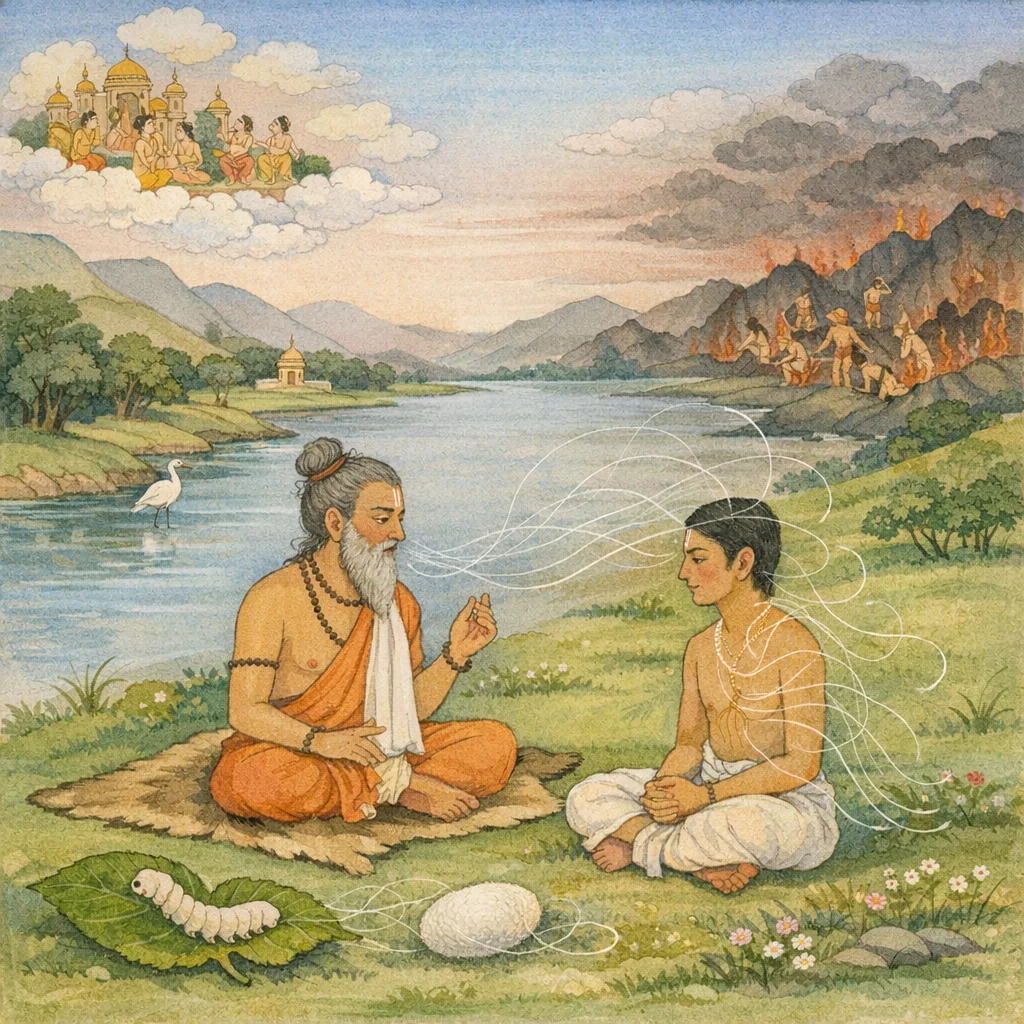
Adhyāya 242 presents Vasiṣṭha’s philosophical teaching on saṃsāra as a cycle driven by ignorance (apratibuddhatva) and misidentification with prakṛti and its three guṇas. The unawakened self follows “the unawakened” through innumerable bodies, revolving through animal births, human life, heavenly states, and hellish realms. A central metaphor likens embodiment to a silkworm binding itself with its own threads, showing how the intrinsically “aguṇa” self becomes entangled through guṇa-association and the sense of “mine” (mamatva). The chapter catalogs bodily afflictions and proliferating dualities (dvaṃdva) mistaken for the self, and surveys many ascetic regimens, diets, vows, social roles, and ritual acts that can also become objects of egoic appropriation. It concludes that prakṛti brings about creation and dissolution, and that liberation is implied by transcending the guṇas and wearing away mamatva, not merely by accumulating external disciplines.
Chapter Arc
{"opening_hook":"Vasiṣṭha opens by diagnosing saṃsāra not as an external fate but as an inner sleep: apratibuddhatva (unawakenedness) that makes the self trail “the unawakened” through countless embodiments.","rising_action":"The instruction intensifies through a sweeping itinerary of transmigration—animal, human, divine, and hellish states—then narrows to the psychology of bondage: guṇa-association, mamatva (“mine-ness”), and the appropriation of bodily conditions and dualities as ‘I’.","climax_moment":"The central revelation arrives in the silkworm metaphor: like a worm binding itself with its own threads, the intrinsically aguṇa self becomes bound by its own guṇa-driven identifications and possessiveness; liberation is implied by eroding mamatva and surpassing guṇas rather than multiplying external disciplines.","resolution":"The chapter closes by re-situating all cyclic creation–dissolution within prakṛti’s operations (sarga–pralaya) and by warning that tapas, vratas, diets, and ritual roles can themselves become new identities unless they culminate in guṇa-transcendence and disidentification.","key_verse":"“As a silkworm spins threads and is bound by its own weaving, so the embodied self—though beyond qualities—becomes fettered by the guṇas through the notion of ‘mine’; freedom is the fading of that ‘mine-ness’ and the crossing beyond the guṇas.”"}
Thematic Essence
{"primary_theme":"Guṇa-bandha and saṃsāra: bondage through misidentification with prakṛti and ‘mine-ness’","secondary_themes":["Transmigration across animal–human–divine–hell realms driven by ignorance and karma","Dvaṃdva (pairs of opposites) and bodily afflictions as falsely owned identities","Tapas, vratas, diets, and varṇa–āśrama duties as potential new ego-anchors","Prakṛti as the engine of sarga–pralaya; liberation as guṇa-transcendence"],"brahma_purana_doctrine":"A distinctly Purāṇic corrective: dharma-practices (tapas/vrata/karma) are not rejected, but their salvific power is conditional—only when they dissolve mamatva and culminate in insight that the self is aguṇa and not prakṛti’s modifications.","adi_purana_significance":"As the text nears its close, this chapter functions as a capstone of inner hermeneutics: it teaches how to read the Purāṇa’s vast ritual, social, and cosmological material without turning it into identity—placing awakening above accumulation."}
Emotional Journey
{"opening_rasa":"भयानक (bhayānaka)","climax_rasa":"शान्त (śānta)","closing_rasa":"शान्त (śānta)","rasa_transitions":["bhayānaka → करुण (karuṇa) → बिभत्स (bībhatsa) → शान्त (śānta)"],"devotional_peaks":["The moment the ‘aguṇa self’ is asserted against guṇa-entanglement, shifting the mood from dread of saṃsāra to contemplative release","The teaching that true tapas is the erosion of mamatva, turning discipline into inward surrender rather than self-display"]}
Tirtha Focus
{"tirthas_covered":[],"jagannath_content":null,"surya_content":null,"cosmology_content":"Prakṛti is presented as the operative principle behind cyclical manifestation and withdrawal (sarga–pralaya); fear, dissolution, and re-emergence belong to guṇa-activity, while liberation is framed as going beyond guṇas."}
Shlokas in Adhyaya 242
Verse 1
वसिष्ठ उवाच एवम् अप्रतिबुद्धत्वाद् अबुद्धम् अनुवर्तते देहाद् देहसहस्राणि तथा च न स भिद्यते //
This entry shows only the number “1”; no Sanskrit text is provided, so the meaning cannot be translated.
Verse 2
तिर्यग्योनिसहस्रेषु कदाचिद् देवतास्व् अपि उत्पद्यति तपोयोगाद् गुणैः सह गुणक्षयात् //
Only the number “2” is given here; the Sanskrit text is not provided for translation.
Verse 3
मनुष्यत्वाद् दिवं याति देवो मानुष्यम् एति च मानुष्यान् निरयस्थानम् आलयं प्रतिपद्यते //
This verse (no. 3) in the Purana sets forth Dharma and sacred history in a solemn manner.
Verse 4
कोषकारो यथात्मानं कीटः समभिरुन्धति सूत्रतन्तुगुणैर् नित्यं तथायम् अगुणो गुणैः //
This verse (no. 4) continues to explain Dharma and the order of the world according to ancient tradition.
Verse 5
द्वंद्वम् एति च निर्द्वंद्वस् तासु तास्व् इह योनिषु शीर्षरोगे ऽक्षिरोगे च दन्तशूले गलग्रहे //
This verse (no. 5) highlights virtue, disciplined practice, and the fruit of merit that leads to well-being.
Verse 6
जलोदरे ऽतिसारे च गण्डमालाविचर्चिके श्वित्रकुष्ठे ऽग्निदग्धे च सिध्मापस्मारयोर् अपि //
This verse (no. 6) teaches reverence for the Divine and the keeping of discipline so that Dharma may remain steadfast.
Verse 7
यानि चान्यानि द्वंद्वानि प्राकृतानि शरीरिणाम् उत्पद्यन्ते विचित्राणि तान्य् एवात्माभिमन्यते //
This verse (no. 7) summarizes the sacred teaching so that the listener may understand and practice the path of Dharma.
Verse 8
अभिमानातिमानानां तथैव सुकृतान्य् अपि एकवासाश् चतुर्वासाः शायी नित्यम् अधस् तथा //
This verse (no. 8) in the Purāṇa is set forth with reverence, in accordance with the transmitted sacred tradition.
Verse 9
मण्डूकशायी च तथा वीरासनगतस् तथा वीरम् आसनम् आकाशे तथा शयनम् एव च //
This verse (no. 9) presents a pure teaching; it should be read and contemplated with a sincere mind.
Verse 10
इष्टकाप्रस्तरे चैव चक्रकप्रस्तरे तथा भस्मप्रस्तरशायी च भूमिशय्यानुलेपनः //
This verse (no. 10) clarifies Dharma and duty, guiding the seeker to walk the righteous path.
Verse 11
वीरस्थानाम्बुपाके च शयनं फलकेषु च विविधासु च शय्यासु फलगृह्यान्वितासु च //
This verse (no. 11) praises the Divine and its grace, showing that reverent devotion leads to peace and well-being.
Verse 12
उद्याने खललग्ने तु क्षौमकृष्णाजिनान्वितः मणिवालपरीधानो व्याघ्रचर्मपरिच्छदः //
This verse (no. 12) concludes the exposition with a concise summary, enabling the reader to grasp the deeper meaning.
Verse 13
सिंहचर्मपरीधानः पट्टवासास् तथैव च फलकं परिधानश् च तथा कटकवस्त्रधृक् //
This is verse 13 of chapter 242 of the Brahma Purana, conveyed in a solemn and sacred register.
Verse 14
कटैकवसनश् चैव चीरवासास् तथैव च वस्त्राणि चान्यानि बहून्य् अभिमत्य च बुद्धिमान् //
Verse 14 of chapter 242 continues the exposition of Dharma and sacred observances in the ancient tradition.
Verse 15
भोजनानि विचित्राणि रत्नानि विविधानि च एकरात्रान्तराशित्वम् एककालिकभोजनम् //
Verse 15 of chapter 242 is to be recited with faith (śraddhā) to grasp the principles of Dharma.
Verse 16
चतुर्थाष्टमकालं च षष्ठकालिकम् एव च षड्रात्रभोजनश् चैव तथा चाष्टाहभोजनः //
Verse 16 of chapter 242 sets forth an ancient teaching that leads toward peace and virtue.
Verse 17
मासोपवासी मूलाशी फलाहारस् तथैव च वायुभक्षश् च पिण्याकदधिगोमयभोजनः //
Verse 17 of chapter 242 concludes this passage, reaffirming reverence for Dharma and the Supreme Deity.
Verse 18
गोमूत्रभोजनश् चैव काशपुष्पाशनस् तथा शैवालभोजनश् चैव तथा चान्येन वर्तयन् //
This entry gives only “18” as the śloka number; the full Sanskrit text is not provided.
Verse 19
वर्तयञ् शीर्णपर्णैश् च प्रकीर्णफलभोजनः विविधानि च कृच्छ्राणि सेवते सिद्धिकाङ्क्षया //
This entry contains only “19” as the śloka number; no complete Sanskrit text is supplied for translation.
Verse 20
चान्द्रायणानि विधिवल् लिङ्गानि विविधानि च चातुराश्रम्ययुक्तानि धर्माधर्माश्रयाण्य् अपि //
Here only “20” is given as the śloka number, but the Sanskrit original is not provided for translation.
Verse 21
उपाश्रयान् अप्य् अपरान् पाखण्डान् विविधान् अपि विविक्ताश् च शिलाछायास् तथा प्रस्रवणानि च //
This item records only “21” as the śloka number; no complete Sanskrit text is provided to translate.
Verse 22
पुलिनानि विविक्तानि विविधानि वनानि च काननेषु विविक्ताश् च शैलानां महतीर् गुहाः //
At this point only “22” is shown as the śloka number; the Sanskrit original is not supplied, so a faithful translation cannot be made.
Verse 23
नियमान् विविधांश् चापि विविधानि तपांसि च यज्ञांश् च विविधाकारान् विद्याश् च विविधास् तथा //
This entry provides only the number “23” and no Sanskrit text; therefore a meaningful translation cannot be given.
Verse 24
वणिक्पथं द्विजक्षत्रवैश्यशूद्रांस् तथैव च दानं च विविधाकारं दीनान्धकृपणादिषु //
This entry provides only the number “24” and no Sanskrit text; therefore a meaningful translation cannot be given.
Verse 25
अभिमन्येत संधातुं तथैव विविधान् गुणान् सत्त्वं रजस् तमश् चैव धर्मार्थौ काम एव च //
This entry provides only the number “25” and no Sanskrit text; therefore a meaningful translation cannot be given.
Verse 26
प्रकृत्यात्मानम् एवात्मा एवं प्रविभजत्य् उत स्वाहाकारवषट्कारौ स्वधाकारनमस्क्रिये //
This entry provides only the number “26” and no Sanskrit text; therefore a meaningful translation cannot be given.
Verse 27
यजनाध्ययने दानं तथैवाहुः प्रतिग्रहम् याजनाध्यापने चैव तथान्यद् अपि किंचन //
This entry provides only the number “27” and no Sanskrit text; therefore a meaningful translation cannot be given.
Verse 28
जन्ममृत्युविधानेन तथा विशसनेन च शुभाशुभभयं सर्वम् एतद् आहुः सनातनम् //
Verse (242.28) is referenced in the Purana, but the Sanskrit original is not provided here.
Verse 29
प्रकृतिः कुरुते देवी भयं प्रलयम् एव च दिवसान्ते गुणान् एतान् अतीत्यैको ऽवतिष्ठते //
Verse (242.29) belongs to the Purana, but the Sanskrit source text is not included here.
Verse 30
रश्मिजालम् इवादित्यस् तत्कालं संनियच्छति एवम् एवैष तत् सर्वं क्रीडार्थम् अभिमन्यते //
Verse (242.30) is listed in the Purana, but no Sanskrit original is provided here for translation.
Verse 31
आत्मरूपगुणान् एतान् विविधान् हृदयप्रियान् एवम् एतां प्रकुर्वाणः सर्गप्रलयधर्मिणीम् //
Verse (242.31) is cited in the Purana, but the Sanskrit text is not shown here.
Verse 32
क्रियां क्रियापथे रक्तस् त्रिगुणस् त्रिगुणाधिपः क्रियाक्रियापथोपेतस् तथा तद् इति मन्यते //
Verse (242.32) falls within the Purana’s context, but the Sanskrit original is not available here.
Verse 33
प्रकृत्या सर्वम् एवेदं जगद् अन्धीकृतं विभो रजसा तमसा चैव व्याप्तं सर्वम् अनेकधा //
This is verse 33 of chapter 242 of the Brahma Purana, revered as a sacred utterance within the Purāṇic tradition.
Verse 34
एवं द्वंद्वान्य् अतीतानि मम वर्तन्ति नित्यशः मत्त एतानि जायन्ते प्रलये यान्ति माम् अपि //
This is verse 34 of chapter 242, continuing the sacred exposition of the Brahma Purana and to be read with reverence.
Verse 35
निस्तर्तव्याण्य् अथैतानि सर्वाणीति नराधिप मन्यते पक्षबुद्धित्वात् तथैव सुकृतान्य् अपि //
This is verse 35 of chapter 242, a portion of the Brahma Purana, presenting its teaching in a solemn, encyclopedic manner.
Verse 36
भोक्तव्यानि ममैतानि देवलोकगतेन वै इहैव चैनं भोक्ष्यामि शुभाशुभफलोदयम् //
This is verse 36 of chapter 242, to be studied and recited with faith so that the pure meaning of dharma may be understood.
Verse 37
सुखम् एवं तु कर्तव्यं सकृत् कृत्वा सुखं मम यावद् एव तु मे सौख्यं जात्यां जात्यां भविष्यति //
This is verse 37 of chapter 242, a solemn closing statement urging reverence for the Purāṇic heritage.
Verse 38
भविष्यति न मे दुःखं कृतेनेहाप्य् अनन्तकम् सुखदुःखं हि मानुष्यं निरये चापि मज्जनम् //
This verse (38) is preserved in the Purāṇa to set forth the meaning of Dharma and the sacred, encyclopedic knowledge.
Verse 39
निरयाच् चापि मानुष्यं कालेनैष्याम्य् अहं पुनः मनुष्यत्वाच् च देवत्वं देवत्वात् पौरुषं पुनः //
This verse (39) continues the teaching on Dharma and the order of the cosmic law according to ancient tradition.
Verse 40
मनुष्यत्वाच् च निरयं पर्यायेणोपगच्छति एष एवं द्विजातीनाम् आत्मा वै स गुणैर् वृतः //
This verse (40) reminds that hearing and retaining the sacred word leads to merit and to pure understanding.
Verse 41
तेन देवमनुष्येषु निरयं चोपपद्यते ममत्वेनावृतो नित्यं तत्रैव परिवर्तते //
This verse (41) teaches that one who honors Dharma and acts righteously attains peace and prosperity.
Verse 42
सर्गकोटिसहस्राणि मरणान्तासु मूर्तिषु य एवं कुरुते कर्म शुभाशुभफलात्मकम् //
This verse (42) concludes that upholding Dharma as one’s foundation blesses life and opens the path to the highest goal.
Verse 43
स एवं फलम् आप्नोति त्रिषु लोकेषु मूर्तिमान् प्रकृतिः कुरुते कर्म शुभाशुभफलात्मकम् //
This verse (ch. 242, v. 43) is preserved as sacred utterance of the Brahma Purana, to set forth dharma and the ancient tradition.
Verse 44
प्रकृतिश् च तथाप्नोति त्रिषु लोकेषु कामगा तिर्यग्योनिमनुष्यत्वे देवलोके तथैव च //
This verse (ch. 242, v. 44) continues the teaching of dharma, stressing righteous conduct and reverence toward the Divine.
Verse 45
त्रीणि स्थानानि चैतानि जानीयात् प्राकृतानि ह अलिङ्गप्रकृतित्वाच् च लिङ्गैर् अप्य् अनुमीयते //
This verse (ch. 242, v. 45) teaches that hearing and remembering the Purana purifies the mind and yields right knowledge.
Verse 46
तथैव पौरुषं लिङ्गम् अनुमानाद् धि मन्यते स लिङ्गान्तरम् आसाद्य प्राकृतं लिङ्गम् अव्रणम् //
This verse (ch. 242, v. 46) declares that sincere observance of dharma is the path to well-being and virtue.
Verse 47
व्रणद्वाराण्य् अधिष्ठाय कर्माण्य् आत्मनि मन्यते श्रोत्रादीनि तु सर्वाणि पञ्च कर्मेन्द्रियाण्य् अथ //
This verse (ch. 242, v. 47) concludes that those endowed with faith and wisdom should honor the Vedas and the Puranas to uphold the order of the world.
Verse 48
रागादीनि प्रवर्तन्ते गुणेष्व् इह गुणैः सह अहम् एतानि वै कुर्वन् ममैतानीन्द्रियाणि ह //
This verse (48) is set forth in the Purāṇa as an exposition of Dharma and the sacred teaching.
Verse 49
निरिन्द्रियो हि मन्येत व्रणवान् अस्मि निर्व्रणः अलिङ्गो लिङ्गम् आत्मानम् अकालं कालम् आत्मनः //
Verse (49) continues by explaining the ordinances of Dharma and the virtues to be observed.
Verse 50
असत्त्वं सत्त्वम् आत्मानम् अमृतं मृतम् आत्मनः अमृत्युं मृत्युम् आत्मानम् अचरं चरम् आत्मनः //
Verse (50) sets forth the fruits of practicing Dharma and safeguarding the sacred teaching.
Verse 51
अक्षेत्रं क्षेत्रम् आत्मानम् असङ्गं सङ्गम् आत्मनः अतत्त्वं तत्त्वम् आत्मानम् अभवं भवम् आत्मनः //
Verse (51) admonishes the wise and lovers of Dharma to listen with reverence.
Verse 52
अक्षरं क्षरम् आत्मानम् अबुद्धत्वाद् धि मन्यते एवम् अप्रतिबुद्धत्वाद् अबुद्धजनसेवनात् //
Verse (52) concludes that understanding and practicing Dharma lead to peace and divine grace.
Verse 53
सर्गकोटिसहस्राणि पतनान्तानि गच्छति जन्मान्तरसहस्राणि मरणान्तानि गच्छति //
This verse (no. 53) of the Brahma Purana sets forth sacred dharma, suitable for devotional recitation and scholarly study.
Verse 54
तिर्यग्योनिमनुष्यत्वे देवलोके तथैव च चन्द्रमा इव कोशानां पुनस् तत्र सहस्रशः //
This verse (no. 54) continues the exposition of dharma and the order of merit, so that devotees and scholars may understand it clearly.
Verse 55
नीयते ऽप्रतिबुद्धत्वाद् एवम् एव कुबुद्धिमान् कला पञ्चदशी योनिस् तद् धाम इति पठ्यते //
This verse (no. 55) urges reverence for the Divine and sincere practice of dharma, so that peace and spiritual merit may be attained.
Verse 56
नित्यम् एव विजानीहि सोमं वै षोडशांशकैः कलया जायते ऽजस्रं पुनः पुनर् अबुद्धिमान् //
This verse (no. 56) teaches that hearing and remembering the sacred word purifies the mind and increases wisdom.
Verse 57
धीमांश् चायं न भवति नृप एवं हि जायते षोडशी तु कला सूक्ष्मा स सोम उपधार्यताम् //
This verse (no. 57) praises the fruits of practicing dharma and offering worship with loving devotion, leading to a благоприят destiny and prosperity.
Verse 58
न तूपयुज्यते देवैर् देवान् अपि युनक्ति सः ममत्वं क्षपयित्वा तु जायते नृपसत्तम प्रकृतेस् त्रिगुणायास् तु स एव त्रिगुणो भवेत् //
This verse (58) in the Purana continues the sacred exposition of Dharma and holy instruction.
Frequently Asked Questions
The chapter’s central theme is bondage through ignorance and guṇa-association: beings cyclically transmigrate because they appropriate bodily states, dualities, actions, and even austerities as “I” and “mine” (mamatva), rather than discerning the self beyond prakṛti.
Ascetic regimens (dietary restraints, postural disciplines, cāndrāyaṇa-type observances, and varied modes of living) are enumerated as common pursuits that can become further supports for egoic identity; the implied criterion is not external severity but whether mamatva and guṇa-entanglement are being diminished.
No tīrtha or pilgrimage geography is inaugurated in this chapter. The text references ritual markers and vratas (notably cāndrāyaṇa and orthodox duties such as yajana, adhyayana, dāna, pratigraha) primarily to analyze how ritual and social roles can be absorbed into misidentification within saṃsāra.