Adhyaya 5
Nārada Instructs Dakṣa’s Sons; Allegory of the World; Dakṣa Curses Nārada
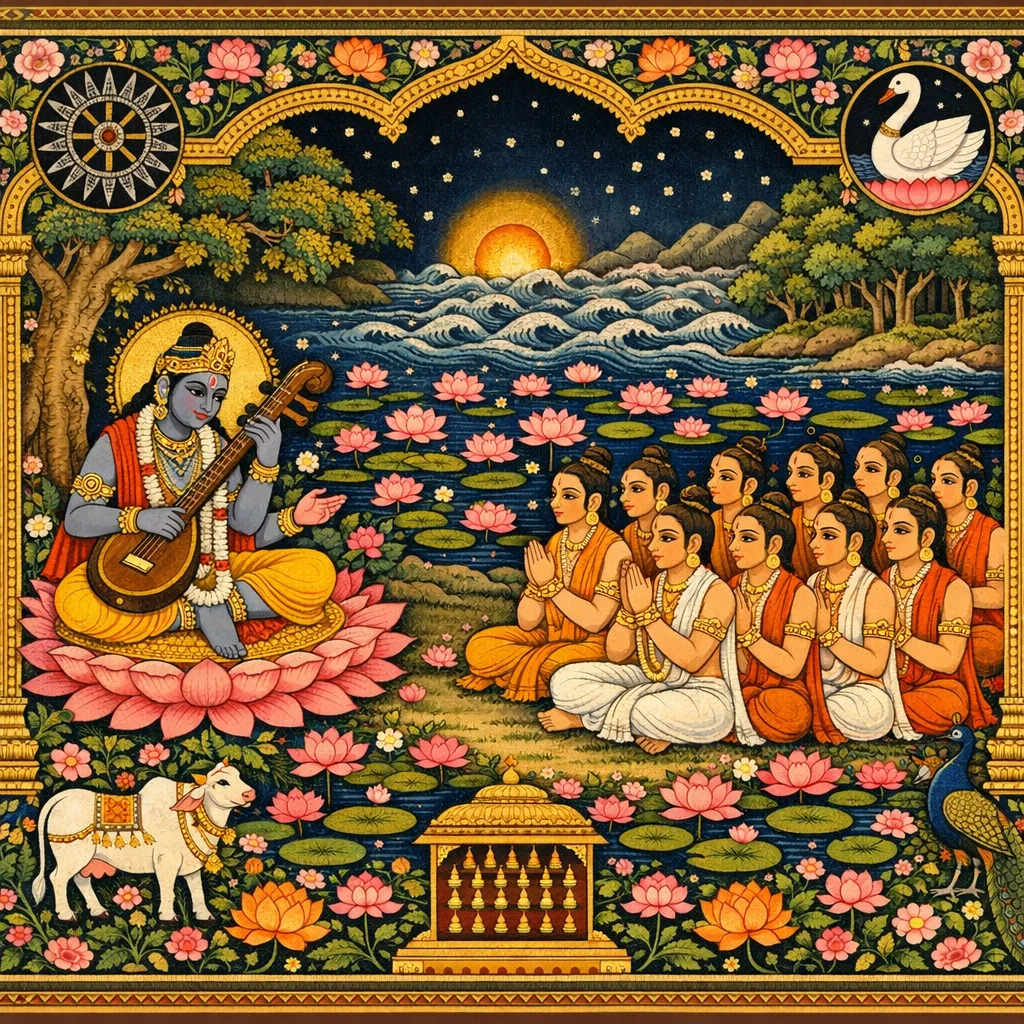
Continuing the Prajāpati line in visarga (secondary creation), Dakṣa begets the Haryaśvas and commands them to increase progeny. They go west to the tīrtha Nārāyaṇa-saras, where the Sindhu meets the sea, and by austerity and purification become drawn to the paramahaṁsa way of life. Nārada Muni arrives and delivers a purposeful allegory—“the one man,” “the unchaste woman,” “the two-way river,” “the house of twenty-five,” “the haṁsa,” and “time like razors”—turning their intelligence from fruitive expansion toward liberation. The Haryaśvas decode the symbols as metaphysics: the Supreme Enjoyer, māyā-buddhi, prakṛti’s cycles, the tattvas, śāstric discrimination, and kāla. Accepting Nārada as guru, they depart on the path of no return. Dakṣa then produces a second group, the Savalāśvas, who perform tapas at the same tīrtha; Nārada’s brief instruction—follow your elder brothers—leads them too into renunciation and bhakti. The chapter ends with Dakṣa’s grief and anger: he accuses Nārada of prematurely inducing vairāgya, invokes the “three debts” to devas, ṛṣis, and pitṛs, and curses Nārada to have no fixed residence—patiently accepted by the sage. This sets the next tension: Dakṣa’s ongoing role in creation and the consequences of offending a mahā-bhāgavata.
Shlokas
Verse 1
श्रीशुक उवाच तस्यां स पाञ्चजन्यां वै विष्णुमायोपबृंहित: । हर्यश्वसंज्ञानयुतं पुत्रानजनयद्विभु: ॥ १ ॥
Śukadeva Gosvāmī continued: Impelled by Lord Viṣṇu’s māyā, Prajāpati Dakṣa begot ten thousand sons in the womb of Pāñcajanī (Asiknī); they were known as the Haryaśvas.
Verse 2
अपृथग्धर्मशीलास्ते सर्वे दाक्षायणा नृप । पित्रा प्रोक्ता: प्रजासर्गे प्रतीचीं प्रययुर्दिशम् ॥ २ ॥
O King, all the sons of Dakṣa were alike—gentle by nature and obedient to their father’s command. When ordered to beget progeny, they set out toward the western direction.
Verse 3
तत्र नारायणसरस्तीर्थं सिन्धुसमुद्रयो: । सङ्गमो यत्र सुमहन्मुनिसिद्धनिषेवितम् ॥ ३ ॥
In the west, where the Sindhu River meets the ocean, lies a great holy place of pilgrimage called Nārāyaṇa-saras, revered and frequented by sages and perfected beings.
Verse 4
तदुपस्पर्शनादेव विनिर्धूतमलाशया: । धर्मे पारमहंस्ये च प्रोत्पन्नमतयोऽप्युत ॥ ४ ॥ तेपिरे तप एवोग्रं पित्रादेशेन यन्त्रिता: । प्रजाविवृद्धये यत्तान् देवर्षिस्तान् ददर्श ह ॥ ५ ॥
In that holy place, by regularly touching and bathing in the lake’s waters, their hearts were cleansed of impurity, and their minds awakened toward the dharma of the paramahaṁsas. Yet, bound by their father’s order to increase the population, they performed severe austerities to fulfill his desire. One day, Devarṣi Nārada saw those youths engaged in such tapas and approached them.
Verse 5
तदुपस्पर्शनादेव विनिर्धूतमलाशया: । धर्मे पारमहंस्ये च प्रोत्पन्नमतयोऽप्युत ॥ ४ ॥ तेपिरे तप एवोग्रं पित्रादेशेन यन्त्रिता: । प्रजाविवृद्धये यत्तान् देवर्षिस्तान् ददर्श ह ॥ ५ ॥
In that holy place the Haryaśvas regularly touched the lake’s waters and bathed there. Gradually their hearts were cleansed of all impurity, and their minds inclined toward the path and conduct of the paramahaṁsas. Yet, because their father had ordered them to increase progeny, they performed severe austerities to fulfill his desire. One day Devarṣi Nārada saw those boys engaged in such fine penance for the sake of begetting offspring, and he approached them.
Verse 6
उवाच चाथ हर्यश्वा: कथं स्रक्ष्यथ वै प्रजा: । अदृष्ट्वान्तं भुवो यूयं बालिशा बत पालका: ॥ ६ ॥ तथैकपुरुषं राष्ट्रं बिलं चादृष्टनिर्गमम् । बहुरूपां स्त्रियं चापि पुमांसं पुंश्चलीपतिम् ॥ ७ ॥ नदीमुभयतो वाहां पञ्चपञ्चाद्भुतं गृहम् । क्वचिद्धंसं चित्रकथं क्षौरपव्यं स्वयं भ्रमि ॥ ८ ॥
The great sage Nārada said: My dear Haryaśvas, you have not seen the ends of the earth; therefore you are still inexperienced boys. There is a kingdom where only one man lives, and there is a hole such that, once one enters it, no one comes out. There a most unchaste woman adorns herself in many attractive guises, and the lone man of that realm is her husband. In that kingdom there is a river flowing in both directions, a wondrous house made of twenty-five elements, a swan that utters various sounds, and a self-turning device fashioned of razor-sharp, vajra-hard materials. Without seeing all this, how will you create progeny?
Verse 7
उवाच चाथ हर्यश्वा: कथं स्रक्ष्यथ वै प्रजा: । अदृष्ट्वान्तं भुवो यूयं बालिशा बत पालका: ॥ ६ ॥ तथैकपुरुषं राष्ट्रं बिलं चादृष्टनिर्गमम् । बहुरूपां स्त्रियं चापि पुमांसं पुंश्चलीपतिम् ॥ ७ ॥ नदीमुभयतो वाहां पञ्चपञ्चाद्भुतं गृहम् । क्वचिद्धंसं चित्रकथं क्षौरपव्यं स्वयं भ्रमि ॥ ८ ॥
The great sage Nārada said: My dear Haryaśvas, you have not seen the ends of the earth; therefore you are still inexperienced boys. There is a kingdom where only one man lives, and there is a hole such that, once one enters it, no one comes out. There a most unchaste woman adorns herself in many attractive guises, and the lone man of that realm is her husband. In that kingdom there is a river flowing in both directions, a wondrous house made of twenty-five elements, a swan that utters various sounds, and a self-turning device fashioned of razor-sharp, vajra-hard materials. Without seeing all this, how will you create progeny?
Verse 8
उवाच चाथ हर्यश्वा: कथं स्रक्ष्यथ वै प्रजा: । अदृष्ट्वान्तं भुवो यूयं बालिशा बत पालका: ॥ ६ ॥ तथैकपुरुषं राष्ट्रं बिलं चादृष्टनिर्गमम् । बहुरूपां स्त्रियं चापि पुमांसं पुंश्चलीपतिम् ॥ ७ ॥ नदीमुभयतो वाहां पञ्चपञ्चाद्भुतं गृहम् । क्वचिद्धंसं चित्रकथं क्षौरपव्यं स्वयं भ्रमि ॥ ८ ॥
The great sage Nārada said: My dear Haryaśvas, you have not seen the ends of the earth; therefore you are still inexperienced boys. There is a kingdom where only one man lives, and there is a hole such that, once one enters it, no one comes out. There a most unchaste woman adorns herself in many attractive guises, and the lone man of that realm is her husband. In that kingdom there is a river flowing in both directions, a wondrous house made of twenty-five elements, a swan that utters various sounds, and a self-turning device fashioned of razor-sharp, vajra-hard materials. Without seeing all this, how will you create progeny?
Verse 9
कथं स्वपितुरादेशमविद्वांसो विपश्चित: । अनुरूपमविज्ञाय अहो सर्गं करिष्यथ ॥ ९ ॥
Alas! Your father is omniscient, yet you do not know the true purport of his command. Without understanding his real intention and without discerning the fitting course, how will you accomplish creation of progeny?
Verse 10
श्रीशुक उवाच तन्निशम्याथ हर्यश्वा औत्पत्तिकमनीषया । वाच: कूटं तु देवर्षे: स्वयं विममृशुर्धिया ॥ १० ॥
Śrī Śukadeva Gosvāmī said: Hearing the enigmatic words of Devarṣi Nārada, the Haryaśvas reflected upon them by their own natural intelligence, without anyone else’s help.
Verse 11
भू: क्षेत्रं जीवसंज्ञं यदनादि निजबन्धनम् । अदृष्ट्वा तस्य निर्वाणं किमसत्कर्मभिर्भवेत् ॥ ११ ॥
“Bhūḥ” means the field of action; the jīva’s material body is that field and the basis of false designations. From time without beginning he has accepted many bodies, the root of bondage in saṁsāra. If one does not look toward the ending of this bondage and busies oneself with temporary fruitive works, what benefit is there?
Verse 12
एक एवेश्वरस्तुर्यो भगवान् स्वाश्रय: पर: । तमदृष्ट्वाभवं पुंस: किमसत्कर्मभिर्भवेत् ॥ १२ ॥
The sole enjoyer and Lord is the Supreme Bhagavān—fully independent, all-seeing, endowed with six opulences, and ever beyond the three modes. If human beings do not understand Him and instead toil day and night for fleeting happiness, what profit is there in their activities?
Verse 13
पुमान्नैवैति यद्गत्वा बिलस्वर्गं गतो यथा । प्रत्यग्धामाविद इह किमसत्कर्मभिर्भवेत् ॥ १३ ॥
Just as one who enters the “hole” called Pātāla is scarcely seen to return, so one who reaches Vaikuṇṭha-dhāma (pratyag-dhāma) does not come back to this material world. If such a place of no return exists, yet one does not seek it and instead leaps about like a monkey in the temporary world, what profit is there in such futile works?
Verse 14
नानारूपात्मनो बुद्धि: स्वैरिणीव गुणान्विता । तन्निष्ठामगतस्येह किमसत्कर्मभिर्भवेत् ॥ १४ ॥
The unsteady intelligence, tinged with rajo-guṇa, is like a wanton courtesan, assuming many guises according to the modes to entice. If one, not understanding this, becomes absorbed in temporary fruitive works, what does one truly gain?
Verse 15
तत्सङ्गभ्रंशितैश्वर्यं संसरन्तं कुभार्यवत् । तद्गतीरबुधस्येह किमसत्कर्मभिर्भवेत् ॥ १५ ॥
As the husband of a prostitute loses all independence, so the living being with polluted intelligence wanders long in material existence. Harassed by nature, he follows the mind’s movements that bring happiness and distress; in such a condition, what benefit can fruitive acts give?
Verse 16
सृष्ट्यप्ययकरीं मायां वेलाकूलान्तवेगिताम् । मत्तस्य तामविज्ञस्य किमसत्कर्मभिर्भवेत् ॥ १६ ॥
Māyā, which brings about creation and dissolution, is like a river flowing both ways, swiftest near its banks. The ignorant soul who falls into it is submerged by its waves and cannot escape; what benefit is there in fruitive work within that river of māyā?
Verse 17
पञ्चविंशतितत्त्वानां पुरुषोऽद्भुतदर्पण: । अध्यात्ममबुधस्येह किमसत्कर्मभिर्भवेत् ॥ १७ ॥
The Supreme Lord is the reservoir of the twenty-five elements and the ruler of cause and effect, like a wondrous mirror that manifests them. If one does temporary fruitive work without knowing that Supreme Person, what benefit can he gain?
Verse 18
ऐश्वरं शास्त्रमुत्सृज्य बन्धमोक्षानुदर्शनम् । विविक्तपदमज्ञाय किमसत्कर्मभिर्भवेत् ॥ १८ ॥
If a fool casts aside the majestic śāstras that reveal the means of bondage and the means of liberation, not knowing the haṁsa’s discriminating path, and delights in temporary works—what result can such vain acts bring?
Verse 19
कालचक्रं भ्रमि तीक्ष्णं सर्वं निष्कर्षयज्जगत् । स्वतन्त्रमबुधस्येह किमसत्कर्मभिर्भवेत् ॥ १९ ॥
The wheel of time turns with razor sharpness, as if made of blades and thunderbolts; unbroken and fully independent, it drags the whole world along. If one does not seek to understand the eternal principle of time, what benefit can temporary material acts provide?
Verse 20
शास्त्रस्य पितुरादेशं यो न वेद निवर्तकम् । कथं तदनुरूपाय गुणविस्रम्भ्युपक्रमेत् ॥ २० ॥
One who does not know the fatherly command of śāstra, which turns one away from the material path, how can he begin in a manner befitting it, with faith and devotion?
Verse 21
इति व्यवसिता राजन् हर्यश्वा एकचेतस: । प्रययुस्तं परिक्रम्य पन्थानमनिवर्तनम् ॥ २१ ॥
My dear King, hearing Nārada’s instructions, the Haryaśvas became firmly resolved and of one mind. Accepting him as their spiritual master, they circumambulated the great sage and followed the path from which one never returns to this world.
Verse 22
स्वरब्रह्मणि निर्भातहृषीकेशपदाम्बुजे । अखण्डं चित्तमावेश्य लोकाननुचरन्मुनि: ॥ २२ ॥
Vibrating sacred sound born of the Sāma Veda, Nārada Muni sings the Lord’s līlās; fixing his mind unbrokenly upon the lotus feet of Hṛṣīkeśa, he continues to wander through all the worlds.
Verse 23
नाशं निशम्य पुत्राणां नारदाच्छीलशालिनाम् । अन्वतप्यत क: शोचन् सुप्रजस्त्वं शुचां पदम् ॥ २३ ॥
Hearing that his well-mannered sons had been lost—separated from him because of Nārada—Dakṣa burned with lamentation. Though the father of such fine sons, he fell into deep sorrow.
Verse 24
स भूय: पाञ्चजन्यायामजेन परिसान्त्वित: । पुत्रानजनयद्दक्ष: सवलाश्वान्सहस्रिण: ॥ २४ ॥
As Dakṣa lamented his lost sons, Ajā—Lord Brahmā—pacified him with instruction. Thereafter Dakṣa begot one thousand sons in the womb of his wife Pāñcajanī; they were known as the Savalāśvas.
Verse 25
ते च पित्रा समादिष्टा: प्रजासर्गे धृतव्रता: । नारायणसरो जग्मुर्यत्र सिद्धा: स्वपूर्वजा: ॥ २५ ॥
Obeying their father’s order to beget progeny, they too took up firm vows and went to Nārāyaṇa-saras, the holy lake where their elder brothers had previously attained perfection.
Verse 26
तदुपस्पर्शनादेव विनिर्धूतमलाशया: । जपन्तो ब्रह्म परमं तेपुस्तत्र महत्तप: ॥ २६ ॥
By the very touch of that sacred water their hearts were cleansed of impure desires; chanting mantras beginning with Oṁ and meditating on the Supreme Brahman, they performed great austerities there.
Verse 27
अब्भक्षा: कतिचिन्मासान् कतिचिद्वायुभोजना: । आराधयन् मन्त्रमिममभ्यस्यन्त इडस्पतिम् ॥ २७ ॥ ॐ नमो नारायणाय पुरुषाय महात्मने । विशुद्धसत्त्वधिष्ण्याय महाहंसाय धीमहि ॥ २८ ॥
For some months they drank only water, and for some time they lived as if feeding on air; thus, in great austerity, they worshiped Nārāyaṇa (Iḍaspati) by repeatedly chanting this mantra.
Verse 28
अब्भक्षा: कतिचिन्मासान् कतिचिद्वायुभोजना: । आराधयन् मन्त्रमिममभ्यस्यन्त इडस्पतिम् ॥ २७ ॥ ॐ नमो नारायणाय पुरुषाय महात्मने । विशुद्धसत्त्वधिष्ण्याय महाहंसाय धीमहि ॥ २८ ॥
Oṁ, obeisances unto Nārāyaṇa, the great-souled Supreme Person; we meditate upon the Mahāhaṁsa, who abides in the realm of perfectly pure sattva.
Verse 29
इति तानपि राजेन्द्र प्रजासर्गधियो मुनि: । उपेत्य नारद: प्राह वाच: कूटानि पूर्ववत् ॥ २९ ॥
O King, Nārada Muni approached those sons, intent on begetting progeny through austerity, and spoke to them the same kind of enigmatic words he had spoken before.
Verse 30
दाक्षायणा: संशृणुत गदतो निगमं मम । अन्विच्छतानुपदवीं भ्रातृणां भ्रातृवत्सला: ॥ ३० ॥
O sons of Dakṣa, hear my instruction with attentive minds. Since you are devotedly affectionate to your elder brothers, the Haryaśvas, follow the very path they have taken.
Verse 31
भ्रातृणां प्रायणं भ्राता योऽनुतिष्ठति धर्मवित् । स पुण्यबन्धु: पुरुषो मरुद्भि: सह मोदते ॥ ३१ ॥
A brother who knows the principles of dharma follows in the footsteps of his elder brothers. By such piety he becomes greatly elevated and gains the joy of association with demigods like the Maruts, who are themselves rich in fraternal affection.
Verse 32
एतावदुक्त्वा प्रययौ नारदोऽमोघदर्शन: । तेऽपि चान्वगमन् मार्गं भ्रातृणामेव मारिष ॥ ३२ ॥
Śukadeva Gosvāmī continued: O best among the refined Āryans, having spoken this much to Dakṣa’s sons, Nārada Muni—whose merciful glance never fails—departed as he had intended. Dakṣa’s sons also followed the path of their elder brothers; without seeking to beget children, they absorbed themselves in Kṛṣṇa consciousness.
Verse 33
सध्रीचीनं प्रतीचीनं परस्यानुपथं गता: । नाद्यापि ते निवर्तन्ते पश्चिमा यामिनीरिव ॥ ३३ ॥
The Savalāśvas took up the true path—attainable by a life meant for devotional service, or by the mercy of the Supreme Personality of Godhead. Like nights that have gone westward, they have not returned even to this day.
Verse 34
एतस्मिन् काल उत्पातान् बहून् पश्यन् प्रजापति: । पूर्ववन्नारदकृतं पुत्रनाशमुपाशृणोत् ॥ ३४ ॥
At that time Prajāpati Dakṣa saw many inauspicious omens. Then, from various sources, he heard that his second group of sons, the Savalāśvas, had followed the path of their elder brothers in accordance with Nārada’s instruction.
Verse 35
चुक्रोध नारदायासौ पुत्रशोकविमूर्च्छित: । देवर्षिमुपलभ्याह रोषाद्विस्फुरिताधर: ॥ ३५ ॥
Hearing that the Savalāśvas too had left this world to take up bhakti, Dakṣa became furious with Nārada and nearly fainted in grief for his sons. When he met the devarṣi Nārada, Dakṣa’s lips trembled with anger, and he spoke as follows.
Verse 36
श्रीदक्ष उवाच अहो असाधो साधूनां साधुलिङ्गेन नस्त्वया । असाध्वकार्यर्भकाणां भिक्षोर्मार्ग: प्रदर्शित: ॥ ३६ ॥
Prajāpati Dakṣa said: Alas, O unholy one! Though you wear the marks of a saint, you are no saint. As a mendicant, you showed my innocent sons the path of renunciation, committing an abominable wrong against me.
Verse 37
ऋणैस्त्रिभिरमुक्तानाममीमांसितकर्मणाम् । विघात: श्रेयस: पाप लोकयोरुभयो: कृत: ॥ ३७ ॥
They were not freed from the three debts, nor had they properly weighed their duties. O Nārada, embodiment of sinful action, you have obstructed my sons’ progress toward auspiciousness in this world and the next, though they still owed debts to the sages, the devas, and their father.
Verse 38
एवं त्वं निरनुक्रोशो बालानां मतिभिद्धरे: । पार्षदमध्ये चरसि यशोहा निरपत्रप: ॥ ३८ ॥
Thus, without compassion, you shatter the minds of innocent boys and yet claim to be an associate of Hari. You have defamed the glory of the Supreme Lord; you are shameless and devoid of mercy. How can you roam among the Lord’s personal companions?
Verse 39
ननु भागवता नित्यं भूतानुग्रहकातरा: । ऋते त्वां सौहृदघ्नं वै वैरङ्करमवैरिणाम् ॥ ३९ ॥
Indeed, all bhāgavatas, the Lord’s devotees, are ever eager to show mercy to the living beings—except you. You are a slayer of friendship, creating enmity among those who are not enemies. Are you not ashamed to pose as a devotee while performing such abominable deeds?
Verse 40
नेत्थं पुंसां विराग: स्यात् त्वया केवलिना मृषा । मन्यसे यद्युपशमं स्नेहपाशनिकृन्तनम् ॥ ४० ॥
Prajāpati Dakṣa said: O solitary ascetic, renunciation does not arise in men in this way; your words are false. Unless full knowledge awakens, merely changing one’s dress as you have done cannot cut the bonds of affectionate attachment.
Verse 41
नानुभूय न जानाति पुमान् विषयतीक्ष्णताम् । निर्विद्यते स्वयं तस्मान्न तथा भिन्नधी: परै: ॥ ४१ ॥
A man cannot know the sharp misery within sense enjoyment without experiencing it himself; therefore he becomes disenchanted on his own. Those whose minds are changed by others do not become as renounced as those transformed by personal experience.
Verse 42
यन्नस्त्वं कर्मसन्धानां साधूनां गृहमेधिनाम् । कृतवानसि दुर्मर्षं विप्रियं तव मर्षितम् ॥ ४२ ॥
You have done to us—pious householders who, according to the Vedas, pursue prescribed works and sacrifices—an intolerably displeasing act; I bear it. Though I live with wife and children, I keep vows and perform yajñas; yet without cause you have misled my sons onto the path of renunciation—this can be tolerated only once.
Verse 43
तन्तुकृन्तन यन्नस्त्वमभद्रमचर: पुन: । तस्माल्लोकेषु ते मूढ न भवेद्भ्रमत: पदम् ॥ ४३ ॥
O cutter of bonds! You made me lose my sons once, and now you have again done that inauspicious deed. Therefore, fool, I curse you: though you may wander through all the worlds, you shall have no fixed residence anywhere.
Verse 44
श्रीशुक उवाच प्रतिजग्राह तद्बाढं नारद: साधुसम्मत: । एतावान्साधुवादो हि तितिक्षेतेश्वर: स्वयम् ॥ ४४ ॥
Śrī Śukadeva said: O King, Nārada Muni, an approved saint, when cursed by Dakṣa replied, “tad bāḍham—so be it,” and accepted the curse. Such is the glory of a sādhu: though able, he endures with mercy and does not curse in return.
Frequently Asked Questions
The Haryaśvas interpret it as a complete map of saṁsāra and liberation: (1) ‘one man’ = the Supreme Enjoyer, Bhagavān, independent of guṇas; (2) ‘hole with no return’ = either descent into Pātāla (rare return) and, more importantly, entry into Vaikuṇṭha (no return to misery); (3) ‘unchaste woman’ = fickle, passion-mixed intelligence that changes ‘dress’ (identities) to attract the jīva; (4) ‘husband’ = the conditioned soul enslaved by that buddhi; (5) ‘river flowing both ways’ = prakṛti’s cycles of creation and dissolution; (6) ‘house of twenty-five’ = the tattva framework (elements) resting in the Supreme as cause and controller; (7) ‘haṁsa’ = śāstra-guided discrimination between matter and spirit; (8) ‘razors and thunderbolts’ = relentless kāla driving all change. The point is that without knowing these truths, producing progeny as an ultimate goal is spiritually misdirected.
Dakṣa argues from pravṛtti-mārga (world-maintaining duty): before adopting renunciation, one should discharge obligations to devas (through yajña), ṛṣis (through study/teaching), and pitṛs/father (through progeny and lineage rites). He sees Nārada’s instruction as inducing vairāgya without sufficient experiential maturity. The Bhāgavata, however, frames Nārada’s intervention as higher guidance: when bhakti awakens and the goal (ending bondage) is understood, the supreme duty becomes surrender to Nārāyaṇa.