Adhyaya 12
Vṛtrāsura Instructs Indra on Providence and Devotion; The Slaying of Vṛtrāsura
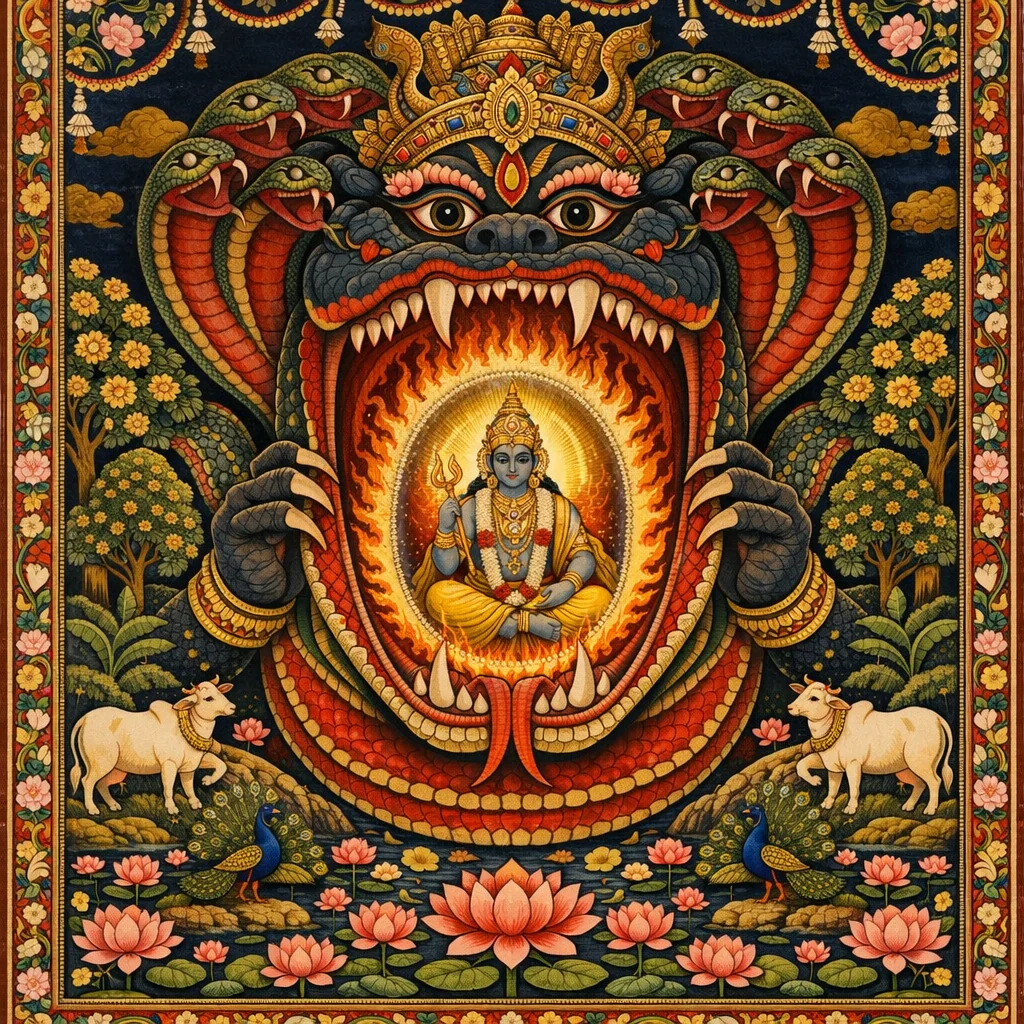
This chapter depicts the intense battle where Vṛtrāsura, despite losing an arm to Indra's thunderbolt, instructs Indra on the supreme will of the Lord. When Indra drops his weapon in shame, Vṛtrāsura encourages him, explaining that victory and defeat are ordained by providence. Indra, recognizing Vṛtrāsura as a great devotee, resumes fighting and cuts off his other arm. Vṛtrāsura swallows Indra, but Indra, protected by the Nārāyaṇa-kavaca, bursts out and severs the demon's head. Vṛtrāsura attains the spiritual abode of Lord Saṅkarṣaṇa.
Shlokas
Verse 1
श्रीऋषिरुवाच एवं जिहासुर्नृप देहमाजौ मृत्युं वरं विजयान्मन्यमान: । शूलं प्रगृह्याभ्यपतत् सुरेन्द्रं यथा महापुरुषं कैटभोऽप्सु ॥ १ ॥
Śukadeva Gosvāmī said: O King, desiring to cast off his body, Vṛtrāsura deemed death in battle better than victory. Grasping his trident, he rushed with great force at Indra, lord of heaven, just as Kaiṭabha once assailed the Supreme Mahāpuruṣa amid the inundating waters of pralaya.
Verse 2
ततो युगान्ताग्निकठोरजिह्व- माविध्य शूलं तरसासुरेन्द्र: । क्षिप्त्वा महेन्द्राय विनद्य वीरो हतोऽसि पापेति रुषा जगाद ॥ २ ॥
Then Vṛtrāsura, the heroic leader of the asuras, whirled his trident, its points hard like the tongues of the end-of-age fire. Roaring in wrath, he hurled it at Indra, crying, “O sinful one—now I shall slay you!”
Verse 3
ख आपतत्तद्विचलद्ग्रहोल्कव- न्निरीक्ष्य दुष्प्रेक्ष्यमजातविक्लव: । वज्रेण वज्री शतपर्वणाच्छिनद् भुजं च तस्योरगराजभोगम् ॥ ३ ॥
Flying through the sky, Vṛtrāsura’s trident blazed like a radiant meteor. Though that fiery weapon was hard to behold, fearless King Indra shattered it with his hundred-jointed thunderbolt and at the same time severed one of Vṛtrāsura’s arms, thick as the body of Vāsuki, king of serpents.
Verse 4
छिन्नैकबाहु: परिघेण वृत्र: संरब्ध आसाद्य गृहीतवज्रम् । हनौ तताडेन्द्रमथामरेभं वज्रं च हस्तान्न्यपतन्मघोन: ॥ ४ ॥
Though one arm had been severed, Vṛtrāsura, enraged, rushed at Indra, the wielder of the vajra, and struck Indra on the jaw with an iron mace; he also struck Airāvata, Indra’s elephant. Thus the thunderbolt slipped from Indra’s hand.
Verse 5
वृत्रस्य कर्मातिमहाद्भुतं तत् सुरासुराश्चारणसिद्धसङ्घा: । अपूजयंस्तत् पुरुहूतसङ्कटं निरीक्ष्य हा हेति विचुक्रुशुर्भृशम् ॥ ५ ॥
Vṛtrāsura’s feat was most astonishing. Demigods, demons, Cāraṇas, and Siddhas praised it, yet when they saw Puruhūta Indra in grave peril, they cried out in anguish, “Alas! Alas!”
Verse 6
इन्द्रो न वज्रं जगृहे विलज्जित- श्च्युतं स्वहस्तादरिसन्निधौ पुन: । तमाह वृत्रो हर आत्तवज्रो जहि स्वशत्रुं न विषादकाल: ॥ ६ ॥
Having dropped the thunderbolt from his hand before his foe, Indra felt ashamed, as if defeated, and did not dare to pick it up again. Vṛtrāsura, however, urged him: “O Hara, take up your vajra and slay your enemy; this is not the time for lamentation.”
Verse 7
युयुत्सतां कुत्रचिदाततायिनां जय: सदैकत्र न वै परात्मनाम् । विनैकमुत्पत्तिलयस्थितीश्वरं सर्वज्ञमाद्यं पुरुषं सनातनम् ॥ ७ ॥
O Indra, among dependent warriors who contend in battle, victory does not always remain on one side. Ever invincible is only the Paramātmā—Bhagavān, the Supreme Personality of Godhead, the all-knowing, original and eternal Person, Lord of creation, maintenance, and dissolution.
Verse 8
लोका: सपाला यस्येमे श्वसन्ति विवशा वशे । द्विजा इव शिचा बद्धा: स काल इह कारणम् ॥ ८ ॥
All beings in all worlds, including the presiding deities, breathe and act helplessly under the Lord’s control. Like birds bound in a net, none can move independently; He Himself, as Time, is the cause.
Verse 9
ओज: सहो बलं प्राणममृतं मृत्युमेव च । तमज्ञाय जनो हेतुमात्मानं मन्यते जडम् ॥ ९ ॥
Sensory prowess, courage, strength, the life-air, immortality and death—all are under the superintendence of the Supreme Personality of Godhead. Not knowing this, the foolish take the dull material body to be the cause.
Verse 10
यथा दारुमयी नारी यथा पत्रमयो मृग: । एवं भूतानि मघवन्नीशतन्त्राणि विद्धि भो: ॥ १० ॥
O King Indra, just as a wooden doll shaped like a woman, or an animal made of grass and leaves, cannot move or dance on its own but depends on the one who handles it, so all of us dance according to the will of the supreme controller, Bhagavān. No one is independent.
Verse 11
पुरुष: प्रकृतिर्व्यक्तमात्मा भूतेन्द्रियाशया: । शक्नुवन्त्यस्य सर्गादौ न विना यदनुग्रहात् ॥ ११ ॥
The three puruṣas—Kāraṇodakaśāyī, Garbhodakaśāyī and Kṣīrodakaśāyī Viṣṇu—along with material nature, the mahat-tattva, false ego, the elements, the senses, mind, intelligence and consciousness, cannot bring forth creation without the direction and grace of the Supreme Personality of Godhead.
Verse 12
अविद्वानेवमात्मानं मन्यतेऽनीशमीश्वरम् । भूतै: सृजति भूतानि ग्रसते तानि तै: स्वयम् ॥ १२ ॥
The foolish and senseless cannot understand the Supreme Personality of Godhead. Though always dependent, they falsely think themselves supreme. To think, “The body is created by father and mother and destroyed by some other agent,” is not proper understanding, for the Lord Himself creates and devours living beings through other living beings.
Verse 13
आयु: श्री: कीर्तिरैश्वर्यमाशिष: पुरुषस्य या: । भवन्त्येव हि तत्काले यथानिच्छोर्विपर्यया: ॥ १३ ॥
Just as one who does not wish to die must, at death’s appointed time, relinquish longevity, prosperity, fame, and all else, so at the destined time of victory one gains these when the Supreme Lord bestows them by His mercy.
Verse 14
तस्मादकीर्तियशसोर्जयापजययोरपि । सम: स्यात्सुखदु:खाभ्यां मृत्युजीवितयोस्तथा ॥ १४ ॥
Since everything rests upon the Supreme Lord’s will, one should remain equipoised in honor and dishonor, victory and defeat, life and death; and, as their effects appear as happiness and distress, one should stay balanced, free from anxiety.
Verse 15
सत्त्वं रजस्तम इति प्रकृतेर्नात्मनो गुणा: । तत्र साक्षिणमात्मानं यो वेद स न बध्यते ॥ १५ ॥
Goodness, passion, and ignorance are qualities of material nature, not of the soul. One who knows the pure self to be merely the witness of the actions and reactions of these three modes is to be understood as liberated, not bound by them.
Verse 16
पश्य मां निर्जितं शत्रु वृक्णायुधभुजं मृधे । घटमानं यथाशक्ति तव प्राणजिहीर्षया ॥ १६ ॥
O my enemy, look at me: in battle my weapon and arm have been cut to pieces; I am already defeated. Yet, desiring to take your life, I strive to fight with all my strength. I am not morose at all—so abandon your moroseness and continue fighting.
Verse 17
प्राणग्लहोऽयं समर इष्वक्षो वाहनासन: । अत्र न ज्ञायतेऽमुष्य जयोऽमुष्य पराजय: ॥ १७ ॥
O my enemy, regard this battle as a gambling match: our lives are the stakes, the arrows are the dice, and the carrier animals are the game board. No one can know who will win or lose; everything depends on providence.
Verse 18
श्रीशुक उवाच इन्द्रो वृत्रवच: श्रुत्वा गतालीकमपूजयत् । गृहीतवज्र: प्रहसंस्तमाह गतविस्मय: ॥ १८ ॥
Śrī Śukadeva Gosvāmī said: Hearing Vṛtrāsura’s straightforward, instructive words, King Indra praised him and again took the thunderbolt in his hand. Free from bewilderment and duplicity, he smiled and spoke to Vṛtrāsura as follows.
Verse 19
इन्द्र उवाच अहो दानव सिद्धोऽसि यस्य ते मतिरीदृशी । भक्त: सर्वात्मनात्मानं सुहृदं जगदीश्वरम् ॥ १९ ॥
Indra said: O dānava, you are indeed perfected, for your intelligence is of this kind. You are a wholehearted devotee of Bhagavān—the Supersoul, the Lord of the universe, and the well-wisher of all.
Verse 20
भवानतार्षीन्मायां वै वैष्णवीं जनमोहिनीम् । यद् विहायासुरं भावं महापुरुषतां गत: ॥ २० ॥
You have surmounted the Vaiṣṇavī illusory energy of Lord Viṣṇu that bewilders the world. Thus liberated, you have abandoned the demoniac mentality and attained the status of an exalted devotee.
Verse 21
खल्विदं महदाश्चर्यं यद् रज:प्रकृतेस्तव । वासुदेवे भगवति सत्त्वात्मनि दृढा मति: ॥ २१ ॥
O Vṛtrāsura, this is truly a great wonder: although you are a demon, generally driven by passion (rajas), your mind is firmly fixed on Bhagavān Vāsudeva, who is ever situated in pure goodness (sattva).
Verse 22
यस्य भक्तिर्भगवति हरौ नि:श्रेयसेश्वरे । विक्रीडतोऽमृताम्भोधौ किं क्षुद्रै: खातकोदकै: ॥ २२ ॥
One who is fixed in devotional service to Bhagavān Hari, the Lord of the highest auspiciousness, swims and plays in the ocean of nectar. For such a person, what use is the water in tiny ditches?
Verse 23
श्रीशुक उवाच इति ब्रुवाणावन्योन्यं धर्मजिज्ञासया नृप । युयुधाते महावीर्याविन्द्रवृत्रौ युधाम्पती ॥ २३ ॥
Śrī Śukadeva Gosvāmī said: Vṛtrāsura and King Indra spoke about devotional service even on the battlefield, and then as a matter of duty they again began fighting. My dear King, both of them were great fighters and were equally powerful.
Verse 24
आविध्य परिघं वृत्र: कार्ष्णायसमरिन्दम: । इन्द्राय प्राहिणोद् घोरं वामहस्तेन मारिष ॥ २४ ॥
O Mahārāja Parīkṣit, Vṛtrāsura, who was completely able to subdue his enemy, took his iron club, whirled it around, aimed it at Indra and then threw it at him with his left hand.
Verse 25
स तु वृत्रस्य परिघं करं च करभोपमम् । चिच्छेद युगपद्देवो वज्रेण शतपर्वणा ॥ २५ ॥
With his thunderbolt named Śataparvan, Indra simultaneously cut to pieces Vṛtrāsura’s club and his remaining hand.
Verse 26
दोर्भ्यामुत्कृत्तमूलाभ्यां बभौ रक्तस्रवोऽसुर: । छिन्नपक्षो यथा गोत्र: खाद्भ्रष्टो वज्रिणा हत: ॥ २६ ॥
Vṛtrāsura, bleeding profusely, his two arms cut off at their roots, looked very beautiful, like a flying mountain whose wings have been cut to pieces by Indra.
Verse 27
महाप्राणो महावीर्यो महासर्प इव द्विपम् । कृत्वाधरां हनुं भूमौ दैत्यो दिव्युत्तरां हनुम् । नभोगम्भीरवक्त्रेण लेलिहोल्बणजिह्वया ॥ २७ ॥ दंष्ट्राभि: कालकल्पाभिर्ग्रसन्निव जगत्त्रयम् । अतिमात्रमहाकाय आक्षिपंस्तरसा गिरीन् ॥ २८ ॥ गिरिराट् पादचारीव पद्भ्यां निर्जरयन् महीम् । जग्रास स समासाद्य वज्रिणं सहवाहनम् ॥ २९ ॥
Vṛtrāsura was very powerful. He placed his lower jaw on the ground and his upper jaw in the sky. His mouth became very deep, like the sky itself. Thus assuming a gigantic body, he shook even the mountains and swallowed Indra and Airāvata.
Verse 28
महाप्राणो महावीर्यो महासर्प इव द्विपम् । कृत्वाधरां हनुं भूमौ दैत्यो दिव्युत्तरां हनुम् । नभोगम्भीरवक्त्रेण लेलिहोल्बणजिह्वया ॥ २७ ॥ दंष्ट्राभि: कालकल्पाभिर्ग्रसन्निव जगत्त्रयम् । अतिमात्रमहाकाय आक्षिपंस्तरसा गिरीन् ॥ २८ ॥ गिरिराट् पादचारीव पद्भ्यां निर्जरयन् महीम् । जग्रास स समासाद्य वज्रिणं सहवाहनम् ॥ २९ ॥
Vṛtrāsura, mighty in breath and valor, set his lower jaw upon the earth and raised his upper jaw to the heavens. His mouth yawned deep as the sky, and his tongue writhed like a vast serpent. With deathlike fangs he seemed intent on swallowing the three worlds. Assuming a colossal form, he shook the mountains and crushed the face of the earth beneath his legs, as though the Himalayas themselves were walking. Then he came before Indra and swallowed him along with his carrier Airāvata, as a great python swallows an elephant.
Verse 29
महाप्राणो महावीर्यो महासर्प इव द्विपम् । कृत्वाधरां हनुं भूमौ दैत्यो दिव्युत्तरां हनुम् । नभोगम्भीरवक्त्रेण लेलिहोल्बणजिह्वया ॥ २७ ॥ दंष्ट्राभि: कालकल्पाभिर्ग्रसन्निव जगत्त्रयम् । अतिमात्रमहाकाय आक्षिपंस्तरसा गिरीन् ॥ २८ ॥ गिरिराट् पादचारीव पद्भ्यां निर्जरयन् महीम् । जग्रास स समासाद्य वज्रिणं सहवाहनम् ॥ २९ ॥
Vṛtrāsura, mighty in breath and valor, set his lower jaw upon the earth and raised his upper jaw to the heavens. His mouth yawned deep as the sky, and his tongue writhed like a vast serpent. With deathlike fangs he seemed intent on swallowing the three worlds. Assuming a colossal form, he shook the mountains and crushed the face of the earth beneath his legs, as though the Himalayas themselves were walking. Then he came before Indra and swallowed him along with his carrier Airāvata, as a great python swallows an elephant.
Verse 30
वृत्रग्रस्तं तमालोक्य सप्रजापतय: सुरा: । हा कष्टमिति निर्विण्णाश्चुक्रुशु: समहर्षय: ॥ ३० ॥
Seeing Indra swallowed by the demon, the demigods—along with Brahmā, the prajāpatis, and the great sages—were plunged into grief. They cried out in lamentation, “Alas! What calamity! What calamity!”
Verse 31
निगीर्णोऽप्यसुरेन्द्रेण न ममारोदरं गत: । महापुरुषसन्नद्धो योगमायाबलेन च ॥ ३१ ॥
Though swallowed by the lord of the asuras, Indra did not die within the demon’s belly. For he was clad in the divine armor of the Mahāpuruṣa Nārāyaṇa—non-different from Nārāyaṇa Himself—and was also protected by the strength of his own yoga-māyā.
Verse 32
भित्त्वा वज्रेण तत्कुक्षिं निष्क्रम्य बलभिद् विभु: । उच्चकर्त शिर: शत्रोर्गिरिशृङ्गमिवौजसा ॥ ३२ ॥
With his thunderbolt, Indra—most powerful—pierced Vṛtrāsura’s abdomen and emerged. Then Indra, slayer of Bala, at once severed the enemy’s head with mighty force; it towered like a mountain peak.
Verse 33
वज्रस्तु तत्कन्धरमाशुवेग: कृन्तन् समन्तात् परिवर्तमान: । न्यपातयत् तावदहर्गणेन यो ज्योतिषामयने वार्त्रहत्ये ॥ ३३ ॥
Although the thunderbolt revolved around Vṛtrāsura’s neck with great speed, separating his head from his body took one complete year — 360 days. Then, at the suitable time, his head fell to the ground.
Verse 34
तदा च खे दुन्दुभयो विनेदु- र्गन्धर्वसिद्धा: समहर्षिसङ्घा: । वार्त्रघ्नलिङ्गैस्तमभिष्टुवाना मन्त्रैर्मुदा कुसुमैरभ्यवर्षन् ॥ ३४ ॥
When Vṛtrāsura was killed, the Gandharvas and Siddhas in the heavenly planets beat kettledrums in jubilation. With Vedic hymns they praised Indra and showered flowers upon him.
Verse 35
वृत्रस्य देहान्निष्क्रान्तमात्मज्योतिररिन्दम । पश्यतां सर्वदेवानामलोकं समपद्यत ॥ ३५ ॥
O King, the living spark then came forth from Vṛtrāsura’s body. While all the demigods looked on, he entered the transcendental world to become an associate of Lord Saṅkarṣaṇa.
Frequently Asked Questions
Vṛtrāsura frames the battle as duty under providence (daiva): embodied beings are not independent arbiters of victory, and lamentation is ignorance of the Lord’s supervision. His instruction is not sentimental pacifism but spiritual clarity—perform one’s role without illusion, knowing outcomes rest with Bhagavān. This also reveals Vṛtrāsura’s bhakti: he seeks the Lord’s will, even if it arrives through his own death.
The chapter explicitly distinguishes external designation from internal consciousness. Indra observes Vṛtrāsura’s discrimination, endurance, and fixation on Vāsudeva in pure goodness—symptoms of devotion that surpass bodily identity and social category. The Bhāgavata’s point is that bhakti is defined by surrender and God-centered intent; a devotee may appear in any birth, while demoniac mentality can exist even amid “heavenly” power.
The wooden doll analogy teaches īśvara-sarva-niyantṛtva: beings act as instruments moved by the supreme controller, so independence is illusory. The gambling match analogy addresses uncertainty in worldly struggle: even with strategy and strength, the decisive factor is providence under the Lord’s sanction. Together they cultivate samatā—steady performance of duty without pride in success or despair in failure.
Indra is protected by the Nārāyaṇa-kavaca, described as identical with Nārāyaṇa Himself—signifying that divine protection is not merely symbolic but the Lord’s personal shelter. Thus, even within the demon’s belly, Indra does not die; he then pierces Vṛtrāsura’s abdomen with the vajra and emerges to complete the destined slaying.
The text emphasizes cosmic timing: the weapon revolves with great speed, yet the separation completes only at the “suitable time” for Vṛtrāsura’s death, measured as 360 days (a full solar-lunar cycle of northern and southern courses). The narrative underscores that even divine weapons operate under the Lord’s overarching will and the ordained moment (kāla) governing embodied events.
Vṛtrāsura’s living spark is seen returning ‘back to Godhead’ to become an associate of Lord Saṅkarṣaṇa. This implies that liberation is awarded according to devotional consciousness rather than battlefield alignment. The Bhāgavata thereby teaches that bhakti can be perfected even amid conflict when one’s heart is fixed on the Supreme Lord.