Adhyaya 9
Prahlāda’s Prayers Pacify Lord Nṛsiṁhadeva (Prahlāda-stuti and the Lord’s Benediction Offer)
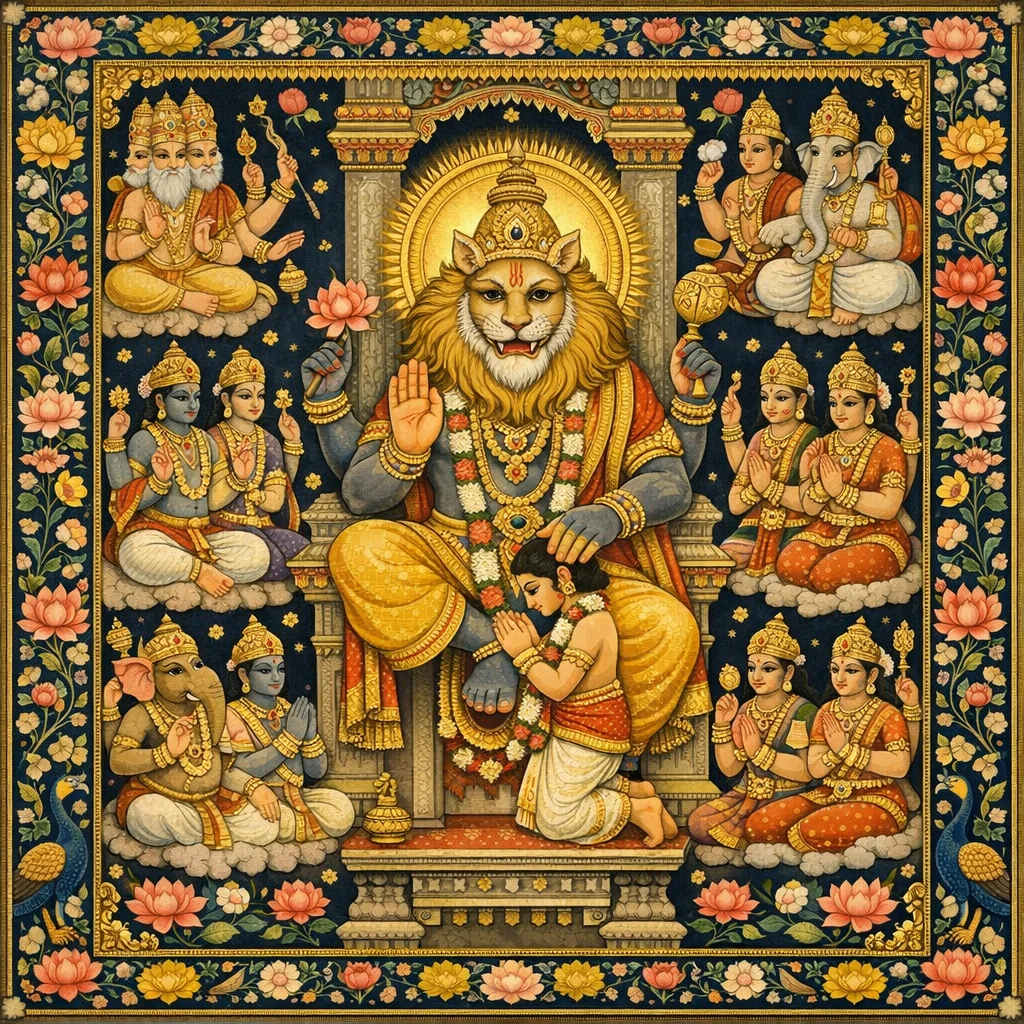
Immediately after Hiraṇyakaśipu’s death, the cosmos remains tense: Brahmā, Śiva, and the devas cannot approach the ferocious Lord Nṛsiṁha, and even Lakṣmī hesitates before His unprecedented form. Brahmā therefore sends Prahlāda forward. The child-bhakta prostrates, and the Lord’s touch grants fearlessness and instant purification, drawing Prahlāda into ecstatic samādhi. Prahlāda’s prayers unfold in a deliberate arc—humility despite his asura birth; the supremacy of bhakti over wealth, learning, or yogic power; the Lord’s self-sufficiency (service benefits the devotee); surrender beneath the crushing wheel of time; and a vision of the Lord as both transcendent and immanent cause of creation. He rejects material boons, critiques sense-driven life and merely professional “liberation practices,” and culminates in compassion, seeking deliverance not only for himself but for the suffering world. Pacified by these transcendental praises, Lord Nṛsiṁhadeva relinquishes His anger and offers Prahlāda any benediction, setting up the next movement: Prahlāda’s refusal of sense-enjoyment and his model of desireless devotion.
Shlokas
Verse 1
श्रीनारद उवाच एवं सुरादय: सर्वे ब्रह्मरुद्रपुर: सरा: । नोपैतुमशकन्मन्युसंरम्भं सुदुरासदम् ॥ १ ॥
Nārada Muni continued: Thus all the demigods, led by Lord Brahmā, Lord Rudra (Śiva), and others, did not dare to approach the Lord at that time, for His wrath was extremely fierce and difficult to face.
Verse 2
साक्षात् श्री: प्रेषिता देवैर्दृष्ट्वा तं महदद्भुतम् । अदृष्टाश्रुतपूर्वत्वात् सा नोपेयाय शङ्किता ॥ २ ॥
Because the demigods were afraid to approach, they requested Lakṣmījī to go before the Lord. But even she, seeing that great and astonishing form—never before seen or heard of—became hesitant and could not draw near.
Verse 3
प्रह्रादं प्रेषयामास ब्रह्मावस्थितमन्तिके । तात प्रशमयोपेहि स्वपित्रे कुपितं प्रभुम् ॥ ३ ॥
Thereupon Lord Brahmā addressed Prahlāda, who stood close by: “My dear son, Lord Nṛsiṁhadeva is fiercely angered at your demoniac father. Please go forward and pacify the Lord.”
Verse 4
तथेति शनकै राजन्महाभागवतोऽर्भक: । उपेत्य भुवि कायेन ननाम विधृताञ्जलि: ॥ ४ ॥
Nārada continued: “O King, though only a small boy, Prahlāda, the great devotee, accepted Brahmā’s words. He gradually approached Lord Nṛsiṁhadeva and fell to the ground, offering obeisances with folded hands.”
Verse 5
स्वपादमूले पतितं तमर्भकं विलोक्य देव: कृपया परिप्लुत: । उत्थाप्य तच्छीर्ष्ण्यदधात्कराम्बुजं कालाहिवित्रस्तधियां कृताभयम् ॥ ५ ॥
Seeing the little Prahlāda fallen at the base of His lotus feet, Lord Nṛsiṁhadeva overflowed with compassion. He lifted him up and placed His lotus hand upon the boy’s head, for that hand ever grants fearlessness to His devotees.
Verse 6
स तत्करस्पर्शधुताखिलाशुभ: सपद्यभिव्यक्तपरात्मदर्शन: । तत्पादपद्मं हृदि निर्वृतो दधौ हृष्यत्तनु: क्लिन्नहृदश्रुलोचन: ॥ ६ ॥
By the touch of Lord Nṛsiṁhadeva’s hand upon his head, Prahlāda was cleansed of all impurity and material desire. At once the vision of the Supreme Soul became manifest; his body thrilled with ecstasy, his heart overflowed with love, his eyes filled with tears, and he held the Lord’s lotus feet firmly within the core of his heart.
Verse 7
अस्तौषीद्धरिमेकाग्रमनसा सुसमाहित: । प्रेमगद्गदया वाचा तन्न्यस्तहृदयेक्षण: ॥ ७ ॥
With mind and gaze fixed in steady trance upon Hari, Lord Nṛsiṁhadeva, Prahlāda began to offer prayers. His voice faltered with love, for his heart and eyes were wholly placed upon the Lord.
Verse 8
श्रीप्रह्राद उवाच ब्रह्मादय: सुरगणा मुनयोऽथ सिद्धा: सत्त्वैकतानगतयो वचसां प्रवाहै: । नाराधितुं पुरुगुणैरधुनापि पिप्रु: किं तोष्टुमर्हति स मे हरिरुग्रजाते: ॥ ८ ॥
Prahlāda prayed: Even Brahmā, the hosts of devas, the sages and the siddhas—though one-pointed in sattva—have not yet been able to satisfy Śrī Hari, rich in countless virtues, by torrents of excellent words. What then can be said of me, born in an asura family—how could I please Him?
Verse 9
मन्ये धनाभिजनरूपतप:श्रुतौज- स्तेज:प्रभावबलपौरुषबुद्धियोगा: । नाराधनाय हि भवन्ति परस्य पुंसो भक्त्या तुतोष भगवान्गजयूथपाय ॥ ९ ॥
I think that wealth, noble birth, beauty, austerity, learning, sensory skill, brilliance, influence, strength, endeavor, intelligence, and yogic power cannot satisfy the Supreme Person. Yet Bhagavān is pleased by bhakti alone, as He was by Gajendra, the lord of elephants.
Verse 10
विप्राद् द्विषड्गुणयुतादरविन्दनाभ- पादारविन्दविमुखात् श्वपचं वरिष्ठम् । मन्ये तदर्पितमनोवचनेहितार्थ- प्राणं पुनाति स कुलं न तु भूरिमान: ॥ १० ॥
I consider a devotee—even if born as a dog-eater—who has offered mind, words, deeds, wealth, and life to the lotus feet of Padmanābha, superior to a brāhmaṇa endowed with all twelve brahminical virtues yet averse to those lotus feet. The devotee purifies his whole family, whereas the proud brāhmaṇa cannot purify even himself.
Verse 11
नैवात्मन: प्रभुरयं निजलाभपूर्णो मानं जनादविदुष: करुणो वृणीते । यद् यज्जनो भगवते विदधीत मानं तच्चात्मने प्रतिमुखस्य यथा मुखश्री: ॥ ११ ॥
The Supreme Lord is complete and satisfied in Himself; He does not seek honor from the ignorant. By His mercy, whatever reverence one offers to Bhagavān benefits the devotee—just as when one adorns the face, its reflection in a mirror also appears adorned.
Verse 12
तस्मादहं विगतविक्लव ईश्वरस्य सर्वात्मना महि गृणामि यथा मनीषम् । नीचोऽजया गुणविसर्गमनुप्रविष्ट: पूयेत येन हि पुमाननुवर्णितेन ॥ १२ ॥
Therefore, without hesitation, I shall glorify the Lord with my whole being, as far as my intelligence allows. Anyone who, driven by ignorance and māyā, has entered the flow of the guṇas and come into material life can be purified by offering prayers and by hearing the Lord’s glories.
Verse 13
सर्वे ह्यमी विधिकरास्तव सत्त्वधाम्नो ब्रह्मादयो वयमिवेश न चोद्विजन्त: । क्षेमाय भूतय उतात्मसुखाय चास्य विक्रीडितं भगवतो रुचिरावतारै: ॥ १३ ॥
O Lord, all the devas headed by Brahmā are faithful servants established in Your realm of pure goodness; therefore they are not disturbed like us. Your appearance in this fearsome form is Your own līlā for Your pleasure, and Your beautiful incarnations are always for the protection and welfare of the universe.
Verse 14
तद्यच्छ मन्युमसुरश्च हतस्त्वयाद्य मोदेत साधुरपि वृश्चिकसर्पहत्या । लोकाश्च निर्वृतिमिता: प्रतियन्ति सर्वे रूपं नृसिंह विभयाय जना: स्मरन्ति ॥ १४ ॥
O Lord Nṛsiṁhadeva, now that my father, the great demon Hiraṇyakaśipu, has been slain by You, please let Your anger subside. Even saintly persons rejoice when a scorpion or snake is killed; thus all the worlds are satisfied by this demon’s death. To be freed from fear, people will ever remember Your auspicious incarnation.
Verse 15
नाहं बिभेम्यजित तेऽतिभयानकास्य- जिह्वार्कनेत्रभ्रुकुटीरभसोग्रदंष्ट्रात् । आन्त्रस्रज: क्षतजकेशरशङ्कुकर्णा- न्निर्ह्रादभीतदिगिभादरिभिन्नखाग्रात् ॥ १५ ॥
O Ajita, unconquerable Lord, I do not fear Your terrifying mouth and tongue, Your sun-bright eyes, or Your frowning brows. I do not fear Your sharp fangs, the garland of intestines, Your blood-soaked mane, or Your high, wedge-like ears. Nor do I fear Your thunderous roar that drives elephants away, or Your nails meant to slay Your enemies.
Verse 16
त्रस्तोऽस्म्यहं कृपणवत्सल दु:सहोग्र- संसारचक्रकदनाद् ग्रसतां प्रणीत: । बद्ध: स्वकर्मभिरुशत्तम तेऽङ्घ्रिमूलं प्रीतोऽपवर्गशरणं ह्वयसे कदा नु ॥ १६ ॥
O Lord, kind to the fallen and invincible in power, I am frightened by the crushing torment of the fierce, unbearable wheel of saṁsāra. By my own karma I have been cast into the company of demons. O most exalted One, when will You, pleased with me, call me to the shelter of Your lotus feet—the supreme refuge for liberation?
Verse 17
यस्मात् प्रियाप्रियवियोगसंयोगजन्म- शोकाग्निना सकलयोनिषु दह्यमान: । दु:खौषधं तदपि दु:खमतद्धियाहं भूमन्भ्रमामि वद मे तव दास्ययोगम् ॥ १७ ॥
O Supreme Lord, by meeting and parting with pleasing and displeasing conditions, the living being burns in the fire of lamentation through every birth. The worldly “remedies” for misery are themselves misery, even more painful than the suffering. Therefore I hold that the only true medicine is dāsya-bhakti—service to You as Your servant. Please instruct me in that service.
Verse 18
सोऽहं प्रियस्य सुहृद: परदेवताया लीलाकथास्तव नृसिंह विरिञ्चगीता: । अञ्जस्तितर्म्यनुगृणन्गुणविप्रमुक्तो दुर्गाणि ते पदयुगालयहंससङ्ग: ॥ १८ ॥
O Lord Nṛsiṁhadeva, by rendering Your transcendental loving service in the company of liberated haṁsa devotees, I shall become free from the contamination of the three modes and chant Your glories, so dear to me, following the footsteps of Brahmā and his disciplic succession; thus I shall surely cross the ocean of nescience.
Verse 19
बालस्य नेह शरणं पितरौ नृसिंह नार्तस्य चागदमुदन्वति मज्जतो नौ: । तप्तस्य तत्प्रतिविधिर्य इहाञ्जसेष्ट- स्तावद्विभो तनुभृतां त्वदुपेक्षितानाम् ॥ १९ ॥
My Lord Nṛsiṁhadeva, for embodied souls bound by bodily conception and thus bereft of Your care, there is no lasting shelter here. Parents cannot always protect a child, physician and medicine cannot fully save the afflicted, and even a boat in the ocean cannot guarantee the drowning man; all such remedies are temporary and impermanent.
Verse 20
यस्मिन्यतो यर्हि येन च यस्य यस्माद् यस्मै यथा यदुत यस्त्वपर: परो वा । भाव: करोति विकरोति पृथक्स्वभाव: सञ्चोदितस्तदखिलं भवत: स्वरूपम् ॥ २० ॥
My dear Lord, in this material world everyone—great or small—acts under the influence of the three modes. The cause, place, time, substance, chosen goal, and the means to attain it are all manifestations of Your energy; and because the energy and the Energetic are non-different, all of this is truly a manifestation of You.
Verse 21
माया मन: सृजति कर्ममयं बलीय: कालेन चोदितगुणानुमतेन पुंस: । छन्दोमयं यदजयार्पितषोडशारं संसारचक्रमज कोऽतितरेत् त्वदन्य: ॥ २१ ॥
O Lord, O eternal Aja, by Your external māyā, stirred by time, You fashion the karma-laden mind for the living being; with the sanction of the modes it binds him in endless desires through the Vedic injunctions of karma-kāṇḍa and the sixteen elements. Who can cross this wheel of saṁsāra with sixteen spokes, woven of Vedic meters, without taking shelter of Your lotus feet?
Verse 22
स त्वं हि नित्यविजितात्मगुण: स्वधाम्ना कालो वशीकृतविसृज्यविसर्गशक्ति: । चक्रे विसृष्टमजयेश्वर षोडशारे निष्पीड्यमानमुपकर्ष विभो प्रपन्नम् ॥ २२ ॥
My Lord, O Aja-īśvara, by the splendor of Your own abode You eternally conquer material qualities; the powers of creation and dissolution, and even time, are under Your control. Though You have fashioned this world of sixteen constituents, You remain beyond their guṇas. I am being crushed by the wheel of time; therefore I fully surrender—please draw me into the protection of Your lotus feet.
Verse 23
दृष्टा मया दिवि विभोऽखिलधिष्ण्यपाना- मायु: श्रियो विभव इच्छति याञ्जनोऽयम् । येऽस्मत्पितु: कुपितहासविजृम्भितभ्रू- विस्फूर्जितेन लुलिता: स तु ते निरस्त: ॥ २३ ॥
O Supreme Lord, I have seen the long life, prosperity, power, and pleasures of the heavenly worlds that people desire, through the deeds of my father. When he laughed in anger and moved his eyebrows, the demigods were shattered at once; yet that very mighty father has been vanquished by You in a moment.
Verse 24
तस्मादमूस्तनुभृतामहमाशिषोऽज्ञ आयु: श्रियं विभवमैन्द्रियमाविरिञ्च्यात् । नेच्छामि ते विलुलितानुरुविक्रमेण कालात्मनोपनय मां निजभृत्यपार्श्वम् ॥ २४ ॥
Therefore, my Lord, I do not desire the boons sought by embodied beings—longevity, prosperity, power, and sensual enjoyment—from Brahmā down to the ant. You are Time itself, and by Your might You shatter them all. Please place me near Your pure devotee, that I may serve him as a sincere servant.
Verse 25
कुत्राशिष: श्रुतिसुखा मृगतृष्णिरूपा: क्वेदं कलेवरमशेषरुजां विरोह: । निर्विद्यते न तु जनो यदपीति विद्वान् कामानलं मधुलवै: शमयन्दुरापै: ॥ २५ ॥
In this world, hopes for future happiness are like a desert mirage—where is water in the desert, that is, where is happiness here? And what is this body worth? It is only a breeding ground of countless diseases. Though the learned know this, they do not become detached; unable to master the senses, they chase fleeting pleasure, as if trying to quench the fire of desire with a few rare drops of honey.
Verse 26
क्वाहं रज:प्रभव ईश तमोऽधिकेऽस्मिन् जात: सुरेतरकुले क्व तवानुकम्पा । न ब्रह्मणो न तु भवस्य न वै रमाया यन्मेऽर्पित: शिरसि पद्मकर: प्रसाद: ॥ २६ ॥
O Lord, I was born from passion and in a demoniac line steeped in ignorance—what am I? Yet how wondrous is Your causeless mercy! The grace of Your lotus hand upon the head—never bestowed even upon Brahmā, Śiva, or Goddess Lakṣmī—you have placed upon mine.
Verse 27
नैषा परावरमतिर्भवतो ननु स्या- ज्जन्तोर्यथात्मसुहृदो जगतस्तथापि । संसेवया सुरतरोरिव ते प्रसाद: सेवानुरूपमुदयो न परावरत्वम् ॥ २७ ॥
My Lord, unlike an ordinary being You do not discriminate between friend and enemy, favorable and unfavorable, for You have no notion of higher or lower. Still, You bestow Your mercy in proportion to one’s service, just as the wish-fulfilling tree yields fruit according to desire without judging high or low.
Verse 28
एवं जनं निपतितं प्रभवाहिकूपे कामाभिकाममनु य: प्रपतन्प्रसङ्गात् । कृत्वात्मसात् सुरर्षिणा भगवन्गृहीत: सोऽहं कथं नु विसृजे तव भृत्यसेवाम् ॥ २८ ॥
My dear Lord, O Supreme Personality of Godhead, because of my association with material desires, one after another, I was gradually falling into a blind well full of snakes, following the general populace. But Your servant Nārada Muni kindly accepted me as his disciple and instructed me how to achieve this transcendental position. Therefore, my first duty is to serve him. How could I leave his service?
Verse 29
मत्प्राणरक्षणमनन्त पितुर्वधश्च मन्ये स्वभृत्यऋषिवाक्यमृतं विधातुम् । खड्गं प्रगृह्य यदवोचदसद्विधित्सु- स्त्वामीश्वरो मदपरोऽवतु कं हरामि ॥ २९ ॥
My Lord, O unlimited reservoir of transcendental qualities, You have killed my father, Hiraṇyakaśipu, and saved me from his sword. He had said very angrily, “If there is any supreme controller other than me, let Him save you. I shall now sever your head from your body.” Therefore I think that both in saving me and in killing him, You have acted just to prove true the words of Your devotee. There is no other cause.
Verse 30
एकस्त्वमेव जगदेतममुष्य यत्त्व- माद्यन्तयो: पृथगवस्यसि मध्यतश्च । सृष्ट्वा गुणव्यतिकरं निजमाययेदं नानेव तैरवसितस्तदनुप्रविष्ट: ॥ ३० ॥
My dear Lord, You alone manifest Yourself as the entire cosmic manifestation, for You existed before the creation, You exist after the annihilation, and You are the maintainer between the beginning and the end. All this is done by Your external energy through actions and reactions of the three modes of material nature. Therefore whatever exists — externally and internally — is You alone.
Verse 31
त्वं वा इदं सदसदीश भवांस्ततोऽन्यो माया यदात्मपरबुद्धिरियं ह्यपार्था । यद्यस्य जन्म निधनं स्थितिरीक्षणं च तद्वैतदेव वसुकालवदष्टितर्वो: ॥ ३१ ॥
My dear Lord, O Supreme Personality of Godhead, the entire cosmic creation is caused by You, and the cosmic manifestation is an effect of Your energy. Although the entire cosmos is but You alone, You keep Yourself aloof from it. The conception of “mine and yours,” is certainly a type of illusion [māyā] because everything is an emanation from You and is therefore not different from You. Indeed, the cosmic manifestation is nondifferent from You, and the annihilation is also caused by You. This relationship between Your Lordship and the cosmos is illustrated by the example of the seed and the tree, or the subtle cause and the gross manifestation.
Verse 32
न्यस्येदमात्मनि जगद्विलयाम्बुमध्ये शेषेत्मना निजसुखानुभवो निरीह: । योगेन मीलितदृगात्मनिपीतनिद्र- स्तुर्ये स्थितो न तु तमो न गुणांश्च युङ्क्षे ॥ ३२ ॥
O my Lord, O Supreme Personality of Godhead, after the annihilation the creative energy is kept in You, who appear to sleep with half-closed eyes. Actually, however, You do not sleep like an ordinary human being, for You are always in a transcendental stage, beyond the creation of the material world, and You always feel transcendental bliss. As Kāraṇodakaśāyī Viṣṇu, You thus remain in Your transcendental status, not touching material objects. Although You appear to sleep, this sleeping is distinct from sleeping in ignorance.
Verse 33
तस्यैव ते वपुरिदं निजकालशक्त्या सञ्चोदितप्रकृतिधर्मण आत्मगूढम् । अम्भस्यनन्तशयनाद्विरमत्समाधे- र्नाभेरभूत् स्वकणिकावटवन्महाब्जम् ॥ ३३ ॥
This cosmic manifestation—the material world—is also Your body. Stirred by Your own kāla-śakti, the power of time, the laws of prakṛti move and the three guṇas become manifest. When You awaken upon Ananta-Śeṣa, a subtle transcendental seed arises from Your navel, and from that seed the lotus of the vast universe appears—just as a banyan grows from a tiny seed.
Verse 34
तत्सम्भव: कविरतोऽन्यदपश्यमान- स्त्वां बीजमात्मनि ततं स बहिर्विचिन्त्य । नाविन्ददब्दशतमप्सु निमज्जमानो जातेऽङ्कुरे कथमुहोपलभेत बीजम् ॥ ३४ ॥
From that great lotus, Brahmā—the inspired sage—was born, yet he saw nothing but the lotus itself. Thinking You to be outside, he plunged into the waters and for one hundred years searched for the lotus’s source. Still he found no trace of You, for when a seed has sprouted and borne its shoot, the original seed is no longer seen.
Verse 35
स त्वात्मयोनिरतिविस्मित आश्रितोऽब्जं कालेन तीव्रतपसा परिशुद्धभाव: । त्वामात्मनीश भुवि गन्धमिवातिसूक्ष्मं भूतेन्द्रियाशयमये विततं ददर्श ॥ ३५ ॥
Brahmā, famed as ātma-yoni for being born without a mother, was struck with wonder. Taking shelter of the lotus, and purified by severe austerities over a long span of time, he then saw You, O Lord, spread throughout his own body, senses, and inner being—just as a subtle fragrance is perceived within the earth.
Verse 36
एवं सहस्रवदनाङ्घ्रिशिर:करोरु- नासाद्यकर्णनयनाभरणायुधाढ्यम् । मायामयं सदुपलक्षितसन्निवेशं दृष्ट्वा महापुरुषमाप मुदं विरिञ्च: ॥ ३६ ॥
Brahmā then beheld You with thousands upon thousands of faces, feet, heads, hands, thighs, noses, ears, and eyes. You were exquisitely arrayed, adorned with many ornaments and divine weapons. Seeing You in the form of Lord Viṣṇu—transcendental in every mark, with legs extending to the lower worlds—Viriñca (Brahmā) attained spiritual bliss.
Verse 37
तस्मै भवान्हयशिरस्तनुवं हि बिभ्रद् वेदद्रुहावतिबलौ मधुकैटभाख्यौ । हत्वानयच्छ्रुतिगणांश्च रजस्तमश्च सत्त्वं तव प्रियतमां तनुमामनन्ति ॥ ३७ ॥
My dear Lord, when You appeared as Hayagrīva, bearing the head of a horse, You slew the two demons Madhu and Kaiṭabha, who were steeped in rajas and tamas and who had violated the Vedas. Then You restored the Vedic śrutis to Brahmā. Therefore the great saints accept Your forms as wholly transcendental, untouched by material qualities—Your most beloved body of śuddha-sattva, pure goodness.
Verse 38
इत्थं नृतिर्यगृषिदेवझषावतारै- र्लोकान् विभावयसि हंसि जगत्प्रतीपान् । धर्मं महापुरुष पासि युगानुवृत्तं छन्न: कलौ यदभवस्त्रियुगोऽथ स त्वम् ॥ ३८ ॥
O Lord, You appear in many avatāras—as man, beast, great sage, deva, fish, or tortoise—sustaining the worlds and destroying demoniac principles. According to each yuga You protect dharma; but in Kali-yuga You do not openly reveal Yourself as the Supreme Personality, and thus You are known as Triyuga, the Lord who appears in three yugas.
Verse 39
नैतन्मनस्तव कथासु विकुण्ठनाथ सम्प्रीयते दुरितदुष्टमसाधु तीव्रम् । कामातुरं हर्षशोकभयैषणार्तं तस्मिन्कथं तव गतिं विमृशामि दीन: ॥ ३९ ॥
O Lord of Vaikuṇṭha, my mind does not take delight in Your sacred narrations; it is stained by sin, wicked and fierce, tormented by lust, tossed between so-called joy and sorrow, filled with lamentation and fear, and ever craving wealth. In such a fallen state, how can I reflect upon Your path and pastimes?
Verse 40
जिह्वैकतोऽच्युत विकर्षति मावितृप्ता शिश्नोऽन्यतस्त्वगुदरं श्रवणं कुतश्चित् । घ्राणोऽन्यतश्चपलदृक् क्व च कर्मशक्ति- र्बह्व्य: सपत्न्य इव गेहपतिं लुनन्ति ॥ ४० ॥
O Acyuta, my senses pull me in many directions like numerous wives vying for the master of a house: the tongue toward tasty dishes, the genitals toward pleasure, the skin toward soft touch. The belly, though filled, still demands more; the ear, neglecting Your kathā, runs after worldly songs; the nose and restless eyes chase other objects, and the active faculties hurry elsewhere. Thus I am truly confounded.
Verse 41
एवं स्वकर्मपतितं भववैतरण्या- मन्योन्यजन्ममरणाशनभीतभीतम् । पश्यञ्जनं स्वपरविग्रहवैरमैत्रं हन्तेति पारचर पीपृहि मूढमद्य ॥ ४१ ॥
O Lord who carries us to the farther shore, by the reactions of our own deeds we have fallen into the Bhava-vaitaraṇī, trembling in fear of repeated birth and death and of dreadful sustenance. We see people entangled in friendship and enmity through bodily ego—“mine” and “theirs”—crying, “Kill!” Please cast Your merciful glance upon us foolish souls, deliver us, and maintain us.
Verse 42
को न्वत्र तेऽखिलगुरो भगवन्प्रयास उत्तारणेऽस्य भवसम्भवलोपहेतो: । मूढेषु वै महदनुग्रह आर्तबन्धो किं तेन ते प्रियजनाननुसेवतां न: ॥ ४२ ॥
O Bhagavān, the universal and original Guru, what difficulty is there for You in ferrying souls across this bondage of bhava, the very cause of birth and death? O friend of the distressed, it is the nature of the great to show mercy to the foolish. Therefore, to us who serve You as Your dear ones, You will surely grant Your causeless compassion.
Verse 43
नैवोद्विजे पर दुरत्ययवैतरण्या- स्त्वद्वीर्यगायनमहामृतमग्नचित्त: । शोचे ततो विमुखचेतस इन्द्रियार्थ मायासुखाय भरमुद्वहतो विमूढान् ॥ ४३ ॥
O best among the great souls, I do not fear this hard-to-cross material existence, like the Vaitaraṇī, for my mind is immersed in the great nectar of singing Your glories and deeds. I grieve only with compassion for the bewildered fools who, for the illusory happiness of the senses, make elaborate plans and carry the burden of family, society, and nation.
Verse 44
प्रायेण देव मुनय: स्वविमुक्तिकामा मौनं चरन्ति विजने न परार्थनिष्ठा: । नैतान्विहाय कृपणान्विमुमुक्ष एको नान्यं त्वदस्य शरणं भ्रमतोऽनुपश्ये ॥ ४४ ॥
My Lord, most sages seek only their own liberation; they practice vows of silence in lonely places and are not devoted to others’ deliverance. But I do not wish to be freed alone, abandoning these poor, foolish souls; for the wandering living beings I see no shelter other than refuge at Your lotus feet.
Verse 45
यन्मैथुनादिगृहमेधिसुखं हि तुच्छं कण्डूयनेन करयोरिव दु:खदु:खम् । तृप्यन्ति नेह कृपणा बहुदु:खभाज: कण्डूतिवन्मनसिजं विषहेत धीर: ॥ ४५ ॥
The gṛhamedhi’s pleasure of sex and the like is paltry—like rubbing one’s hands to relieve an itch: brief relief, then suffering again. The kṛpaṇas, destined for many miseries, are never satisfied by repeated sense enjoyment. But the sober dhīra tolerates this “itch” of lust and is not subjected to the pains of the foolish.
Verse 46
मौनव्रतश्रुततपोऽध्ययनस्वधर्म- व्याख्यारहोजपसमाधय आपवर्ग्या: । प्राय: परं पुरुष ते त्वजितेन्द्रियाणां वार्ता भवन्त्युत न वात्र तु दाम्भिकानाम् ॥ ४६ ॥
O Supreme Person, the practices meant for liberation—silence, vows, hearing Vedic lore, austerity, study, performing one’s svadharma, expounding the śāstras, living in seclusion, silent japa, and samādhi—often become merely a profession and livelihood for those who have not conquered their senses. For such proud hypocrites, these procedures may not succeed.
Verse 47
रूपे इमे सदसती तव वेदसृष्टे बीजाङ्कुराविव न चान्यदरूपकस्य । युक्ता: समक्षमुभयत्र विचक्षन्ते त्वां योगेन वह्निमिव दारुषु नान्यत: स्यात् ॥ ४७ ॥
By authorized Vedic knowledge one understands that the forms of cause and effect in the cosmos—being and nonbeing—belong to You, like seed and sprout, for the universe is Your energy. For the formless Absolute there is nothing separate from this. Those united in bhakti-yoga perceive You directly in both cause and effect, just as a wise man sees fire pervading wood.
Verse 48
त्वं वायुरग्निरवनिर्वियदम्बु मात्रा: प्राणेन्द्रियाणि हृदयं चिदनुग्रहश्च । सर्वं त्वमेव सगुणो विगुणश्च भूमन् नान्यत् त्वदस्त्यपि मनोवचसा निरुक्तम् ॥ ४८ ॥
O Supreme Lord, You alone are air, fire, earth, sky, and water. You are the sense objects, the life airs, the senses, the mind and heart, consciousness, and the false ego. O All-pervading One, subtle and gross—everything is You; whatever is conceived by mind or spoken by words is not apart from You.
Verse 49
नैते गुणा न गुणिनो महदादयो ये सर्वे मन: प्रभृतय: सहदेवमर्त्या: । आद्यन्तवन्त उरुगाय विदन्ति हि त्वा- मेवं विमृश्य सुधियो विरमन्ति शब्दात् ॥ ४९ ॥
O Uru-gāya, neither the three guṇas of nature nor their presiding deities, nor the mahattattva and other principles, nor the mind, nor the demigods or humans can truly understand You, for all are bound to beginning and end. Seeing this, the wise take shelter of bhakti—devotional service—and do not remain absorbed in mere study of words.
Verse 50
तत्तेऽर्हत्तम नम: स्तुतिकर्मपूजा: कर्म स्मृतिश्चरणयो: श्रवणं कथायाम् । संसेवया त्वयि विनेति षडङ्गया किं भक्तिं जन: परमहंसगतौ लभेत ॥ ५० ॥
Therefore, O Bhagavān, most worthy of all prayers, I offer my obeisances to You. Without serving You through the six limbs of bhakti—offering prayers, dedicating the fruits of work, worship, laboring for You, remembering Your lotus feet, and hearing Your glories—who can attain the devotion meant for the path of the paramahaṁsas?
Verse 51
श्रीनारद उवाच एतावद्वर्णितगुणो भक्त्या भक्तेन निर्गुण: । प्रह्रादं प्रणतं प्रीतो यतमन्युरभाषत ॥ ५१ ॥
Śrī Nārada said: Thus praised with bhakti by the devotee Prahlāda, Lord Nṛsiṁhadeva—beyond the guṇas—became pacified. Seeing Prahlāda prostrated in obeisance, He set aside His anger and, pleased, spoke as follows.
Verse 52
श्रीभगवानुवाच प्रह्राद भद्र भद्रं ते प्रीतोऽहं तेऽसुरोत्तम । वरं वृणीष्वाभिमतं कामपूरोऽस्म्यहं नृणाम् ॥ ५२ ॥
The Supreme Lord said: “Prahlāda, gentle one—may all auspiciousness be yours. O best among the asuras, I am greatly pleased with you. It is My līlā to fulfill the desires of all beings; therefore ask of Me whatever benediction you wish to be granted.”
Verse 53
मामप्रीणत आयुष्मन्दर्शनं दुर्लभं हि मे । दृष्ट्वा मां न पुनर्जन्तुरात्मानं तप्तुमर्हति ॥ ५३ ॥
My dear Prahlāda, may you live long. Without pleasing Me, no one can truly know Me; but one who has seen Me or satisfied Me need not lament again for his own fulfillment.
Verse 54
प्रीणन्ति ह्यथ मां धीरा: सर्वभावेन साधव: । श्रेयस्कामा महाभाग सर्वासामाशिषां पतिम् ॥ ५४ ॥
My dear Prahlāda, you are most fortunate. Know from Me that the wise and saintly strive to please Me with their whole being, in every devotional mood, for I am the Lord of all benedictions, the only one who can fulfill everyone’s desires.
Verse 55
श्रीनारद उवाच एवं प्रलोभ्यमानोऽपि वरैर्लोकप्रलोभनै: । एकान्तित्वाद् भगवति नैच्छत्तानसुरोत्तम: ॥ ५५ ॥
Nārada Muni said: Though the Bhagavān tempted him with boons that allure the world toward material happiness, Prahlāda, the best among the asuras, because of his single-minded Kṛṣṇa consciousness, did not desire any material gain for sense gratification.
Frequently Asked Questions
Because the Lord’s wrathful līlā-form was manifest for the immediate purpose of destroying demoniac terror and re-establishing cosmic safety. The devas, though exalted, were overawed by the unprecedented intensity of divine anger, whereas Prahlāda’s pure devotion (free from self-interest) aligned with the Lord’s inner intention—so the devotee could approach and pacify Him.
Prahlāda states that external excellences—aristocracy, beauty, education, austerity, strength, influence, and even mystic power—cannot by themselves satisfy the self-satisfied Supreme. The decisive factor is bhakti, demonstrated by examples like Gajendra. He further asserts that a devotee of any birth can purify others, while a non-devotee brāhmaṇa cannot purify even himself if proud and averse to the Lord.
Prahlāda teaches that the universe is the Lord’s energy and, in that sense, nondifferent from Him as cause and effect, yet the Lord remains aloof and unconquered by material qualities. Time (kāla) and the guṇas operate under His control; thus liberation from the mind’s entanglement is possible only by taking shelter of His lotus feet and engaging in devotional service.