Adhyaya 6
Prahlāda Instructs the Sons of Demons: Begin Bhakti from Childhood; Household Attachment as Bondage; Nārāyaṇa as the All-Pervading Supersoul
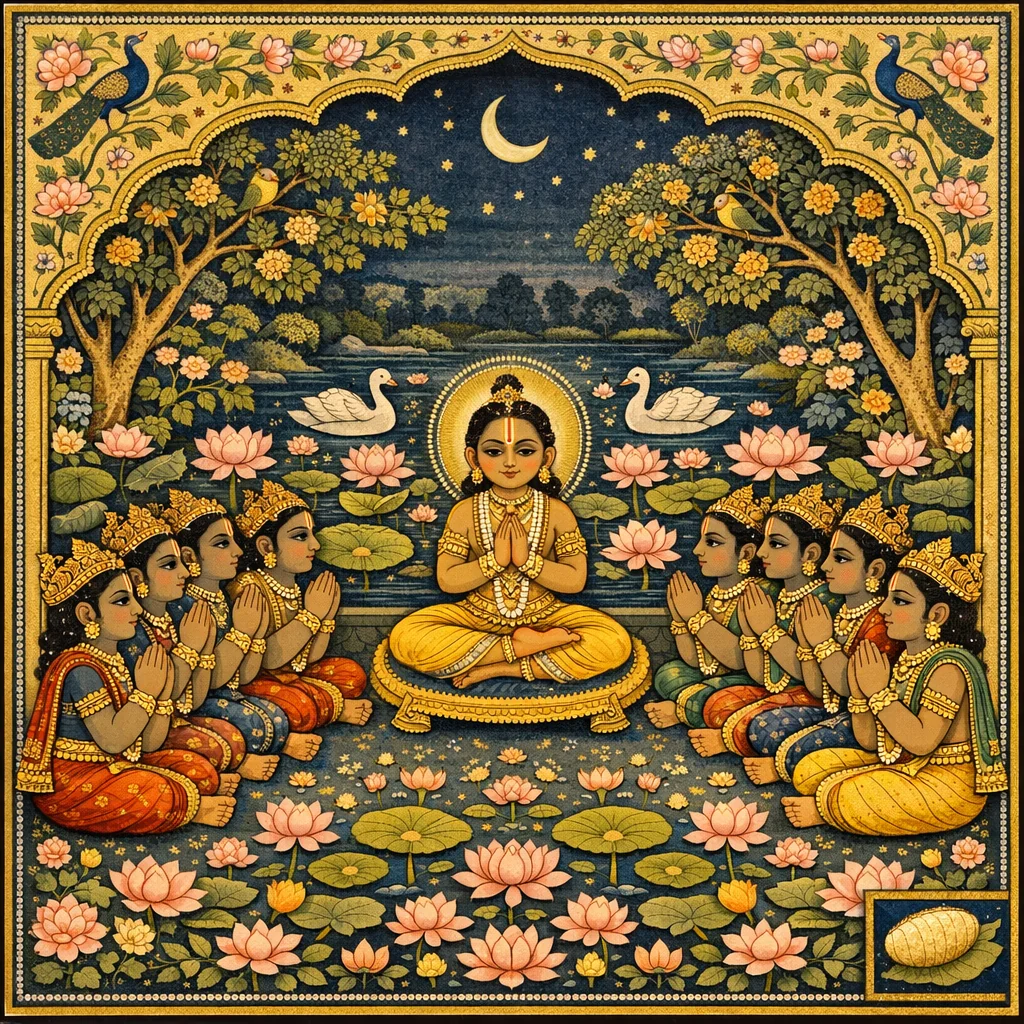
In the classroom among the sons of asuras, Prahlāda continues his unwavering bhakti and turns it into a structured sermon on the urgency of human life. He urges devotion from childhood (kaumāra ācaret), arguing that sense-pleasure is already allotted by karma and is not worth life’s best energy. He breaks down the human lifespan—sleep, childhood, play, and feeble old age—showing how uncontrolled senses make the remaining years vanish in family-absorption and money-chasing, like a silkworm spinning its own cocoon. He then shifts to ontology: Nārāyaṇa is the original Paramātmā, the all-pervading Supersoul, worshipable in any condition, present from plants to Brahmā, within the guṇas and beyond them; known as sac-cid-ānanda yet hidden from atheistic vision by māyā. Prahlāda concludes by calling for non-envious compassion and the devotional enlightenment of others, declaring dharma-artha-kāma-mokṣa secondary for devotees. The chapter ends with the boys asking how Prahlāda received Nārada’s teachings, setting up the next chapter’s account of his initiation and the transmission of bhāgavata-dharma.
Shlokas
Verse 1
श्रीप्रह्राद उवाच कौमार आचरेत्प्राज्ञो धर्मान्भागवतानिह । दुर्लभं मानुषं जन्म तदप्यध्रुवमर्थदम् ॥ १ ॥
Śrī Prahlāda said: From early childhood the wise should practice Bhāgavata-dharma—devotional service to the Lord. Human birth is rare; though temporary, it grants the highest spiritual meaning.
Verse 2
यथा हि पुरुषस्येह विष्णो: पादोपसर्पणम् । यदेष सर्वभूतानां प्रिय आत्मेश्वर: सुहृत् ॥ २ ॥
For in this human life it is fitting to approach the lotus feet of Lord Viṣṇu; He is the dearest of all beings, the Lord of the soul, and the well-wishing friend of everyone.
Verse 3
सुखमैन्द्रियकं दैत्या देहयोगेन देहिनाम् । सर्वत्र लभ्यते दैवाद्यथा दु:खमयत्नत: ॥ ३ ॥
O friends born in daitya families, the sense pleasure that arises from bodily contact with objects is obtained in any condition of life according to one’s past karma, by the arrangement of destiny—just as distress comes without endeavor.
Verse 4
तत्प्रयासो न कर्तव्यो यत आयुर्व्यय: परम् । न तथा विन्दते क्षेमं मुकुन्दचरणाम्बुजम् ॥ ४ ॥
One should not labor in ways that merely waste one’s lifespan; such striving yields no true welfare. The lotus feet of Mukunda alone bestow the supreme good and safety॥4॥
Verse 5
ततो यतेत कुशल: क्षेमाय भवमाश्रित: । शरीरं पौरुषं यावन्न विपद्येत पुष्कलम् ॥ ५ ॥
Therefore, even while dwelling in material existence, the discerning should strive for the supreme welfare, so long as the body remains strong and one’s vigor has not declined॥5॥
Verse 6
पुंसो वर्षशतं ह्यायुस्तदर्धं चाजितात्मन: । निष्फलं यदसौ रात्र्यां शेतेऽन्धं प्रापितस्तम: ॥ ६ ॥
A human life is said to span a hundred years, yet for one who cannot master the senses, half is fruitless—at night he sleeps, covered by the darkness of ignorance; thus his life is as if only fifty years॥6॥
Verse 7
मुग्धस्य बाल्ये कैशोरे क्रीडतो याति विंशति: । जरया ग्रस्तदेहस्य यात्यकल्पस्य विंशति: ॥ ७ ॥
In bewildered childhood and in playful youth, twenty years pass away; and in old age, when the body is seized by decrepitude and one is incapable, another twenty years are wasted॥7॥
Verse 8
दुरापूरेण कामेन मोहेन च बलीयसा । शेषं गृहेषु सक्तस्य प्रमत्तस्यापयाति हि ॥ ८ ॥
Driven by insatiable desire and overpowering delusion, one becomes bound to household attachment; thus the heedless person wastes even the remaining years, unable to engage in devotional service (bhakti-sevā)॥8॥
Verse 9
को गृहेषु पुमान्सक्तमात्मानमजितेन्द्रिय: । स्नेहपाशैर्दृढैर्बद्धमुत्सहेत विमोचितुम् ॥ ९ ॥
Who, unable to conquer the senses and thus attached to household life, can free himself, tightly bound by the strong ropes of affection?
Verse 10
को न्वर्थतृष्णां विसृजेत्प्राणेभ्योऽपि य ईप्सित: । यं क्रीणात्यसुभि: प्रेष्ठैस्तस्कर: सेवको वणिक् ॥ १० ॥
Who can cast off the thirst for wealth, desired even more than life itself? Thieves, hired servants/soldiers, and merchants seek it, risking their most cherished lives.
Verse 11
कथं प्रियाया अनुकम्पिताया: सङ्गं रहस्यं रुचिरांश्च मन्त्रान् । सुहृत्सु तत्स्नेहसित: शिशूनां कलाक्षराणामनुरक्तचित्त: ॥ ११ ॥ पुत्रान्स्मरंस्ता दुहितृर्हृदय्या भ्रातृन् स्वसृर्वा पितरौ च दीनौ । गृहान् मनोज्ञोरुपरिच्छदांश्च वृत्तीश्च कुल्या: पशुभृत्यवर्गान् ॥ १२ ॥ त्यजेत कोशस्कृदिवेहमान: कर्माणि लोभादवितृप्तकाम: । औपस्थ्यजैह्वं बहुमन्यमान: कथं विरज्येत दुरन्तमोह: ॥ १३ ॥
How can one whose heart is bound in deep affection to family give up their company? A beloved, compassionate wife with intimate joys and sweet words, and the charming broken speech of little children—how can such an attached mind become detached?
Verse 12
कथं प्रियाया अनुकम्पिताया: सङ्गं रहस्यं रुचिरांश्च मन्त्रान् । सुहृत्सु तत्स्नेहसित: शिशूनां कलाक्षराणामनुरक्तचित्त: ॥ ११ ॥ पुत्रान्स्मरंस्ता दुहितृर्हृदय्या भ्रातृन् स्वसृर्वा पितरौ च दीनौ । गृहान् मनोज्ञोरुपरिच्छदांश्च वृत्तीश्च कुल्या: पशुभृत्यवर्गान् ॥ १२ ॥ त्यजेत कोशस्कृदिवेहमान: कर्माणि लोभादवितृप्तकाम: । औपस्थ्यजैह्वं बहुमन्यमान: कथं विरज्येत दुरन्तमोह: ॥ १३ ॥
Remembering his sons, his heart‑dear daughters, brothers and sisters, his aged parents, the pleasing home and its furnishings, the family’s livelihood, and the animals and servants—how could he abandon all this?
Verse 13
कथं प्रियाया अनुकम्पिताया: सङ्गं रहस्यं रुचिरांश्च मन्त्रान् । सुहृत्सु तत्स्नेहसित: शिशूनां कलाक्षराणामनुरक्तचित्त: ॥ ११ ॥ पुत्रान्स्मरंस्ता दुहितृर्हृदय्या भ्रातृन् स्वसृर्वा पितरौ च दीनौ । गृहान् मनोज्ञोरुपरिच्छदांश्च वृत्तीश्च कुल्या: पशुभृत्यवर्गान् ॥ १२ ॥ त्यजेत कोशस्कृदिवेहमान: कर्माणि लोभादवितृप्तकाम: । औपस्थ्यजैह्वं बहुमन्यमान: कथं विरज्येत दुरन्तमोह: ॥ १३ ॥
Driven by greed and never‑sated desire, the attached householder is like a silkworm, weaving the cocoon of his deeds and becoming trapped within. Exalting the pleasures of genitals and tongue, how can he renounce that endless delusion?
Verse 14
कुटुम्बपोषाय वियन्निजायु र्न बुध्यतेऽर्थं विहतं प्रमत्त: । सर्वत्र तापत्रयदु:खितात्मा निर्विद्यते न स्वकुटुम्बराम: ॥ १४ ॥
One absorbed in maintaining his family does not perceive that he is squandering his precious life and that the true aim of human birth is being silently spoiled. Though afflicted by the threefold miseries, he does not grow weary of worldly existence, for he delights in his own household.
Verse 15
वित्तेषु नित्याभिनिविष्टचेता विद्वांश्च दोषं परवित्तहर्तु: । प्रेत्येह वाथाप्यजितेन्द्रियस्त- दशान्तकामो हरते कुटुम्बी ॥ १५ ॥
A householder unable to restrain his senses keeps his mind ever absorbed in wealth. Though he knows that stealing another’s riches brings punishment by the king and, after death, by Yamarāja, his restless desires drive him to cheat and take what is not his.
Verse 16
विद्वानपीत्थं दनुजा: कुटुम्बं पुष्णन्स्वलोकाय न कल्पते वै । य: स्वीयपारक्यविभिन्नभाव- स्तम: प्रपद्येत यथा विमूढ: ॥ १६ ॥
O friends, sons of the demons! In this world even the learned cling to the notion, “This is mine, that is for others,” and thus labor only to maintain their families within a narrow vision. Like cats and dogs, they do not take up spiritual knowledge; instead they are bewildered and swallowed by ignorance.
Verse 17
यतो न कश्चित् क्व च कुत्रचिद् वा दीन: स्वमात्मानमलं समर्थ: । विमोचितुं कामदृशां विहार- क्रीडामृगो यन्निगडो विसर्ग: ॥ १७ ॥ ततो विदूरात् परिहृत्य दैत्या दैत्येषु सङ्गं विषयात्मकेषु । उपेत नारायणमादिदेवं स मुक्तसङ्गैरिषितोऽपवर्ग: ॥ १८ ॥
It is certain that one who lacks true knowledge of the Supreme Lord has never, in any time or place, been able to free himself from material bondage. Addicted to sense pleasure and fixed upon woman, such people become mere playthings in the hands of alluring women and are shackled by the chains of progeny. Therefore, O sons of the demons, keep far from the company of those absorbed in sense objects, and take shelter of Nārāyaṇa, the primeval Lord, for the supreme aim of His devotees is apavarga—liberation.
Verse 18
यतो न कश्चित् क्व च कुत्रचिद् वा दीन: स्वमात्मानमलं समर्थ: । विमोचितुं कामदृशां विहार- क्रीडामृगो यन्निगडो विसर्ग: ॥ १७ ॥ ततो विदूरात् परिहृत्य दैत्या दैत्येषु सङ्गं विषयात्मकेषु । उपेत नारायणमादिदेवं स मुक्तसङ्गैरिषितोऽपवर्ग: ॥ १८ ॥
It is certain that one who lacks true knowledge of the Supreme Lord has never, in any time or place, been able to free himself from material bondage. Addicted to sense pleasure and fixed upon woman, such people become mere playthings in the hands of alluring women and are shackled by the chains of progeny. Therefore, O sons of the demons, keep far from the company of those absorbed in sense objects, and take shelter of Nārāyaṇa, the primeval Lord, for the supreme aim of His devotees is apavarga—liberation.
Verse 19
न ह्यच्युतं प्रीणयतो बह्वायासोऽसुरात्मजा: । आत्मत्वात्सर्वभूतानां सिद्धत्वादिह सर्वत: ॥ १९ ॥
O sons of the asuras, to please Acyuta Nārāyaṇa needs no great labor; He is the Paramātmā, the father of all beings, and thus in any condition one can easily worship Him with bhakti.
Verse 20
परावरेषु भूतेषु ब्रह्मान्तस्थावरादिषु । भौतिकेषु विकारेषु भूतेष्वथ महत्सु च ॥ २० ॥ गुणेषु गुणसाम्ये च गुणव्यतिकरे तथा । एक एव परो ह्यात्मा भगवानीश्वरोऽव्यय: ॥ २१ ॥ प्रत्यगात्मस्वरूपेण दृश्यरूपेण च स्वयम् । व्याप्यव्यापकनिर्देश्यो ह्यनिर्देश्योऽविकल्पित: ॥ २२ ॥ केवलानुभवानन्दस्वरूप: परमेश्वर: । माययान्तर्हितैश्वर्य ईयते गुणसर्गया ॥ २३ ॥
From the immovable beings up to Brahmā, within all material transformations, the mahat-tattva, and the balance and intermixture of the three guṇas, the one imperishable Bhagavān, the Supreme Lord, is present everywhere as Paramātmā.
Verse 21
परावरेषु भूतेषु ब्रह्मान्तस्थावरादिषु । भौतिकेषु विकारेषु भूतेष्वथ महत्सु च ॥ २० ॥ गुणेषु गुणसाम्ये च गुणव्यतिकरे तथा । एक एव परो ह्यात्मा भगवानीश्वरोऽव्यय: ॥ २१ ॥ प्रत्यगात्मस्वरूपेण दृश्यरूपेण च स्वयम् । व्याप्यव्यापकनिर्देश्यो ह्यनिर्देश्योऽविकल्पित: ॥ २२ ॥ केवलानुभवानन्दस्वरूप: परमेश्वर: । माययान्तर्हितैश्वर्य ईयते गुणसर्गया ॥ २३ ॥
That one imperishable Bhagavān, the Supreme Lord—within the guṇas, their equilibrium, and their intermixture—abides everywhere as Paramātmā; even amid diversity, His oneness shines.
Verse 22
परावरेषु भूतेषु ब्रह्मान्तस्थावरादिषु । भौतिकेषु विकारेषु भूतेष्वथ महत्सु च ॥ २० ॥ गुणेषु गुणसाम्ये च गुणव्यतिकरे तथा । एक एव परो ह्यात्मा भगवानीश्वरोऽव्यय: ॥ २१ ॥ प्रत्यगात्मस्वरूपेण दृश्यरूपेण च स्वयम् । व्याप्यव्यापकनिर्देश्यो ह्यनिर्देश्योऽविकल्पित: ॥ २२ ॥ केवलानुभवानन्दस्वरूप: परमेश्वर: । माययान्तर्हितैश्वर्य ईयते गुणसर्गया ॥ २३ ॥
He Himself is present as the inward Self (pratyag-ātmā) and also as the visible form; He is spoken of as both the pervaded and the all-pervading, yet in truth He is indescribable—nondual, changeless, and undivided.
Verse 23
परावरेषु भूतेषु ब्रह्मान्तस्थावरादिषु । भौतिकेषु विकारेषु भूतेष्वथ महत्सु च ॥ २० ॥ गुणेषु गुणसाम्ये च गुणव्यतिकरे तथा । एक एव परो ह्यात्मा भगवानीश्वरोऽव्यय: ॥ २१ ॥ प्रत्यगात्मस्वरूपेण दृश्यरूपेण च स्वयम् । व्याप्यव्यापकनिर्देश्यो ह्यनिर्देश्योऽविकल्पित: ॥ २२ ॥ केवलानुभवानन्दस्वरूप: परमेश्वर: । माययान्तर्हितैश्वर्य ईयते गुणसर्गया ॥ २३ ॥
He is the Parameśvara, the very form of sac-cid-ānanda, known only by pure realization; veiled by external māyā, His majesty is hidden, and thus to the atheist absorbed in the guṇa-created world He seems as if nonexistent.
Verse 24
तस्मात्सर्वेषु भूतेषु दयां कुरुत सौहृदम् । भावमासुरमुन्मुच्य यया तुष्यत्यधोक्षज: ॥ २४ ॥
Therefore, dear young friends born of the asuras, show mercy and goodwill to all beings. Cast off the demoniac disposition, live free from enmity and duality, and thus please Adhokṣaja, Śrī Hari, who is beyond material conception.
Verse 25
तुष्टे च तत्र किमलभ्यमनन्त आद्ये किं तैर्गुणव्यतिकरादिह ये स्वसिद्धा: । धर्मादय: किमगुणेन च काङ्क्षितेन सारं जुषां चरणयोरुपगायतां न: ॥ २५ ॥
When the infinite, original Lord—the cause of all causes—is pleased, what is unattainable for His devotees? For those beyond the guṇas, what need is there for dharma, artha, kāma, or mokṣa? We simply sing the glory of His lotus feet.
Verse 26
धर्मार्थकाम इति योऽभिहितस्त्रिवर्ग ईक्षा त्रयी नयदमौ विविधा च वार्ता । मन्ये तदेतदखिलं निगमस्य सत्यं स्वात्मार्पणं स्वसुहृद: परमस्य पुंस: ॥ २६ ॥
Dharma, artha, and kāma are described in the Vedas as the tri-varga, along with learning, Vedic rites, logic, governance and law, and various means of livelihood. I regard all these as the Veda’s external, material concerns. But self-surrender to the lotus feet of Lord Viṣṇu, the Supreme Person, is the transcendental essence.
Verse 27
ज्ञानं तदेतदमलं दुरवापमाह नारायणो नरसख: किल नारदाय । एकान्तिनां भगवतस्तदकिञ्चनानां पादारविन्दरजसाप्लुतदेहिनां स्यात् ॥ २७ ॥
This stainless knowledge is very difficult to attain—thus Nārāyaṇa, the friend of all beings, once taught Nārada. Only those who are exclusive devotees of Bhagavān, free from worldly possession, and purified by the dust of the saints’ lotus feet can realize it.
Verse 28
श्रुतमेतन्मया पूर्वं ज्ञानं विज्ञानसंयुतम् । धर्मं भागवतं शुद्धं नारदाद्देवदर्शनात् ॥ २८ ॥
Prahlāda Mahārāja said: Previously I heard this knowledge from the great sage Nārada Muni, the seer of the devas. This is the pure bhāgavata-dharma, endowed with realized understanding, and free from all material contamination.
Verse 29
श्रीदैत्यपुत्रा ऊचु: प्रह्राद त्वं वयं चापि नर्तेऽन्यं विद्महे गुरुम् । एताभ्यां गुरुपुत्राभ्यां बालानामपि हीश्वरौ ॥ २९ ॥ बालस्यान्त:पुरस्थस्य महत्सङ्गो दुरन्वय: । छिन्धि न: संशयं सौम्य स्याच्चेद्विस्रम्भकारणम् ॥ ३० ॥
The sons of the daityas said: Dear Prahlāda, neither you nor we know any guru other than Ṣaṇḍa and Amarka, the sons of Śukrācārya. We are but children, and they are our controllers.
Verse 30
श्रीदैत्यपुत्रा ऊचु: प्रह्राद त्वं वयं चापि नर्तेऽन्यं विद्महे गुरुम् । एताभ्यां गुरुपुत्राभ्यां बालानामपि हीश्वरौ ॥ २९ ॥ बालस्यान्त:पुरस्थस्य महत्सङ्गो दुरन्वय: । छिन्धि न: संशयं सौम्य स्याच्चेद्विस्रम्भकारणम् ॥ ३० ॥
For a child dwelling within the palace, association with a great saint is hard to attain. O gentle friend, dispel our doubt—how was it possible for you to hear Nārada Muni?
Frequently Asked Questions
Because human birth is rare and uniquely suited for God-realization, yet it is quickly consumed by sleep, play, and later infirmity. Prahlāda’s argument is that waiting for “later” is structurally irrational: the senses strengthen habits early, and uncontrolled senses convert the prime years into gṛha-vrata (family-obsession). Beginning bhakti early safeguards the mind and redirects life’s momentum toward Viṣṇu, where even small sincere practice yields complete perfection.
Prahlāda teaches that sense-based happiness arises by bodily contact with objects and is allotted by prior karma, appearing automatically just like distress. Therefore, extraordinary striving for artha and kāma mainly wastes the scarce human opportunity for self-realization. The recommended endeavor is for Kṛṣṇa consciousness, which yields a qualitatively different result—awakening one’s relationship with the Supreme.
Nārāyaṇa is described as the original Supersoul (Paramātmā), father of all beings, and the infallible controller. He pervades all life forms—from plants to Brahmā—and is present within the material elements, the total energy, the guṇas, the unmanifest, and even the false ego, while remaining one, changeless, and undivided. He is realized as sac-cid-ānanda, yet appears “nonexistent” to the atheist because māyā veils perception.
The silkworm spins a cocoon from its own secretion and becomes trapped inside; similarly, the conditioned soul weaves bondage through self-generated attachment—especially to tongue and genitals—creating a network of affection, possessions, and obligations that feels like shelter but functions as imprisonment. Prahlāda uses this to show that bondage is not merely imposed externally; it is constructed internally by desire and misdirected love.