Adhyaya 5
Prahlāda Rejects Demonic Diplomacy and Proclaims Navadhā Bhakti
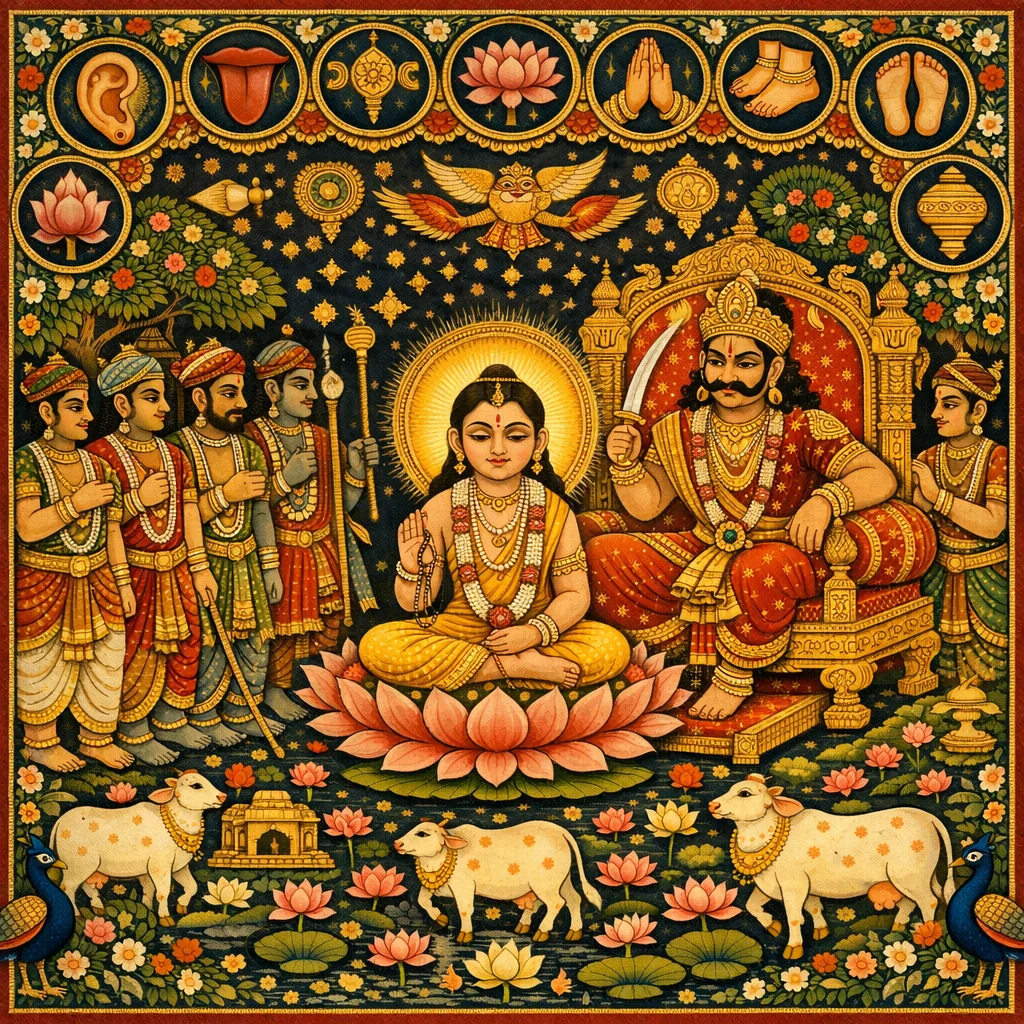
Nārada tells how Hiraṇyakaśipu appoints Śukrācārya’s sons, Ṣaṇḍa and Amarka, to educate the asura princes and sends the already-devotional Prahlāda to their gurukula. Though taught politics and economics, Prahlāda rejects their dualistic basis of friend versus enemy. When his father asks for the “best” learning, Prahlāda urges renunciation of anxious household entanglement and taking shelter of Bhagavān, pointing to Vṛndāvana as the emblem of pure Kṛṣṇa consciousness. Suspecting Vaiṣṇava “contamination,” Hiraṇyakaśipu orders strict surveillance. Questioned by the teachers, Prahlāda explains that the Lord’s external energy manufactures enmity and friendship, while bhakti grants equal vision, and he confesses an irresistible pull to Viṣṇu like iron to a magnet. The teachers, angered, intensify training in dharma-artha-kāma and present him again to his father, where Prahlāda defines the nine processes of devotion (navadhā-bhakti). Hiraṇyakaśipu repeatedly attempts to execute him, but all efforts fail as Prahlāda remains absorbed in the Lord. The chapter ends with the teachers advising restraint by Varuṇa-pāśa and renewed indoctrination, setting the stage for Prahlāda’s coming preaching to his classmates and the escalating conflict that will culminate in divine intervention.
Shlokas
Verse 1
श्रीनारद उवाच पौरोहित्याय भगवान्वृत: काव्य: किलासुरै: । षण्डामर्कौ सुतौ तस्य दैत्यराजगृहान्तिके ॥ १ ॥
Śrī Nārada said: The asuras chose Bhagavān Kāvya (Śukrācārya) as their priest for sacred rites. His two sons, Ṣaṇḍa and Amarka, dwelt near the palace of Hiraṇyakaśipu, king of the daityas.
Verse 2
तौ राज्ञा प्रापितं बालं प्रह्लादं नयकोविदम् । पाठयामासतु: पाठ्यानन्यांश्चासुरबालकान् ॥ २ ॥
The two accepted Prahlāda, the boy sent by the king and skilled in statecraft, and taught him their lessons along with the other sons of the asuras.
Verse 3
यत्तत्र गुरुणा प्रोक्तं शुश्रुवेऽनुपपाठ च । न साधु मनसा मेने स्वपरासद्ग्रहाश्रयम् ॥ ३ ॥
Prahlāda heard and repeated what his teachers spoke on politics and economy, yet he did not deem it wholesome, for it rests on the grasping notion of “friend and enemy,” “ours and theirs.”
Verse 4
एकदासुरराट् पुत्रमङ्कमारोप्य पाण्डव । पप्रच्छ कथ्यतां वत्स मन्यते साधु यद्भवान् ॥ ४ ॥
O Pāṇḍava (Yudhiṣṭhira), once the asura-king Hiraṇyakaśipu placed his son upon his lap and affectionately asked: My child, of all you have learned from your teachers, what do you consider the best?
Verse 5
श्रीप्रह्लाद उवाच तत्साधु मन्येऽसुरवर्य देहिनां सदा समुद्विग्नधियामसद्ग्रहात् । हित्वात्मपातं गृहमन्धकूपं वनं गतो यद्धरिमाश्रयेत ॥ ५ ॥
Prahlāda replied: O best of the asuras, embodied souls are ever anxious because they cling to the unreal and temporary. Household life is a dark well that brings one to ruin; therefore one should abandon it, go to the forest—especially to Vṛndāvana—and take shelter of Śrī Hari.
Verse 6
श्रीनारद उवाच श्रुत्वा पुत्रगिरो दैत्य: परपक्षसमाहिता: । जहास बुद्धिर्बालानां भिद्यते परबुद्धिभि: ॥ ६ ॥
Śrī Nārada said: Hearing Prahlāda’s words on the path of bhakti, as though he were aligned with his father’s enemies, the daitya-king Hiraṇyakaśipu laughed and said, “By the speech of the opposing side, the intelligence of children becomes spoiled.”
Verse 7
सम्यग्विधार्यतां बालो गुरुगेहे द्विजातिभि: । विष्णुपक्षै: प्रतिच्छन्नैर्न भिद्येतास्य धीर्यथा ॥ ७ ॥
Hiraṇyakaśipu instructed his men: “Guard this boy carefully in the gurukula of the twice-born teachers, so that his intelligence will not be further swayed by Vaiṣṇavas of Viṣṇu’s party who may come there in disguise.”
Verse 8
गृहमानीतमाहूय प्रह्रादं दैत्ययाजका: । प्रशस्य श्लक्ष्णया वाचा समपृच्छन्त सामभि: ॥ ८ ॥
When Hiraṇyakaśipu’s servants brought the boy Prahlāda back to the gurukula, the daitya-priests Ṣaṇḍa and Amarka pacified him. With gentle voices and affectionate words, they praised him and inquired as follows.
Verse 9
वत्स प्रह्राद भद्रं ते सत्यं कथय मा मृषा । बालानति कुतस्तुभ्यमेष बुद्धिविपर्यय: ॥ ९ ॥
“Dear son Prahlāda, may auspiciousness be yours. Do not speak falsely; speak the truth. These boys are not like you—how did this perversion of intelligence come to you? From whom did you learn such teachings?”
Verse 10
बुद्धिभेद: परकृत उताहो ते स्वतोऽभवत् । भण्यतां श्रोतुकामानां गुरूणां कुलनन्दन ॥ १० ॥
“Has this corruption of intelligence been caused by the enemies, or has it arisen from you yourself? O delight of your dynasty, we are your teachers and are eager to hear—please speak the truth.”
Verse 11
श्रीप्रह्राद उवाच पर: स्वश्चेत्यसद्ग्राह: पुंसां यन्मायया कृत: । विमोहितधियां दृष्टस्तस्मै भगवते नम: ॥ ११ ॥
Prahlāda said: By the Lord’s māyā, men’s intelligence is deluded and the false notions of “friend” and “enemy” arise. To that Bhagavān I offer my obeisances.
Verse 12
स यदानुव्रत: पुंसां पशुबुद्धिर्विभिद्यते । अन्य एष तथान्योऽहमिति भेदगतासती ॥ १२ ॥
When Bhagavān is pleased by one’s devotional service, the animal-like mentality is shattered and the false division—“he is different, I am different”—is destroyed. Then one knows: all are eternal servants of God.
Verse 13
स एष आत्मा स्वपरेत्यबुद्धिभि- र्दुरत्ययानुक्रमणो निरूप्यते । मुह्यन्ति यद्वर्त्मनि वेदवादिनो ब्रह्मादयो ह्येष भिनत्ति मे मतिम् ॥ १३ ॥
Those who always think in terms of “enemy” and “friend” cannot ascertain the Paramātmā within. Even Brahmā and other Veda-knowers are sometimes bewildered on the path of bhakti. That same Bhagavān who created this situation has given me the intelligence to stand with your so-called enemy.
Verse 14
यथा भ्राम्यत्ययो ब्रह्मन् स्वयमाकर्षसन्निधौ । तथा मे भिद्यते चेतश्चक्रपाणेर्यदृच्छया ॥ १४ ॥
O brāhmaṇa teachers, just as iron near a magnet is drawn of its own accord, so by His will my consciousness has been turned and is attracted to Viṣṇu, the wielder of the disc. Thus I have no independence.
Verse 15
श्रीनारद उवाच एतावद्ब्राह्मणायोक्त्वा विरराम महामति: । तं सन्निभर्त्स्य कुपित: सुदीनो राजसेवक: ॥ १५ ॥
Nārada said: having spoken this much to his teachers, the great-souled Prahlāda fell silent. Then those so-called brāhmaṇas, servants of the king, angrily rebuked him and, greatly distressed, spoke in order to punish him as follows.
Verse 16
आनीयतामरे वेत्रमस्माकमयशस्कर: । कुलाङ्गारस्य दुर्बुद्धेश्चतुर्थोऽस्योदितो दम: ॥ १६ ॥
Bring me a stick. This Prahlāda is ruining our name and fame. By his perverse intelligence he has become a disgrace—like a smoldering cinder—in the daitya dynasty; therefore he must now be restrained by the fourth policy, punishment (daṇḍa).
Verse 17
दैतेयचन्दनवने जातोऽयं कण्टकद्रुम: । यन्मूलोन्मूलपरशोर्विष्णोर्नालायितोऽर्भक: ॥ १७ ॥
In the sandalwood forest of the daityas, this Prahlāda has arisen like a thorn tree. To fell sandalwood one needs an axe, and thorn-wood is fit for the axe-handle. Lord Viṣṇu is the axe that cuts down the “sandalwood forest” of the demon dynasty, and Prahlāda is the handle of that axe.
Verse 18
इति तं विविधोपायैर्भीषयंस्तर्जनादिभि: । प्रह्रादं ग्राहयामास त्रिवर्गस्योपपादनम् ॥ १८ ॥
Thus Śaṇḍa and Amarka, Prahlāda Mahārāja’s teachers, tried to frighten and chastise him in various ways—rebukes and threats—and then began instructing him in the paths of dharma, artha, and kāma, the three worldly aims.
Verse 19
तत एनं गुरुर्ज्ञात्वा ज्ञातज्ञेयचतुष्टयम् । दैत्येन्द्रं दर्शयामास मातृमृष्टमलङ्कृतम् ॥ १९ ॥
After some time, the teachers Śaṇḍa and Amarka concluded that Prahlāda had learned the four policies—sāma, dāna, bheda, and daṇḍa. Then one day, after his mother had bathed him and adorned him with ornaments, they presented the boy before the daitya king Hiraṇyakaśipu.
Verse 20
पादयो: पतितं बालं प्रतिनन्द्याशिषासुर: । परिष्वज्य चिरं दोर्भ्यां परमामाप निर्वृतिम् ॥ २० ॥
When Hiraṇyakaśipu saw his child fall at his feet in obeisance, he welcomed him with blessings like an affectionate father and embraced him for a long time with both arms. In this way he felt supreme happiness.
Verse 21
आरोप्याङ्कमवघ्राय मूर्धन्यश्रुकलाम्बुभि: । आसिञ्चन् विकसद्वक्त्रमिदमाह युधिष्ठिर ॥ २१ ॥
Nārada Muni continued: O King Yudhiṣṭhira, Hiraṇyakaśipu placed Prahlāda upon his lap and smelled the child’s head. Tears of affection flowed from his eyes, moistening the boy’s blossoming, smiling face, and he spoke to his son as follows.
Verse 22
हिरण्यकशिपुरुवाच प्रह्रादानूच्यतां तात स्वधीतं किञ्चिदुत्तमम् । कालेनैतावतायुष्मन् यदशिक्षद्गुरोर्भवान् ॥ २२ ॥
Hiraṇyakaśipu said: My dear Prahlāda, my son, long-lived one, you have for so long heard and studied many things from your teachers. Now tell me what you consider the best of that learning.
Verse 23
श्रीप्रह्राद उवाच श्रवणं कीर्तनं विष्णो: स्मरणं पादसेवनम् । अर्चनं वन्दनं दास्यं सख्यमात्मनिवेदनम् ॥ २३ ॥ इति पुंसार्पिता विष्णौ भक्तिश्चेन्नवलक्षणा । क्रियेत भगवत्यद्धा तन्मन्येऽधीतमुत्तमम् ॥ २४ ॥
Prahlāda Mahārāja said: Hearing and chanting of Lord Viṣṇu, remembering Him, serving His lotus feet; worshiping Him (arcana), offering prayers and obeisances (vandana), becoming His servant (dāsya), accepting Him as one’s dearest friend (sakhya), and surrendering one’s very self (ātma-nivedana)—these nine are pure devotional service. One who dedicates life to Kṛṣṇa through these nine ways is truly the most learned, for he has attained complete knowledge.
Verse 24
श्रीप्रह्राद उवाच श्रवणं कीर्तनं विष्णो: स्मरणं पादसेवनम् । अर्चनं वन्दनं दास्यं सख्यमात्मनिवेदनम् ॥ २३ ॥ इति पुंसार्पिता विष्णौ भक्तिश्चेन्नवलक्षणा । क्रियेत भगवत्यद्धा तन्मन्येऽधीतमुत्तमम् ॥ २४ ॥
Prahlāda Mahārāja said: Hearing and chanting of Lord Viṣṇu, remembering Him, serving His lotus feet; worshiping Him, offering prayers and obeisances, becoming His servant, accepting Him as one’s dearest friend, and surrendering one’s very self—these nine are pure devotional service. One who dedicates life to Kṛṣṇa through these nine ways is the most learned, for he has attained complete knowledge.
Verse 25
निशम्यैतत्सुतवचो हिरण्यकशिपुस्तदा । गुरुपुत्रमुवाचेदं रुषा प्रस्फुरिताधर: ॥ २५ ॥
Hearing these words of devotional service from his son Prahlāda, Hiraṇyakaśipu became exceedingly angry. His lips trembling with rage, he spoke as follows to Ṣaṇḍa, the son of his guru, Śukrācārya.
Verse 26
ब्रह्मबन्धो किमेतत्ते विपक्षं श्रयतासता । असारं ग्राहितो बालो मामनादृत्य दुर्मते ॥ २६ ॥
O unqualified, most heinous son of a brāhmaṇa, you have disobeyed my order and taken shelter of the party of my enemies. You have taught this poor boy about devotional service! What is this nonsense?
Verse 27
सन्ति ह्यसाधवो लोके दुर्मैत्राश्छद्मवेषिण: । तेषामुदेत्यघं काले रोग: पातकिनामिव ॥ २७ ॥
In due course of time, various types of diseases are manifest in those who are sinful. Similarly, in this world there are many deceptive friends in false garbs, but eventually, because of their false behavior, their actual enmity becomes manifest.
Verse 28
श्रीगुरुपुत्र उवाच न मत्प्रणीतं न परप्रणीतं सुतो वदत्येष तवेन्द्रशत्रो । नैसर्गिकीयं मतिरस्य राजन् नियच्छ मन्युं कददा: स्म मा न: ॥ २८ ॥
The son of the Guru said: O enemy of Indra! Whatever your son Prahlada has said was not taught to him by me or anyone else. His devotional service is natural. Therefore, please give up your anger and do not accuse us.
Verse 29
श्रीनारद उवाच गुरुणैवं प्रतिप्रोक्तो भूय आहासुर: सुतम् । न चेद्गुरुमुखीयं ते कुतोऽभद्रासती मति: ॥ २९ ॥
Śrī Nārada Muni continued: When Hiraṇyakaśipu received this reply from the teacher, he again addressed his son Prahlāda. He said: If you have not received this education from your teachers, where have you gotten it?
Verse 30
श्रीप्रह्राद उवाच मतिर्न कृष्णे परत: स्वतो वा मिथोऽभिपद्येत गृहव्रतानाम् । अदान्तगोभिर्विशतां तमिस्रं पुन: पुनश्चर्वितचर्वणानाम् ॥ ३० ॥
Prahlāda replied: Persons addicted to materialistic life and uncontrolled senses never develop inclination toward Kṛṣṇa. They repeatedly chew that which has already been chewed and enter into darkness.
Verse 31
न ते विदु: स्वार्थगतिं हि विष्णुं दुराशया ये बहिरर्थमानिन: । अन्धा यथान्धैरुपनीयमाना- स्तेऽपीशतन्त्र्यामुरुदाम्नि बद्धा: ॥ ३१ ॥
Persons who are strongly entrapped by the consciousness of enjoying material life cannot understand that the goal of life is Lord Viṣṇu. As blind men guided by another blind man miss the right path, they are bound by the ropes of fruitive labor.
Verse 32
नैषां मतिस्तावदुरुक्रमाङ्घ्रिं स्पृशत्यनर्थापगमो यदर्थ: । महीयसां पादरजोऽभिषेकं निष्किञ्चनानां न वृणीत यावत् ॥ ३२ ॥
Unless they smear upon their bodies the dust of the lotus feet of a Vaiṣṇava completely freed from material contamination, persons cannot be attached to the lotus feet of the Lord.
Verse 33
इत्युक्त्वोपरतं पुत्रं हिरण्यकशिपू रुषा । अन्धीकृतात्मा स्वोत्सङ्गान्निरस्यत महीतले ॥ ३३ ॥
After Prahlāda Mahārāja had spoken in this way and become silent, Hiraṇyakaśipu, blinded by anger, threw him off his lap and onto the ground.
Verse 34
आहामर्षरुषाविष्ट: कषायीभूतलोचन: । वध्यतामाश्वयं वध्यो नि:सारयत नैर्ऋताः ॥ ३४ ॥
Indignant and angry, his reddish eyes like molten copper, Hiraṇyakaśipu said to his servants: O demons, take this boy away! He deserves to be killed. Kill him as soon as possible!
Verse 35
अयं मे भ्रातृहा सोऽयं हित्वा स्वान् सुहृदोऽधम: । पितृव्यहन्तु: पादौ यो विष्णोर्दासवदर्चति ॥ ३५ ॥
This boy Prahlāda is the killer of my brother, for he has given up his family to engage in the devotional service of the enemy, Lord Viṣṇu, like a menial servant.
Verse 36
विष्णोर्वा साध्वसौ किं नु करिष्यत्यसमञ्जस: । सौहृदं दुस्त्यजं पित्रोरहाद्य: पञ्चहायन: ॥ ३६ ॥
Although Prahlāda is only five years old, even at this young age he has given up his affectionate relationship with his father and mother. Therefore, he is certainly untrustworthy. Indeed, it is not at all believable that he will behave well toward Viṣṇu.
Verse 37
परोऽप्यपत्यं हितकृद्यथौषधं स्वदेहजोऽप्यामयवत्सुतोऽहित: । छिन्द्यात्तदङ्गं यदुतात्मनोऽहितं शेषं सुखं जीवति यद्विवर्जनात् ॥ ३७ ॥
Although a medicinal herb, being born in the forest, does not belong to the same category as a man, if beneficial it is kept very carefully. Similarly, if someone outside one’s family is favorable, he should be given protection like a son. On the other hand, if a limb of one’s body is poisoned by disease, it must be amputated so that the rest of the body may live happily. Similarly, even one’s own son, if unfavorable, must be rejected, although born of one’s own body.
Verse 38
सर्वैरुपायैर्हन्तव्य: सम्भोजशयनासनै: । सुहृल्लिङ्गधर: शत्रुर्मुनेर्दुष्टमिवेन्द्रियम् ॥ ३८ ॥
Just as uncontrolled senses are the enemies of all yogīs engaged in advancing in spiritual life, this Prahlāda, who appears to be a friend, is an enemy because I cannot control him. Therefore this enemy, whether eating, sitting or sleeping, must be killed by all means.
Verse 39
नैऋर्तास्ते समादिष्टा भर्त्रा वै शूलपाणय: । तिग्मदंष्ट्रकरालास्यास्ताम्रश्मश्रुशिरोरुहा: ॥ ३९ ॥ नदन्तो भैरवं नादं छिन्धि भिन्धीति वादिन: । आसीनं चाहनञ्शूलै: प्रह्रादं सर्वमर्मसु ॥ ४० ॥
The demons [Rākṣasas], the servants of Hiraṇyakaśipu, holding tridents, had fearful faces, sharp teeth and reddish, coppery beards and hair, and they appeared extremely threatening.
Verse 40
नैऋर्तास्ते समादिष्टा भर्त्रा वै शूलपाणय: । तिग्मदंष्ट्रकरालास्यास्ताम्रश्मश्रुशिरोरुहा: ॥ ३९ ॥ नदन्तो भैरवं नादं छिन्धि भिन्धीति वादिन: । आसीनं चाहनञ्शूलै: प्रह्रादं सर्वमर्मसु ॥ ४० ॥
Making a tumultuous sound, shouting, “Chop him up! Pierce him!” they began striking Prahlāda Mahārāja, who sat silently, meditating upon the Supreme Personality of Godhead.
Verse 41
परे ब्रह्मण्यनिर्देश्ये भगवत्यखिलात्मनि । युक्तात्मन्यफला आसन्नपुण्यस्येव सत्क्रिया: ॥ ४१ ॥
For one whose mind is yoked to the Supreme Bhagavān—indescribable, unchanging, and the Soul of all—even good works bear no material fruit. Therefore the demons’ weapons had no effect on Prahlāda Mahārāja, who remained undisturbed and absorbed in meditation and service to the Lord.
Verse 42
प्रयासेऽपहते तस्मिन्दैत्येन्द्र: परिशङ्कित: । चकार तद्वधोपायान्निर्बन्धेन युधिष्ठिर ॥ ४२ ॥
O King Yudhiṣṭhira, when every attempt of the demons to kill Prahlāda proved futile, their king Hiraṇyakaśipu, seized with fear, stubbornly began devising other means to slay him.
Verse 43
दिग्गजैर्दन्दशूकेन्द्रैरभिचारावपातनै: । मायाभि: सन्निरोधैश्च गरदानैरभोजनै: । हिमवाय्वग्निसलिलै: पर्वताक्रमणैरपि ॥ ४३ ॥ न शशाक यदा हन्तुमपापमसुर: सुतम् । चिन्तां दीर्घतमां प्राप्तस्तत्कर्तुं नाभ्यपद्यत ॥ ४४ ॥
By trampling him beneath great elephants, casting him among dreadful serpents, using destructive spells, hurling him from a hilltop, employing māyā and confinement, administering poison, starving him, exposing him to bitter cold, wind, fire and water, and even crushing him with heavy stones—Hiraṇyakaśipu still could not kill his sinless son. Seeing Prahlāda unharmed in every way, he fell into the deepest, longest anxiety about what to do next.
Verse 44
दिग्गजैर्दन्दशूकेन्द्रैरभिचारावपातनै: । मायाभि: सन्निरोधैश्च गरदानैरभोजनै: । हिमवाय्वग्निसलिलै: पर्वताक्रमणैरपि ॥ ४३ ॥ न शशाक यदा हन्तुमपापमसुर: सुतम् । चिन्तां दीर्घतमां प्राप्तस्तत्कर्तुं नाभ्यपद्यत ॥ ४४ ॥
Even with great elephants and dreadful serpents, with sorcery and being cast down, with māyā and confinement, with poison and starvation, with cold, wind, fire and water, and even with crushing assaults like mountains—when the asura still could not kill his sinless son, he fell into a long, consuming anxiety, unable to decide what to do next.
Verse 45
एष मे बह्वसाधूक्तो वधोपायाश्च निर्मिता: । तैस्तैर्द्रोहैरसद्धर्मैर्मुक्त: स्वेनैव तेजसा ॥ ४५ ॥
Hiraṇyakaśipu thought: “I have hurled many vile words at Prahlāda and devised many ways to kill him, yet by his own tejas he has slipped free of these treacheries and acts of adharma, untouched in the least.”
Verse 46
वर्तमानोऽविदूरे वै बालोऽप्यजडधीरयम् । न विस्मरति मेऽनार्यं शुन: शेप इव प्रभु: ॥ ४६ ॥
Although he is very near to me and is merely a child, he is situated in complete fearlessness. He resembles a dog’s curved tail, which can never be straightened, because he never forgets my misbehavior and his connection with his master, Lord Viṣṇu.
Verse 47
अप्रमेयानुभावोऽयमकुतश्चिद्भयोऽमर: । नूनमेतद्विरोधेन मृत्युर्मे भविता न वा ॥ ४७ ॥
I can see that this boy’s strength is unlimited, for he has not feared any of my punishments. He appears immortal. Therefore, because of my enmity toward him, I shall die. Or maybe this will not take place.
Verse 48
इति तच्चिन्तया किञ्चिन्म्लानश्रियमधोमुखम् । षण्डामर्कावौशनसौ विविक्त इति होचतु: ॥ ४८ ॥
Thinking in this way, the King of the Daityas, morose and bereft of bodily luster, remained silent with his face downward. Then Ṣaṇḍa and Amarka, the two sons of Śukrācārya, spoke to him in secret.
Verse 49
जितं त्वयैकेन जगत्त्रयं भ्रुवोर् विजृम्भणत्रस्तसमस्तधिष्ण्यपम् । न तस्य चिन्त्यं तव नाथ चक्ष्वहे न वै शिशूनां गुणदोषयो: पदम् ॥ ४९ ॥
O lord, we know that when you simply move your eyebrows, all the commanders of the various planets are most afraid. Without the help of any assistant, you have conquered all the three worlds. Therefore, we do not find any reason for you to be morose and full of anxiety. As for Prahlāda, he is nothing but a child and cannot be a cause of anxiety. After all, his bad or good qualities have no value.
Verse 50
इमं तु पाशैर्वरुणस्य बद्ध्वा निधेहि भीतो न पलायते यथा । बुद्धिश्च पुंसो वयसार्यसेवया यावद्गुरुर्भार्गव आगमिष्यति ॥ ५० ॥
Until the return of our spiritual master, Śukrācārya, arrest this child with the ropes of Varuṇa so that he will not flee in fear. In any case, by the time he is somewhat grown up and has assimilated our instructions or served our spiritual master, he will change in his intelligence. Thus there need be no cause for anxiety.
Verse 51
तथेति गुरुपुत्रोक्तमनुज्ञायेदमब्रवीत् । धर्मो ह्यस्योपदेष्टव्यो राज्ञां यो गृहमेधिनाम् ॥ ५१ ॥
Having heard the words of Ṣaṇḍa and Amarka, the sons of his guru, Hiraṇyakaśipu assented and said: “Teach Prahlāda the dharma of worldly duty followed by royal householders.”
Verse 52
धर्ममर्थं च कामं च नितरां चानुपूर्वश: । प्रह्रादायोचतू राजन्प्रश्रितावनताय च ॥ ५२ ॥
Thereafter, O King, Ṣaṇḍa and Amarka taught the very humble and obedient Prahlāda, in strict sequence and without pause, about worldly dharma, artha, and kāma.
Verse 53
यथा त्रिवर्गं गुरुभिरात्मने उपशिक्षितम् । न साधु मेने तच्छिक्षां द्वन्द्वारामोपवर्णिताम् ॥ ५३ ॥
Ṣaṇḍa and Amarka taught Prahlāda the tri-varga—dharma, artha, and kāma—but Prahlāda did not accept that training as wholesome, for it rests on worldly duality and entangles one in birth, death, old age, and disease.
Verse 54
यदाचार्य: परावृत्तो गृहमेधीयकर्मसु । वयस्यैर्बालकैस्तत्र सोपहूत: कृतक्षणै: ॥ ५४ ॥
When the teachers went home to attend to household affairs, the boys of Prahlāda’s age would use the leisure time to call him out to play.
Verse 55
अथ ताञ्श्लक्ष्णया वाचा प्रत्याहूय महाबुध: । उवाच विद्वांस्तन्निष्ठां कृपया प्रहसन्निव ॥ ५५ ॥
Then Prahlāda Mahārāja, truly the most learned, called his classmates with gentle words; out of compassion, as if smiling, he began to teach them the futility of the materialistic way of life and spoke as follows.
Verse 56
ते तु तद्गौरवात्सर्वे त्यक्तक्रीडापरिच्छदा: । बाला अदूषितधियो द्वन्द्वारामेरितेहितै: ॥ ५६ ॥ पर्युपासत राजेन्द्र तन्न्यस्तहृदयेक्षणा: । तानाह करुणो मैत्रो महाभागवतोऽसुर: ॥ ५७ ॥
O King, out of reverence and affection for Prahlāda Mahārāja, all the boys abandoned their playthings; their tender minds, not yet tainted by teachers attached to condemned duality and bodily comfort, surrounded him, sat down to hear, and fixed their hearts and eyes upon him with earnest attention.
Verse 57
ते तु तद्गौरवात्सर्वे त्यक्तक्रीडापरिच्छदा: । बाला अदूषितधियो द्वन्द्वारामेरितेहितै: ॥ ५६ ॥ पर्युपासत राजेन्द्र तन्न्यस्तहृदयेक्षणा: । तानाह करुणो मैत्रो महाभागवतोऽसुर: ॥ ५७ ॥
Prahlāda, compassionate and friendly—though born in an asura line yet a great Bhāgavata—wishing their welfare, addressed them and began to teach the futility of materialistic life.
Frequently Asked Questions
Prahlāda’s recitation of śravaṇa, kīrtana, smaraṇa, pāda-sevana, arcana, vandana, dāsya, sakhya, and ātma-nivedana establishes bhakti as complete knowledge (pūrṇa-jñāna) and the highest curriculum, directly opposing the asuric program of artha-nīti and sense enjoyment. In Bhāgavata theology, this moment publicly reveals the devotee’s siddhānta within the enemy’s court, making the coming persecution a test that will display poṣaṇa—Bhagavān’s invincible protection.
Prahlāda attributes friend/enemy distinctions to the Lord’s external energy (bahiraṅgā-śakti) that deludes conditioned intelligence into duality. When devotion pleases Bhagavān, one becomes paṇḍita-like—seeing all beings as servants of God—thereby dissolving enmity-based identity and revealing the Supersoul as the true inner guide.
The narrative frames the failure as the outcome of Prahlāda’s unwavering absorption in the unchangeable Supreme, beyond material sense perception. The chapter explicitly links efficacy to spiritual standing: actions lacking real spiritual assets do not yield intended results, whereas bhakti situates the devotee under divine protection (poṣaṇa), rendering material violence impotent.
Ṣaṇḍa and Amarka are Śukrācārya’s sons serving as court priests and educators for the asuras. Literarily, they represent institutionalized learning aligned with power—training in dharma-artha-kāma and statecraft—contrasted with Prahlāda’s transcendent bhakti that cannot be produced by coercive pedagogy or political ideology.