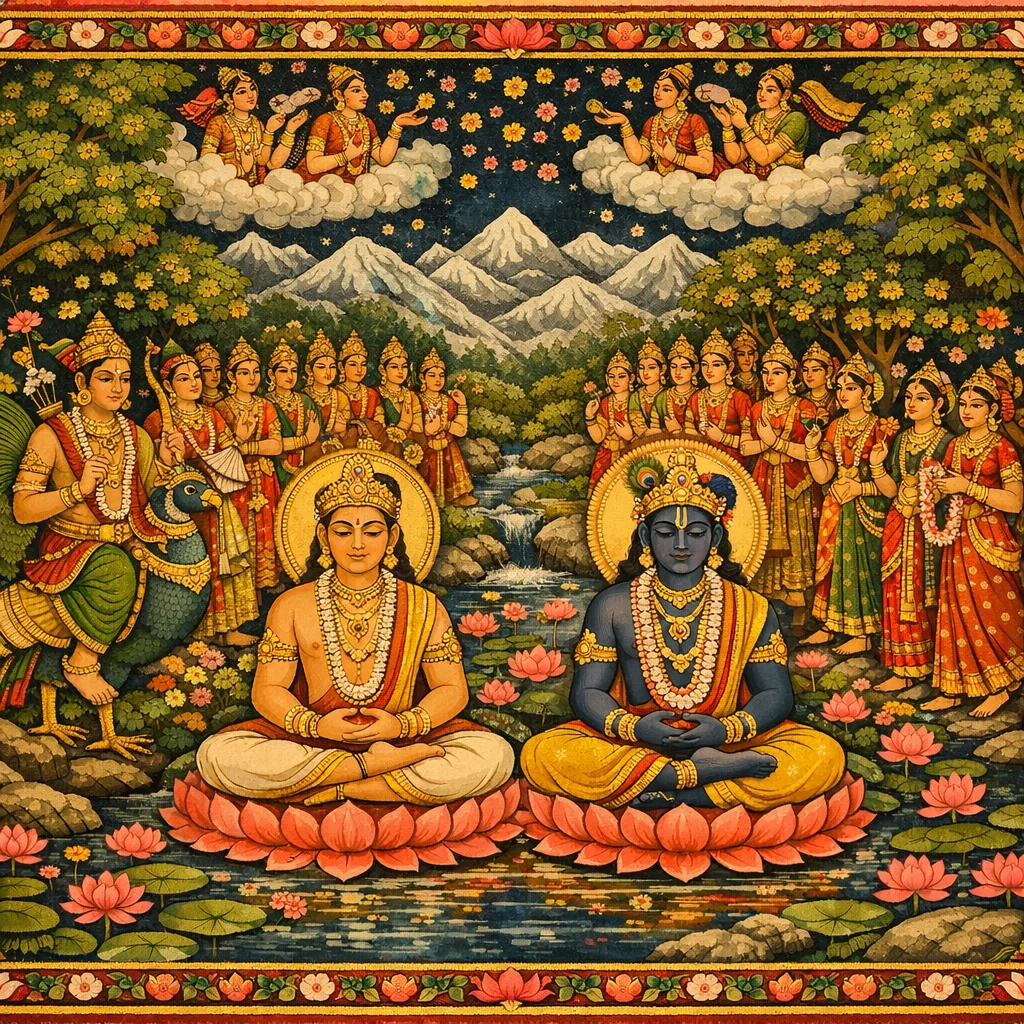
Adhyaya 4
Nara-Nārāyaṇa Ṛṣi and the Lord’s Unlimited Incarnations
Continuing King Nimi’s inquiry into the Lord’s descents, Śrī Drumila first sets an epistemic limit: Bhagavān’s guṇas and līlās are unlimited and cannot be fully enumerated. He then places avatāra-kathā within the cosmic order by describing the Puruṣa entering the universal body and the functional triad—Brahmā (rajas/creation), Viṣṇu (sattva/maintenance), and Rudra (tamas/dissolution). From this frame he recounts the Nara–Nārāyaṇa Ṛṣi episode at Badarikāśrama: Indra, fearing loss of status, sends Kāma and celestial companions to tempt them, but the Lord responds with humility and compassion, nullifies the temptation, and reveals superior opulence by manifesting incomparable attendants, from whom Urvaśī is chosen. The chapter then expands into a catalogue of major avatāras (Haṁsa, Dattātreya, the Kumāras, Ṛṣabhadeva; Matsya, Varāha, Kūrma, Nṛsiṁha, Vāmana, Paraśurāma, Rāma, Buddha, Kalki), linking divine interventions across past, present, and future. Thus it moves from a specific example of poṣaṇa (protection and grace) to a panoramic, manvantara-oriented theology, preparing for deeper teaching on bhakti’s supremacy over demigod-dependent aspirations.
Shlokas
Verse 1
श्रीराजोवाच यानि यानीह कर्माणि यैर्यै: स्वच्छन्दजन्मभि: । चक्रे करोति कर्ता वा हरिस्तानि ब्रुवन्तु न: ॥ १ ॥
King Nimi said: The Supreme Personality of Godhead descends into this world by His internal potency and according to His own desire. Therefore, please tell us of the various līlās Lord Hari has performed in the past, performs now, and will perform in the future in this world through His many incarnations.
Verse 2
श्रीद्रुमिल उवाच यो वा अनन्तस्य गुणाननन्ता- ननुक्रमिष्यन् स तु बालबुद्धि: । रजांसि भूमेर्गणयेत् कथञ्चित् कालेन नैवाखिलशक्तिधाम्न: ॥ २ ॥
Śrī Drumila said: Anyone who tries to enumerate or fully describe the unlimited qualities of the unlimited Supreme Lord has the intelligence of a foolish child. Even if a great genius, after a long endeavor, could count all the particles of dust upon the earth, he could never count the enchanting qualities of Bhagavān, the abode of all potencies.
Verse 3
भूतैर्यदा पञ्चभिरात्मसृष्टै: पुरं विराजं विरचय्य तस्मिन् । स्वांशेन विष्ट: पुरुषाभिधान- मवाप नारायण आदिदेव: ॥ ३ ॥
When the primeval Lord Nārāyaṇa fashioned the universal body (Virāṭ) from the five elements born of Himself and then entered it by His own plenary portion, He became known as the Puruṣa.
Verse 4
यत्काय एष भुवनत्रयसन्निवेशो यस्येन्द्रियैस्तनुभृतामुभयेन्द्रियाणि । ज्ञानं स्वत: श्वसनतो बलमोज ईहा सत्त्वादिभि: स्थितिलयोद्भव आदिकर्ता ॥ ४ ॥
Within His body the three worlds are exquisitely arranged. From His transcendental senses arise the knowing and working senses of all embodied beings. From His consciousness comes conditioned knowledge, and from His mighty breathing come bodily strength, sensory power, and conditioned endeavor. Acting through the modes of goodness, passion, and ignorance, He is the prime mover by whom the universe is created, maintained, and dissolved.
Verse 5
आदावभूच्छतधृती रजसास्य सर्गे विष्णु: स्थितौ क्रतुपतिर्द्विजधर्मसेतु: । रुद्रोऽप्ययाय तमसा पुरुष: स आद्य इत्युद्भवस्थितिलया: सततं प्रजासु ॥ ५ ॥
In the beginning, for creation, the original Supreme Lord manifested Brahmā (Śatadhṛti) through the mode of passion. For maintenance He manifested as Viṣṇu, Lord of sacrifice and protector of the dharma of the twice-born. And at the time of dissolution, employing the mode of ignorance, that same Supreme Lord manifests as Rudra. Thus created beings are ever subject to the forces of creation, preservation, and destruction.
Verse 6
धर्मस्य दक्षदुहितर्यजनिष्ट मूर्त्यां नारायणो नर ऋषिप्रवर: प्रशान्त: । नैष्कर्म्यलक्षणमुवाच चचार कर्म योऽद्यापि चास्त ऋषिवर्यनिषेविताङ्घ्रि: ॥ ६ ॥
Nara-Nārāyaṇa Ṛṣi, perfectly peaceful and the foremost of sages, was born as the son of Dharma and his wife Mūrti, Dakṣa’s daughter. He taught devotion (bhakti) to the Lord, by which material work comes to an end, and He Himself practiced it flawlessly. He lives even today, His lotus feet served by the greatest saints.
Verse 7
इन्द्रो विशङ्क्य मम धाम जिघृक्षतीति कामं न्ययुङ्क्त सगणं स बदर्युपाख्यम् । गत्वाप्सरोगणवसन्तसुमन्दवातै: स्त्रीप्रेक्षणेषुभिरविध्यदतन्महिज्ञ: ॥ ७ ॥
Indra grew fearful, thinking that Nara-Nārāyaṇa Ṛṣi would become immensely powerful by severe penance and seize his heavenly realm. Thus, unaware of the transcendental glory of the Lord’s incarnation, he sent Cupid with his companions to the Lord’s abode at Badarikāśrama. There, fragrant gentle spring breezes and hosts of apsarās fashioned a sensuous mood, and Cupid assailed the Lord with arrows in the form of the irresistible glances of beautiful women.
Verse 8
विज्ञाय शक्रकृतमक्रममादिदेव: प्राह प्रहस्य गतविस्मय एजमानान् । मा भैष्टभो मदन मारुत देववध्वो गृह्णीत नो बलिमशून्यमिमं कुरुध्वम् ॥ ८ ॥
The primeval Lord, understanding Indra’s offense, did not grow proud. Smiling, He spoke to trembling Madana, the wind-god, and the wives of the demigods: “Do not fear. Accept these offerings, and sanctify My āśrama by your presence.”
Verse 9
इत्थं ब्रुवत्यभयदे नरदेव देवा: सव्रीडनम्रशिरस: सघृणं तमूचु: । नैतद् विभो त्वयि परेऽविकृते विचित्रं स्वारामधीरनिकरानतपादपद्मे ॥ ९ ॥
O King Nimi, when Nara-Nārāyaṇa Ṛṣi spoke thus, removing the demigods’ fear, they bowed their heads in shame and, seeking His mercy, said: “O Lord, You are supreme and unchanging, beyond illusion. Your causeless compassion, even after our offense, is not surprising, for countless serene sages bow at Your lotus feet.”
Verse 10
त्वां सेवतां सुरकृता बहवोऽन्तराया: स्वौको विलङ्घ्य परमं व्रजतां पदं ते । नान्यस्य बर्हिषि बलीन् ददत: स्वभागान् धत्ते पदं त्वमविता यदि विघ्नमूर्ध्नि ॥ १० ॥
The demigods place many obstacles before those who worship You to rise beyond the demigods’ temporary abodes and reach Your supreme realm. Those who merely give the demigods their allotted shares in sacrifice face no such hindrance. Yet because You directly protect Your devotee, he can step over any obstacle they set, as if upon its head.
Verse 11
क्षुत्तृट्त्रिकालगुणमारुतजैह्वशैष्णा- नस्मानपारजलधीनतितीर्य केचित् । क्रोधस्य यान्ति विफलस्य वशं पदे गो- र्मज्जन्ति दुश्चरतपश्च वृथोत्सृजन्ति ॥ ११ ॥
Some perform severe austerities to cross beyond our influence—an immeasurable ocean whose waves are hunger, thirst, heat, cold, the changes of time, the winds of the senses, and the urges of tongue and sex. Yet even after crossing that ocean, they fall under useless anger and drown in a puddle no bigger than a cow’s hoofprint, thus squandering the fruit of their hard penance.
Verse 12
इति प्रगृणतां तेषां स्त्रियोऽत्यद्भुरतदर्शना: । दर्शयामास शुश्रूषां स्वर्चिता: कुर्वतीर्विभु: ॥ १२ ॥
As the demigods thus praised the Supreme Lord, the all-powerful Lord suddenly revealed before their eyes many women of astonishing beauty, adorned with fine garments and ornaments, all faithfully engaged in His service.
Verse 13
ते देवानुचरा दृष्ट्वा स्त्रिय: श्रीरिव रूपिणी: । गन्धेन मुमुहुस्तासां रूपौदार्यहतश्रिय: ॥ १३ ॥
When the demigods’ attendants beheld those women, beautiful like Śrī herself, and inhaled the fragrance of their bodies, their minds became bewildered. Before such beauty and grandeur, their own opulence was utterly eclipsed.
Verse 14
तानाह देवदेवेश: प्रणतान् प्रहसन्निव । आसामेकतमां वृङ्ध्वं सवर्णां स्वर्गभूषणाम् ॥ १४ ॥
The Lord of lords smiled gently and said to the heavenly emissaries bowing before Him, “Choose from among these women the one you deem suitable; she will become an ornament of the celestial worlds.”
Verse 15
ओमित्यादेशमादाय नत्वा तं सुरवन्दिन: । उर्वशीमप्सर:श्रेष्ठां पुरस्कृत्य दिवं ययु: ॥ १५ ॥
Chanting the sacred syllable “Om” to accept the order, the demigods’ servants bowed to Him. They then chose Urvaśī, the finest of the Apsarās, placed her respectfully before them, and returned to heaven.
Verse 16
इन्द्रायानम्य सदसि शृण्वतां त्रिदिवौकसाम् । ऊचुर्नारायणबलं शक्रस्तत्रास विस्मित: ॥ १६ ॥
They reached Indra’s assembly and, as the residents of the three heavens listened, described to him the supreme power of Nārāyaṇa. Hearing of Nara-Nārāyaṇa Ṛṣi and realizing his offense, Indra was both frightened and astonished.
Verse 17
हंसस्वरूप्यवददच्युत आत्मयोगं दत्त: कुमार ऋषभो भगवान् पिता न: । विष्णु: शिवाय जगतां कलयावतीर्ण- स्तेनाहृता मधुभिदा श्रुतयोहयास्ये ॥ १७ ॥
The infallible Supreme Lord Viṣṇu descends for the welfare of all worlds through partial incarnations such as Lord Haṁsa, Dattātreya, the four Kumāras, and our own father, the mighty Ṛṣabhadeva, thereby teaching the sacred science of ātma-yoga, self-realization. As Hayagrīva He slew the demon Madhu and restored the Vedas from Pātāla.
Verse 18
गुप्तोऽप्यये मनुरिलौषधयश्च मात्स्ये क्रौडे हतो दितिज उद्धरताम्भस: क्ष्माम् । कौर्मे धृतोऽद्रिरमृतोन्मथने स्वपृष्ठे ग्राहात् प्रपन्नमिभराजममुञ्चदार्तम् ॥ १८ ॥
As Matsya, the Lord protected Satyavrata Manu, the earth, and her precious herbs from the waters of annihilation. As Varaha, He slew Hiranyaksha, Diti’s son, and lifted the earth from the universal flood. As Kurma, He bore Mount Mandara upon His back so the ocean could be churned and nectar arise. And He delivered the surrendered elephant-king Gajendra from the dreadful torment of the crocodile’s grip.
Verse 19
संस्तुन्वतो निपतितान् श्रमणानृषींश्च शक्रं च वृत्रवधतस्तमसि प्रविष्टम् । देवस्त्रियोऽसुरगृहे पिहिता अनाथा जघ्नेऽसुरेन्द्रमभयाय सतां नृसिंहे ॥ १९ ॥
The Lord rescued the tiny ascetic sages called the Vālakhilyas when they fell into the water of a cow’s hoofprint and Indra mocked them. He then protected Indra when darkness covered him as the sinful reaction for killing Vṛtrāsura. When the wives of the demigods were imprisoned in the demons’ palace, helpless and without shelter, the Lord delivered them. And as Nṛsiṁha, to grant fearlessness to His saintly devotees, He slew the demon-king Hiraṇyakaśipu.
Verse 20
देवासुरे युधि च दैत्यपतीन् सुरार्थे हत्वान्तरेषु भुवनान्यदधात् कलाभि: । भूत्वाथ वामन इमामहरद् बले: क्ष्मां याच्ञाच्छलेन समदाददिते: सुतेभ्य: ॥ २० ॥
In the wars between devas and asuras, the Supreme Lord uses the conflict to slay the demon leaders for the sake of the devas, and in each manvantara He protects the worlds through His many empowered incarnations. He then appeared as Vāmana and, on the pretext of begging three steps of land from Bali Mahārāja, took the entire earth by that artful request. Thereafter He returned the whole world to the sons of Aditi.
Verse 21
नि:क्षत्रियामकृत गां च त्रि:सप्तकृत्वो रामस्तु हैहयकुलाप्ययभार्गवाग्नि: । सोऽब्धिं बबन्ध दशवक्त्रमहन् सलङ्कं सीतापतिर्जयति लोकमलघ्नकीर्ति: ॥ २१ ॥
As Paraśurāma, born in the line of Bhṛgu like a consuming fire, the Lord burned the Haihaya dynasty to ashes and thus made the earth bereft of kṣatriyas twenty-one times. The same Lord appeared as Rāmacandra, husband of Sītādevī: He bridged the ocean and slew the ten-headed Rāvaṇa along with the hosts of Laṅkā. May that Śrī Rāma—whose fame destroys the world’s defilement—ever be victorious.
Verse 22
भूमेर्भरावतरणाय यदुष्वजन्मा जात: करिष्यति सुरैरपि दुष्कराणि । वादैर्विमोहयति यज्ञकृतोऽतदर्हान् शूद्रान् कलौ क्षितिभुजो न्यहनिष्यदन्ते ॥ २२ ॥
To lighten the burden of the earth, the unborn Lord will take birth in the Yadu dynasty and perform deeds difficult even for the devas. As Buddha, He will bewilder those unworthy of Vedic sacrifice by teachings of argument and speculation. And at the end of Kali-yuga, as Kalki, He will destroy the base, śūdra-natured men who pose as rulers.
Verse 23
एवंविधानि कर्माणि जन्मानि च जगत्पते: । भूरीणि भूरियशसो वर्णितानि महाभुज ॥ २३ ॥
O mighty-armed King, the appearances and divine deeds of the Lord of the universe are countless; the Supreme Lord’s glories are truly unlimited.
Frequently Asked Questions
Indra’s fear arises from attachment to position and the common demigod anxiety that extraordinary tapas may threaten celestial sovereignty. The episode illustrates that worldly status (even heavenly) is insecure, and that the Lord’s incarnation remains untouched by temptation, responding not with anger but with compassion—thereby exposing Indra’s misunderstanding of Bhagavān’s transcendence.
It shows that mere austerity can be undermined by pride or anger, whereas devotion grounded in humility is protected by the Lord (poṣaṇa). Nara-Nārāyaṇa demonstrates mastery over sense agitation and simultaneously exhibits mercy toward offenders, presenting saintliness as both inner restraint and outward compassion.
Urvaśī is the foremost Apsarā chosen by the demigods’ servants from among the Lord-manifested women. Her selection underscores the Lord’s supremacy: He can produce beauty and opulence surpassing heaven, thereby humbling celestial pride and demonstrating that all splendor ultimately rests in Nārāyaṇa.
The passage frames cosmic administration as guṇa-mediated functions of the one Supreme Person, preventing a sectarian or polytheistic misreading. It aligns sarga/sthāna/nirodha processes to Bhagavān as the ultimate cause, while showing that the devas operate within His potency rather than independently.
Because Bhagavān is ananta (unlimited), and His attributes and līlās expand without exhaustion. The statement is not anti-intellectual; it is a devotional epistemology that redirects the listener from totalizing enumeration to reverent hearing (śravaṇa) and realized relationship through bhakti.
Haṁsa, Dattātreya, the four Kumāras, Ṛṣabhadeva, Hayagrīva, Matsya, Varāha, Kūrma, the deliverer of Gajendra, Nṛsiṁha, Vāmana, Paraśurāma, Rāmacandra, Buddha, and Kalki—presented as representative, not exhaustive, examples of the Lord’s limitless descents.