Adhyaya 28
Nondual Vision Beyond Praise and Blame (Dvandva-nivṛtti and Ātma-viveka)
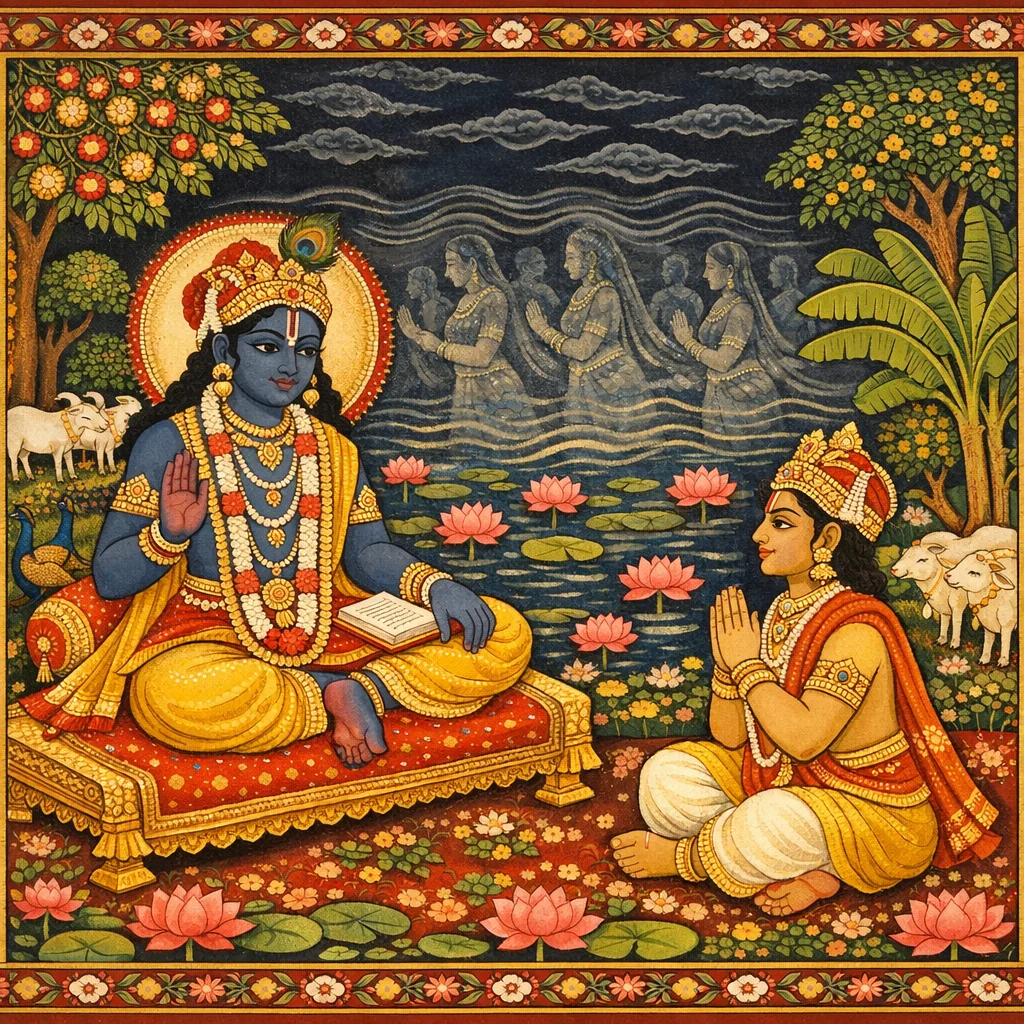
Continuing the Lord Kṛṣṇa’s gradual instruction of Uddhava in steady knowledge and bhakti, this chapter sharpens the practical use of nondual vision: one should avoid praising or blaming others, for such involvement binds the mind in dvandva (material dualities). Kṛṣṇa explains that what material speech and mind can grasp is not ultimate; thus good and bad within name-and-form are relative and immeasurable. Through images of dream, deep sleep, shadows, echoes, and mirages, He shows how false identification with body, mind, and ego produces fear up to death, though the ātman remains untouched. Uddhava raises a key doubt: if the soul is the seer and the body inert, who experiences saṁsāra? The Lord replies that bondage lasts as long as attraction to body and senses continues; fear and grief belong to the false ego, not the pure self. True jñāna is described as discrimination supported by śāstra, guru, tapas, and reasoning, culminating in the realization that the Absolute alone exists before, during, and after creation. The chapter warns sādhakas to avoid guṇa-association until passion is fully removed by bhakti; imperfect yogīs may relapse or face obstacles, yet their progress is carried forward. It concludes by criticizing obsession with bodily siddhis and recommending constant remembrance, hearing and chanting the Holy Name, and following mahā-yogīs—assuring that one who takes shelter of Kṛṣṇa remains undefeated by obstacles and free from hankering.
Shlokas
Verse 1
श्रीभगवानुवाच परस्वभावकर्माणि न प्रशंसेन्न गर्हयेत् । विश्वमेकात्मकं पश्यन् प्रकृत्या पुरुषेण च ॥ १ ॥
The Supreme Lord said: One should neither praise nor condemn the conditioned nature and activities of others. Rather, seeing the universe as one whole, one should perceive it as the combination of prakṛti and the enjoying souls, all resting upon the one Absolute Truth.
Verse 2
परस्वभावकर्माणि य: प्रशंसति निन्दति । स आशु भ्रश्यते स्वार्थादसत्यभिनिवेशत: ॥ २ ॥
Whoever indulges in praising or criticizing the qualities and behavior of others quickly deviates from his own highest good, because he becomes entangled in illusory dualities.
Verse 3
तैजसे निद्रयापन्ने पिण्डस्थो नष्टचेतन: । मायां प्राप्नोति मृत्युं वा तद्वन्नानार्थदृक् पुमान् ॥ ३ ॥
Just as the embodied soul loses outward awareness when the senses are overcome by the māyā of dreaming or by deep sleep, akin to death, so one who perceives material duality must meet illusion and death.
Verse 4
किं भद्रं किमभद्रं वा द्वैतस्यावस्तुन: कियत् । वाचोदितं तदनृतं मनसा ध्यातमेव च ॥ ४ ॥
Within this insubstantial world of duality, what is truly good or bad, and how could its measure be known? Whatever is spoken by material words or contemplated by the material mind is not ultimate truth, but mere untruth.
Verse 5
छायाप्रत्याह्वयाभासा ह्यसन्तोऽप्यर्थकारिण: । एवं देहादयो भावा यच्छन्त्यामृत्युतो भयम् ॥ ५ ॥
Though shadows, echoes, and mirages are unreal, they still create a semblance of meaningful perception. In the same way, although the conditioned soul’s identification with body, mind, and ego is illusory, it generates fear within him up to the moment of death.
Verse 6
आत्मैव तदिदं विश्वं सृज्यते सृजति प्रभु: । त्रायते त्राति विश्वात्मा ह्रियते हरतीश्वर: ॥ ६ ॥ तस्मान्न ह्यात्मनोऽन्यस्मादन्यो भावो निरूपित: । निरूपितेऽयं त्रिविधा निर्मूला भातिरात्मनि । इदं गुणमयं विद्धि त्रिविधं मायया कृतम् ॥ ७ ॥
The Paramātmā alone is the supreme controller and creator of this universe, and thus He alone also appears as the created. Likewise, the Soul of all sustains and is sustained, withdraws and is withdrawn. Therefore no independent entity can be ascertained as separate from Him. The threefold material nature perceived within Him has no real foundation; know it to be the work of His illusory potency, māyā, composed of the three guṇas.
Verse 7
आत्मैव तदिदं विश्वं सृज्यते सृजति प्रभु: । त्रायते त्राति विश्वात्मा ह्रियते हरतीश्वर: ॥ ६ ॥ तस्मान्न ह्यात्मनोऽन्यस्मादन्यो भावो निरूपित: । निरूपितेऽयं त्रिविधा निर्मूला भातिरात्मनि । इदं गुणमयं विद्धि त्रिविधं मायया कृतम् ॥ ७ ॥
The Paramātmā alone is the supreme controller and creator of this universe, and thus He alone also appears as the created. Likewise, the Soul of all sustains and is sustained, withdraws and is withdrawn. Therefore no independent entity can be ascertained as separate from Him. The threefold material nature perceived within Him has no real foundation; know it to be the work of His illusory potency, māyā, composed of the three guṇas.
Verse 8
एतद् विद्वान् मदुदितं ज्ञानविज्ञाननैपुणम् । न निन्दति न च स्तौति लोके चरति सूर्यवत् ॥ ८ ॥
One who truly understands the skill of knowledge and realized wisdom spoken by Me neither indulges in worldly blame nor praise; like the sun, he moves freely through this world.
Verse 9
प्रत्यक्षेणानुमानेन निगमेनात्मसंविदा । आद्यन्तवदसज्ज्ञात्वा नि:सङ्गो विचरेदिह ॥ ९ ॥
By direct perception, reasoning, scriptural testimony, and inner realization, one should know this world has a beginning and an end and thus is not the ultimate reality; therefore one should live here without attachment.
Verse 10
श्रीउद्धव उवाच नैवात्मनो न देहस्य संसृतिर्द्रष्टृदृश्ययो: । अनात्मस्वदृशोरीश कस्य स्यादुपलभ्यते ॥ १० ॥
Śrī Uddhava said: My Lord, material existence cannot be the experience of the soul, the seer, nor of the body, the seen. The soul is innately full of knowledge, and the body is unconscious; to whom, then, does the experience of saṁsāra belong?
Verse 11
आत्माव्ययोऽगुण: शुद्ध: स्वयंज्योतिरनावृत: । अग्निवद्दारुवदचिद्देह: कस्येह संसृति: ॥ ११ ॥
The spirit soul is inexhaustible, beyond the guṇas, pure, self-luminous, and never covered by matter—like fire. But the body, like firewood, is inert and unconscious. So who, in this world, truly undergoes material life?
Verse 12
श्रीभगवानुवाच यावद् देहेन्द्रियप्राणैरात्मन: सन्निकर्षणम् । संसार: फलवांस्तावदपार्थोऽप्यविवेकिन: ॥ १२ ॥
The Supreme Lord said: As long as the undiscerning soul remains drawn to the body, the senses, and the vital air, his material existence continues to flourish as if fruitful, though ultimately it is without true meaning.
Verse 13
अर्थे ह्यविद्यमानेऽपि संसृतिर्न निवर्तते । ध्यायतो विषयानस्य स्वप्नेऽनर्थागमो यथा ॥ १३ ॥
Even when there is no real basis, material bondage does not cease; one who meditates on sense objects is afflicted, as in a dream, by many misfortunes.
Verse 14
यथा ह्यप्रतिबुद्धस्य प्रस्वापो बह्वनर्थभृत् । स एव प्रतिबुद्धस्य न वै मोहाय कल्पते ॥ १४ ॥
Just as a dream brings many troubles to one who has not awakened, so for one who is awake the dream experiences no longer cause delusion.
Verse 15
शोकहर्षभयक्रोधलोभमोहस्पृहादय: । अहङ्कारस्य दृश्यन्ते जन्म मृत्युश्च नात्मन: ॥ १५ ॥
Lamentation, elation, fear, anger, greed, delusion and hankering, as well as birth and death, are experiences of the false ego, not of the pure soul.
Verse 16
देहेन्द्रियप्राणमनोऽभिमानो जीवोऽन्तरात्मा गुणकर्ममूर्ति: । सूत्रं महानित्युरुधेव गीत: संसार आधावति कालतन्त्र: ॥ १६ ॥
The living being who falsely identifies with body, senses, life air and mind dwells within these coverings and takes a form shaped by conditioned qualities and work; thus, in relation to the total material energy he is called by various names, and under the strict rule of supreme Time he is driven to run here and there within samsara.
Verse 17
अमूलमेतद् बहुरूपरूपितं मनोवच:प्राणशरीरकर्म । ज्ञानासिनोपासनया शितेन- च्छित्त्वा मुनिर्गां विचरत्यतृष्ण: ॥ १७ ॥
Though the false ego has no real root, it is perceived in many forms—as the workings of mind, speech, life air, body and action. But with the sword of transcendental knowledge, sharpened by worshipful service to the genuine spiritual master, the sage cuts off this false identification and lives in the world free from material attachment.
Verse 18
ज्ञानं विवेको निगमस्तपश्च प्रत्यक्षमैतिह्यमथानुमानम् । आद्यन्तयोरस्य यदेव केवलं कालश्च हेतुश्च तदेव मध्ये ॥ १८ ॥
Real spiritual knowledge rests on discerning spirit from matter, and it is nurtured by scriptural authority, austerity, direct perception, the historical narrations of the Purāṇas, and logical inference. The Absolute Truth—alone existing before creation and alone remaining after dissolution—is also the factor of time and the ultimate cause; even in the middle of creation’s existence, He alone is the actual reality.
Verse 19
यथा हिरण्यं स्वकृतं पुरस्तात् पश्चाच्च सर्वस्य हिरण्मयस्य । तदेव मध्ये व्यवहार्यमाणं नानापदेशैरहमस्य तद्वत् ॥ १९ ॥
Just as gold exists before it is fashioned into ornaments, and gold alone remains when the ornaments are destroyed, and even while being used under many names its essence is only gold—so too, before the creation of this universe, after its dissolution, and during its maintenance, I alone exist.
Verse 20
विज्ञानमेतत्त्रियवस्थमङ्ग गुणत्रयं कारणकार्यकर्तृ । समन्वयेन व्यतिरेकतश्च येनैव तुर्येण तदेव सत्यम् ॥ २० ॥
My dear one, this wisdom explains that the material mind appears in three states of consciousness—waking, dreaming, and deep sleep—born of nature’s three modes. The same mind also seems to be the perceiver, the perceived, and the regulator of perception. Yet the fourth principle, distinct from all of this (turīya), alone is the Absolute Truth.
Verse 21
न यत् पुरस्तादुत यन्न पश्चा- न्मध्ये च तन्न व्यपदेशमात्रम् । भूतं प्रसिद्धं च परेण यद् यत् तदेव तत् स्यादिति मे मनीषा ॥ २१ ॥
That which did not exist in the past and will not exist in the future has no independent existence even during the time it seems to endure; it is merely a superficial designation. In My view, whatever is created and revealed by something else is, in the end, only that other reality.
Verse 22
अविद्यमानोऽप्यवभासते यो वैकारिको राजससर्ग एष: । ब्रह्म स्वयंज्योतिरतो विभाति ब्रह्मेन्द्रियार्थात्मविकारचित्रम् ॥ २२ ॥
Though it has no true existence, this display of transformations born of passion appears real, because Brahman—self-manifest and self-luminous, the Absolute Truth—reveals Himself as the material variety of the senses, their objects, the mind, and the elements of physical nature.
Verse 23
एवं स्फुटं ब्रह्मविवेकहेतुभि: परापवादेन विशारदेन । छित्त्वात्मसन्देहमुपारमेत स्वानन्दतुष्टोऽखिलकामुकेभ्य: ॥ २३ ॥
Thus, by clear reasoning that awakens discrimination of Brahman, one should understand the unique position of the Absolute Truth, expertly refute the false identification of the self with matter, and cut apart all doubts about the soul’s true identity. Satisfied in the soul’s natural bliss, one should desist from all lustful engagements of the material senses.
Verse 24
नात्मा वपु: पार्थिवमिन्द्रियाणि देवा ह्यसुर्वायुर्जलम् हुताश: । मनोऽन्नमात्रं धिषणा च सत्त्व- महङ्कृति: खं क्षितिरर्थसाम्यम् ॥ २४ ॥
The earthly material body is not the true self; nor are the senses, their presiding demigods, or the prāṇa-vāyu; nor the external air, water, or fire; nor the mind—these are all mere matter. Likewise, neither intelligence, material consciousness, nor false ego; neither ether nor earth; neither the objects of perception; nor even the primordial equilibrium of material nature can be taken as the soul’s actual identity.
Verse 25
समाहितै: क: करणैर्गुणात्मभि-र्गुणो भवेन्मत्सुविविक्तधाम्न: । विक्षिप्यमाणैरुत किं नु दूषणंघनैरुपेतैर्विगतै रवे: किम् ॥ २५ ॥
For one who has properly realized My personal identity as the Supreme Lord, what special credit is there if his senses—mere products of the guṇas—are perfectly concentrated in meditation? And conversely, what blame is there if his senses become agitated? Indeed, what does it matter to the sun if clouds come and go?
Verse 26
यथा नभो वाय्वनलाम्बुभूगुणै- र्गतागतैर्वर्तुगुणैर्न सज्जते । तथाक्षरं सत्त्वरजस्तमोमलै- रहंमते: संसृतिहेतुभि: परम् ॥ २६ ॥
Just as the sky may display the passing qualities of air, fire, water, and earth, and also heat and cold that come and go with the seasons, yet is never entangled by them, so the supreme, imperishable Absolute Truth is never entangled in the contaminations of sattva, rajas, and tamas, which—through false ego—cause material transformation.
Verse 27
तथापि सङ्ग: परिवर्जनीयो गुणेषु मायारचितेषु तावत् । मद्भक्तियोगेन दृढेन यावद् रजो निरस्येत मन:कषाय: ॥ २७ ॥
Nevertheless, until by firmly practicing bhakti-yoga to Me one has completely driven from the mind all rajas-born contamination, one must very carefully avoid association with the material modes, which are fashioned by My māyā.
Verse 28
यथामयोऽसाधुचिकित्सितो नृणां पुन: पुन: सन्तुदति प्ररोहन् । एवं मनोऽपक्वकषायकर्म कुयोगिनं विध्यति सर्वसङ्गम् ॥ २८ ॥
Just as a disease treated improperly sprouts again and again and torments the patient, so the mind not fully purified of its perverse tendencies clings to material association and repeatedly afflicts the imperfect yogī.
Verse 29
कुयोगिनो ये विहितान्तरायै- र्मनुष्यभूतैस्त्रिदशोपसृष्टै: । ते प्राक्तनाभ्यासबलेन भूयो युञ्जन्ति योगं न तु कर्मतन्त्रम् ॥ २९ ॥
Sometimes the progress of an imperfect transcendentalist is checked by attachment to family, disciples, or others—human obstacles sent by envious demigods. Yet by the strength of prior practice he resumes yoga in the next life and is never again caught in the web of fruitive work.
Verse 30
करोति कर्म क्रियते च जन्तु: केनाप्यसौ चोदित आनिपातात् । न तत्र विद्वान् प्रकृतौ स्थितोऽपि निवृत्ततृष्ण: स्वसुखानुभूत्या ॥ ३० ॥
An ordinary being performs material work and is shaped by its reactions; driven by many desires, he labors for results up to the very moment of death. But the wise, having tasted the bliss of the self, renounce all material craving and do not engage in fruit-seeking action.
Verse 31
तिष्ठन्तमासीनमुत व्रजन्तं शयानमुक्षन्तमदन्तमन्नम् । स्वभावमन्यत् किमपीहमान- मात्मानमात्मस्थमतिर्न वेद ॥ ३१ ॥
The wise, whose awareness is fixed in the self, does not even notice his bodily activities. Whether standing, sitting, walking, lying down, urinating, eating, or performing other functions, he understands that the body acts according to its own nature.
Verse 32
यदि स्म पश्यत्यसदिन्द्रियार्थं नानानुमानेन विरुद्धमन्यत् । न मन्यते वस्तुतया मनीषी स्वाप्नं यथोत्थाय तिरोदधानम् ॥ ३२ ॥
Even if a self-realized soul sometimes beholds an impure object or act, he does not accept it as real. Understanding by discernment that sense objects rest upon illusory material duality, the intelligent see them as contrary to and distinct from reality—just as one who awakens watches a dream fade away.
Verse 33
पूर्वं गृहीतं गुणकर्मचित्र- मज्ञानमात्मन्यविविक्तमङ्ग । निवर्तते तत् पुनरीक्षयैव न गृह्यते नापि विसृज्य आत्मा ॥ ३३ ॥
My dear one, the nescience of matter—variegated by the modes and their works—was formerly mistaken by the bound soul to be the self. Yet by the cultivation of spiritual knowledge, at liberation that very nescience subsides. The eternal Atman, however, is never taken up and never cast away.
Verse 34
यथा हि भानोरुदयो नृचक्षुषां तमो निहन्यान्न तु सद् विधत्ते । एवं समीक्षा निपुणा सती मे हन्यात्तमिस्रं पुरुषस्य बुद्धे: ॥ ३४ ॥
As the rising sun destroys the darkness that veils men’s eyes, yet does not create the objects they then behold—for those existed all along—so does true and penetrating realization of Me destroy the gloom that covers a person’s real consciousness.
Verse 35
एष स्वयंज्योतिरजोऽप्रमेयो महानुभूति: सकलानुभूति: । एकोऽद्वितीयो वचसां विरामे येनेषिता वागसवश्चरन्ति ॥ ३५ ॥
The Supreme Lord is self-luminous, unborn, and immeasurable—pure transcendental consciousness, perceiving all. One without a second, He is realized only when ordinary words fall silent. By Him the power of speech and the life-airs are set in motion.
Verse 36
एतावानात्मसम्मोहो यद् विकल्पस्तु केवले । आत्मनृते स्वमात्मानमवलम्बो न यस्य हि ॥ ३६ ॥
Whatever duality seems to appear within the self is merely the mind’s delusion. Indeed, that supposed two-ness has no resting place apart from one’s own Atman.
Verse 37
यन्नामाकृतिभिर्ग्राह्यं पञ्चवर्णमबाधितम् । व्यर्थेनाप्यर्थवादोऽयं द्वयं पण्डितमानिनाम् ॥ ३७ ॥
The duality of the five material elements is grasped only as names and forms. Those who declare that duality to be real are mere pseudo-scholars, vainly advancing fanciful doctrines without any true foundation.
Verse 38
योगिनोऽपक्वयोगस्य युञ्जत: काय उत्थितै: । उपसर्गैर्विहन्येत तत्रायं विहितो विधि: ॥ ३८ ॥
The physical body of a striving yogī whose practice is not yet mature may at times be overcome by various disturbances; therefore the following method is prescribed.
Verse 39
योगधारणया कांश्चिदासनैर्धारणान्वितै: । तपोमन्त्रौषधै: कांश्चिदुपसर्गान् विनिर्दहेत् ॥ ३९ ॥
Some obstacles are counteracted by yogic concentration and by postures practiced with focused breath control, while others are burned away by austerity, mantras, or medicinal herbs.
Verse 40
कांश्चिन्ममानुध्यानेन नामसङ्कीर्तनादिभि: । योगेश्वरानुवृत्त्या वा हन्यादशुभदान् शनै: ॥ ४० ॥
These inauspicious disturbances are gradually removed by constant remembrance of Me, by congregational hearing and chanting of My holy names, or by following in the footsteps of the great masters of yoga.
Verse 41
केचिद् देहमिमं धीरा: सुकल्पं वयसि स्थिरम् । विधाय विविधोपायैरथ युञ्जन्ति सिद्धये ॥ ४१ ॥
By various methods, some steady yogīs free this body from disease and old age and keep it perpetually youthful; thus they practice yoga to attain material mystic perfections.
Verse 42
न हि तत् कुशलादृत्यं तदायासो ह्यपार्थक: । अन्तवत्त्वाच्छरीरस्य फलस्येव वनस्पते: ॥ ४२ ॥
This mystic perfection of the body is not highly valued by those expert in transcendental knowledge; they deem striving for it useless, for the body is perishable like a tree’s fruit, whereas the soul endures like the tree itself.
Verse 43
योगं निषेवतो नित्यं कायश्चेत् कल्पतामियात् । तच्छ्रद्दध्यान्न मतिमान्योगमुत्सृज्य मत्पर: ॥ ४३ ॥
Even if constant yoga practice improves the body, the wise person devoted to Me does not place faith in attaining bodily perfection through yoga; he abandons such procedures and remains wholly surrendered to Me.
Verse 44
योगचर्यामिमां योगी विचरन् मदपाश्रय: । नान्तरायैर्विहन्येत नि:स्पृह: स्वसुखानुभू: ॥ ४४ ॥
The yogī who has taken shelter of Me practices this path of yoga without being overcome by obstacles; tasting the soul’s happiness within, he becomes free from hankering.
Frequently Asked Questions
Because praise and blame entangle the mind in illusory dualities (dvandva) and divert one from self-realization. When one evaluates others through material qualities and activities, one strengthens identification with guṇas and bodily designations. The chapter teaches a higher vision: see the world as prakṛti and jīvas resting on the one Absolute Truth, and thus remain equipoised, unattached, and inwardly fixed.
The experience of saṁsāra pertains to false identification (ahaṅkāra) sustained by attraction to body, senses, and prāṇa. The pure ātmā is self-luminous and untouched; the body is unconscious. But when consciousness is misdirected through egoic appropriation—“I am this body/mind”—then emotions and conditions such as fear, lamentation, greed, birth, and death are attributed to the self. Thus bondage is a superimposition that ends when discrimination and devotion remove the mistaken identity.