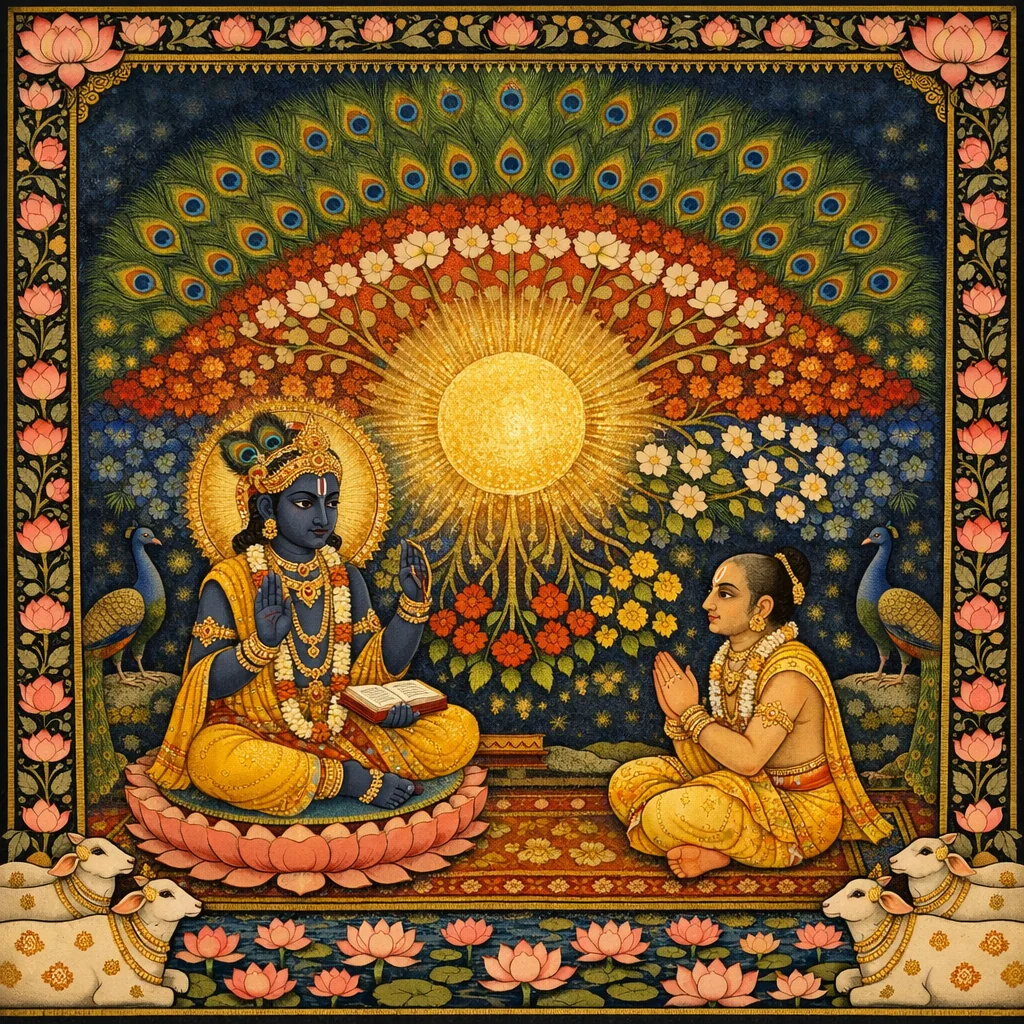
Adhyaya 22
Sāṅkhya Enumeration of Tattvas, Distinction of Puruṣa–Prakṛti, and the Mechanics of Birth and Death
Continuing Śrī Kṛṣṇa’s intimate instruction to Uddhava in the Uddhava-gītā, this chapter opens with Uddhava asking why sages enumerate the tattvas of creation in differing totals (28, 26, 25, 17, and so on). Kṛṣṇa explains that subtle and gross elements interpenetrate, and that His māyā allows multiple valid analytic standpoints, so various enumerations can be logically correct without opposing truth. He then clarifies core Sāṅkhya teachings: the guṇas, time as their agitation, mahat-tattva, and the threefold transformation of false ego (ahaṅkāra), along with the triadic perspective of adhyātmika, adhidaivika, and adhibhautika. Uddhava next asks how puruṣa (the jīva) and prakṛti can seem mutually resident; Kṛṣṇa distinguishes the enjoyer from nature while showing their functional entanglement in conditioned perception. The dialogue culminates in a practical account of transmigration: the karmic mind and senses carry impressions (saṁskāras) from body to body, and “birth” and “death” are re-identifications amid constant transformation. The chapter closes by warning against sense enjoyment and stressing the sādhaka’s need to tolerate insult, preparing the next inquiry into how such spiritual resilience is to be internalized and rightly understood.
Shlokas
Verse 1
श्रीउद्धव उवाच कति तत्त्वानि विश्वेश सङ्ख्यातान्यृषिभि: प्रभो । नवैकादश पञ्च त्रीण्यात्थ त्वमिह शुश्रुम ॥ १ ॥ केचित् षड्विंशतिं प्राहुरपरे पञ्चविंशतिम् । सप्तैके नव षट् केचिच्चत्वार्येकादशापरे । केचित् सप्तदश प्राहु: षोडशैके त्रयोदश ॥ २ ॥ एतावत्त्वं हि सङ्ख्यानामृषयो यद्विवक्षया । गायन्ति पृथगायुष्मन्निदं नो वक्तुमर्हसि ॥ ३ ॥
Uddhava inquired: O Lord, master of the universe, how many tattvas—elements of creation—have the sages enumerated? I have heard You describe nine, eleven, five, and three, totaling twenty-eight. Yet some speak of twenty-six, others of twenty-five; some of seven, nine, six, four, or eleven; and still others of seventeen, sixteen, or thirteen. What was each sage intending by such differing calculations? O Supreme Eternal, please explain this to me.
Verse 2
श्रीउद्धव उवाच कति तत्त्वानि विश्वेश सङ्ख्यातान्यृषिभि: प्रभो । नवैकादश पञ्च त्रीण्यात्थ त्वमिह शुश्रुम ॥ १ ॥ केचित् षड्विंशतिं प्राहुरपरे पञ्चविंशतिम् । सप्तैके नव षट् केचिच्चत्वार्येकादशापरे । केचित् सप्तदश प्राहु: षोडशैके त्रयोदश ॥ २ ॥ एतावत्त्वं हि सङ्ख्यानामृषयो यद्विवक्षया । गायन्ति पृथगायुष्मन्निदं नो वक्तुमर्हसि ॥ ३ ॥
Uddhava inquired: O Lord, master of the universe, how many tattvas—elements of creation—have the sages enumerated? I have heard You describe nine, eleven, five, and three, totaling twenty-eight. Yet some speak of twenty-six, others of twenty-five; some of seven, nine, six, four, or eleven; and still others of seventeen, sixteen, or thirteen. What was each sage intending by such differing calculations? O Supreme Eternal, please explain this to me.
Verse 3
श्रीउद्धव उवाच कति तत्त्वानि विश्वेश सङ्ख्यातान्यृषिभि: प्रभो । नवैकादश पञ्च त्रीण्यात्थ त्वमिह शुश्रुम ॥ १ ॥ केचित् षड्विंशतिं प्राहुरपरे पञ्चविंशतिम् । सप्तैके नव षट् केचिच्चत्वार्येकादशापरे । केचित् सप्तदश प्राहु: षोडशैके त्रयोदश ॥ २ ॥ एतावत्त्वं हि सङ्ख्यानामृषयो यद्विवक्षया । गायन्ति पृथगायुष्मन्निदं नो वक्तुमर्हसि ॥ ३ ॥
Uddhava said: O Lord of the universe, how many tattvas have the sages counted? I heard from You: 9, 11, 5, and 3—making 28. Yet some say 26, others 25; some say 7, 9, 6, 4, or 11; and others 17, 16, or 13. Please tell us the intention behind these varied enumerations.
Verse 4
श्रीभगवानुवाच युक्तं च सन्ति सर्वत्र भाषन्ते ब्राह्मणा यथा । मायां मदीयामुद्गृह्य वदतां किं नु दुर्घटम् ॥ ४ ॥
Lord Kṛṣṇa replied: Since all material elements are present everywhere, it is reasonable that learned brāhmaṇas have analyzed them in different ways. All such philosophers spoke under the shelter of My mystic potency, My māyā, and thus they could say anything without contradicting the truth.
Verse 5
नैतदेवं यथात्थ त्वं यदहं वच्मि तत्तथा । एवं विवदतां हेतुं शक्तयो मे दुरत्यया: ॥ ५ ॥
It is not as you say; it is as I speak. The analytic quarrels of philosophers are stirred by My own insurmountable energies.
Verse 6
यासां व्यतिकरादासीद् विकल्पो वदतां पदम् । प्राप्ते शमदमेऽप्येति वादस्तमनुशाम्यति ॥ ६ ॥
From the intermingling of My energies, diverse opinions arise among those who speak. But for one whose intelligence is fixed on Me and whose senses are controlled, differences of perception vanish, and the very cause of argument is stilled.
Verse 7
परस्परानुप्रवेशात् तत्त्वानां पुरुषर्षभ । पौर्वापर्यप्रसङ्ख्यानं यथा वक्तुर्विवक्षितम् ॥ ७ ॥
O best of men, because subtle and gross elements mutually enter one another, philosophers may count the basic material principles in different ways, according to their own intent.
Verse 8
एकस्मिन्नपि दृश्यन्ते प्रविष्टानीतराणि च । पूर्वस्मिन् वा परस्मिन् वा तत्त्वे तत्त्वानि सर्वश: ॥ ८ ॥
Even within a single element, the other elements are seen to have entered. Whether in the prior subtle cause or the later manifest effect, in every way the elements are present within the elements.
Verse 9
पौर्वापर्यमतोऽमीषां प्रसङ्ख्यानमभीप्सताम् । यथा विविक्तं यद्वक्त्रं गृह्णीमो युक्तिसम्भवात् ॥ ९ ॥
Therefore, whoever among these thinkers may speak, and whether they place the elements within their prior subtle causes or within their later manifest products, I accept their conclusions as authoritative, for a logical explanation can be given for each theory.
Verse 10
अनाद्यविद्यायुक्तस्य पुरुषस्यात्मवेदनम् । स्वतो न सम्भवादन्यस्तत्त्वज्ञो ज्ञानदो भवेत् ॥ १० ॥
Because a person covered by beginningless ignorance cannot, by his own power, attain realization of the Self, there must be another who truly knows the Absolute Truth and can bestow that knowledge.
Verse 11
पुरुषेश्वरयोरत्र न वैलक्षण्यमण्वपि । तदन्यकल्पनापार्था ज्ञानं च प्रकृतेर्गुण: ॥ ११ ॥
According to knowledge in the mode of goodness, there is not even the slightest qualitative difference between the living being and the supreme controller; to imagine such difference is useless speculation, and that knowledge itself is a guṇa of material nature.
Verse 12
प्रकृतिर्गुणसाम्यं वै प्रकृतेर्नात्मनो गुणा: । सत्त्वं रजस्तम इति स्थित्युत्पत्त्यन्तहेतव: ॥ १२ ॥
Material nature exists originally as the equilibrium of the three modes, which belong only to nature and not to the transcendental spirit soul. These modes—goodness, passion, and ignorance—are the effective causes of the creation, maintenance, and destruction of this universe.
Verse 13
सत्त्वं ज्ञानं रज: कर्म तमोऽज्ञानमिहोच्यते । गुणव्यतिकर: काल: स्वभाव: सूत्रमेव च ॥ १३ ॥
In this world, goodness is known as knowledge, passion as fruitive work, and darkness as ignorance. Time is understood as the agitated interaction of the modes, and the totality of functional propensity is embodied in the primeval sūtra, the mahat-tattva.
Verse 14
पुरुष: प्रकृतिर्व्यक्तमहङ्कारो नभोऽनिल: । ज्योतिराप: क्षितिरिति तत्त्वान्युक्तानि मे नव ॥ १४ ॥
I have described the nine basic elements: the enjoying soul (puruṣa), material nature (prakṛti), nature’s primeval manifestation as the mahat-tattva, false ego, ether, air, fire, water, and earth.
Verse 15
श्रोत्रं त्वग्दर्शनं घ्राणो जिह्वेति ज्ञानशक्तय: । वाक्पाण्युपस्थपाय्वङ्घ्रि: कर्माण्यङ्गोभयं मन: ॥ १५ ॥
My dear Uddhava, hearing, touch, sight, smell, and taste are the five senses of knowledge; and speech, the hands, the genitals, the anus, and the legs are the five working senses. The mind partakes of both.
Verse 16
शब्द: स्पर्शो रसो गन्धो रूपं चेत्यर्थजातय: । गत्युक्त्युत्सर्गशिल्पानि कर्मायतनसिद्धय: ॥ १६ ॥
Sound, touch, taste, smell, and form are the objects of the knowledge-acquiring senses; and movement, speech, excretion, and craftsmanship are the functions of the working senses.
Verse 17
सर्गादौ प्रकृतिर्ह्यस्य कार्यकारणरूपिणी । सत्त्वादिभिर्गुणैर्धत्ते पुरुषोऽव्यक्त ईक्षते ॥ १७ ॥
In the beginning of creation, material nature, through the modes of goodness, passion, and ignorance, assumes the form of all subtle causes and gross manifestations within the universe. The Supreme Purusha, the unmanifest Paramatma, does not enter that interaction but merely glances upon nature.
Verse 18
व्यक्तादयो विकुर्वाणा धातव: पुरुषेक्षया । लब्धवीर्या: सृजन्त्यण्डं संहता: प्रकृतेर्बलात् ॥ १८ ॥
As the material elements, headed by the mahat-tattva, transform, they receive their specific potencies from the glance of the Supreme Lord; then, amalgamated by the power of nature, they create the universal egg.
Verse 19
सप्तैव धातव इति तत्रार्था: पञ्चखादय: । ज्ञानमात्मोभयाधारस्ततो देहेन्द्रियासव: ॥ १९ ॥
Some philosophers speak of seven elements: earth, water, fire, air, and ether, along with the conscious spirit soul and the Supreme Soul (Paramatma), the basis of both matter and the individual soul. According to this view, the body, senses, life air, and all material phenomena arise from these seven.
Verse 20
षडित्यत्रापि भूतानि पञ्चषष्ठ: पर: पुमान् । तैर्युक्त आत्मसम्भूतै: सृष्ट्वेदं समपाविशत् ॥ २० ॥
Other philosophers speak of six elements: the five great elements and, as the sixth, the Supreme Personality of Godhead, Bhagavān. Endowed with the elements He has manifested from Himself, that Lord creates this universe and then personally enters within it.
Verse 21
चत्वार्येवेति तत्रापि तेज आपोऽन्नमात्मन: । जातानि तैरिदं जातं जन्मावयविन: खलु ॥ २१ ॥
Some philosophers propose four basic elements: from the Self (Ātman) arise fire, water and food/earth. Once manifest, these elements generate the cosmic manifestation in which all material creation takes place.
Verse 22
सङ्ख्याने सप्तदशके भूतमात्रेन्द्रियाणि च । पञ्च पञ्चैकमनसा आत्मा सप्तदश: स्मृत: ॥ २२ ॥
Some calculate seventeen basic elements: the five gross elements, the five objects of perception, the five senses, the mind, and the soul as the seventeenth.
Verse 23
तद्वत् षोडशसङ्ख्याने आत्मैव मन उच्यते । भूतेन्द्रियाणि पञ्चैव मन आत्मा त्रयोदश ॥ २३ ॥
Similarly, in the count of sixteen, the soul itself is said to be the mind. And if we consider five elements, five senses, the mind, the individual soul and the Supreme Purusha, there are thirteen elements.
Verse 24
एकादशत्व आत्मासौ महाभूतेन्द्रियाणि च । अष्टौ प्रकृतयश्चैव पुरुषश्च नवेत्यथ ॥ २४ ॥
Counting eleven, one includes the soul, the gross elements and the senses. Eight gross and subtle principles together with the Supreme Purusha make nine, according to some.
Verse 25
इति नानाप्रसङ्ख्यानं तत्त्वानामृषिभि: कृतम् । सर्वं न्याय्यं युक्तिमत्त्वाद् विदुषां किमशोभनम् ॥ २५ ॥
Thus the sages have analyzed the material principles in many ways. All their proposals are reasonable, for they are presented with ample logic; such philosophical brilliance befits the truly learned.
Verse 26
श्रीउद्धव उवाच प्रकृति: पुरुषश्चोभौ यद्यप्यात्मविलक्षणौ । अन्योन्यापाश्रयात् कृष्ण दृश्यते न भिदा तयो: । प्रकृतौ लक्ष्यते ह्यात्मा प्रकृतिश्च तथात्मनि ॥ २६ ॥
Śrī Uddhava inquired: O Kṛṣṇa, although material nature and the living being are distinct in constitution, no difference seems to appear, because each is seen to reside within the other. Thus the soul appears within nature, and nature within the soul.
Verse 27
एवं मे पुण्डरीकाक्ष महान्तं संशयं हृदि । छेत्तुमर्हसि सर्वज्ञ वचोभिर्नयनैपुणै: ॥ २७ ॥
O lotus-eyed Kṛṣṇa, O omniscient Lord, please cut this great doubt from my heart with Your own words, which display Your skill in reasoning.
Verse 28
त्वत्तो ज्ञानं हि जीवानां प्रमोषस्तेऽत्र शक्तित: । त्वमेव ह्यात्ममायाया गतिं वेत्थ न चापर: ॥ २८ ॥
From You alone the living beings’ knowledge arises, and by Your own potency that knowledge is taken away. Indeed, none but You can understand the true nature of Your ātmamāyā, Your illusory power.
Verse 29
श्रीभगवानुवाच प्रकृति: पुरुषश्चेति विकल्प: पुरुषर्षभ । एष वैकारिक: सर्गो गुणव्यतिकरात्मक: ॥ २९ ॥
The Supreme Lord said: O best among men, the distinction between material nature and the enjoyer is clear. This manifest creation is ever transforming, being founded upon the agitation and intermixture of the modes of nature.
Verse 30
ममाङ्ग माया गुणमय्यनेकधा विकल्पबुद्धीश्च गुणैर्विधत्ते । वैकारिकस्त्रिविधोऽध्यात्ममेक- मथाधिदैवमधिभूतमन्यत् ॥ ३० ॥
My dear Uddhava, My material energy, constituted of the three guṇas and acting through them, manifests the many varieties of creation and the many kinds of consciousness that perceive them. The visible result of material transformation is understood in three aspects: adhyātmic, adhidaivic, and adhibhautic.
Verse 31
दृग् रूपमार्कं वपुरत्र रन्ध्रे परस्परं सिध्यति य: स्वत: खे । आत्मा यदेषामपरो य आद्य: स्वयानुभूत्याखिलसिद्धसिद्धि: ॥ ३१ ॥
Sight, visible form, and the sun’s reflected image within the eye’s aperture reveal one another in mutual dependence; yet the original sun in the sky is self-manifest. Similarly, the Supreme Soul—the first cause of all beings, distinct from them—illumines by His own transcendental experience and thus stands as the ultimate source of all mutually manifesting objects.
Verse 32
एवं त्वगादि श्रवणादि चक्षु- । र्जिह्वादि नासादि च चित्तयुक्तम् ॥ ३२ ॥
Similarly, the sense organs—skin, ears, eyes, tongue, and nose—as well as the functions of the subtle body—conditioned consciousness, mind, intelligence, and false ego—may all be analyzed according to the threefold distinction of sense, object of perception, and presiding deity.
Verse 33
योऽसौ गुणक्षोभकृतो विकार: प्रधानमूलान्महत: प्रसूत: । अहं त्रिवृन्मोहविकल्पहेतु- र्वैकारिकस्तामस ऐन्द्रियश्च ॥ ३३ ॥
When the three modes of nature are agitated, the resulting transformation appears as false ego in three phases—goodness (vaikārika), passion (aindriya/rajas), and ignorance (tāmasa). Born from the mahat-tattva, which arises from the unmanifest pradhāna, this false ego becomes the cause of all material illusion and duality.
Verse 34
आत्मा परिज्ञानमयो विवादो ह्यस्तीति नास्तीति भिदार्थनिष्ठ: । व्यर्थोऽपि नैवोपरमेत पुंसां मत्त: परावृत्तधियां स्वलोकात् ॥ ३४ ॥
The philosophers’ speculative quarrel—“This world is real,” “No, it is not real”—arises from incomplete knowledge of the Supreme Soul and is aimed only at grasping material dualities. Though useless, those who have turned their minds away from Me, their own true Self, cannot give it up.
Verse 35
श्रीउद्धव उवाच त्वत्त: परावृत्तधिय: स्वकृतै: कर्मभि: प्रभो । उच्चावचान् यथा देहान् गृह्णन्ति विसृजन्ति च ॥ ३५ ॥ तन्ममाख्याहि गोविन्द दुर्विभाव्यमनात्मभि: । न ह्येतत् प्रायशो लोके विद्वांस: सन्ति वञ्चिता: ॥ ३६ ॥
Śrī Uddhava said: O supreme Lord, the intelligence of those devoted to fruit-seeking karma turns away from You. Please explain how, by their own actions, they accept higher and lower bodies and then abandon them.
Verse 36
श्रीउद्धव उवाच त्वत्त: परावृत्तधिय: स्वकृतै: कर्मभि: प्रभो । उच्चावचान् यथा देहान् गृह्णन्ति विसृजन्ति च ॥ ३५ ॥ तन्ममाख्याहि गोविन्द दुर्विभाव्यमनात्मभि: । न ह्येतत् प्रायशो लोके विद्वांस: सन्ति वञ्चिता: ॥ ३६ ॥
O Govinda, please tell me this, for it is very hard for the spiritually ignorant to grasp. In this world, cheated by māyā, people—often even the learned—generally do not recognize these truths.
Verse 37
श्रीभगवानुवाच मन: कर्ममयं नृणामिन्द्रियै: पञ्चभिर्युतम् । लोकाल्लोकं प्रयात्यन्य आत्मा तदनुवर्तते ॥ ३७ ॥
Lord Kṛṣṇa said: The material mind of men is fashioned by the reactions of karma and is joined with the five senses. It travels from one body to another, and the soul, though distinct, follows it.
Verse 38
ध्यायन् मनोऽनु विषयान् दृष्टान् वानुश्रुतानथ । उद्यत् सीदत् कर्मतन्त्रं स्मृतिस्तदनु शाम्यति ॥ ३८ ॥
Bound to the web of karma, the mind continually meditates on sense objects—those seen and those heard of through Vedic authority. Thus it seems to arise and perish with its objects, and its power of memory and discernment fades.
Verse 39
विषयाभिनिवेशेन नात्मानं यत् स्मरेत् पुन: । जन्तोर्वै कस्यचिद्धेतोर्मृत्युरत्यन्तविस्मृति: ॥ ३९ ॥
Absorbed in sense objects, the living being no longer remembers his former identity. This complete forgetfulness of one’s previous bodily identity, for whatever reason, is called death.
Verse 40
जन्म त्वात्मतया पुंस: सर्वभावेन भूरिद । विषयस्वीकृतिं प्राहुर्यथा स्वप्नमनोरथ: ॥ ४० ॥
O most charitable Uddhava, what is called birth is simply one’s total identification with a new body. One accepts that body as real, just as one fully accepts the experience of a dream or a fantasy.
Verse 41
स्वप्नं मनोरथं चेत्थं प्राक्तनं न स्मरत्यसौ । तत्र पूर्वमिवात्मानमपूर्वम् चानुपश्यति ॥ ४१ ॥
Just as one absorbed in a dream or daydream does not remember previous dreams, so the soul in its present body, though existing before, imagines itself to have only recently come into being.
Verse 42
इन्द्रियायनसृष्ट्येदं त्रैविध्यं भाति वस्तुनि । बहिरन्तर्भिदाहेतुर्जनोऽसज्जनकृद् यथा ॥ ४२ ॥
Because the mind, the resting place of the senses, has created identification with the body, the threefold material variety—high, middle, and low—appears as if within the soul’s reality. Thus the self generates outer and inner duality, like a man begetting a wicked son.
Verse 43
नित्यदा ह्यङ्ग भूतानि भवन्ति न भवन्ति च । कालेनालक्ष्यवेगेन सूक्ष्मत्वात्तन्न दृश्यते ॥ ४३ ॥
My dear Uddhava, material bodies are constantly created and destroyed by the force of time, whose swiftness is imperceptible. Yet because time is subtle, no one perceives this.
Verse 44
यथार्चिषां स्रोतसां च फलानां वा वनस्पते: । तथैव सर्वभूतानां वयोऽवस्थादय: कृता: ॥ ४४ ॥
Just as a lamp’s flame, a river’s current, or a tree’s fruits pass through stages of transformation, so all material bodies undergo changes of age and condition.
Verse 45
सोऽयं दीपोऽर्चिषां यद्वत्स्रोतसां तदिदं जलम् । सोऽयं पुमानिति नृणां मृषा गीर्धीर्मृषायुषाम् ॥ ४५ ॥
Just as a lamp’s radiance is made of countless rays that are continually arising, changing, and vanishing, a man of deluded intelligence, seeing the light for a moment, speaks falsely: “This is the lamp’s light.” And just as in a flowing river ever-new water passes on and goes far away, yet a fool, observing one spot, declares, “This is the river’s water,” so too the human body is constantly transforming—yet those who waste their lives wrongly take each bodily stage to be their true identity.
Verse 46
मा स्वस्य कर्मबीजेन जायते सोऽप्ययं पुमान् । म्रियते वामरो भ्रान्त्या यथाग्निर्दारुसंयुत: ॥ ४६ ॥
A person is not truly born from the seed of his past actions, nor does he die, for he is immortal. By illusion the living being appears to be born and to die, just as fire, in connection with firewood, seems to begin and then cease.
Verse 47
निषेकगर्भजन्मानि बाल्यकौमारयौवनम् । वयोमध्यं जरा मृत्युरित्यवस्थास्तनोर्नव ॥ ४७ ॥
Impregnation, gestation, birth, infancy, childhood, youth, middle age, old age, and death are the nine stages of the body.
Verse 48
एता मनोरथमयीर्हान्यस्योच्चावचास्तनू: । गुणसङ्गादुपादत्ते क्वचित् कश्चिज्जहाति च ॥ ४८ ॥
These superior and inferior bodily conditions are creations of the mind. Through ignorance born of association with the material modes, the soul falsely identifies with them; sometimes a fortunate person can abandon such mental concoction.
Verse 49
आत्मन: पितृपुत्राभ्यामनुमेयौ भवाप्ययौ । न भवाप्ययवस्तूनामभिज्ञो द्वयलक्षण: ॥ ४९ ॥
From the death of one’s father or grandfather one can infer one’s own death, and from the birth of one’s son one can understand one’s own birth. One who thus realistically understands the creation and destruction of material bodies is no longer bound by these dualities.
Verse 50
तरोर्बीजविपाकाभ्यां यो विद्वाञ्जन्मसंयमौ । तरोर्विलक्षणो द्रष्टा एवं द्रष्टा तनो: पृथक् ॥ ५० ॥
A wise person who observes a tree’s birth from its seed and its death after maturity remains a distinct witness, separate from the tree; in the same way, the witness of the material body’s birth and death is separate from the body.
Verse 51
प्रकृतेरेवमात्मानमविविच्याबुध: पुमान् । तत्त्वेन स्पर्शसम्मूढ: संसारं प्रतिपद्यते ॥ ५१ ॥
An unintelligent person, failing to discern the self from prakṛti, takes material nature to be the real truth; by contact with it he becomes utterly bewildered and enters the cycle of saṁsāra.
Verse 52
सत्त्वसङ्गादृषीन्देवान् रजसासुरमानुषान् । तमसा भूततिर्यक्त्वं भ्रामितो याति कर्मभि: ॥ ५२ ॥
Driven to wander by his karmic deeds, the conditioned soul, by contact with sattva, is born among sages or the devas; by contact with rajas he becomes an asura or a human; and by association with tamas he is born as a ghost or in the animal realm.
Verse 53
नृत्यतो गायत: पश्यन् यथैवानुकरोति तान् । एवं बुद्धिगुणान् पश्यन्ननीहोऽप्यनुकार्यते ॥ ५३ ॥
Just as one may imitate people seen dancing and singing, so the soul—though never the doer of material acts—becomes captivated by the qualities of material intelligence and is forced to imitate them.
Verse 54
यथाम्भसा प्रचलता तरवोऽपि चला इव । चक्षुषा भ्राम्यमाणेन दृश्यते भ्रमतीव भू: ॥ ५४ ॥ यथा मनोरथधियो विषयानुभवो मृषा । स्वप्नदृष्टाश्च दाशार्ह तथा संसार आत्मन: ॥ ५५ ॥
Just as trees reflected in agitated water seem to tremble, and just as the earth seems to spin when one spins the eyes, so too, O descendant of Daśārha, the experience of sense enjoyment born of the mind’s fantasy is false; like scenes seen in a dream, so is saṁsāra for the self.
Verse 55
यथाम्भसा प्रचलता तरवोऽपि चला इव । चक्षुषा भ्राम्यमाणेन दृश्यते भ्रमतीव भू: ॥ ५४ ॥ यथा मनोरथधियो विषयानुभवो मृषा । स्वप्नदृष्टाश्च दाशार्ह तथा संसार आत्मन: ॥ ५५ ॥
O descendant of Daśārha, the soul’s material life and its experience of sense enjoyment are truly false—like trees that seem to tremble when reflected in agitated water, or like the earth that seems to spin when one whirls the eyes. In the same way, this world is like fantasy and dream, mere illusion.
Verse 56
अर्थे ह्यविद्यमानेऽपि संसृतिर्न निवर्तते । ध्यायतो विषयानस्य स्वप्नेऽनर्थागमो यथा ॥ ५६ ॥
Even when the object has no real existence, material life does not cease for one who meditates on sense gratification—just as the distressing experiences of a dream, though unreal, still arise.
Verse 57
तस्मादुद्धव मा भुङ्क्ष्व विषयानसदिन्द्रियै: । आत्माग्रहणनिर्भातं पश्य वैकल्पिकं भ्रमम् ॥ ५७ ॥
Therefore, O Uddhava, do not try to enjoy sense objects with the unreal material senses. See how illusion, born of duality, blocks the realization of the true self.
Verse 58
क्षिप्तोऽवमानितोऽसद्भि: प्रलब्धोऽसूयितोऽथवा । ताडित: सन्निरुद्धो वा वृत्त्या वा परिहापित: ॥ ५८ ॥ निष्ठ्युतो मूत्रितो वाज्ञैर्बहुधैवं प्रकम्पित: । श्रेयस्काम: कृच्छ्रगत आत्मनात्मानमुद्धरेत् ॥ ५९ ॥
Even if one is neglected, insulted, mocked, or envied by wicked men; even if one is beaten, bound, or deprived of one’s livelihood; even if ignorant people spit upon one or defile one with urine, shaking one in many ways—still, one who longs for the highest good should, amid hardship, use intelligence to lift oneself up and remain safe upon the spiritual platform.
Verse 59
क्षिप्तोऽवमानितोऽसद्भि: प्रलब्धोऽसूयितोऽथवा । ताडित: सन्निरुद्धो वा वृत्त्या वा परिहापित: ॥ ५८ ॥ निष्ठ्युतो मूत्रितो वाज्ञैर्बहुधैवं प्रकम्पित: । श्रेयस्काम: कृच्छ्रगत आत्मनात्मानमुद्धरेत् ॥ ५९ ॥
Even if one is neglected, insulted, mocked, or envied by wicked men; even if one is beaten, bound, or deprived of one’s livelihood; even if ignorant people spit upon one or defile one with urine, shaking one in many ways—still, one who longs for the highest good should, amid hardship, use intelligence to lift oneself up and remain safe upon the spiritual platform.
Verse 60
श्रीउद्धव उवाच यथैवमनुबुध्येयं वद नो वदतां वर ॥ ६० ॥
Śrī Uddhava said: O best of speakers, please tell me how I may properly understand this.
Verse 61
सुदु:सहमिमं मन्ये आत्मन्यसदतिक्रमम् । विदुषामपि विश्वात्मन् प्रकृतिर्हि बलीयसी । ऋते त्वद्धर्मनिरतान् शान्तांस्ते चरणालयान् ॥ ६१ ॥
O Soul of the universe, I consider it most difficult to endure the unjust offenses committed by ignorant people, for material nature is indeed very strong, and even the learned can scarcely tolerate them. Only Your devotees—fixed in Your dharma and loving service, and peaceful by taking shelter of Your lotus feet—can bear such offenses.
Frequently Asked Questions
Because subtle causes and gross effects mutually pervade one another, a thinker may either (a) include an element within its prior subtle cause or (b) count it separately as a later manifest product. Kṛṣṇa states that such analyses occur under His māyā-śakti, and thus multiple enumerations can be coherent when their assumptions are made explicit. The point is not to win argument but to recognize that all categories ultimately rest on the Supreme Lord’s sanction and that realized intelligence fixed in Him dissolves quarrel.
Kṛṣṇa teaches that prakṛti is the transforming field structured by the guṇas, whereas the jīva is the conscious enjoyer/witness. They appear interwoven because consciousness becomes conditioned through subtle instruments (mind, intelligence, false ego) and identifies with bodily states. Yet the soul remains distinct as the observer, just as one who witnesses a tree’s birth and death is not the tree. The Supreme Soul remains self-manifest and separate, like the sun illuminating the mutual functioning of eye, form, and reflected light.
Death is described as total forgetfulness of the previous embodied identity when the jīva transitions to a new body formed by karma; birth is total identification with the new body, similar to accepting a dream as real. Since bodies are constantly transforming under time, the delusion is to equate any temporary stage with the self. Realistic discernment (viveka) frees one from the dualities of lamentation and fear.
The chapter concludes that one seeking the highest goal should remain spiritually safe even when insulted, beaten, deprived, or humiliated. This is not passivity but disciplined intelligence: refusing to descend into bodily identification and reactive hatred. Such tolerance (titikṣā) supports steady remembrance and detachment from sense gratification, preparing the practitioner to ask—like Uddhava—how to properly internalize and understand these teachings in lived experience.