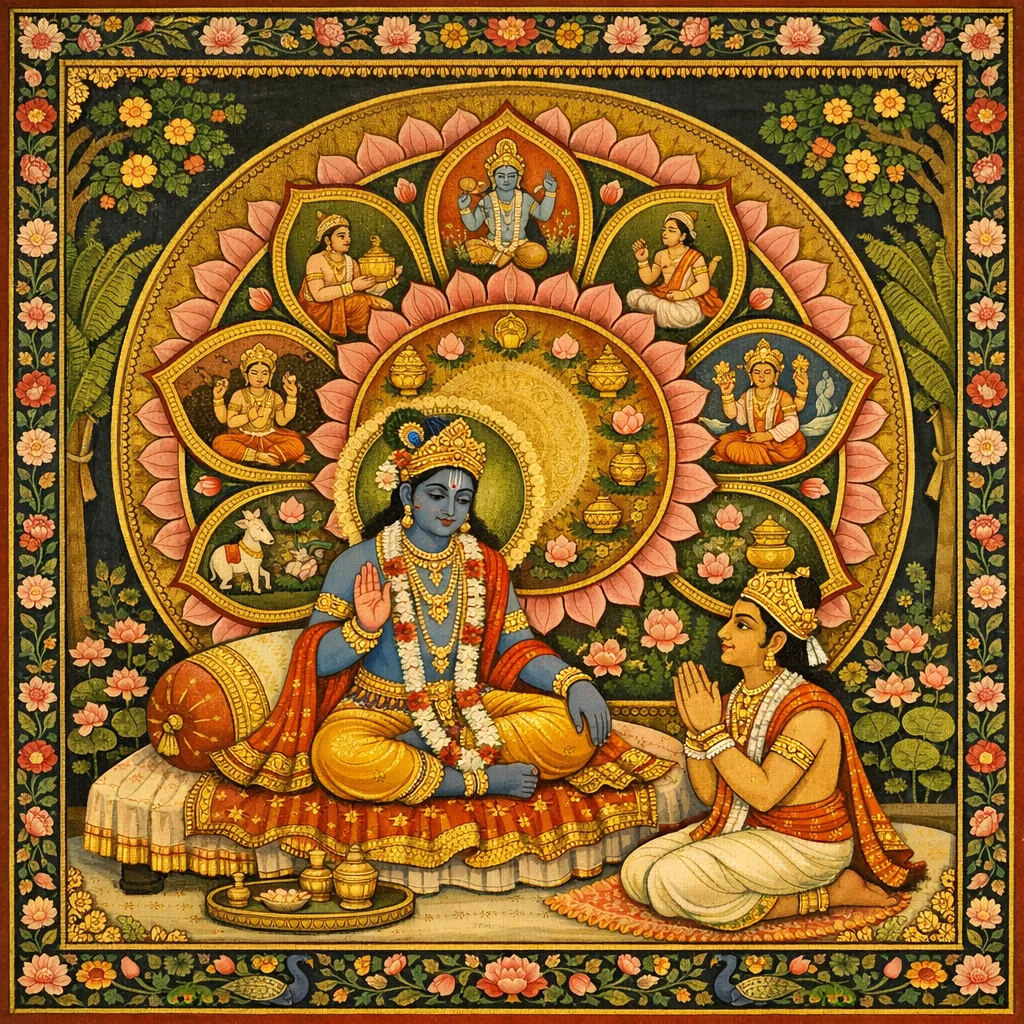
Adhyaya 15
Yoga-siddhi — The Mystic Perfections and Their Origin in Meditation on the Lord
Continuing the Uddhava-gītā’s practical guidance on sādhana, this chapter answers Uddhava’s inquiry into yoga-siddhi—what mystic perfections are, how many there are, and how they are attained. Śrī Kṛṣṇa describes eighteen siddhis: eight primary (aṣṭa-siddhi) rooted in Him and ten secondary arising through sattva-guṇa, along with further yogic attainments born of meditation and control. He links particular siddhis to meditations on His presence within subtle elements, the mahat-tattva, false ego, the sun and vision, prāṇa pathways, and His various manifestations (Viṣṇu/Nārāyaṇa and Brahman). The teaching then turns: although a disciplined yogī may gain such powers, Kṛṣṇa warns that for devotees seeking the supreme yoga of bhakti, siddhis are distractions. Thus the chapter moves from technique to true purpose—yogic powers are real, but devotion is the higher perfection—preparing the way for later instructions that further exalt pure bhakti over subordinate attainments.
Shlokas
Verse 1
श्रीभगवानुवाच जितेन्द्रियस्य युक्तस्य जितश्वासस्य योगिन: । मयि धारयतश्चेत उपतिष्ठन्ति सिद्धय: ॥ १ ॥
The Supreme Lord said: Dear Uddhava, the yogic perfections arise for that yogī who has conquered the senses, steadied the mind, mastered the breath, and fixed his consciousness upon Me.
Verse 2
श्रीउद्धव उवाच कया धारणया कास्वित् कथं वा सिद्धिरच्युत । कति वा सिद्धयो ब्रूहि योगिनां सिद्धिदो भवान् ॥ २ ॥
Śrī Uddhava said: O Lord Acyuta, by what kind of concentration is mystic perfection attained, and what is its nature? How many such perfections are there among yogīs? Please explain, for You are the giver of all siddhis.
Verse 3
श्रीभगवानुवाच सिद्धयोऽष्टादश प्रोक्ता धारणा योगपारगै: । तासामष्टौ मत्प्रधाना दशैव गुणहेतव: ॥ ३ ॥
The Supreme Lord said: The masters of yoga declare eighteen kinds of siddhi and dhāraṇā. Of these, eight are primary, taking shelter in Me, and ten are secondary, arising from the mode of goodness.
Verse 4
अणिमा महिमा मूर्तेर्लघिमा प्राप्तिरिन्द्रियै: । प्राकाम्यं श्रुतदृष्टेषु शक्तिप्रेरणमीशिता ॥ ४ ॥ गुणेष्वसङ्गो वशिता यत्कामस्तदवस्यति । एता मे सिद्धय: सौम्य अष्टावौत्पत्तिका मता: ॥ ५ ॥
Among the eight primary siddhis, three transform one’s own body: aṇimā (becoming smaller than the smallest), mahimā (greater than the greatest), and laghimā (lighter than the lightest). By prāpti-siddhi one obtains what one desires; by prākāmya-siddhi one can enjoy any pleasing object, in this world or the next. By īśitā-siddhi one can impel and govern the subpotencies of māyā; by vaśitā-siddhi one is not obstructed by the three guṇas. And by kāmāvasāyitā-siddhi one can obtain anything from anywhere, up to the highest limit. Gentle Uddhava, these eight are considered My natural and unequaled perfections within this world.
Verse 5
अणिमा महिमा मूर्तेर्लघिमा प्राप्तिरिन्द्रियै: । प्राकाम्यं श्रुतदृष्टेषु शक्तिप्रेरणमीशिता ॥ ४ ॥ गुणेष्वसङ्गो वशिता यत्कामस्तदवस्यति । एता मे सिद्धय: सौम्य अष्टावौत्पत्तिका मता: ॥ ५ ॥
Among the eight primary siddhis, three transform one’s own body: aṇimā (becoming smaller than the smallest), mahimā (greater than the greatest), and laghimā (lighter than the lightest). By prāpti-siddhi one obtains what one desires; by prākāmya-siddhi one can enjoy any pleasing object, in this world or the next. By īśitā-siddhi one can impel and govern the subpotencies of māyā; by vaśitā-siddhi one is not obstructed by the three guṇas. And by kāmāvasāyitā-siddhi one can obtain anything from anywhere, up to the highest limit. Gentle Uddhava, these eight are considered My natural and unequaled perfections within this world.
Verse 6
अनूर्मिमत्त्वं देहेऽस्मिन् दूरश्रवणदर्शनम् । मनोजव: कामरूपं परकायप्रवेशनम् ॥ ६ ॥ स्वच्छन्दमृत्युर्देवानां सहक्रीडानुदर्शनम् । यथासङ्कल्पसंसिद्धिराज्ञाप्रतिहता गति: ॥ ७ ॥
The ten secondary mystic perfections born of nature’s modes are: freedom from hunger, thirst, and other bodily disturbances; hearing and seeing at a distance; moving with the speed of the mind; assuming any desired form; entering another’s body; dying at will; beholding the pastimes of the devas with the apsarās; perfectly fulfilling one’s resolve; and issuing commands whose execution is unobstructed.
Verse 7
अनूर्मिमत्त्वं देहेऽस्मिन् दूरश्रवणदर्शनम् । मनोजव: कामरूपं परकायप्रवेशनम् ॥ ६ ॥ स्वच्छन्दमृत्युर्देवानां सहक्रीडानुदर्शनम् । यथासङ्कल्पसंसिद्धिराज्ञाप्रतिहता गति: ॥ ७ ॥
Among the secondary siddhis arising from nature’s modes are: dying at will, beholding the līlās of the devas with the apsarās, perfectly accomplishing one’s resolve, and possessing command whose fulfillment is unimpeded—along with the previously mentioned powers such as freedom from bodily disturbances and the rest.
Verse 8
त्रिकालज्ञत्वमद्वन्द्वं परचित्ताद्यभिज्ञता । अग्न्यर्काम्बुविषादीनां प्रतिष्टम्भोऽपराजय: ॥ ८ ॥ एताश्चोद्देशत: प्रोक्ता योगधारणसिद्धय: । यया धारणया या स्याद् यथा वा स्यान्निबोध मे ॥ ९ ॥
Knowledge of past, present, and future; equanimity amid heat, cold, and other dualities; insight into others’ minds; checking the effects of fire, sun, water, poison, and the like; and remaining unconquered—these are five perfections of yogic concentration and meditation. I have merely listed them by name and traits; now learn from Me which contemplation yields which siddhi, and by what process.
Verse 9
त्रिकालज्ञत्वमद्वन्द्वं परचित्ताद्यभिज्ञता । अग्न्यर्काम्बुविषादीनां प्रतिष्टम्भोऽपराजय: ॥ ८ ॥ एताश्चोद्देशत: प्रोक्ता योगधारणसिद्धय: । यया धारणया या स्याद् यथा वा स्यान्निबोध मे ॥ ९ ॥
These five siddhis—such as knowing the three phases of time—belong to yogic dhāraṇā, and I have mentioned them only in summary. Now hear from Me: which contemplation gives rise to which perfection, and how it is attained in the course of practice.
Verse 10
भूतसूक्ष्मात्मनि मयि तन्मात्रं धारयेन्मन: । अणिमानमवाप्नोति तन्मात्रोपासको मम ॥ १० ॥
One who worships Me in My atomic form, pervading all subtle elements, and fixes the mind on that alone, attains the mystic perfection called aṇimā.
Verse 11
महत्तत्त्वात्मनि मयि यथासंस्थं मनो दधत् । महिमानमवाप्नोति भूतानां च पृथक् पृथक् ॥ ११ ॥
One who places the mind, as it is, within Me—the Supersoul present as the mahat-tattva—attains the mystic perfection called mahimā. Then, by absorbing the mind in Me within each element, such as sky, air, fire, and so on, one gradually acquires the greatness of each material element.
Verse 12
परमाणुमये चित्तं भूतानां मयि रञ्जयन् । कालसूक्ष्मार्थतां योगी लघिमानमवाप्नुयात् ॥ १२ ॥
By attaching his consciousness to Me, who am present as the atomic essence of all elements, the yogī realizes the extremely subtle, atomic nature of time and attains the perfection called laghimā.
Verse 13
धारयन् मय्यहंतत्त्वे मनो वैकारिकेऽखिलम् । सर्वेन्द्रियाणामात्मत्वं प्राप्तिं प्राप्नोति मन्मना: ॥ १३ ॥
Fixing his entire mind in Me within the vaikarika principle of false ego born of goodness, the yogī attains the siddhi called prāpti, by which he gains mastery over the senses of all living beings, for his mind is absorbed in Me.
Verse 14
महत्यात्मनि य: सूत्रे धारयेन्मयि मानसम् । प्राकाम्यं पारमेष्ठ्यं मे विन्दतेऽव्यक्तजन्मन: ॥ १४ ॥
One who concentrates all mental activity on Me as the Supersoul of the sūtra phase of the mahat-tattva, which manifests the chain of karma, receives from Me—whose appearance is beyond material perception—the most excellent perfection called prākāmya.
Verse 15
विष्णौ त्र्यधीश्वरे चित्तं धारयेत् कालविग्रहे । स ईशित्वमवाप्नोति क्षेत्रज्ञक्षेत्रचोदनाम् ॥ १५ ॥
One who places his consciousness on Viṣṇu, the Supersoul—the prime mover and Supreme Lord of the external energy of the three modes, manifest as time—attains the siddhi called īśitva, by which he can control other conditioned souls, their bodies, and their bodily designations.
Verse 16
नारायणे तुरीयाख्ये भगवच्छब्दशब्दिते । मनो मय्यादधद् योगी मद्धर्मा वशितामियात् ॥ १६ ॥
The yogī who fixes his mind upon Me as Nārāyaṇa—known as the fourth state and resounding with divine majesty—attains My own nature and thus gains the mystic perfection called vaśitā.
Verse 17
निर्गुणे ब्रह्मणि मयि धारयन् विशदं मन: । परमानन्दमाप्नोति यत्र कामोऽवसीयते ॥ १७ ॥
One who holds his pure mind upon Me as the attributeless Brahman attains the highest bliss, wherein all desires are fully stilled and fulfilled.
Verse 18
श्वेतद्वीपपतौ चित्तं शुद्धे धर्ममये मयि । धारयञ्छ्वेततां याति षडूर्मिरहितो नर: ॥ १८ ॥
A person who concentrates on Me as the Lord of Śvetadvīpa—embodiment of purity and upholder of dharma—attains a spotless state of being, free from the six waves of material disturbance.
Verse 19
मय्याकाशात्मनि प्राणे मनसा घोषमुद्वहन् । तत्रोपलब्धा भूतानां हंसो वाच: शृणोत्यसौ ॥ १९ ॥
That purified being who, with the mind, bears the extraordinary sound-vibrations within Me as the personified sky and the total prāṇa can then perceive in the ether the speech of all living entities.
Verse 20
चक्षुस्त्वष्टरि संयोज्य त्वष्टारमपि चक्षुषि । मां तत्र मनसा ध्यायन् विश्वं पश्यति दूरत: ॥ २० ॥
By merging one’s sight into the sun and then the sun into one’s eyes, and meditating on Me as present within that union of sun and vision, one gains the power to see anything far away.
Verse 21
मनो मयि सुसंयोज्य देहं तदनुवायुना । मद्धारणानुभावेन तत्रात्मा यत्र वै मन: ॥ २१ ॥
The yogī who wholly unites his mind with Me, and by the prāṇa-wind that follows the mind absorbs even the material body into Me, attains—by the power of meditation on Me—the mystic perfection by which his body instantly follows his mind wherever it goes.
Verse 22
यदा मन उपादाय यद् यद् रूपं बुभूषति । तत्तद् भवेन्मनोरूपं मद्योगबलमाश्रय: ॥ २२ ॥
When the yogī applies his mind and desires to assume a particular form, that very form immediately manifests as the mind’s own shape. Such perfection arises by absorbing the mind in the shelter of My inconceivable yogic potency, by which I assume innumerable forms.
Verse 23
परकायं विशन् सिद्ध आत्मानं तत्र भावयेत् । पिण्डं हित्वा विशेत् प्राणो वायुभूत: षडङ्घ्रिवत् ॥ २३ ॥
When a perfected yogī wishes to enter another’s body, he should meditate on himself as present within that body; then, abandoning his own gross body, he should enter through the pathways of air as prāṇa become wind—just as a bee leaves one flower and slips into another.
Verse 24
पार्ष्ण्यापीड्य गुदं प्राणं हृदुर:कण्ठमूर्धसु । आरोप्य ब्रह्मरन्ध्रेण ब्रह्म नीत्वोत्सृजेत्तनुम् ॥ २४ ॥
The yogī who has attained the perfection called svacchanda-mṛtyu presses the anus with his heel and lifts the prāṇa from the heart to the chest, to the throat, and finally to the head. Established in the brahma-randhra, he abandons the material body and guides the soul to the chosen destination.
Verse 25
विहरिष्यन् सुराक्रीडे मत्स्थं सत्त्वं विभावयेत् । विमानेनोपतिष्ठन्ति सत्त्ववृत्ती: सुरस्त्रिय: ॥ २५ ॥
The yogī who longs to sport in the pleasure gardens of the demigods should meditate on the purified sattva situated within Me; then the heavenly women, born of the movements of sattva, will approach him in vimānas, celestial airplanes.
Verse 26
यथा सङ्कल्पयेद् बुद्ध्या यदा वा मत्पर: पुमान् । मयि सत्ये मनो युञ्जंस्तथा तत् समुपाश्नुते ॥ २६ ॥
A yogī devoted to Me, fixing his mind upon Me, the Supreme Truth, attains his aim by the very means he has resolved upon within his intelligence.
Verse 27
यो वै मद्भावमापन्न ईशितुर्वशितु: पुमान् । कुतश्चिन्न विहन्येत तस्य चाज्ञा यथा मम ॥ २७ ॥
One who perfectly meditates on Me attains My nature as the supreme ruler and controller; his command, like Mine, can never be thwarted by any means.
Verse 28
मद्भक्त्या शुद्धसत्त्वस्य योगिनो धारणाविद: । तस्य त्रैकालिकी बुद्धिर्जन्ममृत्यूपबृंहिता ॥ २८ ॥
A yogī who has purified his being by devotion to Me and is expert in dhāraṇā gains knowledge of past, present, and future, and thus perceives the birth and death of himself and others.
Verse 29
अग्न्यादिभिर्न हन्येत मुनेर्योगमयं वपु: । मद्योगशान्तचित्तस्य यादसामुदकं यथा ॥ २९ ॥
Just as aquatic creatures are not harmed by water, so the yogamaya body of a sage whose mind is pacified by bhakti-yoga to Me and fully matured in yoga science cannot be injured by fire, sun, water, poison, and the like.
Verse 30
मद्विभूतीरभिध्यायन् श्रीवत्सास्त्रविभूषिता: । ध्वजातपत्रव्यजनै: स भवेदपराजित: ॥ ३० ॥
By meditating on My opulent incarnations—adorned with the Śrīvatsa mark and various weapons, and endowed with royal emblems such as flags, ornamental umbrellas, and fans—My devotee becomes unconquerable.
Verse 31
उपासकस्य मामेवं योगधारणया मुने: । सिद्धय: पूर्वकथिता उपतिष्ठन्त्यशेषत: ॥ ३१ ॥
O sage, the learned devotee who worships Me through yogic concentration surely attains, in full, all the mystic perfections I have described.
Verse 32
जितेन्द्रियस्य दान्तस्य जितश्वासात्मनो मुने: । मद्धारणां धारयत: का सा सिद्धि: सुदुर्लभा ॥ ३२ ॥
For the sage who has conquered the senses, breath, and mind, who is self-controlled and ever absorbed in meditation on Me, what mystic perfection could be difficult to attain?
Verse 33
अन्तरायान् वदन्त्येता युञ्जतो योगमुत्तमम् । मया सम्पद्यमानस्य कालक्षपणहेतव: ॥ ३३ ॥
Experts in bhakti declare that the yogic perfections I have mentioned are actually obstacles and a waste of time for one practicing the supreme yoga, by which all perfection is obtained directly from Me.
Verse 34
जन्मौषधितपोमन्त्रैर्यावतीरिह सिद्धय: । योगेनाप्नोति ता: सर्वा नान्यैर्योगगतिं व्रजेत् ॥ ३४ ॥
Whatever mystic perfections are attained here by noble birth, herbs, austerities, or mantras are all attained by devotional service to Me; indeed, by no other means does one reach yoga’s true perfection.
Verse 35
सर्वासामपि सिद्धीनां हेतु: पतिरहं प्रभु: । अहं योगस्य साङ्ख्यस्य धर्मस्य ब्रह्मवादिनाम् ॥ ३५ ॥
My dear Uddhava, I alone am the cause, protector, and Lord of all mystic perfections; I am also the Lord of yoga, sāṅkhya, pure dharma, and the community of learned Vedic teachers.
Verse 36
अहमात्मान्तरो बाह्योऽनावृत: सर्वदेहिनाम् । यथा भूतानि भूतेषु बहिरन्त: स्वयं तथा ॥ ३६ ॥
Just as the five great elements are found both within and without all bodies, so I can never be covered by anything. I dwell within all as the Paramātmā, and I exist beyond all as the all-pervading Lord.
Frequently Asked Questions
Kṛṣṇa states that yoga masters describe eighteen types: eight primary perfections (aṣṭa-siddhi) that have their shelter in Him, and ten secondary perfections that arise from the material mode of goodness (sattva). He also mentions additional yogic attainments in the context of meditation, such as tri-kāla-jñāna (knowing past, present, future) and resistance to material dualities.
They are: aṇimā (becoming smaller than the smallest), mahimā (becoming greater than the greatest), laghimā (becoming lighter than the lightest), prāpti (obtaining desired objects), prākāmya (experiencing any enjoyable object), īśitā (manipulating subpotencies of māyā), vaśitā (unimpeded by the guṇas), and kāmāvasāyitā (obtaining anything from anywhere to the highest limit).
The chapter links each siddhi to a particular dhyāna: worshiping the Lord in His atomic presence yields aṇimā; meditating on Him as the Supersoul of mahat-tattva yields mahimā; absorption in His presence as the essence within elements yields laghimā; and other perfections arise by fixing consciousness on Him as Viṣṇu/Nārāyaṇa, within ahaṅkāra, within the sun and vision, and through prāṇa-pathways—showing that siddhis are derivative of focused meditation on the Lord’s omnipresence.
Kṛṣṇa states that learned bhakti authorities consider siddhis impediments because they can redirect attention from the supreme goal—exclusive devotion and direct attainment of the Lord. Since bhakti grants the highest perfection (the Lord Himself), fascination with powers can become a waste of time for one practicing para-yoga.
Kṛṣṇa declares Himself to be the cause, protector, and Lord of all mystic perfections, of the yoga system, of analytic knowledge, and of pure activity—establishing that siddhis are not independent achievements but depend on His sanction and presence as Paramātmā within and beyond everything.