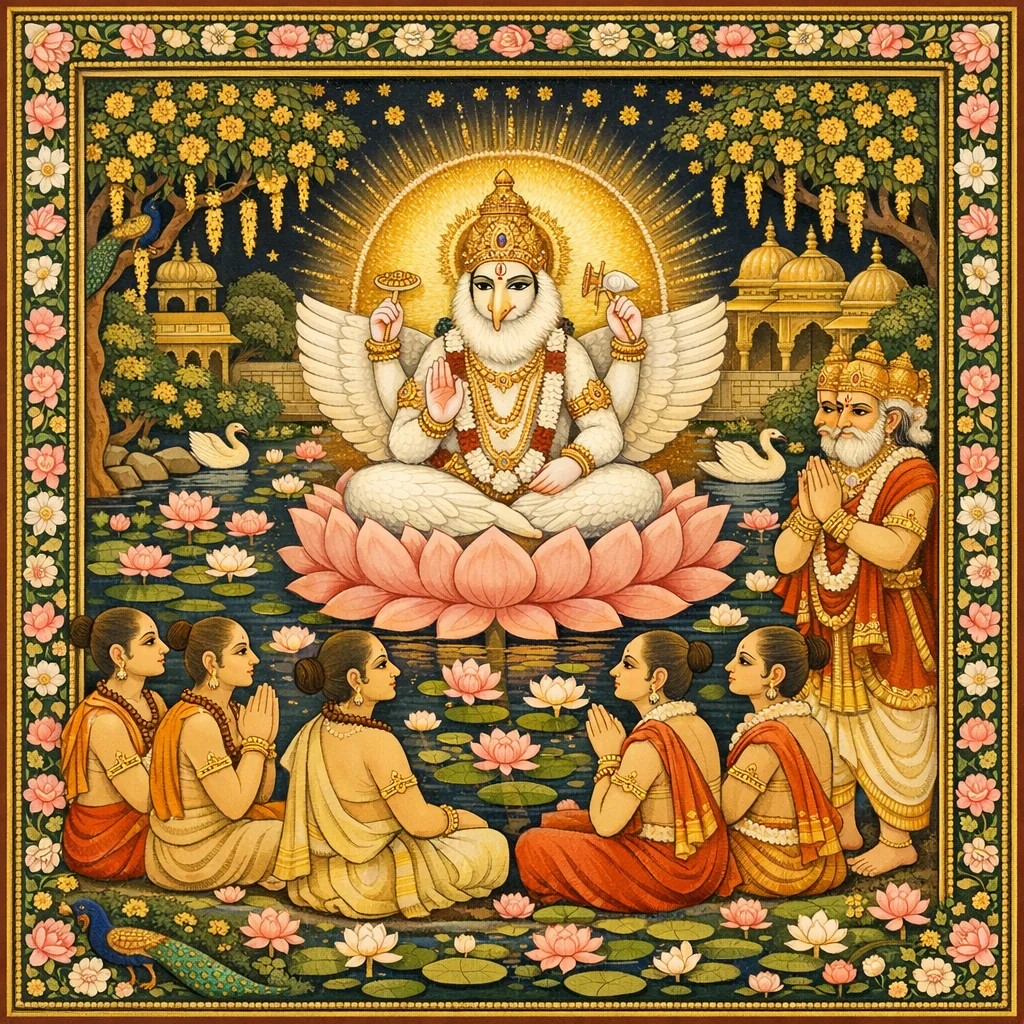
Adhyaya 13
Guṇa-viveka, Haṁsa-gītā, and the Yoga that Cuts False Ego
Continuing Kṛṣṇa’s progressive instruction to Uddhava on liberation, this chapter first clarifies that the guṇas (sattva, rajas, tamas) belong to material intelligence, not to the ātman. It teaches a practical ladder: cultivate sattva to subdue rajas and tamas, then transcend even sattva through transcendental goodness—bhakti/śuddha-sattva. Kṛṣṇa lists influences that intensify the guṇas—scripture, water, association, place, time, activities, birth, meditation, mantra-japa, and saṁskāras—urging the seeker to choose sāttvic supports until direct self-knowledge awakens. Uddhava asks why people pursue pleasure despite knowing future misery; Kṛṣṇa explains bondage through misidentification, passion-driven planning, and unrestrained senses, and prescribes renewed mind-control and absorption in Him at the three sandhyās. The narrative then turns to this yoga’s origin: the Sanaka sages question Brahmā, who cannot answer due to involvement in creation; Kṛṣṇa appears as Haṁsa and delivers decisive nondual analysis—everything perceived is within Him—culminating in the teaching of the witness beyond waking/dream/sleep (turīya) and the sword of knowledge that severs ahaṅkāra. The sages’ doubts dissolve; they worship, and Haṁsa returns to His abode, preparing the Uddhava-gītā’s later emphasis on unwavering remembrance and renunciation grounded in realization.
Shlokas
Verse 1
श्रीभगवानुवाच सत्त्वं रजस्तम इति गुणा बुद्धेर्न चात्मन: । सत्त्वेनान्यतमौ हन्यात् सत्त्वं सत्त्वेन चैव हि ॥ १ ॥
The Supreme Lord said: The three modes—goodness, passion and ignorance—belong to material intelligence, not to the spirit soul. By cultivating material goodness one conquers passion and ignorance, and by nurturing transcendental goodness (śuddha-sattva) one becomes free even from material goodness.
Verse 2
सत्त्वाद् धर्मो भवेद् वृद्धात् पुंसो मद्भक्तिलक्षण: । सात्त्विकोपासया सत्त्वं ततो धर्म: प्रवर्तते ॥ २ ॥
When the living being becomes firmly situated in goodness, religious principles—marked by devotion to Me—become prominent. Goodness is strengthened by worshiping and cultivating what is sāttvika, and from that, dharma arises and proceeds.
Verse 3
धर्मो रजस्तमो हन्यात् सत्त्ववृद्धिरनुत्तम: । आशु नश्यति तन्मूलो ह्यधर्म उभये हते ॥ ३ ॥
Dharma, strengthened by the growth of sattva, destroys rajas and tamas. When both are overcome, their root—adharma—is swiftly vanquished.
Verse 4
आगमोऽप: प्रजा देश: काल: कर्म च जन्म च । ध्यानं मन्त्रोऽथ संस्कारो दशैते गुणहेतव: ॥ ४ ॥
Scripture, water, one’s association with children or with people, place, time, activity, birth, meditation, mantra-chanting, and purificatory rites—these ten are the causes by which the modes of nature become prominent in different ways.
Verse 5
तत्तत् सात्त्विकमेवैषां यद् यद् वृद्धा: प्रचक्षते । निन्दन्ति तामसं तत्तद् राजसं तदुपेक्षितम् ॥ ५ ॥
Among these ten, the venerable sages who know the Veda praise what is in sattva, condemn and reject what is in tamas, and remain indifferent to what is in rajas.
Verse 6
सात्त्विकान्येव सेवेत पुमान् सत्त्वविवृद्धये । ततो धर्मस्ततो ज्ञानं यावत् स्मृतिरपोहनम् ॥ ६ ॥
To increase sattva, one should cultivate only what is sattvic. From sattva arises dharma, and from dharma awakened knowledge—until remembrance of the ātman returns and the illusory identification with body and mind is driven away.
Verse 7
वेणुसङ्घर्षजो वह्निर्दग्ध्वा शाम्यति तद्वनम् । एवं गुणव्यत्ययजो देह: शाम्यति तत्क्रिय: ॥ ७ ॥
A fire born from the friction of bamboo burns down the very bamboo forest that gave it birth, and thus it is calmed by its own action. Similarly, the subtle and gross bodies arise from the interaction of the guṇas; when one employs mind and body to cultivate true knowledge, that illumination destroys the guṇas that generated the body, and the body and mind become pacified.
Verse 8
श्रीउद्धव उवाच विदन्ति मर्त्या: प्रायेण विषयान् पदमापदाम् । तथापि भुञ्जते कृष्ण तत्कथं श्वखराजवत् ॥ ८ ॥
Śrī Uddhava said: My dear Kṛṣṇa, people generally know that sense enjoyment leads to great misery in the future, and yet they still pursue it. O Lord, how can one who has knowledge act like a dog, an ass, or a goat?
Verse 9
श्रीभगवानुवाच अहमित्यन्यथाबुद्धि: प्रमत्तस्य यथा हृदि । उत्सर्पति रजो घोरं ततो वैकारिकं मन: ॥ ९ ॥ रजोयुक्तस्य मनस: सङ्कल्प: सविकल्पक: । तत: कामो गुणध्यानाद् दु:सह: स्याद्धि दुर्मते: ॥ १० ॥
The Supreme Lord said: My dear Uddhava, within the heart of the heedless arises a distorted sense of “I.” From that, dreadful rajas surges forth, and the mind—by nature inclined to goodness—becomes agitated and transformed.
Verse 10
श्रीभगवानुवाच अहमित्यन्यथाबुद्धि: प्रमत्तस्य यथा हृदि । उत्सर्पति रजो घोरं ततो वैकारिकं मन: ॥ ९ ॥ रजोयुक्तस्य मनस: सङ्कल्प: सविकल्पक: । तत: कामो गुणध्यानाद् दु:सह: स्याद्धि दुर्मते: ॥ १० ॥
When the mind is joined with rajas, it spins many plans and counterplans. Then, by constant meditation on the modes of nature, the foolish person is tormented by unbearable desires.
Verse 11
करोति कामवशग: कर्माण्यविजितेन्द्रिय: । दु:खोदर्काणि सम्पश्यन् रजोवेगविमोहित: ॥ ११ ॥
One who does not conquer the senses falls under the rule of desire and is bewildered by the powerful surges of rajas. Though seeing that the result will be future suffering, he still performs material acts.
Verse 12
रजस्तमोभ्यां यदपि विद्वान् विक्षिप्तधी: पुन: । अतन्द्रितो मनो युञ्जन् दोषदृष्टिर्न सज्जते ॥ १२ ॥
Although even a learned person’s intelligence may be disturbed by rajas and tamas, he should, without laziness, again bring the mind under control. Seeing clearly the contamination of the modes, he does not become attached.
Verse 13
अप्रमत्तोऽनुयुञ्जीत मनो मय्यर्पयञ्छनै: । अनिर्विण्णो यथाकालं जितश्वासो जितासन: ॥ १३ ॥
One should be vigilant and grave, never lazy or despondent. Having mastered breath control and proper sitting posture, one should at dawn, noon, and sunset gradually fix the mind upon Me, until the mind becomes wholly absorbed in Me.
Verse 14
एतावान् योग आदिष्टो मच्छिष्यै: सनकादिभि: । सर्वतो मन आकृष्य मय्यद्धावेश्यते यथा ॥ १४ ॥
The true yoga, as taught by My devoted disciples headed by Sanaka, is simply this: withdraw the mind from all objects and directly, in the proper way, absorb it in Me alone.
Verse 15
श्रीउद्धव उवाच यदा त्वं सनकादिभ्यो येन रूपेण केशव । योगमादिष्टवानेतद् रूपमिच्छामि वेदितुम् ॥ १५ ॥
Śrī Uddhava said: My dear Keśava, at what time and in what form did You teach this science of yoga to Sanaka and his brothers? I desire to know this.
Verse 16
श्रीभगवानुवाच पुत्रा हिरण्यगर्भस्य मानसा: सनकादय: । पप्रच्छु: पितरं सूक्ष्मां योगस्यैकान्तिकीं गतिम् ॥ १६ ॥
The Supreme Lord said: Once, the mind-born sons of Hiraṇyagarbha Brahmā—the sages headed by Sanaka—inquired from their father about the subtle subject of yoga’s supreme, exclusive goal.
Verse 17
सनकादय ऊचु: गुणेष्वाविशते चेतो गुणाश्चेतसि च प्रभो । कथमन्योन्यसन्त्यागो मुमुक्षोरतितितीर्षो: ॥ १७ ॥
The sages headed by Sanaka said: O Lord, the mind enters the guṇas—the objects of the senses—and those objects, as desire, enter the mind. How can one who longs for liberation, wishing to cross beyond acts of sense enjoyment, sever this mutual bond between sense objects and the mind? Please explain to us.
Verse 18
श्रीभगवानुवाच एवं पृष्टो महादेव: स्वयम्भूर्भूतभावन: । ध्यायमान: प्रश्नबीजं नाभ्यपद्यत कर्मधी: ॥ १८ ॥
The Supreme Lord said: My dear Uddhava, thus questioned, the great lord Brahmā—self-born and the begetter of beings—deeply contemplated the seed of the inquiry raised by Sanaka and the other sons. Yet his intelligence, influenced by his own work of creation, could not uncover the essential answer.
Verse 19
स मामचिन्तयद् देव: प्रश्नपारतितीर्षया । तस्याहं हंसरूपेण सकाशमगमं तदा ॥ १९ ॥
Desiring to reach the far shore of that perplexing question, Lord Brahmā fixed his mind upon Me; and at that time I appeared before him in My Haṁsa form.
Verse 20
दृष्ट्वा मां त उपव्रज्य कृत्वा पादाभिवन्दनम् । ब्रह्माणमग्रत: कृत्वा पप्रच्छु: को भवानिति ॥ २० ॥
Seeing Me, the sages—placing Brahmā in the lead—came forward, bowed at My feet, and candidly asked, “Who are You?”
Verse 21
इत्यहं मुनिभि: पृष्टस्तत्त्वजिज्ञासुभिस्तदा । यदवोचमहं तेभ्यस्तदुद्धव निबोध मे ॥ २१ ॥
My dear Uddhava, at that time the sages, eager to know the ultimate truth, questioned Me. Now hear from Me what I spoke to them.
Verse 22
वस्तुनो यद्यनानात्व आत्मन: प्रश्न ईदृश: । कथं घटेत वो विप्रा वक्तुर्वा मे क आश्रय: ॥ २२ ॥
O brāhmaṇas, if in asking “Who are You?” you assume that I too am merely a jīva and that ultimately there is no difference between us—since the self is one—then how can your question be proper at all? In the final truth, what is the real shelter and resting ground for both yourselves and for Me?
Verse 23
पञ्चात्मकेषु भूतेषु समानेषु च वस्तुत: । को भवानिति व: प्रश्नो वाचारम्भो ह्यनर्थक: ॥ २३ ॥
If by asking “Who are You?” you mean the material body, know that all bodies are formed of the five great elements and are, in truth, the same. Then you should have asked, “Who are you five?” And if all bodies are essentially one, your question has no real purpose; it is merely speech without meaning.
Verse 24
मनसा वचसा दृष्ट्या गृह्यतेऽन्यैरपीन्द्रियै: । अहमेव न मत्तोऽन्यदिति बुध्यध्वमञ्जसा ॥ २४ ॥
In this world, whatever is grasped by the mind, speech, sight, or any other sense is Me alone; there is nothing apart from Me. Understand this clearly by straightforward discernment.
Verse 25
गुणेष्वाविशते चेतो गुणाश्चेतसि च प्रजा: । जीवस्य देह उभयं गुणाश्चेतो मदात्मन: ॥ २५ ॥
My dear sons, the mind naturally enters the sense objects shaped by the modes, and those objects likewise enter the mind; yet both this material mind and its objects are merely designations that cover the living soul, My own part, making it appear as “the body.”
Verse 26
गुणेषु चाविशच्चित्तमभीक्ष्णं गुणसेवया । गुणाश्च चित्तप्रभवा मद्रूप उभयं त्यजेत् ॥ २६ ॥
By constant indulgence in sense enjoyment, the mind repeatedly lodges itself in the objects of the modes, and those objects—born of the mind—stand out within it. Knowing My transcendental nature in truth, one gives up both: the material mind and its objects.
Verse 27
जाग्रत् स्वप्न: सुषुप्तं च गुणतो बुद्धिवृत्तय: । तासां विलक्षणो जीव: साक्षित्वेन विनिश्चित: ॥ २७ ॥
Waking, dreaming, and deep sleep are three functions of the intelligence, arising from the modes of material nature. The living being is ascertained to be distinct from these three states and thus remains their witnessing observer.
Verse 28
यर्हि संसृतिबन्धोऽयमात्मनो गुणवृत्तिद: । मयि तुर्ये स्थितो जह्यात् त्यागस्तद् गुणचेतसाम् ॥ २८ ॥
When the soul is bound by samsara, driven by the workings of the modes of nature, one should become situated in Me—the Turiya, beyond waking, dream, and deep sleep—and cast off that bondage. Then the material mind and sense objects are renounced of their own accord.
Verse 29
अहङ्कारकृतं बन्धमात्मनोऽर्थविपर्ययम् । विद्वान् निर्विद्य संसारचिन्तां तुर्ये स्थितस्त्यजेत् ॥ २९ ॥
Bondage fashioned by false ego binds the soul and grants the very opposite of its true desire. Therefore the wise should abandon anxiety for material enjoyment and remain situated in the Lord, who transcends the functions of material consciousness.
Verse 30
यावन्नानार्थधी: पुंसो न निवर्तेत युक्तिभि: । जागर्त्यपि स्वपन्नज्ञ: स्वप्ने जागरणं यथा ॥ ३० ॥
According to My instruction, fix the mind on Me alone. But if one still sees many separate values and goals instead of seeing everything within Me, then though appearing awake one is truly dreaming from incomplete knowledge—like dreaming that one has awakened from a dream.
Verse 31
असत्त्वादात्मनोऽन्येषां भावानां तत्कृता भिदा । गतयो हेतवश्चास्य मृषा स्वप्नदृशो यथा ॥ ३१ ॥
States of existence imagined as separate from the Supreme Personality of Godhead have no real being, though they generate a sense of division from the Absolute Truth. As a dreamer invents many actions and rewards, so the living entity, thinking itself apart from the Lord, falsely performs fruitive deeds, taking them to be the cause of future destinations and results.
Verse 32
यो जागरे बहिरनुक्षणधर्मिणोऽर्थान् भुङ्क्ते समस्तकरणैर्हृदि तत्सदृक्षान् । स्वप्ने सुषुप्त उपसंहरते स एक: स्मृत्यन्वयात्त्रिगुणवृत्तिदृगिन्द्रियेश: ॥ ३२ ॥
In wakefulness the living being enjoys, through all the senses, the fleeting traits of body and mind; in dreaming it enjoys similar experiences within the mind; and in dreamless deep sleep all such experience withdraws into ignorance. By remembering and contemplating the succession of waking, dream, and deep sleep, one understands oneself to be one throughout the three states and transcendental; thus one becomes master of the senses.
Verse 33
एवं विमृश्य गुणतो मनसस्त्र्यवस्था मन्मायया मयि कृता इति निश्चितार्था: । सञ्छिद्य हार्दमनुमानसदुक्तितीक्ष्ण- ज्ञानासिना भजत माखिलसंशयाधिम् ॥ ३३ ॥
Thus reflect: the three states of the mind, produced by nature’s modes, are imagined to exist in Me by My māyā. Having ascertained the truth of the ātman, take up the sharpened sword of knowledge—gained through reasoned inquiry and the teachings of sages and the Vedas—and cut away the false ego, the seat of all doubts; then worship Me, who dwells within the heart.
Verse 34
ईक्षेत विभ्रममिदं मनसो विलासं दृष्टं विनष्टमतिलोलमलातचक्रम् । विज्ञानमेकमुरुधेव विभाति माया स्वप्नस्त्रिधा गुणविसर्गकृतो विकल्प: ॥ ३४ ॥
See that this material world is a distinct illusion, a play within the mind: its objects are utterly flickering—seen today, gone tomorrow—like the red streak traced by a whirling firebrand. The ātman is by nature one, pure consciousness; yet māyā makes it appear in many forms. By the modes of nature, awareness is divided into waking, dreaming, and dreamless sleep; all such perceptions are truly māyā, like a dream.
Verse 35
दृष्टिं तत: प्रतिनिवर्त्य निवृत्ततृष्ण- स्तूष्णीं भवेन्निजसुखानुभवो निरीह: सन्दृश्यते क्व च यदीदमवस्तुबुद्ध्या त्यक्तं भ्रमाय न भवेत् स्मृतिरानिपातात् ॥ ३५ ॥
Having understood the fleeting, illusory nature of material things, withdraw your gaze from illusion and become free of craving. Tasting the soul’s own happiness, remain quiet and without worldly striving, giving up material talk and activity. If at times you must observe the world, remember it is not ultimate reality and has therefore been renounced. By such steady remembrance until death, one does not fall again into illusion.
Verse 36
देहं च नश्वरमवस्थितमुत्थितं वा सिद्धो न पश्यति यतोऽध्यगमत् स्वरूपम् । दैवादपेतमथ दैववशादुपेतं वासो यथा परिकृतं मदिरामदान्ध: ॥ ३६ ॥
Just as a drunken man does not notice whether he is wearing a coat or a shirt, so one perfected by realizing his eternal identity does not notice whether the perishable body is sitting or standing. If by God’s will the body comes to an end, or by His will a new body is obtained, the self-realized soul is not aware of it—like the drunkard unaware of his outward dress.
Verse 37
देहोऽपि दैववशग: खलु कर्म यावत् स्वारम्भकं प्रतिसमीक्षत एव सासु: । तं सप्रपञ्चमधिरूढसमाधियोग: स्वाप्नं पुनर्न भजते प्रतिबुद्धवस्तु: ॥ ३७ ॥
The material body moves under the rule of supreme destiny and must therefore live with the senses and vital air as long as karma remains in force, undergoing its prārabdha. But the self-realized soul, awakened to the Absolute and firmly established in perfect samādhi-yoga, will never again submit to the body and its manifold manifestations, knowing them to be like a body seen in a dream.
Verse 38
मयैतदुक्तं वो विप्रा गुह्यं यत् साङ्ख्ययोगयो: । जानीत मागतं यज्ञं युष्मद्धर्मविवक्षया ॥ ३८ ॥
O brāhmaṇas, I have spoken to you the confidential truth of Sāṅkhya and of yoga. Know that I am Viṣṇu, the Supreme Personality of Godhead, appearing to reveal your true duties of dharma.
Verse 39
अहं योगस्य सांख्यस्य सत्यस्यर्तस्य तेजस: । परायणं द्विजश्रेष्ठा: श्रिय: कीर्तेर्दमस्य च ॥ ३९ ॥
O best of brāhmaṇas, know that I am the supreme shelter of yoga, Sāṅkhya, truth, ṛta, spiritual power, beauty, fame, and self-control.
Verse 40
मां भजन्ति गुणा: सर्वे निर्गुणं निरपेक्षकम् । सुहृदं प्रियमात्मानं साम्यासङ्गादयोऽगुणा: ॥ ४० ॥
All superior transcendental qualities—beyond the guṇas, detached, benevolent, most dear, the Paramātmā, equal everywhere, and free from material entanglement—take shelter in Me and worship Me as their supreme abode.
Verse 41
इति मे छिन्नसन्देहा मुनय: सनकादय: । सभाजयित्वा परया भक्त्यागृणत संस्तवै: ॥ ४१ ॥
[Lord Kṛṣṇa continued:] O Uddhava, by My words the doubts of the sages headed by Sanaka were cut away. Worshiping Me with supreme bhakti, they sang My glories in excellent hymns.
Verse 42
तैरहं पूजित: सम्यक् संस्तुत: परमर्षिभि: । प्रत्येयाय स्वकं धाम पश्यत: परमेष्ठिन: ॥ ४२ ॥
Thus the greatest sages, headed by Sanaka, perfectly worshiped and glorified Me; and as Parameṣṭhī Brahmā looked on, I returned to My own abode.
Frequently Asked Questions
It teaches a staged method: since guṇas affect material intelligence (buddhi) rather than the ātman, one should first cultivate sattva through sattvic supports (śāstra, saṅga, mantra, saṁskāra, etc.) to overcome rajas and tamas. When sattva strengthens, dharma characterized by devotion becomes prominent; then, by absorption in the Lord (bhakti/śuddha-sattva), one transcends even material goodness and awakens direct self-knowledge.
Haṁsa is the Lord’s instructing manifestation who appears when Brahmā, unable to resolve the Kumāras’ question due to involvement in creation, turns his mind to the Supreme. Haṁsa teaches the essential yoga: withdraw the mind from objects and fix it directly in the Lord, cutting false ego and dissolving the imagined separation between seer, mind, and sense objects.
Kṛṣṇa explains that misidentification with body and mind generates false knowledge, after which rajas invades the mind and drives incessant planning for material advancement. Uncontrolled senses place one under the rule of desire, so one acts despite foreseeing future misery. The remedy is renewed vigilance, breath-and-posture discipline, and repeated absorption in the Lord, especially at the three sandhyās.
They are described as functions of intelligence shaped by guṇas. The ātman is the consistent witness across all three, and the Lord is presented as turīya—the fourth reality beyond them. By reflecting on the succession of states, one recognizes oneself as transcendental to them, gains mastery over the senses, and renounces the mind–object entanglement.