Adhyaya 12
Sādhu-saṅga, the Gopīs’ Prema, and the Veda’s Culmination in Exclusive Surrender
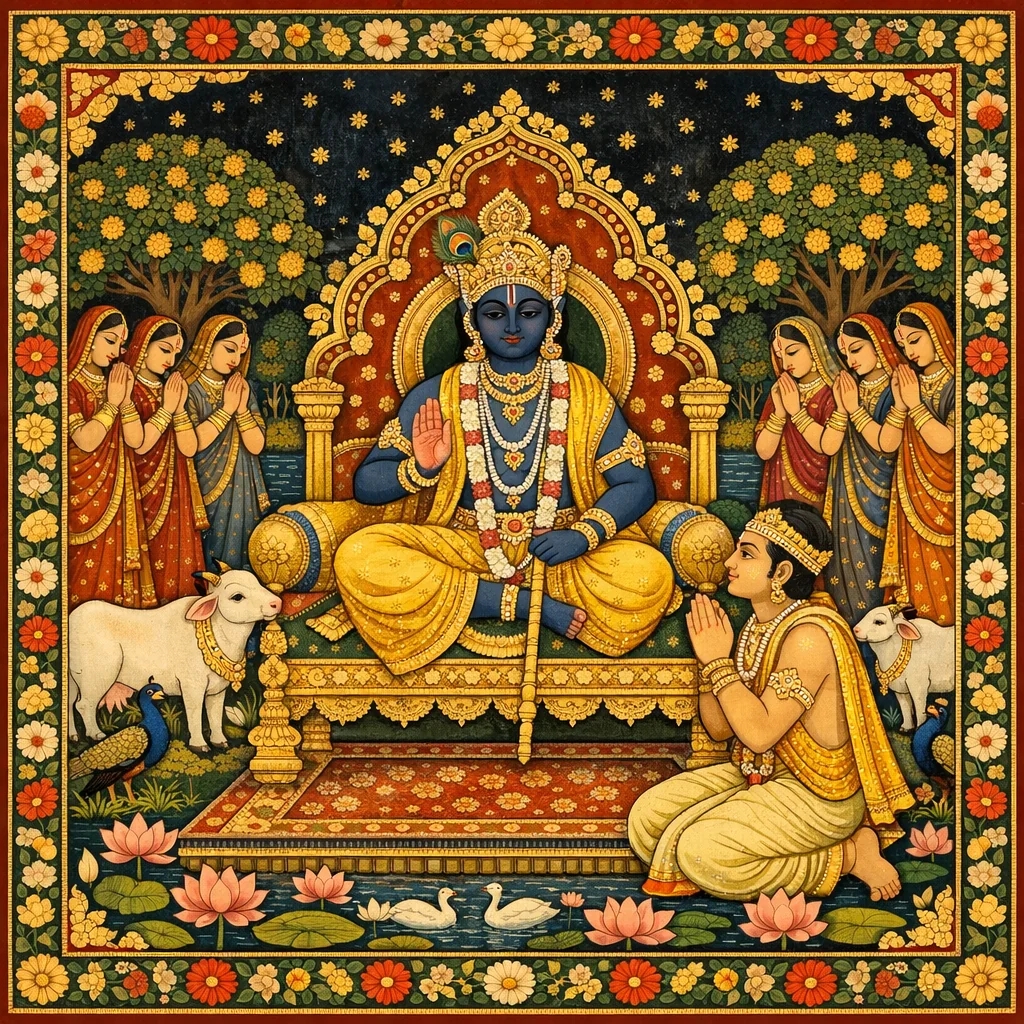
Continuing Kṛṣṇa’s instruction to Uddhava in the Uddhava-gītā, this chapter insists that the decisive cause of liberation and attaining Bhagavān is sādhu-saṅga and unalloyed bhakti, not a mere accumulation of pious or ascetic techniques. Kṛṣṇa lists revered disciplines—aṣṭāṅga-yoga, sāṅkhya analysis, ahiṁsā, Vedic recitation, tapas, sannyāsa, yajña, dāna, tīrtha, vrata, and deva-worship—yet declares they do not “bind” Him as pure devotion does. He then surveys cross-yuga examples of beings and social groups seemingly unqualified yet uplifted by association with devotees, culminating in Vṛndāvana’s residents, whose separation (viraha) from Kṛṣṇa reveals the apex of prema. When Uddhava doubts, Kṛṣṇa explains the Lord’s manifestation through Vedic sound and the cosmos as His form, concluding with the allegory of the tree of material existence and the instruction to cut it with knowledge—then relinquish even that instrument upon realizing the Lord. The chapter sets a hermeneutic: Veda and analysis are supports whose final telos is exclusive shelter (śaraṇāgati) in Kṛṣṇa.
Shlokas
Verse 1
श्रीभगवानुवाच न रोधयति मां योगो न साङ्ख्यं धर्म एव च । न स्वाध्यायस्तपस्त्यागो नेष्टापूर्तं न दक्षिणा ॥ १ ॥ व्रतानि यज्ञश्छन्दांसि तीर्थानि नियमा यमा: । यथावरुन्धे सत्सङ्ग: सर्वसङ्गापहो हि माम् ॥ २ ॥
The Supreme Lord said: My dear Uddhava, neither yoga, sāṅkhya, nor ordinary piety; neither Vedic study, austerity, renunciation, public works, charity, nor offerings can bring Me under one’s control. Nor do vows, sacrifices, mantras, pilgrimages, or disciplines. But saintly association with My pure devotees—destroying all attachment—alone brings Me within the devotee’s grasp.
Verse 2
श्रीभगवानुवाच न रोधयति मां योगो न साङ्ख्यं धर्म एव च । न स्वाध्यायस्तपस्त्यागो नेष्टापूर्तं न दक्षिणा ॥ १ ॥ व्रतानि यज्ञश्छन्दांसि तीर्थानि नियमा यमा: । यथावरुन्धे सत्सङ्ग: सर्वसङ्गापहो हि माम् ॥ २ ॥
The Supreme Lord said: My dear Uddhava, neither yoga nor Sāṅkhya, nor ordinary piety, nor Vedic study, austerity, renunciation, sacrifice, public welfare works, or charity can bring Me under one’s control. But sat-saṅga—association with My pure devotees—destroys all attachment to sense enjoyment, and by that purifying company I become controlled by My bhakta.
Verse 3
सत्सङ्गेन हि दैतेया यातुधाना मृगा: खगा: । गन्धर्वाप्सरसो नागा: सिद्धाश्चारणगुह्यका: ॥ ३ ॥ विद्याधरा मनुष्येषु वैश्या: शूद्रा: स्त्रियोऽन्त्यजा: । रजस्तम:प्रकृतयस्तस्मिंस्तस्मिन् युगे युगे ॥ ४ ॥ बहवो मत्पदं प्राप्तास्त्वाष्ट्रकायाधवादय: । वृषपर्वा बलिर्बाणो मयश्चाथ विभीषण: ॥ ५ ॥ सुग्रीवो हनुमानृक्षो गजो गृध्रो वणिक्पथ: । व्याध: कुब्जा व्रजे गोप्यो यज्ञपत्न्यस्तथापरे ॥ ६ ॥
In every yuga, many beings entangled in rajas and tamas attained the association of My devotees. Thus Daityas, Rākṣasas, beasts and birds, Gandharvas, Apsarās, Nāgas, Siddhas, Cāraṇas, Guhyakas and Vidyādharas—and among humans, those deemed low such as vaiśyas, śūdras, women and others—were able to reach My supreme abode. Vṛtrāsura, Prahlāda Mahārāja and others like them also attained it by such association, as did Vṛṣaparvā, Bali Mahārāja, Bāṇāsura, Maya, Vibhīṣaṇa, Sugrīva, Hanumān, Jāmbavān, Gajendra, Jaṭāyu, Tulādhāra, Dharma-vyādha, Kubjā, the gopīs of Vṛndāvana, and the wives of the brāhmaṇas performing sacrifice.
Verse 4
सत्सङ्गेन हि दैतेया यातुधाना मृगा: खगा: । गन्धर्वाप्सरसो नागा: सिद्धाश्चारणगुह्यका: ॥ ३ ॥ विद्याधरा मनुष्येषु वैश्या: शूद्रा: स्त्रियोऽन्त्यजा: । रजस्तम:प्रकृतयस्तस्मिंस्तस्मिन् युगे युगे ॥ ४ ॥ बहवो मत्पदं प्राप्तास्त्वाष्ट्रकायाधवादय: । वृषपर्वा बलिर्बाणो मयश्चाथ विभीषण: ॥ ५ ॥ सुग्रीवो हनुमानृक्षो गजो गृध्रो वणिक्पथ: । व्याध: कुब्जा व्रजे गोप्यो यज्ञपत्न्यस्तथापरे ॥ ६ ॥
In every yuga, many beings entangled in rajas and tamas attained the association of My devotees. Thus Daityas, Rākṣasas, beasts and birds, Gandharvas, Apsarās, Nāgas, Siddhas, Cāraṇas, Guhyakas and Vidyādharas—and among humans, those deemed low such as vaiśyas, śūdras, women and others—were able to reach My supreme abode. Vṛtrāsura, Prahlāda Mahārāja and others like them also attained it by such association, as did Vṛṣaparvā, Bali Mahārāja, Bāṇāsura, Maya, Vibhīṣaṇa, Sugrīva, Hanumān, Jāmbavān, Gajendra, Jaṭāyu, Tulādhāra, Dharma-vyādha, Kubjā, the gopīs of Vṛndāvana, and the wives of the brāhmaṇas performing sacrifice.
Verse 5
सत्सङ्गेन हि दैतेया यातुधाना मृगा: खगा: । गन्धर्वाप्सरसो नागा: सिद्धाश्चारणगुह्यका: ॥ ३ ॥ विद्याधरा मनुष्येषु वैश्या: शूद्रा: स्त्रियोऽन्त्यजा: । रजस्तम:प्रकृतयस्तस्मिंस्तस्मिन् युगे युगे ॥ ४ ॥ बहवो मत्पदं प्राप्तास्त्वाष्ट्रकायाधवादय: । वृषपर्वा बलिर्बाणो मयश्चाथ विभीषण: ॥ ५ ॥ सुग्रीवो हनुमानृक्षो गजो गृध्रो वणिक्पथ: । व्याध: कुब्जा व्रजे गोप्यो यज्ञपत्न्यस्तथापरे ॥ ६ ॥
In every yuga, many beings entangled in rajas and tamas attained the association of My devotees. Thus Daityas, Rākṣasas, beasts and birds, Gandharvas, Apsarās, Nāgas, Siddhas, Cāraṇas, Guhyakas and Vidyādharas—and among humans, those deemed low such as vaiśyas, śūdras, women and others—were able to reach My supreme abode. Vṛtrāsura, Prahlāda Mahārāja and others like them also attained it by such association, as did Vṛṣaparvā, Bali Mahārāja, Bāṇāsura, Maya, Vibhīṣaṇa, Sugrīva, Hanumān, Jāmbavān, Gajendra, Jaṭāyu, Tulādhāra, Dharma-vyādha, Kubjā, the gopīs of Vṛndāvana, and the wives of the brāhmaṇas performing sacrifice.
Verse 6
सत्सङ्गेन हि दैतेया यातुधाना मृगा: खगा: । गन्धर्वाप्सरसो नागा: सिद्धाश्चारणगुह्यका: ॥ ३ ॥ विद्याधरा मनुष्येषु वैश्या: शूद्रा: स्त्रियोऽन्त्यजा: । रजस्तम:प्रकृतयस्तस्मिंस्तस्मिन् युगे युगे ॥ ४ ॥ बहवो मत्पदं प्राप्तास्त्वाष्ट्रकायाधवादय: । वृषपर्वा बलिर्बाणो मयश्चाथ विभीषण: ॥ ५ ॥ सुग्रीवो हनुमानृक्षो गजो गृध्रो वणिक्पथ: । व्याध: कुब्जा व्रजे गोप्यो यज्ञपत्न्यस्तथापरे ॥ ६ ॥
In every yuga, many beings entangled in rajas and tamas attained the association of My devotees. Thus Daityas, Rākṣasas, beasts and birds, Gandharvas, Apsarās, Nāgas, Siddhas, Cāraṇas, Guhyakas and Vidyādharas—and among humans, those deemed low such as vaiśyas, śūdras, women and others—were able to reach My supreme abode. Vṛtrāsura, Prahlāda Mahārāja and others like them also attained it by such association, as did Vṛṣaparvā, Bali Mahārāja, Bāṇāsura, Maya, Vibhīṣaṇa, Sugrīva, Hanumān, Jāmbavān, Gajendra, Jaṭāyu, Tulādhāra, Dharma-vyādha, Kubjā, the gopīs of Vṛndāvana, and the wives of the brāhmaṇas performing sacrifice.
Verse 7
ते नाधीतश्रुतिगणा नोपासितमहत्तमा: । अव्रतातप्ततपस: मत्सङ्गान्मामुपागता: ॥ ७ ॥
Those I have mentioned did not undertake rigorous study of the Vedas, nor worship great saints, nor perform severe vows and austerities. Simply by the association of Me and My devotees, they attained Me.
Verse 8
केवलेन हि भावेन गोप्यो गावो नगा मृगा: । येऽन्ये मूढधियो नागा: सिद्धा मामीयुरञ्जसा ॥ ८ ॥
By pure, unalloyed loving bhāva alone, the gopīs, the cows, unmoving beings like the twin arjuna trees, animals, dull-conscious beings like bushes and thickets, and even serpents such as Kāliya—all attained life’s perfection and very easily reached Me.
Verse 9
यं न योगेन साङ्ख्येन दानव्रततपोऽध्वरै: । व्याख्यास्वाध्यायसन्न्यासै: प्राप्नुयाद् यत्नवानपि ॥ ९ ॥
Even if one strives intensely through mystic yoga, sāṅkhya philosophy, charity, vows, penances, ritual sacrifices, teaching and explaining Vedic mantras, personal Vedic study, or the renounced order, one still cannot attain Me by those means.
Verse 10
रामेण सार्धं मथुरां प्रणीते श्वाफल्किना मय्यनुरक्तचित्ता: । विगाढभावेन न मे वियोग- तीव्राधयोऽन्यं ददृशु: सुखाय ॥ १० ॥
The residents of Vṛndāvana, headed by the gopīs, were always bound to Me with the deepest love. Therefore, when Akrūra, son of Śvaphalki, took My brother Balarāma and Me to Mathurā, they suffered intense anguish in separation and could find happiness nowhere else.
Verse 11
तास्ता: क्षपा: प्रेष्ठतमेन नीता मयैव वृन्दावनगोचरेण । क्षणार्धवत्ता: पुनरङ्ग तासां हीना मया कल्पसमा बभूवु: ॥ ११ ॥
Dear Uddhava, the nights the gopīs spent with Me, their dearest beloved, in Vṛndāvana seemed to pass in less than a moment. But bereft of My company, those same nights stretched like a kalpa, as if each were endless.
Verse 12
ता नाविदन् मय्यनुषङ्गबद्ध- धिय: स्वमात्मानमदस्तथेदम् । यथा समाधौ मुनयोऽब्धितोये नद्य: प्रविष्टा इव नामरूपे ॥ १२ ॥
My dear Uddhava, just as sages absorbed in samādhi merge into self-realization like rivers entering the ocean and no longer perceive material names and forms, so the gopīs of Vṛndāvana were so bound to Me within their minds that they could not think of their own bodies, this world, or future lives; their whole consciousness was tied only to Me.
Verse 13
मत्कामा रमणं जारमस्वरूपविदोऽबला: । ब्रह्म मां परमं प्रापु: सङ्गाच्छतसहस्रश: ॥ १३ ॥
Those tender gopīs, burning with desire for Me, took Me to be their most charming lover and did not know My true position; yet by intimate association with Me, hundreds of thousands of gopīs attained Me—the Supreme Brahman, the Absolute Truth.
Verse 14
तस्मात्त्वमुद्धवोत्सृज्य चोदनां प्रतिचोदनाम् । प्रवृत्तिं च निवृत्तिं च श्रोतव्यं श्रुतमेव च ॥ १४ ॥ मामेकमेव शरणमात्मानं सर्वदेहिनाम् । याहि सर्वात्मभावेन मया स्या ह्यकुतोभय: ॥ १५ ॥
Therefore, my dear Uddhava, abandon injunctions and prohibitions, engagement and renunciation, and even what has been heard and what remains to be heard. Take shelter of Me alone, for I am the Supreme Person dwelling in the heart of all embodied beings; surrender to Me with your whole self, and by My grace you will be fearless in every circumstance.
Verse 15
तस्मात्त्वमुद्धवोत्सृज्य चोदनां प्रतिचोदनाम् । प्रवृत्तिं च निवृत्तिं च श्रोतव्यं श्रुतमेव च ॥ १४ ॥ मामेकमेव शरणमात्मानं सर्वदेहिनाम् । याहि सर्वात्मभावेन मया स्या ह्यकुतोभय: ॥ १५ ॥
Therefore, O Uddhava, set aside injunction and prohibition, action and renunciation, and what has been heard and what remains to be heard; take refuge in Me alone, the Self within the heart of all embodied beings. Surrender with your whole being, and by My grace you will be fearless in every circumstance.
Verse 16
श्रीउद्धव उवाच संशय: शृण्वतो वाचं तव योगेश्वरेश्वर । न निवर्तत आत्मस्थो येन भ्राम्यति मे मन: ॥ १६ ॥
Śrī Uddhava said: O Lord of all masters of mystic yoga, I have heard Your words, yet the doubt residing in my heart does not depart; therefore my mind is bewildered.
Verse 17
श्रीभगवानुवाच स एष जीवो विवरप्रसूति: प्राणेन घोषेण गुहां प्रविष्ट: । मनोमयं सूक्ष्ममुपेत्य रूपं मात्रा स्वरो वर्ण इति स्थविष्ठ: ॥ १७ ॥
The Supreme Lord said: “Dear Uddhava, I enter the cave of the heart with the life air and the primordial sound, and thus I give life to every living being. By the mind one may perceive My subtle form within the heart; and I also assume a gross form as the Vedic sound—made of short and long measures, vowels and consonants, and varied intonations.”
Verse 18
यथानल: खेऽनिलबन्धुरुष्मा बलेन दारुण्यधिमथ्यमान: । अणु: प्रजातो हविषा समेधते तथैव मे व्यक्तिरियं हि वाणी ॥ १८ ॥
When kindling sticks are vigorously rubbed, contact with air produces heat and a tiny spark appears; then, when ghee is offered, the fire blazes. In the same way, I become manifest in the sound vibration of the Vedas.
Verse 19
एवं गदि: कर्म गतिर्विसर्गो घ्राणो रसो दृक् स्पर्श: श्रुतिश्च । सङ्कल्पविज्ञानमथाभिमान: सूत्रं रज:सत्त्वतमोविकार: ॥ १९ ॥
The activities of the working senses—speech, hands, legs, genitals and anus—and of the knowledge-acquiring senses—nose, tongue, eyes, skin and ears—together with the subtle functions of mind, intelligence, consciousness and false ego, as well as the subtle pradhāna and the transformations of the three modes (rajas, sattva and tamas): all this should be understood as My form manifest within matter.
Verse 20
अयं हि जीवस्त्रिवृदब्जयोनि- रव्यक्त एको वयसा स आद्य: । विश्लिष्टशक्तिर्बहुधेव भाति बीजानि योनिं प्रतिपद्य यद्वत् ॥ २० ॥
Just as many seeds placed in a field produce countless trees, bushes and vegetables from the single source of soil, so the Supreme Personality of Godhead—eternal and the giver of life—exists originally beyond the cosmic manifestation, unmanifest. In time, as the shelter of the three modes and the source of the universal lotus, He divides His material potencies and thus appears in innumerable forms, though He is one.
Verse 21
यस्मिन्निदं प्रोतमशेषमोतं पटो यथा तन्तुवितानसंस्थ: । य एष संसारतरु: पुराण: कर्मात्मक: पुष्पफले प्रसूते ॥ २१ ॥
Just as woven cloth rests upon the spread of lengthwise and crosswise threads, so the entire universe is expanded upon the potencies of the Supreme Personality of Godhead and situated within Him. This ancient tree of saṁsāra is karmic in nature and produces flowers and fruits; similarly, the tree of the material body first blossoms and then yields the fruits of material existence.
Verse 22
द्वे अस्य बीजे शतमूलस्त्रिनाल: पञ्चस्कन्ध: पञ्चरसप्रसूति: । दशैकशाखो द्विसुपर्णनीड- स्त्रिवल्कलो द्विफलोऽर्कं प्रविष्ट: ॥ २२ ॥ अदन्ति चैकं फलमस्य गृध्रा ग्रामेचरा एकमरण्यवासा: । हंसा य एकं बहुरूपमिज्यै- र्मायामयं वेद स वेद वेदम् ॥ २३ ॥
This tree of material existence has two seeds, hundreds of roots, three lower trunks and five upper trunks. It yields five flavors, bears eleven branches and a nest of two birds, is covered by three kinds of bark, gives two fruits, and stretches up to the sun.
Verse 23
द्वे अस्य बीजे शतमूलस्त्रिनाल: पञ्चस्कन्ध: पञ्चरसप्रसूति: । दशैकशाखो द्विसुपर्णनीड- स्त्रिवल्कलो द्विफलोऽर्कं प्रविष्ट: ॥ २२ ॥ अदन्ति चैकं फलमस्य गृध्रा ग्रामेचरा एकमरण्यवासा: । हंसा य एकं बहुरूपमिज्यै- र्मायामयं वेद स वेद वेदम् ॥ २३ ॥
One fruit of this tree is eaten by those who dwell in towns and villages, greedy for sense pleasure and devoted to household life; the other fruit is enjoyed by the forest-dwelling renunciants, swanlike in purity. One who, with the help of bona fide spiritual masters, understands this tree as the manifestation of the māyā-śakti of the one Supreme Truth appearing in many forms truly knows the purport of the Vedas.
Verse 24
एवं गुरूपासनयैकभक्त्या विद्याकुठारेण शितेन धीर: । विवृश्च्य जीवाशयमप्रमत्त: सम्पद्य चात्मानमथ त्यजास्त्रम् ॥ २४ ॥
Thus, by carefully worshiping the spiritual master, cultivate single-minded, pure devotional service; and with the sharpened ax of transcendental knowledge, cut away—without negligence—the soul’s subtle material covering. Having realized the Supreme Personality of Godhead, then abandon even that ax of analytic knowledge.
Frequently Asked Questions
Because sādhu-saṅga awakens śuddha-bhakti, which directly attracts Bhagavān as a person (bhakta-vaśya). Ritual, yoga, and austerity can purify or elevate, but without devotion they do not establish the loving relationship that ‘binds’ the Lord. The chapter’s repeated contrast shows that the decisive factor is the heart’s exclusive attachment to Kṛṣṇa, transmitted and nourished through association with His pure devotees.
The chapter teaches that eligibility is ultimately determined by contact with bhakti—especially via devotees—rather than by birth, ritual capacity, or scholastic attainment. By sādhu-saṅga, even those dominated by rajas and tamas can receive devotion, and devotion itself carries the soul to the Lord’s abode, as illustrated by figures like Prahlāda, Vṛtrāsura, Gajendra, Jaṭāyu, Kubjā, the gopīs, and the wives of the brāhmaṇas.
It is not a rejection of Veda as false, but a declaration of Veda’s final purport (tātparya): all subsidiary rules and ritual procedures are meant to culminate in exclusive surrender to Bhagavān. When direct refuge in Kṛṣṇa is awakened, secondary supports become nonessential, just as one leaves a boat after crossing a river.
It is an allegory of embodied saṁsāra structured by guṇa and karma. Its components (seeds, roots, trunks, branches, fruits, two birds) encode the jīva’s entanglement and the experience of enjoyment and renunciation. With guru-bhakti and sharpened knowledge, one ‘cuts’ the subtle covering (liṅga-śarīra identification) and, upon realizing Bhagavān, relinquishes even the analytic tool—resting in direct devotion and realization.
Their consciousness is portrayed as fully absorbed in Kṛṣṇa beyond self-awareness, social identity, or concern for future lives. Their viraha (anguish of separation when Kṛṣṇa leaves for Mathurā) demonstrates exclusive dependence: without Him, no substitute happiness exists. The chapter uses this as the lived proof that pure love, not technique, is the supreme means and end.