Adhyaya 6
Puruṣa-sūkta Logic of the Virāṭ: Cosmic Anatomy, Sacrifice, and the Lord’s Transcendence
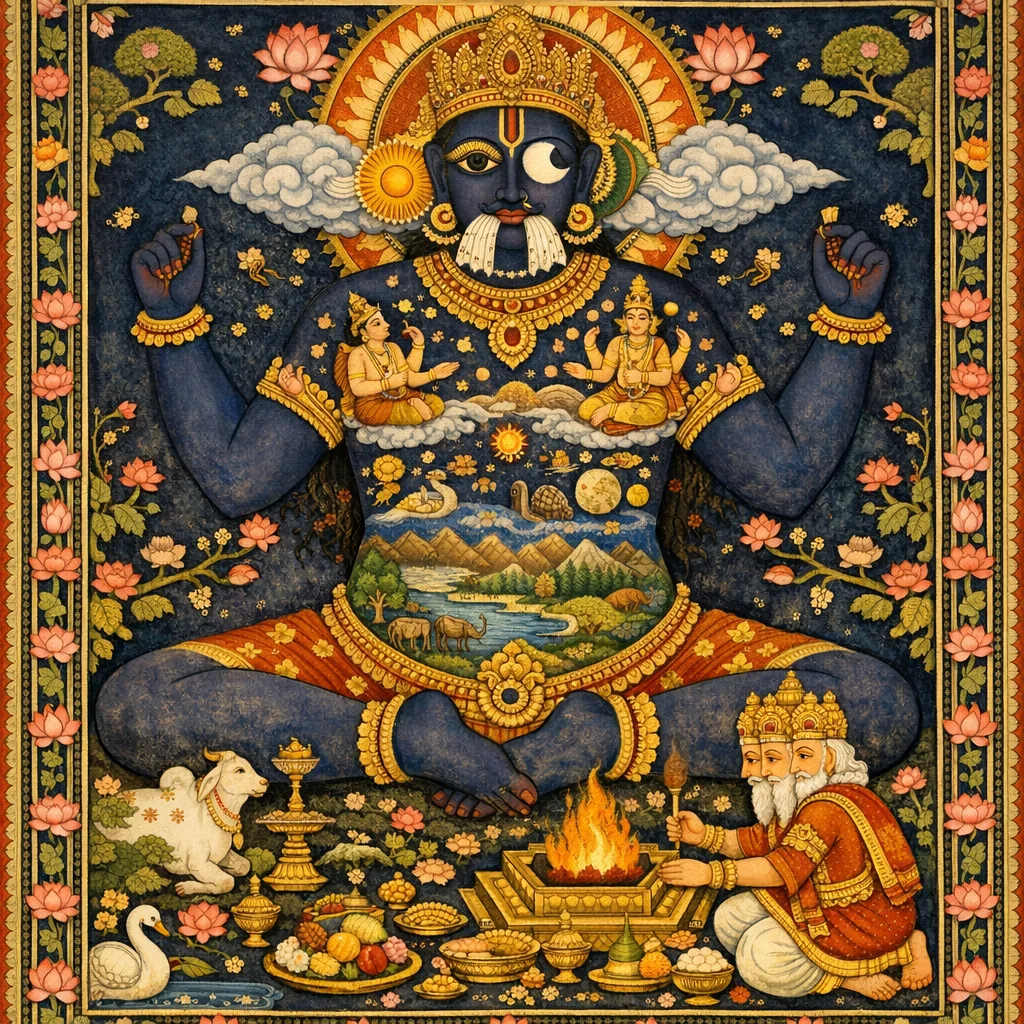
Continuing Brahmā’s instruction to Nārada on knowing the Supreme through both immanence and transcendence, this chapter maps the universe onto the virāṭ-puruṣa: mouth, nostrils, eyes, ears, skin, hair, limbs, and inner organs become sources for speech, Vedic meters, prāṇa, sound/ākāśa, touch/vāyu, vegetation, rivers, mountains, and the devatās’ cosmic governance. It then turns from anatomy to ontology: though the Lord pervades all beings across time, He remains beyond measure, beyond death and karma. Brahmā explains that he derived sacrificial implements from the Lord’s own limbs, establishing yajña as a cosmological principle whose ultimate beneficiary is Viṣṇu. The chapter culminates in Brahmā’s confession of the Lord’s incomprehensibility—even to Brahmā, Śiva, and the devas—followed by praise of Mahā-Viṣṇu as the first expansion for creation and a warning against mistaking powerful beings for the Supreme. It closes by announcing the coming narration of the līlā-avatāras, linking cosmic doctrine to devotional hearing.
Shlokas
Verse 1
ब्रह्मोवाच वाचां वह्नेर्मुखं क्षेत्रं छन्दसां सप्त धातव: । हव्यकव्यामृतान्नानां जिह्वा सर्वरसस्य च ॥ १ ॥
Brahmā said: The mouth of the Virāṭ-Puruṣa is the source of speech, presided over by Agni. His skin, with six further layers, is the womb of the Vedic meters; and His tongue is the fountain of havya and kavya, of amṛta, and of all foods and delicacies offered to the devas, the forefathers, and humankind.
Verse 2
सर्वासूनां च वायोश्च तन्नासे परमायणे । अश्विनोरोषधीनां च घ्राणो मोदप्रमोदयो: ॥ २ ॥
His two nostrils are the sources of prāṇa-vāyu and of all other airs. From His power of smell arise the Aśvinī-kumāra devas and every kind of healing herb, and from His breathing energies come manifold fragrances.
Verse 3
रूपाणां तेजसां चक्षुर्दिव: सूर्यस्य चाक्षिणी । कर्णौ दिशां च तीर्थानां श्रोत्रमाकाशशब्दयो: ॥ ३ ॥
His eyes are the sources of all forms, shining and illumining. His eyeballs are like the sun and the heavenly realms. His ears hear from every direction and are receptacles of all the Vedas, and His faculty of hearing is the source of ākāśa (sky/ether) and of every kind of sound.
Verse 4
तद्गात्रं वस्तुसाराणां सौभगस्य च भाजनम् । त्वगस्य स्पर्शवायोश्च सर्वमेधस्य चैव हि ॥ ४ ॥
His bodily surface is the ground from which the active principles of all things arise, and the vessel of every auspicious fortune. His skin, like the moving wind, is the source of all varieties of touch, and the very place where all kinds of yajña (sacrifice) are performed.
Verse 5
रोमाण्युद्भिज्जजातीनां यैर्वा यज्ञस्तु सम्भृत: । केशश्मश्रुनखान्यस्य शिलालोहाभ्रविद्युताम् ॥ ५ ॥
The hairs upon the Lord’s body are the source of all vegetation, especially the trees required for yajña. The hair of His head and face is the storehouse of clouds, and His nails give rise to stone, iron ore, and lightning.
Verse 6
बाहवो लोकपालानां प्रायश: क्षेमकर्मणाम् ॥ ६ ॥
The Lord’s arms are the fertile field for the lokapālas and all leaders who protect the living beings, by whom the work of welfare and guardianship is carried out.
Verse 7
विक्रमो भूर्भुव: स्वश्च क्षेमस्य शरणस्य च । सर्वकामवरस्यापि हरेश्चरण आस्पदम् ॥ ७ ॥
Thus the Lord’s forward steps are the shelter of the bhūr, bhuvaḥ, and svaḥ worlds, and the support of all our welfare and refuge; there also rest all desired boons. Hari’s lotus feet protect from every kind of fear.
Verse 8
अपां वीर्यस्य सर्गस्य पर्जन्यस्य प्रजापते: । पुंस: शिश्न उपस्थस्तु प्रजात्यानन्दनिर्वृते: ॥ ८ ॥
From the Lord’s genitals arise water, semen, the generative power of creation, rains, and the prajāpatis. His genitals are the cause of a pleasure that counteracts the distress of begetting.
Verse 9
पायुर्यमस्य मित्रस्य परिमोक्षस्य नारद । हिंसाया निऋर्तेर्मृत्योर्निरयस्य गुदं स्मृत: ॥ ९ ॥
O Nārada, the evacuating outlet of the Lord’s universal form is the abode of Yama and Mitra. And the Lord’s rectum is remembered as the place of violence, Nairṛti, death, hell, and the like.
Verse 10
पराभूतेरधर्मस्य तमसश्चापि पश्चिम: । नाड्यो नदनदीनां च गोत्राणामस्थिसंहति: ॥ १० ॥
The Lord’s back is the seat where irreligion, ignorance, and darkness meet their defeat. From His veins flow the great rivers and streams, and upon His bones are arrayed the mighty mountains.
Verse 11
अव्यक्तरससिन्धूनां भूतानां निधनस्य च । उदरं विदितं पुंसो हृदयं मनस: पदम् ॥ ११ ॥
The Lord’s unmanifest feature is the abode of the vast oceans, and His belly is known as the resting place of the jīvas dissolved at material annihilation. His heart is the seat of the subtle bodies and the mind of living beings—so the wise understand.
Verse 12
धर्मस्य मम तुभ्यं च कुमाराणां भवस्य च । विज्ञानस्य च सत्त्वस्य परस्यात्मा परायणम् ॥ १२ ॥
The consciousness of that Great Person is the very abode of dharma—mine, yours, the four Kumāras’, and Bhava’s (Śiva’s) as well. That same consciousness is the shelter of truth, sattva, and transcendental knowledge.
Verse 13
अहं भवान् भवश्चैव त इमे मुनयोऽग्रजा: । सुरासुरनरा नागा: खगा मृगसरीसृपा: ॥ १३ ॥ गन्धर्वाप्सरसो यक्षा रक्षोभूतगणोरगा: । पशव: पितर: सिद्धा विद्याध्राश्चारणा द्रुमा: ॥ १४ ॥ अन्ये च विविधा जीवा जलस्थलनभौकस: । ग्रहर्क्षकेतवस्तारास्तडित: स्तनयित्नव: ॥ १५ ॥ सर्वं पुरुष एवेदं भूतं भव्यं भवच्च यत् । तेनेदमावृतं विश्वं वितस्तिमधितिष्ठति ॥ १६ ॥
From me (Brahmā) down to you and Bhava (Śiva)—the sages born before you; the devas and asuras, humans, Nāgas, birds, beasts, and reptiles; the Gandharvas, Apsarās, Yakṣas, Rākṣasas, hosts of Bhūtas, Uragas, animals, Pitṛs, Siddhas, Vidyādharas, Cāraṇas, and trees; all beings dwelling in water, on land, and in the sky; the planets, stars, comets (ketu), lightning and thunder—whatever is past, present, or future is ever covered by the Lord’s universal form (viśva-rūpa), the Puruṣa. Yet He remains beyond them all, eternally established in a form no more than one vitasti (nine inches).
Verse 14
अहं भवान् भवश्चैव त इमे मुनयोऽग्रजा: । सुरासुरनरा नागा: खगा मृगसरीसृपा: ॥ १३ ॥ गन्धर्वाप्सरसो यक्षा रक्षोभूतगणोरगा: । पशव: पितर: सिद्धा विद्याध्राश्चारणा द्रुमा: ॥ १४ ॥ अन्ये च विविधा जीवा जलस्थलनभौकस: । ग्रहर्क्षकेतवस्तारास्तडित: स्तनयित्नव: ॥ १५ ॥ सर्वं पुरुष एवेदं भूतं भव्यं भवच्च यत् । तेनेदमावृतं विश्वं वितस्तिमधितिष्ठति ॥ १६ ॥
From me (Brahmā) down to you and Bhava (Śiva)—the sages born before you; the devas and asuras, humans, Nāgas, birds, beasts, and reptiles; the Gandharvas, Apsarās, Yakṣas, Rākṣasas, hosts of Bhūtas, Uragas, animals, Pitṛs, Siddhas, Vidyādharas, Cāraṇas, and trees; all beings dwelling in water, on land, and in the sky; the planets, stars, comets (ketu), lightning and thunder—whatever is past, present, or future is ever covered by the Lord’s universal form (viśva-rūpa), the Puruṣa. Yet He remains beyond them all, eternally established in a form no more than one vitasti (nine inches).
Verse 15
अहं भवान् भवश्चैव त इमे मुनयोऽग्रजा: । सुरासुरनरा नागा: खगा मृगसरीसृपा: ॥ १३ ॥ गन्धर्वाप्सरसो यक्षा रक्षोभूतगणोरगा: । पशव: पितर: सिद्धा विद्याध्राश्चारणा द्रुमा: ॥ १४ ॥ अन्ये च विविधा जीवा जलस्थलनभौकस: । ग्रहर्क्षकेतवस्तारास्तडित: स्तनयित्नव: ॥ १५ ॥ सर्वं पुरुष एवेदं भूतं भव्यं भवच्च यत् । तेनेदमावृतं विश्वं वितस्तिमधितिष्ठति ॥ १६ ॥
From me (Brahmā) down to you and Bhava (Śiva), and the great sages born before you; the devas and asuras, Nāgas, human beings, birds, beasts and reptiles; the planets, stars, comets, luminaries, lightning and thunder; and the inhabitants of the worlds—Gandharvas, Apsarās, Yakṣas, Rākṣasas, hosts of Bhūtas, Uragas, animals, Pitṛs, Siddhas, Vidyādharas, Cāraṇas, trees, and all diverse beings dwelling in water, on land, and in the sky—everything in past, present, and future is ever encompassed by the Lord Puruṣa’s universal form. He pervades and upholds this entire cosmos.
Verse 16
अहं भवान् भवश्चैव त इमे मुनयोऽग्रजा: । सुरासुरनरा नागा: खगा मृगसरीसृपा: ॥ १३ ॥ गन्धर्वाप्सरसो यक्षा रक्षोभूतगणोरगा: । पशव: पितर: सिद्धा विद्याध्राश्चारणा द्रुमा: ॥ १४ ॥ अन्ये च विविधा जीवा जलस्थलनभौकस: । ग्रहर्क्षकेतवस्तारास्तडित: स्तनयित्नव: ॥ १५ ॥ सर्वं पुरुष एवेदं भूतं भव्यं भवच्च यत् । तेनेदमावृतं विश्वं वितस्तिमधितिष्ठति ॥ १६ ॥
Whatever is past, future, and present in this world is the Supreme Lord, Puruṣa Himself, established as the universal form (Virāṭ-rūpa). By Him the entire cosmos—moving and unmoving—is enveloped; the infinite Lord presides over and sustains all, within and without.
Verse 17
स्वधिष्ण्यं प्रतपन् प्राणो बहिश्च प्रतपत्यसौ । एवं विराजं प्रतपंस्तपत्यन्तर्बहि: पुमान् ॥ १७ ॥
As the sun, by spreading its radiance, illumines both within and without, so Bhagavān Puruṣa, expanding His universal form, sustains and enlightens all creation internally and externally.
Verse 18
सोऽमृतस्याभयस्येशो मर्त्यमन्नं यदत्यगात् । महिमैष ततो ब्रह्मन् पुरुषस्य दुरत्यय: ॥ १८ ॥
The Supreme Puruṣa is the Lord of immortality and fearlessness; He transcends death and the “food” of worldly karma, its fruitive results. O Nārada, O brāhmaṇa, therefore the glories of the Supreme Person are difficult to measure.
Verse 19
पादेषु सर्वभूतानि पुंस: स्थितिपदो विदु: । अमृतं क्षेममभयं त्रिमूर्ध्नोऽधायि मूर्धसु ॥ १९ ॥
The wise know that all beings rest at the feet of Bhagavān Puruṣa—within that realm of His energy which is but one quarter. Immortality, well-being, and fearlessness—free from the anxieties of old age and disease—abide in the supreme dhāma, beyond the three higher worlds and beyond the material coverings.
Verse 20
पादास्त्रयो बहिश्चासन्नप्रजानां य आश्रमा: । अन्तस्त्रिलोक्यास्त्वपरो गृहमेधोऽबृहद्व्रत: ॥ २० ॥
The spiritual realm, comprising three fourths of the Lord’s energy, lies beyond this material world and is meant especially for those who never take birth again. But those attached to household life, who do not strictly keep the vow of brahmacarya, must dwell within the three material worlds.
Verse 21
सृती विचक्रमे विश्वङ्साशनानशने उभे । यदविद्या च विद्या च पुरुषस्तूभयाश्रय: ॥ २१ ॥
By His energies, the all-pervading Supreme Personality of Godhead fully governs both spheres—control and devotional service. He is the ultimate master of both avidyā (nescience) and vidyā (true knowledge), and the shelter of them both.
Verse 22
यस्मादण्डं विराड् जज्ञे भूतेन्द्रियगुणात्मक: । तद् द्रव्यमत्यगाद् विश्वं गोभि: सूर्य इवातपन् ॥ २२ ॥
From that Supreme Personality of Godhead arise all the universal globes and the universal form (virāṭ), endowed with material elements, qualities, and senses. Yet He remains aloof from such material manifestations, like the sun, distinct from its rays and heat.
Verse 23
यदास्य नाभ्यान्नलिनादहमासं महात्मन: । नाविदं यज्ञसम्भारान् पुरुषावयवानृते ॥ २३ ॥
When I was born from the lotus of the abdomen of the great Mahā-Viṣṇu, I found no ingredients for sacrifice. Except for the bodily limbs of that Supreme Personality, I had no other provisions for yajña.
Verse 24
तेषु यज्ञस्य पशव: सवनस्पतय: कुशा: । इदं च देवयजनं कालश्चोरुगुणान्वित: ॥ २४ ॥
To perform yajña one requires sacrificial ingredients—such as animals for offering, soma plants, and kuśa grass—along with the altar for worship of the devas and a suitable, auspicious time, such as spring.
Verse 25
वस्तून्योषधय: स्नेहा रसलोहमृदो जलम् । ऋचो यजूंषि सामानि चातुर्होत्रं च सत्तम ॥ २५ ॥
Other requisites are vessels, grains and herbs, sacred ghee and unctions, honey and sweet essences, gold and metals, earth and water; also the Ṛg, Yajur, and Sāma Vedas, and four priests to perform the sacrifice, O best of the virtuous.
Verse 26
नामधेयानि मन्त्राश्च दक्षिणाश्च व्रतानि च । देवतानुक्रम: कल्प: सङ्कल्पस्तन्त्रमेव च ॥ २६ ॥
Other necessities include invoking the devas by their sacred names, the mantras, the dākṣiṇās and vows; also the proper order of the deities, the kalpa rules, the saṅkalpa (solemn resolve), and the prescribed ritual procedures.
Verse 27
गतयो मतयश्चैव प्रायश्चित्तं समर्पणम् । पुरुषावयवैरेते सम्भारा: सम्भृता मया ॥ २७ ॥
Goals and dispositions of mind, expiation and full surrender—these too, as the requisites of sacrifice, were gathered by me from the very bodily limbs of the Supreme Puruṣa, the Lord.
Verse 28
इति सम्भृतसम्भार: पुरुषावयवैरहम् । तमेव पुरुषं यज्ञं तेनैवायजमीश्वरम् ॥ २८ ॥
Thus, having assembled the sacrificial ingredients from the limbs of the Supreme Puruṣa, I understood that He Himself is the yajña; and by Him alone I performed the sacrifice to satisfy the Lord.
Verse 29
ततस्ते भ्रातर इमे प्रजानां पतयो नव । अयजन् व्यक्तमव्यक्तं पुरुषं सुसमाहिता: ॥ २९ ॥
Thereafter, my dear son, your nine brothers—the lords of progeny—performed the yajña with steady minds, to please the Puruṣa in both His manifest and unmanifest aspects.
Verse 30
ततश्च मनव: काले ईजिरे ऋषयोऽपरे । पितरो विबुधा दैत्या मनुष्या: क्रतुभिर्विभुम् ॥ ३० ॥
Thereafter, in due course of time, the Manus, the great sages, the Pitṛs (forefathers), the learned devas, the Daityas, and humankind performed various sacrifices to please the Supreme Lord, the all-powerful Master.
Verse 31
नारायणे भगवति तदिदं विश्वमाहितम् । गृहीतमायोरुगुण: सर्गादावगुण: स्वत: ॥ ३१ ॥
Thus all the material manifestations of the universes rest in Bhagavān Nārāyaṇa. He accepts His mighty energy, māyā, of His own accord; though at creation’s dawn He seems connected with the guṇas, in His own nature He is eternally nirguṇa.
Verse 32
सृजामि तन्नियुक्तोऽहं हरो हरति तद्वश: । विश्वं पुरुषरूपेण परिपाति त्रिशक्तिधृक् ॥ ३२ ॥
By His will I create; Hara (Śiva) destroys under His control; and He Himself, in His eternal Puruṣa form as the Supreme Personality of Godhead, maintains the universe, as the mighty Lord who holds the three energies.
Verse 33
इति तेऽभिहितं तात यथेदमनुपृच्छसि । नान्यद्भगवत: किंचिद्भाव्यं सदसदात्मकम् ॥ ३३ ॥
My dear son, I have explained to you everything just as you inquired. Know for certain that whatever exists—cause or effect, in the material or the spiritual realm—depends upon the Supreme Personality of Godhead; nothing stands apart from Him.
Verse 34
न भारती मेऽङ्ग मृषोपलक्ष्यते न वै क्वचिन्मे मनसो मृषा गति: । न मे हृषीकाणि पतन्त्यसत्पथे यन्मे हृदौत्कण्ठ्यवता धृतो हरि: ॥ ३४ ॥
O Nārada, because with intense longing I have taken firm hold of Hari’s lotus feet, my words have never been found false. The course of my mind is never checked, nor do my senses fall onto an untrue path through temporary attachment to matter.
Verse 35
सोऽहं समाम्नायमयस्तपोमय: प्रजापतीनामभिवन्दित: पति: । आस्थाय योगं निपुणं समाहित- स्तं नाध्यगच्छं यत आत्मसम्भव: ॥ ३५ ॥
Though I am Brahmā, perfected in the Vedic disciplic succession, filled with austerity and skilled in yoga, and honored by the Prajāpatis, still I cannot truly understand Him—the Lord, the very source of my birth.
Verse 36
नतोऽस्म्यहं तच्चरणं समीयुषां भवच्छिदं स्वस्त्ययनं सुमङ्गलम् । यो ह्यात्ममायाविभवं स्म पर्यगाद् यथा नभ: स्वान्तमथापरे कुत: ॥ ३६ ॥
Therefore it is best for me to take shelter of His feet, which alone cut the misery of repeated birth and death and are supremely auspicious. Even the sky cannot gauge the limits of its own expanse—how then can others measure the Lord’s boundlessness?
Verse 37
नाहं न यूयं यदृतां गतिं विदु- र्न वामदेव: किमुतापरे सुरा: । तन्मायया मोहितबुद्धयस्त्विदं विनिर्मितं चात्मसमं विचक्ष्महे ॥ ३७ ॥
Since neither Śiva (Vāmadeva), nor you, nor I can ascertain the limits of spiritual bliss, how can other demigods know them? Bewildered by the Lord’s external māyā, we perceive only this manifested cosmos according to our individual capacity.
Verse 38
यस्यावतारकर्माणि गायन्ति ह्यस्मदादय: । न यं विदन्ति तत्त्वेन तस्मै भगवते नम: ॥ ३८ ॥
Let us offer our obeisances to that Supreme Personality of Godhead, whose incarnations and deeds we sing in glorification, though He can scarcely be fully known as He truly is.
Verse 39
स एष आद्य: पुरुष: कल्पे कल्पे सृजत्यज: । आत्मात्मन्यात्मनात्मानं स संयच्छति पाति च ॥ ३९ ॥
He is the original Purusha, the unborn Lord; in every age of creation He brings forth this manifested cosmos. The creation occurs within Him—its substance and forms are His own expansion. For a time He maintains it, and then He draws it back into Himself again.
Verse 40
विशुद्धं केवलं ज्ञानं प्रत्यक् सम्यगवस्थितम् । सत्यं पूर्णमनाद्यन्तं निर्गुणं नित्यमद्वयम् ॥ ४० ॥ ऋषे विदन्ति मुनय: प्रशान्तात्मेन्द्रियाशया: । यदा तदेवासत्तर्कैस्तिरोधीयेत विप्लुतम् ॥ ४१ ॥
The Supreme Personality of Godhead is utterly pure, untouched by any material taint. He is the Absolute Truth and the very form of perfect knowledge—without beginning or end, nirguṇa, eternal, and nondual.
Verse 41
विशुद्धं केवलं ज्ञानं प्रत्यक् सम्यगवस्थितम् । सत्यं पूर्णमनाद्यन्तं निर्गुणं नित्यमद्वयम् ॥ ४० ॥ ऋषे विदन्ति मुनय: प्रशान्तात्मेन्द्रियाशया: । यदा तदेवासत्तर्कैस्तिरोधीयेत विप्लुतम् ॥ ४१ ॥
O sage Nārada, the seers know Him when the self and senses are fully pacified and freed from material longing. But when one clings to baseless arguments, everything is distorted and the Lord is hidden from sight.
Verse 42
आद्योऽवतार: पुरुष: परस्य काल: स्वभाव: सदसन्मनश्च । द्रव्यं विकारो गुण इन्द्रियाणि विराट् स्वराट् स्थास्नु चरिष्णु भूम्न: ॥ ४२ ॥
Kāraṇārṇavaśāyī Viṣṇu is the first expansion of the Supreme Lord. He is the master of eternal time and space, of cause and effect, of mind and the elements, of transformations, the guṇas and the senses, of the universal form, of Garbhodakaśāyī Viṣṇu, and of the totality of all beings—moving and unmoving.
Verse 43
अहं भवो यज्ञ इमे प्रजेशा दक्षादयो ये भवदादयश्च । स्वर्लोकपाला: खगलोकपाला नृलोकपालास्तललोकपाला: ॥ ४३ ॥ गन्धर्वविद्याधरचारणेशा ये यक्षरक्षोरगनागनाथा: । ये वा ऋषीणामृषभा: पितृणां दैत्येन्द्रसिद्धेश्वरदानवेन्द्रा: । अन्ये च ये प्रेतपिशाचभूत- कूष्माण्डयादोमृगपक्ष्यधीशा: ॥ ४४ ॥ यत्किंच लोके भगवन्महस्व- दोज:सहस्वद् बलवत् क्षमावत् । श्रीह्रीविभूत्यात्मवदद्भुतार्णं तत्त्वं परं रूपवदस्वरूपम् ॥ ४५ ॥
I, Brahmā; Bhava (Śiva); Yajña (Viṣṇu); the Prajāpatis such as Dakṣa; you like Nārada; and the guardians of the heavenly, aerial, earthly, and lower worlds—all are but the shining of a tiny portion of the Lord’s transcendental potency.
Verse 44
अहं भवो यज्ञ इमे प्रजेशा दक्षादयो ये भवदादयश्च । स्वर्लोकपाला: खगलोकपाला नृलोकपालास्तललोकपाला: ॥ ४३ ॥ गन्धर्वविद्याधरचारणेशा ये यक्षरक्षोरगनागनाथा: । ये वा ऋषीणामृषभा: पितृणां दैत्येन्द्रसिद्धेश्वरदानवेन्द्रा: । अन्ये च ये प्रेतपिशाचभूत- कूष्माण्डयादोमृगपक्ष्यधीशा: ॥ ४४ ॥ यत्किंच लोके भगवन्महस्व- दोज:सहस्वद् बलवत् क्षमावत् । श्रीह्रीविभूत्यात्मवदद्भुतार्णं तत्त्वं परं रूपवदस्वरूपम् ॥ ४५ ॥
The lords of the Gandharvas, Vidyādharas, and Cāraṇas; the chiefs of the Yakṣas, Rakṣasas, Uragas, and Nāgas; the foremost ṛṣis and the rulers of the Pitṛs; the kings of the Daityas, the lords of the Siddhas, and the leaders of the Dānavas; and even the pretas, piśācas, bhūtas, kūṣmāṇḍas, and the masters of aquatics, beasts, and birds—all are but portions of His power.
Verse 45
अहं भवो यज्ञ इमे प्रजेशा दक्षादयो ये भवदादयश्च । स्वर्लोकपाला: खगलोकपाला नृलोकपालास्तललोकपाला: ॥ ४३ ॥ गन्धर्वविद्याधरचारणेशा ये यक्षरक्षोरगनागनाथा: । ये वा ऋषीणामृषभा: पितृणां दैत्येन्द्रसिद्धेश्वरदानवेन्द्रा: । अन्ये च ये प्रेतपिशाचभूत- कूष्माण्डयादोमृगपक्ष्यधीशा: ॥ ४४ ॥ यत्किंच लोके भगवन्महस्व- दोज:सहस्वद् बलवत् क्षमावत् । श्रीह्रीविभूत्यात्मवदद्भुतार्णं तत्त्वं परं रूपवदस्वरूपम् ॥ ४५ ॥
I myself (Brahmā), Bhava (Śiva), Yajña, the Prajāpatis such as Dakṣa, you Nārada and the Kumāras, the guardians of heaven like Indra and Candra, the rulers of Bhūrloka, Nṛloka and Talaloka, the chiefs of the Gandharvas, Vidyādharas and Cāraṇas, the lords of the Yakṣas, Rākṣasas, Uragas and Nāgas, the great ṛṣis and the Pitṛs, the kings of daityas and dānavas and the masters of the siddhas, as well as pretas, piśācas, bhūtas, kūṣmāṇḍas, and the sovereigns of aquatics, beasts and birds—whatever in this world appears exceptionally endowed with power, splendor, keen intelligence, strength, forgiveness, beauty, modesty and opulence, whether with form or without form, is not itself the Supreme Truth of the Lord; it is only a minute fragment of His transcendental potency.
Verse 46
प्राधान्यतो यानृष आमनन्ति लीलावतारान् पुरुषस्य भूम्न: । आपीयतां कर्णकषायशोषा- ननुक्रमिष्ये त इमान् सुपेशान् ॥ ४६ ॥
O Nārada, I shall now recount, one after another, the Lord’s līlā-avatāras, which the sages have chiefly proclaimed. Hearing their deeds dries up the foulness accumulated in the ear; these pastimes are beautiful and sweet to hear, and thus they abide within my heart.
Frequently Asked Questions
SB 2.6 presents a correspondential cosmology where each organ of the virāṭ serves as a ‘generating center’ (yoni) for a function (e.g., speech, breath, sound) and is governed by an adhi-devatā (e.g., Agni for speech). This teaches that perception and nature are not independent mechanisms but coordinated energies within the Lord’s universal body, meant to be recognized as His arrangement rather than as autonomous material causes.
The narrative establishes that yajña is not a human invention but a cosmic principle grounded in the Lord Himself. Since Brahmā, at the dawn of creation, has no external resources, he ‘constructs’ the sacrificial system from the Lord’s limbs—signifying that all materials, mantras (Ṛg/Yajur/Sāma), priests, timings, and offerings ultimately belong to Viṣṇu and culminate in Viṣṇu as the final goal (yajñārtha).
Kāraṇārṇavaśāyī Viṣṇu (Mahā-Viṣṇu) is described as the first puruṣa-expansion related to cosmic manifestation, presiding over kāla (time), space, causality, mind, elements, the guṇas, the senses, and the totality of living beings. From Him proceed further expansions such as Garbhodakaśāyī Viṣṇu, through whom the universe becomes organized for Brahmā’s secondary creation.
Because the cosmos contains many entities with extraordinary opulence—devas, sages, rulers of lokas, and subtle beings—there is a risk of confusing delegated potency with ultimate divinity. SB 2.6 clarifies that such greatness is only a fragment of the Lord’s transcendental energy; Bhagavān alone is the source and controller, while all others are dependent manifestations within His potency.