Adhyaya 1
The First Step in God Realization: The Glory of Hearing and the Virāṭ-Rūpa Meditation
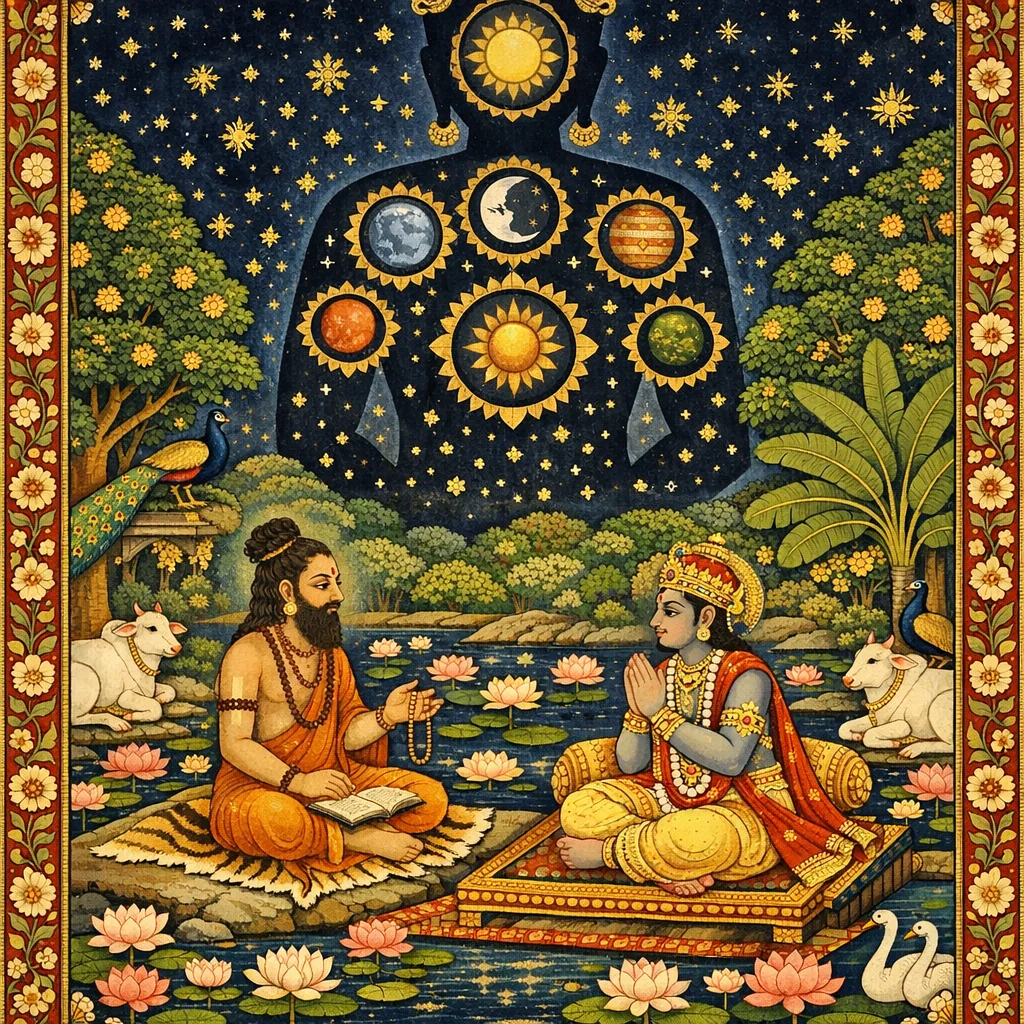
Śukadeva Gosvāmī praises Parīkṣit’s question as universally auspicious, contrasting it with the distracted life of materialistic householders who spend their days making and maintaining wealth and their nights in sleep or sex. He declares that freedom from misery begins with hearing, glorifying, and remembering the Supreme Lord (Paramātmā, controller and savior), and that the highest perfection is to remember Bhagavān at death—whether one follows jñāna, yoga, or karma. He affirms the Bhāgavatam’s supreme authority, recounting how even he, self-realized, was drawn to Kṛṣṇa’s līlā, and recommends nāma-saṅkīrtana as the fearless path for all seekers. With Parīkṣit’s remaining seven days in view, he outlines a disciplined end-of-life sādhana: renunciation, solitude, prāṇāyāma, oṁ-smaraṇa, sense-withdrawal, and focused meditation. At Parīkṣit’s request he introduces concentration on the Lord’s gross potency—the virāṭ-puruṣa—describing the cosmic body and planetary systems as His limbs. The chapter ends by insisting the mind must ultimately fix on the all-blissful Supreme Person, or else it risks misdirection and degradation, preparing the next theological stages.
Shlokas
Verse 1
श्रीशुक उवाच वरीयानेष ते प्रश्न: कृतो लोकहितं नृप । आत्मवित्सम्मत: पुंसां श्रोतव्यादिषु य: पर: ॥ १ ॥
Śrī Śukadeva Gosvāmī said: O King, your question is most excellent and brings welfare to all. Among all that is to be heard, this is the supreme subject, approved by those who know the Self.
Verse 2
श्रोतव्यादीनि राजेन्द्र नृणां सन्ति सहस्रश: । अपश्यतामात्मतत्त्वं गृहेषु गृहमेधिनाम् ॥ २ ॥
O Emperor, for those gṛhamedhīs who are blind to ātma-tattva and absorbed in worldly life, there are thousands of topics for hearing and the like in human society.
Verse 3
निद्रया ह्रियते नक्तं व्यवायेन च वा वय: । दिवा चार्थेहया राजन् कुटुम्बभरणेन वा ॥ ३ ॥
O King, the life of an envious householder is stolen away at night by sleep or sexual indulgence, and by day by the pursuit of wealth or the maintenance of family.
Verse 4
देहापत्यकलत्रादिष्वात्मसैन्येष्वसत्स्वपि । तेषां प्रमत्तो निधनं पश्यन्नपि न पश्यति ॥ ४ ॥
Bound to the fallible ‘soldiers of the self’—the body, children, wife, and the like—those without ātma-tattva do not inquire into life’s true problems; though they witness it, they do not see their inevitable destruction.
Verse 5
तस्माद्भारत सर्वात्मा भगवानीश्वरो हरि: । श्रोतव्य: कीर्तितव्यश्च स्मर्तव्यश्चेच्छताभयम् ॥ ५ ॥
Therefore, O descendant of Bharata, one who longs to be free from all misery should hear about, glorify, and remember Bhagavān Hari—the Supersoul, the Lord Controller, and the deliverer from distress.
Verse 6
एतावान् सांख्ययोगाभ्यां स्वधर्मपरिनिष्ठया । जन्मलाभ: पर: पुंसामन्ते नारायणस्मृति: ॥ ६ ॥
The supreme perfection of human life—whether attained by sāṅkhya, by yoga, or by flawless devotion to one’s duty—is to remember Nārāyaṇa at the end of life.
Verse 7
प्रायेण मुनयो राजन्निवृत्ता विधिषेधत: । नैर्गुण्यस्था रमन्ते स्म गुणानुकथने हरे: ॥ ७ ॥
O King Parīkṣit, for the most part the sages who have risen beyond rules and prohibitions, established in the nirguṇa state, delight in narrating the qualities and glories of Hari.
Verse 8
इदं भागवतं नाम पुराणं ब्रह्मसम्मितम् । अधीतवान् द्वापरादौ पितुर्द्वैपायनादहम् ॥ ८ ॥
At the close of the Dvāpara age, I studied this Mahāpurāṇa called Śrīmad-Bhāgavatam—equal to the Vedas—from my father, Śrī Dvaipāyana Vyāsadeva.
Verse 9
परिनिष्ठितोऽपि नैर्गुण्य उत्तमश्लोकलीलया । गृहीतचेता राजर्षे आख्यानं यदधीतवान् ॥ ९ ॥
O saintly King, though I was firmly established in nirguṇa transcendence, my heart was still drawn to the narration of the Lord’s līlās—He who is praised by the finest enlightened verses.
Verse 10
तदहं तेऽभिधास्यामि महापौरुषिको भवान् । यस्य श्रद्दधतामाशु स्यान्मुकुन्दे मति: सती ॥ १० ॥
That very Śrīmad-Bhāgavatam I shall recite to you, for you are a most sincere devotee. One who hears it with śraddhā and reverence soon gains steadfast faith in Mukunda, the Lord who grants liberation.
Verse 11
एतन्निर्विद्यमानानामिच्छतामकुतोभयम् । योगिनां नृप निर्णीतं हरेर्नामानुकीर्तनम् ॥ ११ ॥
O King, for the detached, for those who seek enjoyment, and even for yogīs satisfied by transcendental knowledge, the sure and fearless path is constant kīrtana of Hari’s holy name, as taught by the great authorities.
Verse 12
किं प्रमत्तस्य बहुभि: परोक्षैर्हायनैरिह । वरं मुहूर्तं विदितं घटते श्रेयसे यत: ॥ १२ ॥
What worth is a long life wasted in heedlessness, passing as years unseen in this world? Better a single moment of full wakeful awareness, for it sets one upon the search for the highest good.
Verse 13
खट्वाङ्गो नाम राजर्षिर्ज्ञात्वेयत्तामिहायुष: । मुहूर्तात्सर्वमुत्सृज्य गतवानभयं हरिम् ॥ १३ ॥
The saintly King Khaṭvāṅga, learning that only a moment of life remained, at once abandoned all material engagements and took shelter of Hari, the Supreme Personality of Godhead, the giver of fearlessness.
Verse 14
तवाप्येतर्हि कौरव्य सप्ताहं जीवितावधि: । उपकल्पय तत्सर्वं तावद्यत्साम्परायिकम् ॥ १४ ॥
O Parīkṣit, descendant of the Kurus, your life is now limited to seven days; therefore, within this time prepare and perform all that is required for the highest good in the life to come.
Verse 15
अन्तकाले तु पुरुष आगते गतसाध्वस: । छिन्द्यादसङ्गशस्त्रेण स्पृहां देहेऽनु ये च तम् ॥ १५ ॥
At life’s final stage, when death arrives, one should be bold and unafraid; and with the weapon of detachment cut off all craving and attachment to the body and to everything connected with it.
Verse 16
गृहात् प्रव्रजितो धीर: पुण्यतीर्थजलाप्लुत: । शुचौ विविक्त आसीनो विधिवत्कल्पितासने ॥ १६ ॥
One should leave home with steady resolve and practice self-control; bathe in the waters of a holy tīrtha, and in a clean, secluded place sit upon a seat prepared according to sacred rule.
Verse 17
अभ्यसेन्मनसा शुद्धं त्रिवृद्ब्रह्माक्षरं परम् । मनो यच्छेज्जितश्वासो ब्रह्मबीजमविस्मरन् ॥ १७ ॥
Seated thus, one should mentally practice the supremely pure threefold brahma-syllable ‘a-u-m’; and, regulating the breath, bring the mind under control, never forgetting that transcendental seed.
Verse 18
नियच्छेद्विषयेभ्योऽक्षान्मनसा बुद्धिसारथि: । मन: कर्मभिराक्षिप्तं शुभार्थे धारयेद्धिया ॥ १८ ॥
As the mind becomes gradually spiritualized, withdraw it from the objects of the senses; with intelligence as the charioteer, bring the senses under control. The mind absorbed in material work should be held, by discernment, in the auspicious service of the Supreme Personality of Godhead, and thus become fixed in full transcendental consciousness.
Verse 19
तत्रैकावयवं ध्यायेदव्युच्छिन्नेन चेतसा । मनो निर्विषयं युक्त्वा तत: किञ्चन न स्मरेत् । पदं तत्परमं विष्णोर्मनो यत्र प्रसीदति ॥ १९ ॥
Thereafter, with unbroken attention, meditate upon the limbs of Viṣṇu one after another, without straying from the vision of His complete form. Thus the mind becomes free from all sense objects and remembers nothing else; for in the supreme abode of Viṣṇu alone the mind finds full satisfaction and peace.
Verse 20
रजस्तमोभ्यामाक्षिप्तं विमूढं मन आत्मन: । यच्छेद्धारणया धीरो हन्ति या तत्कृतं मलम् ॥ २० ॥
The mind of the living being is dragged by rajas and bewildered by tamas, and thus remains restless and deluded. Yet the steady person can restrain it by dhāraṇā in relation to Viṣṇu, which destroys the impurity produced by those modes and brings the mind to peace.
Verse 21
यस्यां सन्धार्यमाणायां योगिनो भक्तिलक्षण: । आशु सम्पद्यते योग आश्रयं भद्रमीक्षत: ॥ २१ ॥
O King, by sustaining this practice of remembrance and becoming fixed in the habit of beholding the all-auspicious personal form of the Lord, the yogī very soon attains yoga marked by bhakti, under the Lord’s direct shelter.
Verse 22
राजोवाच यथा सन्धार्यते ब्रह्मन् धारणा यत्र सम्मता । यादृशी वा हरेदाशु पुरुषस्य मनोमलम् ॥ २२ ॥
The King said: O brāhmaṇa, please explain in full how dhāraṇā is to be maintained, where it is properly applied, and what form of it swiftly removes the impurity from a person’s mind.
Verse 23
श्रीशुक उवाच जितासनो जितश्वासो जितसङ्गो जितेन्द्रिय: । स्थूले भगवतो रूपे मन: सन्धारयेद्धिया ॥ २३ ॥
Śrī Śukadeva said: Having mastered the seat, regulated the breath by prāṇāyāma, and conquered attachment, mind, and senses, one should, with clear intelligence, steady the mind upon the Lord’s gross universal form, the Virāṭ-rūpa.
Verse 24
विशेषस्तस्य देहोऽयं स्थविष्ठश्च स्थवीयसाम् । यत्रेदं व्यज्यते विश्वं भूतं भव्यं भवच्च सत् ॥ २४ ॥
This vast manifestation of the material cosmos as a whole is the personal body of the Absolute Truth, wherein the outcomes of material time—past, present, and future—are experienced.
Verse 25
अण्डकोशे शरीरेऽस्मिन् सप्तावरणसंयुते । वैराज: पुरुषो योऽसौ भगवान् धारणाश्रय: ॥ २५ ॥
Within the universal shell, covered by seven material layers, dwells the Virāja Puruṣa—the Bhagavān—who is the support and object of dhāraṇā in the Virāṭ conception.
Verse 26
पातालमेतस्य हि पादमूलं पठन्ति पार्ष्णिप्रपदे रसातलम् । महातलं विश्वसृजोऽथ गुल्फौ तलातलं वै पुरुषस्य जङ्घे ॥ २६ ॥
Those who have realized this teach that Pātāla forms the soles of the universal Lord’s feet; Rasātala is His heels and toes; Mahātala is His ankles; and Talātala constitutes His shanks.
Verse 27
द्वे जानुनी सुतलं विश्वमूर्ते- रूरुद्वयं वितलं चातलं च । महीतलं तज्जघनं महीपते नभस्तलं नाभिसरो गृणन्ति ॥ २७ ॥
The universal form’s two knees are Sutala; His two thighs are Vitala and Atala; His hips are Mahītala; and outer space is praised as the hollow of His navel (nābhi-sara).
Verse 28
उर:स्थलं ज्योतिरनीकमस्य ग्रीवा महर्वदनं वै जनोऽस्य । तपो वराटीं विदुरादिपुंस: सत्यं तु शीर्षाणि सहस्रशीर्ष्ण: ॥ २८ ॥
The chest of the Virāṭ-Puruṣa is the radiant planetary system; His neck is Maharloka, His mouth Janaloka, and His forehead Tapoloka. Satyaloka, the highest realm, is the head of the Lord of a thousand heads.
Verse 29
इन्द्रादयो बाहव आहुरुस्रा: कर्णौ दिश:श्रोत्रममुष्य शब्द: । नासत्यदस्रौ परमस्य नासे घ्राणोऽस्य गन्धो मुखमग्निरिद्ध: ॥ २९ ॥
His arms are the demigods headed by Indra; the ten directions are His ears, and material sound is His hearing. His nostrils are the two Aśvinī-kumāras, and material fragrance is His sense of smell. His mouth is the blazing fire.
Verse 30
द्यौरक्षिणी चक्षुरभूत्पतङ्ग: पक्ष्माणि विष्णोरहनी उभे च । तद्भ्रूविजृम्भ: परमेष्ठिधिष्ण्य- मापोऽस्य तालु रस एव जिह्वा ॥ ३० ॥
Outer space forms His eye sockets, and the sun is His eyeball as the power of sight. His eyelids are day and night, and within the movements of His eyebrows dwell Brahmā and other supreme beings. His palate is Varuṇa, lord of waters, and the essence of all tastes is His tongue.
Verse 31
छन्दांस्यनन्तस्य शिरो गृणन्ति दंष्ट्रा यम: स्नेहकला द्विजानि । हासो जनोन्मादकरी च माया दुरन्तसर्गो यदपाङ्गमोक्ष: ॥ ३१ ॥
They say the Vedic hymns are the cerebral passage of the Infinite Lord, and the jaws of His teeth are Yama, punisher of sinners. The art of affection is His teeth, and the most enchanting māyā is His smile. This vast ocean of material creation is only the casting of His glance upon us.
Verse 32
व्रीडोत्तरौष्ठोऽधर एव लोभो धर्म: स्तनोऽधर्मपथोऽस्य पृष्ठम् । कस्तस्य मेढ्रं वृषणौ च मित्रौ कुक्षि: समुद्रा गिरयोऽस्थिसङ्घा: ॥ ३२ ॥
Modesty is the upper portion of His lips, and hankering is His chin. Dharma is the Lord’s breast, and adharma is His back. Brahmā, who generates living beings in the material world, is His genitals, and Mitra and Varuṇa are His two testicles. The ocean is His waist, and hills and mountains are the stacks of His bones.
Verse 33
नद्योऽस्य नाड्योऽथ तनूरुहाणि महीरुहा विश्वतनोर्नृपेन्द्र । अनन्तवीर्य: श्वसितं मातरिश्वा गतिर्वय: कर्म गुणप्रवाह: ॥ ३३ ॥
O King, the rivers are the veins of His cosmic body, the trees are the hairs upon His form, and the all-powerful air is His very breath. The flow of the ages is His movement, and His deeds appear as the reactions born of the current of the three guṇas.
Verse 34
ईशस्य केशान् विदुरम्बुवाहान् वासस्तु सन्ध्यां कुरुवर्य भूम्न: । अव्यक्तमाहुर्हृदयं मनश्च स चन्द्रमा: सर्वविकारकोश: ॥ ३४ ॥
O best of the Kurus, the rain-bearing clouds are the Lord’s hair, and the twilights—the meeting of day and night—are His garment. The unmanifest cause (avyakta) is said to be His heart and intelligence, and His mind is the moon, the treasury of all transformations.
Verse 35
विज्ञानशक्तिं महिमामनन्ति सर्वात्मनोऽन्त:करणं गिरित्रम् । अश्वाश्वतर्युष्ट्रगजा नखानि सर्वे मृगा: पशव: श्रोणिदेशे ॥ ३५ ॥
The learned declare that the mahattattva is the omnipresent Lord’s power of conscious knowing (vijñāna-śakti), and that Giritra, Rudradeva, is His ego. The horse, mule, camel, and elephant are His nails, and the wild beasts and all quadrupeds abide in the Lord’s belt region.
Verse 36
वयांसि तद्व्याकरणं विचित्रं मनुर्मनीषा मनुजो निवास: । गन्धर्वविद्याधरचारणाप्सर: स्वरस्मृतीरसुरानीकवीर्य: ॥ ३६ ॥
The many kinds of birds are signs of His wondrous artistic mastery. Manu, the father of mankind, is the emblem of His steady, standard intelligence, and humanity is His dwelling place. Gandharvas, Vidyādharas, Cāraṇas, and apsarās embody His musical rhythm, while the demoniac hosts represent His astonishing prowess.
Verse 37
ब्रह्माननं क्षत्रभुजो महात्मा विडूरुरङ्घ्रिश्रितकृष्णवर्ण: । नानाभिधाभीज्यगणोपपन्नो द्रव्यात्मक: कर्म वितानयोग: ॥ ३७ ॥
The virāṭ-puruṣa’s face is the brāhmaṇas, His arms the kṣatriyas; His thighs the vaiśyas, and the śūdras rest under the shelter of His feet. All worshipable devas, known by many names, are likewise encompassed by Him; therefore it is everyone’s duty to perform sacrifice with fitting offerings, according to one’s means, to please the Lord.
Verse 38
इयानसावीश्वरविग्रहस्य य: सन्निवेष: कथितो मया ते । सन्धार्यतेऽस्मिन् वपुषि स्थविष्ठे मन: स्वबुद्ध्या न यतोऽस्ति किञ्चित् ॥ ३८ ॥
Thus I have described to you the Lord’s gross, gigantic universal form (virāṭ-rūpa). One who truly longs for liberation should, with steady intelligence, fix the mind upon this form, for within the material world there is nothing beyond it.
Verse 39
स सर्वधीवृत्त्यनुभूतसर्व आत्मा यथा स्वप्नजनेक्षितैक: । तं सत्यमानन्दनिधिं भजेत नान्यत्र सज्जेद् यत आत्मपात: ॥ ३९ ॥
He alone is the Paramātmā, experienced through all the movements of intelligence, just as in a dream one person appears in countless forms. Worship Him—the Absolute Truth, the treasury of bliss—and do not cling elsewhere, for such attachment brings one’s own downfall.
Frequently Asked Questions
Because it targets the essential human duty—inquiring into the supreme benefit (śreyas) rather than temporary welfare (preyas). Śukadeva contrasts this with society’s endless topics for hearing that keep people blind to ātma-tattva. A question that leads to hearing and remembering Bhagavān benefits all classes of people and is endorsed by realized transcendentalists.
It advises fearless detachment from body-centered attachments, leaving home, practicing self-control, and fixing consciousness on Bhagavān through regulated posture, breath, oṁ-remembrance, withdrawal from sense engagement, and systematic meditation—culminating in steady remembrance of the Lord at death, which is stated as the highest perfection across paths (jñāna, yoga, and karma).
The virāṭ-rūpa functions as a concrete meditative framework for the conditioned mind: by seeing the universe and its planetary systems as the Lord’s body, one redirects attention away from sense objects toward the Lord’s presence and sovereignty. This purifies agitation from rajas and tamas and quickly leads the practitioner toward devotional service under the Lord’s shelter.
Khaṭvāṅga is cited as an exemplar of immediate spiritual decision: upon learning he had only a moment to live, he renounced material engagement and took shelter of the Supreme Lord. The narrative supports the chapter’s urgency theme—quality of consciousness is superior to length of life.