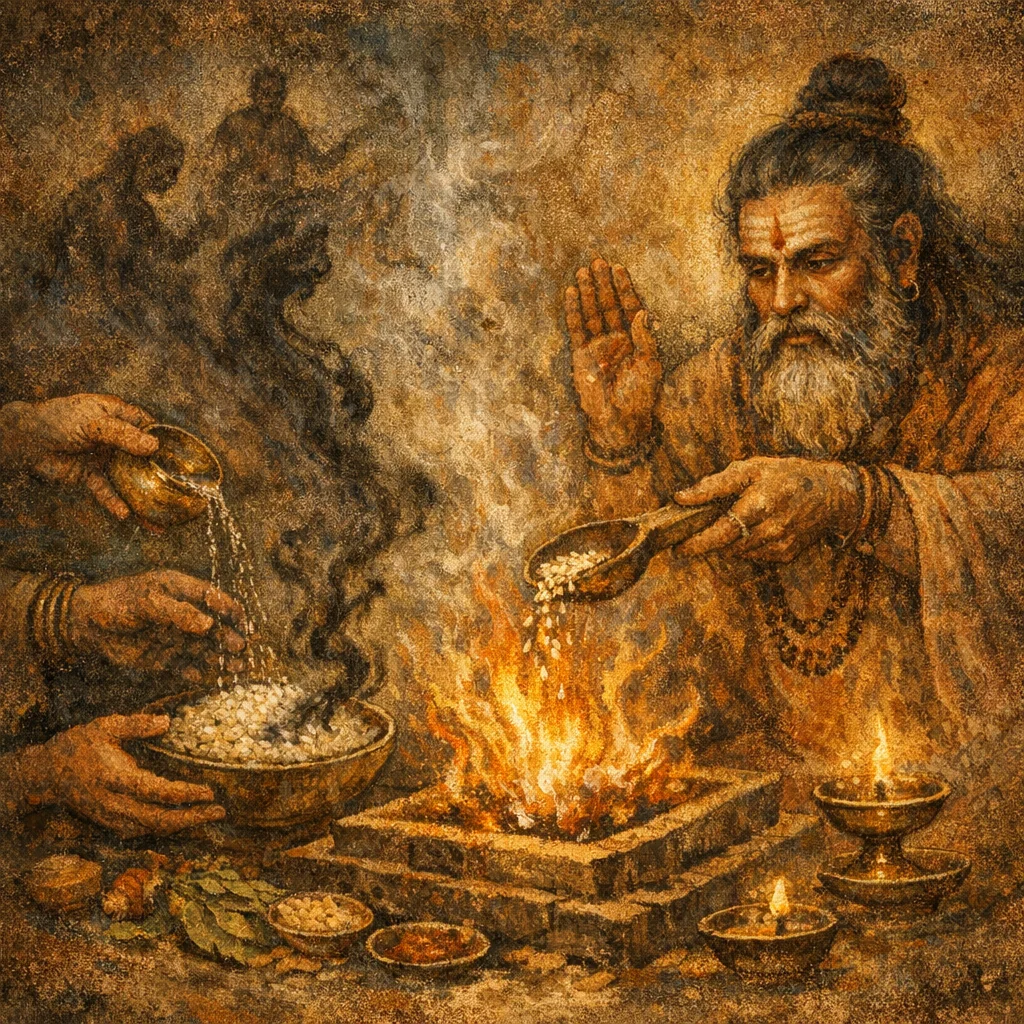
Sukta 71
Rishi: Atharvanic tradition (Anukramaṇī attribution not supplied in input; to be filled from Śaunakīya Anukramaṇī).
Devata: Agni (as Hotar/purifier)
Chandas: Mixed/Anuṣṭubh-adjacent (to be metrically verified against pada counts in critical text).
Mantras
Mantra 1
अन्नम्। यदन्नमद्मि बहुधा विरूपं हिरण्यमश्वमुत गामजामविम्। यदेव किं च प्रतिजग्रहाहमग्निष्टद्धोता सुहुतं कृनोतु
What food soever I consume, of manifold and diverse form—gold, horse, and also cow, goat, and sheep—yea, whatsoever thing at all I have accepted: let Agni, the Hotar, make that a well-offered oblation.
Mantra 2
यन्मा हुतमहुतमाजगाम दत्तं पितृभिरनुमतं मनुष्यैः । यस्मान्मे मन उदिव रारजीत्यग्निष्टद्धोता सुहुतं कृणोतु
What hath come unto me, offered or unoffered—given, approved by the Fathers, assented to by men—wherefrom my mind, as it were, flares up in disquiet: let Agni, the Hotar, make that a well-offered oblation.
Mantra 3
यदन्नमद्म्यनृतेन देवा दास्यन्नदास्यन्नुत संगृणामि । वैश्वानरस्य महतो महिम्ना शिवं मह्यं मधुमदस्त्वन्नम्
If, O Gods, I eat food by untruth—whether giving or not giving, and also while I gather and appropriate—then by the mighty majesty of great Vaiśvānara let the food be for me auspicious, honeyed, and wholesome.
Frequently Asked Questions
It addresses the impurity or anxiety that can arise from eating food or accepting gifts whose ritual or ethical status feels doubtful, asking Agni to make the act ‘as if properly offered.’
Hotṛ is the offering-priest; invoking Agni as Hotṛ means Agni can correct the sacrificial status of what was taken, converting it into a ‘well-offered’ (suhuta) form.
Both: it is prāyaścitta (expiation) and also bhaisajya-adjacent, because it ends by blessing the food to become śiva (benign) and madhumat (pleasant/wholesome) through Vaiśvānara.