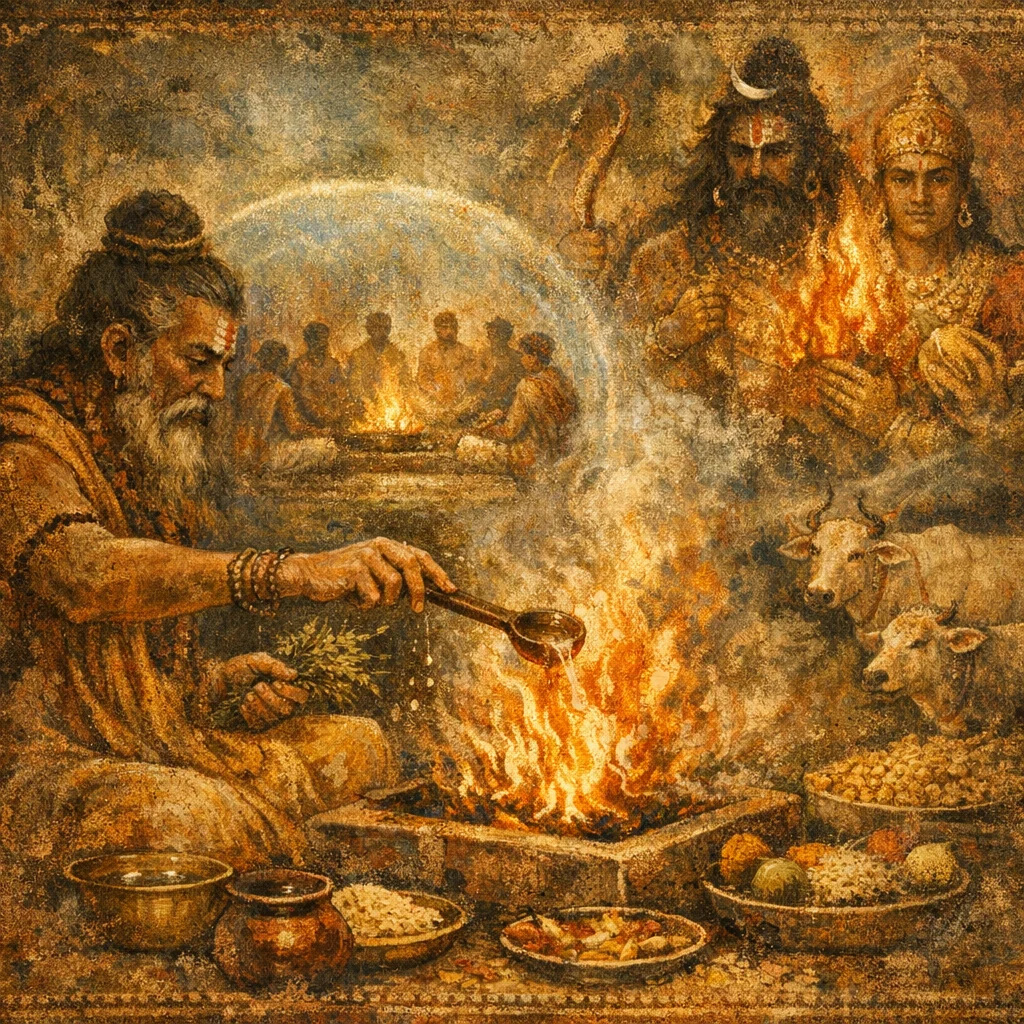
Sukta 55
Rishi: Atharvanic domestic tradition (late AV book 19 compilation; specific ṛṣi not securely fixed in this excerpt)
Devata: Agni Gṛhapati (domestic fire as lord of the house)
Chandas: Anuṣṭubh (predominant domestic meter; this verse is anuṣṭubh-like in cadence)
Mantras
Mantra 1
रायस्पोषप्राप्तिः। रात्रिंरात्रिमप्रयातं भरन्तोऽश्वायेव तिष्ठते घासमस्मै। रायस्पोषेण समिषा मदन्तो मा ते अग्ने प्रतिवेशा रिषाम
Attainment of wealth and thriving. Night after night, not departing, bringing (supply) as fodder for a horse, it stands ready—fodder for him. Rejoicing with wealth and thriving, with gathered nourishment, O Agni, let not thy successive entrants (guests) do us harm.
Mantra 2
या ते वसोर्वात इषुः सा त एषा तया नो मृड । रायस्पोषेण समिषा मदन्तो मा ते अग्ने प्रतिवेशा रिषाम
What arrow of thine, O beneficent one, is in the wind—this is that (same); with it be gracious unto us. Rejoicing with wealth and thriving, with gathered nourishment, O Agni, let not thy successive entrants do us harm.
Mantra 3
सायंसायं गृहपतिर्नो अग्निः प्रातःप्रातः सौमनसस्य दाता। वसोर्वसोर्वसुदान एधि वयं त्वेन्धानास्तन्वं पुषेम
Evening by evening may Agni, our Lord of the house, be for us; morning by morning the Giver of good accord. O giver of wealth upon wealth, wax thou in bounty: we, kindling thee, would foster our own frame.
Mantra 4
प्रातःप्रातर्गृहपतिर्नो अग्निः सायंसायं सौमनसस्य दाता। वसोर्वसोर्वसुदान एधीन्धानास्त्वा शतंहिमा ऋधेम
Morning by morning may Agni be our Lord of the house; evening by evening the Giver of good accord. O giver of wealth upon wealth, increase: kindling thee, indeed may we win these gains an hundredfold.
Mantra 5
अपश्चा दग्धान्नस्य भूयासम्। अन्नादायान्नपतये रुद्राय नमो अग्नये । सभ्यः सभां मे पाहि ये च सभ्याः सभासदः
May I have waters also, and not the portion of burnt food. To Rudra, eater of food, lord of food, be reverence; to Agni be reverence. O man of the assembly, protect my assembly—ye also, assembly-men, that sit in council.
Mantra 6
त्वामिन्द्रा पुरुहूत विश्वमायुर्व्यश्नवन्। अहरहर्बलिमित् ते हरन्तोऽश्वायेव तिष्ठते घासमग्ने
Thee, O Indra, much-invoked, have they fully reached for all their life. Day after day, bringing thee thy tribute, it stands set forth—like fodder for a horse—O Agni, as sustenance.
Frequently Asked Questions
For maintaining household peace (saumanasa), steady prosperity, and protection through regular tending of the domestic fire, especially morning and evening.
It frames the practice as a daily discipline: repeated kindling and offering keep Agni auspicious and make prosperity and concord continuous rather than occasional.
No. Its main ‘substance’ is the domestic Agni itself, supported by fuel-sticks and a simple daily bali/oblation; the power is tied to consistent household maintenance.