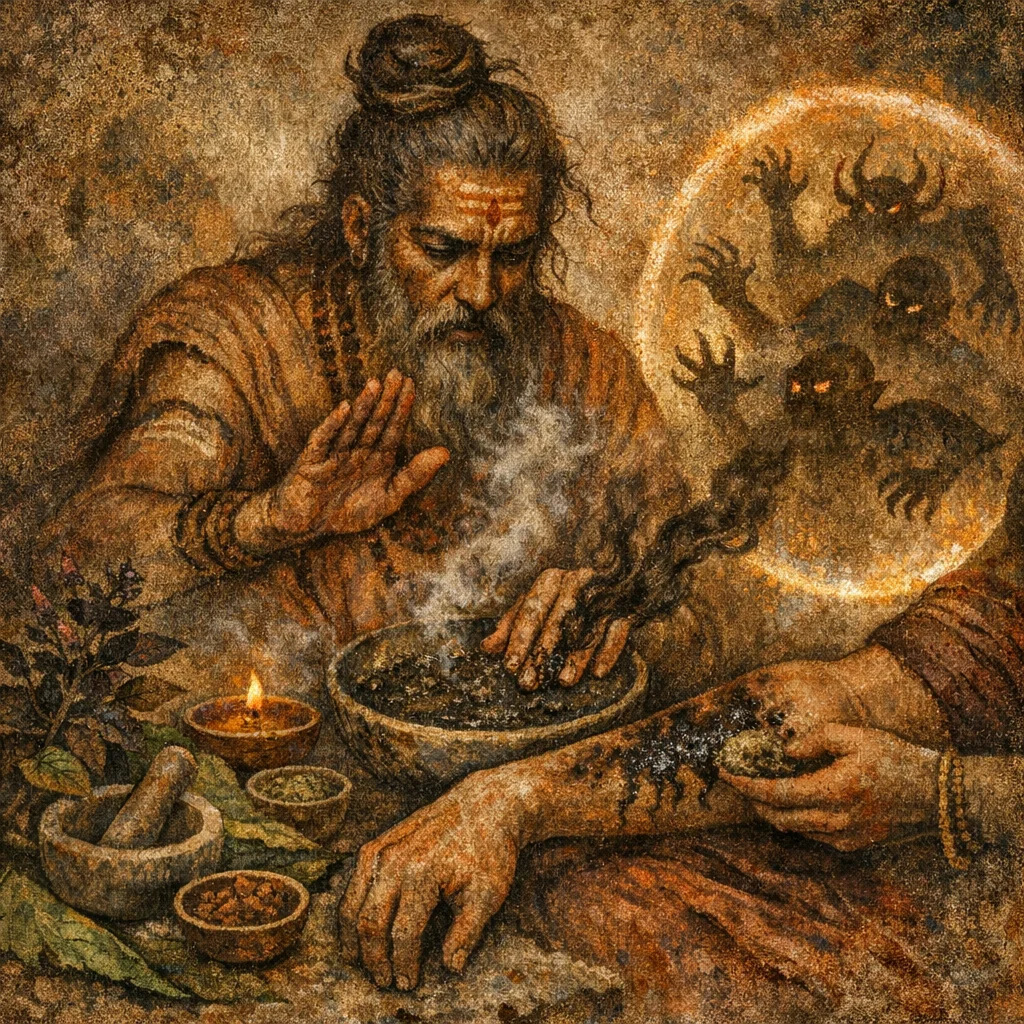
Sukta 24
Rishi: Atharvanic seer (traditionally assigned within the AV medicinal corpus; specific r̥ṣi attribution for 1.24 to be confirmed against Śaunaka anukramaṇī)
Devata: Oṣadhi (Śyāmā) / Pṛthivī-derived healing power
Chandas: Anuṣṭubh (probable; to be verified by pada-count in metrical analysis)
Mantras
Mantra 1
शत्रुनिवारणम्। सुपर्णो जातः प्रथमस्तस्य त्वं पित्तमासिथ । तदासुरी युधा जिता रूपं चक्रे वनस्पतीन्
The Fair-winged was born the first; of him thou art the most pitta-strong. Then was the Asurī, conquered in battle; she took a form—(she made) the lords of the forest.
Mantra 2
आसुरी चक्रे प्रथमेदं किलासभेषजमिदं किलासनाशनम्। अनीनशत् किलासं सरूपामकरत् त्वचम्
Āsurī first prepared this—this medicine for kilāsa, this destroyer of kilāsa. She made kilāsa to disappear; she rendered the skin of one uniform form.
Mantra 3
सरूपा नाम ते माता सरूपो नाम ते पिता। सरूपकृत् त्वमोषधे सा सरूपमिदं कृधि
‘Like-formed’ by name is thy mother; ‘Like-formed’ by name is thy father. A maker of likeness art thou, O Herb: so make thou this here to be like-formed.
Mantra 4
श्यामा सरूपंकरणी पृथिव्या अध्युद्भृता । इदमू षु प्र साधय पुना रूपाणि कल्पय
Śyāmā, the Restorer of like-form, drawn up from Earth—this now do thou accomplish well: refashion once again the forms.
Frequently Asked Questions
It targets kilāsa—understood in the Atharvanic medical register as a skin disorder involving discoloration/depigmentation—and asks the herb-power to restore uniform skin and bodily ‘form’ (rūpa).
Śyāmā/Āsurī is the personified power of a medicinal herb drawn from Earth (Pṛthivī). The hymn treats her as both the plant-medicine and the divine efficacy that makes the cure work.
The mantras are recited over the herb (often made into a paste with water), then applied to the affected skin; a small portion may also be bound as a protective band/amulet to extend the charm’s effect.