Adhyaya 255
Chapter 255: दायविभागकथनम् (On the Division of Inheritance)
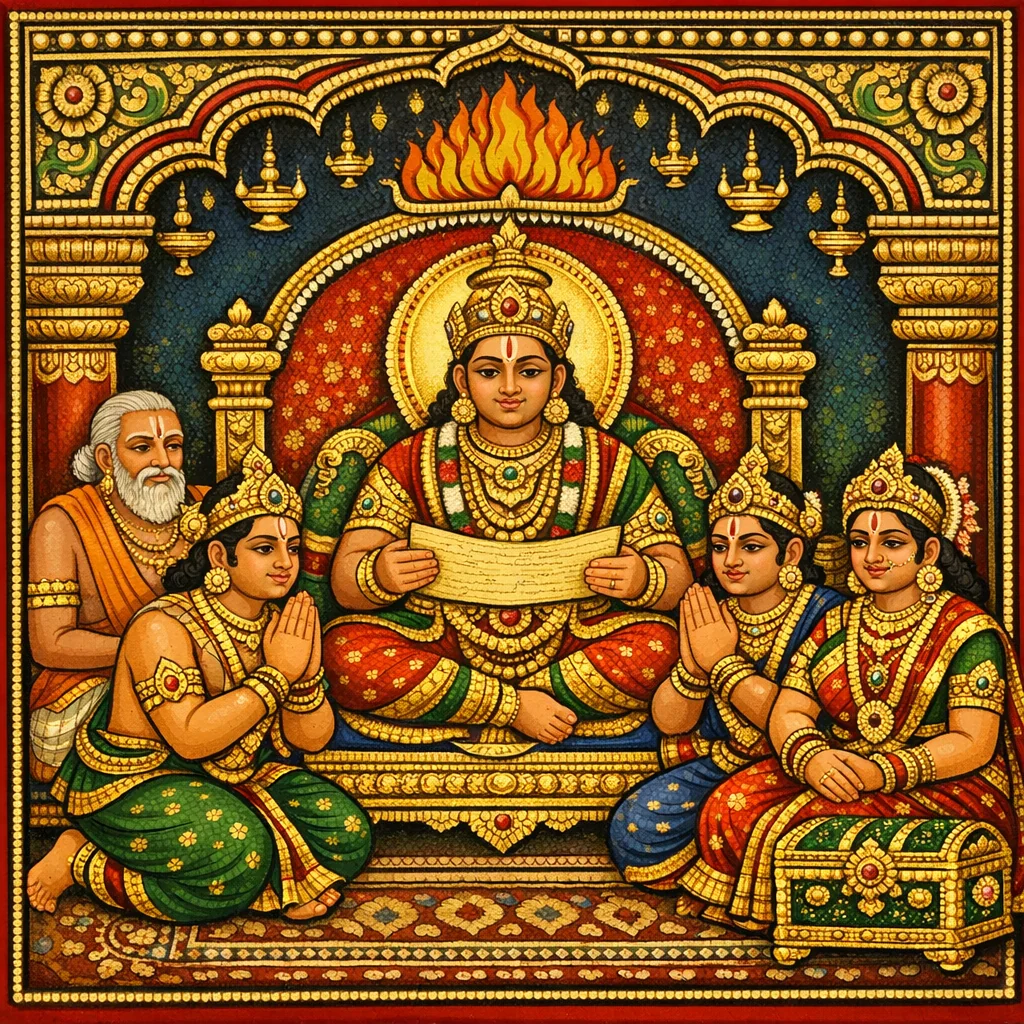
Lord Agni turns from evidentiary ordeals to dāya-vibhāga (inheritance partition), presenting family property law as a Dharma-based means of social stability. He states the father’s discretion in partition—favoring the eldest or equalizing shares—and extends equal-share reasoning to wives, especially when strīdhana remains unpaid. He gives rules for posthumous division, covering debts, daughters’ residual claims, and exclusions such as self-acquired property, friendly gifts, and marriage-related gains. The chapter then formalizes joint-property principles, rights in paternal acquisitions, and the entitlements of sons born after partition. It lists heir-classes and complex filiations (aurasa, kṣetraja, putrikā-suta, kānīna, paunarbhava, adopted and purchased sons), fixing succession order and piṇḍa-duty. Disqualifications (patita, disability, incurable disease) remove inheritance shares but require maintenance for dependents and virtuous wives. Finally, it defines sources and devolution of strīdhana, penalties in marriage disputes, emergency use of strīdhana, compensation for taking a co-wife, and methods to prove partition through witnesses, documents, and separate possession of houses and fields.
Shlokas
Verse 1
इत्य् आग्नेये महापुराणे दिव्यानि प्रमाणानि नाम चतुःपञ्चाशदधिकद्विशततमो ऽध्यायः अथ पञ्चपञ्चाशदधिकद्विशततमो ऽध्यायः दायविभागकथनम् अग्निर् उवाच विभागञ्चेत् पिता कुर्यादिच्छया विभजेत् सुतान् ज्येष्ठं वा श्रेष्ठभागेन सर्वे वा स्युः समांशिनः
Thus ends, in the Agni Mahāpurāṇa, the two-hundred-and-fifty-fourth chapter entitled “Divine Ordeals as Proofs.” Now begins the two-hundred-and-fifty-fifth chapter: “On the division of inheritance.” Agni said: If a father makes a partition, he may divide the sons according to his own will—either assigning the eldest a superior share, or else making all (sons) equal sharers.
Verse 2
यदि दद्यात् समानंशान् कार्याः पत्न्यः समांशिकाः न दत्तं स्त्रीधनं यासां भर्त्रा वा श्वशुरेन वा
If the husband’s estate is to be allotted in equal shares, the wives are to be constituted equal sharers. Those wives whose strīdhana has not been given—either by the husband or by the father-in-law—are to be provided for accordingly.
Verse 3
शक्तस्थानीहमानस्य किञ्चिद्दत्वा पृथक् क्रिया न्यूनाधिकविभक्तानां धर्म्यश् च पितृना कृतः
For one who is present here in a position of capability, after giving something as a due portion, a separate rite is to be performed; and where shares have been divided unequally (less or more), a dharmic adjustment is to be made, as established by the forefathers.
Verse 4
विभजेयुः सुताः पित्रोरूर्ध्वमृक्थमृणं समम् मातुर्दुहितरः शेषमृणात्ताभ्य ऋते ऽन्नयः
After the parents’ demise, the sons should divide the inheritance together with the debt equally. The mother’s daughters should take what remains after the debt has been paid—except for the food-grain (provisions), which is excluded from their share.
Verse 5
पितृद्रव्याविनाशेन यदन्यत् स्वयमर्जयेत् मैत्रमौद्वाहिकञ्चैव दायादानान्न तद्भवेत्
Whatever else a person acquires by his own effort—without diminishing the father’s property—as well as what is obtained through friendship (a gift from a friend) and what is received in connection with marriage, does not become inheritable property to be divided among heirs.
Verse 6
सामान्यार्थसमुत्थाने विभागस्तु समः स्मृतः अनेकपितृकाणान्तु पितृतो भागकल्पना
When the property to be divided has arisen from a common source (joint acquisition), the partition is declared to be equal. But in the case of heirs having different fathers, the allotment of shares is to be determined according to their respective fathers.
Verse 7
भूर्यापिता महोपात्ता निबन्धो द्रव्यमेव वा तत्र स्यात् सदृशं स्वाम्यं पितुः पुत्रस्य चोभयोः
Whether it be land acquired by the father, wealth gained through great exertion, property held under an encumbrance or obligation (nibandha), or merely movable goods—over that property the father and the son possess comparable rights of ownership.
Verse 8
विभक्तेषु सुतो जातः सवर्णायां विभागभाक् दृश्याद्वा तद्विभागः स्यादायव्ययविशोधितात्
A son born after the partition, from a wife of the same varṇa, is entitled to a share. Otherwise, his share should be assigned from what is seen to remain, after accounting for the household’s income and expenditures.
Verse 9
क्रमादभ्यागतं द्रव्यं हृतमभ्युद्धरेच्च यः दायादेभ्यो न तद्दद्याद्विद्यया लब्धमेव च
Whoever, in due course, recovers property that had been stolen yet does not deliver it to the rightful heirs—and likewise withholds what has been gained through learning—acts contrary to dharma and incurs blame.
Verse 10
पितृभ्यां यस्य यद्दत्तं तत्तस्यैव धनं भवेत् पितुरूर्ध्वं विभजतां माताप्यंशं समं हरेत्
Whatever has been given to someone by his parents becomes that person’s own property. After the father’s demise, when the heirs divide the estate, the mother too shall take an equal share.
Verse 11
असंस्कृतास्तु संस्कार्या भ्रातृभिः पूर्वसंस्कृतैः भागिन्यश् च निजादंशाद्दत्वांशन्तु तुरीयकं
But those sisters who have not yet received the saṃskāras (sacraments such as marriage and allied rites) should be duly provided for by the brothers who were previously consecrated. And the sisters too—contributing from their own share—should give a quarter portion (turīyaka) toward that provision.
Verse 12
चतुःस्त्रिद्व्येकभागाः स्युर्वर्णशो ब्राह्मणात्मजाः क्षत्रजास्त्रिद्व्येकभागा विड्जास्तु द्व्येकभागिनः
By division according to varṇa, the sons of a Brāhmaṇa are said to receive shares of four, three, two, and one; the sons of a Kṣatriya receive shares of three, two, and one; while the sons of a Vaiśya receive shares of two and one.
Verse 13
अन्योन्यापहृतं द्रव्यं विभक्ते यत्तु दृश्यते तत् पुनस्ते समैर् अंशैर् विभजेरन्निति स्थितिः
When property taken from one another is found to have already been divided, they should re-divide that property again into equal shares—this is the established rule.
Verse 14
अपुत्रेण परक्षेत्रे नियोगोत्पादितः सुतः उभयोरप्यसावृक्थी पिण्डदाता च धर्मतः
A son produced through niyoga in another man’s “field” (through the wife of a man without a son) becomes, according to dharma, an heir to both and also the lawful giver of the funeral rice-balls (piṇḍa).
Verse 15
औरसो धर्मपत्नीजस्तत्समः पुत्रिकासुतः क्षेत्रजः क्षेत्रजातस्तु सगोत्रेणेतरेण वा
The aurasa son, born of one’s own body, is born from the lawful wife; equal to him is the putrikā’s son, the son of a daughter appointed as a son. The kṣetraja (“field-born”) son is born in the wife through another man, whether of the same lineage (sagotra) or of a different lineage.
Verse 16
गृहे प्रच्छन्न उत्पन्नो गूढजस्तु सुतः स्मृतः कानीनः कन्यकाजातो मातामहसुतो मतः
A son born secretly within the house is remembered as a gūḍhaja (“concealed-born”). A son born from an unmarried girl is called kānīna, and he is regarded as the son of the maternal grandfather.
Verse 17
क्षतायामक्षतायां वा जातः पौनर्भवः सुतः दद्यान्माता पिता वा यं स पुत्री दत्तको भवेत्
A son born of a woman who has remarried—whether she is termed kṣatā (ritually/legally violated) or akṣatā (unviolated)—is called a paunarbhava son. And whomever the mother or the father gives (in adoption), he becomes the putrī-dattaka, the “daughter-given” adopted son.
Verse 18
क्रीतश् च ताभ्यां विक्रीतः कृत्रिमः स्यात् स्व्यं कृतः दत्तात्मा तु स्वयं दत्तो गर्भे वित्तः सहोढजः
Also recognized are the “purchased son” and the son “sold by both (parents).” The kṛtrima (“made/artificial”) son is one constituted as a son by arrangement; likewise the svayaṃ-kṛta (“self-made”) son. The dattātmā is the son who has given himself; the garbhe-vitta is the son for whom wealth is settled while still in the womb; and the sahoḍhaja is the child accepted together with the mother (at marriage).
Verse 19
उत्सृष्टो गृह्यते यस्तु सोपविद्धो भवेत् सुतः पिण्डदो ऽंशहरश् चैषां पूर्वाभावे परः परः
A son who has been abandoned and then taken into a family is called an apaviddha (received) son. He is entitled to offer the funeral rice-ball (piṇḍa) and also to receive a share of inheritance; and among these sons, in the absence of the prior one, the next in order becomes entitled, successively.
Verse 20
सजातीयेष्वयं प्रोक्तस्तनयेषु मया विधिः जातो ऽपि दास्यां शूद्रस्य कामतो ऽंशहरो भवेत्
This rule has been stated by me regarding sons of the same caste (varṇa). Even a son born to a Śūdra from a female slave may, at the father’s discretion, become an heir to a share.
Verse 21
मृते पितरि कुर्युस्तं भ्रातरस्त्वर्धभागिकं अभ्रातृको हरेत् सर्वं दुहितॄणां सुतादृते
When the father has died, the brothers should make that division, with the brothers taking half-shares. But if there are no brothers, one may take the whole estate—except for the sons of the daughters.
Verse 22
पत्नी दुहितरश् चैव पितरो भ्रातरस् तथा तत्सुतो गोत्रजो बन्धुः शिष्यः सब्रह्मचारिणः
The wife, the daughters, the parents, and likewise the brothers; also their son, a kinsman of the same lineage (gotra), a relative, the disciple, and a fellow student (brahmacārin).
Verse 23
एषामभावे पूवस्य धनभागुत्तरोत्तरः स्वर्यात्स्य ह्य् अपुत्रस्य सर्ववर्णेष्वयं विधिः
In the absence of these (heirs previously mentioned), the next one after the former succeeds to the share of the property, in due order. This rule applies to a man who dies sonless, in all the social classes (varṇas).
Verse 24
वानप्रस्थयतिब्रह्मचारिणामृक्थभागिनः क्रमेणाचार्यसच्छिष्यधर्मभ्रात्रेकतीर्थिनः
Forest-dwellers (vānaprasthas), renunciants (yatis), and celibate students (brahmacārins) are entitled to a share of the inheritance; in due order, so too are the teacher, the worthy disciple, the righteous brother, and the single co-pilgrim (one who has gone to the same sacred ford with him).
Verse 25
संसृष्टिनस्तु संसृष्टी सोदरस्य तु सोदरः दद्याच्चापहेरेच्चांशं जातस्य च मृतस्य च
In the case of co-parceners (saṃsṛṣṭin), the co-parcener alone is competent to deal with the joint estate; and in the case of uterine brothers, a uterine brother may both assign and also reclaim the share—whether in respect of one who is newly born or one who has died.
Verse 26
अन्योदर्यस्तु संसृष्टी नान्योदर्यधनं हरेत् असंसृष्त्यपि चादद्यात्सोदर्यो नान्यमानृजः
A half-brother of a different mother (anyodarya) who is in joint estate (saṃsṛṣṭi) must not take the property of another such half-brother. But a full brother (born of the same mother) may take even without such jointness, and should not be treated as a stranger.
Verse 27
पतितस्तत्सुतः क्लीवः पङ्गुरुन्मत्तको जडः अन्धो ऽचिकित्स्यरोगाद्या भर्तव्यास्तु निरंशकाः
A fallen person (patita) and his son; an impotent man; a cripple; a madman; an imbecile; a blind man; and those afflicted with incurable diseases and the like—though they have no share in the inheritance—must nevertheless be maintained.
Verse 28
औरसाः क्षेत्रजास्त्वेषां निर्दोषा भागहारिणः सुताश् चैषां प्रभर्तव्या यावद्वै भर्तृसात्कृताः
Of these, the legitimate (aurasa) sons and the kṣetrajā sons are faultless and entitled to a share of the inheritance. Their sons too are to be maintained, so long as they remain under the protection and acknowledged authority of the husband (head of the family).
Verse 29
अपुत्रा योषितश् चैषां भर्तव्याः साधुवृत्तयः निर्वास्या व्यभिचारिण्यः प्रतिकूलास्तथैव च
And the childless wives among them, if of good conduct, are to be maintained; but adulterous women, and likewise those who are hostile to the husband or household, are to be expelled.
Verse 30
पितृमातृपतिभ्रातृदत्तमध्यग्न्युपागतं आधिवेदनिकुञ्चैव स्त्रीधनं परिकीर्तितं
Whatever is given by the father, mother, husband, or brother, and whatever is received at the time of the nuptial fire-rite (agni), as well as the ādhivedanika gift—these are declared to be a woman’s property (strīdhana).
Verse 31
बन्धुदत्तं तथा शुल्कमन्वाधेयकमेव च अप्रजायामतीतायां बान्धवास्तदवाप्नुयुः
Likewise, the gifts given by kinsmen, the bride-price (śulka), and the supplementary nuptial gift (anvādheya) as well—when a woman dies without issue, her kinsmen (bāndhavas) shall inherit those assets.
Verse 32
अप्रजास्त्रीधनं भ्रत्तुर्ब्राह्म्यादिषु चतुर्ष्वपि दुहितृणां प्रसूता चेच्छ्रेषे तु पितृगामि तत्
If a woman dies without issue, her strīdhana (woman’s separate property) passes to her husband, even in all four forms of marriage beginning with the brāhma. But if she has borne daughters, it passes to those daughters; in the “superior” forms, however, it goes to her father.
Verse 33
दत्वा कन्यां हरन् दण्ड्यो व्ययं दद्याच्च सोदयम् मृतायां दत्तमादद्यात् परिशोध्योभयव्ययम्
If, after giving a maiden in marriage, one later carries her off again, he is punishable; he must also pay the expenses, together with interest. If the maiden has died, the marriage-gift that was given may be taken back, and he must reimburse the expenses on both sides.
Verse 34
दुर्भिक्षे धर्मकार्ये च व्याधौ संप्रतिरोधके गृहीतं स्त्रीधनं भर्ता न स्त्रिये दातुमर्हति
In a famine, for the performance of a religious duty, or in an illness requiring immediate countermeasures, the husband, having taken the wife’s strīdhana (separate property), is not obliged to return it to her at that time.
Verse 35
अधिवित्तस्त्रियै दद्यादधिवेदनिकं समम् न दत्तं स्रीधनं यस्यै दत्ते त्वर्धं प्रकीर्तितम्
To the wife over whom another wife is taken (when a co-wife is brought in), one should give an equal adhivedanika compensation. If strīdhana has not previously been given to her, then in that case the amount to be given is declared to be half.
Verse 36
विभागनिह्नवे ज्ञातिबन्धुसाक्ष्यभिलेखितैः विभागभावना ज्ञेया गृहक्षेत्रैश् च यौतिकैः
When a partition is denied or concealed, the fact and intention of partition should be ascertained through (i) the testimony of kinsmen and relatives, (ii) written records and documents, and also (iii) by considering separately held houses, fields, and other individual possessions.
Frequently Asked Questions
A father may partition at his discretion, either granting the eldest a superior share or making all sons equal sharers.
By treating inheritance, maintenance duties, and evidentiary standards as Dharma-in-action—mechanisms that prevent conflict, protect dependents, and preserve social order, thereby supporting the puruṣārthas and the broader mokṣa-oriented life.